ABSTRACT
Purpose: Laparoscopic gastrectomy is accepted as a standard treatment for patients with early gastric cancer in Korea, Japan, and China. However, duodenal stump leakage remains a fatal complication after gastrectomy. We conducted a prospective phase II study to evaluate the safety of the new technique of laparoscopic reinforcement suture (LARS) on the duodenal stump.
Materials and Methods: The estimated number of patients required for this study was 100 for a period of 18 months. Inclusion criteria were histologically proven gastric adenocarcinoma treated with laparoscopic distal or total gastrectomy and Billroth II or Roux- en-Y reconstruction. The primary endpoint was the incidence of duodenal stump leakage within the first 30 postoperative days. The secondary endpoints were early postoperative outcomes until discharge.
Results: One hundred patients were enrolled between February 2016 and March 2017. The study groups consisted of 65 male and 35 female patients with a mean age (years) of 62.3.
Of these, 63 (63%) patients had comorbidities. The mean number of retrieved lymph nodes was 38. The mean operation time was 145 minutes including 7.8 minutes of mean LARS time.
There was no occurrence of duodenal stump leakage. Thirteen complications occurred, with one case of reoperation for splenic artery rupture and one case of mortality.
Conclusions: Based on the results of this prospective phase II study, LARS can be safely performed in a short operation period without development of duodenal stump leakage. A future randomized prospective controlled trial is required to confirm the surgical benefit of LARS compared to non-LARS.
Keywords: Stomach neoplasms; Laparoscopy; Gastrectomy; Reinforcement; Duodenum;
Leakage
Original Article
Received: Aug 9, 2017 Revised: Dec 6, 2017 Accepted: Dec 6, 2017 Correspondence to Kwan Woo Kim
Department of Surgery, Dong-A University College of Medicine, 26 Daesingongwon-ro, Seo-gu, Busan 49201, Korea.
E-mail: [email protected]
Copyright © 2017. Korean Gastric Cancer Association
This is an Open Access article distributed under the terms of the Creative Commons Attribution Non-Commercial License (https://
creativecommons.org/licenses/by-nc/4.0) which permits unrestricted noncommercial use, distribution, and reproduction in any medium, provided the original work is properly cited.
Funding
This study was supported by a grant from the National R&D Program for Cancer Control, Ministry of Health and Welfare, Republic of Korea (1320270). The funding source had no role in the design of this study and will not have any role during its execution or publication.
Min Chan Kim, Sang Yun Kim, Kwan Woo Kim
Department of Surgery, Dong-A University College of Medicine, Busan, Korea
Laparoscopic Reinforcement Suture (LARS) on Staple Line of Duodenal Stump Using Barbed Suture in
Laparoscopic Gastrectomy for Gastric Cancer: a Prospective Single Arm
Phase II Study
Author Contributions
Conceptualization: M.C.K.; Data curation:
M.C.K.; Formal analysis: M.C.K.; Funding acquisition: M.C.K.; Investigation: M.C.K., S.Y.K.; Methodology: M.C.K.; Project administration: K.W.K., M.C.K.; Resources:
S.Y.K.; Software: S.Y.K.; Supervision: M.C.K.;
Validation: K.W.K.; Visualization: S.Y.K.; Writing - original draft: M.C.K.; Writing - review &
editing: M.C.K.
Conflict of Interest
No potential conflict of interest relevant to this article was reported.
INTRODUCTION
Based on the results of recent, prospective randomized controlled clinical trials [1,2], laparoscopic gastrectomy has been accepted as a standard treatment for early gastric cancer in Korea, Japan, and China. Several multicenter randomized controlled trials (RCTs) [3-6]
are underway, aiming to clarify the benefits of laparoscopic gastrectomy compared to open gastrectomy in terms of surgical outcomes, survival, and quality of life. Moreover, the overall morbidity and mortality rates of gastrectomy in patients with gastric cancer have decreased because of improvements in surgical skill, advancements in surgical instruments, and careful perioperative management over the past 2 decades [7].
However, duodenal stump leakage remains a fatal complication after gastrectomy. The reported incidence of duodenal stump leakage is between 1.6%–5.0% in Billroth II or Roux- en-Y reconstruction following gastrectomy for gastric cancer [8]. According to a recent multicenter study, the laparoscopic approach increased the risk of development of duodenal stump leakage, as compared to the open approach [9].
To date, no prospective clinical trials have been conducted for duodenal stump leakage after laparoscopic or open gastrectomy in patients with gastric cancer. We previously reported a new technique of laparoscopic reinforcement suture (LARS) on the staple line of the duodenal stump using barbed suture for prevention of duodenal stump leakage [10]. Herein, we describe the results of a prospective phase II study to evaluate the safety of this technique.
MATERIALS AND METHODS
Study design
The estimated number of patients required for this study was 100 for a period of 18 months, because duodenal stump leakage after gastrectomy occurred in 1.1% among 1,195 patients in our experience [11]. We planned to discontinue the study if more than 2 cases of duodenal stump leakage occurred. Duodenal stump leakage was defined based on clinical suspicion, laboratory findings of fluid from the drain, or radiologic findings using computed tomography (CT) or fistulogram.
Inclusion criteria were histologically proven gastric adenocarcinoma treated with laparoscopic distal or total gastrectomy and Billroth II or Roux-en-Y reconstruction, and patient age of
>19 years. Patients were excluded if they had a history of previous abdominal surgery except cholecystectomy, and required combined abdominal surgery excepting cholecystectomy.
Patients with gastric outlet obstruction or cancer invasion to the pylorus were also excluded.
The primary endpoint was the incidence of duodenal stump fistula within the first 30
postoperative days. The secondary endpoints were early postoperative outcomes until discharge.
The study was performed under approval of the Institutional Review Board at Dong-A University Hospital (IRB No. DAUHIRB-16-010). All patients provided written informed consent before participating in the study. This study was registered at ClinicalTrials.gov (NCT03085199).
Surgical technique
For laparoscopic gastrectomy in cases of gastric cancer, 5 trocars were used while the operator stood at the patient's right side during the entire procedure, as described in our
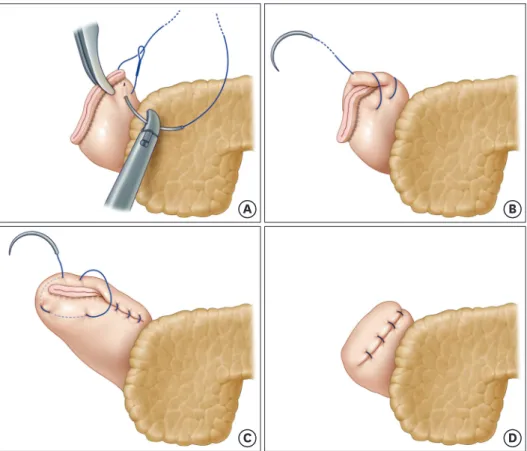
previous report [12]. After cutting the duodenal stump to about 2 cm in length using a linear stapler, LARS was commenced from the upper to the lower part on the staple line of the duodenal stump. Continuous suture with invagination of the duodenal stump was performed using a barbed suture (Fig. 1). In cases of patients with a short duodenal stump owing to chronic ulcer or ectopic pancreas at the duodenal bulb, 2 or 3 interrupted sutures without invagination of the duodenal stump (Fig. 2) were placed using barbed sutures.
A B
C D
Fig. 1. Continuous LARS with invagination. At the upper end of the duodenal stump, a triangular suture with a barbed suture is performed (A). Then, a reinforcement suture with invagination of the staple line is continued up to the lower end of the duodenal stump (B). At the lower end, a triangular suture with invagination is performed once again (C). After the continuous suture with invagination ends, the duodenal stump staple line is buried under the barbed suture (D).
LARS = laparoscopic reinforcement suture.
A B
Fig. 2. Interrupted LARS without invagination. From one end of the duodenal stump, interrupted sutures using barbed sutures are performed 2 or 3 times to cover the whole staple line.
LARS = laparoscopic reinforcement suture.
Perioperative management
All patients were managed routinely using a standardized postoperative protocol as follows: 1) no nasogastric intubation or preoperative mechanical bowel preparation; 2) minimal spillage of gastric contents during surgery; 3) injections of prophylactic antibiotics twice, at preoperative 30 minutes and postoperative 1 hour; 4) the use of one closed-suction drain; 5) sips of water at one day after the operation; 6) a clear liquid diet at 3 days after the operation; and 7) discharge at 6 or 7 days after the operation in the absence of abnormal clinical symptoms.
All operations were performed by M.C. Kim, who had conducted >1,500 laparoscopic gastrectomies for gastric cancer since April 2003. The indication for laparoscopic
gastrectomy for gastric cancer at our institute is less than preoperative stage cT2 or 3N1M0.
RESULTS
Patient characteristics
One hundred patients were enrolled in the study between February 2016 and March 2017.
There was one case of postoperative mortality, but 99 patients completed the postoperative 30-day follow-up protocol as scheduled. The demographic and clinicopathological characteristics of these patients are summarized in Table 1. The study group consisted of
Table 1. Demographic and clinicopathological characteristics of patients
Characteristics Patients (n=100)
Age (yr) 62.3±11.3
Gender
Male 65
Female 35
BMI (kg/m2) 24.0±3.1
ASA status
1 11
2 63
3 26
Comorbidity 63
Extent of resection
Distal subtotal gastrectomy 99
Total gastrectomy 1
Reconstruction
Billroth II 99
Roux-en-Y 1
Tumor depth
T1a 40
T1b 41
T2 10
T3 8
T4a 1
Nodal metastasis
N0 82
N1 12
N2 2
N3 4
Harvested LNs 38.6±12.9
Resection margin (cm)
Proximal 5.8±2.7
Distal 6.9±3.3
All values are mean with standard deviation.
BMI = body mass index; ASA = American Society of Anesthesiologists; LN = lymph node.
65 men and 35 women with a mean age (years) of 62.3. Among the patients, 63 (63%) had a comorbidity, with hypertension and diabetes mellitus the most common. Most patients (n=99) underwent laparoscopic distal subtotal gastrectomy with Billroth II reconstruction.
In the final pathological examination, 84 patients had stage I, 14 patients had stage II, and 2 patients had stage III cancer according to the Union for International Cancer Control/
American Joint Committee on Cancer (UICC/AJCC) tumor, node, and metastasis (TNM) classification (7th edition). The mean number of retrieved lymph nodes (LNs) was 38.
Surgical outcomes and operative complication
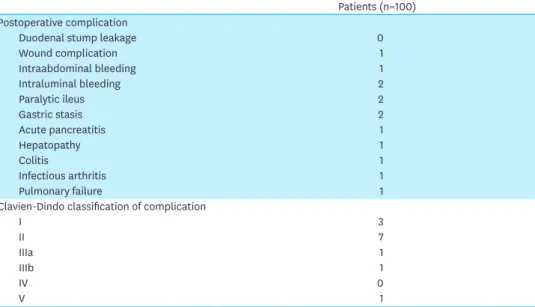
No duodenal stump leakage was observed in any of the study patients. All patients underwent D2 LN dissection with partial omentectomy. The mean operation time was 145 minutes including 7.8 minutes of mean LARS time (Fig. 3). LARS with invagination of the duodenal stump was successfully performed in 99 patients (Table 2). Complications developed in 13 cases, with one reoperation for splenic artery rupture. Only 3 patients experienced complications above grade IIIa based on the Clavien-Dindo classification, and one 80-year- old male patient who suffered from idiopathic pulmonary fibrosis preoperatively died of pulmonary failure at postoperative 27 days (Table 3).
Patients
0 80 100
Minute
18
14 16
10 12
4 6 8
20 40 60
Fig. 3. Operation time of LARS in 100 patients. The mean time for LARS is 7.8 minutes. The 95% confidence interval for the mean is 7.3674 to 8.2106.
LARS = laparoscopic reinforcement suture.
Table 2. Surgical outcomes
Outcomes Patients (n=100)
Operation time (min) 145±29.5
LARS time (min) 7.8±2.1 (5–17)
LARS type
Invagination 99
Non-invagination 1
Intraoperative bleeding loss (mL) 50±43.3
Postoperative hospital stays (day) 7.5±2.0
Morbidity 13
Mortality 1
All values are mean with standard deviation.
LARS = laparoscopic reinforcement suture.
DISCUSSION
In 1992, Kitano et al. [13] first introduced laparoscopic gastrectomy for gastric cancer;
thereafter, the Korean Laparo-endoscopic Gastrointestinal Surgery Study (KLASS) group contributed to the rapid adaptation of laparoscopic gastrectomy for patients with gastric cancer through active learning and education, workshops, and international academic communication [6]. To provide some clinical evidence for laparoscopic gastrectomy for gastric cancer, a retrospective multicenter cohort study including 3,053 patients with gastric cancer was conducted. Based on this database, numerous studies were published to compare open vs. laparoscopic gastrectomy in terms of various aspects such as postoperative complications [14], residual cancer after endoscopic mucosal resection [15], advanced patient age [16], obesity [17], recurrence [18], and survival [19,20]. Subsequently, the 2 most important RCTs, laparoscopic vs. open distal gastrectomy for clinical stage I gastric cancer:
KLASS-01 [1] and locally advanced gastric cancer: KLASS-02 [4] were conducted. Recently, laparoscopic gastrectomy has been commonly performed for the treatment of patients with not only early but also advanced gastric cancer in Korea, Japan, and China.
However, open gastrectomy with LN dissection remains a challenging surgery with a high morbidity rate in the West. The morbidity and mortality rates of 2 western RCTs [21,22] were 25%–46% and 4%–13%, respectively. Regarding laparoscopic gastrectomy, 2 large-scale retrospective multicenter trials [14,23] in the East demonstrated a 14% morbidity rate and a
<1% mortality rate. Several small-sized retrospective single center trials [24-26] of laparoscopic gastrectomy in the West reported an 8%–23% morbidity rate and a 2.0%–3.5% mortality rate, respectively. The differences in reported postoperative morbidity and mortality between the East and West are most likely attributable to differences in patient characteristics as well as the stage and incidence of gastric cancer. Despite the existence of several specialized high-volume centers in the East, anastomotic leakage after laparoscopic gastrectomy for gastric cancer reportedly occurred in 1%–2% of patients [14,24]. Among the types of anastomotic leakages, duodenal stump leakage can be the most serious complication because of impending sepsis or death, despite the performance of re-exploration surgery for duodenal stump leakage.
Table 3. Morbidity and mortality
Patients (n=100) Postoperative complication
Duodenal stump leakage 0
Wound complication 1
Intraabdominal bleeding 1
Intraluminal bleeding 2
Paralytic ileus 2
Gastric stasis 2
Acute pancreatitis 1
Hepatopathy 1
Colitis 1
Infectious arthritis 1
Pulmonary failure 1
Clavien-Dindo classification of complication
I 3
II 7
IIIa 1
IIIb 1
IV 0
V 1
Patient age, comorbidities, nutritional status, chronic ulcer, or ectopic pancreas on
duodenal bulb, cancer invasion to pylorus, or gastric outlet obstruction could be considered risk factors associated with duodenal stump leakage after gastrectomy [8,9]. In addition, precise and careful surgical technique around the duodenum should be recommended for prevention of thermal injury of the duodenum, pancreas, and vessels during laparoscopic gastrectomy. Surgeons had previously become interested in several reinforcement methods for the prevention of staple line leakage in patients with morbid obesity undergoing sleeve gastrectomy. Reinforcement methods for the staple line included various applications of absorbable membrane or bovine pericardium, and suturing on the staple line. Among these approaches, the lowest leakage rate was achieved after reinforcement on the staple line using absorbable membrane or oversewing the suture line [27]. Based on a systematic review and a large retrospective study [8,28], conservative treatment for duodenal stump leakage was determined to be the treatment of choice, eventually associated with percutaneous drainage or percutaneous transhepatic biliary drainage (PTBD) [29]. Re-exploration is recommended in severe cases or for patients who do not respond to conservative treatment.
Reinforcement suturing of the staple line after cutting the duodenum has commonly been performed for prevention of duodenal stump leakage in patients undergoing open gastric surgery. LARS on the staple line of the duodenal stump using barbed suture in laparoscopic gastrectomy for gastric cancer was developed and established in 62 consecutive patients from July 2016 to January 2017 at our institute [10]. Subsequently, the current prospective phase II study was planned for evaluation of the safety of LARS in 100 patients. LARS on the staple line of the duodenal stump using barbed suture includes the invagination and non-invagination types. Non-invagination LARS was chosen when the length of the duodenal stump after cutting was <1 cm. In the present study, there was no occurrence of any intraoperative or postoperative complications related to LARS.
Based on the findings of this prospective phase II study, LARS can be safely conducted in a short operation period without development of duodenal stump leakage. A randomized prospective controlled trial is required to confirm the surgical benefit of LARS in comparison to non-LARS.
REFERENCES
1. Kim W, Kim HH, Han SU, Kim MC, Hyung WJ, Ryu SW, et al. Decreased morbidity of laparoscopic distal gastrectomy compared with open distal gastrectomy for stage I gastric cancer: short-term outcomes from a multicenter randomized controlled trial (KLASS-01). Ann Surg 2016;263:28-35.
PUBMED | CROSSREF
2. Hiki N, Katai H, Mizusawa J, Nakamura K, Nakamori M, Yoshikawa T, et al. Long-term outcomes of laparoscopy-assisted distal gastrectomy with suprapancreatic nodal dissection for clinical stage I gastric cancer: a multicenter phase II trial (JCOG0703). Gastric Cancer 2017. doi: 10.1007/s10120-016-0687-0 [In press].
PUBMED
3. Hu Y, Huang C, Sun Y, Su X, Cao H, Hu J, et al. Morbidity and mortality of laparoscopic versus open D2 distal gastrectomy for advanced gastric cancer: a randomized controlled trial. J Clin Oncol 2016;34:1350-1357.
PUBMED | CROSSREF
4. Hur H, Lee HY, Lee HJ, Kim MC, Hyung WJ, Park YK, et al. Efficacy of laparoscopic subtotal gastrectomy with D2 lymphadenectomy for locally advanced gastric cancer: the protocol of the KLASS-02 multicenter randomized controlled clinical trial. BMC Cancer 2015;15:355.
PUBMED | CROSSREF
5. Park JY, Kim YW, Ryu KW, Nam BH, Lee YJ, Jeong SH, et al. Assessment of laparoscopic stomach preserving surgery with sentinel basin dissection versus standard gastrectomy with lymphadenectomy in early gastric cancer-a multicenter randomized phase III clinical trial (SENORITA trial) protocol. BMC Cancer 2016;16:340.
PUBMED | CROSSREF
6. Kim KH, Kim SH, Kim MC. How much progress has been made in minimally invasive surgery for gastric cancer in Korea?: a viewpoint from Korean prospective clinical trials. Medicine (Baltimore) 2014;93:e233.
PUBMED | CROSSREF
7. Hyung WJ, Kim SS, Choi WH, Cheong JH, Choi SH, Kim CB, et al. Changes in treatment outcomes of gastric cancer surgery over 45 years at a single institution. Yonsei Med J 2008;49:409-415.
PUBMED | CROSSREF
8. Aurello P, Sirimarco D, Magistri P, Petrucciani N, Berardi G, Amato S, et al. Management of duodenal stump fistula after gastrectomy for gastric cancer: systematic review. World J Gastroenterol 2015;21:7571-7576.
PUBMED | CROSSREF
9. Cozzaglio L, Giovenzana M, Biffi R, Cobianchi L, Coniglio A, Framarini M, et al. Surgical management of duodenal stump fistula after elective gastrectomy for malignancy: an Italian retrospective multicenter study. Gastric Cancer 2016;19:273-279.
PUBMED | CROSSREF
10. Kim MC. Laparoscopic reinforcement suture of duodenal stump using barbed suture during laparoscopic gastrectomy for gastric cancer: preliminary results in consecutive 62 patients. Ann Laparosc Endosc Surg 2017;2:28.
CROSSREF
11. Kim KH, Kim MC, Jung GJ. Risk factors for duodenal stump leakage after gastrectomy for gastric cancer and management technique of stump leakage. Hepatogastroenterology 2014;61:1446-1453.
PUBMED
12. Kim MC, Choi HJ, Jung GJ, Kim HH. Techniques and complications of laparoscopy-assisted distal gastrectomy (LADG) for gastric cancer. Eur J Surg Oncol 2007;33:700-705.
PUBMED | CROSSREF
13. Kitano S, Iso Y, Moriyama M, Sugimachi K. Laparoscopy-assisted Billroth I gastrectomy. Surg Laparosc Endosc 1994;4:146-148.
PUBMED
14. Kim MC, Kim W, Kim HH, Ryu SW, Ryu SY, Song KY, et al. Risk factors associated with complication following laparoscopy-assisted gastrectomy for gastric cancer: a large-scale Korean multicenter study.
Ann Surg Oncol 2008;15:2692-2700.
PUBMED | CROSSREF
15. Song KY, Hyung WJ, Kim HH, Han SU, Cho GS, Ryu SW, et al. Is gastrectomy mandatory for all residual or recurrent gastric cancer following endoscopic resection? A large-scale Korean multi-center study. J Surg Oncol 2008;98:6-10.
PUBMED | CROSSREF
16. Cho GS, Kim W, Kim HH, Ryu SW, Kim MC, Ryu SY. Multicentre study of the safety of laparoscopic subtotal gastrectomy for gastric cancer in the elderly. Br J Surg 2009;96:1437-1442.
PUBMED | CROSSREF
17. Lee HJ, Kim HH, Kim MC, Ryu SY, Kim W, Song KY, et al. The impact of a high body mass index on laparoscopy assisted gastrectomy for gastric cancer. Surg Endosc 2009;23:2473-2479.
PUBMED | CROSSREF
18. Song J, Lee HJ, Cho GS, Han SU, Kim MC, Ryu SW, et al. Recurrence following laparoscopy-assisted gastrectomy for gastric cancer: a multicenter retrospective analysis of 1,417 patients. Ann Surg Oncol 2010;17:1777-1786.
PUBMED | CROSSREF
19. Kim HH, Han SU, Kim MC, Hyung WJ, Kim W, Lee HJ, et al. Long-term results of laparoscopic gastrectomy for gastric cancer: a large-scale case-control and case-matched Korean multicenter study. J Clin Oncol 2014;32:627-633.
PUBMED | CROSSREF
20. Kim HH, Hyung WJ, Cho GS, Kim MC, Han SU, Kim W, et al. Morbidity and mortality of laparoscopic gastrectomy versus open gastrectomy for gastric cancer: an interim report--a phase III multicenter, prospective, randomized Trial (KLASS Trial). Ann Surg 2010;251:417-420.
PUBMED | CROSSREF
21. Bonenkamp JJ, Hermans J, Sasako M, van de Velde CJ, Welvaart K, Songun I, et al. Extended lymph-node dissection for gastric cancer. N Engl J Med 1999;340:908-914.
PUBMED | CROSSREF
22. Cuschieri A, Weeden S, Fielding J, Bancewicz J, Craven J, Joypaul V, et al. Patient survival after D1 and D2 resections for gastric cancer: long-term results of the MRC randomized surgical trial. Br J Cancer 1999;79:1522-1530.
PUBMED | CROSSREF
23. Kitano S, Shiraishi N, Uyama I, Sugihara K, Tanigawa NJapanese Laparoscopic Surgery Study Group. A multicenter study on oncologic outcome of laparoscopic gastrectomy for early cancer in Japan. Ann Surg 2007;245:68-72.
PUBMED | CROSSREF
24. Pugliese R, Maggioni D, Sansonna F, Scandroglio I, Ferrari GC, Di Lernia S, et al. Total and subtotal laparoscopic gastrectomy for adenocarcinoma. Surg Endosc 2007;21:21-27.
PUBMED | CROSSREF
25. Strong VE, Devaud N, Allen PJ, Gonen M, Brennan MF, Coit D. Laparoscopic versus open subtotal gastrectomy for adenocarcinoma: a case-control study. Ann Surg Oncol 2009;16:1507-1513.
PUBMED | CROSSREF
26. Allieta R, Nardi M Jr, Brachet-Contul R, Millo P, Fabozzi M, Cornaglia S, et al. Laparoscopic gastrectomy for treatment of advanced gastric cancer: preliminary experience on 38 cases. Minerva Chir 2009;64:445-456.
PUBMED
27. Gagner M, Buchwald JN. Comparison of laparoscopic sleeve gastrectomy leak rates in four staple-line reinforcement options: a systematic review. Surg Obes Relat Dis 2014;10:713-723.
PUBMED | CROSSREF
28. Ali BI, Park CH, Song KY. Outcomes of non-operative treatment for duodenal stump leakage after gastrectomy in patients with gastric cancer. J Gastric Cancer 2016;16:28-33.
PUBMED | CROSSREF
29. Kim KH, Lee HB, Kim SH, Kim MC, Jung GJ. Role of percutaneous transhepatic biliary drainage in patients with complications after gastrectomy. Int Surg 2015;101:78-83.
PUBMED | CROSSREF