June 2018 | Vol. 46 | No. 2 Microbiol. Biotechnol. Lett. (2018), 46(2), 111–113
http://dx.doi.org/10.4014/mbl.1802.02016 pISSN 1598-642X eISSN 2234-7305
Microbiology and Biotechnology Letters
Janthinobacterium sp. 유래 저온 활성 프로테아제 정제
김현도, 최종일*
전남대학교생물공학과, 바이오에너지및바이오소재협동과정
Received: March 6, 2018 / Revised: March 8, 2018 / Accepted: March 9, 2018
일반적으로극지와같은특수한환경에서생장하는생물 종들은생물산업에많은기회를제공해준다. 최근에는이러 한저온에서적응하며생존하는종들을생물산업의응용을
위한연구모델로활용하고있다[1, 2]. 극지와같은저온환
경에서생장하는미생물에서분리된효소는저온및중온에 서높은촉매활성을나타내기때문에, 반응조건이무기촉 매나다른효소에비하여용이하며, 또한적은온도상승에 의해쉽게불활성화될수있기때문에산업적으로응용가 치가높고그에대한연구가증가하고있다[3−5].
세계효소시장의약 60%를차지하는프로테아제는세제 산업, 가죽가공, 식품산업, 의약품및생물학적환경정화등 수많은분야에서잠재적인이점을갖는효소이다[6]. 특히, 저 온성프로테아제는세제및식품가공과같이저온에서반응 이수행되어야하는산업분야에서시간과에너지소비를줄 일수있으므로효율적으로공정을수행할수있게한다[7−9].
지금까지여러종류의저온미생물로부터다양한프로테 아제가보고되었다[7−9]. Yang 등은 Halobacillus에서크로 마토그래피를이용하여저온활성프로테아제를정제하였으 며[9], Yersinia ruckeri에서암모니움설페이트침전과이온
크로마토그래피를이용하여프로테아제가정제되었다[10].
Davail 등은 phenyl-Sepharose CL-4B colum을이용하여저 온성 Bacillus에서 alkaline 프로테아제를정제하였다[11].
하지만, 이러한저온활성효소의분리와정제는효소의특 성에따라조건이다양하고, 온도에따른활성변화가쉽게 야기될수있는경우가많기때문에다양한효소에대한정 제방법연구가필요한실정이다. 따라서, 본논문에서는이 전연구에서선별된극지미생물들중프로테아제의활성이 높은 Janthinobacterium sp. PAMC 25641로부터 분비된 프로테아제의정제연구를수행하였다[12].
본 실험에서 사용된 Janthinobacterium sp. PAMC 25641은 극지연구소(Korea Polar Research Institute, Korea)로부터 분양받았다. 이전 연구에따르면 Janthino- bacterium sp. 다른국지유래균주에비하여성장이우수하 고, 세포외로분비된프로타아제는저온에서높은활성을나 타내는것으로확인하였다[12].
Janthinobacterium sp.는 250 ml erlenmeyer flasks에 50 ml NB 배지(Nutrient broth, Becton, Dickinson and Company, USA)를이용하여 15℃에서 24시간전배양하였 고본배양은같은조건에서전배양액의 2%(v/v)를접종하여 72시간동안배양하였다. 미생물의 성장은 ELISA Reader (Molecular Devices, VersaMaxTM and SpetraMax® 340PC384, USA)를사용하여 600 nm에서흡광도를측정하였다. Purification of Cold-adapted Protease from Janthinobacterium sp.
Hyun-do Kim and Jong-il Choi*
Department of Biotechnology and Bioengineering, Interdisciplinary Program for Bioenergy & Biomaterials, Chonnam National University, Gwangju 61186, Republic of Korea
In this study, purification of cold-adapted protease from Janthinobacterium sp. was investigated. First, using gradient precipitation, protease was confirmed to be deposited in the 30−80% range of ammonium sulfate. Next, DEAE-Sepharose column was used for the binding of the protease under various conditions.
The optimal binding condition was found to be pH 8.5 and flow rate of 30 ml/h. Under the optimal condition, the protease was purified with 29% recovery yield. This result can be useful for the purification of other cold-adapted protein.
Keywords: Purification, protease, Janthinobacterium
*Corresponding author
Tel: +82-62-530-1846, Fax: +82-62-530-1949 E-mail: [email protected]
© 2018, The Korean Society for Microbiology and Biotechnology
112 Kim and Choi
http://dx.doi.org/10.4014/mbl.1802.02016
단백질의농도는 Bradford assay 방법을이용하여측정하 였다[13].
Janthinobacterium sp. 유래 프로테아제 활성 측정은 50 mM sodium phosphate buffer (pH 7.2) 200 µl에기질 인 10 mM AAPF (N-succinyl-ALA-ALA-PRO-PHE-P- nitroanilide, Sigma-Aldrich, USA) 10µl을넣고 100µl의 효소혼합액과 690µl의증류수를혼합하여 25oC에서 10분 간 반응시킨 후 60℃에서 20분간 불활성화 하여, ELISA reader를사용하여 410 nm에서흡광도를측정하였다. 1 unit 의프로테아제활성은 extinction coefficient = 8,800으로하 여다음식에의하여계산하였다[12].
Unit (mmol/min)/l =
Janthinobacterium sp.로부터세포외로분비된프로테아 제를분리하기위하여먼저 gradient precipitation을수행하 였다. 발효후얻어진여액에암모늄설페이트를 0−100% 농 도범위로처리한후 4℃, 22,000 ×g으로 30분간원심분리 하였다. 원심분리후얻은 pellet을 20 mM Tris-HCl buffer (pH 8.5)로녹인후같은용액으로투석을진행하였다. 투석 용액은적어도 2번교체하였고, 침전을위해사용된암모늄 설페이트농도에대한상대적인프로테아제의활성을투석 후측정하였다.
이러한방법을통해서최적의암모늄설페이트농도를설 정하였고, 이후정제단계의최적화를진행하였다. 발효후 얻어진여액에암모늄설페이트를 70%의농도로처리한후 4℃, 22,000 ×g으로 30분간원심분리하였다. 원심분리후 얻은 pellet을 20 mM Tris-HCl buffer (pH 8.5)로녹인 후 같은용액으로투석을진행하였다. 투석용액은적어도 2번 교체하였다. 크로마토그래피를이용한단백질정제의최적 화를위하여다양한조건의 pH (6.5−8.5)와유속(1.5−3 ml/
min)에서정제를수행하고분석하였다. 투석후원심분리하 여분리된상층액을 DEAE-Sepharose column (1.5 × 5 cm, Sigma-Aldrich)에가하였고 0−0.5 M 농도의 NaCl을 30 ml/h의
유속으로 10 ml씩용출하였고각각의분획의효소활성을
측정하였다.
Janthinobacterium sp.로부터생산된프로테아제의최적 침적범위를확인하기위하여 30−80% 범위의암모늄설페 이트를이용하여 gradient precipitation을수행하였다. 그결 과, 프로테아제의최적침전범위는 60−70%로확인되었다 (Fig. 1). 30% 이하의암모늄암모늄설페이트농도에서는프 로테아제는침전이일어나지않았으며, 40% 이상에서프로 테아제침전이확인되었다. 침전된프로테아제의활성은암 (net OD410) × (volume of reaction mixture, L) × 106)
ε × (reaction time, min) × (volume of enzyme solution, L)
Fig. 1. Protease activity after gradient precipitation of cell broth of Janthinobacterium sp..
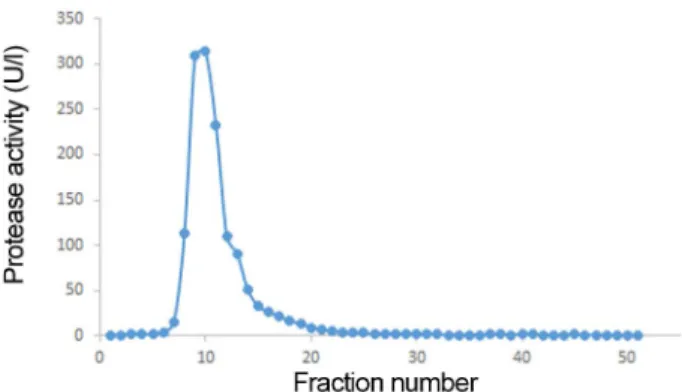
Fig. 2. Protease activity of fractions after elution. The frac- tions were eluted with 0−0.5 M NaCl gradient at a flow rate of 30 ml/h, with 10 mM of the fraction volume.
Fig. 3. SDS-PAGE analysis of fractions after elution.
Purification of Cold-adapted Protease 113
June 2018 | Vol. 46 | No. 2
모늄설페이트의농도가증가할수록증가하여 70%에서가 장높은값을가졌다.
따라서, 배양액으로부터프로테아제의일차적인정제를위 한침전조건을 70%의암모늄설페이트로설정하고, 침전되 어얻어진프로테아제의고순도정제를위한크로마토그래 프를수행하였다. 침전으로부터얻어진프로테아제용액을
DEAE-Sepharose 컬럼의단백질결합을최적화하기위하
여실험을수행한결과, pH 7.5−8.0에서는 pH 8.5 보다낮 은단백질결합을나타내었다. pH 8.5에서유속은단백질결 합정도에영향을 미치지않았다(data not shown). 따라서 DEAE-Sepharose의 로딩 조건을 pH 8.5, 유속 30 ml/h로 설정하였다.
DEAE-Sepharose에결합된프로테아제의용출을통하여
정제된효소의활성은 70−120 mM 농도의 NaCl을이용하 여용출한분획 8−13 사이에서확인하였다(Fig. 2). 프로테 아제의활성이가장높은분획은분획 10이었으며, 분획 8에 서 12까지의용출액을모아서측정한효소의수율은 29%로 확인하였다. 분획정제된 프로테아제의 분자량은 대략 110 kDa으로확인되어졌다(Fig. 3).
Janthinobacterium sp.의배양상등액으로부터프로테아 제를분리하기위한단계별활성, 총단백질양및정제수율 을 Table 1에나타내었다.
극지와같은저온환경에서생장하는미생물이분비하는 프로테아제는여러산업분야에서매우유용하게사용될수 있다. 따라서본연구의결과는산업적이용가치가높은다 양한저온활성효소의정제와그활용에효과적으로이용될 수있을것이다.
Acknowledgement
This research was supported by Golden Seed Project, Ministry of Oceans and Fisheries (213008-05-2-SB910).
Conflict of Interest
The authors have no financial conflicts of interest to declare.
References
1. Nichols D, Bowman J, Sanderson K, Nichols CM, Lewis T,
McMeekin T, et al. 1999. Developments with Antarctic microor- ganisms: culture collections, bioactivity screening, taxonomy, PUFA production and cold-adapted enzymes. Curr. Opin. Bio- technol. 10: 240-246.
2. Antranikian G, Egorova K. 2007. Extremophiles, a unique resource of biocatalysts for industrial biotechnology. pp. 361- 406. In Gerday C, Glansdorff N (eds), Washington: ASM Press.
3. Huston AL. 2008. Biotechnological aspects of cold-adapted enzymes. pp. 347-363. In Margesin R, Schinner F (eds.), Berlin Heidelberg Springer.
4. Gerday C, Aittaleb M, Bentahir M, Chessa JP, Claverie P, Collins T, et al. 2000. Cold-adapted enzymes: from fundamentals to bio- technology. Trends Biotechnol. 18: 103-107.
5. Georlette D, Blaise V, Collins T, D’Amico S, Gratia E, Hoyoux A, et al. 2004. Some like it cold: biocatalysis at low temperatures.
FEMS Microbiol. Rev. 28: 25-42.
6. Rao MB, Tanksale AM, Ghatge MS, Deshpande VV. 1998. Molecu- lar and biotechnological aspects of microbial protease. Micro- biol. Mol. Biol. Rev. 62: 597-635.
7. Kim DK, Park HJ, Lee YM, Hong SG, Lee HK, Yim JH. 2010. Screen- ing for cold-active protease-producing bacteria from the culture collection of polar microorganisms and characterization of pro- teolytic activities. Korean Soc. Microbiol. Biotechnol. 46: 73-79.
8. Zhu HY, Tian Y, Hou YH, Wang TH. 2009. Purification and charac- terization of the cold-active alkaline protease from marine cold- adaptive Penicillium chrysogenum FS010. Mol. Biol. Rep. 36: 2169- 2174.
9. Yang J, Li J, Mai Z, Tian X, Zhang S. 2013. Purification, characteri- zation, and gene cloning of a cold-adapted thermolysin-like protease from Halobacillus sp. SCSIO 20089. J. Biosci. Bioeng.
115: 628-632.
10. Secades P, Guijarro JA. 1999. Purification and characterization of an extracellular protease from the fish pathogen Yersinia ruckeri and effect of culture conditions on production. Appl. Environ.
Microbiol. 66: 3969-3975.
11. Davail S, Feller G, Narinx E, Gerday C. 1994. Cold adaptation of proteins. Purification, characterization, and sequence of the heat-labile subtilisin from the antarctic psychrophile Bacillus TA41. J. Biol. Chem. 269: 17448-17453.
12. Kim HD, Choi J. 2014. Effect of temperature on growth rate and protease activity of Antarctic microorganisms. Korean Soc. Micro- biol. Biotechnol. 42: 293-296.
13. Bradford MM. 1976. A rapid and sensitive method for the quan- titation of microgram quantities of protein utilizing the principle of protein-dye binding. Anal. Biochem. 72: 248-254.
Table 1. Protease activity and recovery yield during purification steps obtained from the culture broth of Janthinobacterium sp..
Step Total volume
(ml)
Activity (U/l)
Total activity recovered (U)
Protein (mg)
Specific activity (U/mg protein)
Recovery yield (%)
Cell-free culture supernatant 1000 40 40,000 1,290 31 100
Ammonium sulfate precipitation 40 980 39,200 243 161 98
DEAE-Sepharose fraction (8-12) 60 195 11,700 20 584 29