| Abstract |
1)PURPOSE: The aim of the present study was to determine whether high frequency repetitive transcranial magnetic stimulation (rTMS) can improve balance ability in acute stage stroke patients.
METHODS: The study was conducted on 30 subjects diagnosed with hemiparesis caused by stroke. The experimental group consisted of 15 patients that underwent rTMS for 15 mins and the control group consisted of 15 patients that underwent sham rTMS (for 15 minutes). A 70-mm figure 8 coil and a Magstim Rapid stimulator was used in both groups. Patients in the experimental group received 10 Hz rTMS applied to the hotspot in the lesioned hemisphere in 10-second trains with 50-second intervals between trains, for 15 minutes (total 2,000 pulses). Both groups received conventional physical therapy for 30 minutes a day, 5 days a week, for 4 weeks. Static balance ability analysis was performed using the Gaitview system to measure pressure rate, postural sway, and total pressure, and dynamic balance
†Corresponding Author : [email protected]
This is an Open Access article distributed under the terms of the Creative Commons Attribution Non-Commercial License (http://creativecommons.org/licenses/by-nc/3.0) which permits unrestricted non-commercial use, distribution, and reproduction in any medium, provided the original work is properly cited.
ability analysis was performed to measure pressure variables using a balance system.
RESULTS: A significant difference was observed in post-training gains for pressure rate, total pressure in static balance, and overall stability index in dynamic balance between the experimental group and the control group (p<.05).
CONCLUSION: The results of this study indicate that high frequency rTMS may be beneficial for improving static and dynamic balance recovery in acute stroke patients.
Key Words: Balance, Repetitive transcranial magnetic stimulation, Stroke
Ⅰ. Introduction
Balance control involves complex interactions between multiple systems, such as, sensory and motor systems, sensorimotor integration, and high-level premotor processing, all of which can be affected after stroke (Mancini and Horak, 2010).
Muscle weakness, spasticity, loss of mobility, and impaired balance contribute to the disabilities associated with stroke (Bohannon, 2007). Muscle weakness on
Research Article Open Access
The Effects of Repetitive Transcranial Magnetic Stimulation on Balance Ability in Acute Stroke Patients
Sang-Goo Ji, PT, PhD⋅Young-Jun Shin, PT, MS
1⋅Myoung-Kwon Kim, PT, PhD
1†Department of Physical Therapy, Eulji university Hospital
1
Department of Physical Therapy, College of Rehabilitation Sciences, Daegu University Received: March 18, 2016 / Revised: March 27, 2016 / Accepted: April 20, 2016
ⓒ 2016 J Korean Soc Phys Med
affected sides results in motor-control deficits and movement initiations in stroke patients (Arene and Hidler, 2009). Balance, that is, the ability to preserve body mass equilibrium, critically affects quality of life, and a lack of balance can lead to an unsteady gait and reduced walking speed (Cunha et al., 2002). Thus, balance markedly affects a patient’s ability to achieve mobility independence and to perform routine activities (Lin et al., 2001; Sandin and Smith, 1990). Furthermore, balance has been shown to be one of the most powerful predictors of functional independence after stroke (DiMonaco et al., 2010), and thus, balance training is a key component of stroke rehabilitation programs.
Many studies have been performed on rehabilitation methods designed to improve balance ability after stroke (Kong et al., 2015; Song and Park, 2016). Physical movements of a force platform coupled with a visual feedback system can be used to monitor weight bearing, posture shifting, and COG (center of gravity), and thus, force platforms are often used to improve balance after stroke (Abhishek et al., 2009). Recently, aquatic therapy has received attention in this context, because it aids muscle activation (Park and Roh, 2011).
The simplicity, of transcranial magnetic stimulation (TMS) suggests that it might be an appropriate alternative treatment for stroke patients. Single TMS pulses have been used to noninvasively and painlessly stimulate the brains of intact conscious human subjects through the scalp (Baker et al., 1985). Furthermore, repeated application of single TMS pulses (rTMS) can sometimes elicit long-lasting changes in the excitability of the corticospinal tract, M1, and spinal cord structures, and induce significant sensory and motor function improvements in patients with motor disorders (Ridding and Rothwell, 2007). It is generally accepted that high frequency (>1 Hz) repetitive transcranial magnetic stimulation (rTMS) increases cortical excitability, whereas low frequency (<1 Hz) rTMS has the opposite effect (Gorsler et al., 2003). Functional movements, such
as, those required for balance and gait are closely related to lower limb strength, and thus, strength exercises are needed to improve functional movements (Nadeau et al., 1999). Rektorova et al. (2005) reported that motor function after stroke was improved by rTMS and Di Lazzaro et al. (2006) reported that rTMS improved motor cortex excitability. Moreover, In addition Le Q et al. (2014) reported that rTMS has positive effects on the recovery of hand function after stroke.
Recovery after stroke mostly occurs during the first month post-onset. However, it is worth noting that spontaneous recovery interferes with attempts to determine the effects of rehabilitation, especially those of early rehabilitation on degree of functional restoration (Langhorne et al., 2011). However, rTMS studies conducted to date have mainly addressed subacute or chronic stage stroke. Therefore, this study was conducted to examine the effects of high frequency rTMS on the balance abilities of acute stage patients (<3 months after stroke onset).
Ⅱ. Methods
1. Participants
This study was approved by the Institutional Ethics Committee of Eulji University Hospital, and was conducted in compliance with the Declaration of Helsinki (2008) and with transcranial magnetic stimulation safety guidelines (Rossi et al., 2009).
Thirty subjects with a diagnosis of hemiparesis by stroke participated in the study. Before starting the experiment, all study subjects were provided information about rTMS and all provided signed informed consent. These 30 study subjects were randomly assigned to either an experimental group of 15 subjects, or a control group of 15 subjects.
For randomization, sealed envelopes were prepared in
advance and marked inside with A or B, indicating the
experimental or control group. Randomization was
performed by a third party unaware of the study content.
The study sample size was calculated using the G
*Power program 3.1.0 (G power program Version 3.1, Heinrich-Heine-University Dusseldorf, Germany) using pilot study data. The estimated sample size to obtain a minimum power of 80% at a significant alpha level of 95% was 24 participants. Accordingly, 30 participants were recruited to account for a potential dropout rate of 20%.
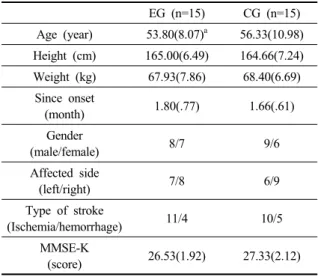
The study inclusion criteria were as follows: (1) stroke onset duration of <3 months, (2) no neurological deficits in cerebellum or brainstem, and (3) no cognitive impairment (a mini-mental function test score of >24). Exclusion criteria were as follows: (1) metal within the brain (2) a cardiac pacemaker, (3) pregnancy, and (4) a history of seizure. Patient demographic information is summarized in Table 1.
EG (n=15) CG (n=15) Age (year) 53.80(8.07)
a56.33(10.98) Height (cm) 165.00(6.49) 164.66(7.24) Weight (kg) 67.93(7.86) 68.40(6.69)
Since onset
(month) 1.80(.77) 1.66(.61)
Gender
(male/female) 8/7 9/6
Affected side
(left/right) 7/8 6/9
Type of stroke
(Ischemia/hemorrhage) 11/4 10/5
MMSE-K
(score) 26.53(1.92) 27.33(2.12)
a
mean (SD)
EG : Experimental Group (rTMS group) CG : Control Group (Sham rTMS group)
Table 1. General and Medical Characteristics of the Study Subjects
2. Intervention
Members of the experimental group received rTMS and conventional rehabilitation therapy for a total of 45 minutes (rTMS 15 minutes; conventional rehabilitation therapy 30
minutes) per day 5 days per week for 4 weeks with a 15-minute rest period halfway through sessions. Conventional rehabilitation therapy consisted of neurodevelopmental facilitation techniques, and was administered by therapists unaware of the study protocol or group assignments. The objectives of stroke rehabilitation were to improve functional abilities, such as dressing, transfer, ambulation and balance, and to provide education to caregivers, so as to help patients achieve earlier and/or greater independence in the activities of daily living. Members of the control group received sham rTMS for 15 minutes and conventional rehabilitation therapy for 30 minutes per day on same days.
A 70-mm figure 8 coil and a Magstim Rapid stimulator (Magstim Company, Dyfed, UK) were used in the experimental and control groups. Patients in the experimental group received 10 Hz rTMS applied to the hotspot in the lesioned hemisphere in 10-second trains with 50-second intervals between trains, for 15 minutes (total 2,000 pulses). Patients in the control group received sham rTMS in the same manner and were played sounds of a stimulator coil.
3. Measurements
1) Static balance measurement
The Gaitview System (AFA-50, Alfoots, Korea) was used to determine pressure distributions and postural sways of both feet in each study subject. The sensor mat had an active area of 410×410×3 mm, was 45 mm thick (700×500 mm), and contained 2,304 (48×48) force- sensitive resistor sensors, which functioned at a sampling rate of 17 Hz.
To measure static balancing ability, data from a floor
mounted foot scan board was harvested using a computer
running Gaitview system software. After selecting the static
test mode, the patient was instructed to step on the foot
board and to "maintain a straight posture". Pressure
distributions of both feet and postural sway were then monitored for 10 seconds. This process was repeated 3 times before and after the experiment, and average data were gathered. A higher figure indicated less movement was detected during testing. Pressure index showed the pressure ratio of the paralyzed foot, given that the ratio of each foot was 50% at the start. A lower sway index implied better balancing ability. Total pressure index was defined as the pressure exerted by the paralyzed foot in kPa (1 kPa = 1.98 kg/cm2).
2) Dynamic balance measurement
Dynamic balance scores were obtained using a balance measurement system (Biodex Balance Master, New York, USA), which incorporates a specific monitor and a movable force platform that provides up to 20° of surface tilt and a 360° range of motion, and a visual feedback system.
Balance index refers to a patient’s ability to maintain the vertical body axis within a suitable range of the balance center of the platform’s angle of tilt. A low balance index score implies excellent balance ability. The overall index captures overall movement changes, the anterior/posterior stability index captures changes in the sagittal plane, and the medial/lateral stability index captures change in the frontal plane. Before testing, patients were allowed three practice sessions on a fixed board to adapt to the equipment.
During the 30 second test period, the intensity of movement
of foot board ranged from 1 to 8 (1 most intense and 8 least intense). Since this study involved stroke patients, the test was executed at level 8 to avoid undue risks. It has been shown to have excellent internal consistency and acceptable intra-rater (r=.82) and inter-rater (r=.70) reliabilities (Wendy et al., 2001).
4. Statistical Analysis
The independent t and chi-square tests were used to determine the significances of pre-interventional differences between the general characteristics of patients in the experimental and control groups. The paired samples t-test was used to analyze intragroup balance differences pre- to post-intervention, and the independent t-test was used to determine the significances of intergroup pre- to post-intervention differences. SPSS ver. 18.0 (SPSS, Chicago, IL, USA) was used for the analysis, and p values of <.05 were considered significant.
Ⅲ. Results
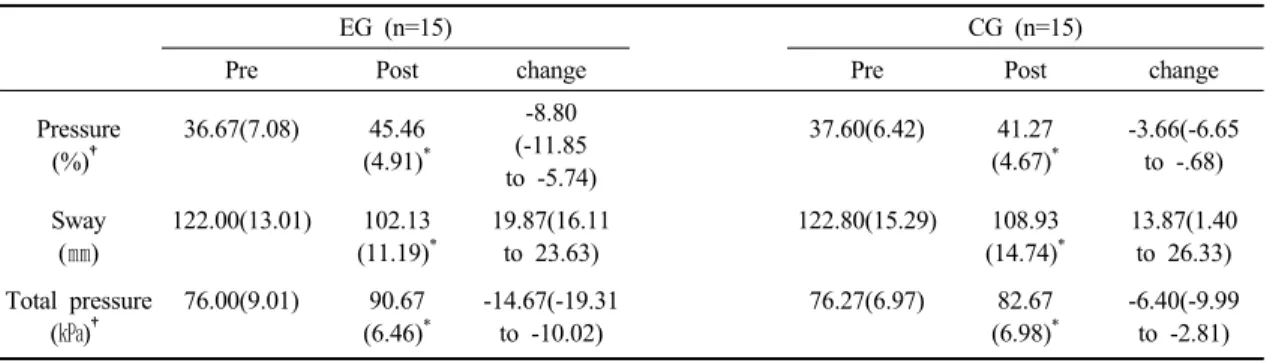
A summary of the clinical and demographic features of the study subjects (n = 30) is provided in Table 1, and static balance abilities in the experimental and control groups are summarized in Table 2. Significant intergroup differences were observed for pressures and total pressure
EG (n=15) CG (n=15)
Pre Post change Pre Post change
Pressure (%)
†36.67(7.08) 45.46 (4.91)
*-8.80 (-11.85 to -5.74)
37.60(6.42) 41.27 (4.67)
*-3.66(-6.65 to -.68) Sway
(㎜)
122.00(13.01) 102.13 (11.19)
*19.87(16.11 to 23.63)
122.80(15.29) 108.93 (14.74)
*13.87(1.40 to 26.33) Total pressure
(㎪)
†76.00(9.01) 90.67 (6.46)
*-14.67(-19.31 to -10.02)
76.27(6.97) 82.67 (6.98)
*-6.40(-9.99 to -2.81)
a
mean (SD), Within group: *p<.01, Between groups: † p<.01
EG : Experimental Group (rTMS group), CG : Control Group (Sham rTMS group)
Table 2. Changes in static balance characteristics pre- to post-intervention in the two study groups
indices post-intervention (p<.05). Pre- to post-intervention results for all variables were significantly different in the experimental and control groups (p<.05). Group dynamic balance abilities are summarized in Table 3. Post- intervention overall stability indices were significantly different in the two groups (p<.05). In the experimental group, significant pre- to post-intervention differences were observed for overall stability index and medial/lateral stability index (p<.05); whereas, in the control group, only overall stability index was found to be significantly different (p<.05).
Ⅳ. Discussion
This study was conducted to investigate the effect of high frequency rTMS on static balance and dynamic balance ability in acute stroke patients. According to our results, pressure rate and total pressure in static balance and overall stability in dynamic balance were greater in the experiment group than in the control group after intervention, which suggests high frequency rTMS is significantly more effective at improving static balance and dynamic balance abilities than sham rTMS. Furthermore, the present study shows consecutive multisession high frequency rTMS applied at a subthreshold intensity to the
affected hemisphere during the acute stage of stroke is safe, and suggests that rTMS might augment static and dynamic balance recovery after stroke.
A mechanism has been suggested to explain the effect of rTMS on balance recovery after stroke. Nadeau et al.
(1999) reported that motor function is closely related with balance. Spontaneous recovery occurs primarily during the first month after stroke onset, but this interferes with efforts to determine the possible effects of early rehabilitation therapies, particular those targeting functional restoration (Langhorne et al., 2011). rTMS involves the non-invasive application of an electrical field outside the cranium, that triggers nerve cell depolarization within the cerebral cortex and changes cerebral cortex excitability (Martin et al., 2004).
High-frequency rTMS is used to up-regulate the affected cortex excitability (Hummel and Cohen, 2006). In a previous study, we found that a single session of 10 Hz rTMS at subthreshold intensity facilitated practice- dependent plasticity and improved motor function in patients with chronic stroke (Kim et al., 2006), and Gorsler et al. (2003) reported increased left motor cortex excitability after the application of high-frequency rTMS to the right motor cortex.
The present study has some limitations that required consideration. First, the small sample size may have impacted results, and thus, our results cannot be generalized
EG (n=15) CG (n=15)
Pre Post change Pre Post change
Overall† 5.45(.72) 4.27 (.86)
*1.17 (.76 to 1.58 )
5.48(.83) 4.94
(.93)
*.54 (.22 to .87)
A/P 4.55(.69) 4.25
(.79)
.30 (-.12 to .72)
4.59(.61) 4.36
(.70)
.22 (-.18 to .63)
M/L 4.41(.63) 3.94
(1.03)
*.47 (.01 to .93)
4.48(.76) 4.29
(.73)
.20 (-.23 to .63)
a