The Model for End-Stage Liver Disease Score-Based System Predicts Short Term Mortality Better Than the Current Child-
Turcotte-Pugh Score-Based Allocation System during Waiting for Deceased Liver Transplantation
To adopt the model for end-stage liver disease (MELD) score-based system in Korea, the feasibility should be evaluated by analysis of Korean database. The aim of this study was to investigate the feasibility of the MELD score-based system compared with the current Child-Turcotte-Pugh (CTP) based-system and to suggest adequate cut-off to stratify waiting list mortality among Korean population. We included 788 adult patients listed in waiting list in Seoul National University Hospital from January 2008 to May 2011. The short-term survival until 6 months after registration was evaluated. Two hundred forty six (31.2%) patients underwent live donor liver transplantation and 353 (44.8%) patients were still waiting and 121 (15.4%) patients were dropped out due to death. Significant difference was observed when MELD score 24 and 31 were used as cut-off. Three-months survival of Status 2A was 70.2%. However, in Status 2A patients whose MELD score less than 24 (n = 82), 86.6% of patients survived until 6 month. Furthermore, patients with high MELD score ( ≥ 31) among Status 2B group showed poorer survival rate (45.8%, 3-month) than Status 2A group. In conclusion, MELD score-based system can predict short term mortality better and select more number of high risk patients in Korean population.
Key Words: Liver Diseases; Waiting Lists; Survival; Mortality; Liver Transplantation; MELD Score
Geun Hong, Kwang-Woong Lee, Sukwon Suh, Tae Yoo, Hyeyoung Kim, Min-Su Park, Youngrok Choi, Nam-Joon Yi, and Kyung-Suk Suh Department of Surgery, Seoul National University College of Medicine, Seoul, Korea
Received: 21 January 2013 Accepted: 28 June 2013 Address for Correspondence:
Kwang-Woong Lee, MD
Department of Surgery, Seoul National University College of Medicine, 101 Daehak-ro, Jongno-gu, Seoul 110-744, Korea Tel: +82.2-2072-2511, Fax: +82.2-766-3975
E-mail: [email protected]
This research was not supported by a financial grant.
http://dx.doi.org/10.3346/jkms.2013.28.8.1207 • J Korean Med Sci 2013; 28: 1207-1212
INTRODUCTION
Despite of increment of liver transplantation (LT), there are still growing numbers of accumulated patients in waiting list in Ko- rea. Child-Turcotte-Pugh (CTP) score-based system has been used for deceased donor allocation in LT in Korea from 2002.
Even though the donation rate after brain death was still rela- tively low, the absolute number and the proportion of deceased donor liver transplantation (DDLT) have been increasing recent- ly. Therefore, adequate deceased donor allocation became im- portant issue in Korea.
Ultimate goal of allocation system is balancing between jus- tice and utility, which means to optimize the use of scarce do- nor organ resource and to reduce waiting list mortality and fur- thermore, to maximize long-term outcome. For this purpose, the model for end-stage liver disease (MELD) score system was adopted for deceased donor allocation in February 2002 in the United States, because it is objective, readily available data and highly predictive of short term mortality, on the other hand, CTP score-based system is partly subjective and empirical (1).
MELD score was introduced for the prediction of short term
mortality of patients with cirrhotic liver after transjugular intra- hepatic portosystemic shunt, using serum creatinine, bilirubin, prothrombin time international normalized ratio (INR) and eti- ology of liver disease (2). MELD allocation system has resulted in positive effects, i.e., 12% reduction in waiting list registration especially patients with MELD score less than 10 because of the very little chance of receiving deceased donor liver (3) and 3.5%
reduction in drop out number, which caused the increase in transplantation rates on the contrary. MELD score based system have settled down to some extent in the United States and many other countries but still, is on the way of refinement, i.e., MELD- Na, MELD refit, additional point for patients with hepatocellu- lar carcinoma (HCC) and so on (4-7).
However, it is not desirable to adopt the allocation system of the Western countries without verification because the medical environment of Korea may be quite different from that of the Western countries. However, there are very few data and reports about the feasibility of MELD score-based allocation system in Korea (8-10).
The aim of this study was to investigate the feasibility of the MELD score-based system compared with the current CTP
score-based system and to suggest adequate cut-off to stratify waiting list mortality among Korean population.
MATERIALS AND METHODS
Nine hundred and one patients have registered for DDLT from January 2008 to May 2011 in Seoul National University Hospital.
Seven hundred and eighty eight adult patients were included for analysis after excluding 113 patients who were status 1 or younger than 18 yr old, or patients whose laboratory data were not available for calculation of MELD score.
We collected the patients’ data of age, sex, the Korean Network for Organ Sharing (KONOS) status, and laboratory data retro- spectively. MELD scores were calculated using values acquired by test just before registration. Values of serum total bilirubin (mg/dL), prothrombin time INR, serum creatinine (mg/dL) less than 1.0 were changed to 1.0 to avoid negative value because they should be calculated in logarithmic function. Creatinine values higher than 4.0 were changed to 4.0 according to the previously proposed protocol (5).
MELD scores were calculated according to the following for- mula:
MELD score = 9.57 * loge (creatinine, mg/dL)+3.78 * loge (total bilirubin, mg/dL)+11.2 * loge (INR)+6.43
Median MELD score was 17 (range, 6-57). Patients were clas- sified into three groups according to the MELD score, i.e., low MELD score group (MELD score < 24), high MELD score group (24 ≤ MELD score < 31) and highest MELD score group (MLED score ≥ 31). Patients were also classified as three groups accord- ing to KONOS status, i.e., 2A group, 2B group, and 3 & 7 group.
KONOS classification is similar with previous UNOS classifica- tion (Table 1) (1).
Patients were observed for 6 month after registration. During follow up period, patients who underwent LT (DDLT or LDLT) or patients who were loss of follow up were considered as cen- sored.
Statistical analysis was performed with the SPSS version 19 (SPSS, Inc., Chicago, IL, USA) and Medcalc for Windows version 12.4.0.0. (MedCalc Software, Mariakerke, Belgium). To identify adequate cut-off value, we performed c-statistics and the area under the curve (AUC) value was calculated. The short term (1, 3, and 6 months) survival was evaluated via Kaplan-Meier meth- od according to current allocation system and MELD score. P <
0.05 was defined as statistically significant.
Ethics statement
This study was approved by the institutional review board of Seoul National University Hospital (H-1212-017-446). The board waived the need for informed consent.
RESULTS
Survival according to MELD score and adequate cut-off values to stratify waiting list mortality
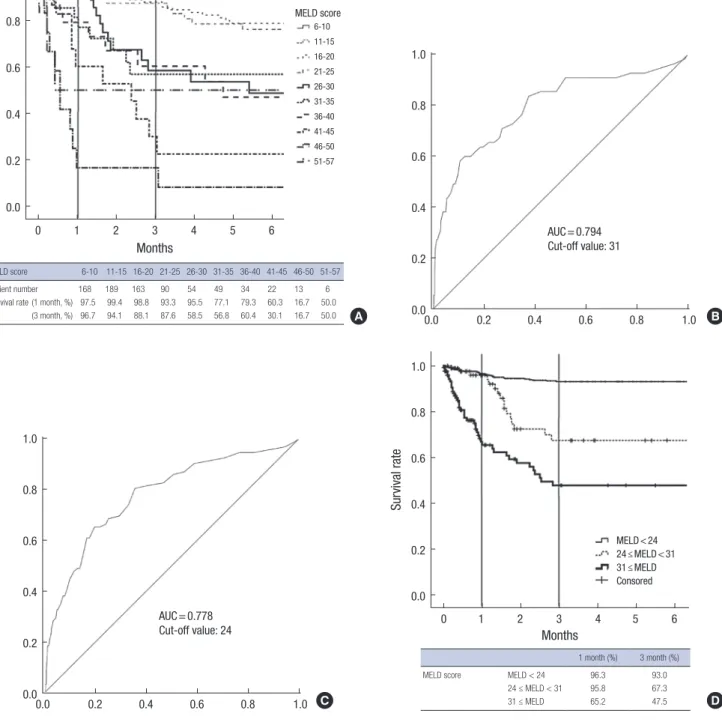
Fig. 1A showed patient survival according to MELD score at an interval of 5 point. One month survival dropped at 30 point. And 3 month survival dropped at 25 point. According to c-statistics, the adequate cut-off value for 1-month mortality was 31 (sensi- tivity, 58.18; specificity, 89.50) and the area under the curve (AUC) value was 0.794 (95% CI, 0.764-0.822; P < 0.001) (Fig. 1B).
The cut-off value for 3-month mortality was 24 (sensitivity, 65.22; specificity, 80.46) and AUC was 0.778 (95% CI, 0.747-0.806, P < 0.001) (Fig. 1C).
We divided into three groups based on different cut-off val- ues. Patients with higher MELD score (MELD ≥ 31) has the lowest 1-month survival rate (65.2%, P < 0.001) but the other two groups showed no difference (P = 0.860) (Fig 1D). Howev- er, 3-month survival rates were significantly different between three groups.
The feasibility of MELD score-based system to predict waiting list mortality compared with the current CTP score-based system
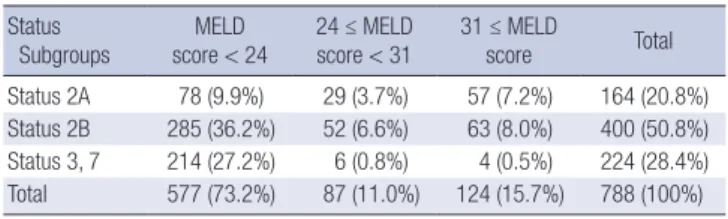
One hundred sixty four patients were listed as Status 2A, 400 patients as Status 2B and 224 patients as Status 3 or 7 (Table 1).
Among 164 patients in Status 2A, 47.6% of patients (78/164) was low MELD group ( < 24). However, 28.8% of patients in Status 2B (115/400) was high MELD group ( ≥ 24).
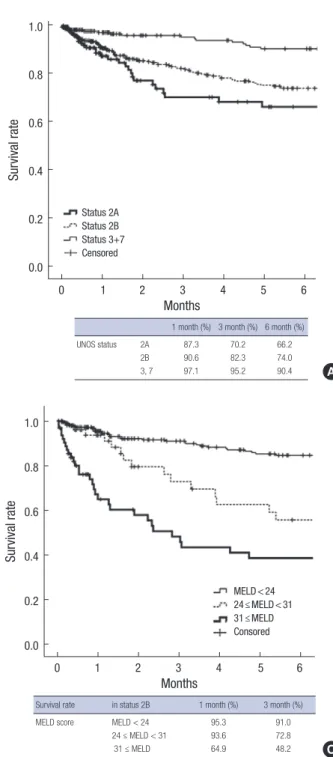
Fig. 2A shows 1, 3, and 6 month survival according to the cur- rent KONOS status. 3-months survival of Status 2A was 70.2%.
However, among Status 2A patients, 82 patients with MELD
< 24 showed better survival (93.0% of 3-months survival) than current Status 2B group (82.3%) (Fig. 2A, B). However, patients with highest MELD score ( ≥ 31) among Status 2B group showed poorer survivals (48.2% of 3-months survival) than current Sta- tus 2A group (70.2%) (Fig. 2C).
Clinical course of the cohorts
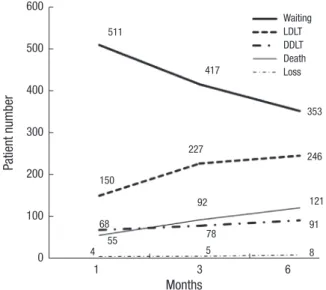
Fig. 3 shows the clinical course of the patients for 6 months after registration under the current allocation system. Only 8.6% of patients (68/788) in the waiting list received DDLT within 1 month. The rate of DDLT was not much increased until 6 months after that. 19% of the patients (150/788) received LDLT within 1 month. It was increased until 6 months. 337 (42.8%) patients Table 1. Distribution of Patients according to the current KONOS status and MELD
subgroups Status
Subgroups MELD
score < 24 24 ≤ MELD
score < 31 31 ≤ MELD
score Total
Status 2A 78 (9.9%) 29 (3.7%) 57 (7.2%) 164 (20.8%) Status 2B 285 (36.2%) 52 (6.6%) 63 (8.0%) 400 (50.8%) Status 3, 7 214 (27.2%) 6 (0.8%) 4 (0.5%) 224 (28.4%) Total 577 (73.2%) 87 (11.0%) 124 (15.7%) 788 (100%)
underwent LT during 6 months follow-up. Among them, only 91 patients (91/337, 27.0%) underwent DDLT, and 246 patients (246/337, 73.0%) underwent LDLT. However, 353 patients (44.8%) were still in waiting list and 121 patients (15.4%) were dropped out due to death and 8 patients (1.0%) were loss of follow up during 6 months after initial registration.
Among status 2A patients, 48.2% (79/164) received DDLT.
However, only 18.5% (23/124) of highest MELD and 27.6% (24/
87) of high MELD group received DDLT (Table 2).
DISCUSSION
Deceased donor allocation system has not been a major con- cern in Korea, because LDLT has been prevalent. Current Kore- an liver allocation system adopted the previous UNOS system, which utilizes CTP score-based system. However, it comprises
MELD score 6-10 11-15 16-20 21-25 26-30 31-35 36-40 41-45 46-50 51-57
Patient number 168 189 163 90 54 49 34 22 13 6
Survival rate (1 month, %) 97.5 99.4 98.8 93.3 95.5 77.1 79.3 60.3 16.7 50.0 (3 month, %) 96.7 94.1 88.1 87.6 58.5 56.8 60.4 30.1 16.7 50.0
Survival rate
Months
0 1 2 3 4 5 6 1.0
0.8
0.6
0.4
0.2
0.0
MELD score 6-10 11-15 16-20 21-25 26-30 31-35 36-40 41-45 46-50 51-57
AUC = 0.794 Cut-off value: 31
0.0 0.2 0.4 0.6 0.8 1.0 1.0
0.8
0.6
0.4
0.2
0.0
AUC = 0.778 Cut-off value: 24
0.0 0.2 0.4 0.6 0.8 1.0 1.0
0.8
0.6
0.4
0.2
0.0
MELD < 24 24 ≤ MELD < 31 31 ≤ MELD Consored
0 1 2 3 4 5 6 1.0
0.8
0.6
0.4
0.2
0.0
Survival rate
Months
1 month (%) 3 month (%)
MELD score MELD < 24 96.3 93.0
24 ≤ MELD < 31 95.8 67.3
31 ≤ MELD 65.2 47.5
A B
C D
Fig. 1. Survival during waiting list according to MELD score at an interval of 5 point (A). C-statistics for 1 month mortality shows that AUC is 0.794 (95% CI, 0.764-0.822;
P < 0.001) and the cut-off value is 31 (sensitivity, 58.18; specificity, 89.50) (B). C-statistics for 3 month mortality shows that AUC is 0.778 (95% CI, 0.747-0.806, P < 0.001) and the cut-off value is 24 (sensitivity, 65.22; specificity, 80.46) (C). The survival curve according to the cut-off values of MELD score for 1, 3 month mortality (D).
ate the feasibility of MELD system in Korea compared with the current allocation system by analyzing Korean database.
There have been some studies about the feasibility of MELD score in Korea. However, most of them were about the progno- sis after resection or prognosis of the patients with cirrhosis. Song et al. (11) showed that MELD score was better predictive factor of early mortality after resection for patients with HCC and cir- rhotic liver than CTP score irrespective of etiology of cirrhosis.
Kim et al. (12) also showed the MELD-Na and MELD score was superior to CTP score for prediction of early mortality for patients with cirrhosis. Hwang et al. (8) suggested the MELD system as a 0 1 2 3 4 5 6
1.0
0.8
0.6
0.4
0.2
0.0
Survival rate
Months
Survival rate in status 2B 1 month (%) 3 month (%)
MELD score MELD < 24 95.3 91.0
24 ≤ MELD < 31 93.6 72.8
31 ≤ MELD 64.9 48.2
MELD < 24 24 ≤ MELD < 31 31 ≤ MELD Consored
C 0 1 2 3 4 5 6 1.0
0.8
0.6
0.4
0.2
0.0
Survival rate
Months
1 month (%) 3 month (%) 6 month (%)
UNOS status 2A 87.3 70.2 66.2
2B 90.6 82.3 74.0
3, 7 97.1 95.2 90.4
Status 2A Status 2B Status 3+7 Censored
A
0 1 2 3 4 5 6 1.0
0.8
0.6
0.4
0.2
0.0
Survival rate
Months
Survival rate in status 2A 1 month (%) 3 month (%)
MELD score MELD < 24 98.4 93.0
24 ≤ MELD < 31 88.9 30.5
31 ≤ MELD 61.2 35.0
MELD < 24 24 ≤ MELD < 31 31 ≤ MELD Consored
B
Fig. 2. Survival according to the current KONOS status and MELD subgroups.
3-months survival of Status 2A was 70.2% (A). However, among Status 2A pa- tients, 78 patients with MELD ≤ 24 showed better survival than current Status 2B group (B). Furthermore, patients with high MELD ( ≥ 31) among Status 2B group showed poorer survivals (48.2% of 3-month survival) than current Status 2A group (C).
a couple of subjective factors such as ascites and encephalopa- thy, therefore, it can be easily manipulated for the purpose of allocation. Furthermore, in Status 2B category, non-medical factors such as waiting time and center incentive determined the order of allocation in current Korean allocation system. As the DDLT is increasing in Korea, there is an argument that the current allocation system needs to be changed into more ob- jective system such as MELD score-based system. Medical en- vironment of Korea is somewhat different from the Western.
Hepatitis B virus (HBV) related liver disease is more prevalent and LDLT is more prevalent. Therefore, it is necessary to evalu-
solution for allocation dilemma (Status 1 vs Status 2A) in cases of HBV related fulminant hepatitis. However, there have been no Korean studies about the usefulness of MELD score system for prediction of early mortality after registration for DDLT.
The definition of KONOS Status 2A is the life expectancy of 1 week or so without LT. So far, those patients of Status 2A have had priority of deceased donor liver over the patients of other status according to this definition. This study, however, did not show the early mortality corresponding to the definition. One month mortality of Status 2A patients was relatively low. Only 12.7% of patients among Status 2A patients were dead at 1 month after registration and they also showed low mortality rate 29.8%, 33.8% at 3 and 6 months respectively. Because of relatively high- er incidence of LDLT in Korea, the mortality could be lower than the United States. However, compared with relatively higher mortality rate in highest MELD score (34.8% of one month mor- tality in MELD ≥ 31), the one month mortality rate of current Status 2A (12.7%) is too low in contrast to the definition. The risk of mortality in Status 2B group was also relatively low com- pared with that of intermediate MELD score group (Fig. 2A &
1D). Therefore, current allocation system does not reflect the risk of early mortality after registration correctly. Furthermore, short term mortality can be stratified by MELD score among Status 2A group (Fig. 2B). One month mortality was 35.1% in patients with MELD score more than 31 among Status 2B, which is higher than that of general Status 2A patients (12.7%) (Fig. 2C).
Thus, we might have overestimated some patients with low ac- tual risk of mortality and we also have overlooked some patients with high actual risk of mortality in the current allocation sys- tem. Therefore, we can conclude that MELD system is better than the current allocation system to stratify the survival during waiting in Korea.
In the current system, if there is no Status 1 patient in the
waiting list, deceased liver allocates to the Status 2A recipients in the same region first, and then if no candidate in the same region, it extends to whole nation before seeking Status 2B pa- tient in the same region. In this study, we tried to find the opti- mal cut-off to apply this nation-wide extension policy in Status 2A if MELD system is applied. In the United States, it is 35 and 15 point (13). According to our analysis, 31 point seems appro- priate to differentiate one month survival. However, 24 point seems more appropriate to differentiate 3-month survival. Fur- thermore, the proportion of patients (MELD ≥ 24) group was 26.7%, which was similar with that of the current Status 2A (20.8%). Therefore, 31 and/or 24 point seemed appropriate cut- offs to differentiate allocation policy in Korea.
Optimal allocation means ‘more livers to sicker patients’, how- ever, short-term post-operative mortality might be increased af- ter this strategy. The actual short term outcome has been re- ported not to be changed compared with the previous outcome according to UNOS/OPTN analysis. Instead, waiting list mor- tality was reduced (14). There have been several efforts of vali- dation after adoption of MELD based system in the United States (15, 16). And further studies are ongoing for refinement of MELD score-based system (4-6, 17). Biselli et al. (4) reported that MELD-Na and integrated MELD were the best prognostic mod- els after comparing 6 score systems. Validation and modifica- tion should also be followed if MELD system is adopted in Ko- rea.
Another issue is the exceptional situations such as HCC and hepatopulmaonary syndrome and so on in which MELD based allocation is not applicable (18-20). We need another study to identify optimal exceptional indication in Korea.
One of the limitations of this study is that we assumed that all mortality was related with hepatic failure. The non-liver failure related mortality such as HCC progression was not considered in this study. However, the tumor biology of the patients in waiting list was usually good because no additional point for HCC in the current listing rule and therefore, the reason for DDLT listing was mainly liver dysfunction in Korea.
In conclusion, MELD score-based system is better than CTP
1 3 6
600
500
400
300
200
100
0
Patient number
Months
Waiting LDLT DDLT Death Loss 511
417
353
227 246 150
68
92 121
91
5 8
4 55 78
Fig. 3. Clinical course of the cohorts during 6 months after registration.
Table 2. The rate and type of liver transplantation according to the current KONOS status and MELD subgroups (within 6 month)
Subgroups LDLT DDLT Without LT Total
KONOS status (n = 788)
Status 2A 28 (17.1%) 79 (48.2%) 66 (40.2%) 164 (100%) Status 2B 144 (36.0%) 12 (3.0%) 244 (61.0%) 400 (100%) Status 3, 7 74 (33.0%) 0 (0.0%) 150 (67.0%) 224 (100%) MELD
class (n = 788)
31 ≥ MELD
score 29 (23.4%) 23 (18.5%) 72 (58.1%) 124 (100%) 24 ≤ MELD
score < 31
25 (28.7%) 24 (27.6%) 38 (43.7%) 87 (100%) MELD < 24 225 (39.0%) 74 (12.8%) 278 (48.2%) 577 (100%) LDLT, live donor liver transplantation; DDLT, deceased donor liver transplantation; LT, liver transplantation
score-based system in that it uses objective data and it can pre- dict short-term mortality better. Therefore, we expect that more number of high risk patients can receive DDLT and thus, drop- out rate will be decreased by adopting MELD score-based sys- tem in Korea. The current CTP score-based system should be changed into the MELD score-based system in Korea. However, nation-wide study is needed to make concrete conclusion.
DISCLOSURE
The authors have no conflicts of interest to disclose.
REFERENCES
1. Wiesner RH, McDiarmid SV, Kamath PS, Edwards EB, Malinchoc M, Kremers WK, Krom RA, Kim WR. MELD and PELD: application of sur- vival models to liver allocation. Liver Transpl 2001; 7: 567-80.
2. Malinchoc M, Kamath PS, Gordon FD, Peine CJ, Rank J, ter Borg PC. A model to predict poor survival in patients undergoing transjugular in- trahepatic portosystemic shunts. Hepatology 2000; 31: 864-71.
3. Wiesner RH. Evidence-based evolution of the MELD/PELD liver alloca- tion policy. Liver Transpl 2005; 11: 261-3.
4. Biselli M, Gitto S, Gramenzi A, Di Donato R, Brodosi L, Ravaioli M, Grazi GL, Pinna AD, Andreone P, Bernardi M. Six score systems to eval- uate candidates with advanced cirrhosis for orthotopic liver transplant:
which is the winner? Liver Transpl 2010; 16: 964-73.
5. Kim WR, Biggins SW, Kremers WK, Wiesner RH, Kamath PS, Benson JT, Edwards E, Therneau TM. Hyponatremia and mortality among pa- tients on the liver-transplant waiting list. N Engl J Med 2008; 359: 1018-26.
6. Leise MD, Kim WR, Kremers WK, Larson JJ, Benson JT, Therneau TM.
A revised model for end-stage liver disease optimizes prediction of mor- tality among patients awaiting liver transplantation. Gastroenterology 2011; 140: 1952-60.
7. Lim YS, Larson TS, Benson JT, Kamath PS, Kremers WK, Therneau TM, Kim WR. Serum sodium, renal function, and survival of patients with end-stage liver disease. J Hepatol 2010; 52: 523-8.
8. Hwang S, Lee SG, Jung DH, Kim KH, Ha TY, Song GW. Simulation of deceased-donor liver graft allocation as UNOS status I or IIa on the cur-
rent Korean setting for patients with hepatitis B virus-induced fulminant hepatic failure. Korean J Hepatobiliary Pancreat Surg 2009; 13: 31-6.
9. Lee JS. Changes of MELD: can exceed Child-Pugh’s authority? Korean J Hepatol 2006; 12: 475-8.
10. Lim YS. Prediction of post-operative mortality in patients with cirrhosis:
growth of child to MELD. Korean J Gastroenterol 2011; 57: 333-4.
11. Song CS, Yoon MY, Kim HJ, Park JH, Park DI, Cho YK, Sohn CI, Jeon WK, Kim BI. Usefulness of model for end-stage liver disease score for pre- dicting mortality after intra-abdominal surgery in patients with liver cirrhosis in a single hospital. Korean J Gastroenterol 2011; 57: 340-5.
12. Kim SY, Yim HJ, Lee J, Lee BJ, Kim DI, Jung SW, Han WS, Lee JS, Koo JS, Seo YS, et al. Comparison of CTP, MELD, and MELD-Na scores for pre- dicting short term mortality in patients with liver cirrhosis. Korean J Gastroenterol 2007; 50: 92-100.
13. OPTN: Organ Procurement and Transplantation Network. Available at http://optn.transplant.hrsa.gov/organDatasource/OrganSpecificPoli- cies.asp?display=Liver [accessed on January 2013].
14. Wiesner R, Edwards E, Freeman R, Harper A, Kim R, Kamath P, Kremers W, Lake J, Howard T, Merion RM, et al. Model for end-stage liver disease (MELD) and allocation of donor livers. Gastroenterology 2003; 124: 91-6.
15. Kamath PS, Kim WR; Advanced Liver Disease Study Group. The model for end-stage liver disease (MELD). Hepatology 2007; 45: 797-805.
16. Freeman RB Jr. Model for end-stage liver disease (MELD) for liver allo- cation: a 5-year score card. Hepatology 2008; 47: 1052-7.
17. Stewart CA, Malinchoc M, Kim WR, Kamath PS. Hepatic encephalopa- thy as a predictor of survival in patients with end-stage liver disease. Liv- er Transpl 2007; 13: 1366-71.
18. Pomfret EA, Washburn K, Wald C, Nalesnik MA, Douglas D, Russo M, Roberts J, Reich DJ, Schwartz ME, Mieles L, et al. Report of a national conference on liver allocation in patients with hepatocellular carcinoma in the United States. Liver Transpl 2010; 16: 262-78.
19. Washburn K, Edwards E, Harper A, Freeman R. Hepatocellular carci- noma patients are advantaged in the current liver transplant allocation system. Am J Transplant 2010; 10: 1643-8.
20. Yao FY, Bass NM, Ascher NL, Roberts JP. Liver transplantation for he- patocellular carcinoma: lessons from the first year under the Model of End-Stage Liver Disease (MELD) organ allocation policy. Liver Transpl 2004; 10: 621-30.