A Case of Congenital Adrenal Hyperplasia Mimicking Cushing’s Syndrome
Congenital adrenal hyperplasia (CAH) is characterized by decreased adrenal hormone production due to enzymatic defects and subsequent rise of adrenocorticotrophic hormone that stimulates the adrenal cortex to become hyperplastic, and sometimes tumorous. As the pathophysiology is basically a defect in the biosynthesis of cortisol, one may not consider CAH in patients with hypercortisolism. We report a case of a 41-yr-old man with a 4 cm-sized left adrenal tumorous lesion mimicking Cushing’s syndrome who was diagnosed with CAH. He had central obesity and acanthosis nigricans involving the axillae together with elevated 24-hr urine cortisol level, supporting the diagnosis of Cushing’s syndrome. However, the 24-hr urine cortisol was suppressed by 95% with the low dose dexamethasone suppression test. CAH was suspected based on the history of precocious puberty, short stature and a profound suppression of cortisol production by
dexamethasone. CAH was confirmed by a remarkably increased level of serum
17-hydroxyprogesterone level. Gene mutation analysis revealed a compound heterozygote mutation of CYP21A2 (I173N and R357W).
Key Words: Congenital Adrenal Hyperplasia; 21-Hydroxylase Deficiency; Hypercortisolism Hye Jeong Kim1,*, Mira Kang2,*,
Jae Hyeon Kim1, Sun Wook Kim1, Jae Hoon Chung1, Yong-Ki Min1, Moon-Kyu Lee1,2, Kwang-Won Kim1, and Myung-Shik Lee1
1Division of Endocrinology and Metabolism, Department of Medicine, Samsung Medical Center, Sungkyunkwan University School of Medicine, Seoul; 2Center for Health Promotion, Samsung Medical Center, Seoul, Korea
*Hye Jeong Kim and Mira Kang contributed equally to this work.
Received: 29 November 2011 Accepted: 30 July 2012 Address for Correspondence:
Myung-Shik Lee, MD
Division of Endocrinology and Metabolism, Department of Medicine, Samsung Medical Center, Sungkyunkwan University School of Medicine, 81 Irwon-ro, Gangnam-gu, Seoul 135-710, Korea
Tel: +82.2-3410-3436, Fax: +82.2-3410-3849 E-mail: [email protected]
http://dx.doi.org/10.3346/jkms.2012.27.11.1439 • J Korean Med Sci 2012; 27: 1439-1443
INTRODUCTION
Congenital adrenal hyperplasia (CAH) is a common autosomal recessive disorder. Steroid 21-hydroxylase deficiency accounts for over 90% of CAH cases and can have diverse manifestations:
from the salt-wasting to the non-classical form due to a highly variable genetic mutation (1, 2). In the case of the simple viriliz- ing or non-classical form, the symptoms related to the enzyme deficiency may be so insidiously progressive that it is not easy to identify the disease. Impaired negative feedback by reduced cortisol causes an exaggerated rise of adrenocorticotrophic hor- mone (ACTH) levels, which stimulates the adrenal cortex to be- come hyperplastic, and sometimes nodular or tumorous (3-5).
If we encounter a patient with adrenal incidentaloma(s), we may consider a variety of adrenal diseases, such as Cushing’s syndrome or CAH (6); however, the two conditions are mutual- ly exclusive with regard to cortisol production. Here, we present a case of CAH mimicking Cushing’s syndrome.
CASE DESCRIPTION
A 41-yr-old man was referred to our emergency room from a
local clinic on July 3, 2006, with the impression of acute viral hepatitis due to a remarkable elevation of liver enzymes. He had experienced generalized weakness, dark urine, and jaundice for a two week period. His previous history included communi- ty-acquired pneumonia and carpal tunnel syndrome, but nei- ther diabetes mellitus nor hypertension. He complained of im- potence, and his mother described precocious puberty and hir- sutism beginning at the age of 7. He was not married and had no children.
His vital signs were a blood pressure of 115/92 mmHg, a regu- lar pulse of 105/min, and a respiratory rate of 18/min. His height was 152.5 cm (< 3th percentile) and body weight was 72.5 kg.
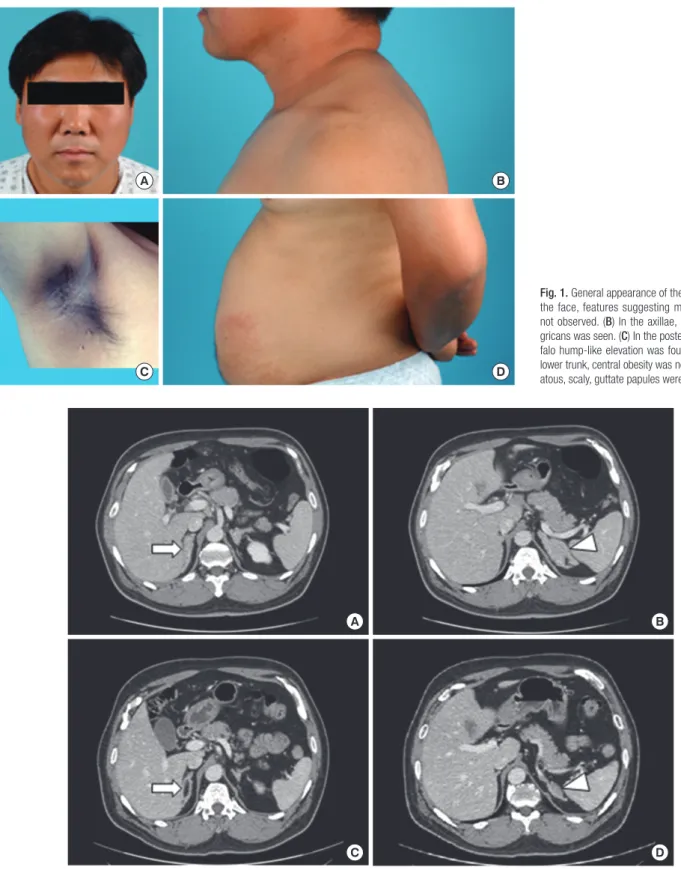
The body mass index was 32.5. Acanthosis nigricans was pres- ent in both axillae, and there was central obesity with erythem- atous, scaly, guttate papules on the lower abdominal skin. He also had a rather ambiguous buffalo hump; however, moon face or red stria was not present (Fig. 1).
Total and direct bilirubin levels were elevated at 11.6 mg/dL and 8.6 mg/dL, respectively. The AST and ALT levels were 224 and 1,044 U/L, respectively. Serum BUN level was 9.7 mg/dL, and serum creatinine level was 0.82 mg/dL. Serum electrolytes were normal. Based on a positive anti-HAV IgM titer, he was di-
agnosed with acute hepatitis A. During the evaluation to exclude other causes of liver dysfunction, a 4 × 2.3 cm left adrenal mass and bilateral adrenal hyperplasia were incidentally noted on ab-
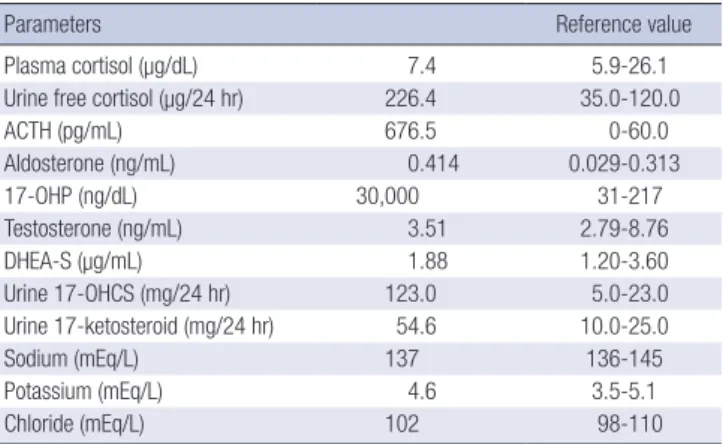
dominal CT (Fig. 2A, B). We evaluated the endocrine function (Table 1). Twenty-four hour urine catecholamines and VMA were within the normal range. However, hypercortisoluria was
B A
D C
Fig. 1. General appearance of the patient. (A) In the face, features suggesting moon face was not observed. (B) In the axillae, acanthosis ni- gricans was seen. (C) In the posterior neck, buf- falo hump-like elevation was found. (D) On his lower trunk, central obesity was noted. Erythem- atous, scaly, guttate papules were also seen.
A B
C D
Fig. 2. Adrenal CT images. (A & B) Bilateral adrenal hyperplasia (A) and tumorous growth in the left adrenal gland (B) were seen before treatment. (C & D) After 6 months of treatment with dexamethasone (0.25 mg per day), size of adrenal hyperplasia and tumorous lesion in left adrenal gland was markedly reduced (arrows, adrenal hyperplasia; ar- row heads, tumorous growth in left adrenal gland).
noted in 2 independent measurements (226.4 μg/24 hr; 122.1 μg/24 hr). Plasma cortisol was within the normal range (7.4 μg/
dL), however, ACTH level was very high (676.5 pg/mL). Urine 17-OHCS and 17-ketosteroid levels were markedly elevated to 123.0 mg/24 hr and 54.6 mg/24 hr, respectively. Serum aldoste- rone level was marginally elevated (0.414 ng/mL). DHEA-S was within the normal range (1.88 μg/mL). Based on the high serum ACTH level, hypercortisoluria, and bilateral adrenal hyperplasia with a large left adrenal mass, we suspected a pituitary cortico- trophic adenoma with marked asymmetric adrenal hyperpla- sia. To confirm the diagnosis of Cushing’s syndrome, low- and high-dose dexamethasone suppression tests were performed.
Then, 24-hr urine cortisol was markedly suppressed, not only by high-dose dexamethasone but also by low-dose dexametha- sone (Table 2); this result essentially eliminates the diagnosis of Cushing’s syndrome (7, 8). We thus suspected CAH based on the short stature, precocious pubarche and marked suppres- sion of 24-hr urine cortisol by dexamethasone suggesting hyper- responsiveness of the adrenal cortex to ACTH. The testosterone level was normal (3.51 ng/mL), but 17α-hydroxyprogesterone (17-OHP) was markedly elevated to 30,000 ng/dL, strongly sup- porting the diagnosis of a simple virilizing form of CAH. Gene analysis revealed CAH due to 21-hydroxylase deficiency by a compound heterozygote for CYP21 mutations: Ile173Asn (I173N) and Arg357Trp (R357W) (Fig. 3), confirming the diagnosis of a simple virilizing from of CAH due to mutations in CYP21.
We began administration of adrenal steroids. After 6 months of treatment with dexamethasone (0.25 mg daily), bilateral ad- renal hyperplasia and tumorous growth in left adrenal gland
were substantially decreased in size (Fig. 2C, D). 17-OHP and ACTH levels were normalized to 118 ng/dL and 20.8 pg/mL, re- spectively, and impotence was improved.
Biochemical assays
Blood samples were obtained in the morning after an overnight fast and a 30-min resting period in the supine position. Hor- mones were assayed using IRMA kits. For low- or high-dose dexamethasone suppression test, 0.5 or 2 mg dexamethasone was administered 4 times a day for 2 consecutive days.
Mutation analysis
Genomic DNA was extracted from the peripheral blood leuko- cytes of patient by using the Wizard Genomic DNA Purification Kit according to the manufacturer’s instructions (Promega, Mad- ison, WI, USA). All exons of the CYP21 gene were amplified by PCR on a thermal cycler (Applied Biosystems, Foster City, CA, USA). Direct sequencing was performed using the BigDye Ter- minator Cycle Sequencing Ready Reaction kit and an ABI Prism 3130 Genetic Analyzer (Applied Biosystems). The sequences were analyzed using the Sequencer program (Gene Codes Corp., Ann Arbor, MI, USA) and were compared to the reference se- quences. The numbering of nucleotide positions was done ac- cording to the CYP21 DNA sequence, and the Gen-Bank acces- sion number was NM000500.
DISCUSSION
It is not rare to find adrenal incidentalomas in patients with CAH. The 21-hydroxylase deficiency is considered to be a pre- disposing factor for adrenocortical tumorigenesis because an increased response of 17-OHP to exogenous ACTH stimulation has been seen in a large proportion of patients with adrenal in- cidentalomas (3-5, 9). Some studies have reported that tumor size and an augmented 17-OHP response to ACTH stimulation were significantly correlated in the subjects with impaired 21- hydroxylase deficiency (5, 9). This tumor-associated phenome- non can be explained by chronic stimulation of the adrenal cor- tex by an elevated ACTH concentration secondary to the reduced Table 1. Endocrine profile and blood chemistry of the patient
Parameters Reference value
Plasma cortisol (µg/dL) 7.4 5.9-26.1
Urine free cortisol (µg/24 hr) 226.4 35.0-120.0
ACTH (pg/mL) 676.5 0-60.0
Aldosterone (ng/mL) 0.414 0.029-0.313
17-OHP (ng/dL) 30,000 31-217
Testosterone (ng/mL) 3.51 2.79-8.76
DHEA-S (µg/mL) 1.88 1.20-3.60
Urine 17-OHCS (mg/24 hr) 123.0 5.0-23.0
Urine 17-ketosteroid (mg/24 hr) 54.6 10.0-25.0
Sodium (mEq/L) 137 136-145
Potassium (mEq/L) 4.6 3.5-5.1
Chloride (mEq/L) 102 98-110
17-OHP, 17α-hydroxyprogesterone; DHEA-S, dehydroepiandrosterone sulfate; 17- OHCS, 17-hydroxycorticosteroids.
Table 2. Results of low- and high- dose dexamethasone suppression test
Variables Basal Low dose DST High dose DST
ACTH (pg/mL) 676.5 176.0 13.3
Plasma cortisol (µg/dL) 7.4 0.8 0.4
Urine free cortisol (µg/24 hr) 226.4 11.1 10.5
DST, dexamethasone suppression test.
Fig. 3. Gene analysis for 21-hydroxylase gene. Nucleotide sequence analysis of the CYP21 gene revealed that the patient was a compound heterozygote of 2 known mu- tations: I173N in exon 4 (A) and R357W in exon 8 (B).
21-hydroxylase reserve. However, as CAH is basically a condi- tion of cortisol insufficiency, CAH may not be considered in patients with adrenal incidentalomas and hypercortisolism.
In the beginning, we also did not consider the diagnosis of CAH because biochemical tests showed elevated urine cortisol level in 2 separate measurements and the patient had clinical evidences suggesting hypercortisolism such as buffalo hump or acanthosis nigricans. However, low-dose dexamethasone test clearly showed that this case is not consistent with the diagnosis of Cushing’s syndrome. In fact, suppression of urine cortisol by low-dose dexamethasone was remarkably high (> 95% suppres- sion), which may suggest the hyperresponsiveness of the hypo- thalamus-pituitary-adrenal axis to dexamethasone. In search for conditions showing hypercortisolism, adrenal tumor and normal-to-increased responsiveness of the hypothalamus-pi- tuitary-adrenal axis, we noticed that this patient has an extreme short stature (< 3th percentile) and precocious puberty which may suggest the diagnosis of the virilizing type of CAH. In fact, hyperresponsiveness of the adrenal gland to ACTH or adrenal steroids is a characteristic feature of CAH (10). We suspected that urine cortisol level in CAH might be able to exceed upper normal limit on certain conditions if the adrenal gland that has become tumorous is chronically stimulated by ACTH (11, 12).
Measurement of 17-OHP revealed that our suspicion was cor- rect. Gene mutation analysis further corroborated our diagno- sis of CAH, and this was similar to previous case heterozygote for a single mutation of CYP21 gene (13).
I173N is one of the most frequent specific point mutations in the simple virilizing form of 21-hydroxylase deficiency, and the R357W mutation is also well-known in the CYP21 gene. These two mutations are generated by intergenic recombination be- tween the CYP21 and CYP21P genes, a frequent cause of 21- hydroxylase deficiency (14-18). According to previous studies, the I173N mutation is specifically associated with the simple virilizing phenotype because of a partial defect in activity. The R357W mutation is known to completely abolish enzymatic ac- tivity and, in its homozygous form, is associated with the salt- wasting phenotype (2). Disease severity in 21-hydroxylase defi- ciency is known to correlate with the less severely mutated al- lele. Our patient exhibited a simple virilizing phenotype because he had I173N mutation with a partial enzymatic defect in agree- ment with previous data (15-18).
In summary, we describe a case of CAH with adrenal tumor- ous lesion and hypercortisoluria mimicking Cushing’s syndrome.
Cortisol production in CAH may exceed the upper limit of nor- mal production under stressed conditions as shown in this case.
Unnecessary testing for differential diagnosis of Cushing’s syn- drome could be avoided if a detailed medical history was ob- tained from patient and 24-hr urine cortisol was measured in stable condition.
REFERENCES
1. Speiser PW, White PC. Congenital adrenal hyperplasia. N Engl J Med 2003; 349: 776-88.
2. White PC, Speiser PW. Congenital adrenal hyperplasia due to 21-hy- droxylase deficiency. Endocr Rev 2000; 21: 245-91.
3. Bernini GP, Brogi G, Vivaldi MS, Argenio GF, Sgro M, Moretti A, Salvetti A. 17-Hydroxyprogesterone response to ACTH in bilateral and monolat- eral adrenal incidentalomas. J Endocrinol Invest 1996; 19: 745-52.
4. Bondanelli M, Campo M, Trasforini G, Ambrosio MR, Zatelli MC, Fran- ceschetti P, Valentini A, Pansini R, degli Uberti EC. Evaluation of hor- monal function in a series of incidentally discovered adrenal masses.
Metabolism 1997; 46: 107-13.
5. Seppel T, Schlaghecke R. Augmented 17 alpha-hydroxyprogesterone re- sponse to ACTH stimulation as evidence of decreased 21-hydroxylase ac- tivity in patients with incidentally discovered adrenal tumours (‘inciden- talomas’). Clin Endocrinol (Oxf) 1994; 41: 445-51.
6. Bornstein SR, Stratakis CA, Chrousos GP. Adrenocortical tumors: recent advances in basic concepts and clinical management. Ann Intern Med 1999; 130: 759-71.
7. Newell-Price J, Trainer P, Besser M, Grossman A. The diagnosis and dif- ferential diagnosis of Cushing’s syndrome and pseudo-Cushing’s states.
Endocr Rev 1998; 19: 647-72.
8. Orth DN. Cushing’s syndrome. N Engl J Med 1995; 332: 791-803.
9. Toth M, Racz K, Glaz E. Increased plasma 17-hydroxyprogesterone re- sponse to ACTH in patients with nonhyperfunctioning adrenal adeno- mas is not due to a deficiency in 21-hydroxylase activity. J Clin Endocri- nol Metab 1998; 83: 3756-7.
10. Van Wyk JJ, Gunther DF, Ritzen EM, Wedell A, Cutler GB Jr, Migeon CJ, New MI. The use of adrenalectomy as a treatment for congenital adrenal hyperplasia. J Clin Endocrinol Metab 1996; 81: 3180-90.
11. Gill GN. ACTH regulation of the adrenal cortex. Pharmacol Ther B 1976; 2:
313-38.
12. Janes ME, Chu KM, Clark AJ, King PJ. Mechanisms of adrenocorticotro- pin-induced activation of extracellularly regulated kinase 1/2 mitogen- activated protein kinase in the human H295R adrenal cell line. Endocri- nology 2008; 149: 1898-905.
13. Boronat M, Carrillo A, Ojeda A, Estrada J, Ezquieta B, Marin F, Novoa FJ.
Clinical manifestations and hormonal profile of two women with Cush- ing’s disease and mild deficiency of 21-hydroxylase. J Endocrinol Invest 2004; 27: 583-90.
14. Chiou SH, Hu MC, Chung BC. A missense mutation at Ile172----Asn or Arg356----Trp causes steroid 21-hydroxylase deficiency. J Biol Chem 1990;
265: 3549-52.
15. Krone N, Braun A, Roscher AA, Knorr D, Schwarz HP. Predicting phe- notype in steroid 21-hydroxylase deficiency? Comprehensive genotyping in 155 unrelated, well defined patients from southern Germany. J Clin Endocrinol Metab 2000; 85: 1059-65.
16. Stikkelbroeck NM, Hoefsloot LH, de Wijs IJ, Otten BJ, Hermus AR, Sister- mans EA. CYP21 gene mutation analysis in 198 patients with 21-hydrox- ylase deficiency in The Netherlands: six novel mutations and a specific cluster of four mutations. J Clin Endocrinol Metab 2003; 88: 3852-9.
17. Torres N, Mello MP, Germano CM, Elias LL, Moreira AC, Castro M.
Phenotype and genotype correlation of the microconversion from the CYP21A1P to the CYP21A2 gene in congenital adrenal hyperplasia.
Braz J Med Biol Res 2003; 36: 1311-8.
18. Tukel T, Uyguner O, Wei JQ, Yuksel-Apak M, Saka N, Song DX, Kayserili H, Bas F, Gunoz H, Wilson RC, et al. A novel semiquantitative polymerase chain reaction/enzyme digestion-based method for detection of large
scale deletions/conversions of the CYP21 gene and mutation screening in Turkish families with 21-hydroxylase deficiency. J Clin Endocrinol Metab 2003; 88: 5893-7.