INTRODUCTION
Osteoporosis is defined as a skeletal disorder characterized by compromised bone strength predisposing a person to an increased risk of fracture (1). It has been estimated that bone mineral density (BMD) accounts for approximately 70% of bone strength, and that at least 70% of BMD variance is at- tributed to genetic factors (2). A number of candidate genes have been investigated in terms of their potential involvements in the regulation of bone mass in various populations, but the results have been conflicting (3 ,4) and osteoporosis genes have not been defined yet. To date, we have demonstrated that the estrogen receptor (ER) PvuII and XbaI polymor- phisms (5), the insulin-like growth factor (IGF-I) (CA) poly- morphism (6), and the vitamin D receptor (VDR) baTL hap- lotype (7) and the osteoprotegerin (OPG) gene G1181C poly- morphism (8), are candidate genetic factors in Korean women.
It has been suggested that bone mass may be affected by mul- tiple genes, and therefore, further studies on other candidate genes are required.
The Wnt/β-cateninin signaling pathway has been shown to play a major role in the control of bone formation, and is
specifically involved in osteoblast proliferation, differentiation, and apoptosis (9-12). In order to transduce the canonical sig- nal, Wnts bind to two different receptors: the low density lipoprotein receptor-related protein (LRP) 5/6 and frizzled re- ceptor (FZD) family members. Recently it has been reported that single nucleotide polymorphisms (SNPs) in the LRP gene may be associated with bone mass, depending on ethnicity (13, 14). We have recently reported non-association of LRP SNPs with bone mass in postmenopausal Korean women (15).
There are 10 members of the FZD gene family in humans.
It has been suggested that not all FZD have the same func- tions in the Wnt signaling pathway, indicating the existence of inhibitory and stimulatory FZD (9). Furthermore it has been reported that the Wnt pathway might be associated with OPG-receptor activator of the NF-κB (RANK) ligand system which is known to regulate osteoclast formation and activity (16, 17). The aim of the present study was to inves- tigate the association between polymorphisms of the FZD genes, and circulating OPG, soluble RANK ligand (sRAN- KL) levels, bone turnover marker levels, and BMD in post- menopausal Korean women.
443
Jung Gu Kim1,2, Hoon Kim1, Byung Chul Jee1, Chang Suk Suh1, Young Min Choi11,,22, and Shin Yong Moon1,2
Department of Obstetrics and Gynecology1, College of Medicine, Seoul National University;
Clinical Research Institute2, Seoul National University Hospital, Seoul, Korea
Address for correspondence Jung Gu Kim, M.D.
Department of Obstetrics & Gynecology, Seoul National University Hospital, 28 Yeongeon-dong, Jongno-gu, Seoul 110-744, Korea
Tel : +82.2-2072-3256, Fax : +82.2-762-3599 E-mail : [email protected]
*This work was supported by the Seoul National University Hospital Research Fund (grant no.03-2006- 0220), and a grant (A080012) from the Korea Health 21 R&D project, Ministry of Health and Welfare, Republic of Korea.
DOI: 10.3346/jkms.2009.24.3.443
We investigated the association between single nucleotide polymorphisms (SNPs) in the frizzled (FZD) genes in the Wnt signal pathway and circulating osteoprotegerin (OPG), soluble receptor activator of NF-κB ligand (sRANKL) levels, bone turnover markers, and bone mineral density (BMD) in postmenopausal women. The SNPs in the FZD1, FZD5, FZD6, FZD7, and FZD9 genes were analyzed by direct sequenc- ing in 371 postmenopausal Korean women. Levels of serum OPG, sRANKL, osteo- calcin, C-telopeptide of type I collagen, calcium, parathyroid hormone and calcitonin, and BMD at the lumbar spine and femoral neck were measured. The SNPs in the FZD1, FZD5, FZD7, and FZD9 genes, and in exon 2 of the FZD6 gene were not observed. No significant differences in the adjusted BMD of lumbar spine and femoral neck and serum levels of OPG, sRANKL, and bone markers were noted among the single or haplotype genotypes of the L345M and E664A SNPs in the FZD6 gene and the distributions of these single or haplotype genotypes were not different accord- ing to the bone mass status. In conclusion, the polymorphisms of the FZD genes are not associated with BMD of the lumbar spine and femoral neck, bone turnover markers, or circulating OPG-sRANKL in Korean women.
Key Words : Bone Density; Frizzled Receptors; Polymorphism, Genetic; Osteoprotegerin; Biological Markers
Non-association Between Polymorphisms of the Frizzled Receptor Genes and Bone Mineral Density in Postmenopausal Korean Women
Received : 1 May 2008 Accepted : 17 July 2008
MATERIALS AND METHODS Subjects
The current study included 371 postmenopausal women between the ages of 48 and 70 yr, who attended the Meno- pause Clinic of Seoul National University Hospital for bone mass examination and who agreed to participate. All of the subjects had been without spontaneous menses for at least one year, and underwent a careful physical examination, and a medical history review. Blood glucose levels, and hepatic and renal functions were determined in the participants. Wo- men who had undergone bilateral oophorectomy or women with current hepatic disease, renal disease, or diabetes mel- litus were excluded. None of the subjects had received any medication known to affect bone metabolism before the study.
All subjects provided their informed consent, and the study protocol was approved by the Institutional Review Board of Seoul National University Hospital.
Measurements of BMD and body mass index (BMI)
The BMD was measured in grams per square centimeter at the lumbar spine (L2-L4), femoral neck, trochanter, and Ward’s triangle, using a Lunar DPX-L dual-energy radiog- raphy absorptiometer (Lunar Radiation Corp., Madison, WI, U.S.A.), and categorized into the following three groups according to the criteria of the World Health Organization (18) as, normal, osteopenic, or osteoporotic, relative to the means and standard deviation of young adult Korean women.
The in vivo coefficient of variation was 1.4% for the lumbar
spine, 2.1% for the femoral neck, 1.1% for the trochanter, and 2.1% for Ward’s triangle. The BMI was calculated by dividing body weight (kg) by the square of body height (m2) Measurements of bone turnover markers
Blood samples were collected from all of the subjects in accordance with the guidelines of the Declaration of Helsin- ki. Serum osteocalcin (OST) was measured using a competi- tive radioimmunoassay kit (Techno Genetics, Milano, Italy).
The minimum detection limit was 0.6 ng/mL, and intra- and inter-assay variations for OST were 4.0% and 5.1%, respec- tively. Serum carboxy-terminal C-telopeptide of type I colla- gen (CTX) was measured using a serum CrossLaps One Step enzyme-linked immunosorbent assay kit (Osteometer Bio- tech, Herlev, Denmark). The minimum detection limit was 94 pM/L and intra- and inter-assay variations for CTX were 5.4% and 5.1% respectively.
Measurement of serum calcitonin, parathyroid hormone (PTH), and calcium (Ca)
Calcitonin was measured using an immunoradiometric assay kit (CIS bio international, Yvette Cedex, France). The mini- mum detection limit was 1.5 pg/mL, and intra- and inter- assay variations for calcitonin were 3.4% and 3.1%, respec- tively. PTH was measured using a total intact PTH immuno- radiometric assay kit (IBL, Hamburg, Germany). The mini- mum detection limit was 1 pg/mL and inter- and intra-assay variations for PTH were 2.7% and 3.4%, respectively. Ca was measured by an atomic extinction photometer.
Types of FZD dbSNP ID Locations Base changes Amino acid changes PCR primers
FZD1 rs3752146 Exon 1 A/G Met 343 Val F: GTGAGCCGACCAAGGTGTAT
R:TCATGAAGAGGATGGTGCAG
FZD5 rs1056614 Exon 2 A/T Thr 88 Ser F: CAACCAGTTCAACCACGACA
R: CGGTTGTAATCCATGCAGAG
FZD6 rs827528 Exon 2 G/A Val 33 Met F: TTGGATGGGGATCTTCTGAG
R: GCGGCAATACTCTGGCATAA
rs3808553 Exon 4 C/A Leu 345 Met F: ATAAGGCTTGCACCGTTTTG
R: AAAGGCACAGTGGCAAGAAT
rs12549394 Exon 7 A/C Glu 664 Ala F: TATTGCACTCCAGCCTAGCA
R: AACCACCTCCCTGCTCTTTT
FZD7 rs1154613 Exon 1 C/T Leu 282 Phe F: CCCCACTGCCTACCCTACC
R: ATGAAGTAGCAGCCCGACAG
FZD9 rs17852398 Exon 1 G/C Arg 199 Pro F: CCCATCATGGAGCAGTTCA
R: GAAGGCGGTGGAGAAGAAG
rs17856756 Exon 1 G/A Val 448 Ile F: CTGGTGCTGGGCAGTAGTTT
R: GCTAGAGGTGTGTGTGGGGTTC
rs17856757 Exon 1 A/G Asn 524 Ser F: same as F1
R: same as R1
rs17852397 Exon 1 A/G His 556 Arg F: same as F1
R: same as R1 Table 1.FZD family SNPs studied and their PCR primers
FZD, frizzled; SNPs, single nucleotide polymorphisms; PCR, polymerase chain reaction.
Measurement of serum OPG and sRANKL
Serum OPG was measured using an enzyme-linked immu- nosorbent assay kit (R&D, Minneapolis, MN, U.S.A.). The minimum detection limit was 0.06 ng/mL and inter- and intra- assay variations for OPG were 7.0% and 5.9% respectively.
Serum sRANKL was measured using an enzyme immunoas- say kit (Biomedica Gruppe, Wien, Austria). The minimum detection limit was 1.6 pg/mL and the inter- and intra-assay variation for sRANKL were 7.2% and 3.9%, respectively.
Determination of the polymorphisms of the FZD genes
Genomic DNA was extracted from the peripheral blood leukocytes using a QIAamp DNA blood kit (Qiagen GmbH, Hilden, Germany). The polymorphic regions of the FZD genes were amplified by polymerase chain reaction (PCR) with spe- cific forward and reverse primers as shown in Table 1. PCR products were electrophoresed through 1.5% agarose gel to verify the reaction, and purified directly from PCR reaction using a PCR clean kit (Qiagen GmbH, Hilden, Germany).
The PCR product sequences were determined by cycle sequ- encing using an ABI PRISM Bigdye Terminator Cycle Sequ- encing Ready Reaction kit (Applied Biosystems, Foster City, CA, U.S.A.) on an automated DNA sequencer ABI PRISM 310 (PE Applied Biosystems).
Statistical analyses
All data are expressed as mean±SE. All statistical analyses were performed using the Statistical Package for Social Sci- ence (SPSS, Chicago, IL, U.S.A.). Genotype frequencies for each polymorphism were tested against the Hardy-Weinberg equilibrium by the chi-square test. Linkage disequilibria re- sulting from the non-random associations of genotypes at polymorphic sites, were also assessed by the chi-square test.
Differences in anthropometric characteristics between the di- fferent FZD genotypes or haplotypes were tested using the Student’s t-test or one way analysis of variance (ANOVA), followed by Tukey’s multiple comparison test. Similar com- parisons were made after adjusting the BMD and the levels of OPG, sRANKL or biochemical markers for potential con- founding factors such as age, years since menopause, and BMI, using analysis of covariance (ANCOVA). A P value of less than 0.05 was considered to be significant for all analyses.
RESULTS Single polymorphisms
The SNPs in the FZD1, FZD5, FZD7, and FZD9 genes, and in exon 2 of the FZD6 gene were not observed. The dis- tributions of the L345M SNP in the exon 4 and the E664A SNP in the exon 8 of FZD6 gene were as follows: LL 36.4%, LM 43.7%, MM 19.9%, AA 95.7%, and AE 4.3%. These allele and genotype frequencies did not deviate from the Hardy-Weinberg equilibrium.
After adjusting for potential confounding factors, such as age, BMI, and years since menopause, no significant differ- ences in the BMD of the lumbar spine and proximal femur were noted among the genotypes of the L345M and the E- 664A SNPs in FZD6 gene (Table 2). As shown in Table 3, the prevalences of genotypes of these FZD6 polymorphisms were not different among normal, osteopenic and osteoporot- ic postmenopausal women.
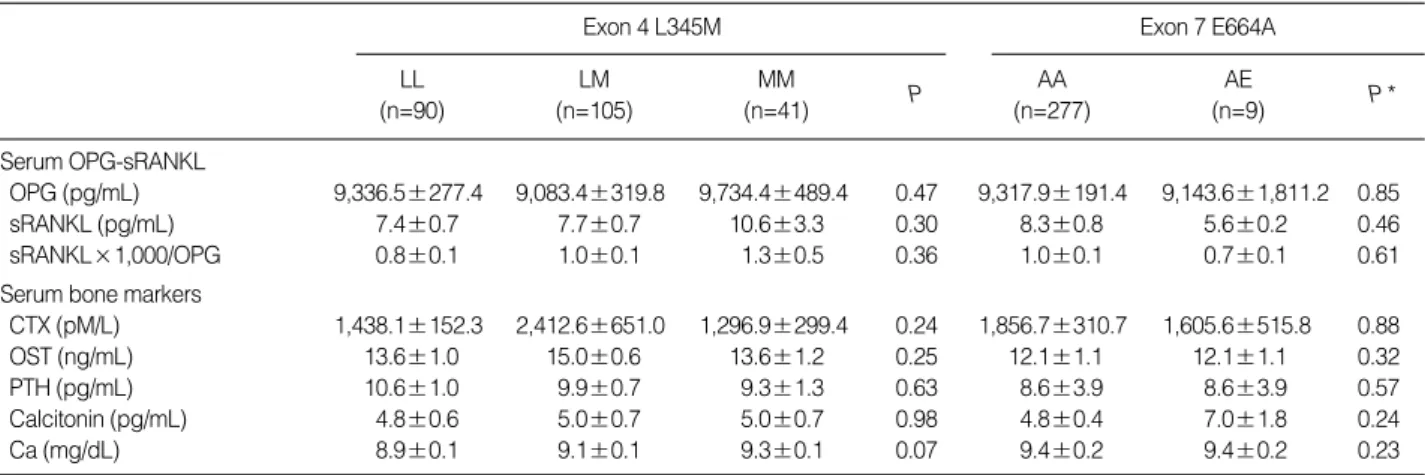
No statistically significant differences in the adjusted serum levels of OPG, or sRANKL, or sRANKL×1,000/OPG ratios were found for these genotypes of the FZD6 gene polymor- phisms (Table 4). Similar findings were obtained for the ad- justed serum levels of bone turnover markers, such as, CTX, OST, PTH, calcitonin, and Ca.
P, ANCOVA; P *, Student’s t-test; �values, adjusted for age, years since menopause, and BMI. Values are mean±SE.
FZD, frizzled; SNPs, single nucleotide polymorphisms; BMI, body mass index.
Exon 4 L345M Exon 7 E664A
LL LM MM
P AA AE
(n=135) (n=162) (n=74) (n=355) (n=16) P *
Age (yr) 58.0±0.6 57.7±0.5 57.2±0.7 0.72 57.8±0.3 57.6±1.5 0.90
Years since menopause 9.4±0.6 9.1±0.6 9.1±0.7 0.94 9.2±0.4 9.0±1.3 0.90
Weight (kg) 58.7±0.7 57.9±0.5 58.1±0.7 0.66 58.3±0.4 57.0±1.3 0.44
Height (cm) 155.2±0.4 155.3±0.4 155.8±0.6 0.63 155.4±0.2 153.9±1.0 0.22
BMI (kg/m2) 24.4±0.3 24.0±0.2 24.0±0.3 0.49 24.1±0.2 24.1±0.6 0.92
Bone mineral density (g/cm2)�
Lumbar spine 1.002±0.015 1.009±0.015 0.999±0.020 0.92 1.005±0.009 0.998±0.046 0.89 Femoral neck 0.813±0.013 0.817±0.010 0.830±0.017 0.69 0.818±0.007 0.819±0.033 0.97 Ward’s triangle 0.711±0.010 0.732±0.014 0.741±0.019 0.87 0.725±0.008 0.757±0.037 0.42 Trochanter 0.631±0.013 0.660±0.011 0.649±0.020 0.26 0.647±0.008 0.674±0.046 0.47 Table 2.Clinical characteristics and bone mineral density in postmenopausal women in relation to the FZD6 SNPs
Combined polymorphisms
Strong linkage disequilibrium was found between the L345M and E664A polymorphisms ( 2=9.032, P<0.05).
Three different haplotype alleles (ME, MA, and LA) were identified by haplotype analysis for these two polymorphisms of the FZD 6 gene in combination, and these haplotypes combined to give five different genotypes: LAMA (42.0%), LALA (35.8%), MAMA (18.1%), MELA (2.2%), and MAME (1.9%). However, these haplotype alleles or genotypes were found to have no significant association with the adjusted BMDs of all skeletal sites measured, or with the serum lev- els of OPG, RANKL, CTX, OST, PTH, calcitonin, and Ca.
DISCUSSION
It has been demonstrated that the canonical Wnt/β-catenin pathway modulates most aspects of osteoblast physiology, including proliferation, differentiation, bone matrix forma- tion and mineralization, and apoptosis. This signaling is ini-
tiated following binding of Wnt proteins to the FZD and LRP5/6 receptors (9-12). To the best of our knowledge, this is the first study conducted to establish an association between bone mass and the SNPs in the FZD genes.
We investigated non-synonymous SNPs in the FZD1, FZD5, FZD6, FZD7, and FZD9 genes, which have been reg- istered in the SNP database by the National Center For Bio- technology Information (dbSNP). The SNPs in the FZD1, FZD5, FZD7, and FZD9 genes, and in exon 2 of the FZD6 gene were not polymorphic in our study subjects. The fre- quencies of the L allele of the L345 SNP and the E allele of the E664A SNP in the FZD6 gene were comparable to that reported in Asian dbSNP.
FZD6 is located on chromosome 8q22.3 (19). It has been reported that the FZD6 transcript is detected in calvaria and primary osteoblast (20), and decreased in osteoblasts after 10 days of culture in conditions favoring mineralization (9).
Human FZD6 acts as a negative regulator of the canonical Wnt/β‚-catenin signaling cascade (21), which is believed to play a substantial role in the control of bone formation. In the present study, no significant association between C345A
P, ANCOVA; P *, Student’s t-test.
Values are mean±SE.
OPG, osteoprotegerin; RANKL, receptor activator of the NF-κB (RANK) ligand; FZD, frizzled; SNPs, single nucleotide polymorphisms; CTX, CrossLaps;
OST, osteocalcin; PTH, parathyroid hormone; Ca, calcium.
FZD, frizzled; SNPs, single nucleotide polymorphisms.
Exon 4 L345M Exon 7 E664A
LL LM MM
P AA AE
(n=90) (n=105) (n=41) (n=277) (n=9) P *
Serum OPG-sRANKL
OPG (pg/mL) 9,336.5±277.4 9,083.4±319.8 9,734.4±489.4 0.47 9,317.9±191.4 9,143.6±1,811.2 0.85
sRANKL (pg/mL) 7.4±0.7 7.7±0.7 10.6±3.3 0.30 8.3±0.8 5.6±0.2 0.46
sRANKL×1,000/OPG 0.8±0.1 1.0±0.1 1.3±0.5 0.36 1.0±0.1 0.7±0.1 0.61
Serum bone markers
CTX (pM/L) 1,438.1±152.3 2,412.6±651.0 1,296.9±299.4 0.24 1,856.7±310.7 1,605.6±515.8 0.88
OST (ng/mL) 13.6±1.0 15.0±0.6 13.6±1.2 0.25 12.1±1.1 12.1±1.1 0.32
PTH (pg/mL) 10.6±1.0 9.9±0.7 9.3±1.3 0.63 8.6±3.9 8.6±3.9 0.57
Calcitonin (pg/mL) 4.8±0.6 5.0±0.7 5.0±0.7 0.98 4.8±0.4 7.0±1.8 0.24
Ca (mg/dL) 8.9±0.1 9.1±0.1 9.3±0.1 0.07 9.4±0.2 9.4±0.2 0.23
Table 4.Serum levels of OPG, RANKL and bone turnover markers in postmenopausal women in relation to FZD6 SNPs
Polymorphic sites Genotypes Normal Osteopenia Osteoporosis
Cross-tabulation test
(n=93) (n=175) (n=103)
Exon 4 L345M LL 30 (32.3%) 68 (38.9%) 36 (35.0%) P=0.54
LM 46 (49.5%) 71 (40.6%) 46 (44.7%) P=0.37
MM 17 (18.3%) 36 (20.6%) 21 (20.4%) P=0.90
2=2.07, P=0.72
Exon 7 E664A AA 90 (96.8%) 167 (95.4%) 98 (95.1%)
AE 31 (3.2%) 8 (4.6%) 5 (4.9%)
2=0.37, P=0.82
Table 3.Distribution of single genotype of the FZD6 SNPs according to the bone mass status
or A664C SNPs in the FZD6 gene and BMD at skeletal sites measured or circulating levels of bone turnover markers were noted. Haplotype analysis on the L345M and E664A SNPs in combination showed similar findings. Our results may in- dicate that SNPs in FZD6 gene may not be involved in the regulation of bone mass or bone remodeling.
It has been demonstrated that the secreted antagonist of the Wnt/β‚-catenin signaling pathway regulates the expres- sion of OPG- RANKL of bone tissue (16). Secreted FZD relat- ed protein, which is highly homologous to the Wnt binding protein of FZD and is capable of binding Wnt, has been sho- wn to bind RANKL, resulting in inhibition of osteoclasto- genesis (16). In this study, SNPs in FZD6 gene did not affect circulating OPG-sRANKL levels.
The present study had several limitations. First, this study group was composed of ethnically homogenous Korean women and undertaken in relatively small number of women who attended a menopause clinic. Second, limited numbers of SNP in the FZD genes were analyzed. Therefore, further studies including other SNPs in the FZD genes are necessary in a larger general population and in other ethnic groups.
REFERENCES
1. Osteoporosis prevention, diagnosis, and therapy. NIH Consensus State- ment 2007; 17: 1-45.
2. Jouanny P, Guillemin F, Kuntz C, Jeandel C, Pourel J. Environmental and genetic factors affecting bone mass. Similarity of bone density among members of healthy families. Arthritis Rheum 1995; 38: 61-7.
3. Liu YZ, Liu YJ, Recker RR, Deng HW. Molecular studies of identi- fication of genes for osteoporosis: the 2002 update. J Endocrinnol 2003; 177: 147-96.
4. Gong G, Haynatzki G. Association between bone mineral density and candidate genes in different ethnic populations and its implications.
Calcif Tissue Int 2003; 72: 113-23.
5. Kim JG, Lim KS, Kim EK, Choi YM, Lee JY. Association of vitamin D receptor and estrogen receptor gene polymorphisms with bone mass in postmenopausal Korean women. Menopause 2001; 8: 222-8.
6. Kim JG, Roh KR, Lee JY. The relationship among serum insulin-like growth factor-I, insulin-like growth factor-I gene polymorphism and bone mineral density in postmenopausal women in Korea. Am J Obstet Gynecol 2002; 186: 345-50.
7. Kim JG, Kwon JH, Kim SH, Choi YM, Moon SY, Lee JY. Associ- ation between vitamin D receptor gene haplotypes and bone mass in postmenopausal Korean women. Am J Obstet Gynecol 2003; 189:
1234-40.
8. Kim JG, Kim JH, Kim JY, Ku SY, Jee BC, Suh CS, Kim SH, Choi YM. Association between the osteoprotegrin (OPG), receptor acti- vator of NF-kB (RANK), and RANK ligand (RANKL) gene polymor- phisms, and circulating OPG, soluble RANKL levels, and bone mineral density in Korean postmenopausal women. Menopause 2007;
14: 913-8.
9. Westendorf JJ, Kahler RA, Schroeder TM. Wnt signaling in osteoblasts and bone diseases. Gene 2004; 341: 19-39.
10. Baron R, Rawadi G. Targeting the Wnt/β-catenin pathway to regu- late bone formation in the adult skeleton. Endocrinology 2007; 148:
2635-43.
11. Johnson ML, Kamel MA. The Wnt signaling pathway and bone meta- bolism. Curr Opin Rheumatol 2007; 19: 376-82.
12. Bodine PV, Komm BS. Wnt signaling and osteoblasotogenesis. Rev Endocr Metab Disord 2006; 7: 33-9.
13. Ferrari SL, Deutsch S, Antonarakis SE. Pathogenic mutations and polymorphisms in the lipoprotein receptor-related protein 5 reveal a new biological pathway for the control of bone mass. Curr Opin Lipi- dol 2005; 16: 207-14.
14. Balemans W, Van Hul W. The genetics of low-density lipoprotein receptor-related protein 5 in bone: a story of extremes. Endocrinology 2007; 148: 2622-9.
15. Kim JY, Jee BC, Suh CS, Kim SH, Choi YM, Moon SY, Kim JG.
Relationship between low density lipoprotein related receptor protein 5 gene polymorphism, and bone mineral density in postmenopausal Korean women. J Korean Soc Menopause 2007; 13: 21-32.
16. Hausler KD, Horwood NJ, Chuman Y, Fisher JL, Ellis J, Martin TJ, Rubin JS, Gillespie MT. Secreted frizzled-related protein-1 inhibits RANKL-dependent osteoclast formation. J Bone Miner Res 2004; 19:
1873-81.
17. Wang FS, Ko JY, Lin CL, Wu HL, Ke HJ, Tai PJ. Knocking down dickkopf-1 alleviates estrogen deficiency induction of bone loss. A his- tomorphological study in ovariectomized rats. Bone 2007; 40: 485-92.
18. Kanis JA, Melton LJ 3rd, Christiansen C, Johnston CC, Khaltaev N.
The diagnosis of osteoporosis. J Bone Miner Res 1994; 9: 1137-41.
19. Tokuhara M, Hirai M, Atomi Y, Terada M, Katoh M. Molecular clon- ing of human frizzled-6. Biochem Biophys Res Comm 1998; 243: 622-7.
20. Kato M, Patel MS, Levasseur R, Lobov I, Chang BH, Glass DA 2nd, Hartmann C, Li L, Hwang TH, Brayton CF, Lang RA, Karsenty G, Chan L. Cbfa1-independent decrease in osteoblast proliferation, osteo- penia, and persistent embryonic eye vascularization in mice deficient in Lrp5, a Wnt coreceptor. J Cell Biol 2002; 157: 303-14.
21. Golan T, Yaniv A, Bafico A, Liu G, Gazit A. The human frizzled 6 (HFZ6) acts as a negative regulator of the canonical Wnt-b-catenin signaling cascade. J Biol Chem 2004; 279: 14879-88.