How to prevent the postoperative pancreatic fistula with an ethylene vinyl alcohol copolymer (Onyx
Ⓡ):
A proposal of a new technique
Francesco Crafa1, Francesco Esposito1, Adele Noviello1, Nicola Moles1, Enrico Coppola Bottazzi1, Carmelo Lombardi2, Antonio Miro1, and Giulio Lombardi2
1Oncological and General Surgery Unit and 2Department of Radiology,
“St. Giuseppe Moscati” Hospital of National Relevance and High Specialty, Avellino, Italy
Backgrounds/Aims: Despite the advances in identifying risk factors, improving operative technique, and postoperative patient care, pancreatic leakage after pancreatic resection remains a highly debated topic. The aim of this study is to describe our technique and our initial experience with the intraoperative embolization of the main pancreatic duct with an Ethylene Vinyl Alcohol Copolymer (OnyxⓇ). Methods: Two patients of 63 and 64 years underwent pan- creaticoduodenectomy for a cholangiocarcinoma of the extrahepatic bile duct and a pancreatic adenocarcinoma, respectively. At the time of pancreatic parenchyma resection, a Wirsung duct was identified and catheterized. A wirsun- gography was done and then, embolization with OnyxⓇ was carried out under fluoroscopic control. Results: Neither of the patients developed a postoperative pancreatic fistula. They were discharged to home on the 17th and 18th post- operative day, respectively. At the last follow-up, no recurrence was found. The two patients became diabetics; both needed the support of supplementary pancreatic enzymes. Conclusions: To our knowledge, we are the first to describe this technique, which seems safe and reliable. Studies on this subject with more patients are needed to confirm the validity of this procedure. (Ann Hepatobiliary Pancreat Surg 2018;22:248-252)
Key Words: Postoperative pancreatic fistula; Pancreaticoduodenectomy; OnyxⓇ
Received: December 10, 2017; Revised: June 10, 2018; Accepted: June 14, 2018 Corresponding author: Francesco Crafa
Oncological and General Surgery Unit, “St. Giuseppe Moscati” Hospital of National Relevance and High Specialty, Plesso Città Ospedaliera – Contrada Amoretta, 83100 Avellino, Italy
Tel: +390825203371, Fax: +390825203371, E-mail: [email protected]
Copyright Ⓒ 2018 by The Korean Association of Hepato-Biliary-Pancreatic Surgery
This is an Open Access article distributed under the terms of the Creative Commons Attribution Non-Commercial License (http://creativecommons.org/
licenses/by-nc/4.0) which permits unrestricted non-commercial use, distribution, and reproduction in any medium, provided the original work is properly cited.
Annals of Hepato-Biliary-Pancreatic Surgery ∙ pISSN: 2508-5778ㆍeISSN: 2508-5859
INTRODUCTION
Post-operative pancreatic fistula (POPF) is the most common and troublesome complication after pancreatic resection, with reported rates ranging from 3% to 45%.1-3 It represents the factor most often linked with post- operative complications, longer hospital stays, readmissions, increased costs, and, above all, more postoperative deaths.4,5 Despite advances in operative techniques and improve- ments in postoperative patient care, this subject remains highly debated in the literature.6 A very controversial is- sue is the obliteration of the main pancreatic duct with chemicals substances.7-9 Numerous substances and techni- ques have been described with very controversial results.10-12 OnyxⓇ (Medtronic, Heerlen, the Netherlands) is an liquid agent used for embolization of vascular structures; it con-
sists of an ethylene vinyl alcohol copolymer (EVOH), made opaque with micronized tantalum powder. OnyxⓇ provides a good contrast for visualization under fluoro- scopy, and so is used especially in the field of vascular interventional radiology13,14 but also for bile duct leakage.15,16 To the best of our knowledge, the obliteration of the main pancreatic duct with OnyxⓇ has not yet been described.
We present our initial technical and clinical experience with two patients who were successfully treated by intra- operative OnyxⓇ application.
MATERIALS AND METHODS
Two patients of 63 and 64 years came to our attention for a cholangiocarcinoma of the extrahepatic bile duct and pancreatic adenocarcinoma, respectively. After an accu-
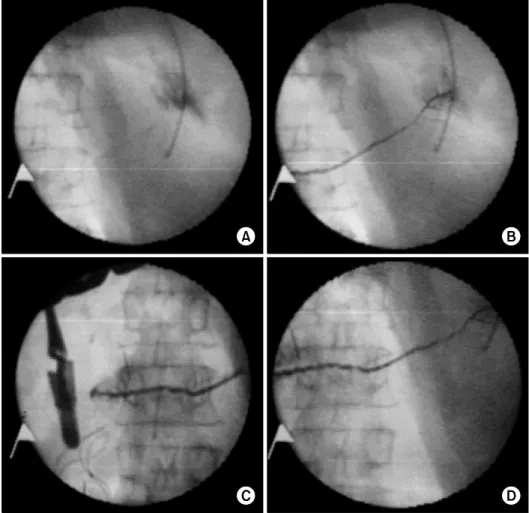
Fig. 1. Intraoperative fluoro- scopy: the procedure begins with the embolization of the distal part of the duct (A), continues to the body (B) and up to the stump (C). The final angiographic control shows the Wirsung mold, with evidence of all secondary pancreatic branches (D).
rate preoperative evaluation, the patients underwent pan- creaticoduodenectomy (PD). In both cases, a Whipple re- section was performed, and an extended lymphadenec- tomy with a third-level mesopancreas resection was car- ried out.
At the time of pancreatic parenchyma resection, the main pancreatic duct was identified and catheterized. An 18 G needle was placed into the Wirsung stump and, us- ing fluoroscopic guidance, a hydrophilic microcatheter (Maestro, Merit) was introduced into the duct to reach the end of the pancreatic stump. After wirsungography, OnyxⓇ, always under angiographic control, was slowly injected to embolize the main pancreatic duct and all secondary pan- creatic branches. Immediate angiographic control after the embolization procedure demonstrated complete closure of the Wirsung (Fig. 1). After the embolization, the pancre- atic extremity was further sectioned using an ECHELON FLEXTM (Ethicon, Cincinnati, OH, USA) stapling device, with a 45-mm white or blue cartridge depending on the thickness of the parenchyma. A hepaticojejunostomy was
fashioned using a running 5/0 polydioxanone, and a gas- troenterostomy was constructed using an ECHELON FLEXTM stapling device. Drainage was always placed in contact with the sectional pancreatic parenchyma, and two additional drains were placed in the perianastomotic sites.
Postoperative assessment included measurement of drainage and serum amylase on the first, third, and fifth postoperative day. An abdominal computed tomography (CT) scan was performed on the seventh postoperative day, and if no peripancreatic collection was detected, the drainages were removed gradually.
An enteral nutrition tube was placed beyond the gastro- enterostomy during surgery, and enteral nutrition was started on the first postoperative day. Subcutaneous oc- treotide was not administered systematically.
RESULTS
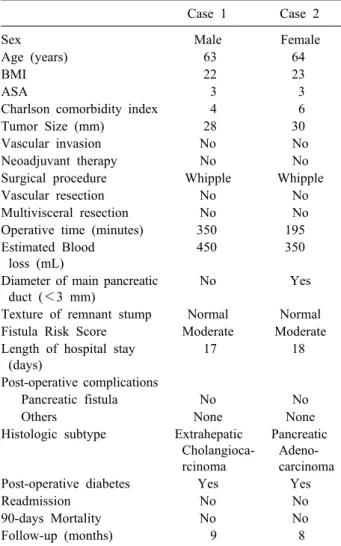
The details of the patients are summarized in Table 1.
No perioperative complications related to the OnyxⓇ
Table 1. Baselines characteristics of patients treated with OnyxⓇ embolization
Case 1 Case 2
Sex Male Female
Age (years) 63 64
BMI 22 23
ASA 3 3
Charlson comorbidity index 4 6
Tumor Size (mm) 28 30
Vascular invasion No No
Neoadjuvant therapy No No
Surgical procedure Whipple Whipple
Vascular resection No No
Multivisceral resection No No
Operative time (minutes) 350 195
Estimated Blood loss (mL)
450 350
Diameter of main pancreatic duct (<3 mm)
No Yes
Texture of remnant stump Normal Normal Fistula Risk Score Moderate Moderate Length of hospital stay
(days)
17 18
Post-operative complications
Pancreatic fistula No No
Others None None
Histologic subtype Extrahepatic Cholangioca- rcinoma
Pancreatic Adeno- carcinoma
Post-operative diabetes Yes Yes
Readmission No No
90-days Mortality No No
Follow-up (months) 9 8
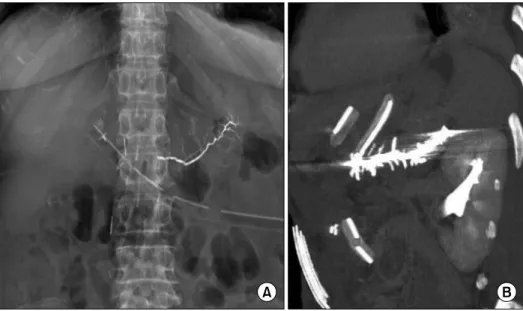
application were observed. In the postoperative course, no biochemical leaks (grade A), grade B, or grade C POPF was identified. Dosages of the amylase level were always three times lower than the serum amylase activity. X-ray and thoracic-abdominal computed tomography performed on the 7th postoperative day (Fig. 2) confirmed the Wirsung mold, correlatable to total occlusion of the ducts, and no peripancreatic collection was identified. Patients were discharged to home on the 17th and 18th post- operative day, respectively. At the last follow-up, no re- currence was found. Both patients later developed dia- betes mellitus and needed the support of supplementary pancreatic enzymes until the last follow-up.
DISCUSSION
We present our technique and our initial experience
with the intraoperative embolization of Wirsung’s duct with OnyxⓇ in order to prevent pancreatic leakage.
Nowadays, a solution for POPF is the most important challenge for pancreatic surgeons. New classification,3 better understanding of risk factors (e.g. age, obesity, car- diovascular diseases, diabetes mellitus, pancreatic texture, and pancreatic duct size)17-19 and technical advance2,20 are reported in the literature. Despite this, the risk of develop- ing POPF remains high and is linked to lethal complications.4,5 Some authors have reported lower mor- bidity and death rates in a non-randomized trial using duct occlusion with synthetic glues after PD.7,10 However, as shown by Cheng et al.12 in a recent meta-analysis, which included nine trials involving 1095 participants who were randomized to the fibrin sealant group (N=550) and the control group (N=545) after pancreatic surgery, there was no evidence of differences in overall postoperative pancre- atic fistula (fibrin sealant 29.6%, control 31.0%, p=0.58), postoperative deaths (3.1% versus 2.1%, p=0.53;), overall postoperative morbidity (29.6% versus 28.9%, p=0.77), reoperation rate (8.7% versus 10.7%, p=0.29), or length of hospital stay (12.9 days versus 13.1 days, p=0.331) be- tween the groups. Therefore, based on the currently avail- able evidence, fibrin sealants do not seem to prevent post- operative pancreatic fistula in people undergoing pancre- atic surgery.9,12 We have tried to overcome these issues by using a new substance already widely used in other fields and a new technique that has never before used in this way.
The glues most frequently described in the literature and used for occlusion of the main pancreatic duct are Neoprene, Ethibloc, and Tissucol. Neoprene latex 671 (Dupont de Nemours) is a liquid synthetic rubber com- posed of polychloroprene homopolymer. When in contact with the pancreatic juice (pH 8 to 9), Neoprene polymer- izes and hardens permanently. Ethibloc (Johnson &
Johnson) is an alcoholic prolamine solution that hardens in 15 to 20 minutes in a moist environment; it dis- integrates within 11 days. Tissucol (Immuno GmbH) is a modified fibrin glue solution, and in combination with thrombin (Trasylol) it will harden; it dissolves in about 7 days.8
OnyxⓇ consists of an EVOH dissolved in various con- centrations of dimethyl sulfoxide (DMSO). The viscosity of the mixture depends on the concentration of EVOH.
Fig. 2. (A) X-ray and (B) ab- dominal computed tomography scan at the 7th postoperative day shows the pancreatic mold, cor- relatable to successful emboli- zation of the main pancreatic duct and its secondary branches.
Solutions with a higher concentration of EVOH are more viscous. When the mixture comes in contact with aqueous solutions, the DMSO diffuses away and EVOH precipitates.
This precipitation starts at the interface while the core is still liquid. As pancreatic flow is substantially slower than that of blood and biliary flow, DMSO diffusion may be slower and EVOH remain liquid for a longer time. Two versions of OnyxⓇ (18 and 34) are available with different concentrations of EVOH. We prefer to use the less-vis- cous version (18), with a lower concentration of EVOH (6%) in order to allow adequate progression of the embol- izing material within the secondary pancreatic ducts. In fact, the OnyxⓇ 34, with a high concentration of EVOH (8%,) is more viscous and would not ensure an adequate progression in the ducts. The physicochemical character- istics of OnyxⓇ allow controlled application, forming a defined cast and permanent occlusion.
In addition to chemical differences from other sub- stances, OnyxⓇ has a substantial innovation in the appli- cation technique. All glues used until now were placed without a real objective feedback. In our technique, a wir- sungography was performed prior to the OnyxⓇ’s applica- tion, and the procedure was performed under direct fluo- roscopic control.
The major limitations of a permanent occlusion of the main pancreatic duct are the consequent pancreatic atro- phy and a complete loss of exocrine function.7
According to Tran et al.,8 no difference has been de- tected in terms of exocrine insufficiency between pan-
creatojejunostomy and pancreatic duct occlusion. Indeed, in their study, pancreatic enzyme substitution was, on dis- charge and at 3 months, significantly higher in patients with occlusion of the pancreatic duct (p=0.001 and p=0.003), but no difference was found at 12 months com- pared to patients with pancreatojejunostomy. In our expe- rience, the two patients required enzyme supplementation support at the time of discharge to home and at the last follow-up.
About endocrine function, some authors suggest that occlusion of the main pancreatic duct would cause a pa- renchymal atrophy with a high risk of developing endo- crine failure.21 Tran et al.8 reported a significantly higher incidence of endocrine insufficiency in the pancreatic duct occlusion group, with a diabetes rate of 34%. In our ser- ies, both patients had become diabetic at last examination.
In conclusion, we demonstrate that this approach is fea- sible and safe; studies with more patients are needed to verify the validity of this technique.
REFERENCES
1. Zhang H, Zhu F, Shen M, Tian R, Shi CJ, Wang X, et al.
Systematic review and meta-analysis comparing three techniques for pancreatic remnant closure following distal pancreatectomy.
Br J Surg 2015;102:4-15.
2. Xiong JJ, Tan CL, Szatmary P, Huang W, Ke NW, Hu WM, et al. Meta-analysis of pancreaticogastrostomy versus pan- creaticojejunostomy after pancreaticoduodenectomy. Br J Surg 2014;101:1196-1208.
3. Bassi C, Marchegiani G, Dervenis C, Sarr M, Abu Hilal M, Adham M, et al. The 2016 update of the International Study Group (ISGPS) definition and grading of postoperative pancre-
atic fistula: 11 years after. Surgery 2017;161:584-591.
4. Gouma DJ, van Geenen RC, van Gulik TM, de Haan RJ, de Wit LT, Busch OR, et al. Rates of complications and death after pan- creaticoduodenectomy: risk factors and the impact of hospital volume. Ann Surg 2000;232:786-795.
5. Vollmer CM Jr, Sanchez N, Gondek S, McAuliffe J, Kent TS, Christein JD, et al. A root-cause analysis of mortality following major pancreatectomy. J Gastrointest Surg 2012;16:89-102; dis- cussion 102-103.
6. Schulick RD, Yoshimura K. Stents, glue, etc.: is anything proven to help prevent pancreatic leaks/fistulae? J Gastrointest Surg 2009;13:1184-1186.
7. Di Carlo V, Chiesa R, Pontiroli AE, Carlucci M, Staudacher C, Zerbi A, et al. Pancreatoduodenectomy with occlusion of the re- sidual stump by Neoprene injection. World J Surg 1989;13:
105-110; discussion 110-101.
8. Tran K, Van Eijck C, Di Carlo V, Hop WC, Zerbi A, Balzano G, et al. Occlusion of the pancreatic duct versus pancreatico- jejunostomy: a prospective randomized trial. Ann Surg 2002;236:
422-428; discussion 428.
9. Suc B, Msika S, Fingerhut A, Fourtanier G, Hay JM, Holmières F, et al. Temporary fibrin glue occlusion of the main pancreatic duct in the prevention of intra-abdominal complications after pancreatic resection: prospective randomized trial. Ann Surg 2003;237:57-65.
10. Alfieri S, Quero G, Rosa F, Di Miceli D, Tortorelli AP, Doglietto GB. Indications and results of pancreatic stump duct occlusion after duodenopancreatectomy. Updates Surg 2016;68:
287-293.
11. Martin I, Au K. Does fibrin glue sealant decrease the rate of anastomotic leak after a pancreaticoduodenectomy? Results of a prospective randomized trial. HPB (Oxford) 2013;15:561-566.
12. Cheng Y, Ye M, Xiong X, Peng S, Wu HM, Cheng N, et al.
Fibrin sealants for the prevention of postoperative pancreatic fis- tula following pancreatic surgery. Cochrane Database Syst Rev 2016;2:CD009621.
13. Adamus Nürnberg R, Uder Erlangen M, Kleinschmidt T, Detmar K, Bolte R, Stein H, et al. Embolization of acute abdominal and thoracic hemorrhages with ethylene vinyl alcohol copolymer (onyx): initial experiences with arteries of the body trunk. Rofo 2010;182:900-904.
14. Eberhardt KM, Treitl M, Sadeghi-Azandaryani M. An endovas- cular technique for treatment of high-risk iatrogenic aortic pseu- doaneurysms with the ethylene vinyl alcohol copolymer onyx and aortic stent grafting. Rofo 2012;184:1163-1165.
15. Kyokane T, Nagino M, Oda K, Nimura Y. An experimental study of selective intrahepatic biliary ablation with ethanol. J Surg Res 2001;96:188-196.
16. Uller W, Müller-Wille R, Loss M, Hammer S, Schleder S, Goessmann H, et al. Percutaneous management of postoperative bile leaks with an ethylene vinyl alcohol copolymer (onyx). Rofo 2013;185:1182-1187.
17. Gaujoux S, Cortes A, Couvelard A, Noullet S, Clavel L, Rebours V, et al. Fatty pancreas and increased body mass index are risk factors of pancreatic fistula after pancreaticoduodenectomy. Surgery 2010;148:15-23.
18. Callery MP, Pratt WB, Kent TS, Chaikof EL, Vollmer CM Jr.
A prospectively validated clinical risk score accurately predicts pancreatic fistula after pancreatoduodenectomy. J Am Coll Surg 2013;216:1-14.
19. Ramacciato G, Mercantini P, Petrucciani N, Nigri GR, Kazemi A, Muroni M, et al. Risk factors of pancreatic fistula after pan- creaticoduodenectomy: a collective review. Am Surg 2011;77:
257-269.
20. Figueras J, Sabater L, Planellas P, Muñoz-Forner E, Lopez-Ben S, Falgueras L, et al. Randomized clinical trial of pancreatico- gastrostomy versus pancreaticojejunostomy on the rate and se- verity of pancreatic fistula after pancreaticoduodenectomy. Br J Surg 2013;100:1597-1605.
21. Okamoto A, Tsuruta K. Fistulation method: simple and safe pan- creaticojejunostomy after pancreatoduodenectomy. Surgery 2000;
127:433-438.