Copyright © 2020 Korean Society for the Study of Obesity
This is an Open Access article distributed under the terms of the Creative Commons Attribution Non-Commercial License (https://creativecommons.org/licenses/by-nc/4.0/) which permits unrestricted non-commercial use, distribution, and reproduction in any medium, provided the original work is properly cited.
2017-03-16 https://crossmark-cdn.crossref.org/widget/v2.0/logos/CROSSMARK_Color_square.svg
Psycho-Physiological Responses to a 4-Month High-Intensity Interval Training-Centered
Multidisciplinary Weight-Loss Intervention in Adolescents with Obesity
Marwa Khammassi1,2,3,*, Maud Miguet1, Valérie julian4, Charlotte Cardenoux5, Yves Boirie6,7,8,9, Martine Duclos6,7,8,9, Bruno Pereira10, David Thivel1,7
1Clermont Auvergne University, EA 3533, Laboratory of the Metabolic Adaptations to Exercise under Physiological and Pathological Conditions (AME2P), Clermont-Ferrand, France; 2Research Unit, Sportive Performance and Physical Rehabilitation, High Institute of Sports and Physical Education of Kef, University of Jendouba, Kef; 3Faculty of Science of Bizerte, University of Carthage, Zarzouna, Tunisia; 4CHU med du sport CHU Clermont-Ferrand, Clermont-Ferrand; 5CMI Romagnat, Clermont-Ferrand; 6INRA/UMR 1019, Clermont-Ferrand; 7CRNH-Auvergne, Clermont-Ferrand; 8University Clermont 1, UFR Medicine, Clermont-Ferrand;
9Departments of Human Nutrition and Sport Medicine and Functional Explorations, Clermont-Ferrand University Hospital, G. Montpied Hospital, Clermont-Ferrand;
10Clermont-Ferrand University Hospital, Biostatistics Unit (DRCI), Clermont-Ferrand, France
Background: To evaluate the impact of 4 months of a high-intensity interval training (HIIT)-centered weight- management intervention on health-related quality of life (HR-QOL), health perception (HP) and physical self- perception (PSP) in adolescents with obesity.
Methods: Fifty-six adolescents with obesity (28 girls; mean body mass index [BMI], 35±4.89 kg/m2; z-BMI, 2.3±0.3; 11–17 years) followed a multidisciplinary weight-management intervention composed of nutritional counseling, HIIT program, and health-related therapeutic education. Anthropometric parameters, body compo- sition (dual X-ray absorptiometry), and maximal aerobic capacities (maximal oxygen consumption [VO2peak]) were assessed, and self-reported questionnaires were used to assess HR-QOL (36-item short form survey), HP and PSP at baseline (T0) and post-intervention (T1).
Results: Body weight (92.6±18.9 to 85.9±16.2 kg), BMI (35.0±4.8 to 32.1±4.5 kg/m²), z-BMI (2.3±0.3 to 2.1±0.3) and fat mass percentage (36.0%±9.1% to 30.4%±7.8%) were significantly decreased (P<0.001) be- tween T0 and T1. There was a tendency for VO2peak to increase from 26.35±5.81 mL/kg/min at T0 to 28.79±6.59 mL/kg/min at T1 (P=0.06). Physical functioning (P=0.002), physical limitation (P=0.048), general health (P<0.001) and bodily pain (P=0.030) were improved at T1. A significant improvement occurred in dimensions of HP such as physical condition (P=0.001), adiposity (P<0.001), alimentation (P<0.001), general health (P=0.038), and perceived general health (P=0.001). In addition, there was an improvement in items of PSP such as self-perceived coordination (P=0.022), endurance (P=0.001) and activity (P=0.001), global self-concept (P=0.015), and appearance (P=0.016). Physical but not mental HR-QOL domains, HP and PSP were associated with weight reduction.
Conclusion: While HIIT favors improved HR-QOL, HP status and PSP in adolescents with obesity, physical but not mental HR-QOL, HP and PSP were associated with weight reduction.
Key words: High-intensity interval training, Quality of life, Health perception, Adolescents, Obesity
Received July 7, 2020 Reviewed July 31, 2020 Accepted September 10, 2020
* Corresponding author Marwa Khammassi
https://orcid.org/0000-0002-5509-5997 Clermont Auvergne University, EA 3533, Laboratory of the Metabolic Adaptations to Exercise under Physiological and Pathological Conditions (AME2P), BP 80026, F-63171 Aubière Cedex, France Tel: +33-4-73-40-76-79
Fax: +33-4-73-40-76-79 E-mail:
Psycho-Physiological Responses to a 4-Month High-Intensity Interval Training-Centered
Multidisciplinary Weight-Loss Intervention in Adolescents with Obesity
Marwa Khammassi1,2,3,*, Maud Miguet1, Valérie julian4, Charlotte Cardenoux5, Yves Boirie6,7,8,9, Martine Duclos6,7,8,9, Bruno Pereira10, David Thivel1,7
1Clermont Auvergne University, EA 3533, Laboratory of the Metabolic Adaptations to Exercise under Physiological and Pathological Conditions (AME2P), Clermont-Ferrand, France; 2Research Unit, Sportive Performance and Physical Rehabilitation, High Institute of Sports and Physical Education of Kef, University of Jendouba, Kef; 3Faculty of Science of Bizerte, University of Carthage, Zarzouna, Tunisia; 4CHU med du sport CHU Clermont-Ferrand, Clermont-Ferrand; 5CMI Romagnat, Clermont-Ferrand; 6INRA/UMR 1019, Clermont-Ferrand; 7CRNH-Auvergne, Clermont-Ferrand; 8University Clermont 1, UFR Medicine, Clermont-Ferrand;
9Departments of Human Nutrition and Sport Medicine and Functional Explorations, Clermont-Ferrand University Hospital, G. Montpied Hospital, Clermont-Ferrand;
10Clermont-Ferrand University Hospital, Biostatistics Unit (DRCI), Clermont-Ferrand, France
Background: To evaluate the impact of 4 months of a high-intensity interval training (HIIT)-centered weight- management intervention on health-related quality of life (HR-QOL), health perception (HP) and physical self- perception (PSP) in adolescents with obesity.
Methods: Fifty-six adolescents with obesity (28 girls; mean body mass index [BMI], 35±4.89 kg/m2; z-BMI, 2.3±0.3; 11–17 years) followed a multidisciplinary weight-management intervention composed of nutritional counseling, HIIT program, and health-related therapeutic education. Anthropometric parameters, body compo- sition (dual X-ray absorptiometry), and maximal aerobic capacities (maximal oxygen consumption [VO2peak]) were assessed, and self-reported questionnaires were used to assess HR-QOL (36-item short form survey), HP and PSP at baseline (T0) and post-intervention (T1).
Results: Body weight (92.6±18.9 to 85.9±16.2 kg), BMI (35.0±4.8 to 32.1±4.5 kg/m²), z-BMI (2.3±0.3 to 2.1±0.3) and fat mass percentage (36.0%±9.1% to 30.4%±7.8%) were significantly decreased (P<0.001) be- tween T0 and T1. There was a tendency for VO2peak to increase from 26.35±5.81 mL/kg/min at T0 to 28.79±6.59 mL/kg/min at T1 (P=0.06). Physical functioning (P=0.002), physical limitation (P=0.048), general health (P<0.001) and bodily pain (P=0.030) were improved at T1. A significant improvement occurred in dimensions of HP such as physical condition (P=0.001), adiposity (P<0.001), alimentation (P<0.001), general health (P=0.038), and perceived general health (P=0.001). In addition, there was an improvement in items of PSP such as self-perceived coordination (P=0.022), endurance (P=0.001) and activity (P=0.001), global self-concept (P=0.015), and appearance (P=0.016). Physical but not mental HR-QOL domains, HP and PSP were associated with weight reduction.
Conclusion: While HIIT favors improved HR-QOL, HP status and PSP in adolescents with obesity, physical but not mental HR-QOL, HP and PSP were associated with weight reduction.
Key words: High-intensity interval training, Quality of life, Health perception, Adolescents, Obesity
Received July 7, 2020 Reviewed July 31, 2020 Accepted September 10, 2020
* Corresponding author Marwa Khammassi
https://orcid.org/0000-0002-5509-5997 Clermont Auvergne University, EA 3533, Laboratory of the Metabolic Adaptations to Exercise under Physiological and Pathological Conditions (AME2P), BP 80026, F-63171 Aubière Cedex, France Tel: +33-4-73-40-76-79
Fax: +33-4-73-40-76-79 E-mail:
INTRODUCTION
Pediatric obesity, resulting mainly from a physically inactive life- style and inappropriate dietary habits, is becoming one of the ma- jor public health problems of the 21th century.
1,2Early prevention strategies remain a high priority given the negative health conse- quences of being overweight/obese during adolescence but also later in life.
3Indeed, pre-pubertal children with obesity have a 20%
to 50% higher risk of remaining obese once adult, which rises to between 50% and 70% in pubertal adolescents with obesity.
4This rising prevalence of obesity is associated with a concomitant in- crease of several medical complications such as functional impair- ments, metabolic disorders and altered psychological health among others, which has been well documented in the literature.
5,6The prevention and the treatment of obesity, which is consid- ered a multifactorial disorder, requires effective multifaceted inter- ventions.
7Multidisciplinary weight-loss interventions combining physical activity, nutritional guidelines and psychological support have been recommended and found effective for the treatment of pediatric obesity and its related complications (physical and psy- chological complications).
8,9However, evidence regarding the ef- fect of such interventions on health-related quality of life (HR- QOL) in children and adolescents remains scarce. Recently, Kham- massi et al.
10found improvements in the main dimensions of HR- QOL, such as physical functioning, general health, physical score and mental score, in adolescents with obesity who underwent a 10-month multidisciplinary weight loss program. In addition to quality of life, which basically refers to wellbeing, the authors also assessed the effects of their intervention on the adolescents’ per- ception of their health, which could be defined as what they self- believe about their own physical fitness, weight, diet, sleep quality or level of stress.
11,12According to their results, the adolescents also improved their overall health perception (HP). Freitas et al.
13also found improved HR-QOL in adolescents with obesity in response to a 12-week multidisciplinary weight management program com- bined with clinical counseling, physical activity (moderate aerobic training), and nutritional education with or without psychological support. Interestingly, these HR-QOL benefits were greater in the group of adolescents who received psychological counseling.
13While most of the available studies used multidisciplinary inter-
ventions that included moderate-intensity aerobics plus resistance exercises, more recent studies compared the effect of different physical activity programs. For instance, Lopera et al.
14compared the effect of 16 weeks of land versus water-based physical interven- tions of similar work volume, in adolescents with obesity. While both interventions improved HR-QOL, the land-based program had particular effects on the social and psychosocial dimensions of HR-QOL as well as on the total HR-QOL score compared with the water-based program. Similarly, Rey et al.
15assessed the effect of 5 weeks vigorous interval training combined with dietary coun- seling on the physical self-perception (PSP) of adolescents with obesity demonstrating improved self-perception of endurance, ac- tivity level, sport competence, global physical self-concept and ap- pearance.
Although a lot of attention has been given to the use of high-in- tensity interval training (HIIT) as an effective strategy among ado- lescents with obesity,
16-18to our knowledge, the psychological re- sponses to this exercise modality in this population remains un- known. In 2017, Svensson et al.
19compared the effects of 16 weeks HIIT or moderate-intensity training on HR-QOL among adults with obesity. While both groups improved overall HR-QOL, great- er effects were observed in the HIIT group, particularly regarding physical functioning, vitality and general health, improvements that were however not associated with changes in body mass of aerobic capacities.
Since the achievement and maintenance of weight loss may rely mainly on the psychological responses to our interventions, it is of high importance to improve the assessment and understanding of the responses to HIIT in adolescents with obesity. Therefore, the first aim of the present study was to examine for the first time the impact of a 16-week HIIT on HR-QOL, HP, and PSP in adoles- cents with obesity. The second aim was to explore whether ob- served changes were associated with changes in body weight, body composition and aerobic capacity.
METHODS Population
Adolescents with obesity were recruited from an inpatient
weight-management intervention (Pediatric Obesity Service Sesa-
me, Centre Médical Infantile de Romagnat, Romagnat, France).
Fifty-six adolescents (28 girls and 28 boys; mean body mass index [BMI], 35± 4.89 kg/m
2; mean BMI z-score, 2.34± 0.31; BMI per- centile, 98.58± 0.95) aged from 11–17 years were screened for the study. The main inclusion criteria were primary obesity (BMI
> 95th percentile of the Centers for Disease Control reference charts; Centers for Disease Control and Prevention 1999–2000);
no pre-existing medical condition that would restrict participants from engaging in regular exercise; and not being engaged in more than 2 hours of structured physical activity per week (International Physical Activity Questionnaire).
All experiments were performed in accordance with the princi- ples of the Declaration of Helsinki and were formally approved by the local Ethical Committee (CPP Sud Est VI: AU1178; Clinical Trial NCT02482220). Adolescents and their legal representatives were given study information sheets and provided dsigned in- formed consent.
Study design
All adolescents were medically screened by a pediatrician to en- sure appropriate recruitment. Subsequently, their baseline anthro- pometric profile, body composition (measured by dual X-ray ab- sorptiometry [DXA]) and individual aerobic capacities (maximal oxygen consumption [VO
2peak]) were assessed. The HR-QOL (36- item short form survey [SF-36]), HP (HP questionnaire) and PSP (PSP questionnaire) self-reported by the adolescents were also evaluated. The adolescents then joined the local Pediatric Obesity Center (Service Sesame, Centre Médical Infantile de Romagnat, Romagnat, France) for a 4-month inpatient multidisciplinary weight-management program combining nutritional counseling, physical training (HIIT exercises+leisure-time activities), and health-related therapeutic education. All measurements were repli- cated by the end of the 16-week intervention.
Anthropometric measurements and body composition
Body weight and height were measured according to the recom- mended procedure in indoor clothing and without shoes, and they were recorded to the nearest 0.1 kg and 0.5 cm, respectively. Sub- jects were weighed on a reliable digital scale (SECA, Les Mureaux, France). Height was measured by a standard wall-mounted stadi-
ometer (SECA). BMI was calculated as body weight (kg) divided by height (m) squared (kg/m
2); and reported on appropriate growth curves. Body composition was obtained using DXA following stan- dardized procedures (QDR4500A scanner; Hologic, Waltham, MA, USA).
Maximal oxygen uptake test (VO2)
Each participant performed an incremental exercise test to exhaus- tion on a traditional concentric ergometer
20to determine VO
2peak. The test consisted of pedaling for 3 minutes with an initial power of 30 W, followed by increments in power of 15 W at 1-minute inter- vals until exhaustion. Participants were requested to wear a polar heart rate monitor (Polar V800) during the test to observe maximal heart rate percentage throughout the test. Cardiac electrical activity (Ultima Series, Saint Paul, MN, USA) was monitored in addition to breath by breath gas exchange (BreezeSuite, Saint Paul, MN, USA) to determine VO
2and carbon dioxide (CO
2) production (VCO
2).
Volumes and gases were calibrated before each test. The validation of VO
2peakattainment was based on these criteria: (1) heart rate
>90% of the theoretical maximum heart rate (210−0.65× age), (2) respiratory exchange ratio (VCO
2/VO
2) > 1.1 and/or VO
2plateau despite increasing exercise intensity. When the subject could no longer maintain the required speed imposed, the test was stopped and the VO
2peak was defined as the average of the last 30 seconds of exercise before exhaustion.
Multidisciplinary weight loss program
The 16-week inpatient multidisciplinary weight-loss intervention combined physical exercise (4/wk), nutritional education (2/mo) and psychological support (1/mo). The adolescents received an isocaloric diet based on recommendations for their age and sex.
21Physical activity included aquatic activities (1/wk), leisure-time ac- tivities (e.g., ball games; 1/wk) and HIIT+strength training (2/wk).
In addition, the adolescents performed 2 hours of physical educa- tion per week at school. The HIIT session started with 15 minutes intermittent exercise on an ergometer bicycle, alternating 30 seconds intense exercise and 30 seconds active recovery (free but compul- sory pedaling), also followed by strength training (2 times/wk).
After a 5-minute warm-up set at 60% of the adolescents VO
2peak,
the intensity of the HIIT exercise followed a progressive increase
from 75% of baseline VO
2peak, ending at 90%. The cycling intensity of HIIT was controlled using mechanical workload settings. Re- garding the strength training, tests were realized for each of the se- lected exercises to determine the participants maximal 10 repeti- tions. The exercises were the bench press, pulley (lat pull-down), leg-press, curl, ankle extension machine (sitting), curl machine for triceps, abdominal machine and trunk extensor machine. The ado- lescents had to perform 10 repetitions of each exercise interspersed by one minute of rest; and to repeat this three times, with a rest pe- riod of 4 minutes between each round. The training intensity was set individually and progressively increased from 65% to 85% of 10 maximal repetitions at the post-intervention. This training pro- gram has already been implemented with success in this popula- tion.
22Health-related quality of life
The SF-36 that was developed by Ware and Sherbourne was used in our study to assess HR-QOL in adolescents. The SF-36 evaluates health based on scores of 0–100 with higher scores indi- cating a good state of QOL. Based on 36 items, this questionnaire measures eight domains: general health, physical functioning, physical role, pain, vitality, social functioning, role emotional, and mental health.
23A physical component scale (PCS) and mental component scale (MCS) can then be calculated.
24The validity of this questionnaire has been previously reported in adolescents with obesity.
10Health perception (health perception scale)
All adolescents were asked to complete a short self-administered questionnaire specifically designed to explore their perception of health (“HP scale”). Six criteria were investigated: perceived (1) physical fitness, (2) ideal weight, (3) healthy balanced diet, (4) sleep quality, (5) stress level, and (6) general health. A 10-point scale from 1 (not at all) to 10 (very much) was used to assess each item.
The six individual scores were computed to obtain a global score for HP. This questionnaire has been shown to provide satisfactory results in both adults
11,21and adolescents with obesity.
10Physical self-perception
PSPs were measured with the French version of the short form
of the physical self-description questionnaire.
25This questionnaire contains 40 items that measure 11 physical self-dimensions: coor- dination, strength, flexibility, endurance, global self-esteem, health, activity, body fat, sport competence, global physical self-concept, and appearance. A 6-point scale from 1 (false) to 6 (true) was used to assess each item. The eleven individual scores were com- puted to obtain a global score for PSP. The validity of this question- naire in children and adolescents with obesity has been reported previously.
15Statistical procedures
The sample size estimation was determined according to (1) the CONSORT 2010 statement and (2) Cohen’s recommendations,
26who has defined effect-size (ES) bounds as small (ES 0.2), medi- um (ES 0.5) and large (ES 0.8, “grossly perceptible and therefore large”). Therefore, with more than 50 participants at each time point evaluation (baseline and at the post-intervention), an ES greater than 0.5 can be hypothesized for a two-tailed type I error at 5%, a statistical power greater than 95% and an intra-individual correla- tion coefficient at 0.5 to take into account between and within par- ticipant variability.
Statistical analyses were performed using Stata version 15 (Stata- Corp., College Station, TX, USA). All tests were two-tailed, with a type I error set at 0.05. Continuous data were expressed as mean±
standard deviation. The assumption of normality was assessed by using the Shapiro-Wilk test. The comparisons between baseline and post-intervention were performed using Student paired t-test or Wilcoxon’s test when the assumptions of the t-test were not met.
As proposed by Feise
27a particular focus has been also given to the
magnitude of differences, in addition to inferential statistical tests
expressed using P-values and Hedges’ ESs with 95% confidence in-
tervals. Typical error and intra-class coefficients (ICCs) for the dif-
ferences between baseline and T1 are also provided. Then, the
changes between baseline and the post-intervention were calculat-
ed. The study of relationships between anthropometric, body com-
position and aerobic capacity variations and HR-QOL, HP, and
PSP changes was conducted using Pearson or Spearman coefficient
correlation, applying a Sidak’s type I error correction to take into
account multiple comparisons.
RESULTS
Anthropometric measurements, body composition, and aerobic capacities
As detailed in Table 1, body weight, BMI and fat mass percent- age were all significantly reduced by the intervention (P<0.001), while fat-free mass (FFM, kg) and VO
2peakremains unchanged (P=0.083 and P=0.062, respectively).
Health perception
Data related to changes in HP during the 16-week intervention are summarized in Table 2. Significant improvements were observed in the dimensions of HP, such as physical condition (P<0.001), adiposity (P<0.001), alimentation (P<0.001), general health (P=
0.038), and general health perceived (P=0.001). Neither sleep nor stress were improved by the intervention.
Health-related quality of life
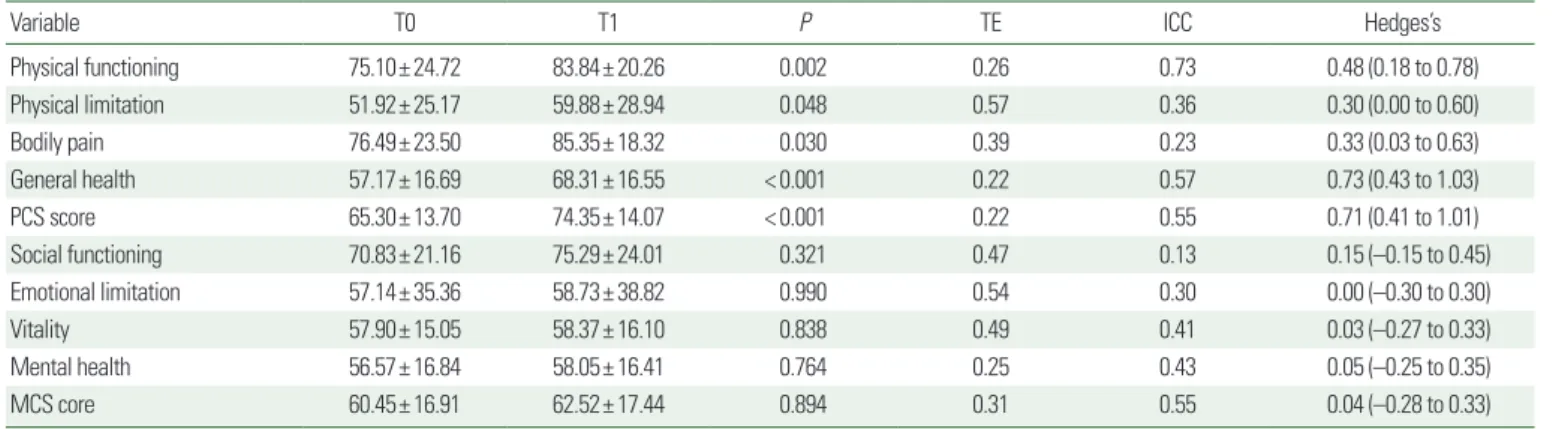
Data related to changes in HR-QOL during the 16-week inter- vention are presented in Table 3. Significant improvements were
observed in the dimensions of HR-QOL after the program, such as physical functioning (P=0.002), physical limitations (P=0.048), bodily pain (P=0.030), general health (P<0.001), and PCS (P<
0.001). None of the other dimensions of the SF-36 questionnaire were significantly modified.
Physical self-perception
Table 4 details the effect of the intervention on the PSP compo- nents. Self-perceived coordination (P=0.022), endurance (P=
0.001), activity (P<0.001), global self-concept (P=0.015), and appearance (P=0.016) were significantly improved while perceived sport competence and perceived body fat almost reached signifi- cance (P=0.054 and P=0.064 respectively). Whereas the other dimensions of the questionnaire did not significantly change, the global computed PSP score was significantly improved (P=0.006).
Correlations between anthropometric, body composition and aerobic capacities variations with HR-QOL, HP, and PSP changes
The heatmap in Fig.1 presents the different correlations obtained
Table 1. Effects of the HIIT program on anthropometric measurements, body composition and aerobic capacity in obese adolescents
Variable T0 T1 P TE ICC Hedges’s
Weight (kg) 92.69± 18.90 85.97± 16.27 < 0.001 0.03 0.97 –1.52 (–1.81 to–1.23)
BMI (kg/m2) 35± 4.89 32.11± 4.50 < 0.001 0.03 0.95 –1.92 (–2.22 to –1.63)
BMI percentile 98.58± 0.95 97.61± 2.39 < 0.001 0.01 0.45 –0.54 (–0.83 to –0.25)
Z score 2.34± 0.31 2.11± 0.36 < 0.001 0.06 0.87 –1.16 (–1.41 to –0.90)
FM (%) 36.05± 9.15 30.40± 7.86 < 0.001 0.05 0.96 –1.35 (–1.64 to –1.06)
FFM (kg) 54.99± 11.47 53.97± 10.43 0.083 0.04 0.96 –0.26 (–0.55 to 0.03)
VO2peak (mL/kg/min) 26.35± 5.81 28.79± 6.59 0.062 0.24 0.95 0.29 (–0.01 to 0.60)
Values are presented as mean± standard deviation.
HIIT, high-intensity interval training; T0, baseline; T1, post-intervention; TE, typical error; ICC, intra-class coefficient; BMI, body mass index; FM, fat mass; FFM, fat-free mass; VO2peak, maximal oxygen consumption.
Table 2. Effects of HIIT program on health perception in obese adolescents
Variable T0 T1 P TE ICC Hedges’s
Physical condition 4.96± 2.69 6.39± 2.05 < 0.001 1.46 0.33 0.53 (0.23 to 0.82)
Adiposity 2.47± 1.89 4.14± 1.88 < 0.001 1.05 0.50 0.91 (0.61 to 1.21)
Alimentation 4.63± 2.30 6.25± 2.27 < 0.001 1.47 0.33 0.57 (0.35 to 0.94)
Sleep 6.65± 3.18 6.18± 2.82 0.230 0.89 0.36 –0.18 (–0.48 to 0.11)
Stress 5.96± 3.03 6.30± 3.18 0.529 1.21 0.28 0.09 (–0.20 to 0.39)
General health 6.04± 2.57 6.89± 2.10 0.038 1.17 0.30 0.31 (0.02 to 0.61)
General health perceived 5.13± 1.43 6.02± 1.42 0.001 0.59 0.20 0.52 (0.22 to 0.81)
Values are presented as mean± standard deviation.
HIIT, high-intensity interval training; T0, baseline; T1, post-intervention; TE, typical error; ICC, intra-class coefficient.
between the variables in the study. Regarding HP, negative correla- tions between Δweight and Δphysical condition (r= –0.33, P<
0.05), Δgeneral health (r= –0.39, P<0.05), and Δgeneral health perceived (r= –0.42, P<0.05) were observed. Similarly, negative relationships were found between ΔBMI and Δphysical conditions (r=–0.46, P<0.05), Δalimentation (r=–0.37, P<0.05), and Δgeneral health perceived (r= –0.35, P<0.05). The ΔFFM was negatively correlated with Δadiposity (r= –0.33, P<0.05) and ΔVO
2peakwas correlated negatively with Δphysical condition (r= –0.40, P<0.05) and Δstress (r= –0.39, P<0.05).
Regarding HR-QOL, Δweight was found to correlate negatively with Δgeneral heath (r= –0.45, P<0.05), and Δvitality (r=–0.37, P<0.05). Similarly, a negative correlation was observed between ΔBMI and Δphysical functioning (r= –0.38, P<0.05), Δgeneral
health (r= –0.49, P<0.05), Δphysical score (r=–0.34, P<0.05), and Δvitality (r= –0.36, P<0.05). ΔZscore was correlated nega- tively with physical functioning (r= –0.34, P<0.05). Finally, re- garding Δweight, the ΔZscore, ΔBMI percentile and ΔVO
2peakwere positively correlated with Δbody fat (r= 0.44, r= 0.59, r= 0.49, and r= 0.53, respectively, P<0.05) and ΔFFM was negatively correlat- ed with Δflexibility (r= –0.41, P<0.05).
DISCUSSION
The main goal of the present study was to question the effects of 16 weeks of HIIT as a component of a multidisciplinary weight-loss intervention, on HR-QOL, HP, and PSP in adolescents with obesity.
According to our results, the intervention favored improvements in
Table 4. Effects of HIIT program on physical self-perception in obese adolescentsVariable T0 T1 P TE ICC Hedges’s
Coordination 3.26± 1.29 3.94± 1.22 0.022 0.75 0.20 0.43 (0.07 to 0.80)
Strength 3.69± 1.35 4.18± 1.19 0.096 0.55 0.17 0.31 (–0.06 to 0.68)
Flexibility 3.00± 1.42 3.21± 1.42 0.568 0.51 0.60 0.11 (–0.27 to 0.49)
Endurance 2.53± 1.32 3.54± 1.33 0.001 1.06 0.20 0.65 (0.28 to 1.02)
Global self-esteem 3.44± 0.80 3.67± 0.65 0.173 0.26 0.25 0.26 (–0.12 to 0.62)
Health 2.53± 1.16 1.93± 1.37 0.239 0.09 0.97 0.22 (–0.16 to 0.60)
Activity 2.62± 1.64 3.59± 1.62 < 0.001 0.92 0.61 0.70 (0.34 to 1.05)
Body fat 5.13± 1.18 4.50± 1.52 0.064 0.44 0.44 –0.34 (–0.71 to 0.02)
Sport competence 3.31± 1.76 4.00± 1.53 0.054 0.85 0.21 0.35 (0.00 to 0.70)
Global self-concept 2.78± 1.54 3.55± 1.67 0.015 0.87 0.48 0.44 (0.09 to 0.80)
Appearance 2.83± 1.30 3.61± 1.71 0.016 0.43 0.55 0.45 (0.08 to 0.82)
PSP general score 3.20± 0.83 3.72± 0.80 0.006 0.20 0.57 0.67 (0.28 to 1.07)
Values are presented as mean± standard deviation.
HIIT, high-intensity interval training; T0, baseline; T1, post-intervention; TE, typical error; ICC, intra-class coefficient; PSP, physical self-perception.
Table 3. Effects of HIIT program on health-related quality of life in obese adolescents
Variable T0 T1 P TE ICC Hedges’s
Physical functioning 75.10± 24.72 83.84± 20.26 0.002 0.26 0.73 0.48 (0.18 to 0.78)
Physical limitation 51.92± 25.17 59.88± 28.94 0.048 0.57 0.36 0.30 (0.00 to 0.60)
Bodily pain 76.49± 23.50 85.35± 18.32 0.030 0.39 0.23 0.33 (0.03 to 0.63)
General health 57.17± 16.69 68.31± 16.55 < 0.001 0.22 0.57 0.73 (0.43 to 1.03)
PCS score 65.30± 13.70 74.35± 14.07 < 0.001 0.22 0.55 0.71 (0.41 to 1.01)
Social functioning 70.83± 21.16 75.29± 24.01 0.321 0.47 0.13 0.15 (–0.15 to 0.45)
Emotional limitation 57.14± 35.36 58.73± 38.82 0.990 0.54 0.30 0.00 (–0.30 to 0.30)
Vitality 57.90± 15.05 58.37± 16.10 0.838 0.49 0.41 0.03 (–0.27 to 0.33)
Mental health 56.57± 16.84 58.05± 16.41 0.764 0.25 0.43 0.05 (–0.25 to 0.35)
MCS core 60.45± 16.91 62.52± 17.44 0.894 0.31 0.55 0.04 (–0.28 to 0.33)
Values are presented as mean± standard deviation.
HIIT, high-intensity interval training; T0, baseline; T1, post-intervention; TE, typical error; ICC, intra-class coefficient; PCS, physical component scale; MCS, mental component scale.
the physical dimension of quality of life as well as in the HP and PSP of the adolescents. In addition, our results suggest that the im- provements in the physical dimension of HR-QOL, HP, and PSP, might be associated with the observed changes in body weight. The adolescents showed marked improvement in body composition and HP, which may, in turn, have led to improvements in perceived physical condition, adiposity, alimentation, general health and per- ceived general health. The physical functioning, physical limitations, bodily pain, and general health items of the SF-36 and PCS increased significantly with the intervention, while the mental dimension of the SF-36 questionnaire remained unchanged. In addition, our HIIT intervention was effective in improving some dimensions of
the PSP questionnaire, such as coordination, endurance, activity, sport competence, global physical self-concept, appearance and the PSP general score.
While the effect of weight-loss interventions on body composi- tion, metabolic profile, or physical fitness have been widely ques- tioned among adolescents with obesity, their psychological and men- tal health impact remain poorly explored. HR-QOL is reported to be inversely associated with weight gain and the risk of obesity in pediatric populations
28and there is a strong association between the degree of obesity and quality of life among children and adoles- cents.
29Previous studies have demonstrated that a reduction in weight is associated with an improvement in HR-QOL,
30,31and
Figure 1. Heatmap representation of the correlations between changes (Δ) of the items and scores for health-related quality of life, health perception, physical self-per- ception, anthropometrics, body composition variables, and maximal aerobic capacities (VO2peak), between baseline (T0) and post-intervention (T1). The darkest is the box and the higher is the correlation. *P< 0.05. BMI, body mass index; FM, fat mass (% and kg); FFM, fat-free mass (kg); BMI pct, BMI percentile; VOpeak, maximal oxygen con- sumption; PSDQ, physical self-perception description questionnaire.ΔPhysical condition ΔAdiposity ΔAlimentation ΔSleep ΔStress ΔGeneral health ΔGeneral health perceived ΔPhysical functioning ΔPhysical limitations ΔBodily pain ΔGeneral health ΔPhysical component score ΔSocial functioning ΔEmotional limitations ΔVitality
ΔMental health ΔMental component score ΔCoordination
ΔStrength ΔFlexibility ΔEndurance ΔGlobal self-esteem ΔHealth
ΔActivity ΔBody fat ΔSport competence ΔGlobal physical self-concept ΔAppearance
ΔPSDQ general score –1 –0.5 0 0.5 1
ΔWeight ΔBMI (Kg/m2) ΔFM kg ΔFFM ΔZscore ΔBMI pct ΔVO2peak (mL/kg/min) ΔFM %