• 검색 결과가 없습니다.

The Ongoing Effect of Transcranial Direct Current Stimulation on both the Hemispheres: Single Case fMRI Study

N/A
N/A
Protected

Academic year: 2021

Share "The Ongoing Effect of Transcranial Direct Current Stimulation on both the Hemispheres: Single Case fMRI Study"

Copied!
5
0
0

로드 중.... (전체 텍스트 보기)

전체 글

(1)

on both the Hemispheres: Single Case fMRI Study

The Journal of Korean Society of Physical Therapy

Jung-Won Kwon, PT, MS; Sung-Min Son, PT, MS; Chung-Sun Kim, PT, PhD, Professor

1

; In-Sul Cho, PhD

2

Department of Rehabilitation Science, Graduate School, Daegu University;

1

Department of Physical Therapy, College of Rehabilitation, Daegu University;

2

Department of Physical Therapy, Yeungnam College of Science and Technology Purpose: The  purpose  of  this  study  is  to  investigate  whether  dual‐hemisphere  transcranial  direct  current  stimulation  (tDCS) could induce more cortical activity, compared to single‐hemisphere, using functional MRI (fMRI).

Methods: One right‐handed healthy subject was recruited. Three phases of dual‐hemisphere tDCS (i.e. anodal tDCS over  the  left‐dominant  primary  sensoriomotor  cortex  (SM1)  and  cathodal  tDCS  over  the  right‐non  dominant  SM(1)  were  consecutively  delivered  on  to  a  subject,  during  fMRI  scanning.  The  voxel  count  and  the  intensity  index  in  the  averaged  cortical map were analyzed among the three tDCS phases.

Results: Our result showed that cortical activation was observed on all the three phases of the dual‐hemisphere tDCS. Voxel  count and intensity index were as following; 912 and 4.07 in the first phase, 1102 and 3.90 in the second phase, 1031 and 3.80  in the third phase.

Conclusion: This  study  demonstrated  that  application  of  the  dual‐hemisphere  tDCS  could  induce  cortical  activity  and  maintain  to  recruit  cortical  neurons.  Our  findings  suggested  that  application  of  dual‐hemisphere  tDCS  could  produce  efficiency of the ongoing tDCS effect to facilitate cortical excitability.

Keywords: Transcranial direct current stimulation, Dual‐hemispheric stimulation, Cortical activation Received: October 28, 2011

Revised: November 25, 2011 Accepted: November 26, 2011

Corresponding author: Chung-Sun Kim, [email protected]

I. Introduction

Human brain has the ability to change structurally and functionally as a result of various inputs from internal or external environment for a lifetime, which termed as brain plasticity.

1-4

Brain plasticity is accompanied by a change in the neural excitability and by an increase in the synaptic efficiency of the cortical neuron pool.

2,3

It would be expressed into habituation, sensitization, adaptation, memory, learning, and so forth.

Recently, with the development of biomedical technology, several brain stimulation techniques for modulation of brain function have been introduced in the field of neuroscience.

5-10

These techniques were classified into invasive (i.e. epidural or implanted cortical simulation) and non-invasive techniques (i.e.

transcranial direct current stimulation (tDCS), repetitive transcranial magnetic stimulation (rTMS)). In particular,

non-invasive brain stimulation techniques have been extensively used, due to great advantages of proved safety guideline and possibility of repetitive application without painful sensation.

8

tDCS has been reintroduced in neurophysiologic experime-

nts, which is one of the typical non-invasive techniques to use

constant, low current delivered directly to the scalp via a pair of

electrodes.

10

Depending on the polarity of the applied

electrodes, tDCS can modulate cortical excitability, i.e., an

anodal electrode on the scalp increases cortical excitability,

whereas a cathodal electrode has the opposite effect. Using the

characteristics of tDCS polarity effect, several studies have been

carried out to improve a variety of cognitive and motor functions

in healthy individuals.

11-13

Moreover; several clinical trials have

proven that tDCS could recover the loss of neurologic function

in patients with brain damage. So, tDCS has been investigated

to prove the ongoing and the long lasting effects.

14-17

(2)

In general, anodal current as an active electrode was applied on the scalp site where the performance would like to facilitate.

Cathodal current was placed as a reference electrode on the supraorbital area at the opposite side of the anodal electrode.

10

However, simultaneously applying anodal tDCS over the right motor cortex and cathodal tDCS over the left motor cortex had an additive effect to facilitate greater improvement for the left motor function, compared to the conventional stimulation method which applied anodal tDCS over the right motor cortex and cathodal tDCS over the left supraorbital area.

18,19

It seems that these dual-tDCS on bilateral hemispheres have greater benefits on efficiently modulating the cortical excitability.

However, there was no evidence that dual-tDCS on bilateral hemispheres could induce more cortical activation, compared to the single-tDCS on a unilateral hemisphere. Therefore, in the current study, we investigated whether anodal tDCS over the left primary sensoriomotor cortex (SM1) along with cathodal tDCS over the right SM1 could induce and maintain cortical activity, in three consecutive phases for a period of 3 minutes.

II. Methods

1. Subjects

One right-handed healthy male subject (age: 23) without neurological or psychiatric history participated in this study.

Handedness was assessed by the modified Edinburg Handedness Inventory.

20

The subject was naive with regard to the stimulation of direct current on the scalp and previous experiment similar to this purpose of study. He understood the purpose of this study, and gave written, informed consent to participate in this experiment.

2. Experimental methods 1) tDCS application

Direct current was provided via a battery-driven constant DC current stimulator (NeuroConn GmbH, Ilmenau, Germany) from outside the MRI room. Current was delivered to the scalp of the subject, using a pair of electrodes (EL508, Biopac System INC, US) and lead (LEAD108, Biopac System INC, US) manufactured for compatibility with a magnetic field. MRI compatible electrodes, which were pre-gelled with a 1cm diam- eter circular contact area on a 38 cm diameter backing, were

placed on a water-soaked sponge (5 × 7 cm). This was kept in contact with the scalp. The center of the anodal electrode was placed over the primary motor cortex (SM1) in the dominant hemisphere, whereas one of the cathodal electrodes were placed over SM1 in the non-dominant hemisphere. 10/20 international electroencephalographic system was used for electrodes placement, in which M1 corresponds to C3 or C4 in both hemispheres respectively. This area is well known as the neural representational area for hand motor function.

21

2) tDCS stimulation paradigm during fMRI scanning

Subject was placed in a supine position with eyes closed and wore headphones to protect from noise. To prevent motion artifacts during fMRI scanning, movements of the head, trunk, and arms was restricted. The fMRI paradigm was conducted as a block design with rest phase, preparatory phase, and stimulation phase. The rest phase with on tDCS consisted of three consecutive cycles of 60 seconds. The preparatory tDCS cycle with three consecutive cycles of 60 seconds was composed by a preparation period to reach an output of stable direct current, and then it was excluded in the final data analysis. The tDCS stimulation included three tDCS phases which consisted of three consecutive cycles of 60 seconds. The preparatory and stimulation phases were applied at a constant current with an intensity of 1.0 m A for two minutes, with ramp up and down over the initial and the last 3 seconds of the 60 stimulation period.

The subject was instructed to notify our inspector if felt adverse effects such as headache, nausea, and so forth. On our experiment, the subject did not complain of any adverse effects expect a mild itching sensation under the electrodes. Finally, to test region-specific condition effects for the stimulation phase, we subtracted the rest phase from the tDCS phase with a bipolar application on the bilateral hemispheres.

3. Image acquisition and analysis

Blood oxygenation level-dependent (BOLD) fMRI measure-

ments, which employed the Echo Planar Imaging (EPI) tech-

nique, were performed using a 1.5T MR scanner (Gyroscan

Intera System, Phillips, Germany) with a standard head coil. For

anatomic base images, 20 axial, 5 mm thick, T1-weighted, spin

echo images were obtained with a matrix size of 256 × 205 and

a field of view (FOV) of about 210 mm, parallel to the

(3)

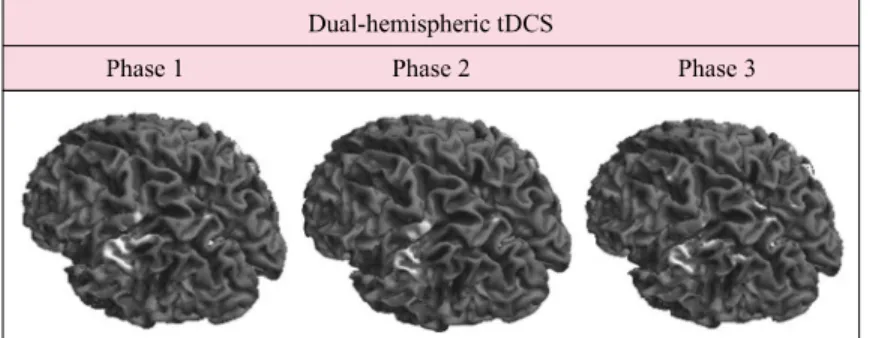
Figure 1. Cortical activation map of the functional MRI data during bipolar transcranial direct current stimulation on bilateral hemispheres (anodal electrode on the left SM1 and cathodal electrode on the right SM1 or on the supraorbital area).

bicommissure line of the anterior commissure-posterior com- missure. EPI-BOLD images were acquired over the identical 20 axial sections, producing a total of about 310 images for each subject, including 10 dummy images. Imaging parameters consisted of TR/TE = 2.0 sec/50 msec, FOV = 210 mm, matrix size = 64 × 64, and slice thickness = 5 mm. fMRI data analysis was accomplished using a SPM8 software (Wellcome Depart- ment of Cognitive Neurology, UK) running under the MATLAB environment (The Mathworks, USA). Functional data for each participant were motion-corrected. All images were realigned and normalized. Images were smoothed with an 8-mm isotropic Gaussian kernel. Statistical parametric maps were obtained. Voxels were considered significant at an uncorrected p<0.01. Activations were based on the five voxel regions. For group analysis of the normal group, images associated with the amplitude of the hemodynamic response were entered into one-sample t-test random effects analysis, and registered to the standard stereotaxic space of Talairach coordinates for the creation of statistical parametric maps and documenting the group average. The differences in the brain activation between the two tasks were compared by a random effect group analysis (uncorrected p < 0.01). Regions of interest were drawn around the SM1, supplementary motor area (SMA), and premotor cortex (PMC). The SM1 includes the precentral and postcentral gyruses centered on the precentral knob. The PMC extends horizontally from the precentral sulcus to the rostral limit, which lies halfway between the central sulcus and the anterior-most extent of the brain and in between the sylvian fissure and the SMA. The SMA, which is located to the anterior of leg somatotopy of the primary sensoiomotor cortex, extends from the brain vertex to the cingulate sulcus. We conducted voxel counts to estimate the amount of cortical activation in response

to the tDCS, as these are reliable indicators which reflect cortical activation and changes in cerebral blood flow.

22,23

III. Results

Figure 1 indicated that the cortical activation map was analyzed in the three ph

ases of the dual-hemisphere tDCS, when bipolar direct current stimulation was applied on the bilateral hemispheres (i.e. anodal stimulation over the left SM1, cathodal stimulation over the right hemisphere). SM1 of the dominant left hemisphere was activated in all the phases of dual-hemisphere tDCS. In each of the three phases, voxel count and intensity index were 912 and 4.07 in the first phase, 1102 and 3.90 in the second phase, 1031 and 3.80 in the third phase. Voxel count and intensity index with Talairach coordinates were expressed in table 1.

IV. Discussion

In the current study, we investigated whether dual-hemisphere tDCS which simultaneously was applied in the anodal current on the left SM1 and in the cathodal current on the right SM1 could induce cortical activity in the left SM1, and maintain the amount of cortical activity using voxel count and intensity index.

As a result, our findings showed that cortical activity by the

dual-hemisphere tDCS was found in all the three phases. In

addition, the dual-hemisphere tDCS induced cortical activity in

the three stimulation phases for 3 minutes from the onset of

direct current injection. Therefore, we suggest that dual-

(4)

Phase Activation areas (x, y, z) Voxel count Peak intensity index Dual-hemispheric tDCS

(Phase 1)

Left primary sensoriomotor cortex

(-44, -40, 64) 912 4.07

Dual-hemispheric tDCS (Phase 2)

Left primary sensoriomotor cortex

(-44, -40, 64) 1102 3.90

Dual-hemispheric tDCS (Phase 3)

Left primary sensoriomotor cortex

(-44, -40, 64) 1031 3.80

tDCS: transcranial direct current stimulation BOLD: Blood oxygenation level-dependent

Table 1. Areas of functional activation of the cerebral cortex during three phases of dual-hemisphere tDCS and one phase of single-hemisphere tDCS. In each of the regional activation clusters, voxel count and BOLD signal intensity were analyzed with Talairach coordinates.

hemisphere tDCS can modulate and maintain brain function, while tDCS was consistently injected 3 minutes.

These findings are compatible with prior neuroimaging studies. This indicates that the excitability of the cortical neurons was modulated by the ongoing effect during the deli- very of tDCS.

24-27

According to fMRI study by Kwon et al,

24

the anodal application of tDCS, had the direct stimulating effect on the underlying motor cortex. This increased the neural cortical activation of the targeted brain area. Kwon et al,

25

showed that the ongoing effect of the anodal tDCS is induced and maintained after one minute of application of direct current to the target neurons. These evidences support that when direct current is applied on the underlying targeted brain area, it can directly induce the neural activity. Moreover, several prior studies indicates that the cognitive behavior was modulated by the polarity-specified effect during the delivery of the tDCS.

13,28

Dockey et al,

13

examined that planning ability and cognitive skill learning were enhanced during the tDCS application on the left dorsolateral prefrontal cortex, through the Tower of London task performance. Stone et al,

28

revealed that the tDCS on the left parietal cortex modulated the performance of the local-to-global attentional switching by the ongoing effect of the tDCS. Accordingly, the activities of the cortical neurons and the brain functions could be modulated during the delivery of direct current. Its changes would be described by the ongoing effects of tDCS. To our knowledge, the first experiment about the concept of dual-hemisphere tDCS might be conducted by Vines et al in 2006. They showed that anodal tDCS over the left motor area led to highly improved right hand performance, compared to the cathodal tDCS. On the other hand, cathodal stimulation induced increase in the left-hand performance significantly more than anodal stimulation. In their further study in 2008, they

suggested that by simultaneously applying cathodal tDCS over the dominant motor cortex and anodal tDCS over the non-dominant motor cortex produced an additive effect. This led to significantly greater improvements in finger sequencing task for the non-dominant hand, compared to uni-hemisphere tDCS. This outcome may be attributed to interhemispheric inhibition between the motor cortices of the two hemispheres.

We believe that the inhibition of the cortical neurons in the cathodal tDCS enhance the facilitative effect of anodal tDCS all the more. This outcome provides evidence for the role of interhemispheric inhibition in corticomotor functioning. It also has implications on treatment methods aimed at facilitating motor recovery after a stroke.

In conclusion, we found out that the anodal tDCS over the targeted brain area simultaneously with cathodal tDCS over the same brain area of the opposite hemisphere was [the right?]

application method to trigger the targeted neural cells. Recently, tDCS has been investigated to elucidate the effectiveness of the brain modulation in various research areas such as neurophysiology, neuropsychology, clinical neuroscience, and so forth. In addition, tDCS has great advantages in terms of the proved safety guideline and convenient-cost effective application. Accordingly, we speculate whether our results will produce a rationale for the dual-hemisphere tDCS application in order to efficiently facilitate brain function. Our findings are difficult to generalize the effectiveness of the application of dual-hemisphere tDCS, because of single subject case study.

Therefore, further study is required to ascertain the comparison

of the effectiveness between the dual-hemisphere and

single-hemisphere tDCS application.

(5)

Author Contributions Research design: Kim CS

Acquisition of data: Kwon JW, Son SM Analysis and interpretation of data: Son SM Drafting of the manuscript: Kwon JW Research supervision: Kim CS References

1. Park JW, Kwon YH, Lee MY et al. Brain activation pattern according to exercise complexity: a functional mri study.

NeuroRehabilitation. 2008;23(3):283-8.

2. Leonard C. The neuroscience of human movement. St Louis, Mosby, 1998:125-50.

3. Kandal E, Schwartz J, Jessell T. Principles of neural science (Internation Edition). New York, Mcgraw-Hill, 2000:440-66.

4. Kaplan MS. Plasticity after brain lesions: contemporary concepts. Arch Phys Med Rehabil. 1988;69(11):984-91.

5. Antal A, Nitsche MA, Paulus W. Transcranial magnetic and direct current stimulation and the visual cortex. Brain Res Bull.

2006;68(6):459-63.

6. Reis J, Robertson E, Krakauer JW et al. Consensus: "Can tdcs and tms enhance motor learning and memory formation?".

Brain Stimul. 2008;1(4):363-9.

7. Nitsche MA, Liebetanz D, Antal A et al. Modulation of cortical excitability by weak direct current stimulation--technical, safety and functional aspects. Suppl Clin Neurophysiol.

2003;56(1):255-76.

8. Lefaucheur JP. Methods of therapeutic cortical stimulation.

Neurophysiol Clin. 2009;39(1):1-14.

9. Been G, Ngo TT, Miller SM et al. The use of tdcs and cvs as methods of non-invasive brain stimulation. Brain Res Rev.

2007;56(2):346-61.

10. Paulus W. Transcranial direct current stimulation (tdcs). Suppl Clin Neurophysiol. 2003;56(1):249-54.

11. Antal A, Nitsche MA, Kincses TZ et al. Facilitation of visuo-motor learning by transcranial direct current stimulation of the motor and extrastriate visual areas in humans. Eur J Neurosci. 2004;19(10):2888-92.

12. Iyer MB, Mattu U, Grafman J et al. Safety and cognitive effect of frontal dc brain polarization in healthy individuals.

Neurology. 2005;64(5):872-5.

13. Dockery CA, Hueckel-Weng R, Birbaumer N et al.

Enhancement of planning ability by transcranial direct current stimulation. J Neurosci. 2009;29(22):7271-7

14. Fregni F, Boggio PS, Mansur CG et al. Transcranial direct

current stimulation of the unaffected hemisphere in stroke patients. Neuroreport. 2005;16(14):1551-5.

15. Hummel FC, Cohen LG. Non-invasive brain stimulation: a new strategy to improve neurorehabilitation after stroke?

Lancet Neurol. 2006;5(8):708-12.

16. Nitsche MA, Cohen LG, Wassermann EM et al. Transcranial direct current stimulation: state of the art 2008. Brain Stimul.

2008;1(3):206-23.

17. Schlaug G, Renga V. Transcranial direct current stimulation:

A noninvasive tool to facilitate stroke recovery. Expert Rev Med Devices. 2008;5(6):759-68.

18. Sparing R, Thimm M, Hesse MD et al. Bidirectional alterations of interhemispheric parietal balance by non-invasive cortical stimulation. Brain. 2009;132(Pt 11):3011-20.

19. Vines BW, Cerruti C, Schlaug G. Dual-hemisphere tdcs facilitates greater improvements for healthy subjects' non-dominant hand compared to uni-hemisphere stimulation. BMC Neurosci. 2008;9(1):103.

20. Oldfield RC. The assessment and analysis of handedness: the edinburgh inventory. Neuropsychologia. 1971;9(1):97-113.

21. Yousry TA, Schmid UD, Alkadhi H et al. Localization of the motor hand area to a knob on the precentral gyrus. a new landmark. Brain. 1997;120(Pt 1):141-57.

22. Ugurbil K, Ogawa S, Kim S et al. Imaging brain activity using nuclear spins. Amsterdam, IOS Press, 1999:261-310.

23. Waldvogel D, van Gelderen P, Immisch I et al. The variability of serial fmri data: correlation between a visual and a motor task.

Neuroreport. 2000;11(17):3843-7.

24. Kwon YH, Ko MH, Ahn SH et al. Primary motor cortex activation by transcranial direct current stimulation in the human brain. Neurosci Lett. 2008;435(1):56-9.

25. Kwon YH, Nam KS, Lee MY et al. The temporal change of cortical activation induced by the ongoing effects of transcranial direct current stimulation. Journal of Physical Therapy Science.

2011;23(1):65-9.

26. Lim YE, Kim SH, Yang DJ et al. Change of cerebral motor area activity by anodal transcranial direct current stimulation (tDCS). J Kor Soc Phys Ther. 2009;21(4):65-71.

27. Kwon YH, Kim CS, Jang SH. Cortical activation in the human brain induced by transcranial direct current stimulation. J Kor Soc Phys Ther. 2009;21(4):73-9.

28. Stone DB, Tesche CD. Transcranial direct current stimulation modulates shifts in global/local attention. Neuroreport.

2009;20(12):1115-9.

수치

Figure 1. Cortical activation map of the functional MRI data during bipolar transcranial direct current  stimulation on bilateral hemispheres (anodal electrode on the left SM1 and cathodal electrode on the right  SM1 or on the supraorbital area).
Table 1. Areas of  functional activation of  the cerebral cortex during three phases of  dual-hemisphere tDCS and one  phase of single-hemisphere tDCS

참조

관련 문서

Current study explores the effects of entrepreneurial orientation both on financial and innovative performance with 1,497 Korean small and medium-sized

This study analysed diverse data on colors and the current statues of actual education, and suggested an emotional coloring program which can motivate

Mean values of the distance from the most superior point of the mandibular condyle to the most inferior point of the articular eminence on transcranial and

첫째, UTAUT모형을 이용하여 스마트폰 어플리케이션의 구매에 대해 검정한 결과 독립변수들 (성과기대, 예상노력, 사회적 영향, 유희적 가치,

- 회로에 흐르는 전류의 방향과 크기가 일정한 전류를 직류(direct current) 라고 한다... 기전력이란 용어는 전기를 일으키는 힘이라는

• The supply and demand curves cross at the equilibrium price and quantity.. • You can read off approximate equilibrium values

1 John Owen, Justification by Faith Alone, in The Works of John Owen, ed. John Bolt, trans. Scott Clark, &#34;Do This and Live: Christ's Active Obedience as the

The purpose of this study is to investigate the effect of online shopping mall characteristics on direct purchasing satisfaction of foreign consumers and purchase