DOI: http://dx.doi.org/10.14773/cst.2015.14.6.273
Effect of Chemical Passivation Treatment and Flow on the Corrosion of 304 Stainless Steel in Hydrochloric Acid Solution
Jie Zhao, Cong Qian Cheng†, and Tie Shan Cao
School of Materials Science and Engineering, Dalian University of Technology, Dalian, 116085, China (Received June 12, 2015; Revised November 18, 2015; Accepted December 01, 2015)
Effects of passive film quality by chemical passivation and solution flow on the corrosion behavior of 304 stainless steel in HCl solution were investigated using a coloration indicator, and by corrosion weight loss, electrochemical polarization and element dissolution measurements. A high redness degree suggests a low passive-film integrity for 304 stainless steel following air exposure, while the minimum redness degree for the samples after chemical passivation suggests a high passive-film integrity. In the static condition, samples subjected to air exposure exhibited a high corrosion rate and preferential dissolution of Fe. Chemical passivation inhibited the corrosion rate due to the intrinsically high structural integrity of the passive film and high concentrations of Cr-rich oxides and hydroxide. Solution flow accelerated corrosion by promoting both the anodic dissolution reaction and the cathodic reaction. Solution flow also altered the preferential dissolution to fast uniform dissolution of metal elements.
Keywords : stainless steel, chemical passivation treatment, flow, corrosion, metal element dissolution
†Corresponding author: [email protected]
1. Introduction
Stainless steels are materials frequently used in over- flowing facilities in petrochemical industry and power plants. In flowing acceleration corrosion environment, stainless steels are considered as good choice of replace- ment of carbon steel due to the intrinsic high corrosion resistance. However, solution flow still causes corrosion of stainless steel. In multiphase flowing environment, cor- rosion-erosion damages the surface of stainless steel1-4). Even in one-phase flowing condition, the acceleration of pitting by solution flowing was also been reported5). Therefore, the corrosion of stainless steel in flowing envi- ronment arouses many researchers’ interest. Many re- searchers have studied the flow corrosion of stainless in salt and marine solution, but rare studies have been re- ported in the acid solution.
Excessive dissolution of metal elements into solution could impose a risk to environment and human health.
Attentions have been received for dissolution of stainless steel in acid food solution and body fluids6,7). It has been recognized that corrosion behavior of stainless steel di- rectly influence the dissolution of metal elements6). Many factors that involve the corrosion properties, such as sur- face roughness, temperature and solution concentration
have been examined in acid food solution. However, the metal dissolution under flowing environment has not yet been studied.
In the present paper, the corrosion behavior and metals dissolution of 304 stainless steel was studied in flowing hydrochloric solution. The hydrochloric acid solution is one typical industrial solution. Many published literatures have reported the corrosion of stainless steel in hydrochloric sol- ution8-10); such experimental data can be utilized to ex- tensively realize the corrosion of stainless steel in flowing solution. Moreover, various processes could results in dif- ferent quality of surface passive film and then effect on corrosion resistance. Therefore the role of passive film quality and solution flowing during the corrosion of 304 stainless steel has been our focus. The passive film quality was firstly evaluated by X-ray photoelectron spectroscopy (XPS) and color indicator. The corrosion behavior was ex- amined by immersion test, electrochemical polarization.
And also the dissolution of metals was discussed.
2. Experimental procedure
A commercial AISI 304 stainless steel plate was used.
The plate was cut into pieces with size of f10 mm ´ 3 mm. The samples were ground up to 1200 grit size using SiC paper. Passivation treatment was then conducted by air exposure and chemical passivation. Chemical passi-
Fig. 1. Schematic of coloration reaction during examination on the passive film integrity by color-change indicator.
Cr CrO3
Cr(OH)3 Cr2O3 chemical passivation (a) Cr 2p3/2
a.u.
580 578 576 574 572
air exposure
Bonding energy, eV
satellite
Fe2O3 FeOOH
FeO
chemical passivation
(b) Fe 2p3/2
a.u.
Fe
718 716 714 712 710 708 706
air exposure
Bonding energy, eV
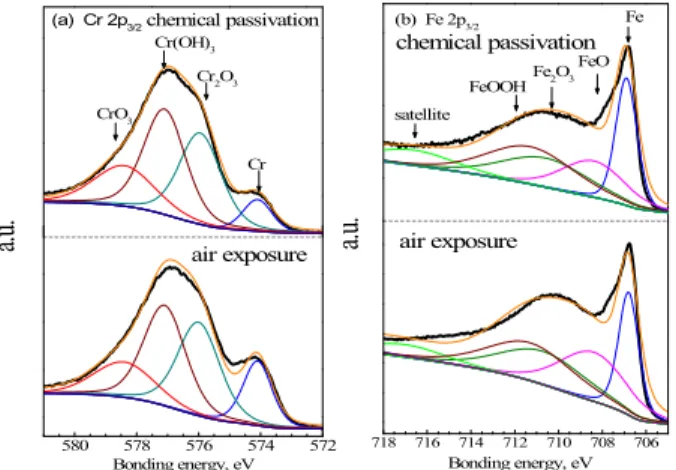
Fig. 2. XPS spectra for passive films on 304 stainless steels after 1 h air exposure and chemical passivation in HNO3 solution: (a) Cr 2p3/2, (b) Fe 2p3/2.
vation was carried out by immersing the samples in 20 vol.% HNO3 solution at 45 °C for 30 min.
2.1 Passive film inspection
Quality of passive film was evaluated through two pro- cedures: the coloration reaction by color-change indicator and subsequent color measurement by a colorimeter. The phenanthroline solution, which was composed of 0.1 g/L C12H8N2·H2O, 1.954 g/L to 0.109 g/L C6H8O7·H2O and 0.206 g/L to 2.735 g/L of C6H5O7Na3·H2O, was employed as the indicator. A piece of white test paper saturated with the solution was attached on the samples for colouration reaction. Fig. 1 shows the schematic of the coloration re- action that occurred on the surface of stainless steel. Once the indicator reacted with stainless steel, ferrous ions re- leased from the matrix through the defects or porosity of passive film. The phenanthroline solution showed good complexation ability with ferrous to form deep red col- oured ferroin, whereas the passive film can inhibit the release of Fe ions and retard the reaction. The quality of passive films was indirectly characterised by the red- ness degree of the ferroin11). It is noted that the ferroin indicator has been used extensively for several years in solution titration analysis of iron12), but no research has been reported on the application of passive film inspection before. After 3 min of colouration reaction, the redness degree of produced ferroin was evaluated by colour measurement. A colour reader (Konica Minolta, CR-10) was used to measure the redness in the CIE Lab space.
XPS measurement was carried out using an XPS spec- trometer (Thermo ESCALAB 250Xi) without any sputter- ing technique. The X-ray source employed was a mono- chromator Al-Kα (1486.6 eV, 15 kV, 14.9 mA). The spec- trometer was operated with constant pass energy of 20 eV.
2.2 Immersion corrosion and element dissolution measurement
300 ml of 0.36 M HCl solution for each specimen was employed in immersion corrosion. A stirring hot plate was used to control the solution at room temperature and 50
°C in water bath. Since this paper only compered two conditions (the flowing and static) on the corrosion, a rota- tor stirring rate of 700 r/min was employed for the flowing condition. The flowing velocity around the rotator calcu- lated about 2.4 m/s. However, the flow velocity on the samples surface is much lower than the calculated velocity because the distance from the string is 50 mm. Weight variation was measured by using electronic balances with accurate to 0.1 mg (Sartorius, BS 124S). The corrosion morphologies of the samples after corrosion were analysed by SEM (JSM5600-LV). The concentration of Fe, Ni, Cr in the solution after corrosion was analysed using SOLAN 969 Atomic Absorption Spectrophotometer, and the dis- solution amounts per surface area of specimens were cal- culated, respectively.
2.3 Electrochemical test
Electrochemical measurements were performed in 0.36 M HCl solution with a conventional three-electrode cell, and a saturated calomel reference electrode (SCE) and a Pt plate for a counter electrode were used. The exposed area of the samples that made contact with the NaCl sol- ution was a circle with a diameter of 10 mm. The potentio- dynamic polarisation was scanned from -0.6 V and ended at 0.1 A·cm-2 with a scan rate of 0.5 mV/s. Before poten- tial scanning, initial delaying of more than 20 min was carried out to achieve a stable open potential.
3. Results and discussion
3.1 Passive film analyses
Fig. 2 shows the XPS spectra of Cr 2p3/2and Fe 2p3/2+
detected for passive films on 304 stainless steel after 1 h air exposure and chemical passivation treatment. The
Fig. 3. Optical photograph and the measured redness degree during coloration reaction of indicator with 304 stainless steel after air exposure and chemical passivation in HNO3 solution.
1 10
10 100 1,000 10,000
air exposure
■ air exposure for 1 h
● air exposure for 2 h
▲ air exposure for 3 h
▼ air exposure for 10 h
◆ air exposure for 50 h static
weight loss, mg/cm2
time, h
flowing
40
(a)
chemical passivation: weight loss not detected
1 10
10 100 1,000 10,000
flowing static
■ air exposure for 1 h
★ chemical passivation
weight loss, mg/cm2
time, h 40
flowing (b)
static
Fig. 4. Weight loss of 304 stainless steel after corrosion in 0.36 M hydrochloric solution under static and flowing condition at vari- ous temperature: (a) at room temperature, (b) at 50 °C.
spectra of Cr 2p3/2 for the passive films show a broad distinct peak that can be attributed to the presence of Cr3+
oxides [Cr3+(ox) 576 eV], Cr3+ hydroxides [Cr3+(hyd) 577.3 eV] and Cr6+oxides [Cr6+(ox) 578.4 eV], with a small shoulder-related Cr metal [Cr(met) 574.1 eV]. The Fe 2p3/2 ionizations reveal the presence of metallic Fe [Fe(met)706.8 eV], Fe2+ oxides [Fe2+(ox) 708.6 eV], Fe3+
oxides [Fe3+(ox) 710.6 eV] and hydroxides [Fe3+(hyd) 711.8 eV]. Based on the XPS spectra, the ratio of {[Crox]+[Crhyd]}/{[Feox]+ [Fehyd]} was calculated. It was found that the ratio value is 0.5 in the samples subject to air exposure, while close to 1.8 for the samples sub- jected to chemical passivation, respectively. This result suggests the Cr-rich oxide and hydroxide of the high con- tent form in the passive film after the chemical passivation Fig. 3 shows the optical photograph and the measured redness degree during coloration reaction of indicator with 304 stainless steel. The optical graphs reveal the red-col- ored circles in the samples exposed to air for 1 and 3 h.
The intensity of redness is higher in the samples exposed to air for 1 h than in those exposed to air for 3 h. However, the color of the test paper is still white on the samples subjected to chemical passivation. Correspondently, the measured a* value was used to characterizes the redness degree. Significant differences between the samples sub- jected to air exposure and chemical passivation are observed. The highest a* value corresponds to the sample exposed to air for 0 h. The inspected a* values decrease as the thin passive films grow during air exposure. The measured a* values in the samples exposed to air for more than 3 h are close to 2, indicating that more passive films have formed. Compared with the samples exposed to air, the samples subjected to chemical passivation have a* val-
ues close to 0. This finding suggests that the optimum film quality can be found in the samples subjected to chemical passivation.
3.2 Corrosion weight loss and surface morphology Fig. 4 shows the weight loss of 304 stainless steel after corrosion in 0.36 M HCl solution at different temperatures and flowing conditions. At room temperature, the weight loss decreases with increasing air exposure period. Under solution flowing condition, the corrosion of stainless steel was accelerated but no obvious difference between the samples after various periods of air exposure, suggesting weak protectiveness of passive film formed in air under flowing condition. Notably, no obvious weight loss was evidenced in the sample after chemical passivation, as shown in Fig. 4(a). At the elevated temperature of 50 °C, the corrosion weight loss was boosted. In such condition the sample subject to chemical passivation also corroded after immersion of 12 h, as shown in Fig. 4(b). Moreover, weight loss of specimen subject to air exposure and that
1 10 100
1,000 10,000
■ air exposure for 1 h
★ chemical passivation static 0.1M HCl solution at 50 °C
weight loss, mg/cm2
time, h flowing 0.1M HCl solution at 50 °C
40 static 0.36 M HCl solution at 50 °C
flowing 0.36 M HCl solution at 50 °C
Fig. 5. Weight loss of 304 stainless steel after corrosion in 0.36 M and 0.1 M hydrochloric solutionunder static and flowing con- dition at 50 °C.
Table 1. Graded evaluation of weight loss of 304 stainless steel after corrosion
0.36 M HCl 0.1 M HCl 0.01 M HCl Corrosion extent
flowing static flowing static flowing static small
Sair at RT corroded corroded slight slight No
Sair at 50 °C corroded corroded slight slight No
Scp at RT No No No large
Scp at 50 °C corroded corroded No No
Fig. 6. Surface morphology of 304 stainless steel subject to chemical passivation after corrosion in 0.36 M HCl solution: (a) in solution at room temperature, (b) in static solution at 50 °C, (c) in flowing solution at 50 °C.
subject to chemical passivation is similar in the flowing condition. But, there is difference in the weight loss in the stagnant condition.
Fig. 5 shows the weight loss of 304 stainless steel after corrosion in different concentration of HCl at 50 °C.
Compared with the weight loss in 0.36 M HCl solution, the corrosion of 304 stainless steel was decreased and the effect of flowing was apparently diminished in 0.1 M HCl solution. No obvious weight loss was observed for the samples subject to chemical passivation.
Table 1 classified corrosion grades according to the weight loss, where Sair and Scp was shortened for the sam- ple subject to air exposure and chemical passivation, and
room temperature as RT, respectively. It is seen that Sair
samples are easier to corrode than Scp ones. Corrosion quantity decreases with increasing pH value, but increases with increasing temperature. Flowing accelerating corro- sion becomes visible at high concentration of HCl and high temperature.
Fig. 6 chooses surface morphologies of Scp after im- mersion in 0.36 HCl solution to illustrate the effect of temperature and flowing on corrosion morphology. Only scratches after ground was observed suggesting no serious corrosion occurred at room temperature. As the temper- ature was raised to 50 °C, corrosion and dissolution of stainless steel resulted in surface corrosion ditches. In the flowing condition, the surface corrosion degradation was further aggravated.
3.3 Potentiodynamic polarization
Fig. 7 shows the potentiodynamic polarization curves of 304 stainless steel subject to air exposure and chemical passivation in 0.36 M HCl solution. The polarization curve of the samples after air exposure shows an active dis- solution from -0.4 V(SCE) to -0.25 V (SCE) and a passive region from approximately -0.1 V (SCE) to 0.1 V (SCE) in 0.36 M HCl solution at room temperature. Similar po- larization were reported for 316L stainless steel in HCl solution9). Under the flowing condition, a right forward shift of polarization curves and narrowed passive region were found as shown in Fig. 7(a). It is noted that although there exist passivation and pitting regions in the polar-
-8 -7 -6 -5 -4 -3 -2 -0.6
-0.4 -0.2 0.0 0.2 0.4 0.6
E, V(SCE)
log(i, A.cm-2) Scp, static
Scp, flowing Sair, static Sair, flowing (a) at room temperature
active dissolution peak
-6 -5 -4 -3 -2 -1
-0.6 -0.5 -0.4 -0.3 -0.2 -0.1
Sair, static Sair, flowing Scp, static Scp, flowing
E, V(SCE)
log (i, A.cm-2)
(b) at 50 °C
Fig. 7. Potentiodynamic polarization curves in 0.36 M HCl solution at different temperature for 304 stainless steel after air exposure for 1 h and chemical passivationin HNO3 solution: (a) at room temperature, (b) at 50 °C.
Table 2. Electrochemical parameters calculated from the potentiodynamic polarization curves in Fig. 7 air exposure room
temperature
Chemical passivation
room temperature air exposure 50 °C Chemical passivation 50 °C
static flowing static flowing static flowing static flowing
-Ecorr, mV(SCE) 394 390 349 391 404 393 394 410
Icorr, μA.cm-2 83.1 145.3 5.4 43.4 952 3087 220 1784
ization curves, the presence of active dissolution peaks suggest a dissolution process during the immersion exper- iment. For the sample after air exposure of 1 h no passive region was observed, suggesting none existence of pro- tective passive film under such condition. As solution tem- perature increased up to 50 °C, all samples exhibit active dissolution according to the polarization curves. This re- sult indicates the degradation of passive film stability by the solution flowing and possibly gives a reason of differ- ent weight loss effect of chemical passivation under flow- ing and stagnant condition in Fig. 4.
The corresponding corrosion potential Ecorr and corro- sion current density icorr can be obtained from potentiody- namic polarization curves (Table 1). Very low values of corrosion current at room temperature was achieved for the samples subjected to chemical passivation, which is according with the weight loss result (Fig. 4(a)). It is appa- rent that solution flowing boosted the value of icorr. Moreover, such promotion effect increases with increasing temperature. Although the chemical passivation inhibited the corrosion of 316 L stainless steel, such inhibition can not prevent the fast corrosion in the presence of high value of icorr.
3.4 Metal element dissolution
Fig. 8 shows the dissolution concentration of metal ele- ments that remained in 0.36 M HCl solution after im-
mersion corrosion of 24 h at 50 °C. A large amount of Fe ions dissolved into solution after corrosion. Chemical passivation inhibited the dissolution of metal elements.
Under the flowing condition, increment in dissolved Fe, Cr and Ni irons were evidenced, as shown in Fig. 8(a).
The relative concentration percentage was calculated ac- cording to the following equation:
C 100%
C
0 0
´
´
=
å
å
i i i
i
i C
R C (1)
Where Ci is the concentration of metal i,C0i is the weight percentage of metal element i in 316L substrate.
The value of Ri means the ratio of dissolution percentage of Fe, Cr or Ni in HCl solution to that in 316L substrate.
It is easy to considered that element i would preferentially dissolved during corrosion when Ri >100, while the dis- solution of i may be inhibited when Ri <100.
Fig. 8(b) shows the calculated value of Ri for Fe, Cr and Ni element. The value of RFe is close to 120 %, indicat- ing a preferential dissolution of Fe element during corro- sion under static condition. The values below 70 % are achieved for RCr and RNi, which accord with the result in reported literatures6). This result suggests the slow dis- solution of Cr and Ni element during corrosion. Chemical passivation further decreased the dissolution of Cr element.
Under the flowing condition, however, all values for those
0 10 20 30 40 50 60 70
Leaching amount of metal elements, mg/(L×cm2)
Scp, flowing Sair, static
Scp, static Fe
Cr Ni
Sair, static
(a)
40 60 80 100 120
Relative concentartion of metal element Ri, %
Sair, static Scp, static Sair, flowing Scp, flowing RFe RCr RNi(b)
Fig. 8. Dissolution of metal elements from 304 stainless steel after corrosion in 0.36 M hydrochloric solution at 50 °C: (a) dissolution amount of metal elements, (b) relative concentration percentage of metal elements.
elements are close to 100 %, illustrating a fast and non- preferential dissolution.
The experimental results show that surface passive film and solution flowing affected corrosion of 304 stainless steel in HCl solution. As mainly two reactions involved during the corrosion, that is the oxidation of metal sub- strate and the reduction of hydrogen ion in the acid sol- ution10), different role of passive film and solution flowing on those reactions is critical to the corrosion behavior.
At room temperature, the low value of corrosion weight- loss (Fig. 4(a)) and the presence of passive region in the polarization curves (Fig. 7(a)) indicate that the corrosion of 304 stainless steel is controlled by the anodic oxidation reaction. The associated integrity of the passive films is thus importance in such condition. The passive film that formed during air exposure is non-protective due to its small amount of Cr-richen oxide (Fig. 2) and low level of film integrity (Fig. 3). On the contrary, the surface pas- sive film that formed after chemical passivation processes large amount of Cr-richen oxide and exhibits high level of film integrity. The high quality passive film inhibits the anodic dissolution of metal substrate and thus nearly no corrosion weight-loss was observed (Fig. 4(a)).
Solution flowing deteriorated the corrosion resistance by modifying the anodic reaction as shown in Fig. 7(a).
As the solution temperature increased up to 50 °C, the anodic dissolution was greatly promoted and the dissolved metal ions diffused fast into the solution, as illustrated by Fig. 8(a). A distinctive active dissolution was achieved at the high temperature (Fig. 7(b)). At the high temper- ature, it seems that the corrosion behavior is controlled by the cathode reduction reaction. Indeed a careful exami- nation on the polarization curves in Fig. 7(b), the calcu- lated anodic Tafel slop is about 99 mV/dec, which is much lower than the cathodic Tafel slop 155 mV/dec. Therefore, the effect of chemical passivation is weakened at 50 °C.
Moreover, solution flowing accelerated the corrosion by promoting cathodic reaction, as illustrated by the right shift of cathodic region in the polarization curves in Fig.
7(b).
4. Conclusion
(1) Coloration indicator reveals that a low integrity of passive film for 304 stainless steel after air exposure and a high integrity of passive film formed after chemical passivation.
(2) Immersion corrosion and polarization behavior show that solution flowing accelerated the corrosion of 304 stainless steel in HCl solution. Chemical passivation inhibited the corrosion due to high content of Cr-rich oxide and hydroxide and its high integrity.
(3) Fe preferential dissolution occurred in the static sol- ution during corrosion, but no apparent preferential dissolution in the flowing solution.
Acknowledgement
This work is supported by National Nature Science Foundationof China (No. 51571051, 51101024, 51171037).
References
1. S. Aribo, R. Barker, X. Hu, Wear, 302, 1602 (2013).
2. R. J. K. Wood, J. C. Walker, T. J. Harvey, S. Wang, S.
S.Rajahram, Wear, 306, 254 (2013).
3. Y. Wang, Y. G. Zheng, W. Kea, W. H. Sun, W. L. Hou, X. C. Chang, J. Q. Wang Corros. Sci., 53, 3177 (2011).
4. B. T. Lu, L. C. Mao, J. L. Luo, Electrochim. Acta, 56, 85 (2010).
5. J. A. Wharton, R. J. K. Wood, Wear, 252, 525 (2006).
6. G. Herting, I. Odnevall Wallinder, C. Leygraf, J. Food Eng., 87, 291 (2008).
7. P. Agarwal, Srivastava, M. M. Srivasta, S. Prakash, M.
Ramanamurthy, R. Shrivast, S. Dass, Sci. Total Environ., 199, 271 (1997).
8. N. Soltani, N. Tavakkoli, M. Khayatkashani, M. R. Jalali, A. Mosavizade, Corros. Sci., 62, 122 (2012).
9. A. S. Fouda, G. Y. El-Ewady, S. Fathy, Desal. Wat. Treat., 51, 2202 (2013).
10. M. Behpour, S. M. Ghoreishi, N. Soltani, Corros. Sci., 51, 1073 (2009).
11. C. Q. Cheng, J. Zhao, T. S. Cao, M. K. Lei, D. W. Deng, Corros. Sci., 70, 235 (2013).
12. T. S. Lee, I. M. Kolthoff, D. L. Leussing, J. Am. Chem.
Soc., 70, 2348 (1948).