저작자표시-비영리-변경금지 2.0 대한민국 이용자는 아래의 조건을 따르는 경우에 한하여 자유롭게 l 이 저작물을 복제, 배포, 전송, 전시, 공연 및 방송할 수 있습니다. 다음과 같은 조건을 따라야 합니다: l 귀하는, 이 저작물의 재이용이나 배포의 경우, 이 저작물에 적용된 이용허락조건 을 명확하게 나타내어야 합니다. l 저작권자로부터 별도의 허가를 받으면 이러한 조건들은 적용되지 않습니다. 저작권법에 따른 이용자의 권리는 위의 내용에 의하여 영향을 받지 않습니다. 이것은 이용허락규약(Legal Code)을 이해하기 쉽게 요약한 것입니다. Disclaimer 저작자표시. 귀하는 원저작자를 표시하여야 합니다. 비영리. 귀하는 이 저작물을 영리 목적으로 이용할 수 없습니다. 변경금지. 귀하는 이 저작물을 개작, 변형 또는 가공할 수 없습니다.
A THESIS
FOR THE DEGREE OF MASTER OF SCIENCE
Tenebrio molitor Larvae Counter Stress Response by
Suppression within HPI-axis in Zebrafish
Jeongwon Lee
Department of Marine Life Science
GRADURATE SCHOOL
JEJU NATIONAL UNIVERSITY
Tenebrio molitor Larvae Counter Stress Response by Suppression
within HPI-axis in Zebrafish
Jeongwon Lee
(Supervised by Professor Seungheon Lee)
A thesis submitted in partial fulfillment of the requirement for the degree of Master of Science
2021.02.
This thesis has been examined and approved.
Thesis director, Gi-Young Kim Prof. of marine life science
Sang Rul Park, Prof. of marine life science
Seungheon Lee, Prof. of marine life science
Department of Marine Life Science
GRADUATE SCHOOL
JEJU NATIONAL UNIVERSITY
i
Abstract
In this study, the antistress effects of the water extract of Tenebrio molitor larvae (WTML) were investigated. To determine the effects of WTML on fish stress, changes in whole-body cortisol levels and behavior were monitored in zebrafish. To induce physical stress, we used net handling stress (NHS). Fish were treated with WTML for 6 min before exposure to stress. Then, the fish were used for evaluation via behavioral tests, including novel tank tests and open field tests, or sacrificed for collection of the whole body fluid. Increased anxiety-like behaviors in the novel tank test and open field test under stress were recovered after treatment with WTML at 25, 50 and 100 mg/L (p < 0.05). Moreover, compared with the normal group, which was not induced by NHS, the whole-body cortisol levels of the control group were significantly increased after induction by NHS. Compared with the control group, pretreatment with WTML at concentrations of 25, 50 and 100 mg/L for 6 min significantly prevented the increase in whole-body cortisol levels induced by NHS (p < 0.05). In addition, challenge studies showed that WTML completely blocked the effects of intraperitoneally-injected adrenocorticotropin hormone (ACTH; 0.2 IU/g) on cortisol secretion. These results suggest that WTML may be a good antistress candidate, and that its mechanism of action may be related to its positive effects on cortisol release.
Keywords: Net handling stress; Novel tank test; Open field test; Tenebrio molitor larvae; Whole-body cortisol; Zebrafish
ii Contents Abstract ... i Contents ... ii List of Figures ... iv I. Introduction ... 1
II. Materials and Methods ... 4
1. Materials ... 4
2. Preparation of the extract ... 4
3. Animals ... 5
3.1 Zebrafish ... 5
3.2 Mouse ... 5
4. Drug administration and induction of stress ... 6
5. Novel tank test (NTT) ... 6
6. Open field test (OFT) ... 7
7. Measurement of whole-body cortisol levels ... 7
8. Electrophysiology test ... 8
8.1 Slice preparation... 8
8.2 Extracellular recording ... 9
9. ACTH challenge test ... 9
10.Statistics ... 10
III. Results ... 11
1. Anti-stress effects of WTML by the NTT ... 11
1.1 Duration in the top portion ... 11
1.2 Distance moved ... 12
1.3 Velocity ... 12
1.4 Not moving duration ... 13
1.5 Zone transition frequency ... 13
2. Anti-stress effects of WTML in the OFT ... 16
2.1 Meandering movement ... 16
2.2 Distance moved ... 17
2.3 Velocity ... 17
2.4 Not moving duration ... 18
2.5 Turn angle ... 18
iii
4. Electrophysiology test ... 23
5. ACTH challenge test ... 24
IV. Discussion... 25
V. References ... 29
Abstract in Korean ... 33
iv
List of Figures
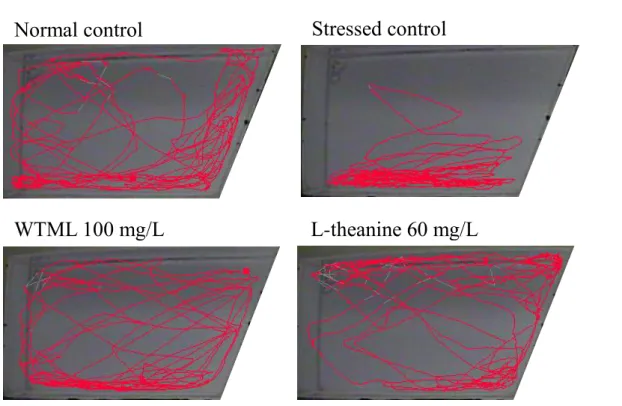
Figure 1. Behavioral effect of the water extract of Tenebrio molitor larvae (WTML; 25-100 mg/L) and L-theanine (60 mg/L) on the novel tank test in adult zebrafish. The graph shows Duration in top (A), Distance moved (B), Velocity (C), Not moving duration (D), Zone transition (E) and Visual data (F). Each bar
represents the mean S.E.M. of 6 zebrafish. P values for the group
comparisons were obtained by one-way ANOVA followed by
Student-Newman-Keuls test (# P < 0.05 compared with the normal control group, * P <
0.05 compared with the vehicle-treated control group). ... 15 Figure 2. Behavioral effect of the water extract of Tenebrio molitor larvae (WTML;
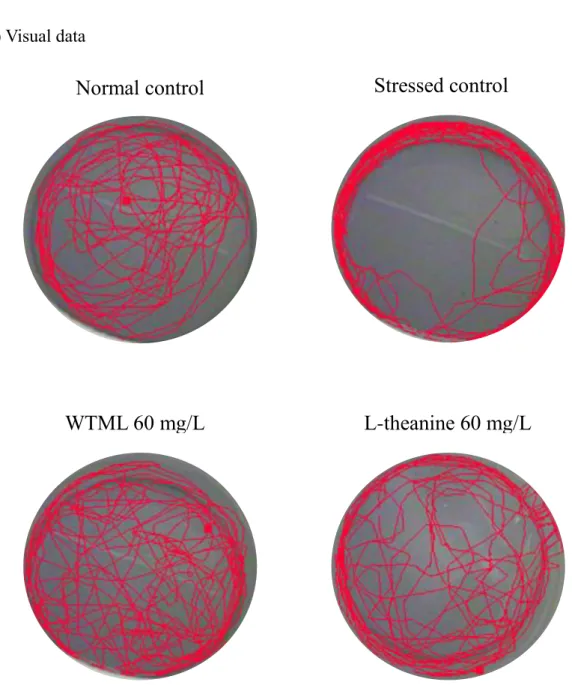
25-100 mg/L) and L-theanine (60 mg/L) on the open field test in adult zebrafish. The graph shows Meandering movement (A), Distance moved (B), Velocity (C), Not moving duration (D), Turn angle (E) and Visual data (F).
Each bar represents the mean S.E.M. of 6 zebrafish. P values for the group
comparisons were obtained by one-way ANOVA followed by
Student-Newman-Keuls test (# P < 0.05 compared with the normal control group, * P <
0.05 compared with the vehicle-treated control group). ... 20 Figure 3. Effect of the water extract of Tenebrio molitor larvae (WTML; 25-100
mg/L) and L-theanine (60 mg/L) on whole-body cortisol in adult zebrafish. The data are expressed as the mean ( S.E.M.) of the whole-body cortisol level.
Each bar represents the mean S.E.M. of 6 zebrafish. P values for the group
comparisons were obtained by one-way ANOVA followed by
Student-Newman-Keuls test (# P < 0.05 compared with the normal control group, * P <
0.05 compared with the vehicle-treated control group). ... 22 Figure 4. Effect of the water extract of Tenebrio molitor larvae (WTML; 100 µg/ml)
and Muscimol (5 µM) on electrophysiology test in mouse. Cotreatment of muscimol and WTML group does not have a significant difference of the level of field excitatory postsynaptic potential (fEPSP) compared with muscimol group... 23 Figure 5. Increase of cortisol induced by adrenocorticotropic hormone (ACTH) was
blocked by the water extract of Tenebrio molitor larvae (WTML; 25-100 mg/L)
in ACTH challenge test. The data are expressed as the mean ( S.E.M.) of the
whole-body cortisol level (n = 6 zebrafish per group). P values for the group comparisons were obtained by two-way ANOVA followed by Student Newman-Keuls test (* P < 0.05 versus the vehicle-treated control, # P < 0.05 compared with the only ACTH-treated group). ... 24
1
I. Introduction
Stress response are the none specific physiological responses of the body to fulfill any demand for change [1]. Stress occurs when organisms are threatened with unfamiliar environments and struggle for homeostasis. The physiological responses that arise under different stressors can be combined into different groups [2]. Elevated levels of the catechol amines or corticosteroids manifest the primary stress response including endocrine changes. Stress responses that belong to the category of secondary stress response affects metabolism and the homeostasis of the respiratory, cardiovascular and immune systems. The tertiary stress response may occurs due to the primary and secondary responses that will consequently changes rate of growth, disease resistance and fish behaviors [2]. These authors mentioned that stress induced various negative effects. According to recent studies, exposure to excessive stress or chronic stress in fish results in an increase in plasma cortisol levels, which consequently leads to abnormal behaviors including anxiety-like behavior [3]. Stress is also responsible for a decrease in resistance to infection due to suppression of the immune response [4, 5].
According to a recent study, fish have been proven to be more sensitive to stressors comparable to the other vertebrates and respond to stressors at levels of intensity is also often far below than that to the terrestrial animals [6]. Stress could be caused by various factors, including chemical (e.g. low dissolved oxygen, water pollution or water temperature changes), biological (e.g. high density, pathogenic or nonpathogenic) or physical factors (e.g. handling or transportation) in fish [5, 7]. Stress events in fish are generally initiated through involvement of the
hypothalamic-2
pituitary-interrenal (HPI) axis, which plays the primary role in endocrine stress response behavior regulation [8, 9]. A stress stimulus is transmitted to the hypothalamus, and signaled to the pituitary via corticotrophin-releasing hormone (CRH). In turn, adrenocorticotrophic hormone (ACTH) is released into the bloodstream from the pituitary to induce cortisol release from the interrenal gland [10]. In turn, the release of cortisol is carefully regulated by negative feedback under control of the HPI axis [8, 11].
Cortisol adjusts physiological functions, in which it stimulates several aspects of intermediary energy metabolism, and elevates oxygen uptake, including increased protein turnover, amino acid metabolism regulation, ammonia output and lipolysis [8]. However, a high level of cortisol causes negative effects including abnormal behavior, immune suppression, depressive disorder, panic disorders and sleep disorders [12, 13].
Mealworm beetles (Tenebrio molitor) belong to the family Tenebrionidae and are widely cultivated worldwide for animal feed for birds, hedgehogs and reptiles. In addition, due to their high protein and high fat contents, an increase in consumption by people has also become popular for the past few years. Interestingly, recent studies have revealed that Tenebrio molitor larvae possess anti-inflammatory and antioxidative properties [14, 15]. Therefore, Tenebrio molitor larvae may be developed as a healthy functional food and medicine. However, the antistress effects of Tenebrio molitor larvae have not been studied thus far.
The interest in animal welfare has increased with aquaculture industry development. The stress response is related to fish welfare, as stress affects endocrine homeostasis and modifies behaviors [3]. Accumulating evidence suggests
3
that fish exposed to low levels of stress could have high disease resistance [3, 16]. For this reason, pathological and physiological research focusing on stress in fish has been increased over past few decades, however, only a few studies have been conducted to investigate stress control in fish. Therefore, in our study, we investigated the antistress activities of Tenebrio Molitor larvae using biochemistry and behavioral pharmacology in zebrafish.
4
II. Materials and Methods
1. Materials
ACTH and tricaine were purchased from Sigma-Aldrich Co. (St. Louis, MO). Freeze-dried Tenebrio molitor larvae powder was supplied from Huimang-Gonchung Farm (2626-11 Gajogaya-ro, Gaya-myeon, Gapcheon-gun, Gyeongsangnamdo, Republic of korea), and a voucher specimen (JJNUOPS 2020-01) was deposited at the Marine Biomedical Science of the College of Ocean Sciences, Jeju National University. L-Theanine was purchased from Santa Cruz Biotech (Santa Cruz, CA). All other materials were of the highest grade and were obtained from standard commercial sources.
2. Preparation of the extract
To obtain the aqueous extract of the freeze-dried Tenebrio molitor powder, approximately 100 g of powder was extracted with 1 L of water for 2 hours at 80-100℃. The solids were removed by vacuum filtration. The water extract of Tenebrio
molitor larvae (WTML) was lyophilized (Eyela, model FDU-1200, Japan). The total
yield was approximately 18.0 %.
In the WTML, protein quantification was performed by Bio-Rad Bradford protein assay reagents (Bio-Rad, Hercules, CA) according to the protocols of the manufacturer. Briefly, equal amounts of protein samples were mixed with 1x Bradford assay reagent and maintained for 15 min at room temperature to facilitate
5
the Bradford reaction. Then the absorbance was measured at 595 nm using a microplate reader. The amounts of protein present were quantified using a BSA standard curve. The calibration curve was drawn as follows: y = 160.17 * -10.098; R² = 0.9945 in a standard concentration range. Using these equations, the quantity of protein in the WTML was calculated and determined to be 665 mg/g.
3. Animals
3.1 Zebrafish
We used 5-6 month-old wild-type zebrafish purchased from the World-fish aquarium (Jeju-si, Republic of Korea). All fish were acclimated for at least two weeks in the experimental room and maintained in constant temperature (26 ± 1℃) tanks with aerated water. Fish were kept on a 14–10 hour light/dark cycle (lights on from 07:00-21:00) and fed two times a day with TetraMin commercial flakes (Tetra, Germany). During the experiments, the zebrafish were not fed. Animal treatment and maintenance were conducted in accordance with the Principles of Laboratory Animal Care (NIH Publication No. 85-23, 8th edition).
3.2 Mouse
Male CD-1 mice (8 weeks) were purchased from SAMTAKO Bio Korea (Osan-si, Korea), and kept in the University Animal Care Unit for 1 week prior to the experiments. The animals were housed 5 per cage, allowed access to water and food ad libitum; the environment was maintained at a constant temperature (23 ± 1 °C)
6
and humidity (60 ± 10 %) under a 12-h light/dark cycle (the lights were on from 07:30 to 19:30). The treatment and maintenance of the animals were carried out in accordance with the Animal Care and Use Guidelines of Dong-A University, Korea. All of the experimental protocols using animals approved by the Institutional Animal Care and Use Committee of Dong-A University, Korea.
4. Drug administration and induction of stress
Net handling stress (NHS) was induced using the method of Ramsay et al [17]. After being subjected to NHS, zebrafish were suspended in the air for 4 min. Then, the fish were returned to the water for 3 min. Afterward, the fish were suspended in the air for an additional 4 min. Fish were induced with NHS after treatment with WTML for 6 min. The fish were randomly divided into an unstressed normal group, a stressed control group, stressed WTML-treated groups, and stressed positive control group. WTML and L-theanine were separately dissolved in 0.9% NaCl solution. Zebrafish were put into a medicinal bath of 0.9% NaCl solution, WTML (25-100 mg/L) or L-theanine (60 mg/L) for 6 min just before testing.
5. Novel tank test (NTT)
To assess the effects of WTML exposure on zebrafish behavior, a NTT was performed according to the method of Kyzar et al [18] between 11:00 and 16:00. Zebrafish (n= 8-12 in each group) were placed in a tank (15 cm height × 28 cm top × 23 cm bottom × 7 cm width) maximally filled with water and divided into two equal virtual horizontal portions. Zebrafish behavior was recorded with the subsequent
7
automated analysis of generated traces by Ethovision XT 8.5 software (Noldus IT, Wageningen, Netherlands) from the side view for 6 min to calculate the duration in top portion, distance moved, velocity, not moving duration and zone transition frequency.
6. Open field test (OFT)
To assess the effects of WTML exposure on zebrafish behavior, an OFT was performed according to the method of Cachat et al [19] between 11:00 and 15:00. The zebrafish (n= 9-12 in each group) were placed in a white plastic cylinder (22 cm bottom × 24 cm top × 20.5 cm height) filled with 4 litters of water. Zebrafish behaviors were recorded with the subsequent automated analysis of generated traces with Ethovision XT 8.5 software (Noldus IT, Wageningen, Netherlands) from the side view for 6 min to calculate the meandering movement, distance moved, velocity, not moving duration and turn angle.
7. Measurement of whole-body cortisol levels
Extraction of cortisol was performed using the method of Giacomini et al [20]. Zebrafish (n = 5-6 zebrafish per group) were sacrificed with tricaine (Sigma-Aldrich, St. Louis, MO) at a concentration of 150 mg/l to obtain the body fluid. After the moistness of the zebrafish skin had dried, it was put into a prepared cryo tube with 2 ml of 0.1 M phosphate buffered saline (PBS) for homogenization. Five milliliters of diethyl ether was put into the cryo tube, and then vortexed 3 times for 1
8
min each time. Then, the samples were centrifuged (Hanil, Korea) at 4,000 g for 15 min and rapidly cooled for 45 seconds in liquid nitrogen to transfer the supernatant to a test tube. The test tubes containing the sample were evaporated with a vacuum evaporator (CVE-2000, EYELA, Japan) to remove the diethyl ether from the sample. After the evaporation of the diethyl ether, 1 ml of 0.1 M PBS was added to the test tube, and the content was moved to a new 1.7 ml tube. This tube was then stored at -20℃ until it was submitted for cortisol measurement.
Level of whole-body cortisol was measured using a cortisol assay kit (R&D System, Minneapolis, MN). To analyze the ELISA plate, the absorbance was measured at 450 nm using a microplate reader (Molecular Devices, San Jose, CA). The absorbance value was converted to a cortisol concentration based on a 4-parameter sigmoid minus curve. Level of whole-body cortisol is expressed as the ratio of the cortisol concentration to the weight of each fish.
8. Electrophysiology test
8.1 Slice preparation
Mouse hippocampal slices were prepared using micro-vibratome (Lafayette Instrument; Lafayette, IN). The brain was rapidly removed and placed in ice-cold artificial cerebrospinal fluid (ACSF; bubbled with 95% O2/5% CO2), which comprised: (mM) NaCl, 124; KCl, 3; NaHCO3, 26; NaH2PO4, 1.25; CaCl2, 2; MgSO4, 1; D-glucose, 10. Transverse hippocampal slices (400 μm thick) were prepared. Hippocampal slices were submerged in ACSF (20-25°C) for 1 h before transfer to the recording chamber (28-30°C, flow rate: 3 ml/min) as required.
9
8.2 Extracellular recording
Field recordings were made from stratum pyramidal in area CA1. Stimulating electrodes were placed in the Schaffer collateral-commissural pathway. Stimuli (constant voltage) were delivered at 30 seconds intervals. To induce LTP, one train of high frequency stimulation (100 pulses at 100 Hz) was delivered. The slope of the evoked field excitatory postsynaptic potential responses (fEPSPs) was averaged from four consecutive recordings evoked at 30 seconds intervals.
9. ACTH challenge test
Four treatment groups (n = 6 zebrafish per group) were used in order to determine whether an ACTH challenge could short-circuit possible inhibitory effects at the brain and pituitary levels exerted by 100 mg/L WTML. The challenge dose of ACTH (Sigma-Aldrich Co., MO; freshly dissolved in sterile 0.1 M PBS) was paired with WTML or home tank water pretreatment. The challenge dose of ACTH was determined from a pilot dose-response study that examined four doses of ACTH in the range of 0.05–0.4 IU/g. We used the lowest dose examined since it produced a maximal stimulatory effect on cortisol secretion (data not shown). ACTH (0.2 IU/40 μl/g) or vehicle (0.1 M PBS, pH 7.4) were intraperitoneally injected after pretreatment with WTML for 6 min or 0.9% NaCl solution. Fish were sacrificed 15 min after ACTH injection for the measurement of whole-body cortisol levels [21, 22].
10
10. Statistics .
Values are expressed as the means ± S.E.M. Data were analyzed by one-way analysis of variance (ANOVA) followed by the Student-Newman-Keuls test for multiple comparisons. Statistical significance was set at p < 0.05. For the challenge study, the interactions between the agonist and WTML were analyzed separately with two-way ANOVA [factors: ACTH versus drug]; pairwise comparisons for the assessment of the drug influence on the ACTH effects were conducted by using Student-Newman-Keuls test. Statistical significance was set at p < 0.05.
11
III. Results
1. Anti-stress effects of WTML by the NTT
The NTT is an experiment that evaluates behaviors such as anxiety and stress using zebrafish instinctive behavior. We observed the movement of zebrafish such as total distance moved, duration in the top portion, swimming velocity, zone transition and not moving duration through the NTT to determine anxiety-like behavior [23, 24].
1.1 Duration in the top portion
Duration in the top portion was measured for 6 min in the NTT. The duration in the top was 164.09 ± 13.41 seconds in the normal control group and 22.59 ± 6.55 seconds in the stressed control group which decreased by approximately 86.3 % after NHS induction (p < 0.05). Notably, the duration at the top was 34.56 ± 14.70 seconds at 25 mg/L WTML (p < 0.05), 96.09 ± 14.67 seconds at 50 mg/L WTML (p < 0.05) and 110.34 ± 9.5 seconds at 100 mg/L WTML (p < 0.05). In the WTML-treated groups at 25-100 mg/L, the duration at the top significantly increased compared to the stressed control group. In the L-theanine-treated group, which was a positive control group, the duration in the top was significantly increased compared with that in the stressed control group (154.38 ± 18.71 seconds, p < 0.05; Fig. 2A).
12
1.2 Distance moved
The distance moved was measured for 6 min in the NTT. The distance moved was 2105.89 ± 107.76 cm in the normal control group while it was 1297.80 ± 61.29 cm in the stressed control group, which showed a decrease by approximately. 34.4 % after NHS induction (p < 0.05). Intriguingly, the distance moved was 1410.55 ± 66.44 cm after treatment with 25 mg/L WTML (p < 0.05), 1747.65 ± 48.31 cm at 50 mg/L WTML (p < 0.05) and 1738.34± 91.49 cm at 100 mg/L WTML (p < 0.05). In the WTML-treated groups at 25-100 mg/L, the distance moved showed a significant increase compared to the stressed control group. In the L-theanine-treated group, which was a positive control group, the distance moved was significantly increased compared with the stressed control group (2277.79± 109.63 cm, p < 0.05; Fig. 2B).
1.3 Velocity
Velocity was measured for 6 min in the NTT. The velocity was 6.22 ± 0.29 cm/s in the normal control group and 3.65 ± 0.16 cm/s in the stressed control group, showing an approximately 41.4% decrease after NHS induction (p < 0.05). Interestingly, the velocity was 3.89 ± 0.14 cm/s at after treatment with 25 mg/L WTML (p < 0.05), 4.89 ± 0.13 cm/s at 50 mg/L WTML (p < 0.05) and 4.89 ± 0.25 cm/s at 100 mg/L WTML (p < 0.05). In the WTML-treated groups at 25-1000 mg/L, the velocity significantly increased compared to the stressed control group. In the L-theanine-treated group, the velocity was significantly increased compared with that in the stressed control group (6.46 ± 0.31 cm/s, p < 0.05; Fig. 2C).
13
1.4 Not moving duration
The not moving duration was measured for 6 min in the NTT. This duration was 32.52 ± 4.59 seconds in the normal control group and 111.39 ± 1.33 seconds in the stressed control group which was an approximately 342 % increase after NHS induction (p < 0.05). Interestingly, this duration was 89.66 ± 6.58 seconds after treatment with 25 mg/L WTML (p < 0.05), 50.61 ± 4.03 seconds at 50 mg/L WTML (p < 0.05) and 47.9 ± 6.93 seconds at 100 mg/L WTML (p < 0.05). In the WTML-treated groups at 25-100 mg/L, the not moving duration significantly decreased compared to the stressed control group. In the L-theanine-treated group, which was a positive control group, this duration was significantly decreased compared with that of the stressed control group (34.02 ± 3.85 seconds, p < 0.05; Fig. 2D).
1.5 Zone transition frequency
Zone transition was measured for 6 min in the NTT. The zone transition was 24.76 ± 2.35 degrees (deg) in the normal control group and 5.54 ± 1.52 deg in the stressed control group showing an approximately 77.7 % decrease after NHS induction (p < 0.05). Remarkably, the zone transition was 6.54 ± 1.73 deg after treatment with 25 mg/L WTML (p < 0.05), 16.3 ± 1.38 deg at 50 mg/L WTML (p < 0.05) and 17.2 ± 1.03 at 100 mg/L WTML (p < 0.05). In the WTML-treated groups at 25-100 mg/L, the zone transition significantly increased compared to the stressed control group. In the L-theanine-treated group, which was a positive control group, the zone transition was significantly increased compared with the stressed control group (41.11 ± 3.96 deg, p < 0.05; Fig.2E).
14 Normal Control 25 50 100 60 D is ta n c e m o v e d ( s) 0 500 1000 1500 2000 2500 3000 # * * * WTML L-theanine (mg/L) (B) Normal Control 25 50 100 60 D u ra ti o n i n t o p ( s) 0 20 40 60 80 100 120 140 160 180 200 # * * * WTML L-theanine (mg/L) (A) Normal Control 25 50 100 60 V e lo c it y ( c m /s ) 0 2 4 6 8 # * * * WTML L-theanine (mg/L) (C) Normal Control 25 50 100 60 Z o n e t ra n si ti o n ( d e g ) 0 10 20 30 40 50 # * * * WTML L-theanine (mg/L) (E) Normal Control 25 50 100 60 N o t m o v in g d u ra ti o n ( s) 0 20 40 60 80 100 120 140 # * * * * WTML L-theanine (mg/L) (D)
15 (Continued)
(F) Visual data
WTML 100 mg/L
L-theanine 60 mg/L
Normal control
Stressed control
Figure 1. Behavioral effect of the water extract of Tenebrio molitor larvae (WTML; 25-100 mg/L) and L-theanine (60 mg/L) on the novel tank test in adult zebrafish. The graph shows Duration in top (A), Distance moved (B), Velocity (C), Not moving duration (D), Zone transition (E) and Visual data (F). Each bar represents the mean S.E.M. of 6 zebrafish. P values for the group comparisons were obtained by one-way ANOVA followed by Student-Newman-Keuls test (# P < 0.05 compared with the normal control group, * P < 0.05 compared with the vehicle-treated control group).
16
2. Anti-stress effects of WTML in the OFT
The OFT is an experiment to evaluate behaviors such as anxiety and stress using zebrafish instinctive behavior. We observed the movement of zebrafish such as total meandering movement, distance moved, velocity, not moving duration and turn angle through the OFT to determine anxiety-like behavior [23].
2.1 Meandering movement
Meandering movement was measured for 6 min in the OFT. The meandering movement was 288.22 ± 34.37 deg/s in the normal control group and 1469.97 ± 212.78 deg/s in the stressed control group which was an approximately 510 % increase after NHS induction (p < 0.05). Intriguingly, the meandering movements were 922.14 ± 106.27 deg/s after treatment with 25 mg/L WTML (p < 0.05), 373.32 ± 41.69 deg/s at 50 mg/L WTML (p < 0.05) and 420.29 ± 96.55 deg/s at 100 mg/L WTML (p < 0.05). In the WTML-treated groups at all concentrations, the meandering movement significantly decreased compared to the stressed control group. In the L-theanine-treated group, the meandering movement was significantly decreased compared with that in the control group (346.71 ± 42.93 deg/s, p < 0.05; Fig.3A).
17
2.2 Distance moved
The distance moved was measured for 6 min in the NTT. The distance moved was 2967.74 ± 128.85 cm in the normal control group while it was 1410.57 ± 95.198 cm in the stressed control group showing an approximately 52.5 % decrease by after NHS induction (p < 0.05). Interestingly, the distances moved were 1834.54 ± 135.76 cm at 25 mg/L WTML (p < 0.05), 2474.79 ± 125.08 cm at 50 mg/L WTML (p < 0.05) and 2816.84 ± 187.44 cm at 100 mg/L WTML (p < 0.05). In the WTML-treated groups at 25-100 mg/L, the distances moved significantly increased compared to the stressed control group. In the L-theanine-treated group, which was a positive control group, the distance moved was significantly increased compared with the stressed control group (3014.31 ± 206.58 cm, p < 0.05; Fig.3B).
2.3 Velocity
The velocity was measured for 6 min in the NTT. The velocity was 8.67 ± 0.32 cm/s in the normal control group and 3.98 ± 0.27 cm/s in the stressed control group which was an approximately 54.1 % decrease after NHS induction (p < 0.05). Notably, the velocity was 5.14 ± 0.38 cm/s after treatment with 25 mg/L WTML (p < 0.05), 5.14 ± 0.38 cm/s at 50 mg/L WTML (p < 0.05) and 8.02 ± 0.58 cm/s at 100 mg/L WTML (p < 0.05). In the WTML-treated groups at 25-100 mg/L, the velocity significantly increased compared to the stressed control group. In the L-theanine-treated group, velocity was significantly increased compared with that in the stressed control group (8.50 ± 0.58 cm/s, p < 0.05; Fig.3C)
18
2.4 Not moving duration
The not moving duration was measured for 6 min in the NTT. The nonmoving duration was 11.27 ± 2.09 seconds in the normal control group and 93.77 ± 13.96 seconds in the stressed control group showing an approximately 832 % increase after NHS induction (p < 0.05). Interestingly, the not moving duration was 55.49 ± 7.77 seconds after treatment with 25 mg/L WTML (p < 0.05), 21.35 ± 4.08 seconds at 50 mg/L of WTML (p < 0.05) and 29.14 ± 8.86 seconds at 100 mg/L of WTML (p < 0.05). In the WTML-treated groups at 25-100 mg/L, this duration significantly decreased compared to the stressed control group. In the L-theanine-treated group, which was a positive control group, the not moving duration was significantly decreased compared with that of the stressed control group (15.74 ± 2.71 seconds, p < 0.05; Fig.3D).
2.5 Turn angle
The turn angle was measured for 6 min in the NTT. The turn angle was 26.28 ± 1.48 deg in the normal control group and 55.61 ± 6.41 deg in the stressed control group which was an approximately 211 % increase after NHS induction (p < 0.05). Intriguingly, the turn angle was 43.83 ± 3.68 deg after treatment with 25 mg/L WTML (p < 0.05), 28.51 ± 3.42 deg at 50 mg/L WTML (p < 0.05) and 28.36 ± 3.23 deg at 100 mg/L of WTML (p < 0.05). In the WTML-treated groups at 25-100 mg/L, the turn angle significantly decreased compared to the stressed control group. In the L-theanine-treated group, which was a positive control group, the turn angle was
19
significantly decreased compared with that in the stressed control group (22.43 ± 1.69 deg, p < 0.05; Fig.3E). Normal Contol 25 50 100 60 M e a n d e ri n g m o v e m e n t (d e g /c m ) 0 200 400 600 800 1000 1200 1400 1600 1800 # * * * * WTML L-theanine (mg/L) (A) Normal Control 25 50 100 60 D is ta n c e m o v e d ( c m ) 0 500 1000 1500 2000 2500 3000 3500 * * * # WTML L-theanine (mg/L) (B) Normal Control 25 50 100 60 V e lo c it y ( c m ) 0 2 4 6 8 10 # * * * WTML L-theanine (mg/L) (C) Normal Control 25 50 100 60 N o t m o v in g d u ra ti o n ( s) 0 20 40 60 80 100 120 # * * * WTML L-theanine (mg/L) (D) Normal Control 25 50 100 60 T ru n a n g le ( d e g ) 0 10 20 30 40 50 60 70 # * * * * WTML L-theanine (mg/L) (E)
20 (Continued) (F) Visual data
L-theanine 60 mg/L
WTML 60 mg/L
Stressed control
Normal control
Figure 2. Behavioral effect of the water extract of Tenebrio molitor larvae (WTML; 25-100 mg/L) and L-theanine (60 mg/L) on the open field test in adult zebrafish. The graph shows Meandering movement (A), Distance moved (B), Velocity (C), Not moving duration (D), Turn angle (E) and Visual data (F). Each bar represents the mean S.E.M. of 6 zebrafish. P values for the group comparisons were obtained by one-way ANOVA followed by Student-Newman-Keuls test (# P < 0.05 compared with the normal control group, * P < 0.05 compared with the vehicle-treated control
21
3. Effects of the WTML on whole-body cortisol levels
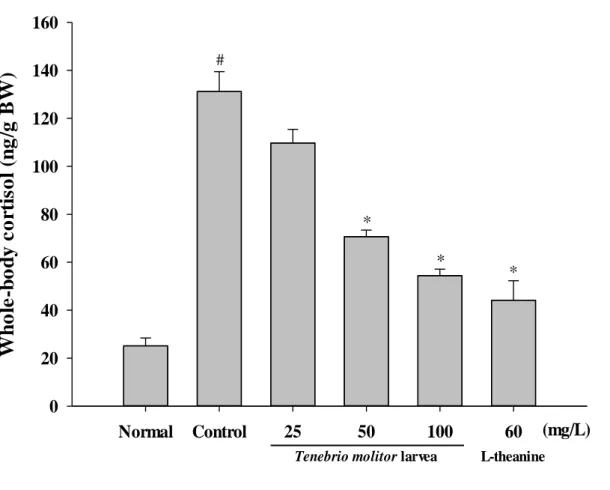
In order to investigate whether changes in the biochemical parameters such as level of whole-body cortisol after stress were normalized or prevented by WTML treatment, we measured level of whole-body cortisol in zebrafish pretreated with WTML (Fig.3). In the unstressed normal control group, the level of whole-body cortisol was 25.14 ± 3.29 ng/g, and this level was significantly higher in the stressed control group (131.22 ± 8.24 ng/g, p < 0.05) which was an approximately 524 % increase after NHS induction (p < 0.05). NHS-induced increases of whole-body cortisol levels were significantly reduced compared to the stressed control group in the presence of WTML and the effect was depended on the tested WMTL concentrations (109.72 ± 5.73, 370.64 ± 2.8, 54.4 ± 2.68 ng/g, respectively by 25, 50, and 100 mg/L WMTL). In addition, L-theanine treatment was also associated with the decreased levels of whole-body cortisol compared to the control group (44.16 ± 8.09 ng/g, p < 0.05).
22
Figure 3. Effect of the water extract of Tenebrio molitor larvae (WTML; 25-100 mg/L) and L-theanine (60 mg/L) on whole-body cortisol in adult zebrafish. The data are expressed as the mean ( S.E.M.) of the whole-body cortisol level. Each bar represents the mean S.E.M. of 6 zebrafish. P values for the group comparisons were obtained by one-way ANOVA followed by Student-Newman-Keuls test (# P < 0.05 compared with the normal control group, * P < 0.05 compared with the
vehicle-treated control group).
Normal Control 25 50 100 60
W
h
o
le
-b
o
d
y
c
o
rt
is
o
l
(n
g
/g
B
W
)
0 20 40 60 80 100 120 140 160Tenebrio molitor larvea L-theanine #
*
*
*
23
4. Electrophysiology test
To investigate the relation between action of WTML and GABAergic, we conducted an electrophysiology test. WTML treatment group does not affect the level of fEPSP. Muscimol of GABA agonist treatment group decrease the level of fEPSP. Cotreatment of muscimol and WTML group does not have a significant difference of the level of fEPSP compared with muscimol group.
WTML (100 µg/ml)
Musciml (5 µM) + WTML (100 µg/ml) Musciml (5 µM)
Figure 4. Effect of the water extract of Tenebrio molitor larvae (WTML; 100 µg/ml) and Muscimol (5 µM) on electrophysiology test in mouse. Cotreatment of muscimol and WTML group does not have a significant difference of the level of field excitatory postsynaptic potential (fEPSP) compared with muscimol group.
24
5. ACTH challenge test
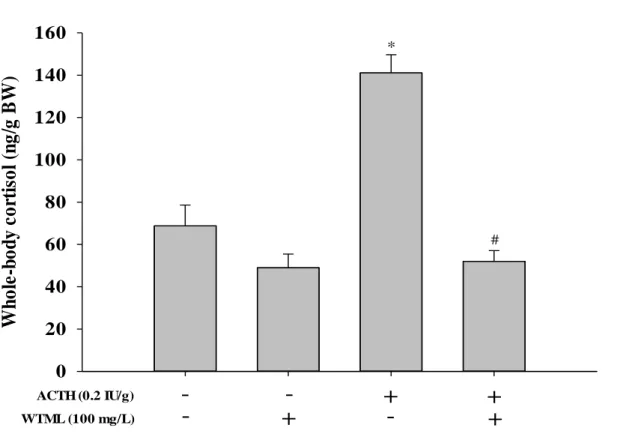
An ACTH challenge was administered after pretreatment with either vehicle or WTML (100 mg/L) to determine whether WTML exerted an inhibitory effect on cortisol secretion from the interrenal glands (Fig.5). A dose of 0.2 IU/g ACTH stimulated cortisol release to an extent comparable to typical stress response levels. WTML completely blocked ACTH induced cortisol secretion.
Figure 5. Increase of cortisol induced by adrenocorticotropic hormone (ACTH) was blocked by the water extract of Tenebrio molitor larvae (WTML; 25-100 mg/L) in ACTH challenge test. The data are expressed as the mean ( S.E.M.) of the whole-body cortisol level (n = 6 zebrafish per group). P values for the group comparisons were obtained by two-way ANOVA followed by Student Newman-Keuls test (* P < 0.05 versus the vehicle-treated control, # P < 0.05 compared with the only ACTH-treated group).
W
h
o
le
-b
o
d
y
co
rt
is
o
l
(n
g
/g
B
W
)
0 20 40 60 80 100 120 140 160-
-
+
+
+
+
-
-ACTH (0.2 IU/g) WTML (100 mg/L) * #25
IV. Discussion
Stress can affect health directly, through neuronal and endocrine responses and also indirectly, through changes in behaviors [25]. Recently it has been proven that chronic or excessive stress induces various negative effects such as anxiety-like behavior, weight changes, and suppression of the immune response in fish [3, 4, 26]. However, so far, only a few studies have been conducted to control stress in fish. In our study, we confirmed that WTML exerts antistress effects by lowering plasma cortisol concentrations in zebrafish.
In fish, cortisol is released in to the blood during the stress-triggered endocrine stress responses due to the activation of the HPI axis [27]. Stress results in changes in behavior, immune function or body weight [3, 5]. Various studies have reported that anxiety-like behavior is related to stress in zebrafish [6, 28]. The NTT and OFT are experiments that evaluate behaviors such as anxiety and stress using the instinctive behaviors of zebrafish to maintain their protection in a novel environment by swimming and remaining at the bottom until they feel safe enough to explore [29]. The NTT and OFT are useful to observe behavior parameters, such as the distance moved, not moving duration and swimming speed. In addition, the NTT is more suitable for observing vertical movement parameters including the duration in top and zone transition frequency, than the OFT. Additionally, the OFT is more suitable for observing horizontal movement parameters related to meandering movement and turn angle. Many authors have mentioned that stressed fish show a significant decrease in their distance moved, zone transition frequency and swimming speed and increased freezing, meandering movements and erratic movement behavior time in
26
behavioral tests [28, 30, 31]. Actually, these parameters could reflect the psychological states of stress or anxiety [14, 17]. We performed of these behavioral tests to determine whether pretreatment with WTML suppresses anxiety-like behaviors induced by NHS. Therefore, we determined some of the behavioral parameters such as total distance moved, duration in the top, swimming velocity, zone transition, turn angle, not moving duration and meandering movement, in both the NTT and OFT to determine anxiety-like behavior in zebrafish.
As a result of the NTT, the stressed control group showed a decrease in the duration in the top, distance moved, velocity, and zone transition; on the other hand, this groups showed an increase not moving duration compared to the unstressed normal control group (Fig.1). In addition, OFT results showed that the stressed control group had increased meandering movement, not moving duration and turn angle measurements, while it showed decreases in the distance moved and movement velocity (Fig.2). Thus, our results show that NHS induces abnormal behaviors in zebrafish. Notably, pretreatment with WTML concentration-dependently prevented the abnormal behaviors of zebrafish induced by stress in both the NTT and OFT. In this study, we observed that pretreatment with WTML could potently recovered the zebrafish from anxiety-like behaviors or reduced locomotor activity induced by NHS in the NTT and OFT at a level comparable to that in the L-theanine, an antistress functional supplement, treatment group.
Takemoto et al demonstrated that stressed behavior is responsible for increasing the levels of cortisol and serotonin [32]. Additionally, in many previous studies, the relationship between the level of cortisol and stress-induced changes in behavior from stress has been confirmed [6, 32]. As the previous study of Keller et al
27
[33], we also revealed that the level of whole-body cortisol of the stressed control group was increased by NHS. Therefore, we speculate that behavioral changes associated with the NHS result due to the increased level of whole-body cortisol. Interestingly, pretreatment with WTML suppressed the NHS-induced whole-body cortisol levels (Fig.3). Therefore, our results suggest that the antistress effects of pretreatment with WTML, which prevents behavioral changes in the NTT and OFT might proceed by suppressing the increase in the whole-body cortisol level.
In previous study, CRH which is synthesized in the paraventricular nucleus (PVN) of the hypothalamus plays an important role in the endocrine stress response. The excitability of CRH neurons is regulated by γ-aminobutyric acid (GABA)-containing neurons projecting to the PVN [34]. Accordingly, we hypothesized that anti-stress effect of WTML is associated with the GABAergic nervous system in zebrafish. However, we could not find the relation between anti-stress effect of WTML and GABAergic nervous system in terms of suppression of cortisol release (Fig.4).
Activation of the HPI axis comprises hypothalamic CRH release, and subsequent stimulation of corticotropic cells in the anterior pituitary to secrete ACTH. ACTH moves through the bloodstream and ligates with the melanocortin 2 receptor (MC2R) of the internal cells of head kidney which is linked to the adenylate cyclase/cyclic adenosine monophosphate/protein kinase A signaling cascade. Initiation of the cyclic adenosine monophosphate-protein kinase A dependent cell signaling cascade in interrenal cells subsequently synthesize and release cortisol into the bloodstream [6, 35]. As shown, we have proven that WTML may effectively block NHS-induced cortisol release (Fig.3). Therefore, we hypothesized that
28
pretreatment with WTML might possess its effects by affecting the HPI axis because the HPI axis is an integral part of the endocrine system which controls the release of cortisol. We investigated whether the release of cortisol by ACTH could be antagonized by the effects of WTML. Consequently, we conducted the ACTH challenge test to observe the effect with WTML on cortisol secretion. We found that pretreatment of WTML associated with complete blockade of the induction of cortisol release by ACTH (Fig.5). The results of this study, suggest that the antistress effects of WTML are mediated through MC2R.
The results presented herein suggest the possibility of WTML as a functional supplement for stress-related disorders. We found that WTML possesses antistress effect with suppression of cortisol secretion via mediation of MC2R. Unfortunately, we could not clearly confirm a mode of action of WTML on MC2R signaling. Nevertheless, the precious mode of action remains to be elucidated, the findings of this study may be important to confirm the medicinal action of WTML. Further studies are warranted to clarify the in-detailed mechanism and active components of
29
V. References
1. Balasch, J.C. and L. Tort, Netting the Stress Responses in Fish. Front
Endocrinol (Lausanne), 2019. 10: p. 62.
2. Daskalova, A., Farmed fish welfare: stress, post-mortem muscle metabolism,
and stress-related meat quality changes. International Aquatic Research,
2019. vol. 11: p. 113.
3. Ellis, T., et al., Cortisol and finfish welfare. Fish Physiol Biochem, 2012.
38(1): p. 163-88.
4. Kirsten, K., et al., First description of behavior and immune system
relationship in fish. Sci Rep, 2018. 8(1): p. 846.
5. Masud, N., A. Ellison, and J. Cable, A neglected fish stressor: mechanical
disturbance during transportation impacts susceptibility to disease in a globally important ornamental fish. Dis Aquat Organ, 2019. 134(1): p. 25-32.
6. Kalamarz-Kubiak, H., Cortisol in Correlation to Other Indicators of Fish
Welfare. Corticosteroids, ed. Ali Gamal Al-kaf2017, London, UK:
IntechOpen.
7. Harper, C. and J.C. Wolf, Morphologic effects of the stress response in fish.
ILAR J, 2009. 50(4): p. 387-96.
8. Kalamarz-Kubiak, H., Cortisol in Correlation to Other Indicators of Fish
Welfare. chapter72017, London, UK: IntechOpen.
9. Stewars, A.V.K.M., Zebrafish Protocols for Neurobehavioral Research.
Adapting the Open Field Test to Assess Anxiety-Related Behavior in Zebrafish. . Vol. 66. 2012: Humana Press, Totowa, NJ.
30
10. Sadoul, B. and B. Geffroy, Measuring cortisol, the major stress hormone in
fishes. Journal of Fish Biology, 2019. 94(4): p. 540-555.
11. Kiilerich, P., et al., Regulation of the corticosteroid signalling system in
rainbow trout HPI axis during confinement stress. Gen Comp Endocrinol,
2018. 258: p. 184-193.
12. Best, C. and M.M. Vijayan, Cortisol elevation post-hatch affects behavioural
performance in zebrafish larvae. Gen Comp Endocrinol, 2018. 257: p.
220-226.
13. Morey, J.N., et al., Current Directions in Stress and Human Immune
Function. Curr Opin Psychol, 2015. 5: p. 13-17.
14. Choi, R.Y., et al., Defatted Tenebrio molitor Larva Fermentation Extract
Modifies Steatosis, Inflammation and Intestinal Microflora in Chronic Alcohol-Fed Rats. Nutrients, 2020. 12(5).
15. Navarro Del Hierro, J., et al., Characterization, antioxidant activity, and
inhibitory effect on pancreatic lipase of extracts from the edible insects Acheta domesticus and Tenebrio molitor. Food Chem, 2020. 309: p. 125742.
16. Huntingford, F.A. and S. Kadri, Defining, assessing and promoting the
welfare of farmed fish. Rev Sci Tech, 2014. 33(1): p. 233-44.
17. Ramsay, J.M., et al., Whole-body cortisol response of zebrafish to acute net
handling stress. Aquaculture, 2009. 297(1-4): p. 157-162.
18. Kyzar, E., et al., Behavioral effects of bidirectional modulators of brain
monoamines reserpine and d-amphetamine in zebrafish. Brain Res, 2013.
31
19. Cachat, J., et al., Unique and potent effects of acute ibogaine on zebrafish:
the developing utility of novel aquatic models for hallucinogenic drug research. Behavioural Brain Research, 2013. 236(1): p. 258-269.
20. Giacomini, A., et al., Fluoxetine and diazepam acutely modulate stress
induced-behavior. Behavioural Brain Research, 2016. 296: p. 301-310.
21. Felix, A.S., et al., Noninvasive measurement of steroid hormones in zebrafish
holding-water. Zebrafish, 2013. 10(1): p. 110-5.
22. Oh, J., et al., Hydrangeae Dulcis Folium Attenuates Physical Stress by
Supressing ACTH-Induced Cortisol in Zebrafish. Chin J Integr Med, 2020.
26(2): p. 130-137.
23. Stewart, A., et al., Pharmacological modulation of anxiety-like phenotypes in
adult zebrafish behavioral models. Prog Neuropsychopharmacol Biol
Psychiatry, 2011. 35(6): p. 1421-31.
24. Wong, K., et al., Analyzing habituation responses to novelty in zebrafish
(Danio rerio). Behavioural Brain Research, 2010. 208(2): p. 450-457.
25. Clyde, J.S. and T. Boyd, The etched cast metal resin-bonded (Maryland)
bridge: a clinical review. J Dent, 1988. 16(1): p. 22-6.
26. Nardocci, G., et al., Neuroendocrine mechanisms for immune system
regulation during stress in fish. Fish Shellfish Immunol, 2014. 40(2): p.
531-8.
27. Aerts, J., et al., Scales tell a story on the stress history of fish. Plos One, 2015.
32
28. Alia, A.O. and M.L. Petrunich-Rutherford, Anxiety-like behavior and
whole-body cortisol responses to components of energy drinks in zebrafish (Danio rerio). PeerJ, 2019. 7: p. e7546.
29. Levin, E.D., Z. Bencan, and D.T. Cerutti, Anxiolytic effects of nicotine in
zebrafish. Physiol Behav, 2007. 90(1): p. 54-8.
30. Egan, R.J., et al., Understanding behavioral and physiological phenotypes of
stress and anxiety in zebrafish. Behavioural Brain Research, 2009. 205(1): p.
38-44.
31. Stewart, A.M., et al., Understanding spatio-temporal strategies of adult
zebrafish exploration in the open field test. Brain Res, 2012. 1451: p. 44-52.
32. Ghisleni, G., et al., The role of CRH in behavioral responses to acute
restraint stress in zebrafish. Prog Neuropsychopharmacol Biol Psychiatry,
2012. 36(1): p. 176-82.
33. Keller, T.L., et al., Halofuginone and other febrifugine derivatives inhibit
prolyl-tRNA synthetase. Nat Chem Biol, 2012. 8(3): p. 311-7.
34. Kakizawa, K., et al., A novel GABA-mediated corticotropin-releasing
hormone secretory mechanism in the median eminence. Sci Adv, 2016. 2(8):
p. e1501723.
35. Lacroix, M. and A. Hontela, Regulation of acute cortisol synthesis by
cAMP-dependent protein kinase and protein kinase C in a teleost species, the rainbow trout (Oncorhynchus mykiss). J Endocrinol, 2001. 169(1): p. 71-8.
33
Abstract in Korean
- 갈색거저리 유충 추출물이 Net Handling Stress 를 유도한 제브라피쉬에
미치는 영향
본 연구는 water extract of Tenebrio molitor larvae (WTML)의 스트레스 예방 효과를 연구하였다. 어류에서 WTML 의 스트레스 예방 효과를 알아보기 위해 제브라피시의 행동 변화와 cortisol 수치를 관찰하였다. 스트레스를 유도하기 위해 물리적 스트레스 방법인 net handling stress (NHS)를 이용하였다. NHS 는 제브라피시를 4 분간 공기 중에 노출시키고 3 분간 물속에서 휴식, 다시 4 분간 공기 중 노출시키는 방법으로 진행되었다. 6 분간 WTML 에 약욕 후 NHS 를 유도하여 novel tank test (NTT), open field test (OFT), whole-body cortisol 수준 측정을 진행하였다. NTT 와 OFT 결과, NHS 를 유도한 대조군은 NHS 를 유도하지 않은 정상군과 비교하여 부동 시간, meandering movement, 회전각이 증가하였고 총 이동거리, 이동속도, 상단에서의 유영 시간이 감소하는 행동 변화가 나타났다. 그러나 25-100 mg/L 농도의 WTML 을 6 분간 전처리한 결과 NHS 로 인한 행동의 변화가 억제되었다(P <0.05). 또한 NHS 를 유도한 대조군은 NHS 를 유도하지 않은 정상군과 비교하여 유의성 있는 whole-body cortisol 수준의 증가가 관찰되었다. 흥미롭게도 25-100 mg/L 농도의 WTML 을 6 분간 전처리한 결과 대조군과 비교하여 유의성 있는 whole-body cortisol 수준의 감소가 나타났다(P <0.05). ACTH (adrenocorticotrophic hormone) challenge test 결과, ACTH 처리에 의한 whole-body cortisol 분비 증가가 WTML 에 의해 현저하게 억제됨을 확인하였다(P <0.05). 이 결과는 WTML 이
34
스트레스로 인한 cortisol 의 분비를 억제하여 스트레스 예방 효과를 가지며 스트레스성 질환의 치료제 또는 기능성 소재 등의 개발에 유용하게 이용될 수 있음을 시사한다.
35 감사의 글 항상 그랬지만 돌이켜보니 유독 짧은 2 년 이였습니다. 많은 분들의 도움으로 외롭지 않고 힘들지 않았던 덕분인 것 같습니다. 미흡하지만 학위논문을 마무리 지으면서 힘이 되어 주신 감사한 분들에게 감사의 말씀을 전합니다. 먼저 부족하고 게으른 제자를 싫은 소리 한번 없이 끝까지 이끌어주시고 항상 진심 어린 조언을 해주신 이승헌 교수님께 깊은 감사의 인사를 전합니다. 그리고 논문 심사를 맡아 주시고 항상 격려를 아끼지 않으시던 김기영 교수님과 박상률 교수님께 감사를 드립니다. 힘들고 외로울 수도 있었던 시간을 함께 툴툴거리면서 웃음으로 채워준 약리방 명예 멤버 재범이와 세희, 같이 화내고 웃어주던 현운이, 실험실 생활을 알려준 지원이, 찾아와 웃음을 주고 안부를 물어주는 원보형, 언제나 웃는 얼굴로 반겨주는 chanaka 와 gihan, 꿈을 이뤄 교수가 된 친절한 친구 hasitha, 도움이 필요할 때 언제나 해결사처럼 나타나는 척척박사 neellaka, 멀리 떨어져 있어도 과하게 옆에 있는 듯한 주훈이 모두의 덕분에 졸업하게 되어 감사의 마음을 진심으로 전합니다. 그리고 가장 힘든 순간에도 가장 기쁜 순간에도 모든 순간을 가장 가까이에서 함께하며 같이 울어주고 웃어준 소중한 단짝 혜영이에게 진심 어린 감사를 전합니다. 마지막으로 끝없는 사랑과 믿음으로 언제나 세상 누구보다 행복함을 느끼게 해주시는 부모님에게 감사의 인사를 전합니다. 부족한 아들이지만
36 앞으로 더 자랑스러운 아들이 되어 부모님의 은혜에 보답할 수 있도록 노력하겠습니다. 한 분 한 분 언급하지 못하였지만 저를 아끼고 사랑해 주신 모든 분들께 다시 한번 진심으로 감사드립니다. 2021 年 02 月 이 정 원