333
유효성과 안전성 평가
Efficacy and Safety of Alfuzosin 10 mg Once Daily in Patients with Lower Urinary Tract Symptoms
Suggestive of Benign Prostatic Hyperplasia:
A 6-Months Study in Real Life Practice
Seung Wook Lee, Seung Hwan Lee1, Cheol Young Oh2, Byung Ha Chung1
From the Depatment of Urology, Eulji University College of Medicine, and
1Urological Science Institute, Yonsei University College of Medicine, Seoul, and
2Hallym University College of Medicine, Chuncheon, Korea, Korean Alfuzosin Study Group
Purpose: The aim of the study was to evaluate the long-term safety profile and efficacy of Alfuzosin 10 mg once daily in patients with lower urinary tract symptoms (LUTS) suggestive of benign prostatic hyperplasia (BPH), under daily practice conditions in Korea.
Materials and Methods: In this 6-months, open-label, multicenter, non- comparative, observational study, 511 men were enrolled. International Prostate Symptom Score (IPSS), IPSS 8th question (bother score), maximum flow rate (Qmax), Danish Prostate Symptom Score (DAN-PSS) were evaluated at baseline and after 3, 6 months of treatment. Safety was analyzed in all patients exposed to alfuzosin (n=480). Analysis was performed at end-point in the intent to treat population (n=368).
Results: Of the 511 enrolled patients in the study, 218 patients (42.7%) dropped out. With alfuzosin, IPSS and bother score significantly improved from baseline by −6.7±6.4 (−31.9%, p<0.001) and −1.2±1.2 (−29.3%, p
<0.001), respectively. Nocturia also significantly improved from 2.3±1.3 at baseline to 1.8±1.0 at end-point (−0.6±1.1, p<0.001). In the subgroup of patients likely to be obstructed (Qmax <10 ml/sec at baseline), Qmax improved from 8.3±1.2 at baseline to 13.7±6.1 at end-point (+5.4±5.8, p=0.001). In patients with pain/discomfort on ejaculation, weighted score significantly improved from 2.4±2.2 at baseline to 1.5±1.9 at end-point (−31%, p=0.002). There were no clinically relevant changes in sitting systolic BP and diastolic BP at endpoint.
Conclusions: Alfuzosin 10 mg once daily administered for 6-months is effective in improving LUTS and quality of life, and is well tolerated from a sexual and cardiovascular perspective, including in elderly men and those receiving anti-hypertensive co-medication. (Korean J Urol 2009;
50:333-339)
Key Words: Prostatic hyperplasia, Alfuzosin
Korean Journal of Urology Vol. 50 No. 4: 333-339, April 2009 DOI: 10.4111/kju.2009.50.4.333
을지대학교 의과대학 을지병원
비뇨기과학교실, 1연세대학교
의과대학 비뇨기과학교실,
비뇨의과학연구소, 2한림대학교
의과대학 비뇨기과학교실, Alfuzosin 연구자 모임
이승욱ㆍ이승환1ㆍ오철영2ㆍ정병하1
Received:December 5, 2008 Accepted:February 11, 2009 Correspondence to: Byung Ha Chung
Department of Urology, Urological Science Institute, Yonsei University College of Medicine, 146-92, Dogok-dong,
Gangnam-gu, Seoul 135-720, Korea
TEL: 02-3497-3474 FAX: 02-3462-8887 E-mail: chung646@yumc.
yonsei.ac.kr
Ⓒ The Korean Urological Association, 2009
서 론
전립선비대증 (benign prostatic hyperplasia; BPH)은 남성
노화에 따라 유병률이 증가하는 질환으로 60대의 나이에서 약 50%의 조직학적 유병률을 보이며 80세에 이르러서는 남 성의 대부분이 가지고 있을 정도로 유병률이 높은 질환이 다.1 현재와 같이 빠르게 고령화 사회로 되어가는 추세에서
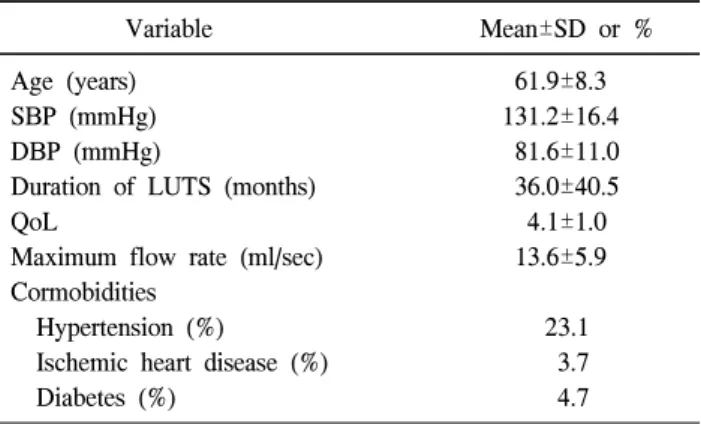
Table 1. Demographic and other baseline characteristics (n=511) Variable Mean±SD or %
Age (years) 61.9±8.3
SBP (mmHg) 131.2±16.4
DBP (mmHg) 81.6±11.0
Duration of LUTS (months) 36.0±40.5
QoL 4.1±1.0
Maximum flow rate (ml/sec) 13.6±5.9 Cormobidities
Hypertension (%) 23.1
Ischemic heart disease (%) 3.7
Diabetes (%) 4.7
SBP: systolic blood pressure, DBP: diastolic blood pressure, LUTS: lower urinary tract symptoms, QoL: quality of life 전립선비대증 환자의 유병률 또한 빠르게 증가할 것이며
더불어 삶의 질을 중요시 여기는 노인 인구층의 경제력이 상승함에 따라 적극적으로 치료를 원하는 환자의 비율도 증가할 것이다.
BPH의 치료에는 크게 수술적 치료와 약물적 치료 두 가 지로 나누어 볼 수 있다. Han 등2은 우리나라에서 BPH로 치료받고 있는 환자가 급격한 증가추세를 보이며 이 중 약 물적 치료의 비율이 점차 증가하고 일차적 치료로 자리 잡 고 있음을 보고한 바 있다. 약물 치료 중에서 선택적 알파차 단제는 하부요로의 증상을 완화시키는데 중요한 치료약물 이며 현재 가장 일반적으로 사용되는 약물이다. 이들 알파 차단제는 전립선과 하부요로에서 교감신경의 알파수용체 자극을 억제하여 평활근 긴장을 감소시켜 소변의 배출을 쉽게 하고 요속을 개선시킨다. 하지만 알파차단제는 체위 성 저혈압, 두통, 어지럼증 등의 부작용들도 일으키는 것이 사실이다. BPH 환자를 대상으로 장기적인 알파차단제 치료 를 할 때 다른 약물 등의 투여가 많은 노령임을 고려하면 장기간 투여 후에도 계속해서 효과가 유지되어야 하고, 부 작용으로 인한 투여 중단이 적어야 하며, 기존의 일상생활 을 유지할 수 있어야 한다.
이에 본 연구에서는 일상적인 한국의 의료 환경 하에서 알파차단제의 일종인 alfuzosin 10 mg을 6개월간 투여 받은 대규모의 환자들에서 그 유효성 및 안전성, 그리고 이에 영 향을 미치는 요인들에 대한 자료를 다기관에서 수집하고, 이를 분석하였다.
대상 및 방법 1. 연구대상
14개 병원 비뇨기과 외래를 방문한, 전립선비대증을 시 사하는 하부요로증상 (lower urinary tract symptoms; LUTS) 을 가진 환자를 대상으로 2003년 5월부터 2004년 8월까지 전향적 연구를 실시하였으며 구체적인 포함기준 (inclusion criteria)은 전립선비대증을 시사하는 하부요로증상 즉 저장 증상 (빈뇨, 야간뇨, 요절박) 또는 배뇨증상 (소변주저, 약 뇨, 불완전방광비우기, 단속뇨)이 있으며 연구에 동의한 환 자를 대상으로 하였다. 제외기준 (exclusion criteria)은 전립 선비대증과 관련되어 수술이 필요하거나, 과거 알파 1 차단 제 치료에 효과가 없었던 경우, alfuzosin에 과민반응을 보이 는 경우, 기립성저혈압의 과거력이 있는 경우, 다른 알파 1 차단제를 복용하고 있는 경우, 불완전 협심증이 있는 경우 등이다. 총 511명의 환자들이 본 연구를 위해 등록되었고, 218명 (42.7%)이 중도 탈락하여 총 293명 (57.3%)이 시험을 완료하였다. 중도 탈락 사유로는 추적 중 탈락 (lost to
follow-up)이 147명으로 가장 많았으며, 약물효과가 충분하 지 않은 경우가 38명, 증상의 호전에 의해 약물복용의 필요 성이 없어진 경우가 18명, 이상반응에 의해 중도 탈락한 경 우가 15명 순이었다.
연구시작 시점에서 환자들의 평균 연령은 61.9±8.3세, BPH의 유병기간은 36.0±40.5개월이었다. 기타 등록된 전체 환자군 (n=511)의 인구학적 특징은 Table 1과 같다.
2. 연구방법
전립선비대증에 의한 요폐색 및 배뇨장애에 대한 alfu- zosin의 용법은 1일 1회 10 mg을 투여하였다. 환자는 임상 시험 기초방문 및 투여 3개월, 6개월째에 내원하여 유효성 및 안전성 검사를 실시하였다. 유효성 평가를 위한 항목으 로 각 방문 시의 국제전립선증상점수 (International Prostate Symptom Score; IPSS) 및 삶의 질 점수 (quality of life; QoL), 최대요속 (maximum flow rate; Qmax), Danish Prostate Symptom Score (DAN-PSS) 등을 조사하였다. 안전성 평가를 위하여 신체기관, 질환/증후군별 이상반응 발현 상황을 관 찰하였다. 또한 혈압에 미치는 영향을 보기 위해 수축기와 이완기 혈압의 변화와 심박동수를 관찰하였다.
3. 통계분석방법
유효성 분석은 윈도우용 SPSS (Ver. 12.0, SPSS Inc.)를 사 용하였으며 intent to treat (ITT)군을 대상으로 Student’s t-test (paired), two sample t-test를 이용하여 p값이 0.05 미만일 때 통계적으로 유의한 것으로 판정하였다. 안전성 분석은 동 일한 통계프로그램을 이용하여 적어도 1회 이상 alfuzosin 10 mg을 복용하고, 최소 1회 이상의 추가방문에서 유효한 자료를 획득한 480명에 대해 실시하였다.
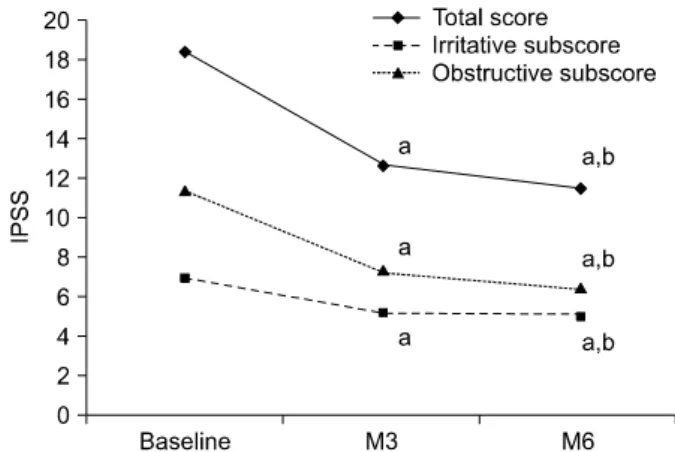
Fig. 1. The improvement of lower urinary tract symptoms (LUTS) following treatment with alfuzosin 10 mg once daily. IPSS:
International Prostate Symptom Score (observed case at each visit).
a: p<0.001 vs. baseline, b: p<0.05 vs. M3.
Table 2. Changes in IPSS, QoL, Qmax, heart rate and blood pressure from baseline to endpoint (Mean±SD)
Baseline End point Change (n)
Irritative subscore (IPSS) 6.9±3.5 5.0±2.8 −1.9±2.9 (368)a
Obstructive subscore (IPSS) 11.5±4.9 6.8±4.3 −4.7±4.7 (368)a
Nocturia criterion (IPSS) 2.3±1.3 1.8±1.0 −0.6±1.1 (368)a
QoL 4.0±1.0 2.8±1.1 −1.2±1.2 (368)a
Qmax 14.4±5.9 15.6±6.2 1.2±6.7 (62)
Heart rate (bpm) 75.5±11.6 76.5±10.1 1.0±10.8 (348)
SBP (mmHg) 131.2±16.4 129.2±14.2 −2.0±14.3 (355)
DBP (mmHg) 81.6±11.0 80.6±10.1 −0.9±11.3 (355)
IPSS: International Prostate Symptom Score, QoL: quality of life, Qmax: maximun flow rate, bpm: beat per minute, SBP: systolic blood pressure, DBP: diastolic blood pressure, a: p<0.05 vs. baseline
Fig. 2. The improvement of weighted score following treatment with alfuzosin 10 mg once daily. DAN-PSS weighted item: Danish Prostate Symptom Score (observed case at each visit). a: p<0.05 vs. baseline, b: p<0.05 vs. M3.
결 과 1. 유효성 평가
최소 1회 이상 alfuzosin 10 mg을 복용하고 기초방문과 최 소 1회 이상의 추가방문에서 IPSS 평가를 실시한 368명에 대하여 유효성 분석을 실시하였다.
IPSS의 총 점수는 기초방문 시 18.4±7.0점에서 최종방문 시 평균 변화 −6.4±6.4점으로 통계적으로 유의한 호전을 보였으며 (p<0.001), 각 방문별로 관찰한 IPSS의 총 점수는 투여 3개월째 12.7±6.3점 (n=358), 투여 6개월째 11.8±6.3점 (n=291)으로 투여기간이 길어짐에 따라 증상점수도 낮아지 는 경향을 보였다 (Fig. 1). IPSS 하위점수인 자극증상점수 (irritative subscore), 폐색증상점수 (obstructive subscore), 야 간뇨점수 (nocturia criterion) 역시 통계적으로 유의한 호전 을 보였다. QoL은 기초방문 시 4.0±1.0점에서 최종방문 시
2.8±1.1점으로 삶의 질이 통계적으로 유의하게 개선됨을 알 수 있었다 (평균 변화 −1.2±1.2점, p<0.001) (Table 2). Qmax 는 최종방문 시 15.6±6.2 ml/sec로 기초방문 시의 14.4±5.9 ml/sec와 비교하여 통계적으로 유의한 호전을 보이지 않았 지만 (p=0.155), 기초방문 시 Qmax가 10 ml/sec 미만이었던 환자의 소집단 분석에서는 평균치가 5.4±5.8 ml/sec 증가하 여 유의한 호전을 보였다 (p=0.001).
기초방문 시의 혈압에 따라 고혈압군과 정상혈압군으로 분류하였을 때 고혈압군은 112명, 정상혈압군은 368명이었 으며, IPSS나 QoL에서는 두 군 간의 차이가 없었다. DAN- PSS에서 기초방문 시 발기강직도 감소, 사정량 감소, 사정 불쾌감/통증의 성기능장애를 보인 환자는 각각 80.6%, 78.0%, 19.7%였다. 발기강직도 감소 및 사정량 감소에 관한 DAN-PSS 가중점수 (weighted score 1Ax1B, 2Ax2B)는 유의 한 변화가 없었지만, 사정불쾌감/통증이 있었던 환자의 가 중점수 (weighted score 3Ax3B)는 기초방문 시 2.4±2.2에서
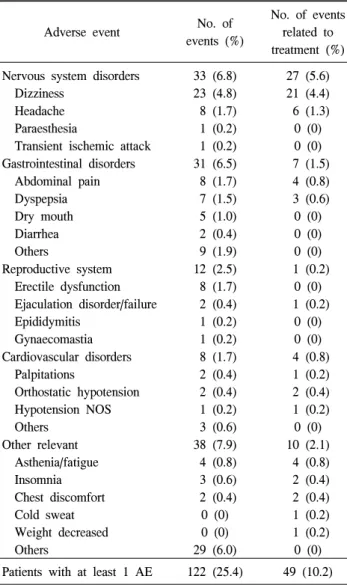
Adverse event No. of events (%)
No. of events related to treatment (%) Nervous system disorders
Dizziness Headache Paraesthesia
Transient ischemic attack
33 (6.8) 23 (4.8) 8 (1.7) 1 (0.2) 1 (0.2)
27 (5.6) 21 (4.4) 6 (1.3) 0 (0) 0 (0) Gastrointestinal disorders
Abdominal pain Dyspepsia Dry mouth Diarrhea Others
31 (6.5) 8 (1.7) 7 (1.5) 5 (1.0) 2 (0.4) 9 (1.9)
7 (1.5) 4 (0.8) 3 (0.6) 0 (0) 0 (0) 0 (0) Reproductive system
Erectile dysfunction Ejaculation disorder/failure Epididymitis
Gynaecomastia
12 (2.5) 8 (1.7) 2 (0.4) 1 (0.2) 1 (0.2)
1 (0.2) 0 (0) 1 (0.2)
0 (0) 0 (0) Cardiovascular disorders
Palpitations
Orthostatic hypotension Hypotension NOS Others
8 (1.7) 2 (0.4) 2 (0.4) 1 (0.2) 3 (0.6)
4 (0.8) 1 (0.2) 2 (0.4) 1 (0.2) 0 (0) Other relevant
Asthenia/fatigue Insomnia Chest discomfort Cold sweat Weight decreased Others
38 (7.9) 4 (0.8) 3 (0.6) 2 (0.4) 0 (0) 0 (0) 29 (6.0)
10 (2.1) 4 (0.8) 2 (0.4) 2 (0.4) 1 (0.2) 1 (0.2) 0 (0) Patients with at least 1 AE 122 (25.4) 49 (10.2) AE: adverse events, NOS: not organ specific
Table 3. Frequency of adverse events under exposure to alfuzosin 10 mg (n=480)
Table 4. Comparison of changes in heart rate, blood pressure between hypertensive and normotensive group (Mean±SD)
Baseline End point Baseline End point
––––––––––––––––––––––––––––––––––––––––––––––– –––––––––––––––––––––––––––––––––––––––––––––––
Hypertensive group (n=112) Normotensive group (n=368)
Heart rate (bpm) 74.2±10.7 77.5±9.4a 76.0±11.9 76.2±9.4a
SBP (mmHg) 137.7±18.0 135.3±16.0a 129.1±15.2 127.2±12.9a
DBP (mmHg) 87.4±11.9 84.7±11.4a 80.5±10.5 79.3±9.3a
bpm: beat per minute, SBP: systolic blood pressure, DBP: diastolic blood pressure, a: p>0.05 vs. baseline 최종방문 시 1.5±1.9로 유의하게 개선되었다 (−31%, p=
0.002). 각 방문별로 관찰한 DAN-PSS 가중점수의 변화는 Fig. 2와 같다.
2. 안전성 평가
총 480명의 환자 중 93명 (19.4%)으로부터 총 122건 (25.4%)의 이상반응이 보고되었고, 이 중 약물과 관련된 이 상반응은 어지럼증이 21건 (4.4%)으로 가장 많았고, 두통이 6건 (1.3%), 복통이 4건 (0.8%), 저혈압, 소화불량이 각각 3 건 (0.6%), 불면증, 흉부불편감, 쇠약 및 피로가 각각 2건 (0.4%)이었다. 실신은 보고되지 않았으며 사정장애 (0.4%) 는 드물었다 (Table 3).
혈압에 미치는 alfuzosin 10 mg의 영향을 관찰해보면 기 초방문 시 131.2±16.4/81.6±11.0 mmHg이던 수축기/이완기 혈압이 최종방문 시 129.2±14.2/80.6±10.1 mmHg로 변화하 여 통계적으로 유의한 감소 소견은 없었다 (p=0.155) (Table 2). 어지럼증이 발생한 21명의 경우 기초방문 시 134.6±
17.2/83.7±13.2 mmHg이던 수축기/이완기혈압이 최종방문 시 121.3±13.1/78.8±12.4 mmHg로 변화하여 통계적으로 유 의한 감소 소견을 나타냈다 (p=0.03). 정상혈압군 (112명), 고혈압군 (368명)으로 분류하여 분석 시에도 혈압에 대한 영향은 미미했다. 즉, 정상혈압군에서는 약물 투여 후 혈압 의 감소가 미미하였고, 고혈압군에서는 기초방문 시 137.7±
18.0/87.4±11.9 mmHg이던 수축기/이완기혈압이 최종방문 시 135.3±16.0/84.7±11.4 mg으로 감소하였지만 통계적으로 유의하지는 않았다 (p>0.05) (Table 4).
기초방문 시 혈압강하제의 병용유무에 따른 최종방문 시 혈압변화의 양상을 분석하였을 때 혈압강하제를 병용한 군 (112명)과 병용하지 않은 군 (368명) 간의 최종방문 시 수축 기/이완기 혈압 변화에서 통계적으로 유의한 차이는 없었 으며, 두 군 모두 기초방문에 비해 혈압이 유의하게 감소된 소견은 없었으며 65세를 기준으로 시행한 혈압 변화의 정 도에서도 통계학적으로 유의한 변화는 없었다 (Fig. 3). 전 반적인 탈락률은 42.7% (511명 중 218명)였으며, 이상반응 과 연관된 탈락률은 2.9% (511명 중 15명)였다.
Fig. 3. Comparison of changes in blood pressure by sub-groups.
a: p>0.05 vs. baseline, b: p>0.05 vs. not treated group, c: p>0.05 vs. ≥65 years old group.
고 찰
본 연구에서의 alfuzosin 10 mg을 6개월간 투여 후 관찰한 결과에서는 과거 위약 대조 3상 임상시험에서 이미 보여 주었던 것과 같이 alfuzosin 10 mg의 높은 효용성과 안전성 을 보여주었다.3-6 더 나아가 환자 중 46.7%가 치료 첫 주안 에 야간빈뇨 증상의 의미 있는 호전과 삶의 질 지수의 개선 을 보일 만큼 약효의 발현이 빨랐다.
국내에서는 과거 alfuzosin의 유효성에 대한 연구가 발표 되지 않아 동일 약제와 비교할 수는 없으나 Joung 등7의 보 고에서 tamsulosin 0.2 mg을 3개월 투여하였을 때 증상점수 는 7.7±6.9 감소하였고 최대요속은 1.7±5.3 ml/sec 증가하였 으며 Nickel 등8의 보고에서는 증상점수는 7.0±6.4의 감소를 보였으며 최대요속은 2.1±4.7 ml/sec 증가를 나타냈다. 증상 점수에 있어 본 연구결과는 위 결과와 일맥상통하여 3개월 에 5.5±6.0, 6개월에 6.4±6.4의 감소치를 보였다. 최대요속에 있어 본 연구 결과는 기초방문 시와 비교하여 최종방문 시 1.2±6.1 ml/sec 증가한 결과로 나와 타 연구 결과와 다르게 유의한 호전을 보이지 않았다. 그러나 기초방문 시 최대요 속이 10 ml/sec 미만의 대상군에서는 기초방문 시와 비교하 여 최종방문 시 최대요속이 5.4±5.8 ml/sec 증가함을 나타냈 다. 이는 타 연구에서는 기초 방문 시 연구 대상군 설정에 있어 최대요속에 제한을 둔 반면 본 연구에서의 포함기준 에는 최대요속에 제한을 두지 않아서 최대요속에 대한 결 과가 다르게 나타났다고 생각한다.
일반적으로 BPH의 치료로 가장 효과적인 방법은 경요도 전립선절제술이지만 이는 침습적인 방법으로 수술에 대한 환자들의 거부감과 수술로 인한 합병증 등이 있어 다양한
다른 치료법들이 사용되고 있으며 이 중 약물 요법은 환자 들이 쉽게 접근할 수 있다는 점과 치료 효과가 좋다는 점으 로 점차 사용이 증가하는 추세이다.9,10 BPH가 만성질환이 라는 점에서 장기적으로 약물 치료를 사용할 때 안전하고 또한 지속적인 효과가 있는 것이 중요하다.
Alfuzosin이 토끼의 해면체에 대해 직접적인 이완작용이 있다는 연구보고가 있다.11 또한 apomorphine의 발기 능력을 강화시켜준다는 연구보고도 있다.12 이 외에도 alfuzosin이 성기능 개선에 도움이 된다는 보고가 있다.13,14 국내에서도 알파차단제인 doxazosin이 전립선비대증 환자에서 성기능 을 향상시킨다는 연구 보고가 있다.15 본 연구에서는 약물 투여 후 성기능 평가에 있어 통계학적으로 의미 있는 변화 가 없었다. 이와 같은 결과는 LUTS를 완화시키기 위해 사 용한 alfuzosin으로 인해 사정 시의 불편함, 발기부전, 사정 량의 감소에 있어 DAN-PSS를 통해 뚜렷한 개선이 있었다 는 보고를 한 van Moorselaar 등16의 연구 결과나 Brief Sexual Function Inventory (BSFI)를 이용한 Elhilali 등17의 연 구 결과와는 차이가 있었다. 향후 이에 대하여 더 진행된 연구가 필요하리라 생각된다. 본 연구에서의 alfuzosin 사용 으로 인해 사정기능의 장애가 생기는 유병률이 낮다는 것 은 (0.2%) 과거의 alfuzosin의 임상시험의 결과와 일치한다.3-6 본 연구는 추적 관찰 중 환자의 탈락률이 타 연구에 비해 높다는 제한점이 있으며, 연구 결과 alfuzosin 10 mg 투여 후 6개월간의 추적관찰을 통해 나타난 전립선비대증 환자 의 탈락률은 42.7%로 Nickel 등8이 보고한 alfuzosin 10 mg 투여 후 6개월간의 추적관찰의 탈락률 19.3%에 비해 높게 나타났으며, 기간의 차이는 있으나 국내의 Chung 등18,19이 보고한 doxazosin GITS 투여 후 2개월간의 추적관찰의 탈락 률 8.7%에 비해서는 높았고, 12개월간의 추적관찰의 탈락 률 61%에 비해서는 낮았다.
일반적으로 약제가 혈압에 미치는 영향을 알아보기 위해 서 앉은 자세 또는 선 자세와 누운 자세에서의 혈압측정이 필요하나 본 연구에서는 앉은 자세에서만 혈압을 측정한 제한점이 있다. 추후 연구에서는 자세변화에 따른 혈압의 측정이 필요하리라 생각한다. 본 연구는 alfuzosin 10 mg이 심혈관계에 대한 내약성이 우수하다는 것을 보여 주고 있 다. 고혈압은 BPH처럼 나이가 증가함에 따라 유병률이 증 가하여 70세에는 약 50%에 이르는 흔한 질환으로 BPH 환 자의 약 44-50%가 고혈압을 동반하고 있다.20,21 따라서 장기 간의 약물투여 시 고령의 환자에게 있어 혈압변화의 안전 성은 매우 중요하다. 이와 관련하여 본 연구에서는 혈관확 장과 연관되어 가능한 이상반응은 낮았다. 가장 흔하게 보 고된 것은 어지럼증 (4.8%)이었다. Alfuzosin 10 mg은 노인 층 (연령≥65세)에서의 혈압과 혈압강하제를 복용하는 군,
고혈압을 가지고 있는 군에서 의미 있는 영향은 없었다. 이 러한 결과는 이전에 보고되었던 alfuzosin 10 mg 매일 복용 의 실제 임상에서의 보고들과 일치한다.22 이는 tamsulosin과 그 외의 선택적인 알파 차단제의 장점과도 비교된다.12 Tamsulosin과의 직접적인 비교시험에서 tamsulosin의 1년간 의 부작용 21%, 약물로 인한 직접적인 부작용 8%, 3년간의 부작용 59%, 약물로 인한 직접적인 부작용 15%로 두 약제 모두 비슷한 심혈관계의 내약성을 나타냈으나 혈압의 변화 에 있어서는 tamsulosin보다 alfuzosin의 변화가 더 낮았다.6 심혈관계에 대한 alfuzosin의 높은 안전성은 alfuzosin의 전 립선 내에서의 선택적인 작용분포에 기인한다고 할 수 있 다.23
이번 보고는 alfuzosin 10 mg을 6개월까지 투여한 결과를 바탕으로 분석한 것으로서, BPH에 사용되는 대부분의 약제 들이 장기간 복용을 필요로 한다는 점에 비추어 보아, 이번 연구가 향후 alfuzosin의 장기간 사용에 대한 유효성과 안전 성에 연구에 대해 매우 유용한 자료가 될 수 있을 것으로 생각한다.
결 론
Alfuzosin 10 mg을 6개월간 투여 받은 환자에서 IPSS, QoL, Qmax를 유의하게 개선시켰으며, 내약성이 우수하였 다. 일상적인 임상적 환경 하에서 실시된 본 연구는 alfu- zosin이 한국의 BPH 환자들의 임상적 증상을 개선시키는 데 있어서 효과적이며 안전하였고 특히, 고혈압과 동반된 경우 매우 효과적임을 확인하였다. 향후 본 약제의 장기간 의 유효성과 안전성을 알아보기 위하여 추적 관찰이 필요 하리라 생각한다.
ACKNOWLEDGEMENTS
The following investigators participated in the Alfuzosin study group:
Se Joong Kim (Ajou University College of Medicine), Chun Il Kim (Keimyung University College of Medicine), Chul Sung Kim (Chosun University College of Medicine), Choung Soo Kim (Ulsan University College of Medicine), Choong Hee Noh (Inje University College of Medicine), Woo Chul Moon (Chung-Ang University College of Medicine), Choal Hee Park (Keimyung University College of Medicine), Soo Bang Ryu (Chonnam National University College of Medicine), Hwan Cheol Son (Seoul National University College of Medicine), Jae Mann Song (Yonsei University Wonju College of Medicine),
Sang Eun Lee (Seoul National University College of Medicine), Jeong Gu Lee (Korea University Collegeof Medicine), Hyuk Soo Chang (Keimyung University College of Medicine), Young Beom Jeong (Chonbuk National University College of Medicine), Hee Chang Jung (Yeungnam University College of Medicine).
REFERENCES
1. Berry SJ, Coffey DS, Walsh PC, Ewing LL. The development of human benign prostatic hyperplasia with age. J Urol 1984;132:474-9
2. Han KS, Hong SJ, Chung BH. Changing trends in the management of benign prostatic hyperplasia during recent 5 years. Korean J Urol 2005;46:458-62
3. van Kerrebroeck P, Jardin A, Laval KU, van Cangh P. Efficacy and safty of a new prolonged release formulation of alfuzosin 10 mg once daily versus alfuzosin 2.5 mg thrice daily and placebo in patients with symptomatic benign prostatic- hyperplasia. Eur Urol 2000;37:306-13
4. Roehrborn CG. Efficacy and safty of once-daily alfuzosin in the treatment of lower urinary tract symptoms and clinical benign prostatic hyperplasia: a randomized, placebo-controlled trial. Urology 2001;58:953-9
5. Roehrborn CG, Van Kerrebroeck P, Nordling J. Safty and efficacy of alfuzosin 10 mg once-daily in the treatment of lower urinary tract symptoms and clinical benign prostatic hyperplasia: a pooled analysis of three double-blind, placebo- controlled studies. BJU Int 2003;92:257-61
6. Nordling J. Efficacy and safty of two doses (10 and 15 mg) of alfuzosin or tamsulosin (0.4 mg) once daily for treating symptomatic benign prostatic hyperplasia. BJU Int 2005;95:
1006-12
7. Joung JY, Park JK, Park CH, Lee JG, Chung BH, Hong SJ, et al. The role of alpha 1(A) adrenoceptor antagonist tam- sulosin for the treatment of patients with benign prostatic hyperplasia: the effect on lower urinary tract symptoms and nocturia. Korean J Urol 2006;47:1-6
8. Nickel JC, Elhilali M, Emberton M, Vallancien G. The beneficial effect of alfuzosin 10 mg once daily in ‘real-life' practice on lower urinary tract symptoms (LUTS), quality of life and sexual dysfunction in men with LUTS and painful ejaculation. BJU Int 2006; 97:1242-6
9. Christensen MM, Bruskewitz RC. Clinical manifestations of benign prostatic hyperplasia and indications for therapeutic intervention. Urol Clin North Am 1990;17:509-16
10. Dorflinger T, England DM, Madsen PO, Bruskewitz RC.
Urodynamic and histological correlates of benign prostatic hyperplasia. J Urol 1988;140:1487-90
11. Palea S, Barras M. Comparison of the relxant effects of alfuzosin, phentolamine and sildenafil on rabbit isolated corpus cavernosum. BJU Int 2003;91:873-7
12. Mayoux E, Ramirez JF, Pouyet T, Barras M, Arbilla S, Galzin AM. Alfuzosin improves penile erection triggered by apomor- phine in spontaneous hypertensive rats. Eur Urol 2004;45:
110-6
13. Vallancien G, Emberton M, Harving N, van Moorselaar RJ;
Alf-One Study Group. Sexual dysfunction in 1274 European men suffering from lower urinary tract symptoms. J Urol 2003;169:2257-61
14. Sak SC, Hussain Z, Johnston C, Eardley I. What is the relationship between male sexual function and lower urinary tract symptoms (LUTS)? Eur Urol 2004;46:482-7
15. Cho YH, Kim DG, Lee KS. Effects of doxazosin on sexual function in patients with benign prostatic hyperplasia. Korean J Urol 2004;45:130-4
16. van Moorselaar RJ, Hartung R, Emberton M, Harving N, Matzkin H, Elhilali M, et al. Alfuzosin 10 mg once daily improves sexual function in men with lower urinary tract symptoms and concomitant sexual dysfunction. BJU Int 2005;95:603-8
17. Elhilali M, Emberton M, Matzkin H, van Moorselaar RJ, Hartung R, Harving N, et al. Long-term efficacy and safety of alfuzosin 10 mg once daily: a 2-year experience in ‘real- life' practice. BJU Int 2006;97:513-9
18. Chung BH, Park EK, Hong SJ. The efficacy and safty of
doxazosin GITS in patients with benign prostatic hyperplasia.
Korean J Urol 2004;45:667-73
19. Chung BH, Kim YS, Hong SJ. 12-month follow-up study to evaluate the efficacy and safty of doxazosin GITS in patients with benign prostatic hyperplasia. Korean J Urol 2005;46:
451-7
20. Schulman CC, Cortvriend J, Jonas U, Lock TM, Vaage S, Speakman MJ. Tamsulosin: 3-year long-term efficacy and safty in patients with lower urinary tract symptoms suggestive of benign prostatic obstruction: analysis of a European, multinational, multicenter, open-label stydy. European Tamsulosin Study Group. Eur Urol 1999;36:609-20
21. Bourke JB, Griffin JP. Hypertension, diabetes mellitus, and blood groups in benign prostatic hypertrophy. Br J Urol 1966;38:18-23
22. Hartung R, Matzkin H, Alcaraz A, Emberton M, Harving N, van Moorselaar J, et al. Age, comorbidity and hypertensive co-medication do not affect cardiovascular tolerability of 10mg alfuzosin once daily. J Urol 2006;175:624-8
23. Mottet N, Bressolle F, Delmas V, Robert M, Costa P. Prostatic tissual distribution of alfuzosin in patients with benign prostatic hyperplasia following repeated oral administration.
Eur Urol 2003;44:101-5