ORIGINAL ARTICLE
대구, 경북 지역의 Helicobacter pylori 제균 치료의 연도별 제균율 변화: 13년간의 다기관 연구
정연수, 이시형, 박찬서, 오명진, 김경옥, 장병익, 전성우
1, 정민규
1, 박경식
2, 김은수
2, 조광범
2, 정진태
3, 권중구
3, 김은영
3, 김완중
4, 양창헌
5영남대학교 의과대학, 경북대학교 의학전문대학원1, 계명대학교 의과대학2, 대구가톨릭대학교 의과대학3, 순천향대학교 의과대학 구미병원4, 동국대학교 의과대학 경주병원5 내과학교실
Trends in the Eradication Rates of Helicobacter pylori Infection in Daegu and Gyeongsangbuk-do, Korea: Multicenter Study over 13 Years
Yeoun Su Jung, Si Hyung Lee, Chan Seo Park, Myung Jin Oh, Kyeong Ok Kim, Byung Ik Jang, Seong Woo Jeon1, Min Kyu Jung1, Kyung Sik Park2, Eun Soo Kim2, Kwang Bum Cho2, Jin Tae Jung3, Joong Goo Kwon3, Eun Young Kim3, Wan Jung Kim4 and Chang Heon Yang5
Department of Internal Medicine, Yeungnam University College of Medicine, Kyungpook National University School of Medicine1, Keimyung University College of Medicine2, Catholic University of Daegu School of Medicine3, Daegu, Soonchunhyang University Gumi Hospital, Soonchunhyang University College of Medicine, Gumi4, Dongguk University Gyeongju Hospital, Dongguk University College of Medicine, Gyeongju5, Korea
Background/Aims: The eradication rates of Helicobacter pylori infection have been reported to have decreased over the years due to antibiotics resistance. The aim of this study is to investigate the trend of eradication rates of first-line triple therapy for H. pylori over the past 13 year period, and to evaluate factors affecting H. pylori eradication in Daegu and Gyeongsangbuk-do, Korea.
Methods: A total of 2,982 patients with H. pylori infection who were treated with either 1 week or 2 weeks first-line therapy (proton pump inhibitor [PPI], amoxicillin, and clarithromycin) from January 1999 through December 2011 were included in this study. Data were collected by retrospectively reviewing the medical records.
Results: The overall H. pylori eradication rate was 87.2%. The eradication rates from 1999 to 2011 fluctuated between 78.0%
and 95.7%, but no definite evidence of a decreasing tendency was seen over the 13 year period (p=0.113). Furthermore, there was no significant difference in the eradication rate according to the duration of therapy (p=0.592). However, there was a significant difference in the eradication rate among various PPIs (p<0.01).
Conclusions: There was no decreasing trend in the H. pylori eradication rate over the past 13 years in Daegu and Gyeongsangbuk-do, Korea. There also was no difference in the eradication rates depending on duration of therapy. However, a significant difference was noted among various PPIs. (Korean J Gastroenterol 2014;63:82-89)
Key Words: Helicobacter pylori; Eradication
Received December 17, 2013. Revised December 31, 2013. Accepted January 1, 2014
CC This is an open access article distributed under the terms of the Creative Commons Attribution Non-Commercial License (http://creativecommons.org/licenses/
by-nc/3.0) which permits unrestricted non-commercial use, distribution, and reproduction in any medium, provided the original work is properly cited.
교신저자: 이시형, 705-717, 대구시 남구 현충로 170, 영남대학교 의과대학 내과학교실 소화기내과
Correspondence to: Si Hyung Lee, Division of Gastroenterology and Hepatology, Department of Internal Medicine, Yeungnam University College of Medicine, 170 Hyeonchung-ro, Nam-gu, Daegu 705-717, Korea. Tel: +82-53-620-3830, Fax: +82-53-654-8386, E-mail: [email protected]
Financial support: None. Conflict of interest: None.
서 론
Helicobacter pylori는 1982년 Warren과 Marshall1,2이 위 생검 검체에서 동정한 이후 여러 후속 연구들을 통하여 H.
pylori가 만성 위염, 소화성 궤양, 변연부 B세포 림프종 및 위 암의 발생을 증가시킨다는 것이 밝혀졌으며,3,4 H. pylori 제균 치료가 이들 치료에 중요한 전략으로 자리잡았다.5-9 전 세계 적으로 H. pylori 감염률은 다양하게 보고되고 있으나 성인의 50% 정도로 보고하며, 국내 H. pylori 유병률은 1998년 66.8%에서 2005년 59.6%로 감소하고 있으나, H. pylori 항체 에 대한 혈청학적 유병률은 약 50%로 특히 16세 이상의 성인 에서는 약 2/3가 감염되어 있다.10 우리나라에서 1998년에 대 한상부위장관ㆍ헬리코박터학회의 전신인 대한 Helicobacter pylori 연구회에서 진단 및 치료에 관한 가이드라인을 처음 정하였으며 이후 2009년 대한상부위장관ㆍ헬리코박터학회에 서 두 번째 가이드라인을 발표하였다.11,12 이 가이드라인에서 는 제균 치료를 프로톤 펌프 억제제(proton pump inhibitor, PPI)를 기본으로 하여 2개의 항생제(amoxicillin, clarithro- mycin)를 추가하는 삼제 요법을 표준 일차 치료로 권고하고 있다.12 2013년 7월 대한상부위장관ㆍ헬리코박터학회에서 발 표한 세 번째 가이드라인에서도, 기존의 삼제 요법을 일차 치 료로 권고하였다.13 그러나 clarithromycin이 호흡기 감염 치 료제로 널리 사용되기 시작함에 따라 clarithromycin에 대한 H. pylori의 내성 획득이 늘어나면서 전세계적으로 제균율 감 소가 보고되고 있다.14-17 또한 우리나라의 제균율도 감소할 것 으로 예상되지만,18,19 국내 제균율의 동향을 살펴보았을 때 의 미 있는 감소를 보인 연구가 있는 반면, 변화가 없었던 연구도 있었다.20 이에 저자들은 최근 13년간 대구 경북 지역의 H.
pylori 제균 치료를 한 환자를 대상으로 제균율의 연도별 추세 및 제균 치료 기간에 따른 제균율을 평가하고, PPI 종류에 따 른 제균율 차이를 알아보기 위해 다기관 연구를 시행하였다.
대상 및 방법
1. 대상
1999년 1월부터 2011년 12월까지 심와부 통증, 속쓰림, 상 복부 불쾌감, 소화불량 등의 증상으로 대구 경북지역의 영남 대학교의료원, 경북대학교병원, 계명대학교 동산의료원, 대구 가톨릭대학교병원, 순천향대학교 구미병원에 내원한 18세 이 상의 성인 남녀 중에서 상부위장관 내시경검사로 H. pylori 감염이 확인되고 PPI, amoxicillin, clarithromycin으로 구성 된 삼제 요법을 시행한 2,982명의 환자를 대상으로 후향적으 로 제균율을 조사하였다. 표준 일차 치료를 시행 후 제균 여부 를 확인할 수 없었던 환자는 대상에서 제외하였다. 이번 연구
는 영남대학교의료원 임상연구윤리위원회(institutional re- view board)의 승인을 받았다(YUH-13-0507-086).
2. 방법
1) H. pylori 제균 요법
일차 제균 치료로 PPI (pantoprazole 40 mg, lansopra- zole 30 mg, esomeprazole 20 mg, rabeprazole 20 mg 또 는 omeprazole 20 mg)와 amoxicillin 1 g, clarithromycin 500 mg을 하루에 2회 1주 또는 2주간 투여하였다.
2) H. pylori 감염의 판정
상부위장관 내시경검사를 통하여 조직검사로 급속요소분 해효소검사를 시행하거나, 조직 검체를 Giemsa 염색을 통해 H. pylori 유무를 확인하였거나, 요소호기검사 중 양성으로, 어느 한 가지라도 양성이면 H. pylori 감염 양성으로 판정하 였다.
3) 제균 판정
제균 판정은 제균 치료 종료 후 최소 4주 이상 경과한 후 시행하였으며, 적어도 2주 이상 PPI를 중단한 후에 시행하였 다. 비침습적으로 요소호기검사를 시행하거나, 상부위장관 내 시경을 시행하여 침습적으로 전정부 또는 체부에서 가능한 위 축성 위염 및 장상피화생이 없거나 적은 부위에서 조직을 채 취하여 급속요소분해효소검사나 Giemsa 염색을 시행하였다.
요소호기검사, 급속요소분해효소검사 또는 조직검사상 Giemsa 염색 중 하나라도 양성이 나올 경우 제균 실패로 판정하였다.
3. 통계 분석
통계 분석은 PASW Statistics program ver. 18.0 (IBM Co., Armonk, NY, USA)을 이용하였다. 결과는 환자수와 비 율로 표시하였으며, 연속변수는 평균과 표준편차로 기술하였 다. 연도별 제균율 변동 추세 및 치료기간의 변화 추세는 선형 대 선형 결합(linear by linear association)을 사용하여 분석 하였으며, PPI 그룹 간의 비교는 logistic regression analy- sis를 사용하였고, 사후검정은 Dunnett T3 test로 분석하였 다. 통계 유의 수준은 0.05 미만으로 하였다.
결 과
1. 환자 특성
1999년 1월 1일부터 2011년 12월 31일까지 H. pylori 감염 이 확인된 환자 2,982명 중 남자는 2,074명, 여자는 876명이 었고 32명은 성별에 대한 자료가 누락되었다. 평균 연령은 55.6±13.0세였고, 기저질환은 심혈관계 질환이 205명(6.9%), 간질환 124명(4.2%), 뇌혈관계 76명(2.5%), 폐질환 43명 (1.4%), 신질환 29명(1%), 상기 질환의 동반이 137명(4.4%),
Table 1. Baseline Characteristics
Characteristic Patient (n=2,982) Sex
Male Female Missing value
2,074 (69.6) 876 (29.3) 32 (1.1)
Age (yr) 55.6±13.0
Underlying disease Cardiovascular disease Hepatic disease Cerebrovascular disease Pulmonary disease Renal disease Combined disease Others
205 (6.9) 124 (4.2) 76 (2.5) 43 (1.4) 29 (1.0) 137 (4.4) 120 (4.0) Diagnosis after endoscopy
Gastric ulcer (GU) Duodenal ulcer (DU) GU+DU
Adenoma EGCa ADGCa MALToma Othersa Missing value
1,488 (49.9) 769 (25.8) 193 (6.5) 179 (6.0) 61 (2.0) 18 (0.6) 6 (0.2) 72 (2.4) 196 (6.6) PPI
Rabeprazole Esomeprazole Pantoprazole Omeprazole Lansoprazole Missing value
1,327 (44.5) 530 (17.8) 414 (13.9) 341 (11.4) 250 (8.4) 120 (4.0) Eradication duration
1 Week 2 Weeks Missing value
2,630 (88.2) 239 (8.0) 113 (3.8) Eradication success rate 2,599 (87.2) Values are presented as n (%) or mean±SD.
MALToma, marginal zone B cell lymphoma; EGCa, early gastric cancer; ADGCa, advanced gastric cancer; PPI, proton pump inhibitor.
aChronic gastritis, intestinal metaplasia, functional dyspepsia.
Fig. 2. Trend in the efficacy of 1 week vs. 2 weeks therapy for Helicobacter pylori eradication over the 13 year period (linear to linear association; 1 week p=0.310, 2 weeks p=0.147).
Fig. 1. Trend of annual eradication rates (linear to linear association, p=0.113).
기타 질환 120명(4.0%)이었다. 내시경 후 진단명은 위궤양 1,488명(49.9%), 십이지장 궤양 769명(25.8%), 위궤양과 십이 지장 궤양이 동반된 경우가 193명(6.5%), 위선종 179명 (6.0%), 조기위암 61명(2.0%), 진행성 위암 18명(0.6%), 변연 부 B세포 림프종 6명(0.2%), 그리고 기능성 소화불량이나 위 축성 위염 등의 기타 진단이 72명(2.4%)이었다. PPI의 종류는 rabeprazole 1,327명(44.5%), esomeprazole 530명(17.8%), pantoprazole 414명(13.9%), omeprazole 341명(11.4%), lansoprazole 250명(8.4%)이었다. 일차 제균 치료를 1주간 시 행받은 환자는 2,630명(88.2%)이었고, 2주간 시행받은 환자 가 239명(8.0%)이었고, 누락된 113명(3.9%)이 있었다(Table 1).
2. 삼제 요법의 연간 제균율 및 제균 치료 기간에 따른 제균율 비교
전체 환자의 H. pylori 제균율은 87.2%로 각 연도별 제균율 은 1999년 78.0%, 2000년 80.5%, 2001년 86.7%, 2002년 89.5%, 2003년 87.7%, 2004년 95.7%, 2005년 92.1%, 2006 년 86.4%, 2007년 82.3%, 2008년 88.3%, 2009년 91.2%, 2010년 85.3%, 2011년 79.3%를 보였다(Fig. 1). 선형 대 선형 결합 분석 결과 1999년부터 2011년까지 연도에 따른 H. py- lori 제균율은 통계적으로는 감소되는 경향이 없었다(p=
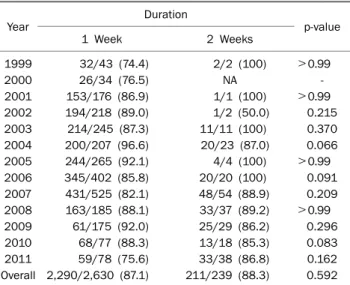
0.113). 제균 치료의 기간은 최근까지도 1주 치료가 대부분이 었지만, 2006년 이후부터는 일부에서 2주 치료를 시도하는 경향을 보였다. 치료기간에 따른 제균율은 1주간 치료군의 제 균율은 87.1%, 2주 치료군의 제균율은 88.3%로, 유의한 차이 는 보이지 않았다(p=0.592) (Fig. 2). 제균 치료기간에 따른
Table 2. Efficacy of 1 Week vs. 2 Weeks Therapy for Helicobacter pylori Eradication over the 13 Year Period
Year Duration
p-value
1 Week 2 Weeks
1999 32/43 (74.4) 2/2 (100) >0.99
2000 26/34 (76.5) NA -
2001 153/176 (86.9) 1/1 (100) >0.99
2002 194/218 (89.0) 1/2 (50.0) 0.215
2003 214/245 (87.3) 11/11 (100) 0.370
2004 200/207 (96.6) 20/23 (87.0) 0.066
2005 244/265 (92.1) 4/4 (100) >0.99
2006 345/402 (85.8) 20/20 (100) 0.091
2007 431/525 (82.1) 48/54 (88.9) 0.209 2008 163/185 (88.1) 33/37 (89.2) >0.99
2009 61/175 (92.0) 25/29 (86.2) 0.296
2010 68/77 (88.3) 13/18 (85.3) 0.083
2011 59/78 (75.6) 33/38 (86.8) 0.162
Overall 2,290/2,630 (87.1) 211/239 (88.3) 0.592 Values are presented as n (%).
NA, not available.
Table 4. Logistic Regression on the Eradication Rates of Various Proton Pump Inhibitors
Proton pump inhibitor B OR (95% CI) p-value Omeprazole vs. Lansoprazole 0.000 1.000 (0.651-1.535) 0.999 Omeprazole vs. Pantoprazole 0.251 1.285 (0.868-1.901) 0.210 Omeprazole vs. Rabeprazole 0.472 1.603 (1.158-2.218) 0.004 Omeprazole vs. Esomeprazole 0.763 2.144 (1.427-3.221) <0.01 Statics were analyzed by backward stepwise method in logistic regression analysis.
B, regression coefficient.
Table 3. Eradication Rates of Various Proton Pump Inhibitors (p
<0.01)
Proton pump inhibitor Eradication success Omeprazole (n=341) 281/341 (82.4) Lansoprazole (n=250) 206/250 (82.4) Pantoprazole (n=414) 355/414 (85.7) Rabeprazole (n=1,327) 1,171/1,327 (88.2) Esomeprazole (n=530) 482/530 (90.9) Values are presented as n (%).
각 연도별 제균율의 차이는 없었으며, 2011년도에는 2주 치 료가 86.8%의 제균 성공률을 보여 1주 치료의 75.6% 제균 성공률에 비해 10% 이상 제균 성공률의 증가를 보였지만 2009년도와 2010년도에는 오히려 1주 치료가 제균 성공률이 높았다. 이러한 변화들은 통계적으로 의미 있는 차이가 없었 다(Table 2).
3. PPI 종류에 따른 제균율 비교
PPI 약제에 따른 제균율은 pantoprazole 85.7%, lanso- prazole 82.4%, esomeprazole 90.9%, rabeprazole 88.2%, omeprazole 82.4%였고, PPI 종류에 따른 제균율 차이가 있 었다(p<0.01) (Table 3). Omeprzole과 비교하여 rabepra- zole의 교차비(OR)는 1.603 (p=0.004), esomeprazole의 교 차비는 2.144 (p<0.01)로 esomeprazole과 rabeprazole을 사용한 군에서 제균 치료의 성공율이 높았다(Table 4).
고 찰
H. pylori 제균 치료는 소화성 궤양의 치유 기간을 단축시 키고 재발을 유의하게 감소시키는 것으로 알려져 있으며, 각 국의 지침에서는 모든 소화성 궤양 환자를 대상으로 제균 치 료를 할 것을 강력히 권고하고 있다. 이 외에도 변연부 B세포 림프종, 조기 위암의 내시경적 절제술 후, 내시경 등의 검사를 시행하지 않은 소화불량증 등도 제균 치료의 대상으로 권고하 고 있다.21-23 우리나라의 대한상부위장관ㆍ헬리코박터학회, 대한소화기학회에서 발표한 권고안에서도 반흔을 포함하는 소화성 궤양, 변연부 B세포 림프종, 조기 위암을 반드시 제균 치료하도록 권고하고 있다.12,13
H. pylori 제균율에 영향을 미칠 수 있는 인자들 중 가장 중요한 인자는 항생제 내성률과 환자의 순응도이다.24-26 항생 제 중에서 H. pylori 제균에 사용하는 항생제는 amoxicillin, clarithromycin과 대체 항생제로 제시되는 metronidazole, tetracycline, quinolone 등이 있으며, metronidazole에 대한 내성률의 증가로 우리나라에서는 일차치료로 PPI를 기본으로 amoxicillin, clarithromycin을 추가하는 삼제 요법을 권고한 다. 2013년 발표된 세 번째 권고안에서 처음 권고안이 발표된 1998년과 비교하여 제균율이 저하되었을 가능성은 있으나 여 전히 일차 제균 요법에 적합한 80% 이상의 제균율을 보이며, 기존의 삼제 요법보다 월등한 요법이 없어 기존의 삼제 요법 을 일차 치료로 권고하고 있다.13 국외에서 보고된 연구들에서 그동안 clarithromycin의 내성률 증가로 인해 삼제 요법 제균 율의 감소가 전세계적으로 보고되고 있다. 이러한 나라에서는 clarithromycin에 대한 내성이 15-20% 이상인 지역에서는 삼 제 요법이 일차 치료로 권고되지 않으며 사제 요법이나 순차 적 제균 요법 등을 일차 치료로 권고하고 있다.27 우리나라의 항생제 내성률 역시 증가 추세인 것으로 보고되고 있으며,28-30 2003년부터 2012년까지 시행한 한 연구는 amoxicillin의 내 성률이 6.3%에서 14.9%로, clarithromycin은 17.2%에서 23.7%로, quinolone은 4.7%에서 28.1%로 증가한 것으로 보 고하였다.31 특히 항생제 내성이 없는 경우 표준 삼제 요법의 제균율은 95% 내외인 반면, clarithromycin에 내성이 있는
경우 제균율은 43-65%로 보고하고 있어, clarithromycin의 내성률 증가가 제균율에 큰 영향을 주고 있다.29,32 이러한 clarithromycin에 대한 내성률이 증가함에 따라 제균율의 감 소를 예상하고 연간 변화를 분석한 여러 연구들이 있으며,33-35 이 연구들 모두 제균율의 의미 있는 감소를 확인할 수 없었으 나, Song 등36이 경기서부 단일 연구기관에서 1997년부터 2007년까지 제균율을 조사하여 93%에서 83%까지 약 10%
정도의 제균율 감소를 보고하였지만, 지역에 따른 항생제 내 성률 및 제균율은 다른 것으로 추정되고 있다.32 대구 경북 지역에서의 제균율 변화에 관한 연구는 한 개로, 단일기관에 서 1999년부터 2007년까지 9년간 제균율의 변화를 연구한 이 논문에서도 제균율의 변화 추세가 없었다고 보고하였다.37 그 러나 최근 들어 국내외의 H. pylori 내성률 증가를 보고하는 다양한 연구들이 있어, 대구 경북 지역의 제균율 역시 감소 추세를 보일 것이라는 가정하에 대구 경북 지역의 다기관에서 자료를 모아 후향적으로 연구를 시행하였다.
1999년부터 2011년까지 13년간 일차 표준 삼제 요법에 대 한 H. pylori 제균율을 분석한 결과 13년 동안 연속적인 제균 율의 감소 추세는 없었지만(p=0.113) (Fig. 1), 13년 동안의 H. pylori 제균율은 87.2%였고 1999년부터 2010년까지 제균 율은 87.5%, 2011년 제균율은 79.3%로 2011년에 의미 있는 감소를 보였다(p=0.010). 2011년도의 제균율 감소는 주목할 만하지만 선형 대 선형 결합에서 통계적으로 의미 있는 제균 율 감소 추세를 확인할 수는 없었고, 아직은 80% 정도의 제균 율을 유지하고 있다. Clarithromycin에 대한 내성이 20% 이 상인 지역에서는 삼제 요법 대신에 사제 요법이나 순차적 제 균 요법 등을 고려해야 하나,27 대구 경북 지역에서 80% 이상 의 제균율을 보여 clarithromycin의 내성이 20%를 넘지 않을 것으로 추정되기 때문에 현재 일차 치료로 사용 중인 삼제 요법이 유용하다고 결론내릴 수 있다.
최근 제균율의 감소에 따라 제균 치료 기간을 2주로 연장 하는 것을 고려해 볼 수 있지만, 지금까지의 연구를 종합해 볼 때 치료 기간의 연장에 따른 제균율 향상에 대해서는 논란 의 여지가 있다. 국외에서도 이런 논란이 있는 상태인데, 2주 치료가 1주 치료에 비해 제균율이 더 높았다고 보고하거나,38 제균 연장은 부작용의 증가 및 복용 순응도의 감소로 인해 제균율에 있어 차이가 없었다고 보고한 연구도 있었고,39 한 무작위 대조 시험에서는 1주 치료와 2주 치료가 부작용 및 약물 복용 순응도에 차이가 없었으며, 제균율 역시 차이가 없 었다고 보고하였다.40 국내에도 1주 치료와 2주 치료 후 제균 율에 차이가 없었다고 보고한 연구들이 있는가 하면,36,41 2주 치료가 제균율의 감소에 따라 더 좋은 결과를 보였다는 연구 도 있다.42 이번 연구는 2011년도에서 1주 치료에 비해 2주 치료군에서 10% 이상의 제균율 상승을 보여주었지만 통계적
으로 의미는 없었고(p=0.162), 2009년도와 2010년도에서는 1주 치료가 오히려 제균 성공률이 높아서 1주와 2주 치료에서 제균율이 통계적으로 의미 있는 차이가 없었다(Table 2). 2주 치료가 최근 들어 조금씩 이루어지고 있지만 그 수가 작고 연도별 편차가 크기 때문에 2011년에 국한된 이 변화만을 가 지고 결론내리기 힘들다.
이번 연구에서는 PPI의 종류에 따라 제균율의 차이가 있었 으며, 특히 esomeprazole, rabeprazole을 사용한 군에서 제 균율이 더 높았다(Tables 3, 4). PPI는 기존의 omeprazole에 서부터 새로이 개발된 pantoprazole, lansoprazole, esome- prazole, rabeprazole 등 다양한 약제들이 있으며, 위 내벽세 포에서 프로톤 펌프(H+/K+ exchanging ATPase)를 억제하여 위산분비를 감소시키지는 기전은 동일하지만, 각각의 약동학 적 특성이 다르다.43 Rabeprazole은 활성화된 형태로 빠르게 변화되어 약물효과가 빠르게 나타나며, esomeprazole은 간 에서의 대사율과 제거율이 낮아 작용시간이 길고 강력한 위산 분비 억제 능력을 가지고 있다.43 Rabeprazole과 esomepra- zole이 다른 PPI와 비교하여 위산 분비 억제 능력이 보다 강 하고 H. pylori에 대한 직접적인 항균력도 보다 강하다는 결 과들이 있으나,44-46 PPI에 따른 제균율을 메타 분석한 연구들 에서 PPI 종류에 따라 제균율은 차이가 없었다.47,48 국내의 연구들도 PPI 종류에 따른 제균율의 차이를 밝힐 수 없었으
나,49,50 이번 연구에서는 다른 PPI들에 비하여 esomeprazole
을 사용한 군에서 제균율이 가장 높았고, 그 다음으로 rabe- prazole 사용군이었다.
이번 연구는 연구는 다기관 연구이기는 하지만, 누락된 자 료가 많고 제균율에 영향을 끼칠 수 있는 흡연력, 음주력 및 약제 복용력에 대한 조사가 시행되지 않았는데, 특히 항생제 에 대한 노출은 내성률의 증가로 이어지며 이는 제균율에 영 향을 끼치는 중요한 변수가 될 것으로 생각되나, 항생제 복용 력에 대한 조사가 이루어지지 않은 것이 하나의 제한점이다.
둘째로 2010년, 2011년도의 연구대상 환자의 수가 다른 연도 에 비해 적은 것도 이 연구의 제한점이라 할 수 있다. 또한 제균율에 영향을 주는 순응도 및 제균 약제 부작용을 평가하 지 못하였으며, 순응도가 떨어져 연구대상에서 제외된 환자들 을 포함하여 연구를 시행하였다면 제균율의 감소에 영향을 주 는 인자를 더 명확히 알 수 있었으리라 생각된다. 하지만 이번 연구에서처럼 지역 내 일차 삼제 치료의 제균 성공률을 알 수 있다면 이를 통해 지역 내 내성 비율을 간접적으로 추정할 수 있을 것이고, 이러한 연구들을 통해 삼제 요법을 일차 치료 로 권고할 수 있는 근거가 될 것이기 때문에 지역별로 이러한 연구들이 필요할 것이다.
대구 경북 지역에서 제균율의 변화는 없었으며, 2011년도 에서 제균율이 79.3%로 감소를 보여주지만 clarithromycin
의 내성은 20%를 넘지 않을 것으로 생각되므로 삼제 치료가 일차 치료로서 유용하다. 지난 13년 동안 제균율의 감소 추세 를 확인할 수 없었고, 제균 치료의 기간에 따른 차이도 없었 다. 그러나 PPI 종류에 따른 제균율의 차이가 있었으며, ome- prazole과 비교하여 esomeprazole, rabeprazole을 사용하는 것이 제균율이 더 높았다. 따라서 향후 esomeprazole, rabe- prazole 기반 치료에 대한 더 많은 연구들이 필요할 것이다.
요 약
목적: 우리나라 Helicobacter pylori 제균 요법의 1차 표준 제균 치료제인 proton pump inhibitor (PPI), amoxicillin, clarithromycin을 병합하는 삼제 요법은 항생제의 내성이 증 가함에 따라 제균율의 감소가 보고되고 있다. 최근 13년간 대 구 경북 지역의 H. pylori 제균 치료를 한 환자를 대상으로 제균율의 연도별 추세 및 제균 치료 기간에 따른 제균율을 평가하고, PPI 종류에 따른 제균율 차이를 알아보기 위해 다 기관 연구를 시행하였다.
대상 및 방법: 대구 경북 지역의 영남대학교의료원, 경북대학 교병원, 계명대학교 동산의료원, 대구가톨릭대학교병원, 순천 향대학교 구미병원에 내원한 환자에서 상부위장관 내시경검 사로 H. pylori 감염이 확인되고 PPI, amoxicillin, clari- thromycin으로 구성된 삼제 요법을 시행한 2,982명의 환자를 대상으로 후향적으로 제균율을 조사하였다. 치료 종료 후 최 소 4주 이상 경과하고, 2주간 PPI를 중단 후 상부위장관 내시 경검사를 통한 조직검사 및 급속요소효소분해검사 또는 요소 호기검사를 시행하여 제균 여부를 평가하였다.
결과: 1999년부터 2011년까지 1차 삼제 요법의 제균율은 78.0, 80.5, 86.7, 89.5, 87.7, 95.7, 92.1, 86.4, 82.3, 88.3, 91.2, 85.3, 그리고 79.3%였고, 유의한 감소 추세가 없었다 (p=0.113). 또한 치료 기간에 따른 제균율의 차이도 관찰되지 않았다(p=0.592). 2011년도에서 제균율이 80% 미만으로 감 소되었으며, 2주 치료가 86.8%의 제균 성공률을 보여 1주 치 료의 75.6% 제균 성공률에 비해 높았지만 통계적인 의미는 없었다(p=0.162). PPI 종류에 따라 제균율의 차이가 있었으 며, omeprazole과 비교하여 esomeprazole과 rabeprazole을 사용한 군에서 제균율의 향상이 관찰되었다.
결론: 대구 경북 지역에서 2011년도에 국한하여 제균율의 감 소와 2주 치료에서 제균율의 증가를 보였지만 통계적으로 의 미 있는 차이는 없었다. 지난 13년 동안 제균율의 감소 추세 를 확인할 수 없었고, 제균 치료의 기간에 따른 차이도 없었 다. PPI 종류에 따른 제균율의 차이가 있었으며, 그 중 eso- meprazole, rabeprazole을 사용하는 것이 제균율이 더 높았 다. 향후 esomeprazole, rabeprazole 기반 치료에 대한 더
많은 연구들이 필요할 것이다.
색인단어: Helicobacter pylori; 제균
REFERENCES
1. Warren JR, Marshall B. Unidentified curved bacilli on gastric epi- thelium in active chronic gastritis. Lancet 1983;321:1273-1275.
2. Marshall BJ, Warren JR. Unidentified curved bacilli in the stom- ach of patients with gastritis and peptic ulceration. Lancet 1984;1:1311-1315.
3. Blaser MJ. Helicobacter pylori and gastric diseases. BMJ 1998;316:1507-1510.
4. Suerbaum S, Michetti P. Helicobacter pylori infection. N Engl J Med 2002;347:1175-1186.
5. Correa P, Fontham ET, Bravo JC, et al. Chemoprevention of gas- tric dysplasia: randomized trial of antioxidant supplements and anti-Helicobacter pylori therapy. J Natl Cancer Inst 2000;92:
1881-1888.
6. Wang J, Xu L, Shi R, et al. Gastric atrophy and intestinal meta- plasia before and after Helicobacter pylori eradication: a meta-analysis. Digestion 2011;83:253-260.
7. Malfertheiner P, Sipponen P, Naumann M, et al. Helicobacter py- lori eradication has the potential to prevent gastric cancer: a state-of-the-art critique. Am J Gastroenterol 2005;100:2100- 2115.
8. Chan FK, Chung SC, Suen BY, et al. Preventing recurrent upper gastrointestinal bleeding in patients with Helicobacter pylori in- fection who are taking low-dose aspirin or naproxen. N Engl J Med 2001;344:967-973.
9. Hunt RH, Xiao SD, Megraud F; World Gastroenterology Organi- zation. World gastroenterology organisation global guideline:
Helicobacter pylori in developing countries. J Dig Dis 2011;12:
319-326.
10. Yim JY, Kim N, Choi SH, et al. Seroprevalence of Helicobacter py- lori in South Korea. Helicobacter 2007;12:333-340.
11. Korean Helicobacter pylori Study Group. Diagnosis and treat- ment of Helicobacter pylori infection in Korea. Korean J Gastro- enterol 1998;32:275-289.
12. Kim N, Kim JJ, Choe YH, Kim HS, Kim JI, Chung IS; Korean College of Helicobacter and Upper Gastrointestinal Research; Korean Association of Gastroenterology. Diagnosis and treatment guidelines for Helicobacter pylori infection in Korea. Korean J Gastroenterol 2009;54:269-278.
13. Kim SG, Jung HK, Lee HL, et al; Korean College of Helicobacter and Upper Gastrointestinal Research. Guidelines for the diag- nosis and treatment of Helicobacter pylori infection in Korea, 2013 revised edition. Korean J Gastroenterol 2013;62:3-26.
14. Misiewicz JJ, Harris AW, Bardhan KD, et al. One week triple ther- apy for Helicobacter pylori: a multicentre comparative study.
Lansoprazole Helicobacter Study Group. Gut 1997;41:735-739.
15. Uygun A, Kadayifci A, Yesilova Z, Safali M, Ilgan S, Karaeren N.
Comparison of sequential and standard triple-drug regimen for Helicobacter pylori eradication: a 14-day, open-label, random- ized, prospective, parallel-arm study in adult patients with non-
ulcer dyspepsia. Clin Ther 2008;30:528-534.
16. Graham DY, Fischbach L. Helicobacter pylori treatment in the era of increasing antibiotic resistance. Gut 2010;59:1143-1153.
17. Fujioka T, Aoyama N, Sakai K, et al. A large-scale nationwide mul- ticenter prospective observational study of triple therapy using rabeprazole, amoxicillin, and clarithromycin for Helicobacter py- lori eradication in Japan. J Gastroenterol 2012;47:276-283.
18. Bang SY, Han DS, Eun CS, et al. Changing patterns of antibiotic resistance of Helicobacter pylori in patients with peptic ulcer disease. Korean J Gastroenterol 2007;50:356-362.
19. Kim JM, Kim JS, Jung HC, Kim N, Song IS. Antibiotic resistance of Helicobacter pylori isolated from Korean patients in 2003.
Korean J Gastroenterol 2004;44:126-135.
20. Kim SY, Jung SW. Helicobacter pylori eradication therapy in Korea. Korean J Gastroenterol 2011;58:67-73.
21. Malfertheiner P, Megraud F, O'Morain C, et al. Current concepts in the management of Helicobacter pylori infection: the Maastricht III Consensus Report. Gut 2007;56:772-781.
22. Chey WD, Wong BC; Practice Parameters Committee of the American College of Gastroenterology. American College of Gastroenterology guideline on the management of Helicobacter pylori infection. Am J Gastroenterol 2007;102:1808-1825.
23. Yamada T, Searle JG, Ahnen D; NIH Consensus development panel on Helicobacter pylori in peptic ulcer disease. NIH Consensus Conference. Helicobacter pylori in peptic ulcer disease. JAMA 1994;272:65-69.
24. Egan BJ, Katicic M, O'Connor HJ, O'Morain CA. Treatment of Helicobacter pylori. Helicobacter 2007;12(Suppl 1):31-37.
25. Byun YH, Jo YJ, Kim SC, et al. Clinical factors that predicts suc- cessful eradication of Helicobacter pylori. Korean J Gastroenter- ol 2006;48:172-179.
26. Qasim A, O'Morain CA. Review article: treatment of Helicobacter pylori infection and factors influencing eradication. Aliment Pharmacol Ther 2002;16(Suppl 1):24-30.
27. Malfertheiner P, Megraud F, O'Morain CA, et al; European Helicobacter Study Group. Management of Helicobacter pylori infection--the Maastricht IV/ Florence Consensus Report. Gut 2012;61:646-664.
28. Kim JY, Kim NY, Kim SJ, et al. Regional difference of antibiotic resistance of Helicobacter pylori strains in Korea. Korean J Gastroenterol 2011;57:221-229.
29. Hwang TJ, Kim N, Kim HB, et al. Change in antibiotic resistance of Helicobacter pylori strains and the effect of A2143G point mu- tation of 23S rRNA on the eradication of H. pylori in a single cen- ter of Korea. J Clin Gastroenterol 2010;44:536-543.
30. Kim JM, Kim JS, Jung HC, Kim N, Kim YJ, Song IS. Distribution of antibiotic MICs for Helicobacter pylori strains over a 16-year period in patients from Seoul, South Korea. Antimicrob Agents Chemother 2004;48:4843-4847.
31. Lee JW, Kim N, Kim JM, et al. Prevalence of primary and secon- dary antimicrobial resistance of Helicobacter pylori in Korea from 2003 through 2012. Helicobacter 2013;18:206-214.
32. Kim N, Kim JM, Kim CH, et al. Institutional difference of antibiotic resistance of Helicobacter pylori strains in Korea. J Clin Gastro- enterol 2006;40:683-687.
33. Yoon JH, Baik GH, Sohn KM, et al. Trends in the eradication rates
of Helicobacter pylori infection for eleven years. World J Gastroenterol 2012;18:6628-6634.
34. Na HS, Hong SJ, Yoon HJ, et al. Eradication rate of first-line and second-line therapy for Helicobacter pylori infection, and re- infection rate after successful eradication. Korean J Gastroen- terol 2007;50:170-175.
35. Choi YS, Cheon JH, Lee JY, et al. The trend of eradication rates of first-line triple therapy for Helicobacter pylori infection: single center experience for recent eight years. Korean J Gastroenterol 2006;48:156-161.
36. Song JG, Lee SW, Park JY. Trend in the eradication rates of Helicobacter pylori infection in the last 11 years. Korean J Med 2009;76:303-310.
37. Cho HJ, Bae RC, Lee SH, et al. The trend in the eradication rates of first- and second-line therapy for Helicobacter pylori infection in Daegu and Kyungpook provinces: a single center experience for the most recent 9 years. Korean J Med 2009;76:186-192.
38. Calvet X, García N, López T, Gisbert JP, Gené E, Roque M. A meta-analysis of short versus long therapy with a proton pump inhibitor, clarithromycin and either metronidazole or amoxycillin for treating Helicobacter pylori infection. Aliment Pharmacol Ther 2000;14:603-609.
39. Fuccio L, Minardi ME, Zagari RM, Grilli D, Magrini N, Bazzoli F.
Meta-analysis: duration of first-line proton-pump inhibitor based triple therapy for Helicobacter pylori eradication. Ann Intern Med 2007;147:553-562.
40. Sokwala A, Shah MV, Devani S, Yonga G. Helicobacter pylori eradication: a randomised comparative trial of 7-day versus 14-day triple therapy. S Afr Med J 2012;102:368-371.
41. Kim N, Park SH, Seo GS, et al. Lafutidine versus lansoprazole in combination with clarithromycin and amoxicillin for one versus two weeks for Helicobacter pylori eradication in Korea.
Helicobacter 2008;13:542-549.
42. Paek NY, Lim YJ, Lee JH, Kang JH, Park JB, Lee JH. Recent erad- ication rates of first-line triple regimens for H. pylori infection.
Korean J Gastrointest Endosc 2010;41:5-9.
43. Stedman CA, Barclay ML. Review article: comparison of the pharmacokinetics, acid suppression and efficacy of proton pump inhibitors. Aliment Pharmacol Ther 2000;14:963-978.
44. Anagnostopoulos GK, Tsiakos S, Margantinis G, Kostopoulos P, Arvanitidis D. Esomeprazole versus omeprazole for the erad- ication of Helicobacter pylori infection: results of a randomized controlled study. J Clin Gastroenterol 2004;38:503-506.
45. Kawakami Y, Akahane T, Yamaguchi M, et al. In vitro activities of rabeprazole, a novel proton pump inhibitor, and its thioether de- rivative alone and in combination with other antimicrobials against recent clinical isolates of Helicobacter pylori. Antimicrob Agents Chemother 2000;44:458-461.
46. Alarcón T, Domingo D, Sánchez I, Sanz JC, Martínez MJ, López-Brea M. In vitro activity of ebrotidine, ranitidine, omepra- zole, lansoprazole, and bismuth citrate against clinical isolates of Helicobacter pylori. Eur J Clin Microbiol Infect Dis 1998;17:
275-277.
47. Vergara M, Vallve M, Gisbert JP, Calvet X. Meta-analysis: com- parative efficacy of different proton-pump inhibitors in triple therapy for Helicobacter pylori eradication. Aliment Pharmacol
Ther 2003;18:647-654.
48. Klok RM, Postma MJ, van Hout BA, Brouwers JR. Meta-analysis:
comparing the efficacy of proton pump inhibitors in short-term use. Aliment Pharmacol Ther 2003;17:1237-1245.
49. Hong EJ, Park DI, Oh SJ, et al. Comparison of Helicobacter pylori eradication rate in patients with non-ulcer dyspepsia and peptic
ulcer diseases according to proton pump inhibitors. Korean J Gastroenterol 2008;52:80-85.
50. Keum B, Lee SW, Kim SY, et al. Comparison of Helicobacter pylori eradication rate according to different PPI-based triple therapy:
omeprazole, rabeprazole, esomeprazole and lansoprazole.
Korean J Gastroenterol 2005;46:433-439.