Meta-Analysis of First-Line Triple Therapy for Helicobacter pylori Eradication in Korea: Is It Time to Change?
Proton pump inhibitor (PPI)-based triple therapy consisting of PPI, amoxicillin, and clarithromycin, is the recommended first-line treatment for Helicobacter pylori infection.
However, the eradication rate of triple therapy has declined over the past few decades. We analyzed the eradication rate and adverse events of triple therapy to evaluate current practices in Korea. A comprehensive literature search was performed up to August 2013 of 104 relevant studies comprising 42,124 patients. The overall eradication rate was 74.6%
(95% confidence interval [CI], 72.1%-77.2%) by intention-to-treat analysis and 82.0%
(95% CI, 80.8%-83.2%) by per-protocol analysis. The eradication rate decreased significantly from 1998 to 2013 (P < 0.001 for both intention-to-treat and per-protocol analyses). Adverse events were reported in 41 studies with 8,018 subjects with an overall incidence rate of 20.4% (95% CI, 19.6%-21.3%). The available data suggest that the effectiveness of standard triple therapy for H. pylori eradication has decreased to an unacceptable level. A novel therapeutic strategy is warranted to improve the effectiveness of first-line treatment for H. pylori infection in Korea.
Keywords: Helicobacter pylori; Eradication; Triple Therapy
Eun Jeong Gong,1* Sung-Cheol Yun,2*Hwoon-Yong Jung,1 Hyun Lim,3 Kwi-Sook Choi,1 Ji Yong Ahn,1 Jeong Hoon Lee,1 Do Hoon Kim,1 Kee Don Choi,1 Ho June Song,1 Gin Hyug Lee,1 and Jin-Ho Kim1 Departments of 1Gastroenterology, 2Clinical Epidemiology and Biostatistics, University of Ulsan College of Medicine, Asan Medical Center, Seoul;
3Department of Gastroenterology, Hallym University Sacred Heart Hospital, Anyang, Korea
*Eun Jeong Gong and Sung-Cheol Yun contributed equally to this work.
Received: 27 December 2013 Accepted: 20 March 2014 Address for Correspondence:
Hwoon-Yong Jung, MD
Department of Gastroenterology, University of Ulsan College of Medicine, Asan Medical Center, Asan Digestive Disease Research Institute, 88 Olympic-ro 43-gil, Songpa-gu, Seoul 138-736, Korea
Tel: +82.2-3010-3197, Fax: +82.2-476-0824 E-mail: [email protected]
http://dx.doi.org/10.3346/jkms.2014.29.5.704 • J Korean Med Sci 2014; 29: 704-713
INTRODUCTION
Helicobacter pylori infection causes chronic gastritis and is as-
sociated with an increased risk of upper gastrointestinal diseas- es, such as peptic ulcer disease, gastric cancer, and mucosa-as- sociated lymphoid tissue lymphoma (1, 2). Although its inci- dence has declined in developed countries, the prevalence of H.
pylori remains high in Korea (3-6). The nationwide seropreva-
lence surveys performed in 1998 and 2005 among asymptom- atic Korean adults reported H. pylori prevalence rates of 66.9%
and 59.5% (5).
Proton pump inhibitor (PPI)-based triple therapy, which con- sists of PPI, amoxicillin, and clarithromycin or metronidazole, is the first-line treatment for H. pylori infection (7). Because metronidazole-resistant H. pylori strains are reported in 40% or more of clinical isolates, triple therapy with PPI standard dose bis in die (bid, twice a day), amoxicillin 1 g bid, and clarithro- mycin 500 mg bid is the standard regimen for H. pylori eradica- tion in Korea (7-9). However, even with the current treatment regimens, treatment fails in approximately 20% of patients who
remain H. pylori positive (10, 11). In addition, the prevalence of clarithromycin-resistant H. pylori strains is increasing in both Korea and other countries, and the efficacy of PPI-based triple therapies has substantially decreased to 80% or below in most countries in recent decades (11-16). Consequently, whether standard triple therapy should continue as first-line therapy is currently under debate.
Several observational studies assessing trends in H. pylori eradication over a number of years have been performed in Ko- rea. In some reports, the eradication rate of standard triple ther- apy was shown to have decreased to 77.5% in recent years (15, 17). In contrast, other studies reported that the eradication rate remained constant over 5-11 yr, although the eradication rate was found to be below 90% in a per-protocol (PP) analysis (18- 20). This discrepancy may be due to geographical differences in antibiotic resistance and to different methods used for deter- mining eradication. We therefore performed a meta-analysis to evaluate the eradication rate and adverse events of first-line tri- ple therapy to verify the effectiveness of current practice in Korea.
Gastroenterology & Hepatology
MATERIALS AND METHODS
Study selectionA comprehensive literature search was performed to identify relevant studies through August 2013 using computer-assisted bibliographic searches of PubMed, KoreaMed, and KMBASE.
Combinations of the following terms were used: H. pylori or H.
pylori and eradication, triple, first-line, proton pump inhibitor,
PPI, amoxicillin, clarithromycin, or metronidazole. Abstracts and full papers from relevant studies were reviewed, and those meeting the defined selection criteria were considered for fur- ther evaluation. Abstracts presented through August 2013 at the following congresses were also hand-search ed: Digestive Dis- ease Week, the United European Gastroenterology Week, the Korean Society of Gastroenterology, the Korean College of Heli- cobacter and Upper Gastrointestinal Research, and the Korean Association of Internal Medicine. Abstracts of articles in each of these multiple searches were reviewed, and those meeting the inclusion criteria were included. Care was taken to avoid ob- taining duplicate data by examining the authors’ names and af- filiations for each publication. Overlapping articles and articles unrelated to our analysis were excluded.
Studies were eligible if they had at least one treatment arm and met all of the following criteria: 1) assessed standard triple ther- apy (a PPI with amoxicillin and clarithromycin) for H. pylori erad- ication; 2) included first-line eradication therapy; 3) demonstrat- ed H. pylori infection by at least one high-accuracy diagnostic test (urea breath test, stool antigen test, histological examina- tion, rapid urease test, or culture); 4) confirmed eradication of infection after completion of treatment, based on an appropri- ate follow-up test; and 5) was the most informative article when multiple articles were published by the same authors or groups.
The quality of each randomized controlled study was assess- ed by using the Jaded composite scale based on three items: 1) randomization; 2) double blinding; and 3) description of with- drawals and dropouts (21). The selection of studies for this me- ta-analysis was performed by two independent reviewers. Dif- ferences between the two reviewers were resolved by assessment of the full article by a third reviewer. The decision as to whether to include the article was made by consensus.
Data extraction and analysis
Data on the following items were extracted from the selected articles: 1) study design; 2) study period; 3) number of patients enrolled in the study and in each treatment arm; 4) drug regi- men, doses, and duration of therapy; 5) diagnostic tests used in the diagnosis of H. pylori infection and confirmation of eradica- tion; 6) indications for H. pylori eradication; 7) number of pa- tients in whom H. pylori infection was successfully eradicated;
and 8) number of patients with adverse events and the type of adverse event.
To account for heterogeneity between studies, the overall and yearly eradication rates and their 95% confidence intervals (CIs) were estimated with a random-effect logistic regression model (PROC NLMIXED in SAS software version 9.2, Cary, NC, USA).
All reported P values are two-sided, and values of P < 0.05 indi- cated statistical significance.
RESULTS
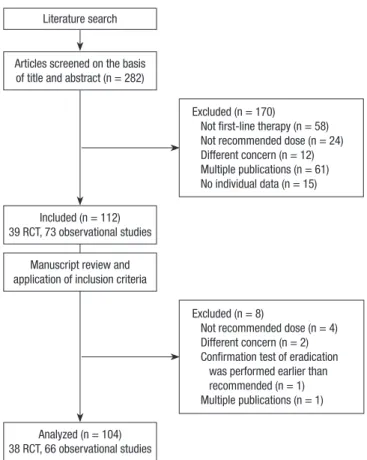
We initially screened 282 studies. Of these, 112 reports of first- line standard triple therapy were included in the analysis (Fig.
1). After systematic review of these studies, a total of 104 studies including 38 randomized controlled trials (RCTs) and 66 obser- vational studies were eligible for meta-analysis. The clinical char- acteristics of the studies are listed in Tables 1 and 2. A total of 42,124 subjects were included, and the sample size per study ranged from 12 to 4,198 subjects.
The overall eradication rate with standard triple therapy was 74.6% (95% CI, 72.1%-77.2%) for intention-to-treat (ITT) analy- sis and 82.0% (95% CI, 80.8%-83.2%) for PP analysis. The eradi- cation rate showed a decreasing tendency from the years 1998 to 2013 based on ITT and PP analysis (P < 0.001 and P = 0.0003, respectively) (Fig. 2). The eradication rates of the 7-day and 14- day treatments were 81.1% (95% CI, 79.8%-82.3%) and 85.3%
(95% CI, 83.5%-87.1%) for PP analysis, respectively.
Literature search
Articles screened on the basis of title and abstract (n = 282)
Excluded (n = 170)
Not first-line therapy (n = 58) Not recommended dose (n = 24) Different concern (n = 12) Multiple publications (n = 61) No individual data (n = 15)
Excluded (n = 8)
Not recommended dose (n = 4) Different concern (n = 2) Confirmation test of eradication was performed earlier than recommended (n = 1) Multiple publications (n = 1) Included (n = 112)
39 RCT, 73 observational studies Manuscript review and application of inclusion criteria
Analyzed (n = 104) 38 RCT, 66 observational studies
Fig. 1. Flowchart of the study design. RCT, randomized controlled trials.
Adverse events were reported in 41 studies (24 RCTs and 17 observational studies) with 8,018 subjects treated with standard triple therapy (22-62). The incidence of adverse events in these studies was 20.4% (95% CI, 19.6%-21.3%). Taste alteration was the most common adverse event, followed by loose stool or di- arrhea, abdominal discomfort, and nausea. The percentage of patients who stopped medication due to adverse events was 1.81% (35/1,930), suggesting that most patients could tolerate adverse events.
DISCUSSION
In our current study, we performed an up-to-date meta-analy-
sis on the eradication rate of first-line PPI-based triple therapy.
The results of our meta-analysis suggest that the efficacy of tri- ple therapy for H. pylori infection is lower than desired, with a pooled eradication rate of 74.6% in ITT analysis and 82.0% in PP analysis. In addition, the eradication rate has significantly decreased over the last 16 yr.
Since 1998, PPI-based triple therapy has been recommended as the first-line therapy for H. pylori eradication in Korea. How- ever, eradication rates have been declining, and, as of 2000, de- creased to below 80% (11, 48), thereby failing to meet the re- quirements of the Asia-Pacific Consensus Guidelines, which state that a success rate of > 80% in ITT analysis and > 90% in PP analysis is needed for a regimen to be considered suitable
Table 1. Characteristics of the randomized clinical studies included in the meta-analysisStudy (yr)
(reference No.) Format No. of patients Indication Duration of
therapy (days) Methods for confirming
eradication Jaded score
Lee et al. (2013) (22) Full paper 308 PUD 7 U 4
Kim et al. (2013) (23) Full paper 135 PUD/gastric polyp/FHx/EGC/AG 7 H/R/U 4
Rew et al. (2013) (76) Abstract 51 gastric epithelial neoplasm 7 U 2
Park et al. (2012) (24) Full paper 164 PUD/AG 7 U 3
Oh et al. (2012) (25) Full paper 130 PUD/AG 7 U 2
Kim et al. (2012) (26) Full paper 104 PUD 14 H/R/U 2
Chung et al. (2012) (27) Full paper 80 PUD 10 U 3
Choi et al. (2012) (28) Full paper 345 PUD/NUD 7/10/14 H/U 2
Kim et al. (2012) (77) Abstract 34 NR 7 U 2
Kim et al. (2011) (29) Full paper 204 PUD/NUD 14 H/R/U 3
Choi et al. (2011) (30) Full paper 99 PUD/AG 7 U 5
Song et al. (2010) (35) Full paper 331 PUD/AG 7 U 4
Lee et al. (2010) (78) Full paper 492 PUD/NUD/gastric polyp/EGC/MALT 7 U 3
Park et al. (2009) (79) Abstract 81 NR 7/10/14 H/R/U 2
Park et al. (2008) (44) Full paper 176 PUD/AG/EGC 7 U 4
Kim et al. (2008) (37) Full paper 93 PUD 14 H/R/U 2
Kim et al. (2008) (38) Full paper 229 PUD 7/14 U 4
Kim et al. (2008) (39) Full paper 179 PUD/NUD 7 U 2
Kim et al. (2008) (40) Full paper 129 PUD/AG/EGC 7 U 3
Jung et al. (2008) (41) Full paper 12 PUD 7 H/U 4
Choi et al. (2008) (42) Full paper 81 PUD/AG 7 H/R/U 3
Kim et al. (2007) (11) Full paper 598 PUD 7/14 U 2
Choi et al. (2007) (45) Full paper 576 PUD/gastric polyp/EGC 7 H/U 3
Lee et al. (2006) (48) Full paper 126 PUD/NUD/AG/dysplasia/FHx 7 H/U 4
Park et al. (2005) (50) Full paper 61 PUD/AG/EGC 7 H/R 4
Jang et al. (2005) (51) Full paper 75 PUD 7 U 2
Lee et al. (2004) (80) Abstract 670 PUD 7/14 U 3
Baik et al. (2004) (81) Abstract 109 PUD 7/14 U 2
Lee et al. (2003) (82) Abstract 96 PUD 7/14 U 2
Kim et al. (2002) (83) Full paper 38 PUD 14 U 3
Choi et al. (2002) (84) Full paper 108 PUD/NUD 7 R/U 2
Lee et al. (2002) (85) Full paper 39 PUD 7 U 4
Hong et al. (2002) (86) Abstract 148 PUD 7 U 2
Cho et al. (2001) (54) Full paper 255 PUD 7/10/14 U 3
Park et al. (2000) (87) Full paper 27 PUD 14 H/R 3
Shim et al. (2000) (88) Full paper 21 PUD 7 H/C 4
Kim et al. (1999) (58) Full paper 70 PUD/AG/MALT 10 R 3
Ryu et al. (1999) (57) Abstract 31 PUD 7/14 C/H/R/U 3
AG, atrophic gastritis; C, culture; EGC, early gastric cancer; FHx, family history of gastric cancer; H, histology; MALT, mucosa-associated lymphoid tumor; NR, not reported; NUD, non-ulcer dyspepsia; PPI, proton pump inhibitor; PUD, peptic ulcer disease; R, rapid urease test; S, serology; U, urea breath test.
Table 2. Characteristics of the observational studies included in the meta-analysis
Study (yr) (reference No.) Format No. of patients Indication Duration of therapy (days) Methods for confirming eradication
Kim et al. (2013) (89) Full paper 110 PUD/EGC/NUD NR H/R/U
Yoon et al. (2012) (18) Full paper 3,969 PUD/NUD 14 C/H/R/U
Kang et al. (2012) (90) Full paper 153 EGC/dysplasia 7 H
Lee et al. (2012) (91) Abstract 1,547 NR 7/14 NR
Kim et al. (2012) (92) Abstract 1,466 NR NR NR
Moon et al. (2012) (93) Abstract 43 PUD/EGC/MALT 7 U
Chung et al. (2011) (15) Full paper 4,198 PUD/AG/EGC/NUD 7 U
Seo et al. (2011) (31) Full paper 204 PUD/AG 7 U
Kim et al. (2011) (32) Full paper 186 PUD/AG 7 U
Kim et al. (2011) (94) Full paper 120 PUD/AG 7 C/H/R/U
Moon et al. (2011) (95) Abstract 102 NR 7 U
Moon et al. (2011) (33) Abstract 85 NR 7 U
Moon et al. (2011) (96) Abstract 770 NR 7 U
Choi et al. (2011) (34) Abstract 38 NR NR U
Kwon et al. (2010) (36) Full paper 135 PUD/AG 7 U
Hwang et al. (2010) (66) Full paper 129 PUD/AG/dysplasia/EGC 7 U
Cho et al. (2010) (19) Full paper 709 PUD/AG/gastric polyp/EGC/MALT 7 U
Paek et al. (2010) (97) Full paper 986 PUD/AG 7/14 U
Lee et al. (2010) (98) Full paper 798 NR 7 H/U
Ahn et al. (2010) (99) Full paper 145 NR 7 H/R/U
Oh et al. (2009) (100) Full paper 210 PUD/AG 7 U
Jung et al. (2009) (101) Full paper 163 PUD 7/14 H/R/U
Chung et al. (2009) (17) Full paper 1,716 PUD/gastric erosion 7 U
Song et al. (2009) (102) Full paper 1,789 PUD/NUD/EGC/MALT 7/14 H/R/U
Cho et al. (2009) (103) Full paper 615 PUD/EGC/AG/MALT 7 H/R/U
Huh et al. (2009) (104) Abstract 859 PUD/AG 7 U
Kang et al. (2008) (105) Full paper 327 PUD/AG/EGC/dysplasia 7 U
Hong et al. (2008) (43) Full paper 2,145 PUD/NUD 7 H/R/U
Nam et al. (2008) (106) Full paper 597 PUD 7 H/R/U
Chung et al. (2008) (107) Full paper 50 PUD/EGC 7 U
Jo et al. (2008) (108) Full paper 39 PUD 7 U
Nam et al. (2008) (109) Abstract 341 PUD 7 NR
Kim et al. (2008) (110) Abstract 166 PUD/NUD/EGC 7/14 U
Na et al. (2007) (20) Full paper 3,267 PUD 7 H/R/U
Paik et al. (2007) (46) Full paper 280 PUD/AG 7 R/U
Kang et al. (2007) (111) Full paper 36 PUD 7 H/R/U
Nam et al. (2007) (112) Abstract 363 PUD 7 U
Lee et al. (2007) (113) Abstract 200 NR 7 U
Lee et al. (2007) (47) Abstract 220 PUD 7/14 NR
Kang et al. (2006) (49) Full paper 61 PUD/AG/EGC 7 H/R/U
Choi et al. (2006) (12) Full paper 525 PUD 7 H/R/U
Byun et al. (2006) (114) Full paper 195 PUD/AG/gastric polyp/dysplasia/MALT/FHx 7 H/U
Suh et al. (2006) (115) Full paper 297 PUD/NUD 7 U
Lee et al. (2006) (116) Abstract 296 NR 7 U
Kim et al. (2006) (117) Abstract 426 PUD 7 U
Keum et al. (2005) (52) Full paper 352 PUD/gastric erosion 7/14 H/R/U
Koo et al. (2005) (118) Abstract 375 PUD 7/14 U
Choi et al. (2003) (53) Full paper 88 PUD 7 U
Jung et al. (2003) (119) Full paper 46 PUD 7 H/R/U
Kim et al. (2003) (120) Abstract 426 PUD 7 U
Choung et al. (2003) (121) Abstract 525 PUD 7/14 H/R/U
Lee et al. (2002) (122) Full paper 28 PUD 14 U
Choi et al. (2002) (123) Full paper 106 PUD 7 H
Lee et al. (2002) (124) Full paper 173 PUD/AG 7 H/R/U
Heo et al. (2002) (125) Abstract 96 PUD/AG 10 H/R
Kim et al. (2002) (126) Abstract 1,150 NR 7/14 U
Choi et al. (2002) (127) Abstract 269 PUD 7/14 R/U
Kim et al. (2002) (128) Full paper 39 PUD 7/14 H/R/U
Jung et al. (2000) (55) Full paper 73 PUD 7 C/H/R
Song et al. (2000) (56) Full paper 42 PUD/AG 7 H/R
Park et al. (2000) (129) Full paper 460 PUD/NUD 7 H/R
Kim et al. (1999) (59) Full paper 64 PUD 14 H/R
Choi et al. (1999) (60) Full paper 42 PUD 7 H/R
Oh et al. (1999) (130) Full paper 132 PUD/AG/MALT 7 H
Kim et al. (1998) (61) Full paper 38 PUD/AG 14 H
Park et al. (1998) (62) Abstract 29 PUD 7/10/14 NR
AG, atrophic gastritis; C, culture; EGC, early gastric cancer; FHx, family history of gastric cancer; H, histology; MALT, mucosa-associated lymphoid tumor; NR, not reported; NUD, non-ulcer dyspepsia; PPI, proton pump inhibitor; PUD, peptic ulcer disease; R, rapid urease test; S, serology; U, urea breath test.
for first-line eradication therapy (19, 42, 63).
There are several known factors that affect the eradication of
H. pylori, such as antibiotic resistance, geographical area, pa-tient age, smoking status, compliance, duration of therapy, bac- terial density, Cag A, gastric acid concentration, individual re- sponse to PPI, and the presence of CYP2C19 polymorphism (10, 37, 64, 65). Among these factors, the main cause of the low eradication rate is presumed to be clarithromycin resistance. In Korea, the rate of resistance to clarithromycin was 5.9% before 2000, but has rapidly increased to 38.5% in the period of 2007 to 2009 (9, 16, 66-68). These rates are much higher than in other countries, such as Italy, and the main reason for this discrepan- cy may be the wide national and regional variations in the prev- alence of antibiotic resistance (69). Clarithromycin resistance has been associated with cross-resistance caused by previous treatment with macrolides (70). In clinical practice, such antibi- otics are usually prescribed for respiratory infections and are widely used for H. pylori eradication treatment. In addition, an- tibiotic treatment interruption due to gastrointestinal adverse events, such as diarrhea, nausea, vomiting, and abdominal dis- comfort, may be another reason for increased antibiotic resis- tance. Whereas an eradication rate higher than 75% is still achi- eved despite metronidazole resistance, clarithromycin resis- tance lowers the eradication rate by 20%, making it difficult to achieve an 80% eradication rate (71, 72). Potential approaches to overcome this resistance problem include patient-tailored, sequential, or concomitant therapies.
Increasing the duration of treatment may prove effective in curing infection, but this hypothesis remains to be validated.
The majority of recently recommended eradication therapy regimens are 7-days in duration, which conveys advantages with respect to compliance and medical cost, while maintain- ing a similar eradication rate to that of longer regimens (73).
The Asia-Pacific Consensus Guidelines and Japanese Consen- sus reports recommend a 7-day PPI-based triple therapy, whilst
the Korean College of Helicobacter and Upper Gastrointestinal Research recommend 7-day or 14-day PPI-based triple therapy (74, 75). In Korea, 7-day PPI-based triple therapy has a PP erad- ication rate of 90%, which is not inferior to that of the 10-day or 14-day therapy (55, 60). However, in a recent study, although the 7-day PPI-based triple therapy was not inferior to the 14- day therapy, neither of the treatment durations provided an ac- ceptable eradication rate of 90% in the PP analysis (11, 38). These studies, which were performed in Korea, were unable to provide conclusive evidence that a prolonged treatment for 2 weeks could counteract resistance to clarithromycin. Moreover, if the cause of treatment failure is antibiotic resistance, extension of the treatment period would not be expected to increase the eradication rate. Therefore, other strategies that achieve higher
H. pylori eradication rates are needed, in addition to prolongedtreatment duration, to increase the eradication rate in Korea.
Our present study is the largest study to date examining H.
pylori eradication in Korea; however, there are several limita-
tions. First, although we tried to include data from all over Ko- rea, our data may not be representative of the entire Korean po- pulation. Second, we could not assess the antibiotic resistance rates and precise compliance rates in each study population.
Therefore, there may be other factors not included in our analy- sis that influence the eradication rate of H. pylori.
In conclusion, conflicting results have been reported world- wide with regard to H. pylori eradication with standard triple therapy. Our data support the evidence for a decreased eradi- cation rate of H. pylori, suggesting that a novel therapeutic strat- egy is warranted to improve first-line treatment for H. pylori in- fection in Korea.
DISCLOSURE
The authors have no competing conflicts of interest to disclose.
ORCID
Eun Jeong Gong http://orcid.org/0000-0003-3996-3472 Sung-Cheol Yun http://orcid.org/0000-0001-8503-109X Hwoon-Yong Jung http://orcid.org/0000-0003-1281-5859 Hyun Lim http://orcid.org/0000-0001-6581-6420 Kwi-Sook Choi http://orcid.org/0000-0002-1190-7092 Ji Yong Ahn http://orcid.org/0000-0002-0030-3744 Jeong Hoon Lee http://orcid.org/0000-0002-0778-7585 Do Hoon Kim http://orcid.org/0000-0002-4250-4683 Kee Don Choi http://orcid.org/0000-0002-2517-4109 Ho June Song http://orcid.org/0000-0001-9255-1464 Gin Hyug Lee http://orcid.org/0000-0003-3776-3928 Jin-Ho Kim http://orcid.org/0000-0002-6533-3127
Fig. 2. Change in the eradication rate of the standard triple therapy by year. A decreas-ing trend was seen in the eradication rate during the last 16 yr (P < 0.001 for ITT anal- ysis and P = 0.0003 for PP analysis). ITT, intention-to-treat; PP, per-protocol.
Eradication rate (%)
Years
89.5 74.0 82.4 79.2 78.9 79.3 79.6 63.5 70.8 76.2 80.4 71.4 76.1 67.6 66.4 77.7 87.3 86.2 82.5 86.2 82.9 84.2 78.4 83.6 82.1 82.3 80.7 76.8 81.9 76.4 ITT
PP
1998 1999 2000 2001 2002 2003 2004 2005 2006 2007 2008 2009 2010 2011 2012 2013 100
80 60 40 20 0
REFERENCES
1. Suerbaum S, Michetti P. Helicobacter pylori infection. N Engl J Med 2002; 347: 1175-86.
2. McColl KE. Clinical practice: helicobacter pylori infection. N Engl J Med 2010; 362: 1597-604.
3. Jung JH, Choi KD, Han S, Jung HY, Do MY, Chang HS, Choe JW, Lee GH, Song HJ, Kim DH, et al. Seroconversion rates of Helicobacter pylo- ri infection in Korean adults. Helicobacter 2013; 18: 299-308.
4. Lim SH, Kwon JW, Kim N, Kim GH, Kang JM, Park MJ, Yim JY, Kim HU, Baik GH, Seo GS, et al. Prevalence and risk factors of Helicobacter pylori infection in Korea: nationwide multicenter study over 13 years.
BMC Gastroenterol 2013; 13: 104.
5. Yim JY, Kim N, Choi SH, Kim YS, Cho KR, Kim SS, Seo GS, Kim HU, Baik GH, Sin CS, et al. Seroprevalence of Helicobacter pylori in South Korea. Helicobacter 2007; 12: 333-40.
6. Kim JH, Kim HY, Kim NY, Kim SW, Kim JG, Kim JJ, Roe IH, Seo JK, Sim JG, Ahn H, et al. Seroepidemiological study of Helicobacter pylori in- fection in asymptomatic people in South Korea. J Gastroenterol Hepa- tol 2001; 16: 969-75.
7. Kim N, Kim JJ, Choe YH, Kim HS, Kim JI, Chung IS; Korean College of Helicobacter and Upper Gastrointestinal Research; Korean Associa- tion of Gastroenterology. Diagnosis and treatment guidelines for Heli- cobacter pylori infection in Korea. Korean J Gastroenterol 2009; 54:
269-78.
8. Kim JM, Kim JS, Jung HC, Kim N, Kim YJ, Song IS. Distribution of an- tibiotic MICs for Helicobacter pylori strains over a 16-year period in patients from Seoul, South Korea. Antimicrob Agents Chemother 2004;
48: 4843-7.
9. Kim JJ, Reddy R, Lee M, Kim JG, El-Zaatari FA, Osato MS, Graham DY, Kwon DH. Analysis of metronidazole, clarithromycin and tetracycline resistance of Helicobacter pylori isolates from Korea. J Antimicrob Che- mother 2001; 47: 459-61.
10. Calvet X, García N, López T, Gisbert JP, Gené E, Roque M. A meta-anal- ysis of short versus long therapy with a proton pump inhibitor, clarithro- mycin and either metronidazole or amoxycillin for treating Helicobacter pylori infection. Aliment Pharmacol Ther 2000; 14: 603-9.
11. Kim BG, Lee DH, Ye BD, Lee KH, Kim BW, Kim SG, Kim SW, Kim SK, Kim JJ, Kim HY, et al. Comparison of 7-day and 14-day proton pump inhibitor-containing triple therapy for Helicobacter pylori eradication:
neither treatment duration provides acceptable eradication rate in Ko- rea. Helicobacter 2007; 12: 31-5.
12. Choi YS, Cheon JH, Lee JY, Kim SG, Kim JS, Kim N, Lee DH, Kim JM, Jung HC, Song IS. The trend of eradication rates of first-line triple ther- apy for Helicobacter pylori infection: single center experience for recent eight years. Korean J Gastroenterol 2006; 48: 156-61.
13. Graham DY, Shiotani A. New concepts of resistance in the treatment of Helicobacter pylori infections. Nat Clin Pract Gastroenterol Hepatol 2008; 5: 321-31.
14. Kim JY, Kim N, Kim SJ, Baik GH, Kim GH, Kim JM, Nam RH, Kim HB, Lee DH, Jung HC, et al. Regional difference of antibiotic resistance of Helicobacter pylori strains in Korea. Korean J Gastroenterol 2011; 57:
221-9.
15. Chung JW, Lee GH, Han JH, Jeong JY, Choi KS, Kim DH, Jung KW, Choi KD, Song HJ, Jung HY, et al. The trends of one-week first-line and sec-
ond-line eradication therapy for Helicobacter pylori infection in Korea.
Hepatogastroenterology 2011; 58: 246-50.
16. Kim JM, Kim JS, Jung HC, Kim N, Song IS. Antibiotic resistance of He- licobacter pylori isolated from Korean patients in 2003. Korean J Gas- troenterol 2004; 44: 126-35.
17. Chung WC, Lee KM, Paik CN, Lee JR, Jung SH, Kim JD, Han SW, Chung IS. Inter-departmental differences in the eradication therapy for Heli- cobacter pylori infection: a single center study. Korean J Gastroenterol 2009; 53: 221-7.
18. Yoon JH, Baik GH, Sohn KM, Kim DY, Kim YS, Suk KT, Kim JB, Kim DJ, Kim JB, Shin WG, et al. Trends in the eradication rates of Helico- bacter pylori infection for eleven years. World J Gastroenterol 2012; 18:
6628-34.
19. Cho DK, Park SY, Kee WJ, Lee JH, Ki HS, Yoon KW, Cho SB, Lee WS, Joo YE, Kim HS, et al. The trend of eradication rate of Helicobacter py- lori infection and clinical factors that affect the eradication of first-line therapy. Korean J Gastroenterol 2010; 55: 368-75.
20. Na HS, Hong SJ, Yoon HJ, Maeng JH, Ko BM, Jung IS, Ryu CB, Kim JO, Cho JY, Lee JS, et al. Eradication rate of first-line and second-line ther- apy for Helicobacter pylori infection, and reinfection rate after success- ful eradication. Korean J Gastroenterol 2007; 50: 170-5.
21. Jadad AR, Moore RA, Carroll D, Jenkinson C, Reynolds DJ, Gavaghan DJ, McQuay HJ. Assessing the quality of reports of randomized clinical trials: is blinding necessary? Control Clin Trials 1996; 17: 1-12.
22. Lee HJ, Kim JI, Cheung DY, Kim TH, Jun EJ, Oh JH, Chung WC, Kim BW, Kim SS, Park SH, et al. Eradication of Helicobacter pylori accord- ing to 23S ribosomal RNA point mutations associated with clarithro- mycin resistance. J Infect Dis 2013; 208: 1123-30.
23. Kim SY, Lee SW, Hyun JJ, Jung SW, Koo JS, Yim HJ, Park JJ, Chun HJ, Choi JH. Comparative study of Helicobacter pylori eradication rates with 5-day quadruple “concomitant” therapy and 7-day standard tri- ple therapy. J Clin Gastroenterol 2013; 47: 21-4.
24. Park HG, Jung MK, Jung JT, Kwon JG, Kim EY, Seo HE, Lee JH, Yang CH, Kim ES, Cho KB, et al. Randomised clinical trial: a comparative study of 10-day sequential therapy with 7-day standard triple therapy for Helicobacter pylori infection in naïve patients. Aliment Pharmacol Ther 2012; 35: 56-65.
25. Oh HS, Lee DH, Seo JY, Cho YR, Kim N, Jeoung SH, Kim JW, Hwang JH, Park YS, Lee SH, et al. Ten-day sequential therapy is more effective than proton pump inhibitor-based therapy in Korea: a prospective, randomized study. J Gastroenterol Hepatol 2012; 27: 504-9.
26. Kim SY, Jung SW, Kim JH, Koo JS, Yim HJ, Park JJ, Chun HJ, Lee SW, Choi JH. Effectiveness of three times daily lansoprazole/amoxicillin dual therapy for Helicobacter pylori infection in Korea. Br J Clin Phar- macol 2012; 73: 140-3.
27. Chung JW, Jung YK, Kim YJ, Kwon KA, Kim JH, Lee JJ, Lee SM, Hahm KB, Lee SM, Jeong JY, et al. Ten-day sequential versus triple therapy for Helicobacter pylori eradication: a prospective, open-label, randomized trial. J Gastroenterol Hepatol 2012; 27: 1675-80.
28. Choi HS, Chun HJ, Park SH, Keum B, Seo YS, Kim YS, Jeen YT, Um SH, Lee HS, Kim CD, et al. Comparison of sequential and 7-, 10-, 14-d tri- ple therapy for Helicobacter pylori infection. World J Gastroenterol 2012; 18: 2377-82.
29. Kim YS, Kim SJ, Yoon JH, Suk KT, Kim JB, Kim DJ, Kim DY, Min HJ, Park SH, Shin WG, et al. Randomised clinical trial: the efficacy of a 10-
day sequential therapy vs. a 14-day standard proton pump inhibitor- based triple therapy for Helicobacter pylori in Korea. Aliment Phar- macol Ther 2011; 34: 1098-105.
30. Choi KH, Chung WC, Lee KM, Paik CN, Kim EJ, Kang BK, Oak JH, Jung SH. Efficacy of levofloxacin and rifaximin based quadruple therapy in Helicobacter pylori associated gastroduodenal disease: a double-blind, randomized controlled trial. J Korean Med Sci 2011; 26: 785-90.
31. Seo JY, Kim MJ, Ko KH, Kim DH, Lim DS, Chon HR. Efficacy of ecabet sodium for Helicobacter pylori eradication, combined with lansopra- zole-based triple regimen: a prospective study. Korean J Med 2011; 80:
546-52.
32. Kim JY, Lee DH, Son JH, Kim JY, Kwon JE, Park YS, Kim N, Shin CM, Jung HC, Song IS. Effect of additional ecabet sodium on conventional triple therapy for Helicobacter pylori eradication in Korea. Korean J Gastrointest Endosc 2011; 42: 349-55.
33. Moon B, Lim H, Lee S, Han K, Chung J, Lee Y. Efficacy of concomitant nonbithmuth-based quadruple therapy as first-line treatment for eradi- cation of Helicobacter pylori [Abstract]. Helicobacter 2011; 16: 131.
34. Choi C, Lee D, Chon I, Park H, Kim N, Jeoung S, Kim J, Hwang J. Con- comitant therapy was more effective than PPI-based triple therapy in Korea: a preliminary report [Abstract]. Helicobacter 2011; 16: 136.
35. Song MJ, Park DI, Park JH, Kim HJ, Cho YK, Sohn CI, Jeon WK, Kim BI. The effect of probiotics and mucoprotective agents on PPI-based tri- ple therapy for eradication of Helicobacter pylori. Helicobacter 2010;
15: 206-13.
36. Kwon JH, Lee DH, Song BJ, Lee JW, Kim JJ, Park YS, Kim N, Jeong SH, Kim JW, Lee SH, et al. Ten-day sequential therapy as first-line treat- ment for Helicobacter pylori infection in Korea: a retrospective study.
Helicobacter 2010; 15: 148-53.
37. Kim SY, Lee SW, Jung SW, Koo JS, Yim HJ, Park JJ, Chun HJ, Lee HS, Choi JH, Kim CD, et al. Comparative study of Helicobacter pylori erad- ication rates of twice-versus four-times-daily amoxicillin administered with proton pump inhibitor and clarithromycin: a randomized study.
Helicobacter 2008; 13: 282-7.
38. Kim N, Park SH, Seo GS, Lee SW, Kim JW, Lee KJ, Shin WC, Kim TN, Park MI, Park JJ, et al. Lafutidine versus lansoprazole in combination with clarithromycin and amoxicillin for one versus two weeks for Heli- cobacter pylori eradication in Korea. Helicobacter 2008; 13: 542-9.
39. Kim MN, Kim N, Lee SH, Park YS, Hwang JH, Kim JW, Jeong SH, Lee DH, Kim JS, Jung HC, et al. The effects of probiotics on PPI-triple thera- py for Helicobacter pylori eradication. Helicobacter 2008; 13: 261-8.
40. Kim HW, Kim GH, Cheong JY, Yang US, Park SK, Song CS, Kang DH, Song GA. Helicobacter pylori eradication: a randomized prospective study of triple therapy with or without ecabet sodium. World J Gastro- enterol 2008; 14: 908-12.
41. Jung JM, Shim KN, Oh HJ, Na YJ, Jung HS, Jung SA, Yoo K. Role of anti- secretory treatment in addition to Helicobacter pylori eradication tri- ple therapy in the treatment of peptic ulcer. Korean J Gastroenterol 2008;
51: 11-8.
42. Choi WH, Park DI, Oh SJ, Baek YH, Hong CH, Hong EJ, Song MJ, Park SK, Park JH, Kim HJ, et al. Effectiveness of 10 day-sequential therapy for Helicobacter pylori eradication in Korea. Korean J Gastroenterol 2008; 51: 280-4.
43. Hong EJ, Park DI, Oh SJ, Song MJ, Choi WH, Hong CH, Park JH, Kim HJ, Cho YK, Shon CI, et al. Comparison of Helicobacter pylori eradica-
tion rate in patients with non-ulcer dyspepsia and peptic ulcer diseases according to proton pump inhibitors. Korean J Gastroenterol 2008; 52:
80-5.
44. Park SK, Park DI, Choi JS, Kang MS, Park JH, Kim HJ, Cho YK, Sohn CI, Jeon WK, Kim BI. The effect of probiotics on Helicobacter pylori eradication. Hepatogastroenterology 2007; 54: 2032-6.
45. Choi HS, Park DI, Hwang SJ, Park JS, Kim HJ, Cho YK, Sohn CI, Jeon WK, Kim BI. Double-dose, new-generation proton pump inhibitors do not improve Helicobacter pylori eradication rate. Helicobacter 2007;
12: 638-42.
46. Paik WH, Kim YJ, Kim IK, Lee JK, Lee CH, Chung GE, Hong KS, Park YS, Hwang JH, Kim JW, et al. Comparison of the eradication rates of one-week low-dose triple therapy with standard-dose triple therapy for Helicobacter pylori infection. Korean J Gastrointest Endosc 2007; 35:
1-5.
47. Lee K, Kim T, Jang B, Lee H, Eun J, Kim K, Lee S, Choi J, Park Y, Moon H, et al. Comparison of the first-line triple therapy for Helicobacter pylori eradication according to the duration of the treatment and trends of eradication rate [Abstract]. Korean J Gastroenterol 2007; 1: 304.
48. Lee JH, Hong SP, Kwon CI, Phyun LH, Lee BS, Song HU, Ko KH, Hwang SG, Park PW, Rim KS, et al. The efficacy of levofloxacin based triple therapy for Helicobacter pylori eradication. Korean J Gastroenterol 2006; 48: 19-24.
49. Kang MS, Park DI, Yun JW, Oh SY, Yoo TW, Park JH, Kim HJ, Cho YK, Sohn CI, Jeon WK, et al. Levofloxacin-azithromycin combined triple therapy for Helicobacter pylori eradication. Korean J Gastroenterol 2006; 47: 30-6.
50. Park SH, Park DI, Kim SH, Kim HJ, Cho YK, Sung IK, Sohn CI, Jeon WK, Kim BI, Keum DK. Effect of high-dose aspirin on Helicobacter py- lori eradication. Dig Dis Sci 2005; 50: 626-9.
51. Jang HJ, Choi MH, Kim YS, Seo YA, Baik KH, Baik IH, Eun CS, Kim JB, Kae SH, Kim DJ, et al. Effectiveness of triple therapy and quadruple therapy for Helicobacter pylori eradication. Korean J Gastroenterol 2005; 46: 368-72.
52. Keum B, Lee SW, Kim SY, Kim JM, Choung RS, Yim HJ, Jeen YT, Lee HS, Chun HJ, Um SH, et al. Comparison of Helicobacter pylori eradi- cation rate according to different PPI-based triple therapy: omeprazole, rabeprazole, esomeprazole and lansoprazole. Korean J Gastroenterol 2005; 46: 433-9.
53. Choi BK, Yang SY, Park ET, Jang YS, Lee YJ, Lee SH, Seol SY, Chung JM. A prospective study on rabeprazole-based triple therapy for Heli- cobacter pylori eradication in patients with peptic ulcer. Korean J Gas- troenterol 2003; 42: 102-7.
54. Cho YJ, Chun HJ, Kim ST, Koh DW, Park JH, Park DK, Park CH, Lee SJ, Jeen YT, Lee HS, et al. Analysis of eradication rate of Helicobacter py- lori according to treatment duration by using 13C-urea breath test com- parison of OAC 7, 10 or 14 days regimen. Korean J Gastrointest Endosc 2001; 23: 207-12.
55. Jung IS, Hong SJ, Kim JO, Cho JY, Lee MS, Shim CS. The effect of Heli- cobacter pylori eradication of triple therapy with omeprazole, amoxi- cillin and clarithromycin. Korean J Med 2000; 58: 626-31.
56. Song HJ, Yang YS, Lee IS, Lee KM, Lee DS, Kim SW, Kim SS, Han SW, Choi KY, Chung IS, et al. Efficacy and tolerability of pantoprazole-based triple therapy in eradication of Helicobacter pylori in patients with pep- tic ulcer and/or gastritis. Korean J Gastroenterol 2000; 36: 185-91.
57. Ryu KH, Kim YH, Lee KT, Lee JK, Lee JH, Rhee PL, Kim JJ, Koh KC, Paik SW, Rhee JC, et al. Comparison of the efficacy of triple therapy with omeprazole, amoxicillin and clarithromycin in Helicobacter py- lori eradication according to the duration in patients with pepric ulcer disease [Abstract]. Korean J Med 1999; 57: 86.
58. Kim JH, Lee KT, Lee SM, Kim SH, Lee BS, Kim NJ, Jeong HY, Lee HY, Kim SY, Kim YK. Efficacy of ten days of clarithromycin, amoxicillin and omeprazole in eradicating Helicobacter pylori infection. Korean J Med 1999; 56: 581-9.
59. Kim JI, Chung IS, Bhang CS, Park SH, Choi MG, Kim JK, Han SW, Sun HS, Park DH, Chang ED. Factors influencing eradication of Helicobacter pylori in patients with peptic ulcer disease. Korean J Gastroenterol 1999;
33: 624-34.
60. Choi IJ, Lee WJ, Kim YS, Kim JS, Jung HC, Song IS, Kim CY. Efficacy of 1-week pantoprazole-based triple therapy in eradicating Helicobacter pylori without additional acid suppression therapy. Korean J Gastro- enterol 1999; 34: 724-32.
61. Kim BS, Chung IS, Park DH, Yang YS, Lee DS, Kim SW, Byun BH, Choi JY. The therapeutic effect of triple therapy in Helicobacter pylori infec- tion. Korean J Gastroenterol 1998; 32: 32-7.
62. Park YJ, Yi JS, Kwon KS, Cho HK, Choi W, Lee DH, Kim PS, Kim H, Shin YW, Kim YS. Efficacy of triple therapy with omeprazole, amoxicillin and clarithromycin in Helicobacter pylori eradication according to the treatment duration [Abstract]. Korean J Med 1998; 55: 219.
63. Malfertheiner P, Megraud F, O’Morain C, Bazzoli F, El-Omar E, Gra- ham D, Hunt R, Rokkas T, Vakil N, Kuipers EJ. Current concepts in the management of Helicobacter pylori infection: the Maastricht III Con- sensus Report. Gut 2007; 56: 772-81.
64. Jafri NS, Hornung CA, Howden CW. Meta-analysis: sequential thera- py appears superior to standard therapy for Helicobacter pylori infec- tion in patients naive to treatment. Ann Intern Med 2008; 148: 923-31.
65. Graham DY, Lew GM, Malaty HM, Evans DG, Evans DJ Jr, Klein PD, Alpert LC, Genta RM. Factors influencing the eradication of Helico- bacter pylori with triple therapy. Gastroenterology 1992; 102: 493-6.
66. Hwang TJ, Kim N, Kim HB, Lee BH, Nam RH, Park JH, Lee MK, Park YS, Lee DH, Jung HC, et al. Change in antibiotic resistance of Helico- bacter pylori strains and the effect of A2143G point mutation of 23S rRNA on the eradication of H: pylori in a single center of Korea. J Clin Gastroenterol 2010; 44: 536-43.
67. Bang SY, Han DS, Eun CS, Kim JE, Ahn SB, Sohn JH, Jeon YC, Kang JO. Changing patterns of antibiotic resistance of Helicobacter pylori in patients with peptic ulcer disease. Korean J Gastroenterol 2007; 50: 356- 62.
68. Graham DY, Fischbach L. Helicobacter pylori treatment in the era of increasing antibiotic resistance. Gut 2010; 59: 1143-53.
69. Kim N, Kim JM, Kim CH, Park YS, Lee DH, Kim JS, Jung HC, Song IS.
Institutional difference of antibiotic resistance of Helicobacter pylori strains in Korea. J Clin Gastroenterol 2006; 40: 683-7.
70. Xia HX, Buckley M, Keane CT, O’Morain CA. Clarithromycin resistance in Helicobacter pylori: prevalence in untreated dyspeptic patients and stability in vitro. J Antimicrob Chemother 1996; 37: 473-81.
71. Laine L, Hunt R, El-Zimaity H, Nguyen B, Osato M, Spénard J. Bismuth- based quadruple therapy using a single capsule of bismuth biskalcitrate, metronidazole, and tetracycline given with omeprazole versus omepra- zole, amoxicillin, and clarithromycin for eradication of Helicobacter
pylori in duodenal ulcer patients: a prospective, randomized, multi- center, North American trial. Am J Gastroenterol 2003; 98: 562-7.
72. Katelaris PH, Forbes GM, Talley NJ, Crotty B. A randomized compari- son of quadruple and triple therapies for Helicobacter pylori eradica- tion: the QUADRATE Study. Gastroenterology 2002; 123: 1763-9.
73. Fuccio L, Minardi ME, Zagari RM, Grilli D, Magrini N, Bazzoli F. Meta- analysis: duration of first-line proton-pump inhibitor based triple ther- apy for Helicobacter pylori eradication. Ann Intern Med 2007; 147: 553- 62.
74. Fock KM, Katelaris P, Sugano K, Ang TL, Hunt R, Talley NJ, Lam SK, Xiao SD, Tan HJ, Wu CY, et al. Second Asia-Pacific Consensus Guide- lines for Helicobacter pylori infection. J Gastroenterol Hepatol 2009;
24: 1587-600.
75. Asaka M, Kato M, Takahashi S, Fukuda Y, Sugiyama T, Ota H, Uemura N, Murakami K, Satoh K, Sugano K, et al. Guidelines for the manage- ment of Helicobacter pylori infection in Japan: 2009 revised edition.
Helicobacter 2010; 15: 1-20.
76. Rew JS, Park SY, Ki HS, Jun CH, Park CH, Kim HS, Choi SK. An antimi- crobial susceptibility-guided versus standard triple therapy for Helico- bacter pylori eradication in patients with gastric epithelial neoplasm [Abstract]. Gastroenterology 2013; 144: S331.
77. Kim N, Nam RH, Kim JY, Lee MK, Lee JW. Comparison of ten-day, fif- teen-day sequential therapy and proton-pump inhibitor-based triple therapy in Korea: a prospective randomized study [Abstract]. Gastro- enterology 2012; 142: S484.
78. Lee JH, Jung HY, Choi KD, Song HJ, Lee GH, Kim JH. The influence of CYP2C19 polymorphism on eradication of Helicobacter pylori: a pro- spective randomized study of lansoprazole and rabeprazole. Gut Liver 2010; 4: 201-6.
79. Park S, Chun H, Kim E, Park S, Jung E, Lee S, Jang J, Kwon Y, Keum B, Seo Y, et al. The 10-day sequential therapy for Helicobacter pylori erad- ication in Korea: less effective than expected [Abstract]. Gastroenterol- ogy 2009; 136: A339-40.
80. Lee D, Lee S, Chun H, Jung H, Kim J. Two weeks triple regimens with PPI, clarithromycin and amoxicillin is more effective in H. pylori erad- ication than one week triple regimens in patients with peptic ulcer dis- ease in South Korea [Abstract]. Helicobacter 2004; 9: 570.
81. Baik GH, Kim DJ, Kim JB, Seo YA, Kae SH, Jang HJ, Kim KH, Park CH, Kim HY. Efficacy of rabeprazole-based 7-day and 14-day triple therapy in patients with Helicobacter pylori-related peptic ulcer [Abstract]. Ko- rean J Gastroenterol 2004; 1: 285.
82. Lee EJ, Lee JE, Choe JW, Kim GH, O HJ, O HA, Lee HC, Kim JH, Kim TN, Jeong MG. Comparison of one-week and two-week triple therapy in Helicobacter pylori eradication [Abstract]. Korean J Gastroenterol 2003; 1: 546.
83. Kim JI, Park SH, Kim JK, Chung IS, Chung KW, Sun HS. The effects of nocturnal acid breakthrough on Helicobacter pylori eradication. Heli- cobacter 2002; 7: 331-6.
84. Choi IJ, Jung HC, Choi KW, Kim JH, Ahn DS, Yang US, Rew JS, Lee SI, Rhee JC, Chung IS, et al. Efficacy of low-dose clarithromycin triple ther- apy and tinidazole-containing triple therapy for Helicobacter pylori eradication. Aliment Pharmacol Ther 2002; 16: 145-51.
85. Lee SW, Kim KH, Oh HJ, Kim TD, Lee EJ, Jang BI, Kim TN, Chung MN.
Ulcer healing effect of Helicobacter pylori eradication in patients with Helicobacter pylori-associated peptic ulcer. Korean J Med 2002; 63: 134-
40.
86. Hong SJ, Jung IS, Ryu CB, Kim JO, Cho JY, Lee JS, Lee MS, Shim CS, Kim BS. Efficacy of one-week esomeprazole-based triple therapy in Helicobacter pylori eradication in patients with duodenal ulcer [Ab- stract]. Korean J Med 2002; 63: 83.
87. Park S, Cho SH, Choi KY, Chung IS, Chung KW, Sun HS, Park DH. Ef- fect of single-dose vs. divided-dose drug administration on eradication of Helicobacter pylori in patients with peptic ulcers. Korean J Gastro- enterol 2000; 35: 23-31.
88. Shim SG, Kim JJ, Kim YH, Sung IK, Son HJ, Lee KT, Rhee PL, Koh KC, Paik SW, Rhee JC, et al. One-week triple therapy for Helicobacter pylo- ri-a prospective, randomized study. Korean J Gastroenterol 2000; 35:
16-22.
89. Kim T, Song HJ, Shin SY, Kim JH, Na SY, Boo SJ, Choi EK, Cho YK, Kim HU, Song BC. Clarithromycin-resistant Helicobacter pylori associated with 23S rRNA point mutations in Jeju Island. Korean J Gastroenterol 2013; 61: 252-8.
90. Kang HY, Kim SG, Lee MK, Kim JS, Jung HC, Song IS. Effect of Helico- bacter pylori eradication according to the IL-8-251 polymorphism in Koreans. J Korean Med Sci 2012; 27: 1202-7.
91. Lee S, Yang C. Comparison of 7-day and 14 day triple therapy for Heli- cobacter pylori eradication and change of eradication rate [Abstract].
Helicobacter 2012; 17: 103.
92. Kim HI, Shim KN, Yoon SY, Song EM, Kwon KJ, Cho WY, Kim SE, Jung HK, Jung SA. Trends of the eradication rates of first- and second-line therapy for Helicobacter pylori in recent ten years [Abstract]. Korean J Helicobacter Up Gastrointest Res 2012; 12: 152.
93. Moon JS, Park KS, Kwak CH, Kim EJ, Kim YS, Kim JN. The detection and eradication rates of clarithromycin-resistant Helicobacter pylori:
efficacy of Panplex TM ClaR-H. pylori (pilot study) [Abstract]. Korean J Helicobacter Up Gastrointest Res 2012; 12: 159.
94. Kim JY, Kim N, Park HK, Jo HJ, Shin CM, Lee SH, Park YS, Hwang JH, Kim JW, Jeong SH, et al. Primary antibiotic resistance of Helicobacter pylori strains and eradication rate according to gastroduodenal dis- ease in Korea. Korean J Gastroenterol 2011; 58: 74-81.
95. Moon BS, An B, Kim H, Lim HC, Lee YC, Lee G, Kim S, Park M. Anti- biotic resistance and eradication rate of Helicobacter pylori strains iso- lated in Korean patients [Abstract]. Helicobacter 2011; 16: 119.
96. Moon B, Lee S, Han K, Chan YY, Chung J, Chon C, Lim H, Lee Y. In- fluence of clinical demographic factors in successful eradication of He- licobacter pylori [Abstract]. Helicobacter 2011; 16: 134.
97. Paek NY, Lim YJ, Lee JH, Kang JH, Park JB, Lee JH. Recent eradication rates of first-line triple regimens for H. pylori infection. Korean J Gas- trointest Endosc 2010; 41: 5-9.
98. Lee JH, Sung IK, Kim JH, Lee SY, Hong SN, Park HS, Shim CS, Jin CJ, Han HS, Kim KH. Impact of Clarithromycin resistance on the outcome of standard triple Helocibacter pylori eradication therapy. Korean J Helicobacter Up Gastrointest Res 2010; 10: 14-20.
99. Ahn JY, Jung HY, Choi JY, Kim MY, Lee JH, Choi KS, Kim DH, Choi KD, Song HJ, Lee GH, et al. Is antimicrobial susceptibility testing necessary in the first Helicobacter pylori eradication? Korean J Helicobacter Up Gastrointest Res 2010; 10: 21-6.
100. Oh JH, Dong MS, Choi MG, Yoo HW, Lee SB, Park YI, Chung IS. Ef- fects of CYP2C19 and MDR1 genotype on the eradication rate of Heli- cobacter pylori infection by triple therapy with pantoprazole, amoxy-
cillin and clarithromycin. J Gastroenterol Hepatol 2009; 24: 294-8.
101. Jung SW, Lee SW, Hyun JJ, Kim DI, Koo JS, Yim HJ, Park JJ, Lee HS, Chun HJ, Um SH, et al. Efficacy of Helicobacter pylori eradication therapy in chronic liver disease. Dig Liver Dis 2009; 41: 134-40.
102. Song JG, Lee SW, Park JY, Nam SJ, Kim SY, Ahn JH, Kim JN, Park SM, Kim JH, Kim DI, et al. Trend in the eradication rates of Helicobacter pylori infection in the last 11 years. Korean J Med 2009; 76: 303-10.
103. Cho HJ, Bae RC, Lee SH, Jang SI, Lee HS, Choi SY, Shin KY, Heo J, Kim SK, Jung MK, et al. The trend in the eradication rates of first- and sec- ond-line therapy for Helicobacter pylori infection in Daegu and Kyung- pook provinces: a single center experience for the most recent 9 years.
Korean J Med 2009; 76: 186-92.
104. Huh K, Kim Y, Kim S, Lee T, Im E, Choi Y, Kang Y. Is the conventional 7-day triple therapy sufficient for eradication of Helicobacter pylori [Abstract]? Gastroenterology 2009; 136: A496.
105. Kang JM, Kim N, Lee DH, Park YS, Kim JS, Chang IJ, Song IS, Jung HC.
Effect of the CYP2C19 polymorphism on the eradication rate of Helico- bacter pylori infection by 7-day triple therapy with regular proton pump inhibitor dosage. J Gastroenterol Hepatol 2008; 23: 1287-91.
106. Nam TM, Lee DH, Kang KP, Lee JH, Chung JI, Choi HC, Lee SH, Park YS, Hwang JH, Kim JW, et al. Clinical factors that potentially affect the treatment outcome of Helicobacter pylori eradication therapy with us- ing a standard triple regimen in peptic ulcer patients. Korean J Gastro- intest Endosc 2008; 36: 200-5.
107. Chung JW, Jung HY, Choi KD, Choi KS, Kim DH, Jung KW, Song HJ, Lee GH, Kim JH. Influence of CYP2C19 polymorphism on eradication of Helicobacter pylori: comparison between pantoprazole based first- line and rabeprazole based second-line therapy. Korean J Helicobacter Up Gastrointest Res 2008; 8: 15-9.
108. Jo HJ, Lee DH, Kang SJ, Kim MN, Kim SH, Park JM, Choi MS, Jung HC, Song IS, Kim N, et al. Comparison of the efficacy of bismuth contain- ing PPI-based quadruple therapy with PPI-based triple therapy only as first-line treatment for Helicobacter pylori infection. Korean J Gas- trointest Endosc 2008; 37: 259-64.
109. Nam T, Lee D, Kim N, Jung S, Kim J, Hwang J, Park Y, Lee S, Jung H, Song I. Histological factors that affect treatment outcome of Helicobacter pylori eradication in peptic ulcers in Korea: high grade of gastric atro- phy was associated with low eradication rate [Abstract]. Gastroenter- ology 2008; 134: A333.
110. Kim D, Kim G, Kim I, Jung W, Jeong K, Heo J, Song G. Efficacy of pre- ceding propon pump inhibitor therapy on successful eradication of He- licobacter pylori [Abstract]. Korean J Helicobacter Up Gastrointest Res 2008; 8: 80.
111. Kang MJ, Shim KN, Baik SJ, Oh HJ, Jung JM, Na YJ, Kim SE, Jung SA, Yoo K. Efficacy and safety of standard triple therapy of Helicobacter pylori eradication in patients with chronic kidney disease. Korean J Helicobacter Up Gastrointest Res 2007; 7: 20-5.
112. Nam Y, Lee D, Kim N, Jung S, Kim J, Hwang J. The efficacy of adding eupatilin to proton pump inhibitor-based triple therapy for Helicobacter pylori eradication in peptic ulcer in Korea [Abstract]. Helicobacter 2007;
12: 435.
113. Lee C, Paik W, Lee J, Chung G, Kim N, Lee D. The role of eupatilin in Helicobacter pylori eradication [Abstract]. Helicobacter 2007; 12: 434.
114. Byun YH, Jo YJ, Kim SC, Lee JS, Shin WY, Park YS, Kim SH, Lee HH, Song MH. Clinical factors that predicts successful eradication of Heli-
cobacter pylori. Korean J Gastroenterol 2006; 48: 172-9.
115. Suh SO, Lee DH, Park YS, Hwang JH, Kim JW, Kim N, Jung H, Song IS.
Difference in Helicobacter pylori eradication rates in patients with pep- tic ulcer and non-ulcer dyspepsia. Korean J Med 2006; 70: 505-10.
116. Lee CH, Lee JK, Kim JW, Park YS. The effectiveness of bismuth and eu- patilin along with proton-pump inhibitor-based triple regimen in erad- ication of Helicobacter pylori [Abstract]. Helicobacter 2006; 11: 392.
117. Kim D. Efficacy of esomeprazole and rabeprazole for Helicobacter py- lori eradication in patients with peptic ulcer [Abstract]. Helicobacter 2006; 11: 394.
118. Koo JS, Lee SW, Jung WW, Han WS, Lee JS, Kim MJ, Lee HS, Choi JH, Kim CD, Ryum HS, et al. Helicobacter pylori eradication rate in pa- tients with scar stage of peptic ulcer [Abstract]. Korean J Med 2005; 69:
193.
119. Jung HK, Jin KJ, You MA, Bae KS, Kwon JM, Lee JS, Kim DY, Moon IH.
Eradication rate of lansoprazole-based triple therapy in peptic ulcer patients with Helicobacter pylori and efficacy of urea breath test in eval- uating Helicobater pylori eradication. Infect Chemother 2003; 35: 154-9.
120. Kim J, Kim J, Lee D, Lee J, Rhee P, Rhee C. Efficacy of esomeprazole and rabeprazole for Helicobacter pylori eradication in patients with peptic ulcer [Abstract]. Helicobacter 2003; 8: 469.
121. Choung R, Lee S, Kim M, Jang Y, Kim J, Lee H. The eradication rate of Helicobacter pylori in complicated peptic ulcer patients [Abstract]. He- licobacter 2003; 8: 472.
122. Lee JH, Rhee PL, Hyun JG, Choe WH, Lim YJ, Ahn BH, Lee YW, Kim YH, Kim JJ, Koh KC, et al. Eradication of Helicobacter pylori in patients with S-2 stage duodenal ulcer scar an interim report. Korean J Gastro- intest Endosc 2002; 24: 71-5.
123. Choi HS, Kim JH, Kim MC, Jeong TH. Eradication rate of one-week
triple therapy for peptic ulcer with Helicobacter pylori and clinical char- acteristics of patients with failed eradication. J Korean Acad Fam Med 2002; 23: 60-7.
124. Lee JH, Kim HY, Park JK, Shim JH, Kim JW, Hwang JH, Kim BG, Chang DK, Kim JW, Kim NY, et al. Current effectiveness of Helicobacter pylori eradication treatment in primary care setting in Korea. Korean J Med 2003; 65: 422-5.
125. Heo JH, Nam SW, Roe IH, Yang MR, Kim JT, Song IH, Lim CY, Kim JW, Shin JH. Correspondence between H. pylori eradication failure rate and clarithromycin resistance rate [Abstract]. Korean J Gastroen- terol 2002.
126. Kim KO, Chun HJ, Jeong RS, Kim YS, Kim YS, Park CH, Jeen YT, Lee HS, Lee SW, Um S, et al. Comparison of 7-day and 14-day triple thera- py in Helicobacter pylori eradication in elderly subjects [Abstract]. Ko- rean J Med 2002; 63: 83.
127. Choi KD, Kim JS, Jung HC, Song IS. Efficacy of rabeprazole-based tri- ple therapy regimen for the eradication of Helicobacter pylori in pa- tients with peptic ulcer disease [Abstract]. Korean J Helicobacter Up Gastrointest Res 2003.
128. Kim YJ, Lee SY, Choi SH, Kim YJ. Treatment behavior for the eradica- tion of Helicobacter pylori in peptic ulcer. Korean J Aerosp Environ Med 2002; 12: 28-31.
129. Park JS, Hong SS, Lee YS, Lee E, Myung SJ, Jung HY, Yang SK. Eradica- tion rate for Helicobacter pylori in the elderly. J Korean Geriatr Soc 2000;
4: 138-47.
130. Oh MK, Choi WS, Lee YB, Chung HR, Kang GH, Kim JS. The effect of smoking on eradication of Helicobacter pylori. J Korean Acad Fam Med 1999; 20: 991-9.