Analysis of Pregnancy Outcomes among Interracial Couples in Korea
Although the prevalence of interracial marriages in Korea is increasing, little is known regarding the pregnancy outcomes of interracial couples. The aim of this study was to investigate the differences in pregnancy outcomes between Korean and interracial Korean- foreign couples. Data for infants born in 2011 and 2012 were obtained from the national birth registry of the Korean Statistical Office. The couples were subdivided into Korean father-Korean mother, Korean father-foreign mother, and foreign father-Korean mother groups. Pregnancy outcomes included neonates with low birth weight (< 2,500 g) and those with high birth weight (> 4,000 g). In 2010 and 2011, 888,447 Korean father- Korean mother, 36,024 Korean father-foreign mother, and 4,955 foreign father-Korean mother neonates were delivered in Korea. After adjustment for parental age, educational level, parity, gestational age at delivery, and neonatal sex, the birth weights were found to be different between groups, with the highest number of foreign father-Korean mother and lowest number of Korean father-foreign mother pregnancies. Based on multivariate logistic regression analysis, the risk of low and large birth weights was higher in the Korean father-foreign mother and foreign father-Korean mother groups, respectively, compared with that in the Korean father-Korean mother group. There are significant differences in pregnancy outcomes including birth weights between Korean and interracial Korean- foreign couples.
Keywords: Interracial Marriage; Pregnancy Outcome; Birth Weight; Korea Sun Young Yang,1* Un Suk Jung,2*
Hye-Ri Hong,3 Soon Young Hwang,4 Min-Jeong Oh,1 Hai-Joong Kim,1 and Geum Joon Cho1
1Department of Obstetrics and Gynecology, Korea University Guro Hospital, Korea University College of Medicine, Seoul, Korea; 2Department of Obstetrics and Gynecology, Hanyang University Guri Hospital, Hanyang University College of Medicine, Guri, Korea; 3Department of Obstetrics and Gynecology, Sung-Ae Hospital, Seoul, Korea; 4Department of Biostatistics, Korea University College of Medicine, Seoul, Korea
* Sun Young Yang and Un Suk Jung contributed equally to this work.
Received: 12 January 2017 Accepted: 15 July 2017 Address for Correspondence:
Geum Joon Cho, MD
Department of Obstetrics and Gynecology, Korea University Guro Hospital, Korea University College of Medicine, 148 Gurodong-ro, Guro-gu, Seoul 08308, Korea E-mail: [email protected]
Funding: This research was supported by a grant from the Korea Health Technology R & D Project through the Korea Health Industry Development Institute, funded by the Ministry of Health and Welfare, Republic of Korea (grant number:
HI15C0810) and a grant from the National Research Foundation of Korea Grant funded by the Korean Government (NRF- 2012R1A1A1044719).
https://doi.org/10.3346/jkms.2017.32.10.1657 • J Korean Med Sci 2017; 32: 1657-1661
INTRODUCTION
Interracial marriages in Korea have become common in the past two decades due to “wife shortages” (1). In 2015, 21,274 in- terracial marriages were registered, with 14,677 (69%) foreign wives and 6,597 (31%) foreign husbands. A total of 302,828 Ko- rean spouses were recorded; therefore, 7.0% of all marriages in Korea were interracial in 2015 (2).
Racial differences in various aspects of health and disease pertaining to birth outcomes have been reported, (3) but little is known regarding pregnancy outcomes in interracial marriages in Korea. Based on studies in the USA, significant differences were found in birth outcomes among biracial infants (black and white parents) compared with those in same-race couples (3- 5). Migone et al. (4) and Gold et al. (6) reported adverse preg- nancy outcomes, related more to the race of the mother than of the father. However, results have been conflicting. Collins and
David (7) reported that residential environment is an important risk factor for poor birth outcomes.
We aimed to improve understanding of maternal versus pa- ternal contributions to ethnicity-related differences in birth wei- ght by comparing the offspring of same-ethnic versus mixed- ethnic unions among Koreans and non-Koreans.
MATERIALS AND METHODS
We conducted a retrospective cohort study of all neonates born in 2011 and 2012. Parental demographic data, including age, ethnicity, educational level, and parity, and pregnancy outcomes, including neonatal sex, birth weight, and gestational age at de- livery were also obtained from the national birth registry of the Korean Statistical Office. Parental ethnicity was divided into three categories: Korean father-Korean mother (KFKM), Korean fa- ther-foreign mother (KFFM), and foreign father-Korean mother ORIGINAL ARTICLE
Obstetrics & Gynecology
2017-03-16 https://crossmark-cdn.crossref.org/widget/v2.0/logos/CROSSMARK_Color_square.svg
(FFKM). In all cases, race was self-reported in the national birth registry of the Korean Statistical Office.
Pregnancy outcomes included low birth weight (LBW), large birth weight (LGA), preterm birth, and multiple pregnancy. LBW and LGA were defined as birth weights of < 2,500 g and > 4,000 g, respectively. Preterm birth was defined as gestational age < 37 weeks.
Data are expressed as mean ± standard deviation (SD) for continuous variables, and percentage for categorical variables.
Characteristics among groups were compared using the one- way analysis of variance for differences in continuous variables, and the χ2 test was used for categorical variables. Multivariate logistic regression analysis was used to estimate the adjusted odds ratio (OR) and 95% confidence interval (CI). All tests were two sided, and a P value < 0.05 was considered statistically sig- nificant. Statistical analysis was performed using the SPSS pack- age ver. 17 (SPSS Inc., Chicago, IL, USA).
RESULTS
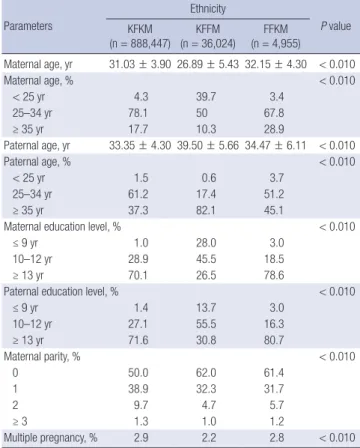
In 2010 and 2011, 888,447 KFKM, 36,024 KFFM, and 4,955 FFKM deliveries were recorded in Korea. Table 1 presents the basic char- acteristics of the study population by parental ethnicity. Signifi- cant differences were found between the groups in maternal
and parental age and educational level. Similarly, significant differences were found in maternal parity between the groups.
Table 2 shows birth weights at term by parental ethnicity. Birth weights were different between the groups after adjustment for parental age, educational level, parity, gestational age at deliv- ery, and neonatal sex.
Table 3 represents the risk of LBW at term by parental ethnic- ity. After adjustment for gestational age at delivery, parental age, educational level, maternal parity, and neonatal sex, the KFFM group had an increased risk for LBW at term compared with the KFKM group. However, no difference was found between the KFKM and FFKM groups.
Otherwise, the risk of HBW was increased in the FFKM group,
Table 1. Basic characteristics of the study population by parental ethnicity Parameters
Ethnicity
P value KFKM
(n = 888,447)
KFFM (n = 36,024)
FFKM (n = 4,955)
Maternal age, yr 31.03 ± 3.90 26.89 ± 5.43 32.15 ± 4.30 < 0.010
Maternal age, % < 0.010
< 25 yr 4.3 39.7 3.4
25–34 yr 78.1 50 67.8
≥ 35 yr 17.7 10.3 28.9
Paternal age, yr 33.35 ± 4.30 39.50 ± 5.66 34.47 ± 6.11 < 0.010
Paternal age, % < 0.010
< 25 yr 1.5 0.6 3.7
25–34 yr 61.2 17.4 51.2
≥ 35 yr 37.3 82.1 45.1
Maternal education level, % < 0.010
≤ 9 yr 1.0 28.0 3.0
10–12 yr 28.9 45.5 18.5
≥ 13 yr 70.1 26.5 78.6
Paternal education level, % < 0.010
≤ 9 yr 1.4 13.7 3.0
10–12 yr 27.1 55.5 16.3
≥ 13 yr 71.6 30.8 80.7
Maternal parity, % < 0.010
0 50.0 62.0 61.4
1 38.9 32.3 31.7
2 9.7 4.7 5.7
≥ 3 1.3 1.0 1.2
Multiple pregnancy, % 2.9 2.2 2.8 < 0.010
KFKM = Korean father-Korean mother, KFFM = Korean father-foreign mother, FFKM = foreign father-Korean mother.
Table 2. Adjusted* birth weights at term based on parental ethnicity Ethnicity
P value KFKM
(n = 888,447) KFFM
(n = 36,024) FFKM (n = 4,955)
Birth weight, kg 3.31 ± 0.01 3.29 ± 0.01 3.36 ± 0.01 < 0.001 KFKM = Korean father-Korean mother, KFFM = Korean father-foreign mother, FFKM = foreign father-Korean mother.
*Adjusted for gestational age at delivery, parental age, educational level, maternal par- ity, and neonatal sex.
Table 3. OR for the risk of LBW at term by parental ethnicity
Parent group Unadjusted OR (95% CI) Adjusted OR* (95% CI)
KFKM 1 1
KFFM 1.465 (1.363–1.575) 1.102 (1.002–1.212)
FFKM 0.972 (0.768–1.230) 0.826 (0.646–1.055)
OR = odds ratio, LBW = low birth weight, CI = confidence interval, KFKM = Korean father-Korean mother, KFFM = Korean father-foreign mother, FFKM = foreign father- Korean mother.
*Adjusted for gestational age at delivery, parental age, educational level, maternal par- ity, and neonatal sex.
Table 4. OR for the risk of HBW at term by parental ethnicity
Parent group Unadjusted OR (95% CI) Adjusted OR* (95% CI)
KFKM 1 1
KFFM 0.907 (0.854–0.964) 0.928 (0.863–0.998)
FFKM 1.557 (1.373–1.765) 1.564 (1.376–1.778)
OR = odds ratio, HBW = high birth weight, CI = confidence interval, KFKM = Korean father-Korean mother, KFFM = Korean father-foreign mother, FFKM = foreign father- Korean mother.
*Adjusted for gestational age at delivery, parental age, educational level, maternal par- ity, and neonatal sex.
Table 5. OR for the risk of preterm birth
Parent group Unadjusted OR (95% CI) Adjusted OR* (95% CI)
KFKM 1 1
KFFM 1.002 (0.951–1.055) 1.029 (0.539–1.964)
FFKM 1.009 (0.880–1.158) 1.022 (0.242–4.326)
OR = odds ratio, CI = confidence interval, KFKM = Korean father-Korean mother, KFFM = Korean father-foreign mother, FFKM = foreign father-Korean mother.
*Adjusted for gestational age at delivery, parental age, educational level, maternal pari- ty, and neonatal sex.
compared with that in the KFKM group (Table 4). No difference was found between the KFFM and KFKM groups.
Table 5 shows the risk of preterm birth by parental ethnicity.
No differences were found in the risk of preterm birth between the three groups.
The risk of multiple pregnancy was increased in the KFFM group compared with the KFKM group (Table 6). However, no difference was found between the KFKM and FFKM groups.
DISCUSSION
This study evaluated pregnancy outcomes according to paren- tal ethnicity and found significant differences in birth weight between the study groups, with the highest birth weight in the FFKM group and the lowest birth weight in the KFFM group.
Although the exact mechanisms accounting for different birth weights among the study groups are unclear, there are several possible explanations. First, the characteristics of marriages may contribute to this difference in birth weight. In Korea, most Ko- rean men in an interracial marriage chose to marry Asian wom- en, particularly those from Southeast Asia, who are generally smaller than Korean women; in contrast, most Korean women in an interracial marriage chose to marry Western men, who are generally taller than Korean men (2,8). Birth weight is known to be associated with parental genetic factors (9). In addition, our results suggest that foreign fathers generate a “promoting effect” on birth weight in the offspring of Korean mothers, where- as foreign mothers generate a “constraining effect” on birth wei- ght in the offspring of Korean fathers, similar to the findings in a study by Wells et al. (10). Based on their study, the results of pa- ternal ethnicity differences between two ethnic groups were asymmetrical, which suggests “paternal-promoting” and “pa- ternal-restraining” effects. This asymmetry is difficult to inter- pret because it might indicate a combination of Mendelian ge- netic effects, parent-of-origin genetic effects, and epigenetic ef- fects reflecting environmental differences. Despite these chal- lenges in interpretation, our data indicate that paternal ethnici- ty differences inducing HBW neonates are “paternal-promot- ing” effects.
Second, environmental factors may also account for differ- ences in birth weights of offspring. Several maternal factors re- portedly lead to LBW, including socioeconomic status, educa-
tional level, and age (11-15). In our study, we also found that LBW was related to low parental educational level, younger ma- ternal age, and older paternal age. Furthermore, the adjusted OR showed that the risk of LBW remained high even after con- trolling for confounding factors. Parental age and educational level are reportedly important risk factors for adverse pregnan- cy outcomes, including LBW (16). Thus, older paternal age and lower educational level in the KFFM group could have contrib- uted to LBW. However, even after controlling for parental age and educational level, the birth weight was significantly lower in the KFFM group than in the KFKM group.
Infants with LBW have an increased risk of mortality and mor- bidity during infancy and childhood (3). In studies in the USA, black infants were twice as likely as white infants to die during their first month of life, and this high mortality rate was primar- ily related to the high incidence of LBW infants among black mothers (17,18). In addition to the association with prenatal and postnatal maternal complications, HBW is also associated with increased neonatal morbidity and mortality (19). Many authors have demonstrated that HBW is a significant risk factor for birth trauma, shoulder dystocia, injuries during delivery, fe- tal death, and low neonatal Apgar scores. In addition, women with HBW infants have a higher rate of cesarean sections (20- 22). In our study, the birth weight of an infant born to a foreign mother was lower than that of an infant born to a Korean moth- er, a finding similar to the results from a previous study (23). Thus, there was a higher risk for LBW in KFKM pregnancies. Otherwise, the FFKM group had a higher birth weights, and thus a higher risk for HBW than the KFKM group. Therefore, the difference in birth weight by ethnicity is an important public health issue with significant individual, familial, and social impact.
In our study, the basic population data showed that paternal age in an interracial couple is older than in a Korean couple, and the preterm birth rate in interracial couples is higher than in Korean couples. Increased paternal age is related to a decre ase in natural pregnancy outcomes (24). A recent review by Dain et al. (25) suggests that a significant decrease in blastocyst embryo formation is associated with increased paternal age. Similarly, based on Astolfi et al. (26), the influence of paternal age is stron- ger in very preterm births, but also influences moderate preterm births.
Our study has several limitations. First, the racial categoriza- tion of “foreign” inadequately reflects the genetic diversity of these broadly-defined groups. In Korea, the number of interra- cial couples is relatively small, but more information is needed regarding racial categories. This was a retrospective database study, and included self-reported information from the nation- al birth registry of the Korean Statistical Office. Parental height and weight data were not available for this study, but would have been helpful in better understanding the reasons behind differ- ences in birth weights among interracial parents compared with Table 6. OR for the risk of multiple pregnancy by parental ethnicity
Parent group Unadjusted OR (95% CI) Adjusted OR* (95% CI)
KFKM 1 1
KFFM 0.763 (0.710–0.819) 1.104 (1.009–1.207)
FFKM 0.957 (0.806–1.135) 0.977 (0.809–1.181)
OR = odds ratio, CI = confidence interval, KFKM = Korean father-Korean mother, KFFM = Korean father-foreign mother, FFKM = foreign father-Korean mother.
*Adjusted for gestational age at delivery, parental age, educational level, maternal par- ity, and neonatal sex.
Korean parents. Another limitation is that we did not have in- formation on other pregnancy outcomes such as development of preeclampsia and gestational diabetes, because this is not available in the database. Further studies are needed to evalu- ate the differences in adverse pregnancy outcomes between Korean and Korean-foreign couples using linkage with Korea Health Insurance Review and Assessment data. Despite these limitations, our study indicates that Korean-foreign couples rep- resent a population with distinct birth weights. Moreover, in most previous research referring to pregnancy outcomes, only ma- ternal race was used, but our study used both maternal and pa- rental race. To the best of our knowledge, our study is the first to have assessed the influence of paternal and maternal race in pregnancy outcomes in Korea.
Future studies should explore the interactions among social, demographic, and environmental factors as they are related to interracial couples, and perinatal outcomes should be based on foreign subgroups rather than an all-inclusive foreign group. In addition, an approach is needed to reduce adverse pregnancy outcomes. Furthermore, our findings can be used for counsel- ing interracial couples regarding specific risks of perinatal out- comes demonstrated in this study.
DISCLOSURE
The authors have no potential conflicts of interest to disclose.
AUTHOR CONTRIBUTION
Conceptualization: Yang SY, Jung US, Cho GJ. Data curation: Oh MJ, Kim HJ, Cho GJ. Formal analysis: Hwang SY. Funding acqui- sition: Cho GJ. Investigation: Yang SY, Jung US, Hong HR. Writ- ing - original draft: Yang SY, Jung US. Writing - review & editing:
Oh MJ, Kim HJ, Cho GJ.
ORCID
Sun Young Yang https://orcid.org/0000-0003-1976-8426 Un Suk Jung https://orcid.org/0000-0003-0421-4148 Hye-Ri Hong https://orcid.org/0000-0002-1786-1320 Soon Young Hwang https://orcid.org/0000-0001-7474-1803 Min-Jeong Oh https://orcid.org/0000-0002-3130-2728 Hai-Joong Kim https://orcid.org/0000-0002-8082-221X Geum Joon Cho https://orcid.org/0000-0001-6761-0944 REFERENCES
1. Kim HS. Social integration and heath policy issues for international mar- riage migrant women in South Korea. Public Health Nurs 2010; 27: 561- 70.
2. http://www.index.go.kr/potal/main/EachDtlPageDetail.do?idx_cd=2430
[accessed on 17 December 2016]
3. Iyasu S, Tomashek K, Barfield W. Infant mortality and low birth weight among black and white infants—United States, 1980–2000. JAMA 2002;
288: 825-6.
4. Migone A, Emanuel I, Mueller B, Daling J, Little RE. Gestational duration and birthweight in white, black and mixed-race babies. Paediatr Perinat Epidemiol 1991; 5: 378-91.
5. Polednak AP, King G. Birth weight of US biracial (black-white) infants: re- gional differences. Ethn Dis 1998; 8: 340-9.
6. Gold KJ, DeMonner SM, Lantz PM, Hayward RA. Prematurity and low birth weight as potential mediators of higher stillbirth risk in mixed black/
white race couples. J Womens Health (Larchmt) 2010; 19: 767-73.
7. Collins JW Jr, David RJ. The differential effect of traditional risk factors on infant birthweight among blacks and whites in Chicago. Am J Public Health 1990; 80: 679-81.
8. Wikipedia. List of average human height worldwide [Internet]. Available at https://en.wikipedia.org/wiki/List_of_average_human_height_world- wide [accessed on 9 December 2016].
9. Troe EJ, Raat H, Jaddoe VW, Hofman A, Looman CW, Moll HA, Steegers EA, Verhulst FC, Witteman JC, Mackenbach JP. Explaining differences in birthweight between ethnic populations. The Generation R Study. BJOG 2007; 114: 1557-65.
10. Wells JC, Sharp G, Steer PJ, Leon DA. Paternal and maternal influences on differences in birth weight between Europeans and Indians born in the UK. PLoS One 2013; 8: e61116.
11. Geronimus AT. Black/white differences in the relationship of maternal age to birthweight: a population-based test of the weathering hypothesis.
Soc Sci Med 1996; 42: 589-97.
12. Beadle MR, Graham GN, Jarris PE, Hussein CA, Morgan A, Finch R. A na- tional partnership for action to end health disparities in the United States.
Proceedings of the World Conference on Social Determinants of Health;
19–21 October 2011; Rio de Janeiro, Brazil. Geneva, World Health Orga- nization, 2011.
13. Vintzileos AM, Ananth CV, Smulian JC, Scorza WE, Knuppel RA. Prenatal care and black-white fetal death disparity in the United States: heteroge- neity by high-risk conditions. Obstet Gynecol 2002; 99: 483-9.
14. Kaufman JS, Cooper RS, McGee DL. Socioeconomic status and health in blacks and whites: the problem of residual confounding and the resilien- cy of race. Epidemiology 1997; 8: 621-8.
15. Srinivasjois RM, Shah S, Shah PS; Knowledge Synthesis Group on Deter- minants of Preterm/LBW Births. Biracial couples and adverse birth out- comes: a systematic review and meta-analyses. Acta Obstet Gynecol Scand 2012; 91: 1134-46.
16. Park MJ, Son M, Kim YJ, Paek D. Social inequality in birth outcomes in Korea, 1995–2008. J Korean Med Sci 2013; 28: 25-35.
17. National Center for Health Statistics. Advance report of final mortality statistics, 1989. Mon Vital Stat Rep 1992; 40: 1-52.
18. National Center for Health Statistics. Annual summary of births, marriag- es, divorces, and deaths: United States, 1994. Mon Vital Stat Rep 1995;
43: 1-44.
19. American Congress of Obstetricians and Gynecologists. Fetal Macroso- mia. ACOG Technical Bulletin No. 159. Washington, D.C., American Con- gress of Obstetricians and Gynecologists, 1991.
20. Spellacy WN, Miller S, Winegar A, Peterson PQ. Macrosomia--maternal characteristics and infant complications. Obstet Gynecol 1985; 66: 158-61.
21. Parks DG, Ziel HK. Macrosomia. A proposed indication for primary ce- sarean section. Obstet Gynecol 1978; 52: 407-9.
22. Bérard J, Dufour P, Vinatier D, Subtil D, Vanderstichèle S, Monnier JC, Pu- ech F. Fetal macrosomia: risk factors and outcome. A study of the outcome concerning 100 cases >4500 g. Eur J Obstet Gynecol Reprod Biol 1998; 77:
51-9.
23. Kim MJ. A comparative study on birth outcomes between Korean wom- en and immigrant women. Korean J Women Health Nurs 2011; 17: 407- 14.
24. Tsai YR, Lan KC, Kung FT, Lin PY, Chiang HJ, Lin YJ, Huang FJ. The effect of advanced paternal age on the outcomes of assisted reproductive tech- niques among patients with azoospermia using cryopreserved testicular spermatozoa. Taiwan J Obstet Gynecol 2013; 52: 351-5.
25. Dain L, Auslander R, Dirnfeld M. The effect of paternal age on assisted re- production outcome. Fertil Steril 2011; 95: 1-8.
26. Astolfi P, De Pasquale A, Zonta LA. Paternal age and preterm birth in Ita- ly, 1990 to 1998. Epidemiology 2006; 17: 218-21.