Intron 4 VNTR (4a/b) Polymorphism of the Endothelial Nitric Oxide Synthase Gene Is Associated with Breast Cancer in
Mexican Women
The endothelial nitric oxide synthase (eNOS) gene plays an important role in several biological functions. Polymorphisms of the eNOS gene have been associated with cancer.
It has been suggested that the VNTR 4 a/b polymorphism may affect the expression of eNOS and contributes to tumor promotion in the mammary gland. We examined the role of the eNOS4 a/b polymorphism by comparing the genotypes of 281 healthy Mexican women with the genotypes of 429 Mexican women with breast cancer (BC). The observed genotype frequencies for control and BC patients were 0.6% and 0.7% for a/a (polymorphic);
87% and 77% for a/a (wild type); and 12% and 22% for a/b respectively. We found that the odds ratio (OR) was 1.9, with a 95% confidence interval (95%CI) of 1.29-2.95, P = 0.001 for genotypes a/a-a/b, b/c. The association was also evident when comparing the distribution of the a/a-a/b genotypes in patients with high levels of glutamate- oxaloacetate transaminase (SGOT) (OR, 1.93; 95% CI, 1.14-3.28; P = 0.015); undergoing menopause with high levels of SGOT (OR, 2.0; 95% CI, 1.1-3.84); and with high levels of glutamic-pyruvic transaminase (SGPT) (OR, 3.5; 95% CI, 1.56-8.22). The genotypes a/a-a/
b are associated with BC susceptibility in the analyzed samples from the Mexican population.
Key Words: VNTR, eNOS, Breast Cancer, Mexican Population Ramiro Ramírez-Patiño,1,2
Luis Eduardo Figuera,3 Ana María Puebla-Pérez,4 Jorge Iván Delgado-Saucedo,4 María Magdalena Legazpí-Macias,5 Rocio Patricia Mariaud-Schmidt,6 Adriana Ramos-Silva,1,7
Itzae Adonai Gutiérrez-Hurtado,1,2 Liliana Gómez Flores-Ramos,1,2 Guillermo Moisés Zúñiga-González,8 and Martha Patricia Gallegos-Arreola1
1Molecular Genetics Laboratory, Molecular Medicine Division, Western Biomedical Research Center (CIBO), Western National Medical Center (CMNO), Mexican Social Security Institute (IMSS); 2PhD Program in Human Genetics, Health Sciences University Center (CUCS), University of Guadalajara (U de G); 3Genetics Division, CIBO, CMNO, IMSS,
4Immunopharmacology Laboratory, Exact Sciences and Engineer University Center (CUCEI), U de G;
5UMAE-CMNO Transplant Unit, 6Research Institute of Dentistry, Department of Integral Clinical Dentistry, CUCS, U de G; 7PhD Program in Pharmacology, CUCS, U de G; 8Mutagenesis Laboratory, Molecular Medicine Division, CIBO, CMNO, IMSS, Guadalajara, Jalisco, Mexico Received: 29 June 2013
Accepted: 17 September 2013 Address for Correspondence:
Dr. en C. Martha Patricia Gallegos-Arreola
División de Medicina Molecular, CIBO, IMSS Sierra Mojada 800, Col. Independencia, Guadalajara, Jalisco 44340, México Tel: +52.33-36170060 (31936), Fax: +52.33-38185786 E-mail: [email protected]
http://dx.doi.org/10.3346/jkms.2013.28.11.1587 • J Korean Med Sci 2013; 28: 1587-1594 Human Genetics & Genomics
INTRODUCTION
Breast cancer (BC) is one of the most common diseases in de- veloping countries. It is estimated that there are millions of symptomatic women that are affected by BC and millions more currently asymptomatic that will develop cancer (1). Incidence rates are variable in different ethnicities (2). In Mexico, the inci- dence of BC has increased within the last 7 yr, and BC is now one of the main causes of death in productive age females, only 10% of all cases are detected at stage I (3, 4). BC might result from a combination of abnormal protein interactions and envi-
ronmental factors (5).
Nitric oxide (NO) is also known as nitrogen monoxide or en- dothelium-derived relaxing factor (EDRF); acts as a signaling molecule. NO participates in neurotransmission, endothelial vasodilatation, immunity and carcinogenesis. It is synthesized by the nitric oxide synthase (NOS) enzyme family: endothelial NOS (eNOS), neuronal NOS (nNOS) and inducible NOS (iNOS), which have been shown to be involved in promoting or inhibit- ing the etiology of cancer (6, 7).
Multiple mechanisms have been proposed to understand the role of NO in carcinogenesis. However, several authors have
suggested that NO may have dual roles in cancer. NO is a highly reactive molecule within biological systems that reacts with other free radicals, such as molecular oxygen and heavy metals, causing DNA breakage. NO contributes to cancer development via the generation of peroxynitrite (ONOO-) and N2O3 by p53 accumulation, which induces apoptosis and activates poly (ADP- ribose) polymerase (PARP) by the breakage of DNA strands or by the nitrosative deamination of DNA bases. The iNOS and eNOS isoforms have been studied in carcinogenesis. The NO- mediated upregulation of vascular endothelial growth factor (VEGF) may enhance the stability of the tumor and increase its invasiveness and metastatic ability. In BC, it has been suggested that the expression of iNOS and eNOS is higher in invasive tu- mors (7).
The eNOS (or NOS3) human gene, locus 7q35-36, encodes for a protein of 1203 amino acids; in addition, several polymor- phisms have been reported, of which 3 (-786T > C, eNOS 4a/b, and 894G > T) are the most studied and are associated with dif- ferent diseases, including cancer (8). The eNOS 4a/b polymor- phism of the 27-bp VNTR in intron 4 has 2 common alleles: 4a with 4 repeats (GAAGTCTAGACCTGCTGC(A/G)GGGGTGAG) and 4b with 5 repeats. Two less common alleles, which are call- ed 4c and 4*y (with 6 and 3 repeats, respectively), have been found in African and Colombian populations (9, 10).
Some reports indicate that carriers of the 4a variant have low- er NO plasma levels and decreased protein expression; howev- er, there is conflict among the different studies. It is possible that the variant is in linkage disequilibrium with other functional variants in regulatory regions of the eNOS gene (6, 11-13). Al- though the biological impact of the VNTR 4a/b polymorphism is unclear, it has been suggested that this polymorphism would regulate the expression of eNOS by the formation of small RNAs (sirRNAs). Endothelial cells containing five copies present high- er quantities of sirRNA and lower levels of mRNA of eNOS, when compared with cells that contain four copies (8, 14).
Different studies have found variability in the allelic frequen- cy of the VNTR 4a/b polymorphism of the eNOS gene among diverse ethnic groups (10, 11, 15-18). The eNOS 4a/b polymor- phism has been associated with different pathologies (6, 7, 19, 20), including cancer (11, 21). However, several of the studies that examined the connection between the eNOS 4a/b poly- morphism and BC did not reveal any statistically significant as- sociations (8). The aim of this study was to determine the asso- ciation between the eNOS 4a/b polymorphism and BC in Mexi- can women.
MATERIAL AND METHODS
DNA was extracted from peripheral blood lymphocytes using standard protocols (22). Blood samples were collected from 281 healthy women that were recruited as volunteer blood donors
with an average age of 34 yr. These volunteers were not matched by age with the patient group. Blood samples were also collect- ed from 429 patients with a clinical and histological confirma- tion of BC, and all of the patients were residents of the metro- politan area of Guadalajara. The patients were recruited from June 2010 to October 2012.
Efforts were taken to ensure that siblings of those patients who were already sampled were excluded. The clinical and de- mographical data were obtained using written questionnaires.
All of the patients were also interviewed to determine occupa- tional exposure and the pharmacological therapeutics used.
The database and DNA samples from BC patients were exam- ined for other polymorphisms.
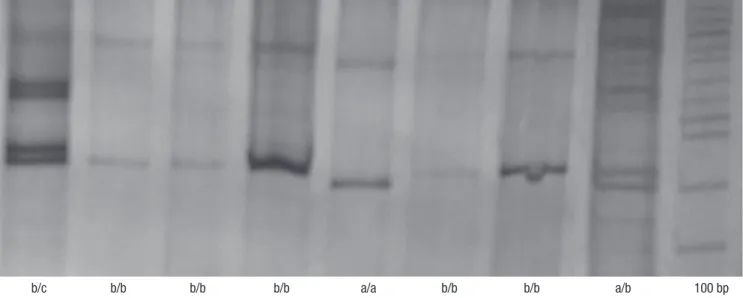
The amplification of the eNOS 4a/b polymorphism of intron 4 was performed by PCR using the following primers: 5´-AGG CCC TAT GGT AGT GCC TTT-3´ and 5´-TCT CTT AGT GCT GTG GTC AC-3´ (24). The PCR reactions were performed in a total volume of 15 μL, which contained 0.2 mM dNTPs (Invitro- gen , Carlsbad, CA USA), 5 pM of primers, 2.0 mM MgCl2, 2.5 U Taq polymerase (Invitrogen), and 50 ng of genomic DNA. The PCR conditions were 95°C (4 min), followed by 35 cycles of 94°C (1 min), 57°C (1 min), and 72°C (1.5 min), and then a final extension at 72°C (7 min). Using this procedure, we obtained fragments of 393 and 420 base pairs (bp). For the allelic discri- mination of the eNOS 4a/b polymorphism, the amplified prod- ucts were separated on 6% polyacrylamide gels (29:1), followed by silver staining (25). We determined that the 393-bp fragment represented a polymorphic genotype (a/a, 4 repeats). Two frag- ments at 393- and 420-bp indicated a heterozygous genotype (a/b), and one fragment at 420-bp represented the wild-type genotype (b/b; 5 repeats) (Fig. 1). The allelic frequencies were obtained by direct counting. Hardy-Weinberg equilibrium was tested by a chi-square goodness-of-fit test to compare the ob- served genotype frequencies with the expected frequencies among control subjects. The odds ratio (OR) and 95% confidence intervals (95% CI) were also calculated. A two-sided P < 0.05 was considered statistically significant. All statistical analyses were performed using the PASW Statistic Base 18 software, 2009 (Chicago, IL, USA).
Ethics statement
All of the samples were obtained with the appropriate written informed consent. This study was approved by the institutional review board of CIBO, IMSS (#1305).
RESULTS
The comparative epidemiological data from the BC patients and the control individuals are displayed in Table 1. In the pa- tient group, the observed average age was 55 yr. Oral contracep- tive use (OR, 2.9: 95%CI, 1.7-4.9; P < 0.001), menopause (OR,
Table 1. Demographic data from the study groups
Parameters BC patients (n = 429) Controls (n = 281) OR (95%IC) * P value
Age (yr)
Mean (SD) 55.0 (12.0) 34.0 (10.0)
Menarche (yr) Mean (SD) 7-10 (No., %) 11-13 (No., %) 14-18 (No., %)
12.54 40 264 125
(1.7) (9) (62) (29)
12.19 1 252 28
(1.0) (0.4) (89.6) (10.0) Oral contraceptive use
Yes (No., %) No (No., %)
177 252
(41) (59)
73 208
(26) (74)
2.9 (1.7-4.9) < 0.001 Breastfeeding
No (No., %)
≤ 6 months (No., %)
> 6 months (No., %)
161 50 218
(38) (11) (51)
108 111 62
(38) (40) (22)
0.10 (0.04-0.23) < 0.001
Menopause Yes (No., %)
No (No., %) 296
133(69)
(31) 24
257(9)
(91) 17 (9.7-29.9) < 0.001
Tobacco consumption Yes (No., %)
No (No., %) 90
339(21)
(79) 44
237(16)
(84) NS
Alcohol consumption Yes (No., %)
No (No., %) 71
358(17)
(83) 65
216(23)
(77) 0.43 (0.23-0.78) 0.006
Familial history (FH) Yes (No., %) No (No., %)
289 140
(67) (33)
62 219
(22) (78)
7.9 (4.2-15) < 0.001
*OR (odds ratio) adjusted regression analysis. NS (No significant difference).
Fig. 1. Polyacrylamide gel electrophoresis of the eNOS 4 a/b polymorphism.
b/c b/b b/b b/b a/a b/b b/b a/b 100 bp
17; 95% CI, 9.7-29.9; P < 0.001), and familial history (FH) (OR, 7.9; 95% CI, 4.2-15; P < 0.001) were presented as risk factors.
Table 2 shows the general clinical characteristics of the pa- tient group. We observed that 28% of the patients had diabetes mellitus-arterial hypertension (DM-AH), 44% had 1-3 pregnan- cies, 30% had abortions, 36.4% had IMC of 25-29.9, 28% were positive for hormonal receptors and were negative for Her 2/neu, 89% had ductal histology, 62.5% had stage III-IV tumors,19%
(approx.) had high levels of SGOT, and more than 23% had high levels of alkaline phosphatase (ALP), gamma-glutamyltrans- peptidase (GGT) and glucose (data not shown).
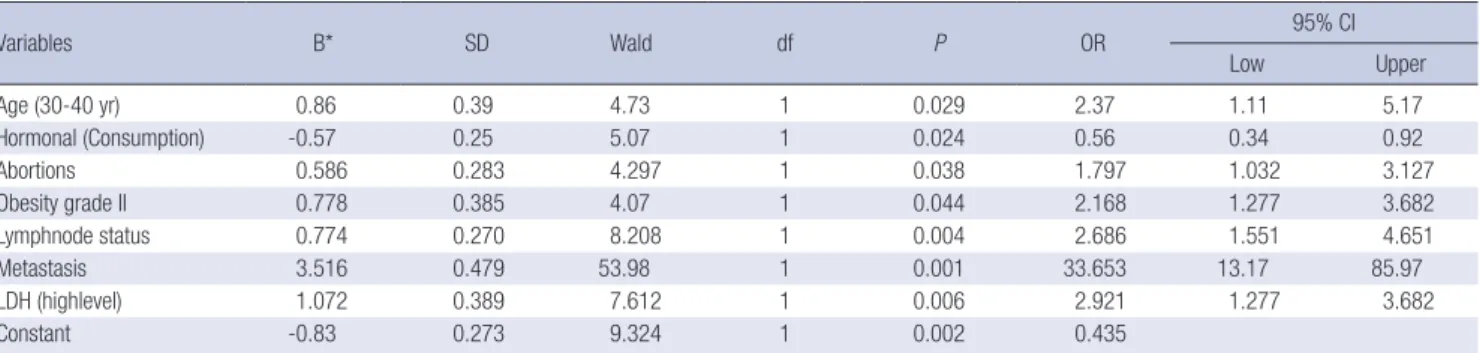
Table 3 summarizes the multivariate logistic regression anal- ysis, where the BC group was classified with tumor stages I-II and III-IV as the dependent variables. The risk factors for stage III-VI tumors included the following: age (30-40 yr), hormonal consumption, abortion presence, obesity grade II, metastatic
Table 2. Clinical data from patients with BC
Parameters No. (%) Parameters No. (%)
Age (yr) 30-40 41-51 52-62 63 or more
49 132 146 102
(11) (31) (34) (24)
Tumor stage I-II III-IV
161 268
(37.5) (62.5) Lymphnode status
Yes No
302 127
(70.4) (29.6) Personal medical history
No DM-AH
Breast fibrosis-myomatosis hysterectomy Depression, pregnancy, asthma
200 120 99 10
(47) (28) (23) (2)
Metastasis Yes No
147 282
(34) (66) Chemotherapy response
Yes No
279 150
(65) (35) Pregnancies
No 1-3 4- and more
64 189 176
(15) (44)
(41) Chemotherapytype
FEC Other
No chemotherapy
326 83 20
(76) (19) (5) Abortions
Yes No
129 300
(30)
(70) Laboratory test hemoglobin (g/dL)
< 11
11-16.4 84
345(19.5) (80.4) BMI
18.5-24.9 25-29.9 (overweight) 30-34.9 (obesity I) 35-39.9 (obesity II)
≥ 40 (obesity III and IV)
82 156 115 53 23
(19) (37) (27) (12) (5)
Hematocrit (%)
< 37
37-47 85
344(19.8) (80.2) Tumor localization
Unilateral (Right/left)
Bilateral 407
22(95) (5)
Platelets (mm3)
< 150,000 150,000-450,000
> 450,000
17 274 138
(4) (64) Diagnostic years (32)
1-4 yr 5-9 yr 10-15 yr
331 83 15
(77) (19) (4)
Leukocytes (mm3)
< 150,000 150,000-500,000
48 381
(11) (89) Tumoral markers
Her2/neu, ER, PR Her2/neu, ER Her2/neu, PR Her2/neu Triple negative ER, PR ER PR No data
57 10 13 64 64 150 39 17 15
(13.5) (2) (3) (15) (15) (35) (9) (4) (3.5)
SGOT (µI/L)
> 35 0-35
83 346
(19) (81) SGPT (µI/L)
> 45 5-45
43 386
(10) (90) LDH (µI/L)
> 333 105-333
75 354
(17.5) (82.5) GGT (µI/L)
> 45 5-45
114 315
(27) (73) Histology
Ductal Lobular Mixed
383 43 3
(89) (10) (1)
FEC: 5-Fluorouracil, Epirubicin, Cyclophosphamide; Others: paclitaxel, docetaxel, Herceptin. Body mass index (BMI), estrogen receptor (ER), progesterone receptor (PR), triple negative (absence of ER, PR, Her2/neu).
Table 3. The regression binary logistic of the patient group
Variables B* SD Wald df P OR 95% CI
Low Upper
Age (30-40 yr) 0.86 0.39 4.73 1 0.029 2.37 1.11 5.17
Hormonal (Consumption) -0.57 0.25 5.07 1 0.024 0.56 0.34 0.92
Abortions 0.586 0.283 4.297 1 0.038 1.797 1.032 3.127
Obesity grade II 0.778 0.385 4.07 1 0.044 2.168 1.277 3.682
Lymphnode status 0.774 0.270 8.208 1 0.004 2.686 1.551 4.651
Metastasis 3.516 0.479 53.98 1 0.001 33.653 13.17 85.97
LDH (highlevel) 1.072 0.389 7.612 1 0.006 2.921 1.277 3.682
Constant -0.83 0.273 9.324 1 0.002 0.435
Variables included in the analysis: Dependent: BC classified by tumor status as I-II and III-IV. Independent: personal medical history, menarche ranges 7-10 yr, 11-13 yr, 14-18 yr; menopause, pregnancies, breastfeeding, oral contraceptive use, tobacco and alcohol consumption, FH, and BMI: 18.5-24.9, ≥ 25-29.9, ≥ 30-34.9, ≥ 35- > 40, lymph node status, metastasis, response to chemotherapy, laboratory tests (hemoglobin, hematocrit, platelets, leukocytes, urea, SGOT, SGPT, LDH, ALP, GGT, and glucose),*coeficient B.
nodules, metastasis presence and high levels of lactate dehy- drogenase (LDH).
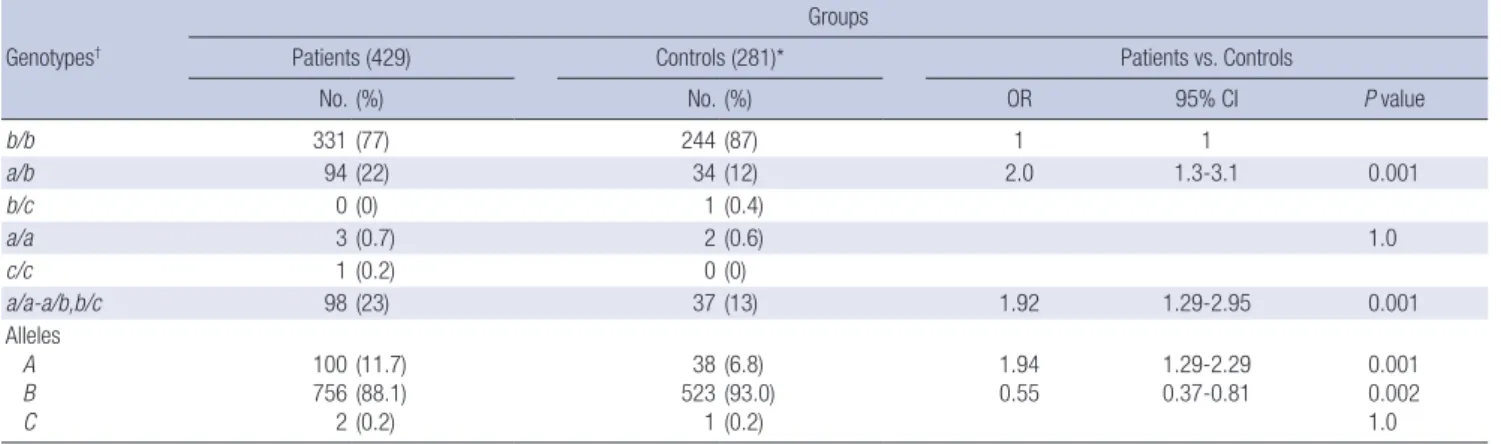
The genotypic and allelic frequencies of the eNOS 4 a/b poly- morphism were different in the control and patient groups (Ta- ble 4). The polymorphic genotype (a/a) was observed in 0.7%
(3/429) of patients compared with 0.6% (2/281) of the controls.
The heterozygous genotype (a/b) was observed in 22% of the patients (94/429) and 34% (12/281) of the controls (OR, 2.0;
95% CI, 1.3-3.1; P = 0.0008), whereas genotype b/c was only ob- served in the control group 0.4% (1/281). Genotype b/b was observed in 77% (331/497) of the patients and 87% (244/281) in the controls. The genotypic distributions of the control group were in Hardy-Weinberg equilibrium. All of the samples were analyzed, and all of the genotypes (281 controls and 429 BC pa- tients) were obtained.
Table 5 shows that the patients with the a/a-a/b genotypes were associated with the presence of high levels of SGOT (OR, 1.936; 95% CI, 1.14-3.26; P = 0.015) along with the variables list- ed in Tables 1 and 2 as risk factors. Additionally, when patients were classified with more than two clinical variables, we observ- ed that the a/a-a/b genotype was associated with the following risk factors: the presence of a metastatic lymph node with high levels of SGOT (OR, 2.1; 95% CI, 1.188-3.94) and SGPT (OR, 2.9;
95% CI, 1.34-6.42); metastasis with high levels of SGPT (OR, 4.0;
95% CI, 1.55-10.49); menopause with high levels of SGOT (OR 2.0, 95% CI; 1.1-3.84) and SGPT (OR, 3.59; 95% CI, 1.56-8.2) (data
no shown).
DISCUSSION
The results of this study were consistent with those described by other authors. We observed the presence of BC at an average age of 55 yr (25), with oral contraceptive use (26, 27), menopau- se, a familial history of cancer, DM and hypertension as risk fac- tors (28), and breastfeeding, which was classified by the period of lactation (≤ 6 month), as a protective factor (29).
When the BC group was stratified by tumor stages as I-II or III-IV and were compared with the clinical and biochemical characteristics of BC, the following risk factors emerged: age (30-40 yr), abortions, obesity grade II, metastatic lymph nodes, metastasis and high levels of LDH. The association of miscar- riage/abortion with BC remains controversial; some studies have found a correlation, whereas others have indicated no ap- parent relation (30). It is thought that the generation of sponta- neous abortions may lead to the enhanced proliferation of un- differentiated breast tissue, and therefore, increased suscepti- bility to carcinogenic change (31). When we adjusted the pa- tient group according to body mass index (BMI), we observed that obesity II (≥ 30 to 34.9) was a risk factor in BC patients with stages III-IV. In fact, there are several theories that attempt to explain this association, and these theories involve the role of leptin, insulin and other molecules that mediate the inflamma- Table 4. The genotype and allelic distribution of the eNOS 4a/b polymorphism in healthy controls and BC patients
Genotypes†
Groups
Patients (429) Controls (281)* Patients vs. Controls
No. (%) No. (%) OR 95% CI P value
b/b 331 (77) 244 (87) 1 1
a/b 94 (22) 34 (12) 2.0 1.3-3.1 0.001
b/c 0 (0) 1 (0.4)
a/a 3 (0.7) 2 (0.6) 1.0
c/c 1 (0.2) 0 (0)
a/a-a/b,b/c 98 (23) 37 (13) 1.92 1.29-2.95 0.001
Alleles A B C
100 756 2
(11.7) (88.1) (0.2)
38 523 1
(6.8) (93.0) (0.2)
1.94
0.55 1.29-2.29
0.37-0.81 0.001
0.002 1.0
*Hardy-Weinberg equilibrium in the controls (chi-square test = 0.52; P = 0.972); †Marker informativity: 0.876 was assessed within a range of 0-1: markers with a score greater than 0.7 were considered to be highly informative, whereas markers with a value of 0.44 were considered to be moderately informative.
Table 5. The association of the a/b-a/a genotypes of the eNOS 4a/b polymorphism with more than one variable of the general characteristics of the BC patients
B SD Wald df P OR 95% CI
Low Upper
SGOT (high level) 0.660 0.270 5.975 1 0.015 1.936 1.140 3.287
Constant -1.390 0.135 106.715 1 0.001 0.249
Variables included in the analysis: Dependent: BC patients classified by a/a-a/b genotype. Independent: personal medical history, menarche ranges 7-10 yr, 11-13 yr, 14-18 yr;
menopause, pregnancies, abortion, breastfeeding, oral contraceptive use, tobacco and alcohol consumption, HF, and BMI: 18.5-24.9, ≥ 25-29.9, ≥ 30-34.9, ≥ 35- > 40, lymph node status, metastasis, response to chemotherapy, laboratory tests (hemoglobin, hematocrit, platelets, leukocytes, urea, SGOT, SGPT, LDH, ALP, GGT, and glucose, *coe- ficient B.
tory process independently of estrogen. In addition, peripheral circulating estrogens (from aromatization of androgens) are el- evated in obese postmenopausal women. Another current hy- pothesis proposes that obesity is associated with metabolic syn- drome, which activates molecular processes that are mitogenic in breast epithelial cells and stimulates neoplasia. A third hy- pothesis suggests that adipocytes and their autocrine mecha- nisms are important for BC development (18, 19).
Additionally, the presence of lymph node metastases and metastasis emerged as risk factors in patients with stages III-IV BC. The tumor stage of BC is important for determining the type of chemotherapy treatment and predicting survival. Moreover, the number of positive axillary nodes is an important prognos- tic factor in cases of invasive carcinoma that are treated with mastectomy and is related to survival, recurrence rate and treat- ment failure (22, 23). In addition, other associated factors in- cluded the high expression of LDH as indicative of a poor re- sponse in patients with later stages of BC. The elevated expres- sion of these enzymes is thought to reflect tumor aggressive- ness (24).
Advances in molecular and genetic epidemiology have in- creased our knowledge of the mechanisms underlying breast carcinogenesis and the relation between exposure to carcino- gens, diet, and individual genetic variations in susceptibility.
Polymorphisms, which are low penetrance genes, are risk fac- tors in BC. NO metabolism has been proposed to act as a pleio- tropic regulator that is involved in carcinogenesis; the high con- centrations of NO and its metabolites contribute as promoters of gene transcription and protein activation that join specific DNA sequences, producing DNA breakage and promoting tu- mor angiogenesis and metastasis (7). However, the exact mech- anism of these contributions is unknown. The eNOS enzyme is calcium-dependent and participates in the regulation of blood pressure, platelet aggregation, leukocyte adherence, vascular smooth muscle cell mitogenesis and angiogenesis (32). The eNOS intron 4a/b polymorphism has been associated with the risk of several diseases, including cancer, and is associated with reduced enzymatic activity (6, 7, 14). In this study, the allelic frequency of the eNOS 4 a/b polymorphism was 0.06 in con- trols and 0.11 in BC patients with associated risk factors. This result most likely suggests that this polymorphism contributes to the angiogenic capacity of the tumor tissue, which could be responsible for tumor growth. However, low levels of NO might also contribute to carcinogenesis (33).
Furthermore, we observed an association of the a/a-a/b gen- otype as a risk factor in patients with high levels of SGOT. In this respect, the relation between a high level of SGOT and BC is complex; SGOT has been associated with several factors, which include alcohol consumption, metastasis, diet and chemother- apy. This observation could possibly be explained by the partic- ipation of SGOT as a marker for liver metastases and hepato-
toxicity by chemotherapy in BC patients. A high level of SGOT has been proposed as a biomarker of the progression of tumor growth. SGOT is required in glycolysis metabolism, which is in- creased with several oncogenes in cancer cells. Cytoplasmic SGOT and mitochondrial SGOT function in tandem with ma- late dehydrogenase to cycle the malate-aspartate shuttle, which is active in the neoplastic cells of several types of tumors (34).
In contrast, the high levels of NO production in breast cancer and chemotherapy may result in high cytotoxic activity. NO promotes cancer progression by activating several oncogenic signaling pathways, such as extracellular signal-regulated ki- nases and phosphoinositide 3-kinases. The upregulation of eNOS and elevated production of NO affect the redox state of cells and can induce protein, lipid, and DNA modifications. A release of variable amounts of NO into the tumor microenvi- ronment can activate oncogenic pathways and stimulate tumor microvascularization. The eNOS 4a/b polymorphism could most likely be related to breast carcinogenesis due to the overpro- duction of eNOS and NO levels and, consequently, the over- production of ROS, which could lead to genetic instability, tu- mor progression, and metastasis by triggering an oncogene path- way that, in turn, activates glycolysis metabolism (34, 35).
Chemotherapeutic drugs not only increase the formation of free radicals but also decrease the ability to detoxify ROS. These chemotherapeutic drugs are hydrophilic and cannot penetrate the inner membrane of cells, where NADH located on the inner membrane surface would reduce them. The increment in se- rum transaminase enzyme levels suggests an increased leakage of this enzyme from mitochondria because of the toxicity in- duced by chemotherapy treatments. Amin et al. (35) reveal ed that oxidative stress and cardiotoxicity development might fa- cilitate breast cancer progression, most likely mediated through catalase, GSH, MDA, NO, LDH, transaminases, and CK activity.
Our results show that the frequencies of the heterozygous genotypes of the eNOS intron 4 a/b polymorphism are signifi- cantly higher in BC patients when compared with controls. The differences were most evident in patients with high SGOT lev- els; additionally, in the analyzed sample from the Mexican po- pulation, the BC patients with metastasis seem to have a signifi- cantly higher susceptibility to develop BC. However, further stud- ies are required to confirm or reject these observations.
ACKNOWLEDGMENTS
We thank Dr. Efrain Salas and the nurses from the UMAE Hos- pital de Gineco-Obstetricia, CMNO, IMSS for providing the fa- cilities for sample collection.
DISCLOSURE
The authors have no conflicts of interest to disclose
REFERENCES
1. Siegel R, DeSantis C, Virgo K, Stein K, Mariotto A, Smith T, Cooper D, Gansler T, Lerro C, Fedewa S, et al. Cancer treatment and survivorship statistics, 2012. CA Cancer J Clin 2012; 62: 220-41.
2. Miller JW, King JB, Joseph DA, Richardson LC; Centers for Disease Con- trol and Prevention (CDC). Breast cancer screening among adult women:
Behavioral Risk Factor Surveillance System, United States, 2010. MM- WR Morb Mortal Wkly Rep 2012; 61: 46-50.
3. Chávarri-Guerra Y, Villarreal-Garza C, Liedke PE, Knaul F, Mohar A, Finkelstein DM, Goss PE. Breast cancer in Mexico: a growing challenge to health and the health system. Lancet Oncol 2012; 13: e335-43.
4. Knaul FM, Nigenda G, Lozano R, Arreola-Ornelas H, Langer A, Frenk J.
Breast cancer in Mexico: an urgent priority. Salud Publica Mex 2009; 51:
s335-44.
5. Ma Q, Lu AY. Pharmacogenetics, pharmacogenomics, and individual- ized medicine. Pharmacol Rev 2011; 63: 437-59.
6. Casas JP, Cavalleri GL, Bautista LE, Smeeth L, Humphries SE, Hingora- ni AD. Endothelial nitric oxide synthase gene polymorphisms and car- diovascular disease: a HuGE review. Am J Epidemiol 2006; 164: 921-35.
7. Xu W, Liu LZ, Loizidou M, Ahmed M, Charles IG. The role of nitric oxide in cancer. Cell Res 2002; 12: 311-20.
8. Lu J, Wei Q, Bondy ML, Yu TK, Li D, Brewster A, Shete S, Sahin A, Mer- ic-Bernstam F, Wang LE. Promoter polymorphism (-786t>C) in the en- dothelial nitric oxide synthase gene is associated with risk of sporadic breast cancer in non-Hispanic white women age younger than 55 years.
Cancer 2006; 107: 2245-53.
9. Thameem F, Puppala S, Arar NH, Stern MP, Blangero J, Duggirala R, Abboud HE. Endothelial nitric oxide synthase (eNOS) gene polymor- phisms and their association with type 2 diabetes-related traits in Mexi- can Americans. Diab Vasc Dis Res 2008; 5: 109-13.
10. Serrano NC, Díaz LA, Casas JP, Hingorani AD, Moreno de Lucca D, Páez MC. Frequency of eNOS polymorphisms in the Colombian general pop- ulation. BMC Genet 2010; 11: 54.
11. Yeh CC, Santella RM, Hsieh LL, Sung FC, Tang R. An intron 4 VNTR polymorphism of the endothelial nitric oxide synthase gene is associated with early-onset colorectal cancer. Int J Cancer 2009; 124: 1565-71.
12. Yanamandra K, Boggs PB, Thurmon TF, Lewis D, Bocchini JA Jr, Dhani- reddy R. Novel allele of the endothelial nitric oxide synthase gene poly- morphism in Caucasian asthmatics. Biochem Biophys Res Commun 2005; 335: 545-9.
13. Via M, González-Pérez E, Esteban E, López-Alomar A, Vacca L, Vona G, Dugoujon JM, Harich N, Moral P. Molecular variation in endothelial ni- tric oxide synthase gene (eNOS) in western Mediterranean populations.
Coll Antropol 2003; 27: 117-24.
14. Silva PS, Lacchini R, Gomes Vde A, Tanus-Santos JE. Pharmacogenetic implications of the eNOS polymorphisms for cardiovascular action drugs.
Arq Bras Cardiol 2011; 96: e27-34.
15. Li A, Song B, Zheng H, Zhang X, He Y, Xu Y. Association between the variable number of tandem repeat polymorphisms of endothelial nitric oxide synthase and ischemic cerebrovascular diseases in Henan Han ethnicity. Life Sci J 2007; 4: 26-9.
16. Patkar S, Charita BH, Ramesh C, Padma T. High risk of essential hyper- tension in males with intron 4 VNTR polymorphism of eNOS gene. Indi- an J Hum Genet 2009; 15: 49-53.
17. Celik U, Yildizdaş D, Alhan E, Celik T, Attila G, Sertdemir Y, Tepe T. Ge- netic dilemma: eNOS gene intron 4a/b VNTR polymorphism in sepsis and its clinical features in Turkish children. Turk J Pediatr 2008; 50: 114-9.
18. Gan YY, Chen CF. The 27-bp VNTR polymorphism in intron 4 of the hu- man eNOS gene in healthy Singaporean Chinese, Indians, and Malays.
Biochem Genet 2012; 50: 52-62.
19. Rusai K, Vannay A, Szebeni B, Borgulya G, Fekete A, Vásárhelyi B, Tul- assay T, Szabó AJ. Endothelial nitric oxide synthase gene T-786C and 27- bp repeat gene polymorphisms in retinopathy of prematurity. Mol Vis 2008; 14: 286-90.
20. Deng F, Hu Q, Tang B, He F, Guo S, Chen J, Li F, Wu X, Zhang J, Zhang H, et al. Endothelial nitric oxide synthase gene intron 4, 27 bp repeat poly- morphism and essential hypertension in the Kazakh Chinese popula- tion. Acta Biochim Biophys Sin (Shanghai) 2007; 39: 311-6.
21. Moreno H Jr. Genetic polymorphisms and haplotypes of eNOS in breast cancer. Breast Cancer Res Treat 2008; 109: 181-2.
22. Miller SA, Dykes DD, Polesky HF. A simple salting out procedure for ex- tracting DNA from human nucleated cells. Nucleic Acids Res 1988; 16: 1215.
23. Yoon Y, Song J, Hong SH, Kim JQ. Plasma nitric oxide concentrations and nitric oxide synthase gene polymorphisms in coronary artery dis- ease. Clin Chem 2000; 46: 1626-30.
24. Sanguinetti CJ, Dias Neto E, Simpson AJ. Rapid silver staining and re- covery of PCR products separated on polyacrylamide gels. Biotechniques 1994; 17: 914-21.
25. Naieni KH, Ardalan A, Mahmoodi M, Motevalian A, Yahyapoor Y, Yaz- dizadeh B. Risk factors of breast cancer in north of Iran: a case-control in Mazandaran Province. Asian Pac J Cancer Prev 2007; 8: 395-8.
26. Macciò A, Madeddu C. Obesity, inflammation, and postmenopausal breast cancer: therapeutic implications. ScientificWorldJournal 2011; 11:
2020-36.
27. IARC Working Group on the Evaluation of Carcinogenic Risks to Hu- mans. Combined estrogen-progestogen contraceptives and combined es- trogen-progestogen menopausal therapy. IARC Monogr Eval Carcinog Risks Hum 2007; 91: 1–528.
28. Lazcano-Ponce EC, Tovar-Guzmán V, Alonso-de Ruiz P, Romieu I, Ló- pez-Carrillo L. Breast cancer: a historical account, present and future.
Salud Publica Mex 1996; 38: 139-52.
29. Anothaisintawee T, Wiratkapun C, Lerdsitthichai P, Kasamesup V, Wong- waisayawan S, Srinakarin J, Hirunpat S, Woodtichartpreecha P, Boon- likit S, Teerawattananon Y, et al. Risk factors of breast cancer: a system- atic review and meta-analysis. Asia Pac J Public Health 2013; 25: 368- 87.
30. Yu ZG, Jia CX, Liu LY, Geng CZ, Tang JH, Zhang J, Zhang Q, Li YY, Ma ZB. The prevalence and correlates of breast cancer among women in Eastern China. PLoS One 2012; 7: e37784.
31. Jiang AR, Gao CM, Ding JH, Li SP, Liu YT, Cao HX, Wu JZ, Tang JH, Qian Y, Tajima K. Abortions and breast cancer risk in premenopausal and postmenopausal women in Jiangsu Province of China. Asian Pac J Can- cer Prev 2012; 13: 33-5.
32. Cines DB, Pollak ES, Buck CA, Loscalzo J, Zimmerman GA, McEver RP, Pober JS, Wick TM, Konkle BA, Schwartz BS, et al. Endothelial cells in physiology and in the pathophysiology of vascular disorders. Blood 1998;
91: 3527-61.
33. Tecder Ünal M, Karabulut HG, Gümüş-Akay G, Dölen Y, Elhan A, Tükün A, Ünal AE. Endothelial nitric oxide synthase gene polymorphism in gas-
tric cancer. Turk J Gastroenterol 2010; 21: 338-44.
34. Thornburg JM, Nelson KK, Clem BF, Lane AN, Arumugam S, Simmons A, Eaton JW, Telang S, Chesney J. Targeting aspartate aminotransferase in breast cancer. Breast Cancer Res 2008; 10: R84.
35. Amin KA, Mohamed BM, El-Wakil MA, Ibrahem SO. Impact of breast cancer and combination chemotherapy on oxidative stress, hepatic and cardiac markers. J Breast Cancer 2012; 15: 306-12.