Spindle cell lipoma is a benign lipomatous lesion, and it was first introduced by Enzinger and Harvey (1). The three principal components of spindle cell lipoma are mature adipocytes, small, undifferentiated spindle cells and short bundles of brightly eosinophilic collagen that are associated with the spindle cells. The relative pro- portion of these three elements within a given lesion varies quite markedly, with the spindle cell areas ac- counting for anytwhere from 1% to 90% of the exam- ined surface area. The imaging findings of this spindle cell lipoma are also variable according to the proportion
of the non-adipose components (2). This non-adipose component within a spindle cell lipoma can make it challenging to differentiate lipoma or other benign lipo- matous lesions from liposarcoma (3, 4). We report here on a case of spindle cell lipoma of the posterior axilla and we discuss what findings could be helpful to differ- entiate it from liposarcoma. We also review the relevant literature.
Case Report
A 71-year-old man presented with an incidentally de- tected painless mass in the posterior axilla, and he had been aware of this lesion for the previous one month.
He complained that the mass seemed to be growing. His past medical history was unremarkable. Physical exami- nation demonstrated a well circumscribed palpable mass the size of an adult fist without overlying skin dis- coloration. Initial MRI for the soft tissue tumor work-up
Spindle Cell Lipoma of the Posterior Axilla:
A Case Report
1Jee Young Lee, M.D., Kyung Jin Suh, M.D.2, Sang Yoon Kim, M.D.
1Department of Radiology, Dankook University Hospital
2Department of Radiology, Dongguk University Hospital
This work was supported by the Dankook University Research Foundation.
Received June 17, 2006 ; Accepted February 1, 2008
Address reprint requests to : Jee Young Lee, M.D., Department of Radiology, Dankook University Hospital, 16-5 Anseo-dong, Cheonom 330-715, Republic of Korea.
Tel. 82-41-550-6921 E-mail: [email protected]
Spindle cell lipoma is characterized by different cell components, mature adiopocytes, spindle cells and collagen bundles, and it presents as a well-defined be- nign fatty mass on the posterior neck or upper back of middle aged men. As a result of the various ratios of non-adipose tissue, it is difficult to differentiate spindle cell lipoma from liposarcoma. To the best of our knowledge, the imaging features of spindle cell lipoma have not been reported in Korea. We report here on the imaging findings of a histologically confirmed spindle cell lipoma in the subcutaneous layer of the posterior axilla.
Index words :Lipoma Neoplasms
Soft tissue neoplasms Ultrasonography Magnetic resonace (MR) Musculoskeletal
indented the triceps and latisimus dorsi muscle (Fig.
1A-1C). The superficial portion of this fatty mass showed elongated tubular-shaped non-adipose tissue that had iso-signal intensity compared to that of muscles on the T1-weighted images; bright high signal intensity was seen on the fat-suppressed T2-weighted images and it showed intense, homogeneous enhancement similar to that of vessels. Linear or septum-like signals traversed
ment. Any other findings of central necrosis or cystic de- generation and dystrophic calcifications were not noted.
Based on the non-adipose component, the mass was thought to be a liposarcoma or an unusual lipoma vari- ant rather than lipoma. When considering that most li- posarcomas occur in deep soft tissue and they have a less intense, irregular enhancing component, the diag- nosis of a lipoma variant would be the first choice for
A B C
D E
Fig. 1. Spindle cell lipoma of the posterior axilla in a 71-year-old man.
A. An axial T1 weighted spin echo image shows a well-defined fatty mass (arrows) at the posterior aspect of the right axilla. Most of the fatty lesion (black asterisk) has iso-signal intensity comparable to subcutaneous fat and the non-adipose component (small white asterisks) has iso-signal intensity comparable to the adjacent muscle.
B. An axial fat-suppressed T2 weighted fast spin echo image shows that the lipomatous component (white asterisk) has low signal intensity and the non-adipose component (small black asterisks) has high signal intensity.
C. An axial fat suppressed T1-weighted spin echo 500/12 (repetition time msec/echo time msec) image with gadolinium enhance- ment shows homogeneous, intense enhancement of the non-adipose component (small black asterisks).
D, E. The ultrasonography shows a well defined complex echoic mass (white arrows) with a low level solid mass area (white aster- isks) and an echogenic fatty area (black asterisks), and the mass was located in the subcutaneous layer, superficial to the triceps and latisimus dorsi muscles. Clear, sharp demarcation was noted between the non-adipose component with a superficial location and the adipose component with a deep location. The deeper portion of the fatty area showed more decreased echogenicity com- pared to the bright high echoic portion (black asterisks) in the superficial fatty portion.
the diagnosis. Ultrasonography showed sharper demar- cation of this fatty mass from the adjacent normal sub- cutaneous fatty layer and there was also an eccentrically located low echoic solid non-adipose component (Fig.
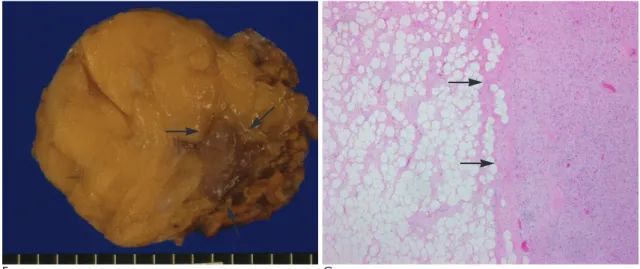
1D). The remained fatty component showed various de- grees of increased echogenicity compared to that of the surrounding subcutaneous fat. There was sharp demar- cation between the adipose and non-adipose compo- nents similar to that seen on MRI. Surgical exploration revealed a well-circumscribed yellowish mass with ec- centric brownish nodular foci (Fig. 1E). The microscopic findings confirmed it was a spindle cell lipoma that con- sisted of spindle cells, collagen fibers and lipocytes (Fig.
1F). In addition, immunohistochemical study showed positive staining for CD 34. There were no lipoblasts or any mitotic activity within the specimen.
Discussion
Spindle cell lipoma is a rare benign musculoskeletal lipomatous lesion among nine different lipomatous le- sions, as classified by the World Health Organization’s Committee for the Classification of Soft Tissue Tumors in 2002 (5). The incidence of spindle cell lipoma has been reported to be about 1.5% of all the 2,478 primary tumors of adipose tissue reported on over a 25 year peri- od (6). Clinicopathologic studies have described spindle cell lipomas as relatively common, yet they are per-
ceived as rare by contemporary radiologists because lipomas are often excised without imaging. The lesion occurs in a characteristic clinical setting, arising almost always in men 45-65 years of age in the subcutaneous tissue of the posterior neck, shoulder and back (4).
Because of the non-adipose component of spindle cell lipoma, it is very difficult to distinguish spindle cell lipo- ma from liposarcoma. The various imaging findings and the slow-growing nature associated with the amount of the non-adipose component may lead to misinterpreting this tumor as liposarcoma and over-treating it. So, the generally accepted principles should be kept in mind when considering the diagnosis of liposarcoma. Most li- posarcomas occur in deep soft tissue, in contrast to lipo- mas, which occur in superficial soft tissue. This implies that subcutaneous well-differentiated liposarcomas are rare and that the diagnosis should be made only after the more common mimics (e.g., spindle cell lipoma, pleomorphic lipoma, chondroid lipoma and angiolipo- ma) are excluded from the differential diagnosis. On the other hand, when true liposarcomas develop in superfi- cial tissues, they have an excellent prognosis because of their limited morbidity and they lack any significant po- tential for dedifferentiation. Despite its cellularity, spin- dle cell lipoma is a slow-growing, solitary painless mass that is readily cured by local excision and there is usual- ly no local recurrence or distant metastasis. Spindle cell lipomas vary in appearance depending on the relative
F G
Fig. 1. F. The gross specimen showed a yellowish lipomatous tumor containing an eccentric nodular portion (black arrows) with a sharply defined border.
G. The microscopic findings, including the transition zones, showed different features depending on the relative amounts of ma- ture fat and spindle cells (hematoxylin-eosin, ×40). The more cellular zone on the left side of the photomicrographs showed dense- ly arranged spindle cells and it also showed diffuse, strong immunoreactivity for CD34 (not shown here). The cellular portion had prominent vascular channels containing the blood cells. The adjacent, less cellular zone showed sparse spindle cells dispersed within mature adipocytes.
for vimentin. Immunostaining for S-100 protein does not mark spindle cells, but mature lipocytes show strong peripheral immunoreactivity for this antigen.
Almost all tumors are strongly positive for CD34. In some cases, scattered multinucleated floret-like giant cells, typical of those found in pleomorphic lipomas, are present and this supports the concept of a histologic spectrum between these tumors. The vascular pattern of spindle cell lipoma is usually inconspicuous, although some tumors have a prominent plexiform vascular pat- tern, similar to that of myxoid liposarcoma, and a he- mangiopericytoma-like vascular pattern or a pseudoan- giomatous variant has also been described. This promi- nent vascularity most likely accounts for the intense en- hancement in the nonadipose components of the spin- dle cell lipomas. Pathologically, liposarcoma or spindle cell liposarcoma showed scattered lipoblasts and only rare cells that may stain for CD34.
In our case, the clinical diagnosis was liposarcoma when considering the patient’s history of a recent grow- ing mass and its large size. On the MR images, the well- defined fat-containing mass showed an eccentric non- adipose component with homogeneous iso-signal inten- sity comparable to muscle on the T1-weighted images and high signal intensity on the fat-suppressed T2- weighted images. This non-adipose lesion showed char- acteristic intense enhancement equal to that of the adja- cent vessels on the gadolinium-enhanced MR images.
The radiological features and superficial location of this fat-containing mass made it possible for us to exclude li- posarcoma. On ultrasonography, the non-adipose com- ponent noted on MR showed diffuse low echogenicity and the fatty area on MR showed variably increased
centric cellular zone composed of only spindle cells. The remained fatty portion noted on the images showed var- ious degrees of spindle cells dispersed in the mature adipocyte background. The ultrasonographic finding of increased echogenicity with a variable degree of the fat- ty portion may be explained by the relative proportion of spindle cells within an adipose background. There was good radiologic-pathologic correlation of the spindle cell lipoma in our case.
In conclusion, although spindle cell lipoma is a rare benign lipomatous lesion and the imaging findings of spindle cell lipoma are not pathognomonic, the diagno- sis of spindle cell lipoma would be strongly suggested when the non-adipose component shows intense diffuse enhancement within a superficially located fat-contain- ing solid mass.
References
1. Enzinger FM, Harvey DA. Spindle cell lipoma. Cancer 1975;
36:1852-1859
2. Weiss SW, Goldblum JR. Benign lipomatous tumors. In Weiss SW, Goldblum JR, eds. Enzinger and Weiss’s soft tissue tumors, 4th ed. St.
Louis: Mosby, 2001:590-597
3. Murphey MD, Carroll JF, Flemming DJ, Pope TL, Gannon FH, Kransdorf MJ. Benign musculoskeletal lipomatous lesions.
Radiographics 2004;24:1433-1466
4. Bancroft LW, Kransdorf MJ, Peterson JJ, Sundaram M, Murphey MC, O’Connor MI. Imaging characteristics of spindle cell lipoma.
AJR Am J Roentgenol 2003;181:1251-1254
5. Christopher D, Unni K, Mertens F. Adipocytic tumors In Eble JN, Sauter G, Epstein JI. WHO classification of tumors. Pathology and ge- netics: tumors of soft tissue and bone. Lyon, France: IARC, 2002:19- 46
6. Fletcher CD, Martin-Bates E. Spindle cell lipoma: a clinicopatho- logical study with some original observations. Histopathology 1987;11:803-817
대한영상의학회지 2008;59:45-49
견관절의 방추 세포형 지방종: 증례 보고1
1단국대학교 의과대학 부속병원 영상의학과
2동국대학교 의과대학 부속병원 영상의학과
이 지 영・서 경 진2・김 상 윤
방추 세포 지방종은 특징적으로 성숙 지방 세포, 방추 세포, 교원 섬유 같은 서로 다른 세포 구성을 가진(구성을 한) 양성 지방 종괴로 중년의 남자에서 후경부나 등의 피하 지방층에 경계가 좋은 종괴로 발현한다. 비지방성 조직 의 비율에 따라 다양한 영상 소견을 보이며, 간혹 지방육종과 감별이 어려운 경우도 있다. 방추 세포 지방종의 영 상소견은 국내에 보고된 증례가 없어, 조직학적으로 확진된 후액와부의 피하 지방층에 생긴 방추 세포 지방종의 영 상 소견을 보고하고자 한다.