Journal of the Korean Chemical Society
2005, Vol. 49, No. 3
Printed in the Republic of Korea
-288-
A New Method for the Synthesis of Heterocycles from
o-Phenylenediamine
M. Kidwai*, S. Saxena, and R. Mohan Department of Chemistry, University of Delhi, Delhi-110007, India
(2004. 7. 16접수 )
A New Method for the Synthesis of Heterocycles from
o-Phenylenediamine
M. Kidwai*, S. Saxena, and R. Mohan Department of Chemistry, University of Delhi, Delhi-110007, India
(Received July 16, 2004)
요 약. 다양한헤테로고리화합물을용매를사용하지않는경제적이고, 매우효율적으로오르소-페닐린다이아민으로
부터합성방법을개발하였다. 마이크로파를이용한이환경친화적인새로운방법은용매를제거해야하는번거로움을
없애는동시에짧은반응시간, 높은수득률그리고균일한가열효과같은장점을가지고있다.
주제어: Microwave Irradiation (MWI), o-Phenylenediamine, Solventfree, Neat Synthesis
ABSTRACT. An highly efficient, economical, solvent-free methodology has been adopted for the synthesis of various heterocycles from o-phenylenediamine. Coupling of this new, environmentally benign, versatile, route with microwave (MW) apart from eliminting organic solvents from the reaction step offer benefits of shorter reaction times, higher yields and uniform heating effect.
Keywords: Microwave Irradiation (MWI), o-Phenylenediamine, Solventfree, Neat Synthesis
INTRODUCTION
The art of performing efficient chemical transfor- mation coupling two or more components in a single operation by a catalytic process avoiding stiochio- metric toxic reagents, large amount of solvents and expensive purification techniques is the fundamen- tal target of modern organic synthesis. In recent years inorganic solid supports (bentonite, alumina, zeolite, silica gel) have occupied an important place in the realm of synthetic organic chemistry.1,2 But this technique does not exactly achieve the goal of clean synthesis as a considerable amount of solvent is required for the adsorption of reagents and elu- tion of product at the pre and post reaction stages
respectively. One of the thrust areas for achieving this target is the environmentally friendly solvent free approach3 that involves the exposure of neat reactants to MWI to give high yield of pure prod- ucts thus eliminating the use of solvent, catalyst and solid support from the reaction. The salient features of this high yield protocol are enhanced reaction rate, low cost, operational simplicity, greater selec- tivity and experimental ease of manipulation.4
In continuation to our earlier work on the neat synthesis5 of heterocyclic compounds of potential biological interest, we studied the condensation of o-phenylenediamine 1 with 1,2-diketones, urea, substituted thioureas and α, β-unsaturated ketones under MWI employing neat reaction conditions.
2005, Vol. 49, No. 3
A New Method for the Synthesis of Heterocycles from o-Phenylenediamine 289
EXPERIMENTAL SECTION
Melting points were determined on a Thomas Hoover melting point apparatus and are uncor- rected. IR spectra were recorded on a Perkin-Elmer FTIR-1710 spectrophotometer. 1H NMR spectra were recorded on FTNMR Hitachi R-600 (60 MHz) instrument using TMS as internal reference.
Microwave irradiation were carried out in Kenstar Microwave Oven, Model No. OM 9925E (2450 MHz, 800 watts). Elemental analysis were per- formed using Heraeus CHN-Rapid Analyzer and was found satisfactory. Temperature of the reaction mixture was measured through AZ, Non-Contact IR Thermometer, Model No. 8868.
General Procedure for the Synthesis of Com- pounds (2-7)
Equimolar amounts of o-phenylenediamine 1 and the dicarbonyl compound (benzil/isatin/ninhydrin) (or the α, β-unsaturated carbonyl compound 4- hydroxycoumarin/chalcone/azlactone or urea/thio- urea/ phenylthiourea) was irradiated in an 100 ml Erlenmeyer flask. On completion of reaction (monitored by TLC at an interval of 30 seconds), the sticky product was titurated with only few drops of methanol to afford the desired products 2,
3, 4, 5, 6 which were recrystallized from aqueous methanol. For compounds 7a-c the sticky solid obtained was titurated with dil. HCl and washed with water.
Scheme 1.
290 M. Kidwai, S. Saxena and R. Mohan
Journal of the Korean Chemical Society RESULTS AND DISCUSSION
Quinoxalines are important heterocycles found in natural products6 such as riboflavine, echinomycin, triostins and synthetic antimicrobials and are reported to be obtained by acid catalysed7 Heisenberg8 con- densation of α-dicarbonyl compounds with 1. We now report the synthesis of quinoxaline 2 and 4a,b in excellent yields by the condensation of 1 with benzil, isatin and ninhydrin in the absence of sol- vent as well as acid just within few minutes of MWI.Further o-phenylenediamine provides a conve- nient route to the synthesis of benzimidazolin-2-one and 2-thione by its condensation with appropriate carbonyl compounds. Since many compounds con- taining this heterocyclic nucleus are of industrial9 or biological10 interest, methods for the preparation of benzimidazolin-2-one/thione skelton have been extensively studied using N,N-dimethylacetamide (DMAC) and diethylene glycol (DEG) as solvents.11 In search of an ecofriendly method, the synthesis of
7a-c was carried out by modifying the recent procedures12 to a simple, facile, solventfree method by the direct condensation of 1 with urea, thiourea and phenyl thiourea under MWI.
Benzodiazepines are an important class of pharmacological13 compounds and are nowadays used as anticonvulsant, antianxiety and hypnotic agents.
Additions of 1 to α,β-unsaturated compounds requires
solvents such as xylene, acetic acid and ethanol under reflux for several hours.14 A great number of methods have been reported in literature recently in the presence of BF3-etherate15, NaBH416, polyphos- phoric acid17, SiO217, Yb(OTf)318 and Al2O3/P2O519, CH3COOH20, xylene21 under MW. But many of these methods suffer from limitations such as drastic reac- tion conditions, expensive reagents, low yield, tedious work up. These observations led us to investigate the possibility of improving the reported methods used for the synthesis of 1,5-benzodiazepine scaf- fold to a simple, efficient, neat method for the syn- thesis of 3 and 6 by the condensation of 1 with 4- hydroxycoumarin and chalcone without solvent, catalyst under MWI. The positive results obtained for the neat synthesis of 1,5-benzodiazepines prompted us to prepare some novel fused imidazoles 5a,b in good yields within few minutes of MWI by the neat reaction of 1 with azlactones.
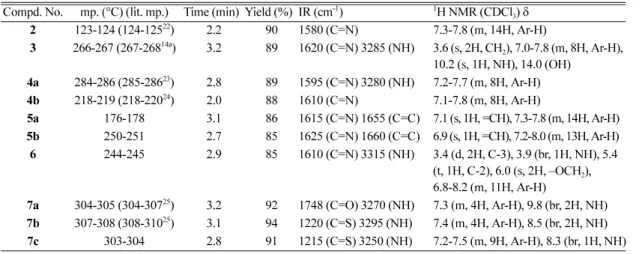
The structure of the products were confirmed by the spectroscopic data (Table 1). Compounds 3 and
6 showed the appearance of a characteristic IR band at 1595 cm−1 (C=N) and disappearance of band at 1710 cm−1 (C=O) while compounds 7a-c showed an IR peak at 3250 cm−1 (NH). A broad singlet due to NH further confirmed the formation of products
7a-c in the 1H NMR spectra. Confirmation of struc- ture of 3 was established by the appearance of sin- glet at δ 3.6 due to methylene protons and the appearance of IR band at 1620 cm−1 (C=N). Disap-
Table 1. Spectral Data, Reaction Time and Yields of Compounds (2-7)
Compd. No. mp. (°C) (lit. mp.) Time (min) Yield (%) IR (cm-1) 1H NMR (CDCl3) δ 2 123-124 (124-12522) 2.2 90 1580 (C=N) 7.3-7.8 (m, 14H, Ar-H)
3 266-267 (267-26814a) 3.2 89 1620 (C=N) 3285 (NH) 3.6 (s, 2H, CH2), 7.0-7.8 (m, 8H, Ar-H), 10.2 (s, 1H, NH), 14.0 (OH)
4a 284-286 (285-28623) 2.8 89 1595 (C=N) 3280 (NH) 7.2-7.7 (m, 8H, Ar-H)
4b 218-219 (218-22024) 2.0 88 1610 (C=N) 7.1-7.8 (m, 8H, Ar-H)
5a 176-178 3.1 86 1615 (C=N) 1655 (C=C) 7.1 (s, 1H, =CH), 7.3-7.8 (m, 14H, Ar-H)
5b 250-251 2.7 85 1625 (C=N) 1660 (C=C) 6.9 (s, 1H, =CH), 7.2-8.0 (m, 13H, Ar-H)
6 244-245 2.9 85 1610 (C=N) 3315 (NH) 3.4 (d, 2H, C-3), 3.9 (br, 1H, NH), 5.4 (t, 1H, C-2), 6.0 (s, 2H, –OCH2), 6.8-8.2 (m, 11H, Ar-H)
7a 304-305 (304-30725) 3.2 92 1748 (C=O) 3270 (NH) 7.3 (m, 4H, Ar-H), 9.8 (br, 2H, NH)
7b 307-308 (308-31025) 3.1 94 1220 (C=S) 3295 (NH) 7.4 (m, 4H, Ar-H), 8.5 (br, 2H, NH)
7c 303-304 2.8 91 1215 (C=S) 3250 (NH) 7.2-7.5 (m, 9H, Ar-H), 8.3 (br, 1H, NH)
2005, Vol. 49, No. 3
A New Method for the Synthesis of Heterocycles from o-Phenylenediamine 291
pearance of IR band of lactone (1740 cm−1) con- firmed the formation of structure 5a, b.
Acknowledgment. The authors Kidwai, M. and Saxena, S. are thankful to University Grants Commis- sion, New Delhi for their financial assistance.
REFERENCES
1. Varma, R.S. Green Chem., 1999, 1, 43.
2. Kidwai, M. Pure Appl. Chem., 2001, 73(1), 147.
3.(a)Dittmer, D.C. Chem. Ind., 1997, 779. (b)Kidwai, M.; Saxena, S.; Mohan, R.; Venkataramanan, R. J.
Chem. Soc. Perkin Trans. 1, 2002, 16, 1845.
4.Loupy, A.; Petit, A.; Hamelin, J.F.; Boullet, T.; Jac- qualt, P.; Mathe, D. Synthesis, 1998, 1213.
5. (a) Kidwai, M.; Venkataramanan, R.; Dave, B. Green Chem., 2001, 3, 278. (b) Kidwai, M.; Mohan, R. Cana- dian J. Chem., 2004, 82(3), 427. (c) Kidwai, M.;
Mohan, R. J. Korean Chem. Society, 2004, 48(2), 177.
6. (a) Karrer, P.; Schopp, K.; Benz, F. Helv. Chim. Acta,
1935, 18, 426. (b) Dell, A.; Williams, D.H.; Morris, R.H.; Smith, G.A.; Feeney, J.; Roberts, G.C.K. J. Am.
Chem. Soc., 1975, 97, 2497.
7. Villemin, D.; Martin, B. Synth. Commun., 1995, 25, 2319.
8. (a) Hinsberg, O. Ann., 1887, 237, 334. (b) Hinsberg, O.
Ber., 1884, 17, 320.
9. Herbst, W.; Hunger, K. Industrial Organic Pigments; VCH: Weinheim, 1993; p. 342.
10. Preston, P.N. Chem. Rev., 1974, 74, 279.
11. (a) Khajavi, M.S.; Hajihadi, M.; Naderi, R. J. Chem.
Research(S), 1996, 92. (b) Khajavi, M.S.; Hajihadi, M.;
Nikpour, F. J. Chem. Research(S), 1996, 94.
12. (a) Jun, L.; Yang, B.; Ba, Y. Synth. Commun., 2002, 32(24), 3703. (b) Guillermo, P.C.; Imelda, B.A.; Jose, G.L.C.; Jose, G.G.E.; Cecilio, A.T. Synth. Commun.,
2002, 30(12), 2191.
13. (a) Landquist, J.K. In Comprehensive Heterocyclic Chemistry; Katritsky, A.R.; Rees, C.W., Eds. Perga- mon: Oxford, 1984; Vol. 1, pp. 166, 170. (b) Archer, G.A.; Sternbach, L.H. Chem. Rev., 1968, 68, 747. (c) Roma, G.; Balbi, A.; Ermili, A.; Vigevani, E. Farmaco Ed. Sci., 1983, 38, 516.
14. (a) Speziale, V.; Grech, O.; Sakeltariou, R. J. Hetero- cyclic Chem., 1994, 31, 509. (b) Reddy, K.V.V.; Rao, P.S.; Ashok, D. Synth. Commun., 2000, 30, 1825.
15. Herbert, J.A.L.; Suschitzky, H. J. Chem. Soc. Perkin Trans. 1, 1974, 2657.
16. Morales, H.R.; Bulbarela, A.; Contreras, R. Heterocy- cles, 1986, 24, 135.
17. Jung, D.I.; Chio, T.W.; Kim, Y.Y.; Kim, I.S.; Park, Y.M.;
Lee, Y.G.; Jung, D.H. Synth. Commun., 1999, 29(11), 1941.
18. Curini, M.; Epifano, F.; Marcotullio, M.C.; Rosati, O.
Tetrahedron Lett., 2001, 42, 3193.
19. Kaboudin, B.; Navaee, K. Heterocycles, 2001, 55, 1443.
20. Pozarentzi, M.; Stephanatou, J.S.; Tsoleridis, C.A. Tet- rahedron Lett., 2002, 43, 1755.
21. Reddy, A.C.S.; Rao, P.S.; Venkataratnam, R.U. Tetra- hedron Lett., 1996, 37, 2845.
22. Ogg, R.A. Jr.; Bergstrom, F.W. J. Am. Chem. Soc.,
1931, 53, 1848.
23. Clemo; Felton J. Chem. Soc., 1952, 1658.
24. Ruheman, S. J. Chem. Soc., 1910, 1449.
25. Smith, D.; Weissberger, A.; Taylor, E. The Chemistry of Heterocyclic Compounds; John Wiley and Sons, New York, 1981, Vol. 40(1), Chapter 1.