[논 문] 한국재료학회지 http://dx.doi.org/10.3740/MRSK.2011.21.10.542 Kor. J. Mater. Res.
Vol. 21, No. 10 (2011)
542
†
Corresponding author
E-Mail : [email protected] (S. -C. Ur)
Thermoelectric Properties of Half-Heusler TiCoSb Synthesized by Mechanical Alloying Process
Soon-Chul Ur
†Department of Materials Science and Engineering / RIC-ReSEM, Chungju National University, 50 Daehangno, Chungju, Chungbuk 380-702, Korea
(Received August 16, 2011 : Received in revised form September 15, 2011 : Accepted September 15, 2011)
Abstract
Half-Heusler alloys are a potential thermoelectric material for use in high-temperature applications. In an attempt to produce half-Heusler thermoelectric materials with fine microstructures, TiCoSb was synthesized by the mechanical alloying of stoichiometric elemental powder compositions and then consolidated by vacuum hot pressing. The phase transformations during the mechanical alloying and hot consolidation process were investigated using XRD and SEM. A single-phase, half- Heusler allow was successfully produced by the mechanical alloying process, but a minor portion of the second phase of the CoSb formation was observed after the vacuum hot pressing. The thermoelectric properties as a function of the temperature were evaluated for the hot-pressed specimens. The Seebeck coefficients in the test range showed negative values, representing n-type conductivity, and the absolute value was found to be relatively low due to the existence of the second phase. It is shown that the electrical conductivity is relatively high and that the thermal conductivities are compatibly low in MA TiCoSb. The maximum ZT value was found to be relatively low in the test temperature range, possibly due to the lower Seebeck coefficient.The Hall mobility value appeared to be quite low, leading to the lower value of Seebeck coefficient. Thus, it is likely that the single phase produced by mechanical alloying process will show much higher ZT values after an excess Ti addition. It is also believed that further property enhancement can be obtained if appropriate dopants are selectively introduced into this MA TiCoSb System.
Key words
half-Heusler, TiCoSb, thermoelectric, mechanical alloying.1. Introduction
Half-Heusler compounds have been emerged as good candidates for thermoelectric conversion materials.
1-2)The unit cell of the half-Heusler with a space group F 3m con- sists of 4 interpenetrating cubic lattices. The crystallographic sites (0,0,0) and (1/4, 1/4, 1/4) are occupied by two different transition metals, the (1/2, 1/2, 1/2) site is occupied by Sn, Sb, or Bi, and the site (3/4, 3/4, 3/4) is empty.
3-4)Candidates with this structure for the investigation would be categor- ized into the combination of (Ti/Zr/Hf)(Co/Ni/Pt)(Sb/Sn/
Bi).
3)TiCoSb belongs to a half-Heusler structure and it is expected to be a promising thermoelectric material having relatively high figure of merit value, especially for power generation.
1,3)The figure of merit is defined as ZT = α
2σT/
κ, where α is the Seebeck coefficient, σ is the electrical conductivity, κ is the thermal conductivity and T is the temperature in Kelvin. Undoped TiCoSb shows intrinsic n- type conduction.
3)Although high performance was antici- pated in the system, the compound itself could not provide high ZT due to relatively higher lattice thermal conduc-
tivity.
4-5)Doping on this system was found to be effective in electrical property enhancement via band structure forming, and the substitution on the Zr and/or Ni site were shown to be decrease in thermal conductivity via point defect phonon scattering, resulting in enhanced thermoelectric properties.
3,6)The conduction type can also be modified by doping or substitution.
6)TiCoSb is generally prepared by induction melting, powder processing with hot pressing or spark plasma sintering, and/
or hybrid methods of these.
4-7)Since micro defects, phase
separation and inhomogeneity created during materials pro-
cessing could greatly influence the thermoelectric properties,
careful control of microstructure with long time annealing
are normally unavoidable.
1,3)Homogenous, single phase
half-Heuslers are inherently difficult to produce in case of
containing low meting point elements such as Sn or Sb,
due to their easy of sublimation during high temperature pro-
cessing. In order to address these problems, mechanical
alloying (MA) process as a solid state synthesis was applied
in this study.
8)It was reported that MAed materials having a
fine grain size may improve thermoelectric conversion effi-
ciency by the reduction in lattice thermal conductivity.
8)In
this work, we adopt MA process on the synthesis of
TiCoSb having ultra fine microstructures as a fundamental
4
Thermoelectric Properties of Half-Heusler TiCoSb Synthesized by Mechanical Alloying Process 543
study for TiCoSb based half-Heuslers. A nominal compos- ition TiCoSb have been synthesized by MA of elemental powders, followed by vacuum hot pressing (VHP) in this study. Thermoelectric properties including thermal conduc- tivity as a function of temperature were measured and compared with the results of analogous studies. Transport properties were also evaluated and correlated with thermo- electric properties.
2. Experimental Procedure
Appropriate elemental powder mixtures of Ti ( −325 mesh, 99.9%), Co ( −325 mesh, 99.9%), and Sb(−250 mesh, 99.9%) for stoichiometric TiCoSb were prepared and mechani- cally alloyed in a Spex mill (8000D) up to for 24 hours.
The milling operation was carried out inside a dedicated glove box under an Ar atmosphere, and the rotation speed was 1,750 rpm. As-milled powders were hot pressed in a cylindrical high strength graphite die at 1073K with a stress of 70 MPa for 2 hours in vacuum. In order to investigate the phase transformation during synthesis, X-ray diffraction (XRD; Bruker AXS ADVANCE D-8) analyses using Cu K
αradiation were carried out for the powders as well as hot pressed samples. Densities after hot consolidation were measured using a He pycnometer. In order to observe microstructures e-SEM (FEI, Quanta-400) were employed.
Thermoelectric properties in terms of Seebeck coefficient, electrical resistivity and thermal conductivity were measured from 300K to 823K, and ZT was evaluated. Here, hot pressed specimens were cut into the size of 3 × 3 × 10 mm
3for Seebeck coefficient and electrical resistivity measure- ments, and into 10 φ × 1 mm for thermal conductivity meas- urement. Seebeck coefficient and electrical resistivity was measured by the differential and 4-point probe methods (Ulvac-Riko ZEM2-M8). Thermal conductivity was evalu- ated from the measurements of thermal diffusivity, specific heat and density by the laser flash method (Ulvac-Riko TC7000). The Hall effect measurement was carried out in a constant magnetic field (1T) and electric current (50 mA)
at 300 K. Hall coefficient (R
H), carrier mobility ( µ
H) and carrier concentration (p) were determined.
3. Results and Discussion
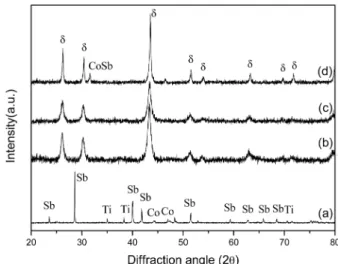
XRD analysis during MA revealed that alloy develop- ment of half-Heusler, TiCoSb( δ) phases appeared after 6 hrs of milling, and saturated afterwards as shown in Fig. 1.
Alloying seemed to be complete after 6 hrs of milling, but the particle size decreases further as milling continues up to 12 hrs and saturated afterwards. As-milled powder size after 12 hrs was typically less than 10 µm. Complete single phase compound seems to be produced in this single step.
It should be noticed that as milled powders are of inherent meta stable state,
8)further powder annealing or hot consoli- dation could induce phase stabilization or transformation.
10)In order consolidate as milled TiCoSb powders were vac- uum hot pressed (VHPed) at 1073K with a stress of 70 MPa for 2 hrs. VHP results in relatively sound microstrudture, and 93% of theoretical density, as shown in Fig. 2. As can be
Fig. 1. XRD patterns of MA TiCoSb powders and hot pressed sample, (a) as-mixed powders, (b) MA for 6hrs, (c) MA for 12hrs and (d) vacuum hot pressed at 1073K for 2hrs. ( δ denotes half-Heusler phase).
Fig. 2. SEM micrographs of MA powders, (a) as mixed powders and (b) MA for 6 hrs.
544 Soon-Chul Ur
seen, SEM observation revealed no microcracks, but some voids were unavoidable, as shown in Fig. 3. However, a little portion of 2
ndphase of CoSb formation was observed after VHP as shown in Fig. 1(d). This is possibly attributed to the nature of meta stable state in MA powders, for which hot consolidation could induce phase transformation, depending on the formation energy or vapor pressure.
3,8)Decreasing VHP temperature and/or processing time to avoid 2
ndphase formation, satisfactory results were not obtained, and the densities were too low to continue further investigation, either. It can be suggested that appropriately calculated excess Ti addition to the soichiometry might be helpful to produce single phase in the future investigation.
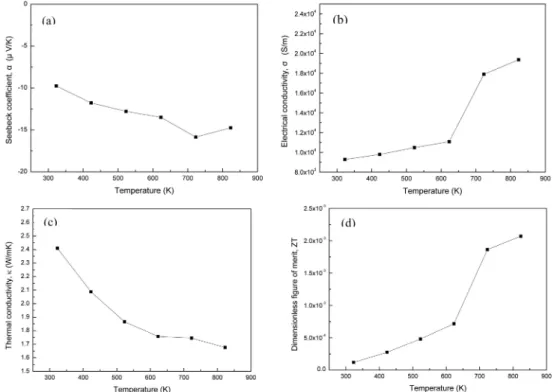
Thermoelectric properties as a function of temperature were evaluated. Seebeck coefficients in the specimen at test range showed negative values, representing n-type conductivity, as presented in Fig. 4(a). Hall coefficient also confirms the n-type conduction as shown in Table 1. Ab- solute value of Seebeck coefficient is relatively small compared to the analogue study.
3)It can be considered that mixed conduction might be taken place due to the exist- ence of second phase CoSb, resulting in low value of Seebeck coefficient.
9)It decreases with increasing tempera- ture in the test range, as in similar studies.
3,5)Electrical conductivity showed to be relatively high comparing to the other analogue studies,
3,5)and increased with increasing temperature, representing an intrinsic semiconducting behavior, as shown in Fig. 4(b). Electrical conductivity
showed abrupt increase above 623 K. This might be attri- buted to the enhancement of non degenerating behavior and/or to the fact that carriers can jump across the band gap as temperature increases. Thermal conductivities of MA TiCoSb as a function of temperature up to 823 K were presented in Fig. 4(c). Thermal conductivities were also shown to be much lower than those in analogue studies.
3,5)This is possibly attributed to the increasing phonon scattering in the typical MA materials, leading to low the lattice thermal conductivity.
Fig. 3. SEM micrograph of VHPed sample, Nital etched.
Fig. 4. Thermoelectric properties of VHPed MA TiCoSb, (a) Seebeck coefficient, (b) Electrical conductivity, (c) Thermal conductivity and
(d) Figure of merit, ZT.
Thermoelectric Properties of Half-Heusler TiCoSb Synthesized by Mechanical Alloying Process 545
From the values of σ, α and κ obtained above, ZT values were possible to calculate, as presented in Fig. 4(d). The maximum value was found to be 0.0021 at 823 K, and it is expected to increase further above the test temperature range. ZT values obtained in this undoped state showed to be lower than those in other analogue studies.
3,5)Though affirmative factors to increase ZT value exist in this speci- men such as the higher electrical conductivity and the lower thermal conductivity, ZT value was shown to be relatively low. Indeed, it is possibly attributed to the lower Seebeck coefficient which is caused by the formation of 2
ndphase.
9)Hall mobility seems to be quite low, which might be attributed to the relatively high carrier concentration, leading to the lower value of Seebeck coefficient,
6)as shown in Table 1. Thus, it can be expected that MAed single phase might show much higher ZT values, if it could be obtained via excess Ti addition and other methods. It is also believed that if appropriate dopants are introduced into this system,
3,5-7)along with producing ultra fine microstructure by MA process would be an effective, alternative process for the high performance TE materials and devices.
4. Conclusion
Half-Heusler, TiCoSb compound have been successfully synthesized by mechanical alloying of elemental powders.
Complete single phase compound was produced in this single step of MA process, but a little portion of 2
ndphase of CoSb formation was observed after vacuum hot pressing.
Seebeck coefficients at test range showed negative values, representing n-type conductivity and the absolute value of Seebeck coefficients showed to be relatively low due to the existence of 2
ndphase. It is shown that electrical conduc- tivity is relatively high and thermal conductivities are com- patibly low in MA TiCoSb. The maximum ZT value was found to be relatively low (0.0021 at 823 K) in the test temperature range, possibly due to the lower Seebeck
coefficient, which is caused by the formation of 2
ndphase.
Hall mobility value seems to be quite low, which might be attributed to the relatively high carrier concentration, leading to the lower value of Seebeck coefficient. Thus, it can be expected that MAed single phase might show much higher ZT values, if it could be obtained via excess Ti addition and other methods. It is also believed that if appropriate dopants are introduced into this MA TiCoSb system would be an effective, alternative process for the high performance TE materials and devices.
Acknowledgement
This research was supported by the Regional Innovation Center (RIC) Program which was conducted by the Ministry of Knowledge Economy of the Korean Government.
References
1. C. Uher, J. Yang, S. Hu, D. T. Morelli and G. P. Meisner, Phys. Rev. B Condens. Matter, 59, 8615 (1999).
2. W. Jeitschko, Metall. Mater. Trans. B, 1(11), 3159 (1970).
3. T. Sekimoto, K. Kurosaki, H. Muta, and S. Yamanaka, in Pro- ceedings of 24th International Conference on Thermoelectrics (Piscataway, NJ, June, 2005), p. 347. DOI : 10.1109/
ICT.2005.1519955.
4. J. Tobola and J. Pierre, J. Alloy. Comp., 296, 243 (2000).
5. K. Kurosaki, H. Muta and S. Yamanaka, J. Alloy. Comp., 384, 51 (2004).
6. V. Ponnambalam, P. N. Alboni, J. Edwards, T. M. Tritt, S. R.
Culp and S. J. Poon, J. Appl. Phys., 103, 063716 (2008).
7. C. Yu, T. -J. Zhu, R. -Z. Shi, Y. Zhang, X. -B. Zhao and J. He, Acta Mater., 57, 2757 (2009).
8. S. -C. Ur, P. Nash and I. -H. Kim, J. Alloy. Comp., 361, 84 (2003).
9. H. Anno, K. Hatada, H. Shimizu, K. Matsubara, Y.
Notohara, T. Sakakibara, H. Tashiro and K. Motoya, J.
Appl. Phys., 83, 5270 (1998).