*Corresponding author : Seung-Hak Yang, National Institute of Animal Science, R.D.A., Suwon 441-706, Korea. Tel: +82-31-290-1714, E-mail: [email protected]
2014년 5월 25일 투고, 2014년 6월 14일 심사완료, 2014년 6월 15일 게재확정
고온 환경이 젖소의 생산성 및 축사환경에 미치는 영향 연구
김 별1⋅임정수2⋅조성백2⋅황옥화2⋅양승학2*
1전북대학교 축산학과, 2농촌진흥청 국립축산과학원 축산환경과
A Study on the Effects of Heat Stress on Feedlot Environment and Productivity of Dairy Cattle
Byul Kim1, Joung-Soo Lim2, Sung-Back Cho2, Ok-Hwa Hwang2, Seung-Hak Yang2*
1Department of Animal Science, Chonbuk National University, Jeonju, 561-756, Korea,
2National Institute of Animal Science, R.D.A., Suwon 441-706, Korea
ABSTRACT
Environmental heat stress by global warming has a severe effect on the productivity of livestock and, in particular, on that of dairy cattle. Heat stress during high temperature environment directly and indirectly affects milk yield, milk quality and physiological response. This study was conducted to investigate the effects of heat stress on productivity and physiological responses of livestock.
Temperature-humidity data logger were established inside the feedlot for measuring real time changes in the feedlot environment. Milk was collected every day for analysing the productivity of dairy cattle. Blood sample and respiration of dairy cattle were collected once in a week for investigating the physiological response factors. Blood component concentration associated with lipolysis metabolism and milk production showed change during tropical night period. Temperature humidity index (THI) of a specific location inside the feedlot showed continuously high levels.
(Key words : Dairy cattle, Environment, Feedlot, Heat stress, Productivity)
서 론
Hansen(2004)과 Hoffmann(2010)은 최근 지 구온난화에 의한 환경적인 온도의 상승으로 젖소의 열 스트레스로 인한 문제점이 주목받 고 있다고 보고하였다. 대기 온도, 복사열 그 리고 습도와 같은 환경적인 요인은 동물에게 직접적이고 간접적인 영향을 끼치며(Collier et al., 1982), 환경적인 스트레스는 가축 중에 서도 특히 젖소의 생산성에 심각한 영향을 끼친다고 보고하였다(Berman, 2011).
젖소가 열 스트레스에 노출되면, 스스로 열 스트레스를 조절하기 위해 높은 에너지를 필요로 하고 대사활동 및 호르몬 농도가 변 화하며 사료 섭취비율이 감소한다고 보고하 였다(National Research Flagships/CSIRO, 2011).
이것은 우유 생산량의 감소로 이어지고(National Research Flagships/CSIRO, 2011), 우유 생산량 은 겨울에 비해 여름 동안 10~40% 감소했다 고 나타냈다(Du preez et al., 1990). 열 스트 레스는 젖의 분비 기능에도 부정적인 영향을 끼치며 유성분, 체세포수, 유방염 빈도수의
변화와도 관련이 있다고 보고하였다(Du preez et al., 1990; Nickerson, 1987; Rodriguez et al., 1985; Silanikove, 1992). 또한 열 스트 레스는 Cortisol(Christison and Johnson, 1972;
Collier et al., 2005), insulin(Bauman and currie, 1980; Johnson et al., 1988), NEFA (Rhoads et al., 2009; Shwartz et al., 2009), prolaction(Collier et al., 2005; Ronchi et al., 2001; Roy and Prakash, 2007), leptin(Spiers et al., 2012)과 같은 호르몬의 변화와 관련이 있다고 제시하였다.
해외 사례의 경우 젖소의 열 스트레스에 대한 연구가 많이 이루어져 있으며, 축산업 부문에 관한 기후변화 영향평가 및 적응방안 이 대부분 구축되어 있다(AIACC, 2006). 하 지만, 국내의 경우 한반도의 온난화로 인한 가축의 생산성 감소가 예상되고 있음에도 불 구하고 타 작물에 비해 온난화에 대한 가축 의 영향평가 및 적응방안이 부족하다.
따라서 본 연구에서는 축사환경 측정시스템 을 구성하여 축사 내부환경의 온습도 변화를 측정하고 열 영향에 따른 젖소의 직/간접적인 생체반응인자를 조사하기 위하여 혈중성분 및 우유 생산성 분석을 수행하였다.
재료 및 방법 1. 시험장소 및 시험기간
고온 환경에 따른 축사 내부환경의 변화 및 젖소의 생체반응인자를 측정하기 위하여 국립축산과학원 착유우사를 시험우사로 이용 하였으며, 시험우사에서 착유우 8두를 공시 하여 2012년 7~10월에 본 시험을 수행하였다.
2. 시험방법
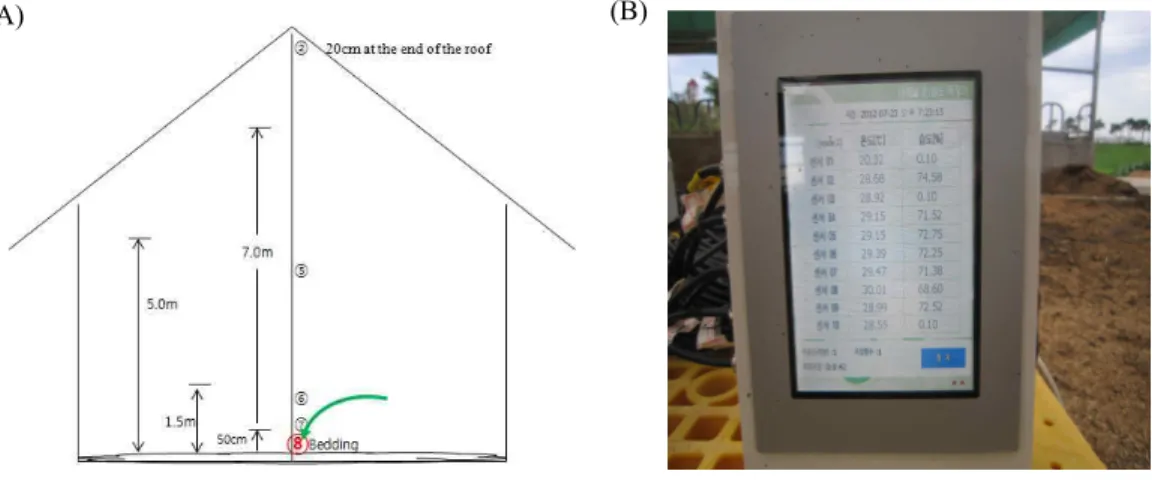
축사환경 측정시스템을 구성하여 실제 축 사환경 요소를 측정하였다. 가축의 행동 관 찰과 온습도를 측정하기 위해 온습도센서의
설치는 Fig. 1와 같이 5개의 온습도센서를 고 온 환경에 따른 축사 내부환경 및 젖소에 영 향을 끼칠 수 있는 요인들을 고려하여 우사 지붕, 우사 내 송풍기, 깔짚 등의 위치에 따 라 축사내부 중앙에 수직으로 배치시켰다.
톱밥 및 왕겨 등을 사용한 깔짚을 축사바닥 으로부터 깔았으며 깔짚표면에 온습도센서를 설치하여 깔짚표면의 THI를 측정하였다. 온 습도데이터는 온습도센서와 다채널 온습도데 이터 로거를 이용하였으며 측정단위는 1분 단위로 측정되었다. THI는 젖소용 THI 방정 식 [ ( 1 . 8 × 온 도 + 3 2 )− 0 . 5 5 ( 1 − 상 대 습 도 /100)×(1.8×온도−26)]을 이용하여 계산하였다 (NRC, 1971).
3. 측정항목 및 방법
유량은 오전, 오후에 각각 측정하여 이를 합한 값을 기록하였으며 유성분 및 생산자가 격(납유업체의 유대산정기준가)은 통계치를 조사하여 분석하였다. 혈액은 매주 오후 2시 에 꼬리로부터 무처리된 vacutainer tube에 채 혈하였으며 곧 바로 ice box에 넣어 실험실 로 운반하였다. 채취한 혈액은 혈액 응고를 위해서 실온에서 2시간동안 정치한 후 4℃에 서 20분간 3000rcf로 원심분리하였다. 원심분 리된 sample은 혈액응고 덩어리를 제외한 분 리된 혈청을 채취한 다음 분석을 위해 -7 0℃에서 냉동 보관하였다. 보관된 시료는 대 사물질(Ndlovu et al., 2007)인 ALB(albumin), GLU(glucose), GOT(glutamic oxalacetic transminase), GPT(glutamic pyruvic transminase), T-BIL(total bilirubin), T-CHO(total cholesterol), T-PRO (total protein), BUN(blood urea nitrogen), NEFA (non esterified fatty acid)는 자동생화학분석기 (Hitachi, Japan)를 이용하여 농도를 측정하였 고(Ndlovu et al., 2007), 열 스트레스 관련 호 르몬 Cortisol, Estradiol, Insulin은 ELISA Kit (Cusabio Biotech, China)를 이용하여 분석하였다.
Fig. 2. Temperature Humidity Index by the location.
(A) (B)
Fig. 1. Temperature-humidity sensor location(A) & Logging display(B).
결과 및 고찰 1. 축사내부 온도 및 온습도의 변화
온습도센서를 이용하여 실시간으로 높이별 축사내부 5곳(지붕부위~깔짚표면)의 온습도 변화를 측정하였다. 축사내부 5곳의 온습도지 수를 비교한 결과, 4곳의(②, ⑤, ⑥, ⑦) 온습 도지수는 비슷한 패턴으로 변화하였으며 깔짚 표면(⑧) 온도 및 THI는 지속적으로 높은 수 치를 유지중인 것으로 나타났다. 특히 깔짚표 면의 THI는 열대야기간 중 74 이상으로 유지 되어 가축에게 열영향을 지속적으로 미쳤을 것으로 생각된다(Fig. 2). 깔짚부위는 가축분뇨 에 의해 미생물 발효가 일어나는 장소로서 고 온에 의해 미생물 발효가 더 활발히 일어났을 것으로 생각되며 가축에게 발효열을 전달하는 직접 매개역할을 했을 것으로 사료된다.
2. 우유 생산량 및 유성분 변화
온도, 유량, 유성분 및 생산자가격을 조사 한 결과(Fig. 3), 월평균 최고기온이 8월(31.2) 에 가장 높게 나타났다. 유지방율은 3~4월에 약 4.0% 이상을 유지하였으며 5월부터 감소 하기 시작하여 약 4.0% 이하를 유지하였다.
8~9월에 약 3.40% 이하까지 감소하여 가장
낮은 유지방율을 나타냈다. 우유생산자 가격 도 5월부터 낮아지기 시작하였으며 8~9월에 가장 낮게 나타났고 우유생산량도 8월초에 최저치 23 kg을 기록했다. 이는 하절기의 영 향이 유지방율과 우유생산량 변화에 영향을 끼쳤을 것으로 보인다. 우유생산자 가격의 변화는 유대산정기준 중 중요한 요인인 유지 방율의 하락이 원인이었으며 8월까지의 온도 환경이 9월초까지 영향을 미쳤을 것으로 사 료된다.
3. 깔짚표면 THI 및 생체반응인자 변화
기상데이터에 의하면 7월 말부터 8월 초까
Date /milk
Bedding THI (Maximum temperature)
Milk yield (kg)
ALB
(g/dl) GLU
(mg/dl) GOT
(IU/L) GPT
(IU/L) T-BIL
(mg/dl) T-CHO
(mg/dl) T-PRO
(g/dl) BUN
(mg/dl) NEFA
(uEq/L) Cortisol
(ng/ml) E2
(pg/ml) Insulin
(ug/L)
07-23 68.6(31.7) 27.46 5.0 60.5 114.6 35.1 0.10 240.0 9.8 20.5 99.9 11.6 164.6 0.66 08-03 78.9(35.2) 24.06 5.0 58.1 115.7 27.0 0.15 198.1 9.7 19.1 206.4 7.4 173.0 0.43 08-09 80.4(33.3) 23.04 4.4 62.1 117.6 21.3 0.08 158.0 8.4 9.3 110.8 7.3 214.9 0.38 08-16 72.1(28.9) 27.26 4.7 64.0 124.6 30.7 0.08 196.0 9.0 7.5 133.9 11.8 188.7 0.27 08-23 69.6(28.1) 25.54 4.7 66.7 102.8 30.1 0.06 202.9 9.0 8.3 121.8 12.9 212.3 0.23 Table 1. Bedding THI and physiological response factors.
Fig. 3. Monthly milk component content and producer’s price(left) & Daily milk yield(right).
지 최고 37.4℃까지 상승했으며 최저 28.4℃
까지 하락하였다. Table 1에서와 같이 깔짚표 면 THI의 수치가 80.4로 가장 높았을 때 유 량, insulin, NEFA 등 여러 반응인자들이 낮 은 수치를 보였다. Johnson 등(1988)은 열 노 출 초기 그리고 중기에는 insulin 수치가 감 소하는 경향을 나타낸 반면에 후기에는 증가 하는 경향을 보인다고 보고하였다. NEFA의 수치도 감소하는 경향을 나타냈는데 열적중 성역 조건에서 영양불균형 상태일 경우에는 지질분해의 비율이 증가하여 NEFA의 높은 수치를 나타내는 반면에 열 스트레스를 받은
젖소에서는 낮은 NEFA 수치를 나타냈다고 보고하였다(Rhoads et al., 2009). NEFA 수치 의 감소는 유지방률 저하를 유도한 것으로 사료된다. 열 스트레스에 의해 cortisol과 같 은 호르몬은 단기적으로 상승하다가 장기적 인 영향에 의해 하락한다고 보고하였다 (Christison and Johnson, 1972). 이 결과에서 THI가 최고점일 때에는 열 스트레스 영향을 충분히 받은 상태일 가능성이 있는데, 이는 계절적인 열 영향은 몇 개월에 걸쳐 영향을 미치기 때문으로 사료된다.
결 론
본 연구는 국립축산과학원 시험우사에서 착유우 8두를 이용하여 2012년 7~10월 동안 시험을 수행하였는데, 축사환경 측정시스템 을 구성하여 축사환경요소를 측정하였다. 온 도, 습도, 혈중성분, 유량, 유성분, 우유생산 자가격 등 환경 반응인자를 측정하여 열 영 향에 대한 연관성을 조사하였는데, 특히 축
사내부 높이별 5곳(축사지붕~깔짚표면)의
온․습도를 실시간으로 측정하여 THI로 변 환 후 다른 반응인자와의 상호작용을 조사하 였다. 축사환경 온습도 변화를 측정한 결과, 4곳의 THI는 비슷한 패턴으로 변화했으며 깔짚표면 THI는 지속적으로 높은 수치를 유 지중인 것으로 나타났다. 특히 깔짚표면의 THI는 열대야기간 중 74 이상으로 유지되어 가축에게 열 영향을 지속적으로 미쳤을 것으 로 생각된다. 깔짚부위는 가축분뇨에 의해 미생물 발효가 일어나는 장소로서 고온에 의 해 미생물 발효가 더 활발히 일어났을 것으 로 생각되며 가축에게 발효열을 전달하는 직 접매개역할을 했을 것으로 사료된다. 유량 및 유지방율, 우유생산자 가격은 8~9월에 가 장 낮았으며 이는 유대산정기준 중 중요한 요인인 유지방율의 하락이 원인이었으며 8월 까지의 온도환경이 9월까지 영향을 미쳤을 것으로 사료된다. 깔짚표면 THI 및 생체반응 인자를 측정한 결과 깔짚 THI의 수치가 80.4 로 가장 높았을 때, 유량, insulin, NEFA 등 여러 반응인자들이 낮은 수치를 보였다.
NEFA 수치의 감소는 유지방율 저하를 유도 한 것으로 사료된다.
사 사
본 논문은 농촌진흥청 공동연구사업(과제 번호: PJ00852701)의 지원에 의해 이루어진 것임
인 용 문 헌
1. AIACC., 2006. Climate change vulnerability and adaptation in the livestock sector of mongolia, AIACC Project No. AS 06.
2. Bauman, D.E., Currie W.B., 1980.
Partitioning of nutrients during pregnancy and lactation: a review of mechanisms involving homeostasis and homeorhesis. J.
Dairy Sci. 63, 1514-1529.
3. Berman, A., 2011. Invited review: are adaptations present to support dairy cattle productivity in warm climates? J. Dairy Sci. 94(5), 2147-2158.
4. Christison, G.l., Johnson, H.D., 1972.
Cortisol turnover in heat-stressed cows. J.
Anim. Sci. 35, 1005-1010.
5. Collier, R.J., Beede, D.K., Thatcher, W.W., Israel, L.A., Wilcox, C.J., 1982. Influences of environment and its modification on dairy animal health and production. J.
Dairy Sci. 65, 2213-2227.
6. Collier, R.J., Baumgard, L.H., Lock, A.L., Bauman, D.E., 2005. Physiological Limita- tions, Nutrient Partitioning. In: Yields of farmed Species: constraints and opportunities in the 21st Century. Proceedings: 61st Easter School. Nottingham, England. J.
Wiseman and R. Bradley, eds. Nottingham University Press, Nottingham, U.K. 221-250.
7. Du Preez, J.H., Hatting, P.J., Giesecke, W.H., Eisenberg, B.E., 1990. Heat stress in dairy cattle and other livestock under Southern African conditions. III. Monthly temperature-humidity index mean values and their significance in the performance of dairy cattle, Onderstepoort J. Vet. Res.
57, 243-248.
8. Hansen, P.J., 2004. Physiological and cellular adaptations of zebu cattle to thermal stress. Anim. Reprod. Sci. 349-360.
9. Hoffmann, I., 2010. Climate change and the characterization, breeding and conservation of animal genetic resources. Anim, Genet.
41 (Suppl 1), 32-46.
10. Johnson, H.D., Katti, P.S., Hahn, L., Shanklin, M.D., 1988. Short-term heat acclimation effects on hormonal profile of lactating cows. In: Research Bulltetin No.
1061. University of Missouri, Columbia. 5-10.
11. National Research Council. 1971. A guide to environmental research on animals. Natl.
Acad. Sci., Washington, DC.
12. National Research Flagships/CSIRO., 2011.
Heat stress in dairy cattle in northern Victoria: responses to a changing climate.
Climate Adaptation Flagship Working Paper 10.
13. Ndlovu, T., Chimonyo, M., Okoh, A.I., Muchenje, V., Dzama, K., Raats, J.G., 2007. Review: Assessing the nutritional status of beef cattle: current practices and future prospects. Afr. J. Biotechnol. Vol. 6 (24), pp. 2727-2734.
14. Nickerson, S.C., 1987. Mastitis management under hot, humid conditions, Proceeding of the dairy herd management conference.
Macon, GA, February. 32-38.
15. Rhoads, M.L., Rhoads, R.P., VanBaale, M.J., Collier, R.J., Sanders, S.R., Weber, W.J., Crooker, B.A., Baumgard, L.H., 2009. Effects of heat stress and plane of nutrition on lactating Holstein cows: I.
Production, metabolism, and aspects of circulating somatotropin. J. Dairy Sci. 92, 1986-1997.
16. Rodriguez, L.W., Mekonnen, G., Wilcox,
C.J., Martin, F.G., Krienk, W.A., 1985.
Effects of relative humidity, maximum and minimum temperature, pregnancy and stage of lactation onmilk composition and yield, J. Dairy Sci. 68, 973-978.
17. Ronchi, B., Stradaioli, G., Verini Supplizi, A., Bernabucci, U., Lacetera, N., Accorsi, P.A., Nardone, A., Seren, E., 2001.
Influence of heat stress and feed restriction on plasma progesterone, estradiol-17b, LH, FSH, prolactin and cortisol in Holstein heifers. Livest. Prod. Sci. 68, 231-241.
18. Roy, K.S., Prakash, B.S., 2007. Seasonal variation and circadian rhythmicity of the prolactin profile during the summer months in repeat-breeding Murrah buffalo heifers.
Reprod. Fertil. Dev. 19, 569-575.
19. Shwartz, G., Rhoads, M.L., VanBaale, M.J., Rhoads, R.P., Baumgard, L.H., 2009.
Effects of a supplemental yeast culture on heat-stressed lactating Holstein cows. J.
Dairy Sci. 92, 935-942.
20. Silanikove, N., 1992. Effects of water scarcity and hot environment on appetite and digestion in ruminants: a review.
Livest. Prod. Sci. 30, 175-194.
21. Spiers, D.E., Wax, L.E., Eichen, P.A., Rottinghaus, G.E., Evans, T.J., Keisler, D.H., Ellersieck, M.R., 2012. Use of different levels of ground endophyte- infected tall fescue seed during heat stress to separate characteristics of fescue toxicosis.
J. Anim. Sci. 2012, 90, 3457-3467.