• 검색 결과가 없습니다.

Electrocardiography Recordings in Higher Intercostal Space for Children With Right Ventricular Outlet Obstruction Reconstruction Operation

N/A
N/A
Protected

Academic year: 2021

Share "Electrocardiography Recordings in Higher Intercostal Space for Children With Right Ventricular Outlet Obstruction Reconstruction Operation"

Copied!
5
0
0

로드 중.... (전체 텍스트 보기)

전체 글

(1)

Korean Circulation Journal

Introduction

The electrocardiogram (ECG) is a simple method used to check car- diac condition. Abnormalities of QRS duration, presence of bundle

Print ISSN 1738-5520 • On-line ISSN 1738-5555

Electrocardiography Recordings in Higher Intercostal Space for Children With Right Ventricular Outlet Obstruction Reconstruction Operation

Jung Ok Kim, MD 1 , Yeo Hyang Kim, MD 2 , and Myung Chul Hyun, MD 3

1

Department of Pediatrics, Inje University Busan Paik Hospital, Busan,

2

Department of Pediatircs, Keimyung University School of Medicine, Daegu,

3

Department of Pediatrics, Kyungpook National University School of Medicine, Daegu, Korea

Background and Objectives: We checked traditional and high-level precordial electrocardiogram (ECG) leads in patients who had under- gone right ventricular outlet obstruction (RVOT) reconstruction surgery and evaluated the effect of ECG lead position on their QRS duration.

Subjects and Methods: We enrolled 34 patients who had undergone surgery for congenital heart disease with RVOT obstruction and who had received followed up care that included recorded ECG at a pediatric cardiac out-patient clinic. The control group included 29 patients who did not have hemodynamically significant intracardiac abnormality. We recorded traditional standard 12-leads ECG from the 4th in- tercostals space, and moved the precordial leads to the 3rd and 2nd intercostals spaces, and recorded ECGs repeatedly.

Results: In all groups, there was no significant difference of mean QRS duration and QTc interval between traditional standard 12-leads ECGs and ECGs at higher intercostals spaces. There was no significant difference of ECG parameters between groups. In the control group, the degree of the change between the 4th intercostals space (ICS) QRS and 3rd ICS QRS was significant (p=0.031), and although, it was insignificant, ECGs at the 3rd ICS showed decreased QRS duration in group 1 (V1: 3rd ICS 119.21±21.53 msec vs. 4th ICS 122.80±31.78 msec. V2: 3rd ICS 113.68±19.43 msec vs. 4th ICS 118.24±19.16 msec).

Conclusion: Although the positional change of ECG leads did not result in a significant effect on measuring QRS duration after surgery, ECG leads at the 3rd ICS rather than at the 4th ICS may cause alteration of ECG readings. Therefore, we suggest that ECGs should be re- corded in as accurate a position as possible. (Korean Circ J 2012;42:414-418)

KEY WORDS: Heart ventricles; Electrocardiography; Thoracic surgery.

Received: September 26, 2011 Revision Received: December 1, 2011 Accepted: January 9, 2012

Correspondence: Yeo Hyang Kim, MD, Department of Pediatircs, Keimyung University School of Medicine, 56 Dalseong-ro, Jung-gu, Daegu 700-712, Korea

Tel: 82-53-250-7524, Fax: 82-53-250-7783 E-mail: [email protected]

• The authors have no financial conflicts of interest.

This is an Open Access article distributed under the terms of the Creative Commons Attribution Non-Commercial License (http://creativecommons.

org/licenses/by-nc/3.0) which permits unrestricted non-commercial use, distribution, and reproduction in any medium, provided the original work is properly cited.

branch blocks, intra-ventricular conduction delay, and ventricular arrhythmias can be detected by the analysis of the QRS complex, which represents ventricular depolarization.

In particular, ECG measurements in patients with congenital heart disease (CHD) can provide several types of information prior to op- eration and during follow-up after treatment. Surgery to treat right ventricular outlet obstruction (RVOT) can cause an injury to the right bundle branch block (RBBB) and can have an effect on regional de- lay in systolic activation of the RV wall. In addition, the volume or pressure loading of RV caused by residual pulmonary stenosis (PS) or regurgitation (PR) can result in prolongation of QRS duration and ventricular arrhythmias as long-term outcomes.

1-7)

Prolonged QRS duration has been recognized as a risk factor for sudden death and right ventricular dysfunction in patients with RVOT reconstruction surgery.

6)8-10)

Therefore, early detection of significantly prolonged QRS duration is helpful in avoiding life-threatening ventricular arrhythmias.

The previous study demonstrated that the electrodes for ECGs

(2)

must be positioned at predefined anatomical landmarks because some ECGs recorded by incorrect electrode positions could cause a misdiagnosis of a pathology.

11)12)

In the present study, we checked traditional and high-level pre- cordial ECG leads in patients with RVOT reconstruction surgery and evaluated the effect of ECG lead position on their QRS duration.

Subjects and Methods

A total of 34 patients were enrolled in this study. These patients visited the pediatric cardiac clinic at Kyungpook National Universi- ty Hospital for follow-up care, and ECG recordings were performed.

The patients were divided into 2 groups. Group 1 was composed of 19 patients who had received a trans-annular incision and right ventriculotomy for RVOT obstructive disease, such as tetralogy of Fallot (TOF), severe PS, and pulmonary atresia with intact ventricu- lar septum. These patients had mild PS and/or PR with or without pulmonary valve replacement and findings determined that they did not need additional surgical correction. Group 2 was composed of 15 patients, whom we selected by the following criteria: 1) pa- tients who had simple ventricular septal defect (VSD) and initial normal QRS duration on preoperative ECG, and 2) had undergone a right atrium (RA) or main pulmonary artery (PA) incision for cor- rection and whose results revealed complete RBBB on postopera- tive ECG. Among group 2, none of the patients had significant re- sidual shunt, valve problems and ventricular dysfunction on echo- cardiographic examination in the postoperative period. The control group included 29 children who met the following conditions: lack of a definite intracardiac abnormality, which was confirmed by 2D- echocardiagraphy or by the presence of a popular left to right shunt lesion { atrial septal defect (ASD), VSD, and patent ductus arteriosus (PDA)} in which the shunt was small and considered to be insignifi- cant. They showed normal QRS duration, and we excluded cases of congenital RBBB.

The 6 precordial leads (V 1-6) and 6 limb leads (I, II, III, aVR, aVL, aVF) of the standard 12-leads were recorded in the supine position.

Further, the V 1-2 leads of the high-level intercostals space (HICS) ECGs were recorded in the supine position. For HICS-ECG, the pre- cordial leads (V 1 and V 2) were moved from the 4th intercostal space to the 3rd and 2nd intercostal spaces. ECG was recorded at the 25 mm/sec recording-speed rate and at normal sensitivity (10 mm/mV), and the QRS duration and corrected QT interval were measured from all leads. The patient ECG data were compared with those of the control group.

Statistical analysis

The data were expressed as mean±SD or median as appropriate.

Statistical analysis was performed using Statistical Package for the Social Sciences (SPSS), for Windows, version 18.0 (SPSS Inc., Chica- go, IL, USA). The independent t-test was used to compare the elec- trocardiographic parameters between groups. Comparisons of the change of the electrocardiographic parameters according to lead position were made using the paired t-test and general linear model.

P<0.05 was defined as significance.

Results

Patients characteristics

Group 1 was composed of 19 patients: 14 males and 5 females.

There were 17 patients with TOF, 1 with severe PS, and 1 with pulmo- nary atresia with intact ventricular septum. Their median age was 4 years (range: 1-21 years), and the range of follow-up period was from 1 year to 20 years after RVOT-PAtomy. Group 2 was composed of 15 patients: 7 males and 8 females. Their median age was 7 years (range: 1-16 years). There were 13 patients with RAtomy and 2 pa- tients with PAtomy, and the range of follow-up period was from 1 year to 12 years after repair. The control group consisted of 29 chil- dren (17 males and 12 females). There were 22 normal hearts, 3 PDA, 3 VSD, and 1 ASD, and the median age was 8 years (range: 1-18 years).

Standard 12-lead electrocardiogram

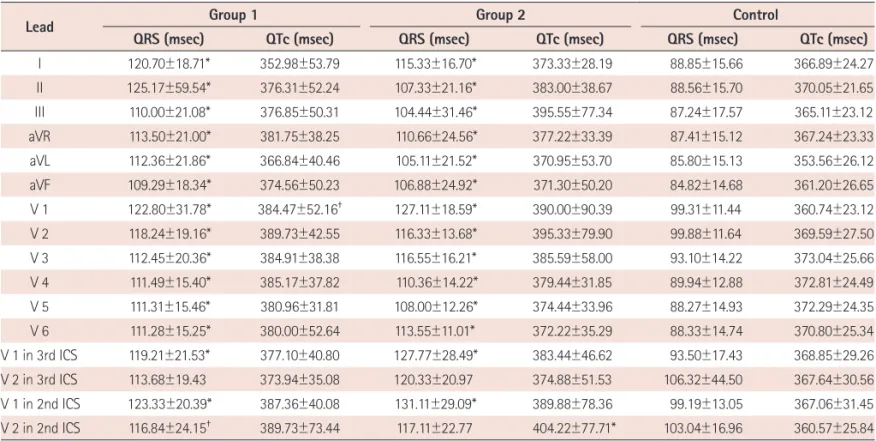
The QRS duration and QTc interval of checked leads are summariz- ed in Table 1. In all limb leads, QRS duration of group 1 and 2 show- ed significantly more prolonged QRS duration than that of the con- trol group (p=0.001). Group 1 showed the most prolonged QRS du- ration, but there was no significant difference compared to that of group 2. In all chest leads, QRS duration of group 1 and 2 showed significantly more prolonged QRS duration than that of the control group (p=0.000). The QTc interval showed the same results that the QRS duration revealed. In other words, the QTc intervals of group 1 and 2 were more prolonged than that of the control group, but there was no significant difference between the groups.

High-level intercostals space electrocardiogram

The comparison of QRS duration between standard and HICS V 1 and V 2 is summarized in Table 2. In group 1 and 2, there was no sig- nificant difference in the degree of intra-patient change and mean QRS duration between traditional standard 12-leads ECG and ECG at HICS. In the control group, the degree of the change between the 4th ICS QRS and 3rd ICS QRS was significant (p=0.031).

Discussion

Most patients with CHD associated with RVOT obstruction, such

(3)

as pulmonary atresia or TOF, had RVOT widening via trans-annular incision and right ventriculotomy. These operation methods result- ed in injury to the distal part of the right bundle branch, the RBBB, and a prolongation of the QRS duration. Prolongation of QRS dura- tion (>180 ms) is one of the indicators of localized areas of slow conduction and regional delay in systolic activation of the RV wall.

In particular, this finding is related mainly to previous surgical repair and fibrosis, and the risk factors for sudden cardiac death after RVOT repair.

13)

Therefore, early detection of prolonged QRS duration is very important to ensure long-term positive outcomes in patients with RVOT repair, and regular ECG checking is necessary.

The position of ECG leads could have an effect on ECG results. For example, if we change the left and right upper limb leads on oppo- site sites, the ECG recording reveals opposite vectors of the P wave

and T wave in the lead I, aVR, and aVL compared to those of the ECGs in their normal positions. When precordial leads (V 1)-ECG are placed at the HICS or at the right side, the QRS complex changes to the rSR type from the rS type normally. A recent study demonstrated that superior or inferior position of ECG electrodes caused alteration of QRS morphology and predictability of outflow tract ventricular tachycardia origin.

14)

In contrast, a positional change of ECG lead is helpful in some cas- es. Recently, researchers have reported that the Brugada syndrome could be identified more easily using HICS for ECG.

15-17)

Brugada syndrome is a disease with a high risk of sudden cardiac death re- lated to ventricular fibrillation in healthy adults. It is characterized by coved-type ST-segment elevation in the right precordial leads, but it is not easily detected in asymptomatic patients.

18)19)

ECGs re- Table 1. Comparison of the QRS duration and QTc interval on 12-leads ECG between groups

Lead Group 1 Group 2 Control

QRS (msec) QTc (msec) QRS (msec) QTc (msec) QRS (msec) QTc (msec)

I 120.70±18.71* 352.98±53.79 115.33±16.70* 373.33±28.19 88.85±15.66 366.89±24.27

II 125.17±59.54* 376.31±52.24 107.33±21.16* 383.00±38.67 88.56±15.70 370.05±21.65

III 110.00±21.08* 376.85±50.31 104.44±31.46* 395.55±77.34 87.24±17.57 365.11±23.12

aVR 113.50±21.00* 381.75±38.25 110.66±24.56* 377.22±33.39 87.41±15.12 367.24±23.33

aVL 112.36±21.86* 366.84±40.46 105.11±21.52* 370.95±53.70 85.80±15.13 353.56±26.12

aVF 109.29±18.34* 374.56±50.23 106.88±24.92* 371.30±50.20 84.82±14.68 361.20±26.65

V 1 122.80±31.78* 384.47±52.16

127.11±18.59* 390.00±90.39 99.31±11.44 360.74±23.12

V 2 118.24±19.16* 389.73±42.55 116.33±13.68* 395.33±79.90 99.88±11.64 369.59±27.50

V 3 112.45±20.36* 384.91±38.38 116.55±16.21* 385.59±58.00 93.10±14.22 373.04±25.66

V 4 111.49±15.40* 385.17±37.82 110.36±14.22* 379.44±31.85 89.94±12.88 372.81±24.49

V 5 111.31±15.46* 380.96±31.81 108.00±12.26* 374.44±33.96 88.27±14.93 372.29±24.35

V 6 111.28±15.25* 380.00±52.64 113.55±11.01* 372.22±35.29 88.33±14.74 370.80±25.34

V 1 in 3rd ICS 119.21±21.53* 377.10±40.80 127.77±28.49* 383.44±46.62 93.50±17.43 368.85±29.26

V 2 in 3rd ICS 113.68±19.43 373.94±35.08 120.33±20.97 374.88±51.53 106.32±44.50 367.64±30.56

V 1 in 2nd ICS 123.33±20.39* 387.36±40.08 131.11±29.09* 389.88±78.36 99.19±13.05 367.06±31.45

V 2 in 2nd ICS 116.84±24.15

389.73±73.44 117.11±22.77 404.22±77.71* 103.04±16.96 360.57±25.84

*p<0.01 vs. group 3,

p>0.05 vs. group 3. ICS: intercostals space, ECG: electrocardiogram, QTc: corrected QT

Table 2. Comparison of the QRS duration and QTc interval on ECG at precordial leads (V 1 and V 2) between groups according to the positional change

Lead Group 1 Group 2 Control

QRS (msec) Difference QRS (msec) Difference QRS (msec) Difference

V 1

2nd ICS 123.33±20.39 -0.52±22.50 131.11±29.09 -4.00±15.11 99.19±13.05 0.05±8.37

3rd ICS 119.21±21.53 3.59±23.67 127.77±28.49 -0.66±17.82 93.50±17.43 5.42±13.33*

4th ICS 122.80±31.78 127.11±18.59 99.31±11.44

V 2

2nd ICS 116.84±24.15 1.40±20.73 117.11±22.77 -0.77±15.89 103.04±16.96 -3.23±16.63

3rd ICS 113.68±19.43 4.56±15.44 120.33±20.97 -4.00±17.37 106.32±44.50 -7.28±42.44

4th ICS 118.24±19.16 116.33±13.68 99.88±11.64

Difference means the degree of the change between the 4th ICS QRS and 3rd ICS QRS and between the 4th ICS QRS and 2nd ICS QRS. *p<0.05. ICS: inter-

costals space, ECG: electrocardiogram, QTc: corrected QT

(4)

corded with precordial leads (V 1 and V 2) in the HICS (3rd ICS) are considered to reflect the potentials of the RVOT and are thought to be useful for detecting the Brugada sign.

15-17)

The J wave of the Bruga- da syndrome is generated by a voltage gradient across the myo- cardial wall of the right ventricular outflow tract. It can be recorded only by electrodes located very close to the site where that phenom- enon originates. The positional change of the right precordial lead electrodes at one or two intercostal spaces above their conven- tional positions may reveal the diagnostic pattern.

20)

Unlike cases with trans-annular incision and right ventriculotomy, sometimes, cases with patch closure for VSD can show postopera- tive RBBB because of injury of the proximal part of the right bundle branch.

From these previous studies, we considered that HICS-ECG lead position might cause alteration of QRS duration in patients with RVOT repair because HICS-ECG lead position may be closer to RVOT, and that it may be helpful to detect early significant prolongation of QRS duration. We attempted to compare the change of QRS du- ration by HICS-ECG in two different patients’ groups with CHD and postoperative RBBB. However, there was no significant difference be- tween traditional standard 12-leads ECG and HICS-ECG in the groups.

We were also not able to find a difference between the RBBB by right ventriculotomy and the RBBB by patch closure for VSD. In contrast with our expectation, the positional change of ECG leads didn’t have a significant effect on the change of QRS duration after cardiac surgery.

Electrocardiograms at the 3rd ICS showed significantly decreased QRS duration in the control group. Although it was insignificant, ECGs at 3rd ICS showed decreased QRS duration in group 1. This re- sult suggests that, like the previous study,

14)

alteration of ECG lead position may cause alteration of ECG readings and meaning.

In the present study, the small number of patients and the hetero- geneous age group are major limitations. Although 74% of the pa- tients were less than 5 years old, the patients’ age was variable, and the difference of QRS duration according to age was not considered.

Second, a patient’s cardiac condition was not considered. RV volume and pressure loading caused by PS and PR in patients with TOF re- pair might have an effect on QRS prolongation related to ventricular arrhythmia. Most patients enrolled in the present study did not have significant PR or PS, which was confirmed by echocardiography per- formed during the follow-up period, and, therefore, the effect of RV loading by PS and PR might not be significant.

In conclusion, although the positional change of ECG leads did not result in a significant effect on measuring QRS duration after surgery, ECG leads at the 3rd ICS rather than 4th ICS may cause al- teration of ECG reading. Therefore, we suggest that it is necessary to record ECG as in accurate a position as possible.

References

1. Harrison DA, Harris L, Siu SC, et al. Sustained ventricular tachycardia in adult patients late after repair of tetralogy of Fallot. J Am Coll Car- diol 1997;30:1368-73.

2. Kugler JD. Predicting sudden death in patients who have undergone tetralogy of fallot repair: is it really as simple as measuring ECG inter- vals? J Cardiovasc Electrophysiol 1998;9:103-6.

3. Marie PY, Marçon F, Brunotte F, et al. Right ventricular overload and induced sustained ventricular tachycardia in operatively “repaired” te- tralogy of Fallot. Am J Cardiol 1992;69:785-9.

4. Garson A Jr, Porter CB, Gillette PC, McNamara DG. Induction of ven- tricular tachycardia during electrophysiologic study after repair of tetralogy of Fallot. J Am Coll Cardiol 1983;1:1493-502.

5. Balaji S, Lau YR, Case CL, Gillette PC. QRS prolongation is associated with inducible ventricular tachycardia after repair of tetralogy of Fallot.

Am J Cardiol 1997;80:160-3.

6. Gatzoulis MA, Balaji S, Webber SA, et al. Risk factors for arrhythmia and sudden cardiac death late after repair of tetralogy of Fallot: a multicentre study. Lancet 2000;356:975-81.

7. Lucron H, Marçon F, Bosser G, Lethor JP, Marie PY, Brembilla-Perrot B.

Induction of sustained ventricular tachycardia after surgical repair of tetralogy of Fallot. Am J Cardiol 1999;83:1369-73.

8. Abd El Rahman MY, Abdul-Khaliq H, Vogel M, Alexi-Meskishvili V, Gut- berlet M, Lange PE. Relation between right ventricular enlargement, QRS duration, and right ventricular function in patients with tetralogy of Fallot and pulmonary regurgitation after surgical repair. Heart 2000;

84:416-20.

9. Wu MH. Sudden death in pediatric populations. Korean Circ J 2010;40:

253-7.

10. Lee YS, Baek JS, Kwon BS, et al. Pediatric emergency room presentation of congenital heart disease. Korean Circ J 2010;40:36-41.

11. Rudiger A, Hellermann JP, Mukherjee R, Follath F, Turina J. Electrocar- diographic artifacts due to electrode misplacement and their frequen- cy in different clinical settings. Am J Emerg Med 2007;25:174-8.

12. Batchvarov VN, Malik M, Camm AJ. Incorrect electrode cable connec- tion during electrocardiographic recording. Europace 2007;9:1081-90.

13. Babu-Narayan SV, Kilner PJ, Li W, et al. Ventricular fibrosis suggested by cardiovascular magnetic resonance in adults with repaired tetralogy of fallot and its relationship to adverse markers of clinical outcome.

Circulation 2006;113:405-13.

14. Anter E, Frankel DS, Marchlinski FE, Dixit S. Effect of electrocardio- graphic lead placement on localization of outflow tract tachycardias.

Heart Rhythm 2012;9:697-703.

15. Sangwatanaroj S, Prechawat S, Sunsaneewitayakul B, Sitthisook S, To- sukhowong P, Tungsanga K. New electrocardiographic leads and the procainamide test for the detection of the Brugada sign in sudden un- explained death syndrome survivors and their relatives. Eur Heart J 2001;

22:2290-6.

16. Sangwatanaroj S, Prechawat S, Sunsaneewitayakul B, Sitthisook S, To-

sukhowong P, Tungsanga K. Right ventricular electrocardiographic

leads for detection of Brugada syndrome in sudden unexplained death

syndrome survivors and their relatives. Clin Cardiol 2001;24:776-81.

(5)

17. Shimizu W, Matsuo K, Takagi M, et al. Body surface distribution and re- sponse to drugs of ST segment elevation in Brugada syndrome: clinical implication of eighty-seven-lead body surface potential mapping and its application to twelve-lead electrocardiograms. J Cardiovasc Elec- trophysiol 2000;11:396-404.

18. Nanke T, Nakazawa K, Arai M, et al. Clinical significance of the disper- sion of the activation--recovery interval and recovery time as markers for ventricular fibrillation susceptibility in patients with Brugada syn- drome. Circ J 2002;66:549-52.

19. Takagi A, Nakazawa K, Sakurai T, Nanke T, Miyake F. Prolongation of LAS40 (duration of the low amplitude electric potential component (<40 microV) of the terminal portion of the QRS) induced by isopro- terenol in 11 patients with Brugada syndrome. Circ J 2002;66:1101-4.

20. Oreto G, Corrado D, Delise P, et al. Doubts of the cardiologist regard-

ing an electrocardiogram presenting QRS V1-V2 complexes with

positive terminal wave and ST segment elevation. Consensus confer-

ence promoted by the Italian Cardiology Society. G Ital Cardiol (Rome)

2010;11(11 Suppl 2):3S-22.

수치

Table 2. Comparison of the QRS duration and QTc interval on ECG at precordial leads (V 1 and V 2) between groups according to the positional change

참조

관련 문서

ECG is a valuable noninvasive diagnostic method for detection of NSTE-ACS. In addition, it has a important role in the management of NSTE-ACS such as

With these results, we can suggest the hypothesis that increased cardiac output in the patients who administered ketamine increased muscle blood flow, and this is the

Now that you have the right bike for you, it is important to learn the right riding position.. A poor riding position can lead to

Risk factors related to fixed airway obstruction in patients with asthma after antiasthma treatment. Identification of sub- types of refractory asthma in Korean patients by

(4) After a certain period of tightening time with tightening torque, Z-axis and rotating axis return in positioning control mode to the retracted

In particular, as some authors assume, the post-liberal engagement with illiberal regimes might lead to “the co-production of non-liberal regimes via foreign policies

Al-Fahoum, “Quality Assessment of ECG Compression Techniquies Using a Wavelet-Based Diagnostic Measure,” IEEE Biomed.. Furht and A.Perez, “AN adaptive real-time

Tale illustration may be the excellent art education tool to children because it has the similar trend with modern arts and shows various expression