Introduction
Lumbar spinal stenosis (LSS) is a commonly encountered, painful, and possibly disabling condition that is usually treated with a spinal epidural injection, or surgery for older patients [1,2]. Degenerative changes that include hypertrophy of the facet joint or surrounding ligamentous structure result in a nar- rowing of the spinal canal or the lateral nerve-root canals. Based on the most narrowed anatomical area, LSS is classified as either central, foraminal, or lateral [3].
The MRI technique is pivotal in the diagnosis of LSS, as it is reportedly more sensitive and specific in the identification of
Clinical Research Article
Background: To investigate and analyze MRI findings in relation to visual analogue scale (VAS), Oswestry Disability In- dex (ODI), psychological-factor, sleep-quality, and Short-Form Health Survey (SF-36) scores among patients with central lumbar spinal stenosis (LSS) for the purpose of elucidating a correlation.
Methods: From July 2013 to May 2014, 117 consecutive patients with central LSS were included in this study. All of the MRIs were evaluated by one of the authors, and the evaluated items were the dural sac cross-sectional area (DSCSA), the number of stenotic levels, and the presence and levels of spondylolisthesis. The ODI, VAS, 36-item SF-36, Beck Depres- sion Inventory (BDI), Beck Anxiety Inventory (BAI), and Pittsburgh Sleep Quality Index (PSQI) questionnaires were used to evaluate the participants.
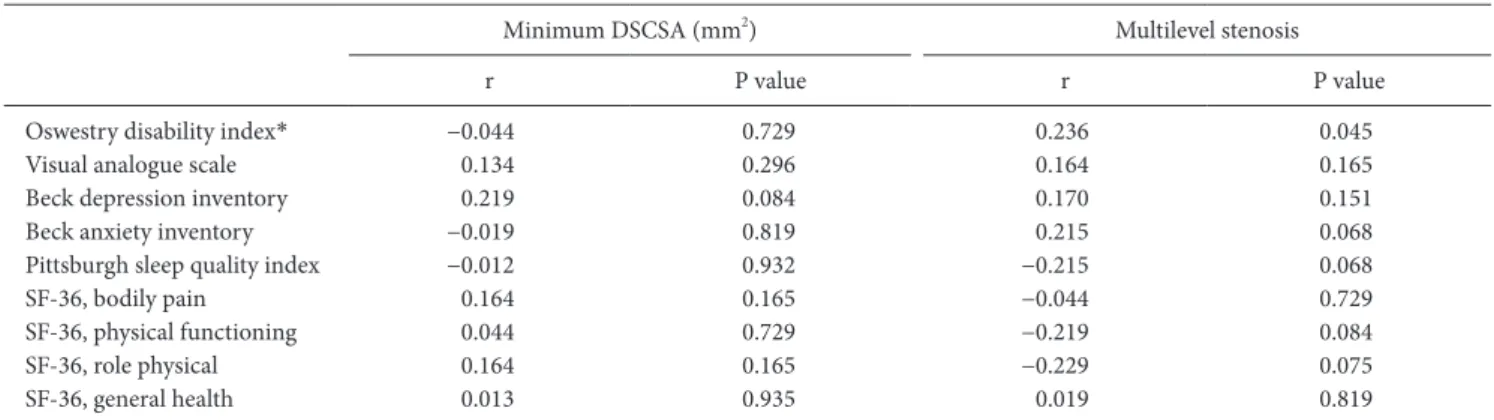
Results: There are no correlations between the ODI, VAS, BDI, BAI, PSQI, and SF-36 scores and the minimum DSCSA;
however, a significant correlation was found between the ODI scores and multilevel LSS. The BDI, BAI, and PSQI scores are higher for multilevel LSS compared with single-level LSS, but the difference of this mean value is not statistically sig- nificant.
Conclusions: A significant correlation was shown between those patients with multilevel LSS and the ODI scores; how- ever, significant correlations were not found between the MRI findings and the psychological factors pertaining to sleep and life qualities.
Key Words: Beck depression inventory, Dural sac cross sectional area, MRI findings, Spinal stenosis, Oswestry disability index, Pittsburgh sleep quality index.
Does spinal stenosis correlate with MRI findings and pain,
psychologic factor and quality of life?
Ji Hee Hong, Mi Young Lee, Sung Won Jung, and Su Yong Lee
Department of Anesthesiology and Pain Medicine, Keimyung University Dongsan Hospital, Daegu, Korea
CC