INTRODUCTION
Characteristic neuropathological features of Alzheimer’s disease (AD), one of the most common forms of dementia, are accumulation of senile plaques, formation of neurofibril- lary tangles, induction of oxidative stress and/or inflamma- tory responses, and disturbance in neurotransmission (Kar- ran et al., 2011). Particularly, decreased cholinergic function is responsible for the progressive loss of memory in AD and closely correlated with the severity of cognitive impairment (Craig et al., 2011). Conversely, the restoration of cholinergic function by cholinergic agonists or prolongation of the acetyl- choline availability into the synaptic cleft by acetylcholinester- ase (AChE) inhibitors has been regarded as a representative therapeutic target for the treatment of AD symptoms (Brenner et al., 2008). Therefore, in the present study, we have utilized scopolamine (SCO), a muscarinic acetylcholine receptor (mA-
ChR) antagonist to induce memory impairment in Sprague- Dawley (SD) rats as a typical screening model system for anti- amnesic drugs.
Because of the limitation of current medications approved for the management of AD such as relatively low efficacy, se- vere adverse effects for the long-term use, and ineffectiveness in the late stage of AD, extensive researches have been car- ried out to search novel and safe phytochemicals with neuro- protective properties. In this regard, an array of natural prod- ucts from dietary foods with high potency and low side effects has been investigated for the prevention and/or treatment of AD and one promising new candidate of interest in this study is arabinoxylan (AX).
AX is the major constituent of wheat non-starch polysac- charides (NSP) accounting for approximately 2.5% of flour and 18% of bran and acts as dietary fiber in wheat (Gebruers et al., 2008; Ward et al., 2008). AX of wheat is composed of
Copyright © 2014 The Korean Society of Applied Pharmacology
* Corresponding Author
E-mail: [email protected] (Jang JH),
[email protected](Lee JW) Tel: +82-53-580-3866 (Jang JH), +82-53-650
-4471(Lee JW) Fax: +82-53-580-3866 (Jang JH), +82-53-621-9206 (Lee JW) Received
May 29, 2014Revised
July 7, 2014Accepted
July 8, 2014Published online
Sep 30, 2014http://dx.doi.org/10.4062/biomolther.2014.063
Open AccessThis is an Open Access article distributed under the terms of the Creative Com- mons Attribution Non-Commercial License (http://creativecommons.org/licens- es/by-nc/3.0/) which permits unrestricted non-commercial use, distribution, and reproduction in any medium, provided the original work is properly cited.
www.biomolther.org The purpose of this study is to investigate the memory enhancing effect and underlying molecular mechanism of arabinoxylan (AX), a major component of dietary fiber in wheat against scopolamine (SCO)-induced amnesia in Sprague-Dawley (SD) rats.
Diverse behavior tests including Y-maze, Morris water maze, and passive avoidance tests were performed to measure cognitive functions. SCO significantly decreased the spontaneous alterations in Y-maze test and step-through latency in passive avoidance test, whereas increased time spent to find the hidden platform in Morris water maze test compared with the sham control group.
In contrast, oral administration of AX (25 mg/kg and 50 mg/kg) effectively reversed the SCO-induced cognitive impairments in SD rats. Furthermore, AX treatment up-regulated the expression of brain-derived neurotrophic factor (BDNF) in the cortex and hippo- campus via promoting activation of cAMP response element binding protein (CREB). Therefore, our findings suggest that AX can improve SCO-induced learning and memory impairment possibly through activation of CREB and up-regulation of BDNF levels, thereby exhibiting a cognition-enhancing potential.
Key Words: Arabinoxylan, Brain-derived neurotrophic factor, cAMP response element binding protein, Learning and memory, Scopolamine
Protective Effect of Arabinoxylan against
Scopolamine-Induced Learning and Memory Impairment
Chang-Yul Kim
1, Gil-Yong Lee
1, Gyu Hwan Park
2, Jongwon Lee
3,* and Jung-Hee Jang
4,*
1
Department of Pathology, College of Oriental Medicine, Daegu Haany University, Daegu 706-828,
2
Research Institute of Pharmaceutical Sciences, College of Pharmacy, Kyungpook National University, Daegu 702-701,
3
Deparment of Biochemistry, School of Medicine, Catholic University of Daegu, Daegu 705-718,
4
Department of Pharmacology, School of Medicine, Keimyung University, Daegu 704-701, Republic of Korea
Abstract
xylose and arabinose serving as backbone and substituent, respectively. The relative ratio of arabinose to xylose (A/X) is approximately 0.5 for total AX in flour (Gebruers et al., 2008;
Ward et al., 2008). Previously, we have shown that hot water extract of milled wheat and total dietary fiber prepared from it improved memory impairment caused by SCO in SD rats (Jang et al., 2010). In addition, we also have reported that hot water extract of milled wheat restored memory deficit in a rat model of chronic hypoperfusion selected for mimicking vascu- lar dementia in human (Han et al., 2010).
As an extension of the previous studies, the purpose of the present work is to investigate whether AX, an active constitu- ent of wheat, has a novel cognition-enhancing activity against the SCO-induced amnesia in SD rats and exhibits a preven- tive and/or therapeutic potential for the management of AD. In this study, basic investigations on the action of AX were ex- tended to the molecular levels by examining alterations in the phosphorylation of cAMP response element binding (CREB) protein and expression of brain-derived neurotrophic factor (BDNF).
MATERIALS AND METHODS Drugs and reagents
Wheat AX was purchased from Megazyme (Wicklow, Ire- land). SCO and anti-actin antibody were obtained from Sigma- Aldrich (St. Louis, MO, USA). Anti-BDNF and anti-phospho- CREB (p-CREB) antibodies were the products of SantaCruz (Santa Cruz, CA, USA) and Cell Signaling (Boston, MA, USA), respectively.
Experimental animals
Male SD rats weighing 250-300 g (8-week old) were sup- plied from the Dae Han Bio-Link. Co., Ltd. (Eumseong-gun, Chungcheongbuk-do, South Korea) and maintained under controlled temperature (21 ± 2
oC) and humidity (45-60%) with a regular 12 h light - 12 h dark cycle (light period starting at 7 a.m.). The rats freely accessed to standard rodent chow and fresh tap water. The experimental procedure was conducted in compliance with institutional guidelines of NIH and Daegu Haany University for the Care and Use of Laboratory Animals.
Drug administration
The rats were divided into four groups (6-7 animals per group): sham control group, SCO model group, and SCO+
AX (25 mg/kg and 50 mg/kg) treatment groups. The rats were orally administered with normal saline or AX, 1 h before start- ing the behavior tests. SCO (0.75 mg/kg, 300 ml, i.p.) was in- jected 30 min prior to the behavior tests, whereas the sham control group was injected with same volume of normal saline.
Y-maze test
Three arms of the Y-maze (41 cm long, 25 cm high, and 10 cm wide) were positioned at an equal angle. Each rat was placed at the end of one arm and allowed to navigate freely for an 8-min session. In each trial, the spontaneous alternations were recorded using Ethovision System (Ethovision system, Noldus, Wageningen, Netherlands). Spontaneous alteration behavior was defined as the entry into all three arms on con- secutive choices in overlapping triplet sets (e.g. ABC, BCA, CAB). The percentage (%) of spontaneous alternation behav-
ior was calculated by dividing the total number of alternations by the total number of arm entries subtracting 2 and then mul- tiplying by 100: % alternation=[(number of alternations)/(total number of arm entries-2)]×100.
Morris water maze test
The Morris water maze test was conducted in accordance with the protocol previously reported (Jang et al., 2010).
Step-through passive avoidance test
The passive avoidance test apparatus (GEMINI
TM, San Di- ego, CA, USA) was consisted of two compartments (26×28×16 cm), illuminated and non-illuminated chambers, equipped with an electrifiable grid floor. The two chambers were connected by an automatically operated guillotine door. During acquisi- tion trial, rats were initially placed in the illuminated chamber and after 30 sec of familiarization, the light was on and the door between the two compartments was opened. When the rats entered the non-illuminated chamber, the guillotine door was automatically closed and an electrical foot shock (0.5 mA) was delivered for 5 sec through the stainless steel rods. The time taken to enter the non-illuminated chamber was recorded as the step-through latency. A retention trial was performed 24 h after training trial. The rats were placed again in the light chamber and the time to enter the dark chamber after door opening was measured without electric foot shock. If the rat did not enter the dark chamber within 300 sec, the step- through latency was regarded as 300 sec.
Reverse transcription-polymerase chain reaction: RT-PCR
After conducting behavior test, rats were anesthetized with pentobarbital (50 mg/kg, i.p.) and sacrified by decapitation to obtain cortical tissues. Total RNA was extracted from the rat cortex with TRI reagent (Molecular Research center, OH, USA) and then reverse transcribed for 60 min at 42
oC using M-MLV re- verse transcriptase (Promega, WI, USA). Amplification of cDNA was conducted by polymerase chain reaction (PCR) using syn- thetic primers specific to choline acetyltransferase (ChAT), M
1type mAChR (M
1mAChR), and glyceralde hyde-3-phosphate dehydrogenase (GAPDH) as follows: ChAT, 5´-AGGGTGA T- C TGTTCACTCAG-3´ (sence), 5´-TCTTGTTGCCTGTCA TC A - TA-3´ (antise nce); M
1mAChR, 5´-CAGAAGTGGTGATCAAGA- TGCC-3´ (sen ce), 5´-GAGCTTTTGGGAGGCTGCTT-3´ (an ti sen ce);
GAPDH, 5´-GCCAAGGTCATCCATGACAAC-3´ (sen se), 5´-AGT- GTAGCCCAGGATGCCCTT-3´ (antisense). The PCR products were analyzed by 1.5% agarose gel electrophoresis in Tris- acetate-EDTA (TAE) buffer and examined under UV light using a gel documentation system (Geldoc 2000, Bio-Rad, Philadel- phia, PA, USA) after staining with ethidium bromide (EtBr).
Immunoblotting
After completing behavior test, rats were sacrificed and
the brains were dissected on an ice-cold operating table. The
cortex and hippocampus were taken from the brain and ho-
mogenated thoroughly with RIPA buffer using automatic ho-
mogenizer (Precellys 24, Bertin Technologies, Montigny le
Bretonneux, France). The homogenates were centrifuged at
14,000 g for 15 min on 4
oC. The concentration of isolated pro-
tein was determined by BCA protein assay kit (Pierce Biotech-
nology, IL, USA). Immunoblotting was performed according to
the procedures previously described (Lee et al., 2011a).
Immunohistochemistry
Rats were anesthetized with an intraperitoneal injection of pentobarbital (50 mg/kg) and perfused with phosphate buff- ered saline (PBS) followed by 4% cold paraformaldehyde in PBS. Brain tissues were post-fixed in the same fixative for additional 2 h at room temperature and then sequentially im- mersed in 10%, 20%, and then 30% sucrose solution. Frozen tissue blocks were made with OTC compound (Tissue Tek, Torrance, CA, USA) and coronal brain sections (30 mm thick) were serially taken using a cryostat (Leica, Wetzlar, Germa- ny). Immunohistochemical staining was conducted following the procedures previously reported with some modifications (Lee et al., 2011b). Correspondent slides with adhered sec- tions were washed with 1% Triton X-100 in PBS for 10 min and then with PBS for 5 min twice. Endogenous peroxidase was inactivated by incubating the tissue sections with 1% H
2O
2in PBS for 30 min. After washing with PBS for three times, the
slides were blocked in 3% normal horse serum containing 0.1% Triton X-100 for 1 h at room temperature and incubated with primary anti-p-CREB antibody (1:200) prepared in PBS containing 0.1% bovine serum for 24 h at 4
oC. After washing again three times with PBS, biotinylated secondary antibody was added for 2 h, followed by incubation with avidin-biotin peroxidase complex (Santa Cruz) for 1 h at room tempera- ture. Then slides were developed by using DAB as substrate, dehydrated with a series of ethanol solution, and mounted with 50% (v/v) glycerol. The stained images were examined under a bright field microscope (Leica).
Statistical analysis
The data were expressed as mean values ± standard error of the mean (S.E.M.). Statistical analysis was performed by one-way ANOVA followed by the Tukey’s test for multiple com- parisons using SPSS software (SPSS 12.0 KO for windows).
Differences were considered to be significant when p value was less than 0.05.
RESULTS
Effect of AX on SCO-induced memory impairments
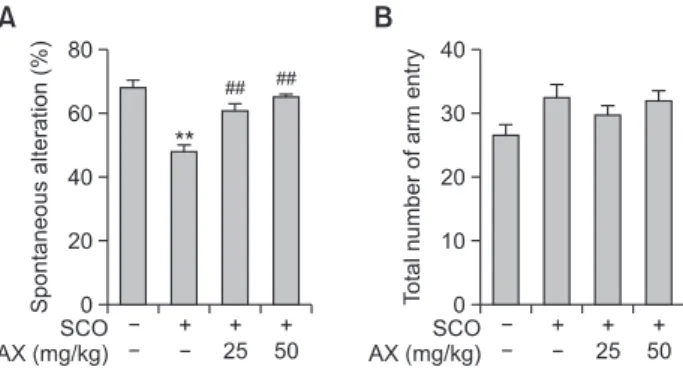
Immediate working memory performance was assessed by recording spontaneous alteration behavior in Y-maze test. In this test, SCO (0.75 mg/kg, i.p.) significantly decreased the percentage of spontaneous alteration (Fig. 1A). Treatment of SD rats with AX (25 or 50 mg/kg) effectively increased % spontaneous alteration and improved memory impairment caused by SCO in a dose-related manner (Fig. 1A). However, under the same experimental condition, the total number of arm entries was similar in each experimental group (Fig. 1B).
In another experiment, Morris water-maze was conducted to compare the spatial memory. The rats in the vehicle-treated sham control group readily learned and memorized the loca- tion of submerged hidden platform during four consecutive training days, which was reached within 30 sec by the last day Fig. 1.
Memory enhancing effect of AX in Y-maze test. (A) Effectof AX on the SCO-decreased spontaneous alternation was moni- tored by Y-maze test. (B) Total number of arm entries during 8-min session of Y-maze test. Data are presented as mean ± S.E.M. (n=7).
Significant difference between groups: **p<0.01, vehicle-treated control vs. SCO alone group; ##p<0.01, SCO alone group vs. AX- treated groups in combination with SCO.
Fig. 2.
Memory promoting activity of AX in Morris water-maze and passive avoidance tests. (A) Effect of AX on the SCO-induced spatial memory impairment which was represented by mean escape latency during training trials in Morris water-maze test. (B) Comparison of time spent in the platform quadrant during probe test in Morris water-maze test. (C) Protective effect of AX on the learning and memory deficit caused by SCO in the passive avoidance test. Data are presented as mean ± S.E.M. (n=6). Significant difference between groups: *p<0.05 and **p<0.01, vehicle-treated control vs. SCO alone group; #p<0.05 and ##p<0.01, SCO alone group vs. AX-treated groups in combination with SCO.of the training period (Fig. 2A). Conversely, the performance in the SCO alone-injected group was significantly impaired.
However, repeated daily administration of AX (25 or 50 mg/kg) reduced mean escape latencies starting from the second day and particularly 50 mg/kg of AX-administered group exhibited almost similar mean escape latency to the vehicle-treated sham control group during four consecutive training days (Fig. 2A). Immediately after the last training session on day 4, the platform was removed and probe test was conducted for 30 s. The time spent in the target quadrant to search for the removed platform was monitored. The sham control and AX- treated groups spent more time in the probe quadrant com- pared with SCO alone-treated group (Fig. 2B) suggesting the retention of learning and memory by oral administration of AX.
To confirm the effect of AX on the SCO-induced learning and memory impairments, passive avoidance test was per- formed. In the acquisition trial, there was no significant differ- ence in step-through latency time among experimental groups (Fig. 2C). However, during retention trial, the step-through latency was dramatically decreased in the SCO-injected rats and SCO-reduced step-through latency was effectively re- stored by oral administration of increasing doses of AX (25 and 50 mg/kg) (Fig. 2C).
Effect of AX on the expression of enzymes and receptors related with acetylcholine
To verify the effect of AX on the acetylcholine metabolism,
the mRNA levels of enzymes and receptors involved in the synthesis as well as pharmacological action of acetylcholine were monitored by RT-PCR. In the cortex, SCO decreased the mRNA expression of ChAT which plays a key role in the formation of acetylcholine (Fig. 3A). SCO-induced a decrease in the ChAT mRNA levels was restored by AX (25 or 50 mg/kg) in a dose-dependent manner (Fig. 3A). However, under the same experimental condition the mRNA expression of AChE, acetylcholine decomposing enzyme, was not much affected by SCO or AX treatment (data not shown). In another experi- ment, SCO injection also suppressed mRNA expression of M
1type of muscarinic acetylcholine receptor (M
1mAChR), which was significantly up-regulated by oral administration of AX (25 or 50 mg/kg) dose-dependently (Fig. 3B).
Effect of AX on the expression of BDNF and activation of CREB To further elucidate the molecular mechanisms underlying the memory enhancing effect of AX, we have examined the expression of BDNF in the cortical and hippocampal brain tis- sues. Treatment of SD rats with AX (25 or 50 mg/kg) dose- dependently increased the protein levels of BDNF which was decreased by SCO in the cortex and hippocampus as well (Fig. 4A). To further determine an upstream regulator for the up-regulation of BDNF by AX, the possible involvement of CREB was investigated. Proteins from cortical or hippocam- pal tissue lysates were analyzed by Western blot analysis with p-CREB specific antibody. SCO-decreased phosphorylation of CREB was marked restored by oral administration of AX with maximal induction at the dose of 50 mg/kg (Fig. 4B). We also verified activation of p-CREB by AX (50 mg/kg) in the cortex as well as hippocampus (Fig. 4C) using immunohistochem- istry. As a result, the phosphorylation of CREB was evident after AX treatment in accordance with the Western blot data of BDNF.
DISCUSSION
In this study, we have investigated the neuroprotective ef- fects of AX against SCO-induced cognitive dysfunction in SD rats. First, to induce learning and memory impairment, we have intraperitonically injected SCO in SD rats and conducted a series of behavior tests. In the Y-maze test, SCO-treated rats showed decreased spontaneous alterations compared with that of vehicle-treated animals, which was improved by AX pretreatment. In Morris water-maze task, SCO-treated rats took longer time to find platform than the rats in sham control group and AX-treated group in combination with SCO easily found the location of hidden platform. In the passive avoid- ance test, SCO treatment reduced step-through latency, which was effectively restored by oral daily administration of AX.
As a molecular mechanism underlying the memory enhanc- ing effect of AX, we showed that AX treatment increased phos- phorylation of CREB, an activated form of CREB, and stimu- lated the expression of BDNF, ChAT and M
1mAChR genes. It has been reported that BDNF, ChAT and mAChR genes have CRE, the binding site of CREB (Zhang et al., 2005) implying that phosphorylation of CREB can stimulate the transcription of aforementioned genes. Indeed, phosphorylation of CREB ameliorated stresses generated by diverse pathophysiological conditions such as AD (Jin et al., 2009), ischemia (Kim et al., 2009), aging (Asanuma et al., 1996; Hu et al., 2010) in as- Fig. 3.
Effect of AX on the mRNA expression of acetylcholine-related proteins The mRNA expression of enzymes involved in the synthesis of acetylcholine (A) and M1 type mAChR (B) was analyzed by RT-PCR (n=3 per lane). mRNA levels of gapdh were determined to confirm equal amount of mRNA loading. Quantita- tive values for the relative mRNA expression were calculated from three independent experiments and represented in the right panels (n=9). Significant difference between groups : ##p<0.01, SCO alone group vs. AX-treated groups in combination with SCO.
sociation with BDNF (Jin et al., 2009; Kim et al., 2009), ChAT (Asanuma et al., 1996; Jin et al., 2009), and mAChR (Jin et al., 2009; Hu et al., 2010). Particularly, the activation of CREB and increased expression of BDNF are involved in enhancement of long-term memory (Cunha et al., 2010; Bitner, 2012). In ad- dition, up-regulated expression of ChAT and mAChR results in an increased production of acetylcholine and amplification of signal transduction with acetylcholine acting as a ligand. Thus, CREB-mediated expression of BDNF, ChAT and mAChR by AX may contribute to the improvement of memory impaired
by SCO.
In accordance with our findings, a wide range of phyto- chemicals have been reported to have neuroprotective and memory enhancing effects via CREB-BDNF signals. Triterpe- noid saponin PGS32 (polygalasaponin XXXII) isolated from the roots of Polygala tenuifolia Willd. prevented SCO-induced cognitive impairments possibly through improvement of syn- aptic transmission, activation of the mitogen-activated protein kinase (MAPK) and CREB, and enhancement of BDNF lev- els (Xue et al., 2009). Kalopanaxsaponins A and B derived Fig. 4.
Effect of AX on the protein levels of BDNF and activation of CREB The protein expression of BDNF (A) and p-CREB (B) was exam- ined by Western blot analysis (n=3 per lane). Proteins from tissue lysates were analyzed by using BDNF or p-CREB specific antibody. Actin expression levels were monitored to ensure equal amount of protein loading. Relative protein expression calculated from three independent experiments was represented in the right panel (n=9). Significant difference between groups : #p<0.05 and ##p<0.01, SCO alone group vs.AX-treated groups in combination with SCO. (C) Activation of CREB was verified by immunohistochemistry utilizing anti-p-CREB antibody. a and d : sham control, b and e : SCO alone (0.75 mg/kg) group, c and f : SCO (0.75 mg/kg)+AX (50 mg/kg)
.
from stem-bark of Kalopanax pictus ameliorated SCO-induced memory deficits by inducing BDNF and p-CREB expression and conversely inhibiting AChE activity as well (Joh et al., 2011).
To determine which compounds might be responsible for improving memory in rats administered with SCO, we have to follow the passages that the AX undergoes in the gastroin- testinal tract. Zhang et al. (Zhang et al., 2003) demonstrated that approximately 3% of arabinose on AX was released in 3 h of incubation at pH 3. Subsequently the remaining AX en- tering the small intestine is suitable for the breakdown as it is not a substrate for enzymatic digestion in the small intes- tine. Finally, the remaining AX entering the large intestine is first degraded into monosaccharides such as arabinose and xylose by bacteria inhabiting in the large intestine, followed by fermentation into short chain fatty acids (SCFA) such as butyrate, propionate and acetate (Broekaert et al., 2011). As a result, both the monosaccharides generated in the small and large intestines and SCFA formed in the large intestine are promising candidates that can be absorbed into the blood and reach the brain. Arabinose (Eidelberg et al., 1967) and bu- tyrate (Dienel et al., 2001) have been reported to penetrate across blood-brain barrier (BBB) and be transported into the brain. However, mechanisms by which arabinose and/or xy- lose might play in enhancing learning and memory functions have not been elucidated yet, although oral administration of arabinose attenuated brain injury by inhibiting inflammatory responses caused by hypoperfusion in SD rats (Han et al., 2010). On the other hand, memory enhancing mechanisms of butyrate are beginning to be elucidated. Butyrate can be metabolized to produce ATP that can be converted to cAMP by adenylyl cyclase. Therefore, consequent increase of cAMP activates protein kinase A (PKA) leading to phosphorylation of CREB (Wang et al., 2012). Thus, contribution of AX to enhanc- ing memory can be explained, at least in part, by conversion of AX into arabinose and butyrate.
In summary, we demonstrated that AX improved learning and memory functions in SD rats with SCO-induced amne- sia. This cognition enhancing effect of AX was mediated partly through activation of CREB cascade and subsequent expres- sion of BDNF. To translate the novel effect of AX in CNS into clinical applications for the improvement of cognitive func- tions, the pharmacology and mode of action of its active com- ponents should be further investigated.
ACKNOWLEDGMENTS
This research was supported by Bio-industry Technology Development Program, Ministry for Food, Agriculture, Forest- ry and Fisheries, Republic of Korea.
REFERENCES
Asanuma, M., Nishibayashi, S., Iwata, E., Kondo, Y., Nakanishi, T., Vargas, M. G. and Ogawa, N. (1996) Alterations of cAMP response element-binding activity in the aged rat brain in response to admin- istration of rolipram, a cAMP-specific phosphodiesterase inhibitor.
Brain Res. Mol. Brain Res. 41, 210-215.
Bitner, R. C. (2012) Cyclic AMP response element-binding protein (CREB) phosphorylation: A mechanistic marker in the development
of memory enhancing Alzheimer’s disease therapeutics. Biochem.
Pharmacol. 83, 705-714.
Brenner, T., Nizri, E., Irony-Tur-Sinai, M., Hamra-Amitay, Y. and Wir- guin, I. (2008) Acetylcholinesterase inhibitors and cholinergic mod- ulation in myasthenia gravis and neuroinflammation. J. Neuroim- munol. 201-202, 121-127.
Broekaert, W. F., Courtin, C. M., Verbeke, K., Wiele, T. V. D., Vers- traete, W. and Delcour, J. A. (2011) Prebiotic and other health-re- lated effects of cereal-derived arabinoxylans, arabinoxylan-oligo- saccharides, and xylooligosaccharides. Crit. Rev. Food Sci. Nutr.
51, 178-194.
Craig, L. A., Hong, N. S. and McDonald, R. J. (2011) Revisiting the cholinergic hypothesis in the development of Alzheimer's disease.
Neurosci. Biobehav. Rev. 35, 1397-1409.
Cunha, C., Brambilla, R. and Thomas, K. L. (2010) A simple role for BDNF in learning and memory? Front. Mol. Neurosci. 3, 1.
Dienel, G. A., Liu, K. and Cruz, N. F. (2001) Local uptake of 14C-labeled acetate and butyrate in rat brain in vivo during spreading cortical depression. J. Neurosci. Res. 66, 812-820.
Eidelberg, E., Fishman, J. and Hams, M. L. (1967) Penetration of sug- ars across the blood-brain barrier. J. Physiol. 191, 47-57.
Gebruers, K., Dornez, E., Boros, D., Fraś, A., Dynkowska, W., Bedo, Z., Rakszegi, M., Delcour, J. A. and Courtin, C. M. (2008) Variation in the content of dietary fiber and components thereof in wheats in the HEALTHGRAIN diversity screen. J. Agric. Food Chem. 56, 9740-9749.
Han, H. S., Jang, J. H., Jang, J. H., Choi, J. S., Kim, Y. J., Lee, C., Lim, S. H., Lee, H. K. and Lee, J. (2010) Water extract of Triticum aestivum L. and its components demonstrate protective effect in a model of vascular dementia. J. Med. Food 13, 572-578.
Hu, H., Zhang, R., Zhang, Y., Xia, Z. and Hu, Y. (2010) Role of CREB in the regulatory action of sarsasapogenin on muscarinic M1 receptor density during cell aging. FEBS Lett. 584, 1549-1552.
Jang, J. H., Kim, C. Y., Lim, S. H., Yang, C. H., Song, K. S., Han, H.
S., Lee, H. K. and Lee, J. (2010) Neuroprotective effects of Triticum aestivum L. against beta-amyloid cell death and memory impair- ments. Phytother. Res. 24, 76-84.
Jin, C. H., Shin, E. J., Park, J. B., Jang, C. G., Li, Z., Kim, M. S., Koo, K. H., Yoon, H. J., Park, S. J., Choi, W. C., Yamada, K., Nabeshi- ma, T. and Kim, H. C. (2009) Fustin flavonoid attenuates β-amyloid (1-42)-induced learning impairment. J. Neurosci. Res. 87, 3658- 3670.
Joh, E. H., Lee, I. A. and Kim, D. H. (2011) Kalopanaxsaponins A and B isolated from Kalopanax pictus ameliorate memory deficits in mice.
Phytother. Res. 26, 546-551.
Karran, E., Mercken, M. and De Strooper, B. (2011) The amyloid cas- cade hypothesis for Alzheimer's disease: an appraisal for the de- velopment of therapeutics. Nat. Rev. Drug Discov. 10, 698-712.
Kim, H. J., Leeds, P. and Chuang, D. M. (2009) The HDAC inhibitor, sodium butyrate, stimulates neurogenesis in the ischemic brain. J.
Neurochem. 110, 1226-1240.
Lee, C., Park, G. H., Kim, C. Y. and Jang, J. H. (2011a) [6]-Gingerol attenuates β-amyloid-induced oxidative cell death via fortifying cel- lular antioxidant defense system. Food Chem. Toxicol. 49, 1261- 1269.
Lee, C., Park, G. H. and Jang, J. H. (2011b) Cellular antioxidant adap- tive survival response to 6-hydroxydopamine-induced nitrosative cell death in C6 glioma cells. Toxicology 283, 118-128.
Ward, J. L., Poutanen, K., Gebruers, K., Piironen, V., Lampi, A. M., Nyström, L., Andersson, A. A., Aman, P., Boros, D., Rakszegi, M., Bedo, Z. and Shewry, P. R. (2008) The HEALTHGRAIN cereal diversity screen: concept, results, and prospects. J. Agric. Food Chem. 56, 9699-9709.
Wang, A., Si, H., Liu, D. and Jiang, H. (2012) Butyrate activates the cAMP-protein kinase A-cAMP response element-binding protein signaling pathway in Caco-2 cells. J. Nutr. 142, 1-6.
Xue, W., Hu, J. F., Yuan, Y. H., Sun, J. D., Li, B. Y., Zhang, D. M., Li, C. J. and Chen, N. H. (2009) Polygalasaponin XXXII from Polyg- ala tenuifolia root improves hippocampal-dependent learning and memory. Acta Pharmacol. Sin. 30, 1211-1219.
Zhang, P., Zhang, Q. and Whistler, R. L. (2003) L-Arabinose release from arabinoxylan and arabinogalactan under potential gastric
aciditities. Cereal Chem. 80, 252-254.
Zhang, X., Odom, D. T., Koo, S. H., Conkright, M. D., Canettieri, G., Best, J., Chen, H., Jenner, R., Herbolsheimer, E., Jacobsen, E., Kadam, S., Ecker, J. R., Emerson, B., Hogenesch, J. B., Unterman,
T., Young, R. A. and Montminy, M. (2005) Genome-wide analysis of cAMP-response element binding protein occupancy, phosphoryla- tion, and target gene activation in human tissues. Proc. Natl. Acad.
Sci. U.S.A. 102, 4459-4464.