Communication
Appl. Chem. Eng., Vol. 32, No. 3, June 2021, 357-360https://doi.org/10.14478/ace.2021.1026
357
1. Introduction 1)
The stringent environmental laws coming in place due to major envi- ronmental concerns have made it inevitable to search for sustainable energy resources[1-3]. Rapid pyrolysis is a thermochemical conversion process for the generation of bio-oil from waste biomass resources and is a potential candidate for replacing fossil fuels[4-7]. On the other hand, the bio-oil obtained from pyrolysis cannot be used directly as a fuel because of its high viscosity (40~100 cP), high oxygen content (40~60 wt.%), lower chemical and thermal stability, lower high heating value (16~19 MJ/kg), and higher water content (15~35 wt.%)[8,9].
Hence, upgrading is required to improve its properties for use as an engine fuel.
Zeolites provide a better solution for the upgrading of oil owing to their lower H/C
eff(hydrogen-to-carbon effective ratios (0~0.3)[10-12].
Moreover, methane is an inexpensive source of hydrogen that can be obtained by decomposition catalytically using metal-loaded zeolites [13]. Furthermore, methane pyrolysis under zeolites and metal-loaded zeolites enhance the generation of benzene, toluene, ethylbenzene, and xylene (BTEX), which ultimately enhances the quality of bio-oil[8,13].
Emulsification is a process to use the bio-oil obtained from pyrolysis [14] directly in a diesel engine as a mixture of bio-oil and diesel. In general, bio-oil and diesel do not mix because of the aforementioned properties. Hence surfactants/emulsifiers are required to make stable bio-oil and diesel emulsions[15-17]. Surfactants are selected based on their hydrophilic/lipophilic balance (HLB)[9,18]. Emulsifiers can be ap-
† Corresponding Author: University of Seoul,
School of Environmental Engineering, Seoul 02504, Republic of Korea Tel: +82-2-6490-2870 e-mail: [email protected]
pISSN: 1225-0112eISSN: 2288-4505 @ 2021 The Korean Society of Industrial and Engineering Chemistry. All rights reserved.
plied individually or with a combination of two or more emulsifiers to obtain the optimal HLB for stabilizing bio-oil in diesel[19]. Researchers have tested several scenarios to develop emulsions using a range of emulsifiers under different conditions and reactor systems[9,15,20,21]
and have produced stable emulsions. On the other hand, more insight is needed to use the produced emulsions as a replacement fuel in diesel engines.
This study evaluated a mixture of bio-oil obtained from the pyrolysis of different waste biomass resources, such as sawdust and Quercus mongolica, in different gas environments (N
2and CH
4). The bio-oil was produced for both non-catalytic and catalytic (HZSM-5 and Ni/HZSM-5) cases. To the best of the author’s knowledge, no study has been per- formed to prepare emulsions with a mixture of bio-oils obtained from pyrolysis in different environments (N
2and CH
4) in diesel. All the emulsions were prepared in an ultrasonicator reactor, observed both physically and with Fourier transform infrared (FTIR) spectroscopy, and stored at room temperature. The heating value was measured to check the feasibility of oil for diesel engine use.
2. Experimental
2.1. Production of catalytic upgraded oil
Both non-catalytic and catalytic pyrolysis oil were produced using sawdust (SD) as a feedstock in an N
2environment and Quercus mon- golica (QM) as a feedstock in a CH
4environment at 550~650 ℃. The catalysts used were HZSM-5 and Ni/HZSM-5. A mixture of bio-oil was prepared from pyrolysis under N
2and CH
4in the ratio of (Pyrolysis un- der N
2/pyrolysis under CH
4= 5 g/1.5 g). The following mixtures were prepared, and their stability in diesel was assessed in a laboratory-scale ultrasonicator:
Emulsification of the Mixture of Catalytic Pyrolysis Oil Obtained under Methane and Nitrogen Environment in Diesel Using Span 80 and Atlox 4916 as Surfactants
Abid Farooq and Young-Kwon Park
†School of Environmental Engineering, University of Seoul, Seoul 02504, Republic of Korea (Received April 1, 2021; Revised April 24, 2021; Accepted April 26, 2021)
Abstract
Emulsions were prepared using a mixture of bio-oil obtained from the pyrolysis of sawdust in an N
2environment and Quercus mongolica in a CH
4environment for both non-catalytic and catalytic cases. Both prepared emulsions were examined by meas- uring the physical stability and Fourier transform infrared spectroscopy. The emulsion with HLB 5.8 (Span 80 and Atlox 4916) for the ratio of bio-oil (B-oil and C-oil): surfactant: diesel = 10% : 3% : 87% showed stability for 15 days. Combining oils produced in N
2and CH
4environments could be a potential solution for generating high-quality emulsions with a high heating value.
Keywords: Emulsification, Bio-oil, Diesel, Catalytic pyrolysis
358 Abid Farooq⋅Young-Kwon Park
공업화학, 제 32 권 제 3 호, 2021
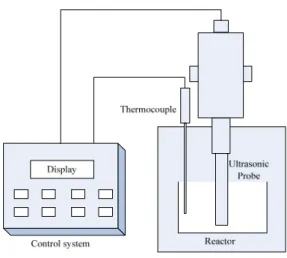
Figure 1. Experimental setup for the ultrasonicator.
ㆍA-oil = SD Pyrolysis NC at 600 ℃ under N
2+ QM Pyrolysis over Ni/HZSM5 at 600 ℃ under CH
4In-situ
ㆍB-oil = SD Pyrolysis over HZSM-5 at 600 ℃ under N
2+ QM Pyrolysis over HZSM-5 (550 ℃) at 650 ℃ under CH
4Ex-situ
ㆍC-oil = SD Pyrolysis over HZSM-5 at 600 ℃ under N
2+ QM Pyrolysis over Ni/HZSM-5 (500 ℃) at 600 ℃ under CH
4Ex-situ
ㆍD-oil = SD Pyrolysis NC at 600 ℃ under N
2+ QM Pyrolysis NC at 650 ℃ under CH
4A combination of Span 80 and Atlox 4916 with HLB 5.8 was tested to obtain a stable emulsion with the above-mentioned mixtures of bio-oils.
2.2. Emulsions preparation
The experimental setup consists of an ultrasonic probe with a ther- mocouple attached in a soundproof box. The ultrasonic probe consists of a 6 mm horn. Parameters, such as the ultrasonic power and time for an ultrasonic wave, can be adjusted using a digital control system, as shown in Figure 1.
The experiments were performed in a neck flask reactor with an ul- trasonic probe and thermocouple. The HLB of 5.8 (Span 80 and Atlox 4916) was chosen based on previous studies for obtaining a stable emulsion[18]. A preset amount of a mixture of bio-oils (10%) was added to the blend and brought under the ultrasonic probe at 40%
power. The ultrasonic pulse was controlled, so a pulse was generated (ultrasonic time) for 3 s and then off (gap time) for 1 s and on again for 3 s. The process was continued for 10 min. Finally, the blend was inserted into a 100 mL cylinder to observe the extent of stratification (phase separation) every 10 min. The stability of the emulsion was also tested periodically by FTIR spectroscopy to ensure stability.
3. Results and Discussions
Gas chromatography/mass spectrometry (GCMS) analysis of the bio-oils (Figure 2) produced under N
2revealed phenols as the major
(a) (b)
Figure 2. GCMS Analysis and phase separated emulsions (a) HLB 5.8 A-oil: 10% SA: 3% D: 87% (b) HLB 5.8 D-oil: 10% SA: 3% D:
87%.
compound. In contrast, the oils produced under CH
4revealed benzene, toluene, ethylbenzene, and xylene (BTEX) and phenols as the major compounds, especially for the catalytic cases, HZSM5 and Ni-HZSM-5.
The increase in the BTEX content under CH
4environment pyrolysis is attributed to the increase in the H/C atomic ratio of feedstock due to enhanced catalytic and thermal cracking of CH
4into H
2. BTEX im- proves the quality of oil; hence, the stability of the bio-oil mixture pro- duced under N
2and CH
4was tested in diesel.
Figure 3 shows the physical stability and FTIR spectra for the emul- sions prepared through B-oil and C-oil. The HLB value of 5.8 for sev- eral mixtures of bio-oils (A-oil, B-oil, C-oil, and D-oil) was tested to check their stability in diesel. The emulsifier amount was kept minimal (3%) to maintain the optimal viscosity of the emulsion. The emulsions for A-oil and D-oil showed stratification (phase separation) within one day, as shown in Figure 2. In contrast, stable emulsions were observed when Span 80 and Atlox 4916 for HLB 5.8 [bio-oil (B and D) : sur- factant : diesel = 10% : 3% : 87%] were employed. The emulsions prepared through B-oil and C-oil showed stability for more than 15 days, observed by both physical state of emulsions and through FTIR spectroscopy. The peaks in the range of 1352~1448 cm
-1were due to vibration of asymmetric, symmetric or scissoring bending of C-H.
While the peak at 1744 cm
-1reveals the stretching of carbonyl group.
Moreover, the peaks in the range of 2845~2961 cm
-1reveals the stretch-
ing of aliphatic C-H[18]. The FTIR peaks showed no change in in-
359 Emulsification of the Mixture of Catalytic Pyrolysis Oil Obtained under Methane and Nitrogen Environment in Diesel Using Span 80 and Atlox 4916 as Surfactants
Appl. Chem. Eng., Vol. 32, No. 3, 2021
tensity for 15 days, confirming the stability of the prepared emulsions.
The presence of BTEX-containing oil (catalytic CH
4pyrolysis) in the mixture enhanced the quality of the oil, thereby producing a stable emulsion with a higher heating value.
The heating values of the emulsion prepared using B-oil and C-oil were 45.26 MJ/kg and 45.02 MJ/kg, which are comparable to commer- cial diesel, 45.65 MJ/kg. Therefore, the prepared emulsion can be a po- tential candidate for use as a fuel in diesel engines.
4. Conclusions
Emulsions were prepared using a combination of bio-oils in N
2and CH
4environments for both non-catalytic and catalytic cases. The emul- sions for the catalytic oils (B-oil and C-oil) were stable for 15 days.
The addition of pyrolysis-derived oil under CH
4provided an emulsion with a comparable heating value to diesel, highlighting its potential for commercial use in diesel engines.
Acknowledgments
This work was supported by the New and Renewable Energy Core Technology Program of the Korea Institute of Energy Technology Eva-
luation and Planning (KETEP), granted financial resource from the Ministry of Trade, Industry & Energy, Republic of Korea (No. 2017- 3010092430).
References
1. A. Abdullah, A. Ahmed, P. Akhter, A. Razzaq, M. Zafar, M.
Hussain, N. Shahzad, K. Majeed, S. Khurrum, M. S. A. Bakar, and Y.-K. Park, Bioenergy potential and thermochemical character- ization of lignocellulosic biomass residues available in Pakistan, Korean J. Chem. Eng., 37, 1899-1906 (2020).
2. G. Özsin, M. Kılıç, E. Apaydin-Varol, A. E. Pütün, and E. Pütün, A thermo-kinetic study on co-pyrolysis of oil shale and poly- ethylene terephthalate using TGA/FT-IR, Korean J. Chem. Eng., 37, 1888-1898 (2020).
3. Y. Liu, Y. Wu, M. Su, W. Liu, X. Li, and F. Liu, Developing Brønsted-Lewis acids bifunctionalized ionic liquids based hetero- polyacid hybrid as high-efficient solid acids in esterification and biomass conversion, J. Ind. Eng. Chem., 92, 200-209 (2020).
4. S.-K. Choi, Y.-S. Choi, Y.-W. Jeong, S.-Y. Han, and Q. V. Nguyen, Combustion characteristics of fuel blends of coffee waste-derived oil and polystyrene foam waste-derived oil in a pilot-scale burner, J. Korea Soc. Waste Manag., 37, 574-582 (2020).
5. L. Zhu and Z. Zhong, Effects of cellulose, hemicellulose and lig- 3 days 5 days 10 days 15 days
Wavenumber (cm-1)0 1000 2000 3000 4000 5000
Transmittance
-20 0 20 40 60 80 100 120 140 160
After 3 days After 5 days After 10 days After 15 days
13531448 1744 2834 2951
(a)
3 days 5 days 10 days 15 days
Wavenumber (cm-1)0 1000 2000 3000 4000 5000
Transmittance
0 20 40 60 80 100 120 140 160
After 3 days After 5 days After 10 days After 15 days
1384 1448 1734 2845 2961
(b)
Figure 3. (a) HLB 5.8 B-oil: 10% SA: 2% D: 88% (b) HLB 5.8 C-oil: 10% SA: 2% D: 88%.
360 Abid Farooq⋅Young-Kwon Park
공업화학, 제 32 권 제 3 호, 2021