• 검색 결과가 없습니다.

염산 수용액 거동에 대한 가변 외부 자기장의 적용과 영향: 실험 연구 및 Taguchi 법을 이용한 모델링

N/A
N/A
Protected

Academic year: 2021

Share "염산 수용액 거동에 대한 가변 외부 자기장의 적용과 영향: 실험 연구 및 Taguchi 법을 이용한 모델링"

Copied!
10
0
0

로드 중.... (전체 텍스트 보기)

전체 글

(1)

Article https://doi.org/10.14478/ace.2017.1119

1)

1. Introduction

Experiments demonstrate that water can be magnetized when ex- posed to a magnetic field. This technique consists of exposing water

† Corresponding Author: Amirkabir University of Technology, Department of Petroleum Engineering, Tehran, Iran Tel: +98-21-64545128 e-mail: [email protected]

pISSN: 1225-0112 eISSN: 2288-4505 @ 2018 The Korean Society of Industrial and Engineering Chemistry. All rights reserved.

to a magnetic field[1,2]. Magnetized water has extensive utilizations in industry[3], agriculture[4], and medicine[5]. The changes in the struc- ture and properties of materials when exposed to a magnetic field are also important in various applications[6,7]. The physical properties of water will be changed after it is magnetized[8].

In addition to pure water, the experimental study showed that the magnetic field increases the heat conductivity and decreases viscosity of ammonia-water[9]. Magnetic nanofluids also have great potential for heat transfer enhancement and are highly suitable for usage in practical

염산 수용액 거동에 대한 가변 외부 자기장의 적용과 영향 : 실험 연구 및 Taguchi 법을 이용한 모델링

하셰미자데 아바스⋅아메리 모하마드
⋅아미샤히디 바바크⋅골리자데 모스타파*

이란 아미카비르 공과대학 석유공학과, *이란 마시하드 페르도우시 대학 화학과 (2017년 12월 1일 접수, 2017년 12월 20일 심사, 2018년 1월 22일 채택)

Influence and Application of an External Variable Magnetic Field on the Aqueous HCl Solution Behavior: Experimental Study and Modelling Using the Taguchi Method

Abbas Hashemizadeh, Mohammad Javad Ameri , Babak Aminshahidy, and Mostafa Gholizadeh

*

Department of Petroleum Engineering, Amirkabir University of Technology, Tehran, Iran

*Department of Chemistry, Faculty of Science, Ferdowsi University of Mashhad, Mashhad, Iran (Received December 1, 2017; Revised December 20, 2017; Accepted January 22, 2018)

초 록

염산 5, 10, 15 wt% 용액(1.5, 3.0, 4.5 M; 석유정 산성화에 사용되는 범위)에 대하여 여러 가지 조건에서 자기장이 미치 는 영향을 연구하였다. 자화된 염산의 pH 변화를 정상적인 염산과 비교하였다. Taguchi 실험 설계법을 사용하여 자장

강도, 농도, 유속, 온도 및 시간의 영향을 모델링하였다. 실험 결과 자화에 따라 염산의 H + 농도가 42%까지 감소하였

다. 자장 강도(기여도 28%), 염산의 농도(기여도 42%), 유속이 커지면 자기장 적용의 효과가 증가하였다. 염산에 대한 자기장의 영향은 용액의 유속과 가열에 의하여 영향받지 않았으며 시간에 따른 자기장 메모리가 유지되는 것으로 나타났다. 최대 H + 농도 변화에 대한 최적의 조합은 10% 염산 용액 및 4,300 Gauss일 때로 얻어졌다. 자화 과정 중 염산의 반응 속도가 감소하므로 자화된 염산은 탄화수소(원유 및 천연가스)정의 매질 산성화에 대한 대체 지연제로 비용면에서 경제적이고 신뢰성 있는 방법이 될 것으로 제안한다.

Abstract

Influences of the magnetic field on 5, 10 and 15 wt% (1.5, 3 and 4.5 M) HCl solution behaviour, which has widespread applications in petroleum well acidizing, were investigated in various conditions. Differences in the pH of magnetized hydro- chloric acid compared to that of normal hydrochloric acid were measured. Taguchi design of experimental (DoE) method were used to model effects of the magnetic field intensity, concentration, velocity and temperature of acid in addition to the elapsed time. The experimental results showed that the magnetic field decreases [H + ] concentration of hydrochloric acid up to 42%

after magnetization. Increasing the magnetic field intensity (with 28% contribution), concentration (with 42% contribution), and velocity of acid increases the effect of magnetic treatment. The results also demonstrated that the acid magnetization was- not influenced by the fluid velocity and heating. It was also displayed that the acid preserves its magnetic memory during time. The optimum combination of factors with respect to the highest change of [H + ] concentration was obtained as an acid concentration of 10% and an applied magnetic field of 4,300 Gauss. Due to the reduction of HCl reaction rate under the magnetization process, it can be proposed that the magnetized HCl is a cost effective and reliable alternative retarder in the matrix acidizing of hydrocarbon (crude oil and natural gas) wells.

Keywords: magnetic field, hydrochloric acid, pH, reaction rate, design of experiments, taguchi method

(2)

216

heat transfer processes[10]. Apart from the mentioned experimental studies, some simulation and modeling investigations have also been performed on the effect of magnetic fields on fluid behavior[11].

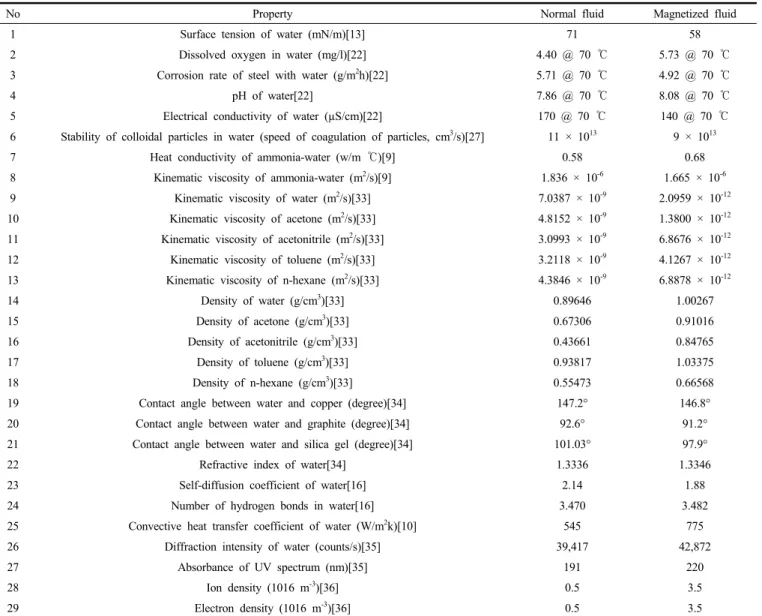
Furthermore, research studies on the effect of magnetic fields on differ- ent properties of fluids are summarized in Table 1.

As mentioned, numerous papers exist on the effect of imposed MF on various solutions. However, no papers are found concerning mag- netization of fluid through the magnetizer system. To the best of the author’s investigations, all of the previous researches deal with an ex- ternal MF that is applied on the reaction cell. But in this paper, the acid magnetizer system has been designed for the first time and the magnetization of acid is done before measuring properties that is more applicable in industry. No studies have delved into the effects of mag- netization of HCl solution behavior. HCl has been used widespread as the main stimulation fluid in the petroleum industry[12].

This study deals with the influence of external variable magnetic fields on the reaction rate of HCl using pH measurement, which has

widespread usage in petroleum well acidizing. The magnetization effect depends on conditions of magnetization. It is expected that the effect of magnetization on acid is influenced by magnetic field intensity, ve- locity and concentration of acid. The mentioned variables as well as acid temperature and elapsed time after magnetization are verified for the first time. Experiments were done using the design of experiments technique by means of the Taguchi method. Due to the successful per- formance of magnetization on delaying efficiency, it can be proposed that magnetized HCl is a cost effective and eco-friendly alternative for regular retarder additives.

2. Experimental

2.1. Fluid Magnetizer Setup

Magnetic devices can be based on electromagnets (solenoids and yoke-based electromagnets) or permanent magnets. Although electro- magnets can produce magnetic fields of great intensity, their use is not

No Property Normal fluid Magnetized fluid

1 Surface tension of water (mN/m)[13] 71 58

2 Dissolved oxygen in water (mg/l)[22] 4.40 @ 70 ℃ 5.73 @ 70 ℃

3 Corrosion rate of steel with water (g/m 2 h)[22] 5.71 @ 70 ℃ 4.92 @ 70 ℃

4 pH of water[22] 7.86 @ 70 ℃ 8.08 @ 70 ℃

5 Electrical conductivity of water (µS/cm)[22] 170 @ 70 ℃ 140 @ 70 ℃

6 Stability of colloidal particles in water (speed of coagulation of particles, cm 3 /s)[27] 11 × 10 13 9 × 10 13

7 Heat conductivity of ammonia-water (w/m ℃)[9] 0.58 0.68

8 Kinematic viscosity of ammonia-water (m 2 /s)[9] 1.836 × 10 -6 1.665 × 10 -6

9 Kinematic viscosity of water (m 2 /s)[33] 7.0387 × 10 -9 2.0959 × 10 -12

10 Kinematic viscosity of acetone (m 2 /s)[33] 4.8152 × 10 -9 1.3800 × 10 -12 11 Kinematic viscosity of acetonitrile (m 2 /s)[33] 3.0993 × 10 -9 6.8676 × 10 -12 12 Kinematic viscosity of toluene (m 2 /s)[33] 3.2118 × 10 -9 4.1267 × 10 -12 13 Kinematic viscosity of n-hexane (m 2 /s)[33] 4.3846 × 10 -9 6.8878 × 10 -12

14 Density of water (g/cm 3 )[33] 0.89646 1.00267

15 Density of acetone (g/cm 3 )[33] 0.67306 0.91016

16 Density of acetonitrile (g/cm 3 )[33] 0.43661 0.84765

17 Density of toluene (g/cm 3 )[33] 0.93817 1.03375

18 Density of n-hexane (g/cm 3 )[33] 0.55473 0.66568

19 Contact angle between water and copper (degree)[34] 147.2° 146.8°

20 Contact angle between water and graphite (degree)[34] 92.6° 91.2°

21 Contact angle between water and silica gel (degree)[34] 101.03° 97.9°

22 Refractive index of water[34] 1.3336 1.3346

23 Self-diffusion coefficient of water[16] 2.14 1.88

24 Number of hydrogen bonds in water[16] 3.470 3.482

25 Convective heat transfer coefficient of water (W/m 2 k)[10] 545 775

26 Diffraction intensity of water (counts/s)[35] 39,417 42,872

27 Absorbance of UV spectrum (nm)[35] 191 220

28 Ion density (1016 m -3 )[36] 0.5 3.5

29 Electron density (1016 m -3 )[36] 0.5 3.5

Table 1. Effects of Magnetic Field on Properties of Some Fluids

(3)

practical because they need an electrical power supply, cooling, and al- so periodic servicing. The permanent magnetic material available today (alnico, ferrite, and rare earth alloys) produces sufficiently intense fields and does not require a power supply or servicing. There are sev- eral types of magnetic systems that can be used for producing mag- netic fluids. The magnetic field can be either parallel or perpendicular to the flow direction (Figure 1a, b). The magnetic systems with closed magnetic circuits (Figure 1c) allow increasing the value of the mag- netic field in the working zone compared to magnetic systems based on the same magnets, but with open magnetic circuits. Closed mag- netic circuits reduce the stray field around the magnetic systems, which minimizes interference with other equipment[13].

In this study, the effect of the permanent magnetic field on solutions of HCl (5, 10 and 15 weight percent in water) is determined. The de- sign of the magnetic system is perpendicular to the flow direction with open magnetic circuit. The magnetic field values were measured using the ‘TM-701’ tesla meter (Kanetec Co., Chiyoda-ku Tokyo, Japan).

The experiments were conducted using a circulation system as shown in Figure 2. The circulation system was composed of an anti-corrosion pump, a magnetic system with variable magnetic fields, an inverter to change fluid velocity through the magnetic field and a flow-meter.

Plastic fittings were used to connect the pump to the magnetic circuit, which in turn was connected to the flow-meter.

The main conditions that determine the fluid behavior under mag- netic field are magnetic field intensity, flow rate of the fluid, and con

centration of acid. It is also important to check if the magnetized acid solution maintains its magnetic style under heating and time.

Consequently, after magnetization of acid by means of an electric heat- ing element, its temperature increased. Thus, in addition to the cited factors, effects of increasing acid temperature and elapsed time after magnetization are two crucial factors that should be inspected in the experiments.

2.2. Design of Experiments

Concerning the effective parameters, five factors have been selected for this experiment, which are magnetic field intensity, HCl concen- tration, flow rate, temperature, and elapsed time at three different lev- els (Table 2).

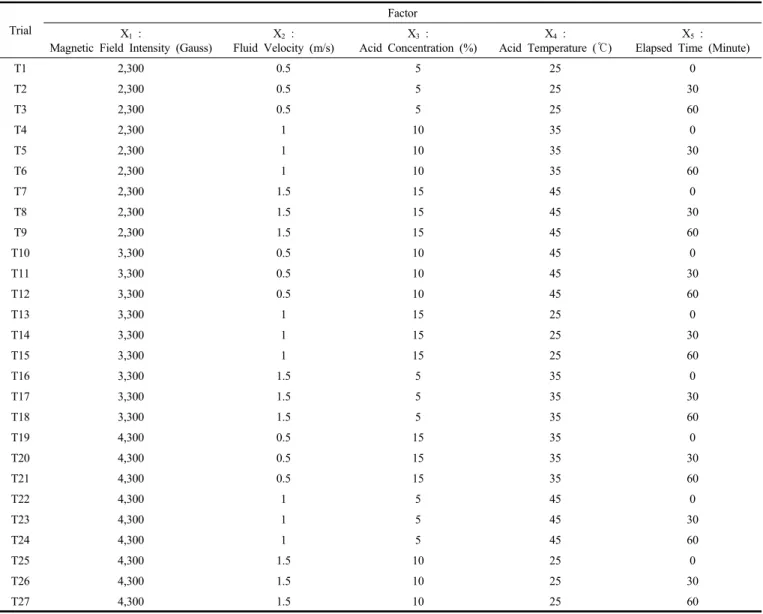
The full factorial experiment of 243 (3 5 ) trials can be completed in just 27 runs due to the slope collector, but that entails a large number of tests, which are significant in both experimental cost and time. As a result, Taguchi DoE layouts are more applicable when compared to a traditional full-factorial counterpart. This is because it reduced the number of tests to a practical level, thus significantly saving the ex- perimental time and associated costs as opposed to the conduct of all factors individually. The L27DoE orthogonal array was selected result- ing in 27 trials as illustrated in Table 3.

2.3. Operating Conditions

In each test, the appropriate fluid is poured to the circulation system and circulates for 5 minutes with the desired flow rate. After magnet- ization, properties of 100 cc of fluid were measured. It should be noted that the temperature of acid increases after magnetization as a result of circulation. Due to high dependency of pH to temperature, it is nec- (a)

(b)

(c)

Figure 1. Orientation of the magnetic field (a) using a ring magnet in open circuit (b) using two cylindrical magnets in open circuit (c) using four block magnets in closed circuit.

Figure 2. Schematic of Experimental Setup Used for Fluid Magnetization.

Factor Factor Description Levels

1 2 3

X 1 Magnetic field intensity (Gauss) 2,300 3,300 4,300

X 2 Fluid velocity (m/s) 0.5 1 1.5

X 3 Acid concentration (percentage) 5 10 15

X 4 Acid temperature (℃) 25 35 45

X 5 Elapsed time (min) 0 30 60

Table 2. Five Factors and Three Levels Selected in the DoE Study of

Magnetic HCl

(4)

218

essary to reveal the relation between pH and temperature for each acid concentration. As a result, it can be distinguished between pH variation caused by magnetization and by temperature change. Due to the high sensitivity of pH to temperature, the temperatures are measured by means of the Samwon SU-105 IP model temperature controller with

± 0.01 ℃ accuracy. For the experiments that were done at 35 and 45 ℃, a heater was used to raise the temperature.

Experiments were conducted at 25 ℃ (room temperature), 35 and 45

℃ and at atmospheric pressure. The linear velocity of the solutions for these experiments differs from the invertor, which varies the RPM of the electro-pump. The magnetic field varies by moving the magnetic poles away from each other. By increasing the distance between mag- nets, the magnetic intensity will decrease. Acid concentrations are 5, 10 and 15% in which titration was measured using 0.1 normal NaOH titrazol. The parameters where measured during different times after magnetization to check the memory of fluid to maintain the magnetic effect. These periods include 0, 30 and 60 minutes after magnetization

(see Table 2).

2.4. Measurement and Calculations

The pH of the solution before and after the magnetic treatment was measured using the “827 pH Lab” pH-meter manufactured by Metrohm, Inc. (Switzerland). The temperature dependency of the pH of non-magnetized (normal) HCl was measured and expressed in equa- tions 5-7. By using these formulas, the temperature effect on pH was extracted and the magnetization effect on pH was calculated purely as the calculations shown in Table 4. Finally, alterations of reaction rates of hydrochloric acid due to magnetization were measured by calculat- ing the variation of [H + ].

3. Results and Discussion

Microscopically, the reaction kinetics of HCl can be described in three steps including (1) the transport of [H + ] ions from the bulk sol- Trial

Factor X 1 :

Magnetic Field Intensity (Gauss)

X 2 : Fluid Velocity (m/s)

X 3 : Acid Concentration (%)

X 4 : Acid Temperature (℃)

X 5 : Elapsed Time (Minute)

T1 2,300 0.5 5 25 0

T2 2,300 0.5 5 25 30

T3 2,300 0.5 5 25 60

T4 2,300 1 10 35 0

T5 2,300 1 10 35 30

T6 2,300 1 10 35 60

T7 2,300 1.5 15 45 0

T8 2,300 1.5 15 45 30

T9 2,300 1.5 15 45 60

T10 3,300 0.5 10 45 0

T11 3,300 0.5 10 45 30

T12 3,300 0.5 10 45 60

T13 3,300 1 15 25 0

T14 3,300 1 15 25 30

T15 3,300 1 15 25 60

T16 3,300 1.5 5 35 0

T17 3,300 1.5 5 35 30

T18 3,300 1.5 5 35 60

T19 4,300 0.5 15 35 0

T20 4,300 0.5 15 35 30

T21 4,300 0.5 15 35 60

T22 4,300 1 5 45 0

T23 4,300 1 5 45 30

T24 4,300 1 5 45 60

T25 4,300 1.5 10 25 0

T26 4,300 1.5 10 25 30

T27 4,300 1.5 10 25 60

Table 3. Taguchi Orthogonal Array with 27 Trials (L27)

(5)

ution to the surface of reactant, (2) the reaction of [H + ] /reactant takes place on the surface, (3) the transport of the reaction products from the reactant surface to the bulk solution[14]. Therefore, [H + ] concentration can introduce a scale of HCl reaction rate. The measured pH and cal- culated [H + ] ion concentrations are shown in Table 4. The change in reaction rate of HCl is computed based on changes in [H + ] concentration.

Reaction reduction of magnetized HCl (as indicated in Table 4 and Figures 3-5) is a result of changes in the molecular arrangement due to magnetization[15]. Many researchers investigated the effects of the magnetic field on the hydrogen-bonded structure and found that the number of hydrogen bonds increased. They showed that an external magnetic field improves hydrogen bonds[16].

The enhancement in the hydrogen-bonded strength under the mag- netic field of 10 Tesla in the hydrogen-bonded molecules is also sug- gested[17]. Increasing the number and strength of hydrogen bonds re- duces the activity of the molecules and may cause a discount in the reaction rate of HCl.

Further investigations on the effect of magnetic fields on electro- chemical reactions showed that these effects became stronger as the conductivity of the water was increased by ionic solutes[18]. Thus, it can be concluded that this would tend to reduce any concentrations of ions or anomalous pH values and could thus minimize localized re- action effects[19]. Studies on corrosion potential values also indicate that the reaction is said to be anodically controlled[20]. Accordingly, reaction reduction of magnetized HCl (as indicated in Table 4 and Figures 3-5) can also be explained on the basis of Cl - ion activity and the extent of its contribution in the acceleration of dissolution[21]. The results of this paper are in agreement with studies on reaction rate and pH of water[22] and corrosion rate[23] reduction due to magnetization.

3.1. Temperature Effect

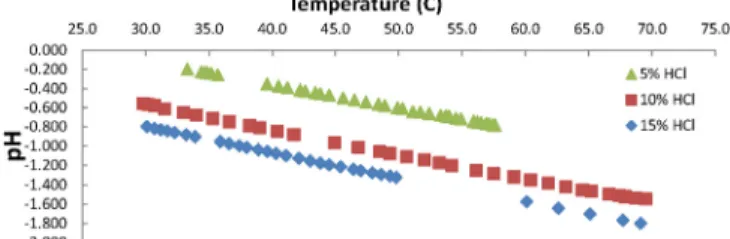
In order to eliminate the temperature effect from the magnetization effect, the temperature dependence of pH for 5, 10% and 15% HCl was measured, as shown in Figure 3 and is presented in equations 1-3, respectively. Finally, all pH values were normalized at 25 C in order Trail Combination of Factors pH of Normal

Acid @ 25 C

[H + ] of Normal Acid @ 25 C

pH of Magnetized Acid @ 25 C

[H + ] of Magnetized Acid @ 25 C

Change in [H + ] Concentration (%) S/N

T1 X 11 X 21 X 31 X 41 X 51 0.016 0.964 0.062 0.868 -10 20

T2 X 11 X 21 X 31 X 41 X 52 0.016 0.964 0.038 0.916 -5 13.9794

T3 X 11 X 21 X 31 X 41 X 53 0.016 0.964 0.038 0.916 -5 13.9794

T4 X 11 X 22 X 32 X 42 X 51 -0.417 2.612 -0.262 1.828 -30 29.5424

T5 X 11 X 22 X 32 X 42 X 52 -0.417 2.612 -0.309 2.037 -22 26.8485

T6 X 11 X 22 X 32 X 42 X 53 -0.417 2.612 -0.309 2.037 -22 26.8485

T7 X 11 X 23 X 33 X 43 X 51 -0.654 4.508 -0.552 3.561 -21 26.4444

T8 X 11 X 23 X 33 X 43 X 52 -0.654 4.508 -0.598 3.967 -12 21.5836

T9 X 11 X 23 X 33 X 43 X 53 -0.654 4.508 -0.608 4.057 -10 20

T10 X 12 X 21 X 32 X 43 X 51 -0.417 2.612 -0.256 1.802 -31 29.8272

T11 X 12 X 21 X 32 X 43 X 52 -0.417 2.612 -0.331 2.142 -18 25.1055

T12 X 12 X 21 X 32 X 43 X 53 -0.417 2.612 -0.346 2.220 -15 23.5218

T13 X 12 X 22 X 33 X 41 X 51 -0.654 4.508 -0.608 4.057 -10 20

T14 X 12 X 22 X 33 X 41 X 52 -0.654 4.508 -0.618 4.147 -8 18.0618

T15 X 12 X 22 X 33 X 41 X 53 -0.654 4.508 -0.618 4.147 -8 18.0618

T16 X 12 X 23 X 31 X 42 X 51 0.016 0.964 0.0382 0.916 -5 13.9794

T17 X 12 X 23 X 31 X 42 X 52 0.016 0.964 0.0031 0.993 3 9.54243

T18 X 12 X 23 X 31 X 42 X 53 0.016 0.964 -0.001 1.003 4 12.0412

T19 X 13 X 21 X 33 X 42 X 51 -0.654 4.508 -0.499 3.156 -30 29.5424

T20 X 13 X 21 X 33 X 42 X 52 -0.654 4.508 -0.598 3.967 -12 21.5836

T21 X 13 X 21 X 33 X 42 X 53 -0.654 4.508 -0.608 4.057 -10 20

T22 X 13 X 22 X 31 X 43 X 51 0.016 0.964 0.141 0.723 -25 27.9588

T23 X 13 X 22 X 31 X 43 X 52 0.016 0.964 0.118 0.762 -21 26.4444

T24 X 13 X 22 X 31 X 43 X 53 0.016 0.964 0.113 0.771 -20 26.0206

T25 X 13 X 23 X 32 X 41 X 51 -0.417 2.612 -0.180 1.515 -42 32.465

T26 X 13 X 23 X 32 X 41 X 52 -0.417 2.612 -0.274 1.881 -28 28.9432

T27 X 13 X 23 X 32 X 41 X 53 -0.417 2.612 -0.286 1.932 -26 28.2995

Table 4. Changes in [H + ] Concentration of HCl (Reaction Rate) due to Magnetization

(6)

220

to carry out exact comparison between pH values (Table 4).

pH (HCl 5%) =

4E-05 T 2 - 0.0278 T + 0.6856, (R² = 0.9998) (1)

pH (HCl 10%) =

7E-05 T 2 - 0.0324 T + 0.3427, (R² = 0.9998) (2)

pH (HCl 15%) =

6E-05 T 2 - 0.0314 T + 0.0933, (R² = 0.9999) (3)

The results are in agreement with the literature[24] in which the pH of the solutions decrease by increasing temperature in acidic solutions.

3.2. Analysis of Variance (ANOVA)

The order of experiments was randomized to lower the uncontrolled effect of factors. A quadratic polynomial equation was developed to predict the responses as a role of independent variables involving their quadratic interactions and squared terms. The basis of forming a poly- nomial equation is given in Eq. (4):

     

  

     

  

      

  

       

    

        (4)

Multiple regression analysis techniques comprised in the Taguchi were used to estimate the models’ coefficients. The resultant sec- ond-order models for the changes on [H + ] are shown in Eq. (5):

    

 

 

 

 

  × 

 





  × 

 

  × 

 

  × 

(5)

The analysis of variance (ANOVA) is a statistical method in which the main objective is to extract from the results how much variation each factor causes relative to the total variation observed in the results.

Basically, it computes a parameter called the sum of squares (SSQ), degree of freedom (DF), variance (V), F-value and percentage of con- tribution for each factor[25]. The F value is a ratio of the mean square due to regression to the mean square due to error. If the calculated val- ue of F is greater than the value in the F table at a specified proba- bility level (e.g., F 0.05 (10,16) = 2.49), a statistically significant factor or interaction is obtained. From ANOVA results depicted in Table 5, the value of F for magnetic field, fluid velocity, acid concentration, temperature and elapsed time are 41.77, 3.01, 63.22, 6.36 and 26.14, respectively. These F values are higher than the F table, which is 2.49.

The F values of the factors support that the factors are highly significant. P-values are associated with F values as they are useful to display whether F values are large enough to show the statistical significance. The P-values fewer than 0.05 show the factor is sig- nificant at the 95% confidence limit. Therefore, factor B (flow rate) can be pooled from the calculations for more precise interpretation.

Calculations of mean square of the model and error are:

    

  

  

(6) Figure 3. Effecf of magnetic field (2,300 Gauss) on pH of HCl

solutions.

Figure 4. Effecf of magnetic field (3,300 Gauss) on pH of HCl solutions.

Figure 5. Effecf of magnetic field (4,300 Gauss) on pH of HCl solutions.

Figure 6. The temperature dependence of pH of normal (non-

magnetized) HCl.

(7)

     

   

   

(7)

where MS, SS, and df are the mean squares, sum of squares and de- gree of freedom, respectively. The F value can be calculated by the following expression:

 

   

  

(8)

High values of R 2 for Eq. (4) mean a good fitting for the ex- perimental data and predicted values. Figure 7a explains the observed relative to predicted values. From the figure, most of the points of ex- perimental values lie close to the straight line, which are the predicted values. The linear pattern also shows that no transformation of the re- sponse is required. Figure 7b is a plot of the residuals versus the ex- perimental run order. It checks for lurking variables that may have in- fluenced the response during the experiment. The plot shows a random scatter that provides insurance against trends ruining the analysis.

The ANOVA table also reveals the effect of magnetic field on changes of hydrogen concentration [H + ] of HCl by the percentage con- tributions for selected L27DoE factors using Eq. 9:

(9)

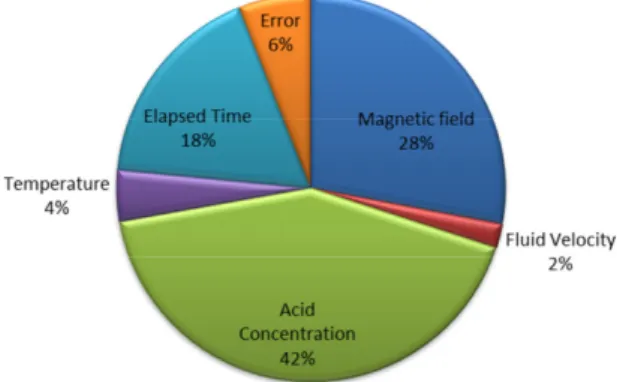
As illustrated in Figure 8, the acid concentration (factor X 3 ) was a significant variable to control the pH with a contribution percentage of about 42.58%. The second and third most prevalent factors in minimiz- ing [H + ] were the magnetic field intensity (factor X 1 ) and the elapsed time (factor X 5 ) with the contributions percentages of about 28.13%

and 17.60%, accordingly. The temperature (factor X 4 ) appeared to be insignificant at less than only 4.28%. It is implied that the fluid veloc- ity (factor X 2 ) has a trivial impact on the change of [H + ], which can be maintained at the workable experimental range. This confirms anal- yses obtained from F-value and P-value factors. Error less than 10%

(6.06% error in Figure 8) indicates that the results are reliable.

Mentioned calculations were done by means of Qualitek and Minitab softwares.

3.3. Optimum combination of factors

Taguchi endorses analyzing the variations using a suitable chosen signal-to-noise ratio (S/N) that can be calculated by the formula[25]:

 

    × log 

 

(10)

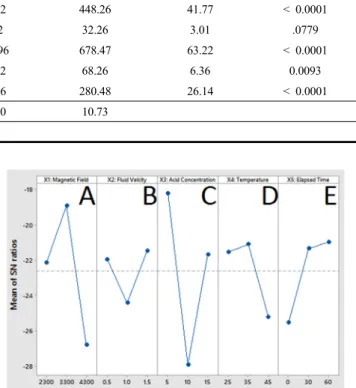
where y i is the characteristic property (reduction in reaction rate) and n is the replication number of the experiment. The S/N ratios are dif- ferent according to the type of characteristics. The S/N ratios for changes in [H + ] concentration of HCl were calculated for the 27 Taguchi DoE study in Table 4. The “bigger the better” response is considered with the aim to maximize reduction of reaction rate (%).

The average S/N ratio calculated to determine the best level factor for the optimum contribution level of factor X 2 , 10 wt% HCl concen- trations (second level of factor X 3 ), temperature of 45 degrees centi- grade (third level of factor X 4 ) and elapsed time of 0 minute after magnetization (first level of factor X 5 ), is the optimum combination of factors to obtain maximum reduction in HCl reaction rate due to mag- netization (X 13 X 22 X 32 X 43 X 51 ). It is further proven that the HCl concen- Figure 7. (a) Normal plot of residuals, (b) Residuals of each run.

Figure 8. Contributions of factors in magnetization of the HCl

solutions.

(8)

222

tration and magnetic field intensity are the two most significant factors;

whereas the flow rate and the heating temperature after magnetization appear to be relatively insignificant.

3.4. Effect of magnetic field intensity on magnetization of acid As presented in Figure 5, by increasing magnetic field intensity, the [H + ] concentration of HCl and therefore its reaction rate due to mag- netization decreases. This observation is a result of Lorentz force (Eq.

1) in which by increasing the magnetic field intensity, the imposed force on moving particles of charge q will increase[26-28]. In Figure 6a, the minimum value of reaction rate at different magnetic fields ob- served at the highest level (level 3) confirms this outcome.

3.5. Effect of flow rate on magnetization of acid

Figure 9 shows that by increasing the velocity of flowing fluid in the magnetic field from level 1 to level 2, the effect of magnetic field increases. Concerning the Lorentz force (see Eq. 1), by increasing the velocity of the particle of charge q in the magnetic field, its imposed force will increase[26-28]. However, the effect of magnetic field de- creased by continuing the increment of velocity from level 2 to level 3. This trend was also seen in Figure 10b. It can be due to the fact that by moving the particle very fast, the magnetic field does not have sufficient time to have force on it. Thus, increasing the particle veloc- ity will cause an increase in the Lorentz force up to a specific amount.

3.6. Effect of acid concentration on magnetization of acid The effect of acid concentration has been shown in Figure 9. As a result of the Lorentz force, to the extent that the concentration of acid increases from 5% to 10%, the amount of charged particles in the

magnetic field increases and therefore the amount of force imposed by the magnetic field of fluid increases[26-28]. By increasing the acid concentration from 10% to 15% (v/v%), the density of charged par- ticles in unit volume increases so that the magnetic field effect en- forced on each particle decreases. Consequently, as Figure 10c in- dicates, the maximum effect of the magnetic field can be observed on 10% HCl. It can be concluded that for more acid concentrations, the longitude of the magnetic field should be enhanced.

3.7. Effect of acid temperature on magnetization of acid In many practical cases, HCl acid is used in high temperature mediums. So in this study, the temperature of acid increased after magnetization. This work was done to observe whether the effect of magnetization will remain after heating the acid or not. The ex- perimental results illustrated in Figure 9 and Figure 10-D show that heating the fluid does not eliminate the effect of magnetization and so it is possible to use the magnetized acid in hot medium without any problem.

3.8. Effect of elapsed time on magnetization of acid

As mentioned above, the memory of acid to maintain the effect of magnetization is very important in the magnetization of acid and con- sequently in the matrix acidizing process. For this purpose, the pH of the acid is measured at three different times (0, 30 and 60 minutes af- ter magnetization). The results show that the effect of magnetization is stored in acid (Figure 9 and Figure 10-E).

Factor DF SSQ V F-Value P-Value

X 1 Magnetic Field Intensity 2 896.52 448.26 41.77 < 0.0001

X 2 Flow Rate 2 64.52 32.26 3.01 .0779

X 3 Acid Concentration 2 1356.96 678.47 63.22 < 0.0001

X 4 Temperature 2 136.52 68.26 6.36 0.0093

X 5 Elapsed Time 2 560.96 280.48 26.14 < 0.0001

Residual 16 171.70 10.73

Total 26

Table 5. Analyze of Variance (ANOVA) for the Determination of Significant Factors which Influence [H + ] due to HCl Magnetization

Figure 9. Average value of S/N ratios for different variables in HCl solutions magnetization.

Figure 10. Average value of means.

(9)

3.9. Magnetized HCl applications

Due to the wide use of petroleum, many crude oil reservoirs experi- ence the problem of formation damage during time. Formation damage is a generic terminology referring to the impairment of the perme- ability of petroleum-bearing formations by various adverse processes.

Formation damage is an undesirable operational and economic problem that can occur during the various phases of oil and gas recovery from subsurface reservoirs[29]. Depending on the types of formation dam- age, there are several techniques to overcome this problem[12]. Matrix acidizing is a very common practice in carbonate reservoirs to remove the near-wellbore formation damage created by drilling mud and work- over interventions. It aims to improve the access to reserves and in- crease well output in producers[12]. For its availability, high rock dis- solving power and soluble reaction products, HCl has been used as the main stimulation fluid. The reactions of components with HCl acid in matrix acidizing of carbonate reservoirs are as follow[29]:

                 (11)

                          (12)

Rapid spending of the HCl acid with carbonates avoids deeper pene- tration of the acid into the formations. Alternatives such as organic acids, gel acids, micro emulsion acids, self-diverting acids and retarder additives have lent themselves to retarded reaction rates, and low cor- rosivity[30]. However the problem of high reaction rate is still ob- served with organic acids at very high temperatures[31]. Likewise some retarder additives lose their retarding attribute at very high tem- peratures and also make injection difficulties due to increase acid vis- cosity[32]. Due to the successful performance of magnetization on re- duction of the HCl reaction rate as reported in this paper, it can be proposed that magnetized HCl is a cost effective and eco-friendly alter- native for regular retarder additives in matrix acidizing of hydrocarbon (crude oil and natural gas) wells.

4. Conclusion

The behavior of magnetized 5, 10 and 15 wt% (1.5, 3 and 4.5 M) HCl solutions was investigated and modeled by means of the Taguchi method. The following points can be highlighted;

1. An L27 orthogonal array along with S/N ratios, ANOVA and modeling in the Taguchi DoE method was used to investigate magnetic field intensity, flow rate, acid concentration, temperature and elapsed time at three different levels on the pH of HCl concerning the acidiz- ing process.

2. The obtained results indicate that magnetization of 5, 10 and 15 wt% (1.5, 3 and 4.5 M) HCl solutions at different conditions increase pH value, which can be related to decreasing the reaction rate. The de- termined high reduction in [H + ] is attributed to the changing molecular arrangement of acid due to the magnetic field.

3. ANOVA results depicted that the main factors affecting changes in the reaction rate are acid concentration and the magnetic field in-

tensity with about 42.58% and 28.13% of contribution, respectively.

However, the influence of elapsed time is also significant. The effect of temperature (heating acid after magnetization) and flow rate (velocity of charge particles in the magnetic field) are negligible and can be ignored.

4. A decrease in [H + ] was found at about 42% for 10 wt% HCl that was magnetized in a 3,300 Gauss magnetic field. The reduction in- creases with magnetic field intensity, but decreases with elapsed time.

The optimum combination of factors with the highest change of [H + ] concentration was found along with acid concentration of 10% and an applied magnetic field of 4,300 Gauss (X 13 X 22 X 32 X 43 X 51 ).

5. Due to reduction of the HCl reaction rate under the magnetization process, it can be proposed that magnetized HCl is a cost effective and reliable alternative of retarder acids in matrix acidizing of hydrocarbon (crude oil and natural gas) wells.

References

1. L. M. A. Monzon and J. M. D. Coey, Magnetic fields in electro- chemistry: The Lorentz force. A mini-review, Electrochem.

Commun., 42, 38-41 (2014).

2. B. Q. Welder and P. P. Everett, Practical performance of wa- ter-conditioning gadgets, Ind. Eng. Chem., 46, 954-960 (1954).

3. D. A. Bograchev and A. D. Davydov, Optimization of electrolysis in the cylindrical electrochemical cell rotating in the magnetic field, Russ. J. Electrochem., 46, 331-335 (2010).

4. M. Hozayn, A. A. Abdel-Monem, A. Qados, and H. M. A.

El-Hameed, Response of some food crops to irrigation with mag- netized water under greenhouse condition, Aust. J. Basic Appl.

Sci., 5, 29-36 (2011).

5. Y. Takeuchi and M. Iwasaka, Effects of magnetic fields on dis- solution of arthritis causing crystals, J. Appl. Phys., 117, 17D152 (2015).

6. Y. Oh, S. Kang, and D. Choe, Preparation and current-voltage characteristics of well-aligned NPD (4,4’bis[N-(1-napthyl)-N-phe- nyl-amino] biphenyl) thin films, Appl. Chem. Eng., 17, 591-596 (2006).

7. Y. Kang and D. Choe, Formation and Current-voltage Characteristics of molecularly-ordered 4,4’,4”-tris(N-(1-naphthyl)-N-phenylamino)- triphenylamine film, Appl. Chem. Eng., 18, 506-510 (2007).

8. Y. Wang, H. Wei, and Z. Li, Effect of magnetic field on the phys- ical properties of water, Results Phys., 8, 262-267 (2018).

9. X. Niu, K. Du, and F. Xiao, Experimental study on the effect of magnetic field on the heat conductivity and viscosity of ammo- nia-water, Energy Build., 43, 1164-1168 (2011).

10. M. Bahiraei and M. Hangi, Flow and heat transfer characteristics of magnetic nanofluids: A review, J. Magn. Magn. Mater., 374, 125-138 (2015).

11. A. J. Ahrar and M. H. Djavareshkian, Lattice Boltzmann simu- lation of a Cu-water nanofluid filled cavity in order to investigate the influence of volume fraction and magnetic field specifications on flow and heat transfer, J. Mol. Liq., 215, 328-338 (2016).

12. G. B. Holman, State-of-the-Art Well Stimulation, J. Pet. Technol., 34, 239-241 (1982).

13. F. F. Farshad, J. Linsley, O. Kuznetsov, and S. Vargas, The effects

of magnetic treatment on calcium sulfate scale formation. In: SPE

(10)

224

Western Regional/AAPG Pacific Section Joint Meeting May 20-22, Anchorage, Alaska, USA (2002).

14. X. W. Qiu, W. Zhao, S. J. Dyer, A. Al Dossary, S. Khan, and A.

S. Sultan, Revisiting reaction kinetics and wormholing phenomena during carbonate acidising. In: International Petroleum Technology Conference, Jan. 19-22, Doha, Qatar (2014).

15. T. Imamura, Y. Yamada, S. Oi, and H. Honda, Orientation behav- ior of carbonaceous mesophase spherules having a new molecular arrangement in a magnetic field, Carbon N. Y., 16, 481-486 (1978).

16. K.-T. Chang and C.-I. Weng, The effect of an external magnetic field on the structure of liquid water using molecular dynamics simulation, J. Appl. Phys., 100, 43917 (2006).

17. H. Hosoda, H. Mori, N. Sogoshi, A. Nagasawa, and S.

Nakabayashi, Refractive indices of water and aqueous electrolyte solutions under high magnetic fields, J. Phys. Chem. A, 108, 1461-1464 (2004).

18. P. Neufeld, Effect of magnetic fields on electrochemical reactions, Corros. Sci., 36, 1947-1948 (1994).

19. Z. Lu and W. Yang, In situ monitoring the effects of a magnetic field on the open-circuit corrosion states of iron in acidic and neu- tral solutions, Corros. Sci., 50, 510-522 (2008).

20. E. A. Noor and A. H. Al-Moubaraki, Corrosion behavior of mild steel in hydrochloric acid solutions, Int. J. Electrochem. Sci., 3, 806-818 (2008).

21. R. J. Chin and K. Nobe, Electrodissolution kinetics of iron in chloride solutions III. Acidic solutions, J. Electrochem. Soc., 119, 1457-1461 (1972).

22. G. Bikul’chyus, A. Ruchinskene, and V. Deninis, Corrosion behav- ior of low-carbon steel in tap water treated with permanent mag- netic field, Prot. Met., 39, 443-447 (2003).

23. R. Sueptitz, K. Tschulik, M. Uhlemann, J. Eckert, and A. Gebert, Retarding the corrosion of iron by inhomogeneous magnetic fields, Mater. Corros., 65, 803-808 (2014).

24. J. J. Barron, C. Ashton, and L. Geary, The effects of temperature on pH measurement, Tech. Serv. Dep., Reagecon Diagnostics Ltd,

Ireland (2005).

25. R. K. Roy, Design of Experiments Using the Taguchi Approach:

16 Steps to Product and Process Improvement, John Wiley & Sons (2001).

26. J. S. Baker and S. J. Judd, Magnetic amelioration of scale for- mation, Water Res., 30, 247-260 (1996).

27. K. Higashitani, A. Kage, S. Katamura, K. Imai, and S. Hatade, Effects of a magnetic field on the formation of CaCO 3 particles, J. Colloid Interface Sci., 156, 90-95 (1993).

28. H. Inaba, T. Saitou, K. Tozaki, and H. Hayashi, Effect of the mag- netic field on the melting transition of H 2 O and D 2 O measured by a high resolution and supersensitive differential scanning calo- rimeter, J. Appl. Phys., 96, 6127-6132 (2004).

29. F. Civan, Reservoir Formatin Damage: Fundamentals, Moddelig, Assessment and Mitigation, Elsevier (2007).

30. A. K. Deysarkar, J. C. Dawson, L. P. Sedillo, and S. K. Davis, Crosslinked acid gel, J. Can. Pet. Technol., 23, 26-32 (1984).

31. O. O. Adenuga, H. A. Nasr-El-Din, and M. A. I. Sayed, Reactions of simple organic acids and chelating agents with dolomite. In:

SPE Production and Operations Symposium, March 23-26, Oklahoma City, USA (2013).

32. Q. Ji, L. Zhou and H. Nasr-El-Din, Acidizing sandstone reservoirs with aluminum-based retarded mud acid, SPE J., 21, 1-50 (2016).

33. F. Moosavi and M. Gholizadeh, Magnetic effects on the solvent properties investigated by molecular dynamics simulation, J. Magn.

Magn. Mater., 354, 239-247 (2014).

34. X.-F. Pang and B. Deng, The changes of macroscopic features and microscopic structures of water under influence of magnetic field, Physica B, 403, 3571-3577 (2008).

35. B. Deng and X. Pang, Variations of optic properties of water un- der action of static magnetic field, Chin. Sci. Bull., 52, 3179-3182 (2007).

36. H.-J. Kim, D.-C. Kwon, and N.-S. Yoon, A one-dimensional fluid

simulation of a magnetized DC discharge including the non-uni-

form effects of the magnetic field, Curr. Appl. Phys., 9, 647-650

(2009).

수치

Table 1. Effects of Magnetic Field on Properties of Some Fluids
Figure 1. Orientation of the magnetic field (a) using a ring magnet in open circuit (b) using two cylindrical magnets in open circuit (c) using  four block magnets in closed circuit.
Table 3. Taguchi Orthogonal Array with 27 Trials (L27)
Table 4. Changes in [H + ] Concentration of HCl (Reaction Rate) due to Magnetization
+4

참조

관련 문서

Field : Spatial distribution of scalar and vector quantity Electric field and magnetic field.. 3-1

Magnetic characteristic of Zr-7Cu-xSn alloys: (a) The magnetization of applied magnetic field for Zr-7Si-xSn and (b) Magnetic susceptibilities of Zr-7Si-xSn and

- The effect of the motif (one wide slit) is to alter the intensity of each main peak, but the position of the main peaks are unchangedD. - intensity envolope →

2-5 Distribution of radial component of magnetic field around a hole-type crack (Br) .. 2-6 Distribution of eddy current around a cirumferential groove ... 2-7 Distribution

As stated in its contribution to the preparation of Europe 2020 2 , reinforcing the Open Method of Coordination in the field of social protection and social inclusion and

ㆍWhen a large Solar Flare shoots additional energetic electrons and protons into the radiation belts. ㆍa temporary disturbance of the Earth's Magnetosphere caused by a

produces a magnetic field which can be guided by a magnetic yoke to a linear Hall sensor; the output of the sensor is proportional to the electric current..

1 John Owen, Justification by Faith Alone, in The Works of John Owen, ed. John Bolt, trans. Scott Clark, &#34;Do This and Live: Christ's Active Obedience as the