• 검색 결과가 없습니다.

Variable Levels of Chromosomal Instability and Mitotic Spindle Checkpoint Defects in Breast Cancer.

N/A
N/A
Protected

Academic year: 2021

Share "Variable Levels of Chromosomal Instability and Mitotic Spindle Checkpoint Defects in Breast Cancer."

Copied!
7
0
0

로드 중.... (전체 텍스트 보기)

전체 글

(1)

Short Communication

Variable Levels of Chromosomal Instability and

Mitotic Spindle Checkpoint Defects in Breast Cancer

Dae-Sung Yoon,* Robert P. Wersto,

Weibo Zhou,* Francis J. Chrest,

Elizabeth S. Garrett,* Teag Kyu Kwon,

and Edward Gabrielson*

From the Departments of Pathology and Oncology,* Johns Hopkins University School of Medicine, Baltimore, Maryland; The Gerontology Research Center,

National Institute on Aging, Baltimore, Maryland; and the Department of Immunology,

Keimyung University School of Medicine, Taegu, Korea

Cytogenetic analyses have revealed that many aneu- ploid breast cancers have cell-to-cell variations of chromosome copy numbers , suggesting that these neoplasms have instability of chromosome numbers.

To directly test for possible chromosomal instability in this disease , we used fluorescent in situ hybridiza- tion to monitor copy numbers of multiple chromo- somes in cultures of replicating breast cancer-derived cell lines and nonmalignant breast epithelial cells.

While most (7 of 9) breast cancer cell lines tested are highly unstable with regard to chromosome copy numbers , others (2 of 9 cell lines) have a moderate level of instability that is higher than the “back- ground” level of normal mammary epithelial cells and MCF-10A cells , but significantly less than that seen in the highly unstable breast cancer cell lines. To evaluate the potential role of a defective mitotic spin- dle checkpoint as a cause of this chromosomal insta- bility , we used flow cytometry to monitor the re- sponse of cells to nocodazole-induced mitotic spindle damage. All cell lines with high levels of chromo- somal instability have defective mitotic spindle check- points , whereas the cell lines with moderate levels of chromosomal instability (and the stable normal mam- mary cells and MCF10A cells) arrest in G

2

when chal- lenged with nocodazole. Notably , the extent of mi- totic spindle checkpoint deficiency and chromosome numerical instability in these cells is unrelated to the presence or absence of p53 mutations. Our results provide direct evidence for chromosomal instability in breast cancer and show that this instability occurs at variable levels among cells from different cancers , perhaps reflecting different functional classes of

chromosomal instability. High levels of chromosomal instability are likely related to defective mitotic check- points but not to p53 mutations. (Am J Pathol 2002, 161:391–397)

Abnormal numbers of chromosomes (aneuploidy), struc- turally rearranged chromosomes, and nucleotide-level mutations are characteristic of most human cancers. In fact, the numbers of genomic alterations in cancer cells appear to exceed the level possible from a stepwise accumulation of mutations in cells with normal mutation rates, leading to the proposition that cancer cells have genomic instability.

1,2

One form of genomic instability found in cancer cells, chromosomal instability, is characterized by losses or gains of chromosomes during cell replication. Much of our understanding of chromosomal instability is based on cell culture experiments that monitored chromosome numbers of replicating cultures of colorectal cancer de- rived cell lines.

3,4

These studies have shown a consistent relationship between instability of chromosome numbers in replicating cultures of the colorectal cancer cells and a defect in a checkpoint that normally arrests cells in mito- sis when agents such as nocodazole disrupt the mitotic spindle,

5

suggesting that chromosomal instability results from a defective mitotic spindle mechanism that allows segregation of improperly aligned chromosomes during mitosis. Some colorectal cancer cell lines with chromo- somal instability have also have been found to have mutations of the BUB1 mitotic checkpoint gene,

5

provid- ing genetic evidence to strengthen this link between the

Supported by the National Cancer Institute Breast Cancer SPORE Pro- gram (5P50CA088843).

Accepted for publication May 16, 2002.

Dae-Sung Yoon’s current address is Department of Surgery, Konyang University, School of Medicine, 685, Gasoowon-dong, Seo-gu Daejeon 302–718, Korea.

Teag Kyu Kwon’s current address is Department of Immunology, School of Medicine, Keimyung University #194 Dong San Dong Jung-Gu, Taegu, Korea.

Address reprint requests to Edward Gabrielson, Department of Pathol- ogy, Johns Hopkins Oncology Center, 418 North Bond Street, Baltimore, MD 21231. E-mail: [email protected].

391

(2)

mitotic spindle checkpoint defect and the unstable phe- notype.

Studies of breast cancer karyotypes have demon- strated that this type of cancer frequently has the struc- tural genomic aberrations seen in other forms of human cancer, including aneuploidy.

6 – 8

Furthermore, several recent studies have shown variability of chromosome numbers from cell-to-cell within a given breast can- cer,

7,9 –11

suggesting that breast cancers also have chro- mosomal instability. The present study was undertaken to characterize chromosomal instability of breast cancer by measuring chromosome numerical changes in replicat- ing cultures of breast cancer cell lines, and to study the possible mechanistic role of defective mitotic spindle checkpoints in causing chromosomal instability in breast cancer. In addition to the expected finding of some breast cancer cell lines with high levels of chromosomal instability and defective mitotic checkpoints, we ob- served other cell lines with moderate levels of chromo- somal instability and intact mitotic spindle checkpoints.

These results suggest that there are multiple mecha- nisms for generating chromosomal instability in breast cancer.

Materials and Methods

Breast Cancer Cell Lines, Culture Conditions, and Treatments

Nine human breast cancer cell lines (MCF7, MDA-MB- 361, MDA-MB-231, T47D, BT-549, HCC38, HCC1806, HCC1143, HCC1937), and the non-tumorigenic breast epithelial cell line MCF10A were purchased from ATCC (Rockville, MD) and cultured in recommended media at 37°C/5% CO

2

. Primary cultures of mammary epithelial cells were established and maintained in MEGM (Clonet- ics, San Diego, CA) using previously described meth- ods.

12

All cell types proliferated well in cell culture, with doubling times ranging from 0.8 days (for HCC1143 cells) to 1.2 days (for MCF10A cells).

Nocadazole treatment of cells (0.2 or 2.0 ␮g/ml for 24 hours) was used to disrupt the mitotic spindle and induce mitotic arrest. Treated and untreated cell cultures were harvested with trypsin for cell cycle analysis or stained in situ for fluorescent in situ hybridization (FISH) analysis.

Cell Cycle Analysis

Single parameter cell cycle was measured using a FAC- Scan (Becton-Dickinson Immunocytometry Systems, San Jose, CA) on propidium iodide stained nuclei, prepared with the nuclear isolation technique previously de- scribed.

13

Cell cycle compartments were deconvoluted from single-parameter histograms of 10

4

cells by Multi- cycle (Phoenix Flow Systems, San Diego, CA) and debris and doublets were removed via software algorithms.

Because single-parameter DNA histograms cannot dif- ferentiate G

2

from M cells, immunofluorescent staining with the mitotic protein monoclonal #2 antibody (MPM-2, Upstate Biotechnology, Lake Placid, NY) was used as

previously described

14

to distinguish these phases of cell cycle. In addition, cycling and non-cycling cells in the G

0

/G

1

peak were differentiated pulse-labeling cultures for 24 hours with 10 ␮mol/L 5-bromodeoxyuridine (BrdU;

Sigma Chemical Co., St. Louis, MO) as previously de- scribed.

15

Cells were harvested at 24 hour intervals after removal of BrdU (chase periods) for analysis and incor- porated BrdU was detected using a fluorescein (FITC) conjugated antibody to BrdU (clone B44, Becton-Dickin- son Immunocytometry Systems, San Jose, CA).

Fluorescence in Situ Hybridization Analysis of Chromosome Copy Numbers

To determine chromosome copy numbers in proliferating cell cultures, cells were subcultured on chamber slides at low density and allowed to proliferate until discrete colo- nies of approximately 100 to 200 cells formed (ie, 6 to 8 generations). FISH was then performed with centromeric probes specific for chromosomes 4, 6, 7, 9, 10, 11, 15, 16, 17, and 18 (Vysis, Downers Grove, IL), using proto- cols recommended by the manufacturer. Individual rep- resentative colonies were selected for each experiment and chromosome copy numbers were counted for all cells within the colony using appropriate excitation light sources to visualize the probes.

Results

Infidelity of Chromosome Copy Numbers in Replicating Breast Cancer Cell Cultures

Using centromeric fluorescent FISH probes, we counted copy numbers for up to 10 different chromosomes in at least 100 cells from each of several colonies

2–5

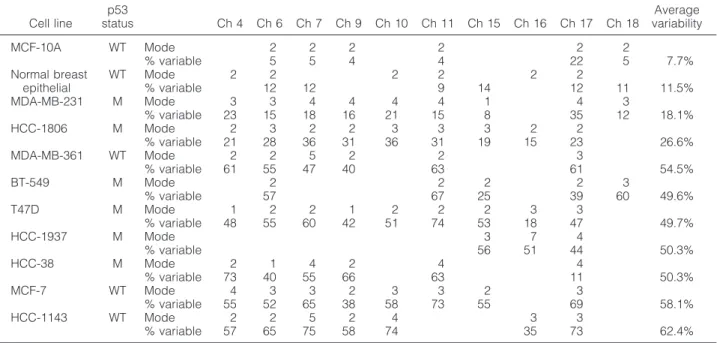
in the 11 cell types examined. Examples of the results of the FISH experiments are shown in Figure 1. Little variation was seen for counts between different colonies using the same probe (even when colonies from different original platings of cells were counted) and we combined all counts to calculate a mode (the most common copy number) and variability (percentage of cells with copy number different from the mode) for each chromosome of each cell type and we also calculated a mean variability index for all chromosomes counted in each cell type.

These modes were remarkably consistent among the multiple colonies examined to count individual chromo- somes. Even for situations where the average variability of chromosome counts within individual colonies fre- quently exceeded 50% (eg, HCC1143), only two colonies had a mode different (by a value of 1) than the overall mode. These results are summarized in Table 1.

Some variability in the extent of instability among dif-

ferent individual chromosomes within particular cell types

is seen, the most striking example being in the MCF10A

cells, where 22% of the cells showed deviation from the

mode for chromosome 17 in contrast to 3 to 4% deviation

for other chromosomes. No particular chromosome

showed a consistently increased level of variability com-

(3)

pared to other chromosomes across the different cell types, and thus an explanation for this chromosome- specific instability is not readily apparent. Notably, this variability for individual chromosomes does not affect the general classification of the cell lines with regard to the overall level of chromosome numerical instability, as de- scribed below.

Considering overall chromosomal instability, seven of the breast cancer cell lines (MCF7, MDA-MB-361, T47D, BT-549, HCC38, HCC1143, and HCC1937) showed highly variable copy numbers among different cells in the culture for all of the chromosomes counted, with numbers of specific chromosomes varying from the mode in over 40% of the cells. For example, the highest level of vari- ability, 62.6%, was seen for the HCC1143 cell line. The differences in the level of variability were not significantly

different among these seven cell lines (using two-tailed t-test with unequal variance, P ⬎ 0.25 for all compari- sons).

Two of the breast cancer cell lines, MDA-MB-231 (18.1%) and HCC1806 (26.6%), were found to have sig- nificantly lower levels of chromosome numerical variabil- ity than the seven most unstable cell lines (P ⬍ 0.001 for all pairwise comparisons of MDA-MB-231 or H1806 to other cell lines). However, the MDA-MB-231 and HCC1806 cell lines do have significantly greater variabil- ity than do normal mammary epithelial cells or the non- tumorigenic MCF10A cell line (P ⬍ 0.05 for all pairwise comparisons), indicating that these two cell lines show a measurable level of instability by this assay. It is uncertain whether the level of variability measured in the normal mammary epithelial cell cultures (10.5%) and MCF10A

Figure 1. Chromosomal instability in breast cancer cells. Fluorescent in situ hybridization measurement of centromeric probes was used to measure chromosome copy numbers in colonies of cultured cells. Results shown are for probes to chromosome 11 in normal mammary epithelial cells (A), chromosome 16 in HCC1806 cells (B), and chromosome 7 in HCC1143 cells (C) are shown. Significant cell-to-cell variability in numbers of chromosomes is seen only in the HCC1143 cells.

Table 1. Summary of FISH Results in Breast Cancer Cell Lines and Normal Mammary Epithelial Cells

Cell line

p53

status Ch 4 Ch 6 Ch 7 Ch 9 Ch 10 Ch 11 Ch 15 Ch 16 Ch 17 Ch 18

Average variability

MCF-10A WT Mode 2 2 2 2 2 2

% variable 5 5 4 4 22 5 7.7%

Normal breast WT Mode 2 2 2 2 2 2

epithelial % variable 12 12 9 14 12 11 11.5%

MDA-MB-231 M Mode 3 3 4 4 4 4 1 4 3

% variable 23 15 18 16 21 15 8 35 12 18.1%

HCC-1806 M Mode 2 3 2 2 3 3 3 2 2

% variable 21 28 36 31 36 31 19 15 23 26.6%

MDA-MB-361 WT Mode 2 2 5 2 2 3

% variable 61 55 47 40 63 61 54.5%

BT-549 M Mode 2 2 2 2 3

% variable 57 67 25 39 60 49.6%

T47D M Mode 1 2 2 1 2 2 2 3 3

% variable 48 55 60 42 51 74 53 18 47 49.7%

HCC-1937 M Mode 3 7 4

% variable 56 51 44 50.3%

HCC-38 M Mode 2 1 4 2 4 4

% variable 73 40 55 66 63 11 50.3%

MCF-7 WT Mode 4 3 3 2 3 3 2 3

% variable 55 52 65 38 58 73 55 69 58.1%

HCC-1143 WT Mode 2 2 5 2 4 3 3

% variable 57 65 75 58 74 35 73 62.4%

The mode and percentage of cells with copy numbers different than mode are reported for each of the chromosomal probes tested. In addition, for

each cell type, the overall variability represents the average of variability for all individual chromosomes.

(4)

cultures (7.7%) reflects the background error in our mea- surements or a modest level of instability in these cells.

Mitotic Checkpoints Are Defective in Breast Cancer Cell Lines with High Chromosomal Instability

To quantify the ability of nocadazole to block cells in mitosis, we performed flow cytometric analysis and mea- sured the G

0

/G

1

, S, and G

2

/M areas of the DNA labeling histograms (Figure 2A). For normal mammary cells, MCF10A cells, and the MDA-MB-231 and HCC1806 cell lines, nocodazole treatment (at 0.2 ␮g/ml) results in a

nearly complete accumulation of cells in the G

2

/M peak.

For the other 7 breast cancer cell lines, the accumulation of cells in response to nocodazole treatment is incom- plete, and significant numbers of cells are seen in the G

0

/G

1

peak. This incomplete block was seen even when higher levels (2 ␮g/ml) were used.

We further characterized the G

2

/M peak of the HCC1806 and HCC 1143 cells using antisera to MPM-2 as a marker to differentiate M phase cells from those in G

2

phase (Figure 2B). These experiments showed that nocodazole treatment leads to a 390-fold increase in the percentage of HCC1806 cells in M phase, but only a 1.33-fold increase in the percentage of HCC1143 cells in

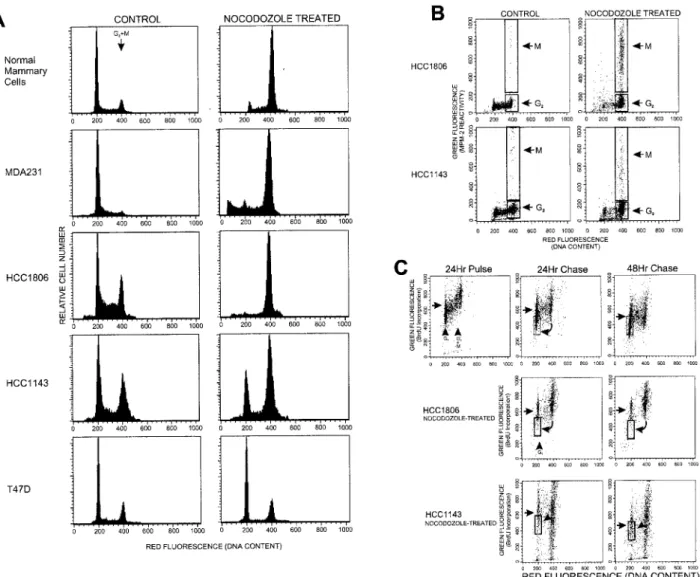
Figure 2. Flow cytometry analysis of mitotic checkpoints in mammary epithelial cells and breast cancer cells. A: DNA content histograms are shown for 5 cell types grown in control (log growth) conditions and 24 hours after treatment with nocodazole. Effective block in G/M is seen for normal mammary cells, MDA-MB-231 cells, and HCC1806 cells, but not in HCC1143 or T47D cells. B: The increase in the G

2

/M peak of the histogram for nocadozole-treated HCC1806 cells is largely due to arrest of cells in mitosis. Cells represented in boxes labeled M have high DNA content (G

2

/M peak) and high level of labeling with the MPM-2 antibody.

Increased numbers of cells arrested in mitosis are seen in the nocodazole-treated HCC1806 cultures but not the nocodazole-treated HCC1143 cultures. C: BrdU

pulse-label experiments to demonstrate escape of HCC1143 cells from G

2

/M block. The top row of panels show distribution of BrdU labeling as a function of

DNA content for untreated HCC1806 cultures at end of 24-hour BrdU label (pulse) and 24 hours and 48 hours after removal of BrdU (chase). Increasing numbers

of cells in G

1

with low levels of BrdU (box) represent cells that have diluted amounts of BrdU through cell replication. The second row shows results for

nocodazole-treated HCC1806 cultures. After 24 hours and 48 hours chase, these treated cultures have significantly fewer numbers of cells in G

1

with reduced levels

of BrdU (boxes) when compared to control cultures, consistent with arrest of these cultures in G

2

. In contrast, a significant proportion of the nocodazole-treated

HCC1143 cells in G

1

have reduced BrdU labeling after 24 hours and 48 hours chase (third row), indicating that these cells incorporated BrdU during a previous

pulse-label cycle and escaped the G

2

/M block during nocodazole treatment. The distribution of cells for untreated HCC1143 cultures was essentially similar to

those shown for HCC1806.

(5)

M phase. Thus, quantitative data indicate that the accu- mulation of nocodazole-treated HCC1806 cells in the G

2

/M peak is due specifically to block of cells in M phase.

These data corroborate independent observations of in- creased mitotic figures in DAPI-stained cultures of HCC1806 and MDA-MB-231 cells treated with nocoda- zole (data not shown).

To determine whether the substantial G

0

/G

1

peak seen in most nocodozole-treated breast cancer cultures (eg, HCC1143) represents cells that have escaped from the nocodazole-induced mitotic block or cells that failed to undergo DNA synthesis and cell replication (ie, blocked in G

0

/G

1

), we pulse-labeled cultures with BrdU for 24 hours before nocodazole treatment. Then, at 24-hour in- tervals of “chase” (incubation without BrdU), we mea- sured the levels of incorporated BrdU and total DNA content (Figure 2C). In control cultures grown in the ab- sence of nocodazole, transition of cells through the G

2

and M phases of the cell cycle was represented by increasing numbers of cells in G

1

with low levels of BrdU label. Nocodazole treatment of HCC1806 cultures blocked this transition, preventing the emergence of these cells in G

1

with low levels of BrdU label during the 48 hours chase. In contrast, increased numbers of HCC1143 cells in G

1

with low levels of BrdU appeared during the 48-hour chase, indicating that significant num- bers of these cells escaped the of nocodazole-induced G

2

/M block.

For each cell type, we compared the relative ability of nocodazole to arrest cultures in mitosis (expressed as the ratio of the G

2

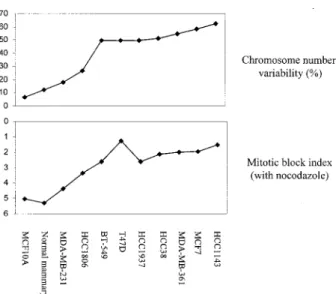
/M peak in nocodazole-treated cultures to that in control cultures) to the level of chromosome nu- merical instability. These ratios range from 1.29 in the T47D cells, which show minimal blocking response to nocodazole, to 5.28 in normal epithelial cultures, where essentially all nocodazole-treated cells are blocked in mitosis. Overall, a remarkably strong correlation (corre- lation ⫽ 0.951, P ⬍ 0.001) was seen between this “mitotic block index” and the measures of variability from the mode numbers of chromosomes.

16

This data for our set of breast cancer and mammary epithelial cell cultures is summarized in Figure 3.

Defective Mitotic Checkpoints and Chromosome Numerical Instability Are Unrelated to p53 Mutations in Breast Cancer Cell Lines

Mutations of the p53 gene have been previously pro- posed to be associated with defective mitotic check- points and genetic instability.

17–21

All of the cell types used in these experiments have been characterized with regard to p53 mutations,

22,23

with the exception of the primary mammary cells, which we assume to have wild- type p53. Our data (Table 1) failed to find any relationship between the presence or absence of p53 mutations and chromosome numerical instability. For example, p53 mu- tations have been described for only 4 of the 7 breast cancer cell lines

22,23

with defective mitotic checkpoints

and high levels of chromosome numerical instability. Fur- thermore, MDA-MB-231 and HCC1806 cell lines, the two breast cancer cell lines with the lowest levels of instability of chromosome numbers during replication and intact nocodazole-induced mitotic checkpoints, also have mu- tations of the p53 gene.

22,23

Discussion

As seen in other forms of human cancer, the genetic alterations in breast cancers include chromosome struc- tural alterations as well as specific gene sequence alter- ations. However, the extent of these structural changes, including variations in chromosome copy numbers, is not uniform among all breast cancers. For example, karyo- typic studies of breast cancers have previously shown that while many neoplasms have extensive chromosome structural and numerical changes, other breast cancers have only minimal chromosomal changes.

8,9

These cyto- genetic studies demonstrate variable states of chromo- some structural variation among different cancers and, with our present investigation, we demonstrate that breast cancer cell lines have vastly different rates by which these chromosome numerical changes occur. Our studies are a thus a more direct measure of chromosome numerical instability, and our results suggest that this form of genetic instability is highly variable among differ- ent breast cancers.

Notably, the breast cancer cell lines with the highest levels of chromosome numerical instability all have a defective mitotic spindle checkpoint as reflected by transition of cells through G

2

/M during exposure to nocodazole. This situation parallels that reported for

Figure 3. Relationship between chromosome number variability and no- codazole-induced mitotic arrest. Chromosome number variability and mitotic block index (ratio of G

2

/M peak in nocodazole-treated cells compared to control cultures) for nocodazole-treated cells are shown for all of the 11 cell types tested. Nearly complete lack of blocking by nocodazole treatment results in a low ratio (eg, 1.29 for T47D cells), whereas higher ratios (eg, 5.28 for normal epithelial cells) are limited by the presence of some G

2

/M cells in control cultures. The relationship of chromosome number variability to mitotic block index shows a strong negative (ie, inverse) correlation of

⫺0.951, 95% confidence interval of ⫺0.988 to ⫺0.819, (P ⬍ 0.001).

16

(6)

colorectal cancer cells with chromosome numerical instability

3

and is consistent with a defective mitotic spindle checkpoint contributing to the development of chromosome numerical instability in many breast can- cers. Remarkably, however, breast cancer cell lines with intact mitotic spindle checkpoints also have mea- surable levels of chromosome numerical instability, al- though to a significantly lesser extent than the cell lines with defective mitotic spindle checkpoints. Thus, our data imply that there may be functionally different classes of breast cancers based on different levels of chromosome numerical instability as well as different mechanisms for achieving this instability.

Our data do not, however, appear to be entirely con- sistent with an alternative hypothesis for chromosomal instability, which proposes that aneuploidy itself destabi- lizes the symmetry of chromosome segregation, leading to chromosomal instability.

24

The MDA-MB-231 and HCC-1806 cell lines are both highly aneuploid,

22,23

yet both of these cell lines have relatively modest levels of chromosome numerical instability. Furthermore, the fibro- cystic-disease derived MCF-10A cell line also has signif- icant aneuploidy,

25

although the level of chromosome numerical instability measured in this cell line using our assay is not significantly different from that of normal mammary epithelial cell cultures.

A number of previous studies have also associated p53 mutations with genetic instability and, in some cases, defective mitotic checkpoints.

17

The functional signifi- cance of p53 mutations likely depends on the specific mutation. For example, one class of p53 missense muta- tion results in a dominant, gain-of-function activity that results in altered spindle checkpoint control and genomic instability.

19

Furthermore, some defects in p53 might be more closely related to mitotic recombination errors than chromosomal losses and gains.

20,26

Based on our studies, defects in the mitotic spindle checkpoint and high levels of chromosome numerical instability in breast cancer do not appear to be related in any consistent manner to p53 status. While we do not yet understand the molecular mechanisms for defective mi- totic spindle checkpoint and associated chromosomal instability in breast cancer, it is notable that several of the breast cancer cell lines with these properties (T47D, MDA-MB-361, and BT-549) have been reported to ex- press relatively decreased levels of the MAD2L1 mitotic spindle checkpoint gene.

27,28

It is also notable that the MDA-MB-231 cell line, which has an intact mitotic check- point response to nocodazole and an intermediate level of chromosomal instability, has amplification and over- expression of the STK15 gene that has been previously shown to be associated with centrosomal amplification and aneuploidy.

29

Future investigations may help to de- termine whether defects of the mitotic spindle checkpoint and defects of centrosomes are independent mecha- nisms for causing chromosomal instability and differen- tially involved in different cancers.

Given the extensive chromosomal instability seen in many of the breast cancer cell lines, it is surprising that the modes of chromosomal numbers were remarkably consistent among different colonies of a given cell line,

even when less than 50% of the cells within a colony had the modal number of chromosomes. Individual cancer cells undoubtedly had variability for many different chro- mosomes at the time they were plated to form colonies.

Yet, as these cells replicated to from colonies, chromo- somal counts apparently tended to return to a particular mode rather than drift toward increasing levels of aneu- ploidy. The mechanism for this tendency to return to a particular mode and range of chromosome numbers, though clearly not evident from our data, could involve unbalanced distribution of chromosomes in a non-ran- dom manner or a selective growth advantage for cells with particular chromosomal content.

In summary, our study indicates that chromosome nu- merical instability occurs at variable levels in breast can- cers, perhaps reflecting functionally different classes of chromosomal instability in breast cancer. Abnormal no- codazole-related mitotic spindle checkpoints probably contribute to high levels of chromosomal instability and might define one of these classes. Other breast cancers, without defective nocodazole-related mitotic spindle checkpoint defects, have more modest levels of chromo- some number variability and appear to constitute a dif- ferent class with respect to chromosomal instability. Fi- nally, it is also important to consider that most breast cancers have structural rearrangements of chromosomes in addition to alterations of chromosome numbers. Thus other mechanisms for disrupting the genome, which might lead to events such as illegitimate recombination, are also likely to contribute to genetic instability in breast cancers.

Acknowledgments

We thank Donald Coffee for the helpful discussions and Christa Morris and Anita Hawkins for technical assistance and advice.

References

1. Nowell PC: The clonal evolution of tumor cell populations. Science 1976, 194:23–28

2. Loeb LA: A mutator phenotype in cancer. Cancer Res 2001, 61:3230 – 3239

3. Lengauer C, Kinzler KW, Vogelstein B: Genetic instability in colorectal cancers. Nature 1997, 386:623– 627

4. Lengauer C, Kinzler KW, Vogelstein B: Genetic instabilities in human cancers. Nature 1998, 396:643– 649

5. Cahill DP, Lengauer C, Yu J, Riggins GJ, Willson JK, Markowitz SD, Kinzler KW, Vogelstein B: Mutations of mitotic checkpoint genes in human cancers. Nature 1998, 392:300 –303

6. Hainsworth PJ, Raphael KL, Stillwell RG, Bennett RC, Garson OM:

Cytogenetic features of twenty-six primary breast cancers. Cancer Genet Cytogenet 1991, 53:205–218

7. Pandis N, Heim S, Bardi G, Idvall I, Mandahl N, Mitelman F: Chromo- some analysis of 20 breast carcinomas: cytogenetic multiclonality and karyotypic-pathologic correlations. Genes Chromosomes Cancer 1993, 6:51–57

8. Pandis N, Idvall I, Bardi G, Jin Y, Gorunova L, Mertens F, Olsson H, Ingvar C, Beroukas K, Mitelman F, Heim S: Correlation between karyotypic pattern and clinicopathologic features in 125 breast can- cer cases. Int J Cancer 1996, 66:191–196

9. Teixeira MR, Pandis N, Bardi G, Andersen JA, Heim S: Karyotypic

comparisons of multiple tumorous and macroscopically normal sur-

(7)

rounding tissue samples from patients with breast cancer. Cancer Res 1996, 56:855– 859

10. Takami S, Kawasome C, Kinoshita M, Koyama H, Noguchi S: Chro- mosomal instability detected by fluorescence in situ hybridization in Japanese breast cancer patients. Clin Chim Acta 2001, 308:127–131 11. Farabegoli F, Santini D, Ceccarelli C, Taffurelli M, Marrano D, Baldini N: Clone heterogeneity in diploid and aneuploid breast carcinomas as detected by FISH. Cytometry 2001, 46:50 –56

12. Stampfer M, Hallowes RC, Hackett AJ: Growth of normal human mammary cells in culture. In Vitro 1980, 16:415– 425

13. Wersto RP, Stetler-Stevenson M: Debris compensation of DNA histo- grams and its effect on S-phase analysis. Cytometry 1995, 20:43–52 14. Wersto RP, Rosenthal ER, Seth PK, Eissa NT, Donahue RE: Recom- binant, replication-defective adenovirus gene transfer vectors induce cell cycle dysregulation and inappropriate expression of cyclin pro- teins. J Virol 1998, 72:9491–9502

15. Schutte B, Reynders MM, van Assche CL, Hupperets PS, Bosman FT, Blijham GH: An improved method for the immunocytochemical de- tection of bromodeoxyuridine labeled nuclei using flow cytometry.

Cytometry 1987, 8:372–376

16. Fisher LD, van Belle G: Biostatistics: Methodology for the Health Sciences. New York, John Wiley & Sons, 1993, p 381

17. Cross SM, Sanchez CA, Morgan CA, Schimke MK, Ramel S, Idzerda RL, Raskind WH, Reid BJ: A p53-dependent mouse spindle check- point. Science 1995, 267:1353–1356

18. Donehower LA, Godley LA, Aldaz CM, Pyle R, Shi YP, Pinkel D, Gray J, Bradley A, Medina D, Varmus HE: Deficiency of p53 accelerates mammary tumorigenesis in Wnt-1 transgenic mice and promotes chromosomal instability. Genes Dev 1995, 9:882– 895

19. Gualberto A, Aldape K, Kozakiewicz K, Tlsty TD: An oncogenic form of p53 confers a dominant, gain-of-function phenotype that disrupts spindle checkpoint control. Proc Natl Acad Sci USA 1998, 95:5166 – 5171

20. Shao C, Deng L, Henegariu O, Liang L, Stambrook PJ, Tischfield JA:

Chromosome instability contributes to loss of heterozygosity in mice lacking p53. Proc Natl Acad Sci USA 2000, 97:7405–7410 21. Shin DM, Charuruks N, Lippman SM, Lee JJ, Ro JY, Hong WK,

Hittelman WN: p53 protein accumulation and genomic instability in head and neck multistep tumorigenesis. Cancer Epidemiol Biomark- ers Prev 2001, 10:603– 609

22. Runnebaum IB, Nagarajan M, Bowman M, Soto D, Sukumar S: Mu- tations in p53 as potential molecular markers for human breast can- cer. Proc Natl Acad Sci USA 1991, 88:10657–10661

23. Wistuba II, Behrens C, Milchgrub S, Syed S, Ahmadian M, Virmani AK, Kurvari V, Cunningham TH, Ashfaq R, Minna JD, Gazdar AF:

Comparison of features of human breast cancer cell lines and their corresponding tumors. Clin Cancer Res 1998, 4:2931–2938 24. Duesberg P, Rausch C, Rasnick D, Hehlmann R: Genetic instability of

cancer cells is proportional to their degree of aneuploidy. Proc Natl Acad Sci USA 1998, 95:13692–13697

25. Soule H, McGrath CM: Immortal human mammary epithelial cell lines.

United States, 1991

26. Honma M, Zhang LS, Hayashi M, Takeshita K, Nakagawa Y, Tanaka N, Sofuni T: Illegitimate recombination leading to allelic loss and unbalanced translocation in p53-mutated human lymphoblastoid cells. Mol Cell Biol 1997, 17:4774 – 4781

27. Li Y, Benezra R: Identification of a human mitotic checkpoint gene:

hsMAD2. Science 1996, 274:246 –248

28. Percy MJ, Myrie KA, Neeley CK, Azim JN, Ethier SP, Petty EM:

Expression and mutational analyses of the human MAD2L1 gene in breast cancer cells. Genes Chromosomes Cancer 2000, 29:356 –362 29. Zhou H, Kuang J, Zhong L, Kuo WL, Gray JW, Sahin A, Brinkley BR, Sen S: Tumour amplified kinase STK15/BTAK induces centrosome amplification, aneuploidy, and transformation. Nat Genet 1998, 20:

189 –193

수치

Table 1. Summary of FISH Results in Breast Cancer Cell Lines and Normal Mammary Epithelial Cells
Figure 2. Flow cytometry analysis of mitotic checkpoints in mammary epithelial cells and breast cancer cells
Figure 3. Relationship between chromosome number variability and no- no-codazole-induced mitotic arrest

참조

관련 문서

Despite this trend in addition to numerous studies examining the crime prevention effects of CCTV, a research that studies the difference between the effects

A cross section of wood from a white-pocket area of decayed wood showing delignified wood cells. These cells have no middle lamella (this is the area between

Colorectal cancer screening using fecal occult blood test and subsequent risk of colorectal cancer: a prospective cohort study in Japan.. Allison JE, Sakoda LC, Levin

This book contains hundreds of complete, working examples illustrating many common Java programming tasks using the core, enterprise, and foun- dation classes APIs.. Java Examples

1 John Owen, Justification by Faith Alone, in The Works of John Owen, ed. John Bolt, trans. Scott Clark, "Do This and Live: Christ's Active Obedience as the

Patients with breast cancer; ovarian cancer; renal cell carcinoma; pancreatic neuroendocrine cancer; colorectal cancer; head and neck cancer; non-small cell lung

• Hormone Therapy With or Without Combination Chemotherapy in Treating Women Who Have Undergone Surgery for Node-Negative Breast Cancer (The TAILORx Trial)..

It reveals that remarkable improvement in the convective heat transfer coefficient of MWCNT/Fe 3 O 4 hybrid nanofluid was shown at a weight concentration