• 검색 결과가 없습니다.

Pulse Electrodeposition and Characterization of Ni-Si<sub>3</sub>N<sub>4</sub> Composite Coatings

N/A
N/A
Protected

Academic year: 2021

Share "Pulse Electrodeposition and Characterization of Ni-Si<sub>3</sub>N<sub>4</sub> Composite Coatings"

Copied!
6
0
0

로드 중.... (전체 텍스트 보기)

전체 글

(1)

한국표면공학회지 J. Kor. Inst. Surf. Eng.

Vol. 43, No. 5, 2010.

<연구논문>

Pulse Electrodeposition and Characterization of Ni-Si 3 N 4 Composite Coatings

Gobinda Gyawali

a

, Dongjin Woo

b

, Soo Wohn Lee

c*

a

Department of Metallurgy and Materials Engineering, Sun Moon University, Asan, Korea

b

Korea Institute of Construction Materials, Korea

c

Department of Environmental Engineering, Sun Moon University, Asan, Korea

(Received October 20, 2010 ; revised October 27, 2010 ; accepted October 30, 2010)

Abstract

Ni-Si

3

N

4

nano-composite coatings were prepared by pulse current (PC) electrodeposition and direct current (DC) electrodeposition techniques. The micro-structure of the coatings was characterized by scanning electron microscopy (SEM), vickers microhardness, X-Ray Diffraction (XRD) and wear-friction tests. The results showed that the micro-structure and wear performance of the coatings were affected by the electrodeposition techniques. Pulse current electrodeposited Ni-Si

3

N

4

composite coatings exhibited higher microhardness, smooth surface, and better wear resistance properties as compared to coatings prepared under DC condition. The Ni-Si

3

N

4

composite coatings prepared at 50 Hz pulse frequency with 10% duty cycles has shown higher codepo- sition of nano-particles. Consequently, increased microhardness and less plastic deformations occurred in coat- ings during sliding wear test. The XRD patterns revealed that the increased pulse frequencies changed the preferred (100) nickel crystallite orientations into mixed (111) and (100) orientations.

Keywords: Composite coatings, Pulse electrodepositon, Microhardness

1. Introduction

Composite electrodeposition is a method of codepositing micron or nano-sized particles of metallic or non-metallic compounds and polymers with a metal or alloy matrix. Composite deposits are used in various fields, from high-tech industries such as electronic components and computers, to more traditional industries such as general mechanics and automobiles, paper mills, textiles and food industries.

During the last decades, the main work carried out in this field is aimed almost entirely to the production of wear and corrosion resistant coatings, self-lubricating systems and dispersion strengthened coatings

1-3)

. With the increasing availability of nano-particles, the interest of the low cost and low temperature composite electroplating is continuously growing, with major challenge being the achievement of high codeposition rates and homogenous distribution of the particles in

the metallic matrix. Considerable research has been mainly focused on the impact of the electrodeposition parameters such as electrolysis conditions (composition of the electrolytic bath, presence of additives, pH value), applied current conditions

4-7)

, and properties of the reinforcing particles (size, surface properties, concentration and type of dispersant in the bath) on the electrolytic codeposition process as well as the properties of the composite coatings

8-15)

.

Electrodeposition using pulse currents, usually known as Pulse Plating, is a relatively new approach.

Though electrodeposition was traditionally carried out using DC, a modification of this by use of current interruption or even current reversal goes back many years, as does the use of AC, superimposed on DC.

Pulse electrodeposition has been found to be an effective means of perturbing the adsorption-desorption phenomena occurring at the electrode-electrolyte interface and hence the electrocrystallization process.

In addition, pulse plating permits higher current density than the limiting direct current density to be

*
Corresponding author. E-mail : [email protected]

(2)

Gobinda Gyawali 외/한국표면공학회 43 (2010) 224-229 225

attained and thus nano-crystalline Ni deposits could be produced.

In the present study, the electrolytic codeposition of 200 nm average sized Si

3

N

4

particles in Ni matrix was carried out from nickel sulfamate bath by applying pulse electrodeposition technique. The effect of pulse plating parameters on the codeposition percentage of Si

3

N

4

, orientation of nickel crystallites, microstructures, wear-friction properties and micro- hardness of the composite coatings were evaluated.

2. Experimental

All electroplating experiments were conducted in a 1000 ml glass beaker. The plating electrolyte was made using nickel sulfamate (Purity ≥90%, Samchun pure chemical Co., Korea) of which concentration and compositions are listed in Table 1. Pure nickel balls inside titanium basket was used as anode while SUS 304 stainless steel sheet of exposed area 2 cm × 3 cm was used as cathode. Cathode was ultrasonically cleaned for 5 minutes before plating.

Cathode and anode were placed vertically in electrolytic bath and were separated about 5 cm apart from each other. Pulse current (PC) with average current density 80 mA/cm

2

, current frequency 50- 1000 Hz and duty cycles ranging from 10% to 100%

were used as pulse variable parameters during electrodeposition process and the electrolyte was stirred about 250 rpm with magnetic stirrer. After the electrodeposition, the samples were cleaned by running distilled water followed by ultrasonic cleaning for 5 minutes in order to remove loosely adsorbed particles and then subjected for further analysis.

Microstructures, phase compositions, mechanical

properties such as wear and microhardness were analysed and evaluated with SEM (JSM-6400, JEOL, Tokyo, Japan), XRD (Rigaku DMAX 2200, X-Ray Diffractometer, Japan), wear (Plint TE77 Tribometer, UK) and vickers microhardness (Buehler Ltd., USA).

Vickers microhardness test was carried out by applying 0.98 N loads for 10 seconds on five different places of cross-sections of a sample and the values were averaged. Coefficients of friction were evaluated simultaneously during bidirectional sliding wear test by applying 2 N loads for 10 minutes with the frequencies of 10 Hz. Si

3

N

4

ball (SN101C) of specific diameter 12.7 mm was used as counterpart during sliding wear test.

3. Results and Discussion 3.1 Effect of pulse frequency

The effect of pulse frequency on the microstructure and codeposition of Si

3

N

4

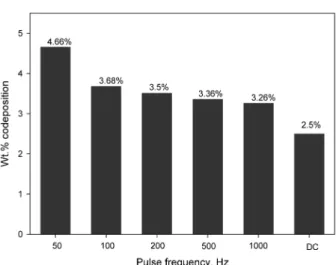
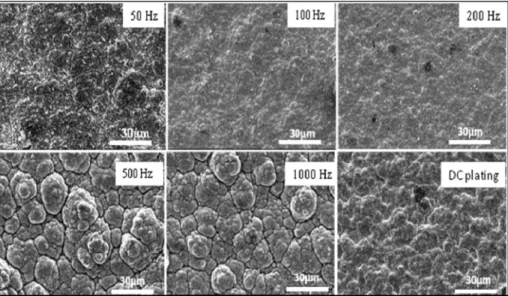
nano particles in nickel matrix were evaluated. The pulse frequency variations were set to 50, 100, 200, 500, and 1000 Hz with the fixed square shaped wave form (i.e. 50% duty cycles) on each. The surface morphologies of the composite coatings at different pulse frequencies are shown in Fig. 1. It can be observed that the surface morphological variations are not much distinct at the frequency range of 50 to 200 Hz but at the frequency 500 Hz and above, some micro-cracks in between larger bulk crystallites on surface were also observed (Fig. 1).

The surface roughness (Ra) of as plated composites coatings at different pulse frequencies were also measured which is shown in Fig. 2. The surface roughness values were also found to be increased by increasing pulse frequencies. The highest surface roughness was found in the composite coating prepared at 1000 Hz pulse frequency. This increase in surface roughness at higher frequencies might be attributed due to the increase in polarization effect at electrolyte-electrode interface as well as increase pH values at higher frequencies.

Vickers microhardness of composite coatings were found to be decreased on increasing pulse frequencies upto 200 Hz and beyond 200 Hz, microhardness values were slightly increased as shown in Fig. 3.

The decrease in microhardness by increasing pulse frequency upto 200 Hz can be explained on the basis of lower incorporation of nano particles while the slight increase in microhardness beyond 200 Hz pulse frequency may be due to change in orientation Table 1. Electrolytic bath composition and operating

conditions

Ni(NH

2

SO

3

)

2

(gl

−1

) 300

NiCl

2

(gl

−1

) 10

H

3

BO

3

(g l

−1

) 40

α-Si

3

N

4

(gl

−1

) 20

CTAB (gl

−1

) 0.3

Temperature (

o

C) 50

pH 4

Current type Pulse

Average current density (mA/cm

2

) 80

Stirring rate (rpm) 250

Pulse Frequency (Hz) 50-1000

Pulse duty cycle (%) 10-100

(3)

patterns of nickel crystallites. XRD patterns of composite coatings prepared at different pulse frequencies are shown in Fig. 4. It reveals that by increasing the pulse frequencies above 200 Hz, diffraction intensity of [211] fiber orientation was increased which is accompanied by reinforcement of (111) and (220) peak intensities and attenuation of (100) peak intensity. Wt.% of the Si

3

N

4

nano particles incorporated in composite coatings, prepared at different pulse frequencies, were measured by EDS analysis which is shown in Fig. 5. It shows that by lowering the pulse frequency, higher wt.% of Si

3

N

4

nano particles can be codeposited. The decrease in codeposition percentage of nano particles in coatings at higher frequencies may be explained by the capacitance effect and consequent incomplete Fig. 1. Surface morphologies of the Ni-Si

3

N

4

composite coatings prepared from different pulse frequencies (Si

3

N

4

content: 20 g/ l, pH=4, Temp. 50

0

C, Average current density=80 mA/cm

2

).

Fig. 2. Surface roughness (Ra) of the Ni-Si

3

N

4

composite coatings prepared from different pulse frequencies at 50% pulse duty cycle.

Fig. 3. Variation of vickers microhardness of the composite coatings as a function of pulse frequency.

Fig. 4. XRD patterns of Ni-Si

3

N

4

composite coatings

prepared from different pulse frequencies.

(4)

Gobinda Gyawali 외/한국표면공학회 43 (2010) 224-229 227

discharge of ions absorbed on particles.

3.2 Effect of duty cycle

The pulse duty cycles selected in this experiment were 10%, 25%, 50%, 75%, and 100% (i.e. DC plating). Effect of pulse duty cycle on the micro- hardness of the composite coatings is shown in Fig. 6. It shows that microhardness of the composite coatings was increased by decreasing pulse duty cycles. Increase in microhardness of composite coating at lower duty cycles is due to the increase in codeposition of nano particles by allowing more chance for nano particles to arrive at the double layer.

The cross-section SEM images of the composite coating at different duty cycles are shown in Fig. 7.

The Si

3

N

4

nano particles are well distributed in cross- sections of the composite coatings prepared at lower duty cycles. On the other hand, Si

3

N

4

nano particles tend be agglomerated in DC plating condition.

Wear tracks of the composite coatings prepared at different duty cycles are shown in Fig. 8. Metallic coatings generally undergo plastic deformations during sliding wear due to the movement of slip planes. The wear behavior of the composite coatings prepared at lower duty cycles exhibited less plastic deformations as compared Ni-Si

3

N

4

coatings prepared at higher duty cycles. This might be due to the deposit containing higher percentage of dispersed nano particles prepared at lower duty cycle which resist for movement of dislocation planes. In addition, the surface roughness of composite coatings at different duty cycles is Fig. 5. Wt.% codeposition of Si

3

N

4

in the composite

coating at different pulse frequencies.

Fig. 7. SEM micrographs of cross-sections of Ni-Si

3

N

4

composite coatings at different duty cycle.

Fig. 6. Variation of vickers microhardness of the

composite coatings as a function pulse duty

cycle.

(5)

shown in Fig. 9. By decreasing pulse duty cycles, the surface roughness was also found to be decreased.

Hence, due to the grain refining effects at lower duty cycles, the harder composite coatings self act as wear resistance. Frictional coefficients were also recorded simultaneously during sliding wear test. In the same way, frictional coefficients were also found to be lower for the composite coatings prepared at lower duty cycles as shown in Fig. 10.

4. Conclusions

Compared to direct current (DC) electrodeposition, pulse current (PC) electrodeposited Ni-Si

3

N

4

composite coatings exhibited higher codeposition percentage of nano particles, increased microhardness and smooth surface. Pulse electrodeposited Ni-Si

3

N

4

composite coatings at lower pulse duty cycles and frequencies have shown smooth surface with reduced grains.

Higher pulse frequencies with higher duty cycles caused to decrease in particles incorporation. Consequently, microhardness and wear resistance properties were also decreased. Nevertheless, the microhardness of the composite coatings was found to be increased slightly by increasing pulse frequencies beyond 200 Hz.

In addition, XRD patterns showed that by increasing the pulse frequency, diffraction intensity of [211] fiber orientation was also increased, which was accompanied by reinforcement of (111) and (220) peak intensities and attenuation of (100) peak intensity.

Fig. 8. Wear tracks of composite coatings prepared at different duty cycles (load: 2 N, frequency: 10 Hz, time: 10 minutes, counter ball SN1010C, no lubricants, temperature: 23

o

C, and humidity: 47%).

Fig. 9. Surface roughness of the Ni-Si

3

N

4

composite coatings prepared from different pulse duty cycles.

Fig. 10. Coefficient of friction measured during the

sliding wear test for the composites as a

function of different pulse duty cycle.

(6)

Gobinda Gyawali 외/한국표면공학회 43 (2010) 224-229 229

Acknowledgement

This research was supported by Ministry of Knowledged Economy, Korea (Grant: Korea evaluation institute of industrial technology; 10033293).

References

1. J. Fransaer, J. P. Celis, J. R. Roos, Met. Finish., 91 (1993) 97.

2. M. Musiani, Electrochim. Acta, 45 (2000) 3397.

3. M. Srivastava, V. K. W. Grips, A. Jain, K. S.

Rajam, Surf. Coat. Technol., 202 (2007) 310.

4. L. M. Chang, M. Z. An, H. F. Guo, S. Y. Shi, App. Surf. Sci., 253 (2006) 2132.

5. W. Wang, F. Y. Hou, H. Wang, H. T. Guo, Scripta Mater., 53 (2005) 613.

6. P. Gyftou, E. A. Pavlatou, N. Spyrellis, App. Surf.

Sci., 254 (2008) 5910.

7. L. M. Chang, H. F. Guo, M. Z. An, Mater. Lett., 62 (2008) 3313.

8. N. S. Qu, K. C. Chan, D. Zhu, Scripta Mater., 50 (2004) 1131.

9. L. Shi, C. Sun, P. Gao, F. Zhou, W. Liu, App.

Surf. Sci., 252 (2006) 3591.

10. D. Thiemig, A. Bund, Surf. Coat. Technol., 202 (2008) 2976.

11. M. R. Vaezi, S. K. Sadrnezhaad, L. Nikzad, Colloid Surf. A, 315 (2008) 176.

12. F. Erler, C. Jakob, H. Romanus, L. Spiess, B.

Wielage, T. Lampke, S. Steinhauser, Electrochim.

Acta, 48 (2003) 3063.

13. J. Li, Y. Sun, X. Sun, J. Qiao, Surf. Coat. Technol., 192 (2005) 331.

14. A. Abdel Aal, Mater. Sci. Eng. A, 474 (2008) 181.

15. S. H. Yeh, C. C. Wan, J. Appl. Electrochem., 24

(1994) 993.

수치

Fig. 2. Surface roughness (Ra) of the Ni-Si 3 N 4  composite coatings prepared from different pulse frequencies at 50% pulse duty cycle.
Fig. 7. SEM micrographs of cross-sections of Ni-Si 3 N 4  composite coatings at different duty cycle.
Fig. 8. Wear tracks of composite coatings prepared at different duty cycles (load: 2 N, frequency: 10 Hz, time: 10 minutes, counter ball SN1010C, no lubricants, temperature: 23 o C, and humidity: 47%).

참조

관련 문서

Second, what effect does psychodrama have on sub-factors of personal relationship; satisfaction, communication, trust, intimacy, sensitivity, openness,

Si 마이크로머시닝(mi cromachi ni ng)은 마이크로 열센서(thermalmi crosensor)나 가스 센서의 발달에 영향을 주고 있다 1-3) .현재까지 pol y Si 4) ,Si C 5) ,Ni Fe Al l oy 6) ,Ni

Pol y(2, 3, 4, 5-tetraphenyl )si l ol es (1 1 1, so cal l ed pol ysi l ol e, PTPS) shown i n Scheme1possessboth 2, 3, 4, 5-tetraphenyl -1-si l acycl openta- 2, 4-di

Among the sub-factors of autonomy support coaching behavior, strategy recognition had the most direct influence on the grit of athletes, followed by

This study was conducted to recognize the importance of self - management of dance major students and to understand the relationship between the sub -

Among the sub-factors, confidence, The factors of setting, team harmony, image and will power were higher in the group with national representative

For the sub-factors of selection attributes and customer value according to screen golf course handicap, convenience, professionality, facilities, price,

The results of this study are as follows: ⑴ 4 basic directions, 16 themes, and 64 sub-themes of the vocational high school development are established, and