A Study on the Influences of Enterprise Organizational Effectiveness in Learning Organization Activity.
Ji Chul Yoo
**
Dept. Of Industrial Management Engineering, Chung Ju National University
학습조직활동이 조직 유효성에 미치는 영향
유 지 철
**
충주대학교 산업경영공학과
Abstract
지식기반경제사회에서 지식을 습득하고 행동할 수 있는 능력을 갖춘 인적자원이야말로 기업의 핵심경쟁력 이라 는 것은 자명한 것이다. 디지털시대로 특징지어지는 21세기에는 지식이야말로 기업의 경쟁우위에 중요한 영향을 미 칠 것이다. 기업은 디지털 시대에 있어서 경쟁우위를 확보하기 위하여 학습조직의 활성화는 기업의 경쟁에 있어서 중요한 핵심요소가 된다. 그러나 대부분 기업들이 학습활동을 하면서도 학습조직의 활성화가 기업에 어떠한 영향을 미치는지에 대한 분석은 미흡한 실정이다.
따라서 본 연구는 학습조직의 활성화가 기업조직의 유효성에 미치는 영향에 관한 분석을 실시하였다. 연구의 결 과 기업학습조직 활성화에 지속적 학습, 시스템적 사고, 조직몰입 등이 기업조직의 유효성에 유의하게 판단되었다.
Keywords : organizational effectiveness, learning activity, learning organization, human resources
1. Introduction
With an increasing speed of knowledge sharing in the knowledge base economic society now, the core competitiveness of the enterprise comes from the human resources that are capable of creating knowledge, and act on its acquired knowledge.
Since knowledge surely is the core competence factor in knowledge base economic society, the activities of learning organization is the most important element in an enterprise.
Moreover, in 21 C, the digital age, the knowledge is the key for the competitive advantages.
Accordingly, the promotion of learning organization is the important core element of enterprise competitiveness.
Despite of most enterprises’ adaptation of learning activity, however, there are few of analysis in the effectiveness of
learning activity on influencing enterprise competitiveness.
Therefore, this paper shows how the promotion of learning activity in any enterprise influences the overall effectiveness.
Specifically, this study focuses the promotion of learning organization activity in small & medium enterprise which face more obstacles than large corporations.
2. A special quality of learning organization
The learning organization is one that is capable to acquire, systematize and communicate the knowledge.
The enterprise which is exercising learning organization allows people inside and outside of companies to learn more in the process of doing their tasks, and to optimize the productivity by applying advanced technology.
†이 논문은 충주대학교 학술연구조성비에 의해 쓰여 진 논문임
†교신저자 : 유지철, 충청북도 충주시 충주대학교 공과대학 산업경영공학과 M·P: 017-705-5305, E-Mail: [email protected]
2009년 10월 20일 접수; 2009년 12월 10일 수정본 접수; 2009년 12월 16일 게재확정
3. Learning Organization Cases of Enterprises 3.1. Mentoring
Mentoring might have been described as the activity conducted by a person (the mentor) for another person (the mentee) in order to help that other person to do a job more effectively or to progress in their career.
3.2. Coaching
Coaching is a method of directing, instructing and training a person or group of people, with the aim to achieve some goal or develop specific skill. There are many ways to coach, types of coaching and methods to coaching.
3.3. KMS
Knowledge management comprises a range of practices used in an organization to identify, creation, represent, distribute and enable adaption of insights and experience.
Such insights and experiences comprise knowledge, either embodied in individuals or embed in organizational processes or practice.
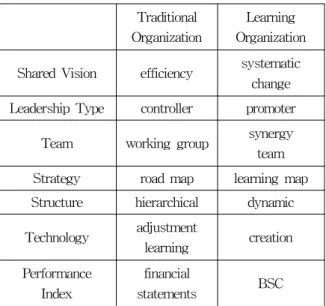
Table 1. traditional organization vs. learning organization characteristics
Traditional Organization
Learning Organization Shared Vision efficiency systematic
change Leadership Type controller promoter
Team working group synergy
team Strategy road map learning map Structure hierarchical dynamic Technology adjustment
learning creation Performance
Index
financial
statements BSC
the origin : Hitt(1995), "The Learning organization : Some reflections on organization renewal" Leadership & Organization Development, p.16
3.4. E‐learning
E‐learning is a term which is commonly used, but does not have a universally accepted definition.
Most frequently it seems to be used for web‐based and distance education, which may also involve face to face interaction
3.5. Off‐the job
Off‐the job training involves employes taking training courses away from their place of work. This is often also referred to as formal training.
3.6. CoP
Communities of Practice are collaborative, informal networks that support professional practitioners in their effort to develop shared understandings and engage in work‐relevant knowledge building.
4. Organizational Effectiveness
Organizational effectiveness is the concept of how effective an organization is in achieving the outcomes the organization intends to produce. The idea of organizational effectiveness is especially important for non‐profit organizations as most people who donate money to non‐profit organizations and characteristics are interested in knowing whether the organization is effective in accomplishing its goal.
Effectiveness is a measure of task output or goal accomplishment but efficiency is a measure of the resource cost associated with goal accomplishment.
The effectiveness of the organization stands for a criterion to evaluate organizational performance, representing how much well the organization is operated. However, although the organizational performance is high, if the members of the organization are not satisfied, the organization is not desirable.
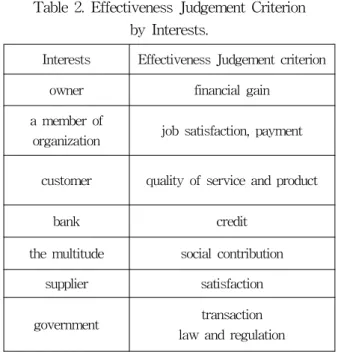
Table 2. Effectiveness Judgement Criterion by Interests.
Interests Effectiveness Judgement criterion
owner financial gain
a member of
organization job satisfaction, payment
customer quality of service and product
bank credit
the multitude social contribution
supplier satisfaction
government transaction
law and regulation
5. The method of Organizational Effectiveness Evaluation 5.1 System resource approach
System resource approach judge of effectiveness on a side input the organizations.
5.2 Internal process approach
Internal process approach judge of economics and soundness on a side internal activity
5.3 Goal approach
Goal approach judge of a organizational target value on a side output in the organizations.
5.4 Constituency approach
Consistency approach judge of interests on a side profit and lose between internal and external in the organizations.
5.5 Competing approach
Competing approach judge of finding a common criterion from conflicting goals.
Table3. Evaluation Indications of Organizational Effectiveness
Indication Contents
Psychological Indications
job satisfaction, motivation, moral, conflict and cohesion, alignment, flexibility and adaptability.
Economics Indications
general effectiveness, productivity, efficiency, profit, quality, growth, understanding of environment, human resources value, goal attainment.
Managerial Indications
frequency of accidents, rate of absent, plan and target, human relations management of manager, information and communication, speed, stability, decision making, training.
6. A Study Methodology 6.1 Study Mode
lThis study model is following.
6.2 Collection of Data.
The subjects for questionnaires of this study were small and medium‐sized enterprises in around Seoul, which had a learning organization. Random samples from these enterprises were extracted and the outputs of the questionnaires were statistically analyzed.
Each items of the questionnaire was evaluated by 5 point scales. The test of the research hypotheses was performed through factorial analysis, reliability analysis, frequency analysis, regression analysis and analysis of variance, using SPSS13.0. The survey wasconducted during 45 days (7/15/2009~8/30/2009) and 15 enterprises participated in this survey. The 252 questionnaires were collected from 600 questionnaires.
6.3 Factor Analysis
Factor analysis is a statistical method used to describe variability among observed variables in terms of fewer unobserved called factors. The observed variables are models as linear combinations of the factors, plus ‘error’
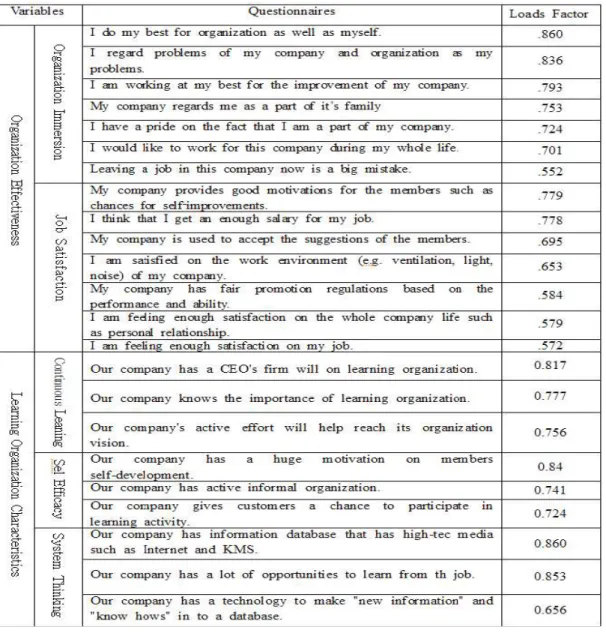
terms. The information gained about the interdependencies can be used later to reduce the set of variables in a data set. The results of relationship factors loading between loads factors and variables regard as significance more than 0.5 generally.
6.4 Reliability Analysis
Reliability is the consistency of a set of measurements or
measuring instrument, often used to describe a test. This can either be whether the measurements of the same instrument give or are likely to give the same measurement, or in the case of more subjective instruments, such as personality or trait inventories, whether two independent assessors give similar scores. Reliability is inversely related to random error. In this study, the reliability of survey questions are analyzed by Cronbach’s Alpha reliability coefficient of correlation.
Generally, if the coefficient of correlation of Cronbach’s Alpha is bigger than 0.6, the reliability is acceptable.
The results of correlation and regression analysis, factor relevancy regard significance.
**coefficient of correlation regard 0.01 level(both side) significance.
Table 4. The Results of Factorial Analysis on the Characteristics of Organization Effectiveness.
Table 5. The result of Reliability Analysis
Variables Construct Definitions Cronbach’s Alpha
Continuous Learning
learning attitude and concern
learning desire of members CEO’s will for
learning organization .849
Self‐Efficacy organization environment friendship of members
learning organization activity easy to shift of
human resource between team and team .874 System
Thinking job performance ability give an opportunity to apply acquired knowledge .906 Job
Satisfaction degree of job satisfaction satisfaction and worth from job satisfaction
to business creed, and business goal. .875 Organization
Immersion
degree of organization immersion
pride of company’s member feeling of family
in company .915
Table 6. The results of correlation analysis Systematic
Thinking
Self‐
Efficacy
Continuous Learning
Organization Immersion
Job Satisfaction Systematic thinking 1
Self‐Efficacy .542** 1
Continuous
Learning .440** .594** 1
Organization
Immersion .545** .659** .599** 1
Job Satisfaction .463** .619** .672** .764** 1
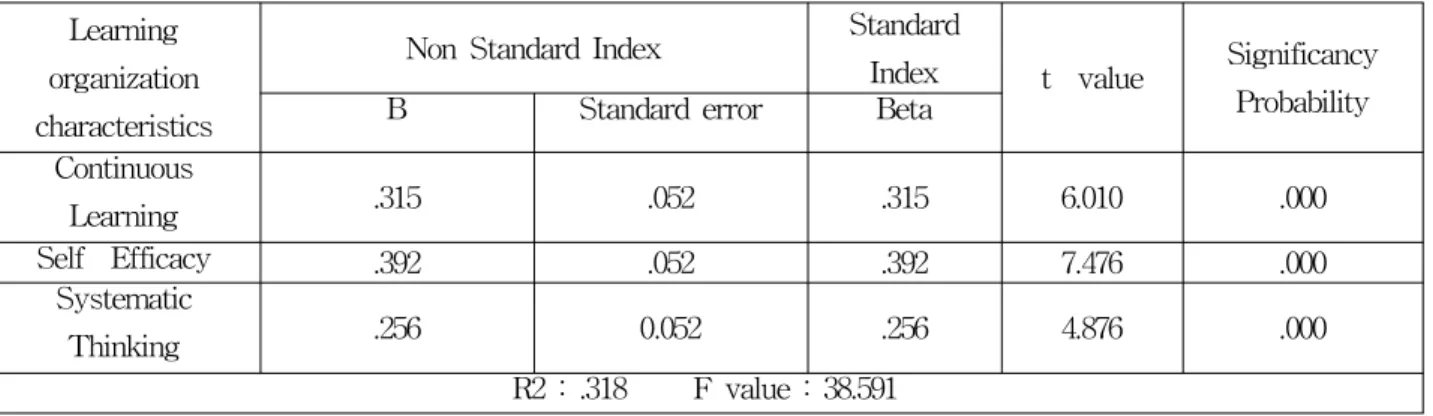
Table 7. The result of regression analysis learning organizational characteristics and job satisfaction.
Learning organization characteristics
Non Standard Index Standard
Index t‐value Significancy Probability
B Standard error Beta
Continuous
Learning .315 .052 .315 6.010 .000
Self‐Efficacy .392 .052 .392 7.476 .000
Systematic
Thinking .256 0.052 .256 4.876 .000
R2 : .318 F value : 38.591
Table 8. The result of regression analysis the learning organization and organizational Immersion Learning
Organization Characteristics
Non Standard Index Standard
Index t‐Value Significancy Probability
B Standard Error Beta
Continuous
Leaning .145 .051 .145 2.817 .0005
Self-Efficacy .266 .051 .266 5.172 .000
System
Thinking .50 .051 .501 9.730 .000
R2 : .343 F value : 43.118
The effects of factors continuous learning, self efficacy and systematic thinking on job satisfaction regard as significance level from 0.01. Also R2 shows 0.318, this meaning is R2 as explanation about significance of level 0.01.
7. Conclusion
The purpose of the study is to analyze related characteristics of the learning organization and to understand the organizational effectiveness, especially on small & medium enterprises.
The paper shows the important characteristics of organization. And it would help many small & medium enterprises to facilitate the adaptation of learning organization.
In conclusion, continuous learning, individual self‐efficacy, systematically thinking, and organizational immersion are very influential to the overall enterprise effectiveness.
Moreover, individual characteristics also affect the performance of learning organization and the overall enterprise effectiveness.
Finally, in order to sustain the business success and to keep core human resources strategically, the company should provide the environment to organization the learning group and to support the learning organization acquire, systematize, and communicate the knowledge.
This research analyzed on the effects of small &
medium enterprise's productivity. But this research has some limit.
First, It needs to diversify the range of research's subject.
Second, It needs a research on new factors about the learning organization factors.
8. References
[1] Na Buyong Sun(2002), A study on the relationship of organization effectiveness learning organization and organization culture, Korea Univ., thesis of ph. D.
[2] Bennet, Joan Kremer & O’Brien, Michael J., “The building blocks of the learning Organization, “ Training, Jun. 1994, pp.41‐49
[3] Marquardt, M., “Building The Learning Organization”, Singapore: McGraw‐Hill Book co., 1997.
[4] Senge, P.M., “The fifth Discipline: The Art and Practice of The Learning Organization”, New York:
Doubleday/Currency, 1994.
[5] Steers, R.M., “Problems in The Organizational Effectiveness”, Adminstrative Science Quarterly, 20(4) 1975, pp.548‐549.
[6] Vowels, Andrew, “Gaining competitive Adventage through organizational learning”, CMA Magazine, April. 1993, pp12‐14.
[7] Williams, Alan P.O., “New Developments in improving Learning”, Organizational Review, 1987.
저 자 소 개
유 지 철
동국대학교 산업공학과 및 동국대학 원을 졸업하고 Adamson Universtiy 에서 박사를 수려한후 , University of Windsor에서 1년 6개월 간 연구 원으로 재직. 한국산업개발연구원에 서 연구원을 거친후 현재 충주대학 교 산업경영공학과에 교수로 재직중.
관심분야는 Ergnomics와 기업에서 의 인적자원에 관한 분야이다. 현재 사단법인 경영기술연구원 이사, (주)입소 경영자원위원, 한국산업인력공단 HRD전문위원, 노동부 충북고용포럼부위원장 , 국가품질상심사위원(지경부) 주소: 충북 충주시 대학로 72 충주대학교 산업경영공학과