• 검색 결과가 없습니다.

STAR FORMATION ACTIVITY OF GALAXIES IN A NEARBY COMPACT GROUP: THE NGC 4095 GROUP

N/A
N/A
Protected

Academic year: 2021

Share "STAR FORMATION ACTIVITY OF GALAXIES IN A NEARBY COMPACT GROUP: THE NGC 4095 GROUP"

Copied!
3
0
0

로드 중.... (전체 텍스트 보기)

전체 글

(1)

Publications of the Korean Astronomical Society pISSN: 1225-1534

30: 507 ∼ 509, 2015 September eISSN: 2287-6936

2015. The Korean Astronomical Society. All rights reserved. c http://dx.doi.org/10.5303/PKAS.2015.30.2.507

STAR FORMATION ACTIVITY OF GALAXIES IN A NEARBY COMPACT GROUP: THE NGC 4095 GROUP Panomporn Poojon

1

, Utane Sawangwit

2

, and Wichean Kriwattanawong

1

1

Department of Physics and Materials Science, Faculty of Science, Chiang Mai University, Chiang Mai 50200, Thailand

2
National Astronomical Research Institute of Thailand, Chiang Mai 50200, Thailand E-mail: [email protected], [email protected]

(Received November 30, 2014; Reviced May 31, 2015; Aaccepted June 30, 2015)

ABSTRACT

This work aims to study the evolution of galaxies, located in the dense environment of the NGC 4095 compact group, which have recession velocities 6,000 < v (km s

−1

) < 8,000. Imaging observations for BV R

c

broad-band, and [S ii] and red-continuum narrow-band were carried out with the 2.4 m Thai National Telescope (TNT) at Doi Inthanon, Chiang Mai, Thailand. The sample contains 13 galaxies, consisting of 8 spirals, 4 ellipticals and 1 irregular morphological type. Late type galaxies tend to be bluer than early type galaxies. The results show that most of the late type galaxies have ongoing star formation activity, which could be triggered by galaxy-galaxy or tidal interactions, and that young massive stars in these galaxies cause their colors to be bluer than the early type galaxies.

Key words: galaxies: star formation – galaxies: groups: individual (NGC 4095)

1. INTRODUCTION

Dense material could trigger star formation in galaxies, as it falls into clusters or compact groups. Evidence of disturbance is frequently found in rich clusters (Brether- ton et al., 2013).

The galaxies in the sample are in a compact group lo- cated around NGC 4095, hereafter called the NGC 4095 group. The recession velocities of the target galaxies are in the range of about 6,000 – 8,000 km s

−1

. This work aims to study physical properties and star forma- tion activity represented by the equivalent width of the Hα emission line for galaxy members in this group.

2. METHODS OF THE STUDY 2.1. Observations

Imaging data were obtained using the 2.4 m Thai Na- tional Telescope (TNT) at Doi Inthanon, Chiang Mai.

The observations were taken during 25 - 27 Febru- ary and 9 - 11 March 2014, using BV R

c

broad-band, and [S ii] and red-continuum narrow-band filters. The redshifts of target galaxies were collected from the NASA/IPAC Extragalactic Database (NED).

2.2. Morphological Types of the Sample Galaxies

The sample galaxies were classified follow the de Vau- couleurs’ T-type system. An additional type, “11” was defined for spiral galaxies which are edge-on and do not clearly show structure. Furthermore, “pec” was used to mark peculiar galaxies.

http://pkas.kas.org

2.3. Calculations of B and R Magnitudes and Color Indices First, we used the Starlink package to calibrate the zero point and determine B

25

isophotes for each sam- ple galaxy. Next, we measured B, V and R magnitudes, and [S ii] and red-continuum flux counts. Finally, we calculated the absolute magnitudes and color indices.

2.4. Calculation of Hα Equivalent Width

The Hα equivalent width, EW (Hα), is calculated by using the following equation (e.g., Gavazzi et al., 2006;

Kriwattanawong et al., 2011):

EW (Hα) = R T

n

(λ)dλ T

n

(6563(1 + z))

C

C

C

(1) where T

n

(λ) is the transmissivity of the [S ii] filter, z is the redshift of the galaxy, C

is the Hα emission line flux count, and C

C

is the continuum flux count.

3. RESULTS

The (B − V ) versus M

B

plot in Figure 1 shows 13 sam- ple galaxies, consisting of 8 spirals, 4 ellipticals and 1 irregular morphological type. Five of them are peculiar galaxies; 3 spirals and 2 ellipticals. The eight brighter galaxies (M

B

< −20) tend to be redder than the others.

Figure 2 illustrates the B − V color versus T-type plot. Our sample shows that late type galaxies tend to be bluer than early type ones. All sample galaxies having M

B

fainter than −20 mag are late type galaxies.

Figure 3 illustrates the relationship between the

EW (Hα) and T-type. Nine of thirteen galaxies show

emission lines with S/N > 3, indicating a significant

507

(2)

508 P. POOJON ET AL.

Figure 1. B − V color vs. absolute magnitude M

B

diagram.

Figure 2. B − V color vs. T-type diagram, separated by M

B

∼ −20 mag.

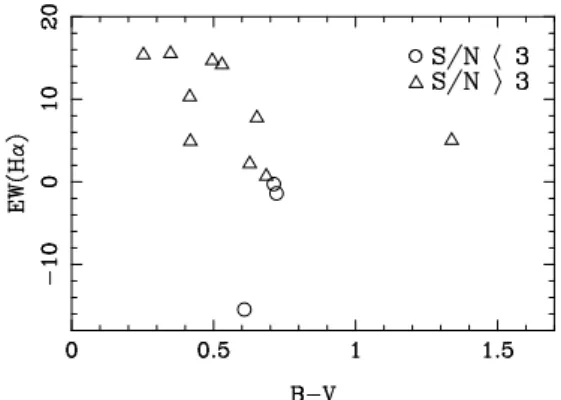
amount of star formation. Most late type galaxies tend to have higher Hα emission than the early type galax- ies. Most emission line galaxies (S/N (Hα) > 3) tend to be bluer than non-emission line galaxies as shown in Figure 4. This could be due to the formation of young massive stars in these emission line galaxies

4. DISCUSSION AND CONCLUSIONS

This study presents an investigation of star formation activity for thirteen sample galaxies in a nearby com- pact group, NGC 4095. Four elliptical galaxies are gi- ants with M

B

< −20, while the others are late type.

The late type galaxies tend to be bluer than the early galaxies, which could be due to OB star formation in the galaxies (Phillipps, 2005). Moreover, most of the late type galaxies tend to have higher Hα emission than the early type ones. This implies that most active star forming galaxies are late type galaxies, similar to evi- dence found in the Virgo cluster by Gavazzi et al. (2006), that giant galaxies in the Virgo cluster have a current massive star formation rate per unit mass that increases from Sa to Scd. The results show that most of the late type galaxies in our sample have ongoing star formation, whereas the other galaxies, including the early type sam- ple, are passive galaxies with little or no Hα emission.

Star formation in the emission line galaxies could be triggered by galaxy-galaxy or tidal interactions with the group potential well, during which material falls into the dense environment of this compact group. The results are similar to those found in eight low-redshift clusters

Figure 3. Hα equivalent width vs. T-type diagram for the sample galaxies.

Figure 4. Hα equivalent width vs. B − V color diagram for the sample galaxies.

(Moss, 2006) and consistent with the idea that molecu- lar clouds of disk galaxies that are falling into the center of a cluster could be accelerated by tidal forces due to the cluster potential well, forming young stars (Valluri, 1993; Henriksen & Byrd, 2006).

ACKNOWLEDGMENTS

We thank the National Research Council of Thai- land (NRCT), and the National Astronomical Research Institute of Thailand (NARIT), for financial support, the NASA/IPAC Extragalactic Database(NED), for database was used in this research and the Science Achievement Scholarship of Thailand (SAST) for sup- ported scholarship. We are very grateful for all support.

REFERENCES

Bretherton, C. F., Mass, C., & James, P. A., 2013, Star- Forming Galaxies in Low-Redshift Clusters: Effects of En- vironment on the Concentration of Star Formation, A&A, 553, A67

Gavazzi, G., Boselli, A., Cortese L., Arosio, I., Gallazzi, A., Pedotti, P., & Carrasco, L., 2006, Hα Surface Photometry of Galaxies in Nearby Clusters V. The Survey Completion, A&A, 446, 839

Henriksen, M. & Byrd, G., 1996, Tidal Triggering of Star

Formation by the Galaxy Cluster Potential, ApJ, 459, 82

Kriwattanawong, W., Moss, C., James, P. A., & Carter, D.,

2011, The Galaxy Population of Abell 1367: Photometric

and Spectroscopic Data, A&A, 527, A101

(3)

STAR FORMATION ACTIVITY OF GALAXIES IN A NEARBY COMPACT GROUP: THE NGC 4095 GROUP 509 Moss, C., 2006, Enhanced Mergers of Galaxies in Low-

Redshift Clusters, MNRAS, 373, 167

Phillipps, S., 2005, The Structure & Evolution of Galaxies, West Sussex: John Wiley & Sons, Ltd, 109

Valluri, M., 1993, Compressive Tidal Heating of a Dish

Galaxy in a Rich Cluster, ApJ, 408, 57

수치

Figure 3. Hα equivalent width vs. T-type diagram for the sample galaxies.

참조

관련 문서