1)
†To whom correspondence should be addressed.
Department of Civil and Environmental Engineering, Kongju National University
E-mail: [email protected]
Comparison of nutrient removal efficiency of an infiltration planter and an infiltration trench
K.A.V. Yano・F.K.F. Geronimo・N.J.D.G. Reyes・M. S. Jeon・L. H. Kim†
Department of Civil and Environmental Engineering, Kongju National University
침투도랑(IT)과 침투화분(IP)의 영양염류 저감효율 비교분석
K.A.V. Yano・F.K.F. Geronimo・N.J.D.G. Reyes・전민수・김이형† 공주대학교 건설환경공학과
(Received : 07 November 2019, Revised: 15 November 2019, Accepted: 15 November 2019)
Abstract
Nutrients in stormwater runoff have raised concerns regarding water quality degradation in the recent years. Low impact development (LID) technologies are types of nature-based solutions developed to address water quality problems and restore the predevelopment hydrology of a catchment area. Two LID facilities, infiltration trench (IT) and infiltration planter (IP), are known for their high removal rate of nutrients through sedimentation and vegetation. Long-term monitoring was conducted to assess the performance and cite the advantages and disadvantages of utilizing the facilities in nutrient removal. Since a strong ionic bond exists between phosphorus compounds and sediments, reduction of total phosphorus (TP) (more than 76%), in both facilities was associated to the removal of total suspended solids (TSS) (more than 84%). The efficiency of nitrogen in IP is 28% higher than IT. Effective nitrification occurred in IT and particulate forms of nitrogen were removed through sedimentation and media filters. Decrease in ammonium- nitrogen (NH4-N) and nitrite-nitrogen (NO2-N), and increase in nitrate-nitrogen (NO3-N) fraction forms indicated that effective nitrification and denitrification occurred in IP. Hydrologic factors such as rainfall depth and rainfall intensity affected nutrient treatment capabilities of urban stormwater LID facilities The greatest monitored rainfall intensity of 11 mm/hr for IT yielded to 34% and 55% removal efficiencies for TN and TP, respectively, whereas, low rainfall intensities below 5 mm resulted to 100 % removal efficiency. The greatest monitored rainfall intensity for IP was 27 mm/hr, which still resulted to high removal efficiencies of 98% and 97% for TN and TP, respectively. Water quality assessment showed that both facilities were effective in reducing the amount of nutrients; however, IP was found to be more efficient than IT due to its additional provisions for plant uptake and larger storage volume.
Key words : Infiltration planter, infiltration trench, low impact development, nature-based solution, nutrients, urban stormwater
요 약
최근 강우시 수계로 유출되는 비점오염물질로 인한 수질오염의 문제를 해결하고자 저영향개발(Low Impact development, LID)을 적용하고 있다. LID 시설 중 침투도랑 (Infiltration trench, IT) 과 침투화분 (Infiltration Planter, IP) 은 높은 침투율 및 침강지를 통한 오염물질 제거와 식생을 통한 영양염류 저감효율이 높다. 따라서 본 과제에서는 장기간 모니터링을 통한 침투도랑(IT)과 침투화분(IP)의 영양염류 오염물질 제거효율에 대해 분석하였다. 침투도랑(IT)과 침투화분(IP) 두 시설 모두 TSS 약 84%, TP 약 76%이상으로 제거효율이 높은것으로 나타났는데 이는 인의 화합물과 퇴적물간의 이온교환으로 인한 것으로 나타났다. 질소의 경우 침투화분시설(IP)의 제거효율이 침투도랑(IT)에 비해 약 28% 높은것으로 분석되었다. 이는 침투도랑(IT) 내 여재와 침강지에
서의 침전을 통한 입자성 질소를 제거하는데 효과적이었으며, 암모늄질소(NH4-N)와 아질산염 질소(NO2-N)의 감소 및 질소
(NO3-N)의 증가는 질산화 및 탈질산화로 인한것으로 나타났다. 침투도랑(IT 모니터링 이벤트 중 강우강도가 11mm/hr로 강한 강우사상에서의 TN 및 TP의 저감효율은 각 34% 및 55%로 저감효율이 낮았으나, 5mm이하의 강우강도에서의 저감효율은 약 100%로 높은것으로 분석됬다. 반면 침투화분시설(IP)은 최대 강우강도 27mm/hr에서도 TN 및 TP의 저감효율은 97%이상으로 높은것으로 나타났다. 두 시설 모두 영양염류의 제거효율은 좋은것으로 나타났으나, 시설용량 및 HRT가 높고 시설 내 식생이 적용된 침투화분시설(IP)이 영양염류 제거효율이 더 높은것으로 분석되었다.
핵심용어 : 침투화분, 침투도랑, 저영향개발, 자연기반해법, 영양염류, 도시강우유출수
1. Introduction
Urban stormwater is one of the major contributors of non-point source (NPS) pollutants. Pollutants in stormwater runoff such as nutrients, nitrogen (N) and phosphorus (P), as well as heavy metals raised concerns in water quality degradation on receiving water bodies in significant amount (Mercado et al., 2012). Sources of nutrients in urban areas come from septic systems, leaky sewer lines, lawn fertilizers and other anthropogenic activities. Natural sources of nutrients may come from weathering of soluble inorganic materials, natural decomposition of rocks and minerals and decaying biomass (Fadiran and Mavuso, 2008). Transport of excessive nutrients through runoff can lead to eutrophication and harmful algal blooms (Yang et al., 2017). In response to the growing problems of water quality degradation, different kinds of cost-effective best management practices (BMP), sustainable urban design (SUDs), water sensitive urban design (WSUD) and low impact development (LID) technologies were developed. These technologies address the problems in urban stormwater by restoring natural water cycles and design strategies that infiltrate, filter, store, evaporate and detain runoff close to its source (Maniquiz et al., 2012). There has been rapid growth to these urban drainage technologies because of significant change over the years, adapting from typical flood reduction to multiple objectives (Fletcher et al., 2015).
Advantages of using LID provide cost-effective means of treating urban stormwater. Various LID technologies, such as infiltration trenches (IT) and infiltration planters (IP), utilize treatment mechanisms such as bioremediation, filtration, sorption process, and soil microbial activities to treat stormwater runoff. These LID facilities depend on physical, biological, and chemical mechanisms to capture stormwater runoff and retain pollutants while reducing runoff volume through storage and infiltration (Maniquiz-Redillas & Kim, 2016). IT was usually constructed to filter captured stormwater runoff and infiltrate it to the underlying soil (Reyes et al., 2018). These LID technologies were also designed to store stormwater for a certain period of time (Akan, 2002). IP is similar to IT, except that IP have vegetation that provides evapotranspiration. This study assessed the performance of IT and IP in removing N and P from stormwater runoff. Nutrient forms present in stormwater were also analyzed to determine the characteristics and patterns of nutrient transport in an urban catchment area.
2. Materials and Methods
2.1 Site description and facility design
The LID facilities, IT and IP, were constructed at Kongju
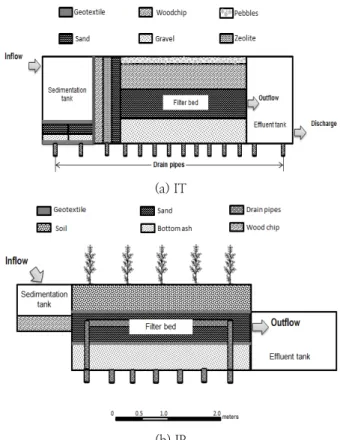
National University, Cheonan City, Chungnam Province, South Korea. The schematic diagram of the media filter arrangement and facilities’ distinct components were illustrated in Fig. 1.
The LID facilities were both divided in three treatment zones:
sedimentation tank, filter bed, and effluent tank. The sedimentation tank, which allows pre-treatment of stormwater runoff, was consisted of sand and gravel in IT and woodchip in IP. The vertical media filters of IT were consisted of woodchip, zeolite and sand which were incorporated for the adsorption, reduction of flow rates, and to enhance the sediment control.
Woodchip has an advantage on nitrogen removal because of its carbon source that enhances nitrification, but it was supported by other media filters since it also contains organic components which can lead pollutant leaching problems (Chen et al., 2013). The filter bed in IT was composed of pebbles, woodchip, sand and gravel, whereas IP’s filter bed was made of soil, sand and bottom ash. Gravel filters are highly effective in removing suspended solids, while plants contribute to the nutrient uptake in stormwater (Hatt et.
al, 2006). IT has a storage capacity of 3.54m3 designed to capture runoff from its adjacent road with an area of 371 m2, while IP has a storage capacity of 2.88 m3 that captures runoff from a parking lot with an area of 481 m2. The characteristics of the catchment area and facility characteristics were summarized in Table 1.
(a) IT
(b) IP
Fig. 1. Schematic diagram of LID technologies.
2.2 Data gathering and analyses
A total of 52 storm events from May 2009 to August 2018 and 22 storm events from May 2014 to July 2016 were monitored to assess the performance of IT and IP, respectively. First influent samples were collected as soon as the runoff entered the LID facilities, followed by collecting samples at 5, 10, 15, 30 and 60 min. After first hour of sampling, samples were collected for each succeeding hour throughout the rainfall duration.
Continuous measurement of inflow and outflow rates was also performed every five minutes during the rainfall duration.
Standard methods for the examination of water and wastewater were employed to assess the water quality of the collected samples (APHA et al., 1992). Total suspended solids (TSS), total nitrogen (TN), total phosphorus (TP), nitrate-nitrogen (NO3-N, NO2-N, NH4-N, and orthophosphate (PO4-P) were among the water quality parameters examined. Primary hydrologic data such as rainfall depth and rainfall duration were obtained from Korea Meteorological Administration. The collected stormwater runoff was evaluated by calculating the event mean concentration (EMC) and pollutant loads. Organic nitrogen and phosphorus were obtained by subtracting TN and TP with their inorganic forms. Equations 1 to 3 provided detailed calculation procedure for determining the EMC, pollutant load and mass removal efficiency, respectively.
∑
∑
(1)
∑ (2)
∑
∑ ∑
(3)
Where Cin(t) and Cout(t) denoted the pollutant concentrations of the influent and effluent, respectively, and qin(t) and qout(t) represented the inflow and outflow rates at time t, respectively.
3. Results and Discussion
3.1 Characteristics of monitored storm events Monitored rainfall events during the months of June to August constituted 38% and 55% of total monitored storm events of IT and IP, respectively. Summer season (June to August) corresponds to the wettest season in South Korea, characterized by high rainfall depths and frequency (Geronimo et al., 2013).
From 2008 to 2018, the observed precipitation for the summer season ranged from 1 mm to 90 mm. Moreover, lower antecedent dry days (ADD) ranging from 0.7 day to 16 days was recorded for summer season. Among the total monitored storm events for each facility, 40% and 36% produced outflow for IT and IP, respectively. Storm events without outflow experienced lower rainfall depths (2.8 ± 1.9 mm for IT and 10.5 ± 8 mm for IP) than events that produced outflow (12.3 ± 17.5 mm for IT and 24.1 ± 10.3 mm for IP). On cases where the facilities produced outflow, IT and IP exhibited runoff reduction ranging from 4% to 87% and 81% to 96%, respectively.
Both facilities were equipped with sedimentation tank, thereby allowing greater storage volume to accommodate stormwater runoff. However, IP has higher SV/CA ratio (1:105) as compared with the IT (1:167), resulting to a more efficient runoff retention and detention. Additionally, longer HRT was observed in IP as compared with IT. The mean HRT observed in IP amounted to 1.5 ± 2 hours, which was 1.07 times greater than the IT’s (1.4 ± 1.2 hours). Based on the analyses of rainfall and runoff duration, IP can store higher stormwater volume than IT because of its larger storage capacity. The characteristics of hydrologic and hydraulic monitored storm events were summarized in Table 2.
3.2 Transport and fate of nutrients before and after LID
Significant amount of pollutants including N and P existed Table 1. Summary of the characteristics of the LID
Parameter Unit LID
IT IP
Year constructed - 2009 2014
Media - Sand, gravel, woodchip, zeolite Sand, bottom ash, soil, woodchip
Runoff source - Road Parking lot
Dimension, (L × W × H) m 5 × 1.2 × 1.3 6 × 1.2 × 1.2
Pre-treatment volume m3 0.81 0.14
Catchment area m2 371 481
SA/CA % 1.29 1.21
SV/TV % 0.15 0.31
SV/CA % 0.95 0.60
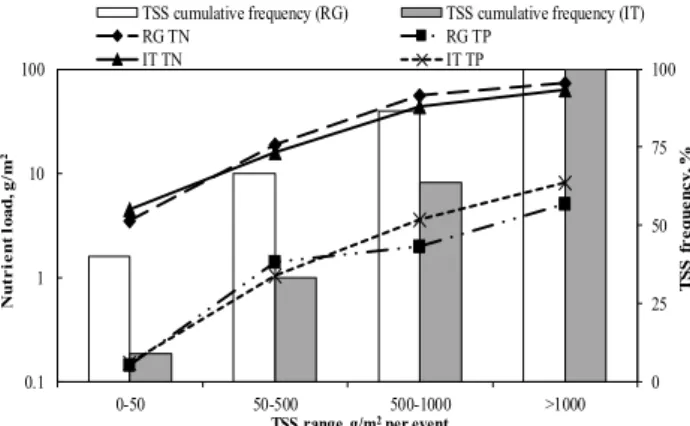
in sediments and transported in water bodies through runoff (Chow et al., 2015). As exhibited in Figure 2, the influent TSS load entering IT and IP ranged from 1 to 10662 g/m2 and 0.9 to 4243 g/m2, respectively. Calculated amount of TN and TP for IT and IP have an average of 40.8 g/m2 and 4.3 g/m2; 27 g/m2 and 1.5 g/m2, respectively. TSS ranging from 0-50 g/m2 occurred most frequently in IP while TSS greater than 1000 g/m2 occurred the most in IT. Further analysis revealed that the influent nutrient concentration in IT was higher as compared with IP’s influent due to greater vehicular and anthropogenic activities such as waste gas and residues in IT’s catchment area (Khatri et al., 2015).
0 25 50 75 100
0.1 1 10 100
0-50 50-500 500-1000 >1000
TSS frequency, %
Nutrient load, g/m2
TSS range, g/m2per event
TSS cumulative frequency (RG) TSS cumulative frequency (IT)
RG TN RG TP
IT TN IT TP
Fig. 2. Pollutant load before LID.
Figure 3 illustrated the box plot of inflow (EMCin) and outflow (EMCout) EMC of the monitored storm events for IT and IP.
It was observed that the pollutant concentrations of TP and TSS were reduced by 76% and 83% for IT and 99% and 98.7%
for IP. P was adsorbed easily by sediments through ion exchange (Kim et al., 2003). IP has a larger filter bed volume (10.65 m3) than IT (6.8 m3), which resulted to a higher filtration capacity of solids and removal efficiency of TSS. Organic nutrients were found to be dominantly present in an urban stormwater. Org-N has an average EMCin of 5.8 ± 3.8 mg/L and 4.5 ± 3.3 mg/L;
average EMCout of 4.9 ± 3.7 mg/L and 2.5 ± 2.6 mg/L for IT and IP respectively. While, org-P have an average EMCin
of 1.0 ± 1.0 mg/L and 0.7 ± 0.6 mg/L; an average EMCout
of 0.8 ± 1.7 mg/L and 0.5 ± 0.6 mg/L for IT and IP, respectively.
Generally, IT and IP decreased 15% and 43% of org-N and 24% and 21% of org- P, respectively.
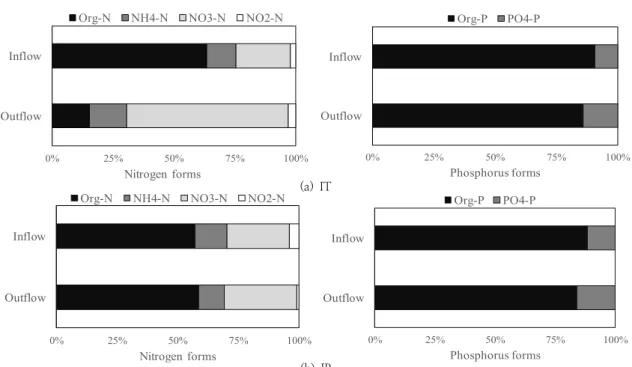
The average form of N and P concentrations for inflow and outflow in LID were illustrated in Figure 4. Generally, the concentrations of different nitrogen constituents were reduced by 5.8 mg/L to 0.4 mg/L. However, the NH4-N, NO3-N, and NO2-N fractions increased by 3%, 44% and 0.8%, respectively, after receiving treatment in IT. Nitrification occurred in IT and particulate forms of nitrogen were removed through sedimentation and filtration. In IP, NH4-N and NO2-N decreased by 2.6% and 3.2%, respectively, and NO3-N Table 2. Summary of monitored storm events
Facility
Parameter
unit nd ADD Rainfall
depth Rainfall
intensity HRT Rainfall
duration Runoff duration
day mm mm/hr hr hr hr
IT
With outflow
Mina
21
0.5 1.5 0.6 0.1 0.9 0.4
Maxb 16.2 90.5 11.3 5.4 8.7 7.4
Median 4.8 6.5 1.7 1.5 3.9 3
Mean ± Std. devc 5.3 ± 3.6 12.3 ± 17.5 3.2 ± 3.3 1.4 ± 1.2 4 ± 2.2 3.2 ± 1.9
Without outflow
Mina
31
0.3 1.0 0.4 - 1.0 0.5
Maxb 9.9 6.5 3.5 - 11.0 2.0
Median 3.7 1.5 0.7 - 3.0 1.0
Mean ± Std. devc 5.1 ± 3.5 2.8 ± 1.9 1 ± 0.9 - 3.8 ± 3 1.1 ± 0.5
IP
With outflow
Mina
8
0.2 7.5 2.0 0.2 1.1 0.4
Maxb 7.1 40.3 22.2 6.3 13.1 7.9
Median 2.9 25.0 9.4 0.6 2.3 1.5
Mean ± Std. devc 3.6 ± 2.4 24.1 ± 10.3 10.8 ± 8.1 1.5 ± 2 4.1 ± 3.8 2.8 ± 2.6
Without outflow
Mina
14
0.8 0.5 0.4 - 0.9 0.4
Maxb 20.2 28.0 27.2 - 11.0 8.0
Median 4.8 9.0 1.9 - 3.0 2.0
Mean ± Std. devc 6.6 ± 5.1 10.5 ± 8 3.8 ± 6.6 - 5 ± 3.6 3 ± 2.2
aMinimum; bMaximum; cStandard deviation; dnumber of events
increased by 4.2% which indicated that effective nitrification and denitrification occurred within IP. Though TP was generally reduced on both facilities, PO4-P concentration increased after passing in LID facilities. The increased in PO4-P concentration can be attributed to the pollutant leaching from the media filters. On the other hand, particulate forms of P were removed
mainly through physical filtration and sedimentation mechanisms.
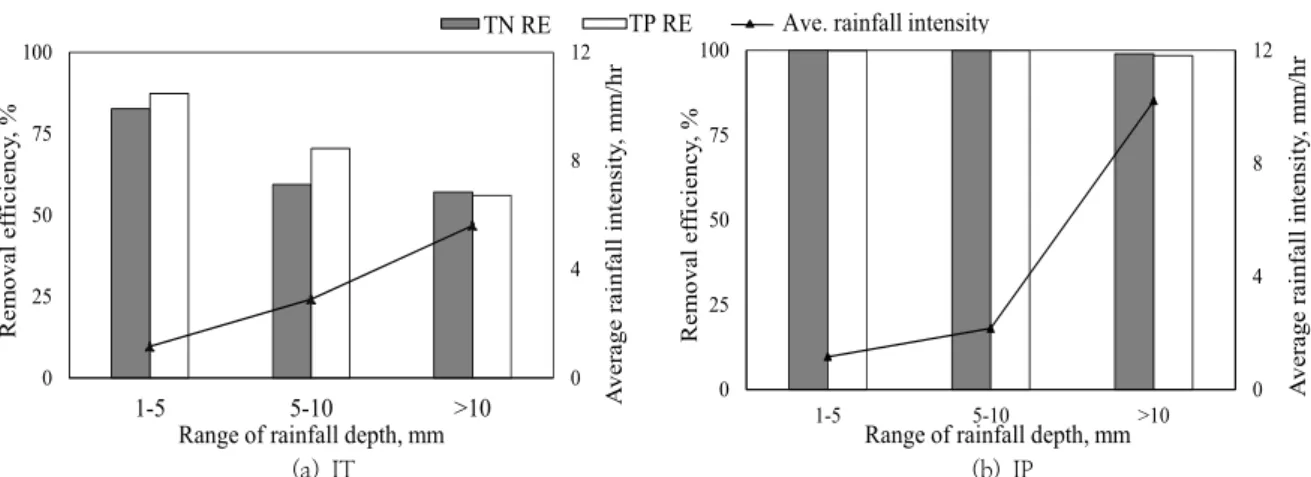
3.3 Comparison of stormwater treatment performance Figure 5 shows the trend between the amount of rainfall and the efficiency of the facilities in removing nutrients in urban
0.0001 0.001 0.01 0.1 1 10 100 1000 10000
1 2 3 4 5 6 7 8 9 10 11 12 13 14 15 16 17 18
Event mean concentration, mg/L
TSS TN NO2-N NO3-N NH4-N Org-N TP PO4-P Org-P
Inflow Outflow
maximum
median 25thpercentile 75th percentile
mean minimum
(a) IT
0.0001 0.001 0.01 0.1 1 10 100 1000 10000
1 2 3 4 5 6 7 8 9 10 11 12 13 14 15 16 17 18
Event mean concentration, mg/L
TSS TN NO2-N NO3-N NH4-N Org-N TP PO4-P Org-P
Inflow Outflow
(b) IP
Fig. 3. Characteristics of event mean concentration of pollutants.
0% 25% 50% 75% 100%
Outflow Inflow
Nitrogen forms
Org-N NH4-N NO3-N NO2-N
0% 25% 50% 75% 100%
Outflow Inflow
Phosphorus forms Org-P PO4-P
(a) IT
0% 25% 50% 75% 100%
Outflow Inflow
Nitrogen forms
Org-N NH4-N NO3-N NO2-N
0% 25% 50% 75% 100%
Outflow Inflow
Phosphorus forms Org-P PO4-P
(b) IP
Fig. 4. Average forms of nitrogen and phosphorus for inflow and outflow in LID.
stormwater runoff. Both LID facilities exhibited decreasing pollutant removal performance at increasing rainfall depth.
The greatest monitored rainfall intensity of 11 mm/hr for IT yielded to 34% and 55% removal efficiencies for TN and TP, respectively, whereas, low rainfall intensities resulted to 100 % removal efficiency. The greatest monitored rainfall intensity for IP was 27 mm/hr, which still resulted to high removal efficiencies of 98% and 97% for TN and TP, respectively. This result indicated that a 5-year old LID facility (IP) yielded higher pollutant removal efficiency than a 10-year old facility (IT). Older facility experienced more rainfall events, thus more sediment passed and trapped in IT than IP. Clogging of sediments over time reduces infiltration rate during rainfall events despite of being a well-designed system (Mercado et al., 2013).
3.4 Comparison to other studies
The removal efficiency of TSS, TN, and TP together with
the corresponding site characteristics from different studies were provided in Table 3. The site monitored in USA exhibited low TP removal due to initial TP concentration were relatively low and can be subjected to irreducible concentration (Brown et al., 2012). The site in Australia indicated that ADD period influenced the treatment performance of the facility by affecting the moisture in filter media and its ability to retain volume.
On the other hand, hydrologic factors such as precipitation, ADDs and rainfall duration mostly affected the pollutant removal in the site at China. Dierkes et al., 2015 mentioned that the range of removal efficiencies listed under the study in Germany is considered relatively high. All mentioned sites, including the site in this study, have similar volume reduction, nutrient uptake and pollutant removal functions (Oregon State University et al., 2006). The efficiency of an LID in reducing pollutant varies with the hydrologic parameters, composition of media filters and source of runoff. Overall, other sites were efficient in reducing pollutant in stormwater.
0 4 8 12
0 25 50 75 100
1-5 5-10 >10 Aver
age rainfall intensity, mm/hr
Removal efficiency, %
Range of rainfall depth, mm
0 4 8 12
0 25 50 75 100
1-5 5-10 >10
Average rainfall intensity, mm/hr
Removal efficiency, %
Range of rainfall depth, mm TN RE TP RE Ave. rainfall intensity
(a) IT (b) IP Fig. 5. Relationship between rainfall depth and nutrient removal efficiency.
Table 3. Removal efficiency of TSS, TN and TP of other studies
Country Germany Australia China USA South Korea
Reference Dierkes et al., 2015 Mangangka et al.,
2017 Jiang et al., 2017 Brown et al.,
2012 This study
LID/BMP Bioretention systems Bioretention basins Rain Garden Bioretention cell Infiltration trench Rain Garden Runoff source Road, commercial,
industrial
Residential
(52% impervious) Roof Parking lot Road Parking lot
Catchment
area, m2 - 6530 288 6800 371 481
Filter media Soil - Clay, silt, sand - Sand, gravel,
woodchip, zeolite
Sand, bottom ash, soil, woodchip
Surface area, m2 - - 24 425 4.8 7.2
Parameter Removal efficiency, %
TSS 50 to 90 80 - 79 84 98
TN 10 to 40 48 83 35 71 95
TP 30 to 60 75 80 12 76 94
4. Conclusion
The application of LID technologies generally improved the quality of urban stormwater. Hydrologic factors including rainfall depth and rainfall intensity affected nutrient treatment in urban stormwater runoff. Greater rainfall depths and intensity resulted to a lower pollutant removal performance due to the increase in hydraulic loading rate. The amount of sediments accumulated in the catchment areas during the period of dry days can also influence the nutrient concentration in stormwater, since particulate forms of nitrogen and phosphorus were attached on sediments. Analyses of various nitrogen forms indicated that IP exhibited better nitrification and denitrification mechanisms as compare with IT. Additionally, IP was found to be more efficient than IT in terms of nitrogen and phosphorus removal. Overall, both LID technologies were effective in treating nutrients in stormwater. Ultimately, several factors including runoff type, catchment area characteristics, and target pollutants should be considered in selection of LID facility of a certain environment.
Acknowledgement
This work was supported by Korea Environment Industry
& Technology Institute (KEITI) through Public Technology Program based on Environmental Policy Project, funded by Korea Ministry of Environment(MOE) under project code 2016000200002. The authors are grateful for their support.
References
A., A., Wef, C., & E., A. (1992). Standard methods for the examination of water and wastewater. Washington, DC:
APHA, AWWA & WEF.
Akan, A. O. (2002). Modified rational method for sizing infiltration structures. Canadian Journal of Civil Engineering, 29(4), 539-542.
Brown, R. A., & Hunt, W. F. (2012). Improving bioretention/
biofiltration performance with restorative maintenance. Water Science and Technology, 65(2), 361-367.
Chen, Y., Cheng, J., Niu, S., & Kim, Y. (2013). Evaluation of the different filter media in vertical flow stormwater wetland. Desalination and Water Treatment, 51(19-21), 4097-4106.
Chow, M. F., Yusop, Z., & Abustan, I. (2015). Relationship between sediment build-up characteristics and antecedent dry days on different urban road surfaces in Malaysia. Urban Water Journal, 12(3), 240-247.
Dierkes, C., Lucke, T., & Helmreich, B. (2015). General
technical approvals for decentralised sustainable urban drainage systems (SUDS)―The current situation in Germany. Sustainability, 7(3), 3031-3051.
Fadiran, A. O., Dlamini, S. C., & Mavuso, A. (2008). A comparative study of the phosphate levels in some surface and ground water bodiesof Swaziland. Bulletin of the Chemical Society of Ethiopia, 22(2).
Fletcher, T. D., Shuster, W., Hunt, W. F., Ashley, R., Butler, D., Arthur, S., ... & Mikkelsen, P. S. (2015). SUDS, LID, BMPs, WSUD and more–The evolution and application of terminology surrounding urban drainage. Urban Water Journal, 12(7), 525-542.
Geronimo, F. K. F., Maniquiz-Redillas, M. C., & Kim, L.
H. (2013). Treatment of parking lot runoff by a tree box filter. Desalination and water treatment, 51(19-21), 4044-4049.
Hatt, B. E., Siriwardene, N., Deletic, A., & Fletcher, T. D.
(2006). Filter media for stormwater treatment and recycling: the influence of hydraulic properties of flow on pollutant removal. Water Science and Technology, 54(6-7), 263-271.
Jiang, C., Li, J., Li, H., Li, Y., & Chen, L. (2017). Field performance of bioretention systems for runoff quantity regulation and pollutant removal. Water, Air, & Soil Pollution, 228(12), 468.
Khatri, N., & Tyagi, S. (2015). Influences of natural and anthropogenic factors on surface and groundwater quality in rural and urban areas. Frontiers in Life Science, 8(1), 23-39.
Kim, L. H., Choi, E., & Stenstrom, M. K. (2003). Sediment characteristics, phosphorus types and phosphorus release rates between river and lake sediments. Chemosphere, 50(1), 53-61.
Mangangka, I. R., Liu, A., Egodawatta, P., & Goonetilleke, A. (2015). Performance characterisation of a stormwater treatment bioretention basin. Journal of environmental management, 150, 173-178.
Maniquiz, M. C., Kim, L. H., Lee, S., & Choi, J. (2012). Flow and mass balance analysis of eco-bio infiltration system. Frontiers of Environmental Science & Engineering, 6(5), 612-619.
Maniquiz-Redillas, M. C., & Kim, L. H. (2016). Understanding the factors influencing the removal of heavy metals in urban stormwater runoff. Water Science and Technology, 73(12), 2921-2928
Mercado, J. M. R., Geronimo, F. K. F., Choi, J., Song, Y.
S., & Kim, L. H. (2012). Characteristics of stormwater runoff from urbanized areas. Journal of Wetlands Research, 14(2), 159-168.
Mercado, J. M. R., Maniquiz-Redillas, M. C., & Kim, L.
H. (2015). Laboratory study on the clogging potential of
a hybrid best management practice. Desalination and Water Treatment, 53(11), 3126-3133.
Oregon State University; Geosyntec Consultants; University of Florida; Low Impact Development Center. Inc. (2006).
Evaluation of Best Management. Washington D.C.:
Transportation Research Board.
Reyes, N. J. D. G., Geronimo, F. K. F., Choi, H. S., & Kim, L. H. (2018). Performance assessment of an urban stormwater infiltration trench considering facility maintenance. Journal of Wetlands Research, 20(4), 424-431.
Yang, Y. Y., & Toor, G. S. (2017). Sources and mechanisms of nitrate and orthophosphate transport in urban stormwater runoff from residential catchments. Water research, 112, 176-184.
<저자소개>
Kimberly Ann Yano Kongju National University
Graduate student / [email protected] Franz Kevin Geronimo
Kongju National University
Ph.D. candidate / [email protected] Nash Jett Reyes
Kongju National University
Graduate student / [email protected] Minsu Jeon
Kongju National University
Graduate student / [email protected],kr Leehyung Kim
Kongju National University Professor / [email protected]