Received May 13, 2016 / Revised May 30, 2016 / Accepted June 1, 2016 Corresponding Author: Eunsung Lee
Center for Self-assembly and Complexity, Institute for Basic Science, Department of Chemistry, Pohang University of Science and Technology, Division of Advanced Materials Science, Pohang University of Science and Technology, 77 Cheongam-Ro, Nam-gu, Pohang 37673, Korea
Tel: +82-54-279-2111, Fax: +82-54-279-8129, E-mail: [email protected] Copyright ⓒ 2016, The Korean Society of Radiopharmaceuticals and Molecular Probes
JRMP
Theoretical study on electronic properties of deoxyfluorinating sulfur-based reagents
Soobin Lim1,2, and Eunsung Lee1,2,3*
1Center for Self-assembly and Complexity, Institute for Basic Science (IBS), 2Department of Chemistry, 3Division of Advanced Materials Science, Pohang University of Science and Technology, Pohang, Korea
ABSTRACT Organofluorine compounds have become increasingly important as pharmaceuticals, radiopharmaceuticals, agrochemicals, and material science. Recent advances on the efficient introduction of fluorine to organic molecules are mainly results of development of transition metal catalysts and fluorination reagents. Among the various fluorination reagents, we have been interested in developing more efficient sulfur-based deoxy- fluorinating reagents. Here we report various electronic properties of five popular sulfur-based deoxyfluori- nating reagents using density functional theory calculation. We believe that the theoretical study on the re- agents will assist the rational design of new deoxyfluorinating reagents.
J Radiopharm Mol Prob 2(1):51-55, 2016
Key Words: Organofluorine, Deoxyfluorination, Density Functional Theory, Aminosulfur fluoride
Introduction
불소가 도입된 유기화합물은 안정성, 친지방성, 방수성 등의 성질을 지니기 때문에 약학, 농약학, 및 재료화학 등 의 다양한 분야에서 촉망받고 있다(1,2). C-F 결합은 특히 약물 설계에서 신진대사 내에서의 안전성, 용해도 그리고 약의 활성에 상당히 큰 기여를 한다(3). 또한 fluorine-18은 반감기가 약 109분으로 방사성 탄소, 질소, 혹은 산소에 비해 상대적으로 긴 반감기를 가지고 있으며 양전자단층 촬영(Positron emission tomography, PET)에서 깔끔한 이미 지를 얻을 수 있다는 장점으로 인해 PET tracer로 많이 활 용된다(4).
하지만 유기불소화합물은 자연적으로 오직 30여개 정 도만 존재한다(5). 목적하는 유기불소화합물을 합성하기 위해 천연 유기불소화합물로부터 변환 반응하는 것은 극
히 제한적이다. 따라서 C-F 결합을 형성하기 위해 친핵성 불소화 시약, 친전자성 불소화 시약 등 다양한 시약과 그 와 관련된 반응들이 연구되어 왔다(6). 특히 지방족 화합 물은 알코올을 포함하고 있는 물질이 흔하게 존재하여 알 코올을 이용한 데옥시불소화 반응이 유리하다(7-9). 1970 년에 diethylaminosulfur trifluoride (DAST)가 데옥시불소화 반응을 위한 시약으로 발표되었으며, 이는 알코올뿐만 아 니라 케톤 혹은 알데히드 계열에도 적용될 수 있다(7b, c).
같은 황 기반의 시약으로 bis(2-methoxyethyl)aminosulfur trifluoride (Deoxo-Fluor®), (diethylamino)difluorosulfonium tetrafluoroborate (XtalFluor-E®), difluoro(morpholino)sulfonium tetrafluoroborate (XtalFluor-M®) 그리고 2-pyridinesulfonyl Fluoride (PyFluor)가 있다(Figure 1, Scheme 1). 지금까지 PyFluor를 제외한 시약들은 메커니즘이 제시되었으며, 시 약의 친전자성 황이 알코올의 친핵성 산소와 상호작용하
Scheme 1. Deoxyfluorination. aDAST, Deoxo-Fluor®, XtalFluor-E® or XtalFluor-M®. bPyFluor.
Figure 1. Examples of sulfur-based deoxyfluorinating reagents.
A B C
D E
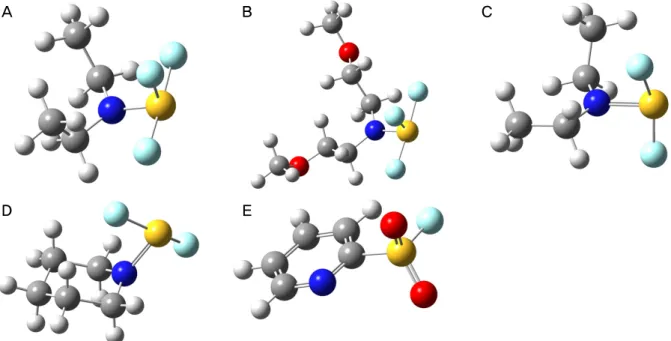
Figure 2. Optimized molecular structures of deoxyfluorinating reagents with B3PW91. (Deep gray=C, week gray=H, deep blue=N, yellow=S, week blue=F, red=O.) (a) DAST. (b) Deoxo-Fluor®. (c) XtalFluor-E®. (d) XtalFluor-M®. (e) PyFluor.
며 반응이 시작된다(10). 이번 논문에서는 황의 친전자성 성질을 확인하고, 시약의 구조적 특성을 파악하기 위해 밀 도범함수이론(Density Functional Theory, DFT) 계산을 진행 해 보았다.
Materials and Methods
계산을 위해서 Gaussian09 프로그램을 사용하고, B3PW91 함수를 인용하였다. 특히 황 원소에 대해서는 10개의 핵심 부 전자를 가지고 있어 (4s4p)/[2s2p], MWB10의 바탕 함수 (basis set) 집합과 분극화된 정도는 d 오비탈, 0.503값을 사 용하여 계산하였다. 나머지 원소에 대해서는 6-31G(d,p) 의 바탕 함수 집합을 사용하였다(11). 각각의 deoxy- fluorinating 화합물들의 분자 구조 뿐 만 아니라 각 분자 내 원소들의 친전자도와 각 분자의 highly occupied mo- lecular orbitals (HOMO)와 lowest unoccupied molecular or- bitals (LUMO) 모양도 계산하였다.
Results
각 원소에 적합한 바탕 함수 집합을 사용하여 Gaussian09 프로그램으로 최적화된 분자 구조를 얻었다(Figure 2). 황 과 그에 근접한 원소들의 친전자도를 멀리켄 전하 분포 를 통해 알아본 결과 황의 전자 밀도가 확연하게 낮음을
A B C
D E
Figure 3. Mulliken charge distribution of deoxyfluorinating reagents. The green color represents an electrophilic character and the red one represents a nucleophilic character. The numbers near sulfur represent Mulliken charge distribution. (A) DAST. (B) Deoxo-Fluor®. (C) XtalFluor-E®. (D) XtalFluor-M®. (E) PyFluor.
Table 1. Mulliken charge distributions of key elements in deoxyfluorinating reagents
DAST Deoxo-Fluor® XtalFluor-E® XtalFluor-M® PyFluor
S 0.910 0.912 0.841 0.840 0.864
N (or C) -0.401 -0.420 -0.241 -0.239 0.177
F1 -0.370 -0.367 -0.282 -0.291 -0.263
F2 (or O1) -0.363 -0.359 -0.277 -0.270 -0.380
F3 (or O2) -0.277 -0.276 N/A N/A -0.377
확인할 수 있다(Figure 3, Table 1).
또한 각각의 deoxyfluorinating 화합물들의 정밀한 반응 성을 연구하기 위하여 HOMO와 LUMO의 모양을 계산해 보았다(Figure 4).
Discussion
데옥시불소화 반응의 첫 단계는 친핵성인 알코올의 산 소와 친전자성인 시약의 황이 반응하는 것이며(Scheme 2), 이 때 황이 친전자성인 것은 HOMO와 LUMO의 오비탈 구조로 확인할 수 있다. DAST와 Deoxo-Fluor®의 경우, 황 을 중심으로 오비탈 분포를 보았을 때 HOMO 보다 LUMO 에서 분자의 바깥쪽 오비탈이 더 커진 것을 확인할 수 있 었다. 중심 원자에서 HOMO가 크다는 것은 친핵성의 성 질이 더 크다는 것을 의미하고, LUMO가 크다는 것은 반 대로 친전자성의 성질이 더 큼을 의미한다. 따라서 황이
친핵성보다는 친전자성의 성질을 가지고 있음을 알 수 있다. XtalFluor-E®와 XtalFluor-M®의 경우 또한 황을 기준 으로 보았을 때 LUMO가 분자의 중심에서 바깥쪽으로 넓 게 뻗어있는 형태이고 전자를 더 잘 받을 수 있는 구조임 을 확인할 수 있다. 반면에 PyFluor는 HOMO와 LUMO로 는 황의 친핵성 혹은 친전자성의 성질을 확인할 수 없었 다. 아직까지 메커니즘이 밝혀지지 않았고, 다른 황기반 의 데옥시불소화 시약과는 달리 황에 두 개의 산소가 결 합되어 있는 형태이기 때문일 것으로 추측된다. PyFluor 에 대해서만 추가적으로 HOMO-1, HOMO-2, LUMO+1, LUMO+2를 살펴보았으며, LUMO+2를 제외한 HOMO-2, HOMO-1, HOMO, LUMO, LUMO+1의 경우에는 오비탈이 벤젠고리를 중심으로 형성되어 있는 것을 확인하였다. 반 면 황을 중심으로 분자 바깥쪽으로 뻗은 LUMO+2을 통 해 친전자성을 확인할 수 있었다(Figure 5).
Figure 5. HOMO-1, HOMO-2, LUMO+1 and LUMO+2 of PyFluor. (Deep gray=C, week gray=H, deep blue=N, deep yellow=S, week yellow=F, red=O.)
A B
C D
E
Figure 4. HOMOs and LUMOs of deoxyfluorinating reagents. (Deep gray=C, week gray=H, deep blue=N, deep yellow=S, week yellow=F, red=O.) (a) HOMO and LUMO of DAST. (b) HOMO and LUMO of Deoxo-Fluor®. (c) HOMO and LUMO of XtalFluor-E®. (d) HOMO and LUMO of XtalFluor-M®. (e) HOMO and LUMO of PyFluor.
Conclusion
C-F결합의 경우 상대적으로 긴 반감기를 가진 fluorine-18 을 적용시킬 수 있다는 점, 생체 내에서의 안정성과 약물 의 반응성을 증가시킨다는 점 등으로 인해 약학, 방사화 학 등에서 많이 응용되고 있다. 결론적으로 지방족 화합 물에 C-F 결합을 형성시키기 위해서는 알코올을 이용한
데옥시불소화 반응이 유리하며, 이때 사용되는 다양한 황 기반의 데옥시불소화 시약들의 전자적인 성질을 Gaussian 프로그램을 통해서 살펴보았고, 이러한 계산을 통해서, 다양한 불소화 시약들의 특성을 유추하고 반응성을 예측 하는 데 많이 활용될 것으로 기대된다.
Acknowledgments
이 연구는 기초과학연구원(IBS-R007-D1)의 지원을 받아 수행되었다.
References
1. (a) Wang J, Sánchez-Roselló M, Aceña JL, del Pozo C, Sorochinsky AE, Fustero S, Soloshonok VA, Liu H. Fluorine in pharmaceut- ical industry: fluorine-containing drugs introduced to the market in the last decade (2001-2011). Chem Rev 2014;114:2432-2506.
(b) Ilardi EA, Vitaku E, Njardarson JT. Data-mining for sulfur and fluorine: an evaluation of pharmaceuticals to reveal oppor- tunities for drug design and discovery. J Med Chem 2014;57:
2832-2842. (c) Jeschke P. The unique role of fluorine in the de- sign of active ingredients for modern crop protection. Chembiochem 2004;5:571-589.
2. O'Hagan D. Understanding organofluorine chemistry. An in-
troduction to the C-F bond. Chem Soc Rev 2008;37:308-319.
3. Purser S, Moore PR, Swallow S, Gouverneur V. Fluorine in me- dicinal chemistry. Chem Soc Rev 2008;37:320-330.
4. Tredwell M, Gouverneur V. 18F Labeling of arenes. Angew Chem Int Ed Engl 2012;51:11426-11437.
5. Gribble GW. Natural organohalogens: a new frontier for medici- nal agents? J Chem Ed 2004;81:1441-1449.
6. Furuya T, Kuttruff CA, Ritter T. Carbon-fluorine bond formation.
Curr Opin Drug Discov Devel 2008;11:803-819.
7. (a) Hasek WR, Smith WC, Engelhardt VA. The chemistry of sul- fur tetrafluoride. II. The fluorination of organic carbonyl com- pounds. J Am Chem Soc 1960;82:543. (b) Middleton WJ. Tetra- fluorodithiosuccinyl difluoride. J Org Chem 1975;40:574. (c) Markovskij LN, Pashinnik VE, Kirsanov AV. Application of Dia- lkylaminosulfur Trifluorides in the Synthesis of Fluoroorganic Compounds. Synthesis 1973;12:787. (d) Lal GS, Pez GP, Pesaresi RJ, Prozonic FM, Cheng H. Bis(2-methoxyethyl)aminosulfur tri- fluoride: a new broad-spectrum deoxofluorinating agent with en- hanced thermal stability. J Org Chem 1999;64:7048. (e) Beaulieu F, Beauregard LP, Courchesne G, Couturier M, LaFlamme F, L’Heureux A. Aminodifluorosulfinium tetrafluoroborate salts as stable and crystalline deoxofluorinating reagents. Org Lett 2009;
11:5050-5053. (f) Umemoto T, Singh RP, Xu Y, Saito N. Discov- ery of 4-tert-butyl-2,6-dimethylphenylsulfur trifluoride as a deoxofluorinating agent with high thermal stability as well as un-
usual resistance to aqueous hydrolysis, and its diverse fluorina- tion capabilities including deoxofluoro-arylsulfinylation with high stereoselectivity. J Am Chem Soc 2010;132:18199-18205.
8. (a) Hayashi H, Sonoda H, Fukumura K, Nagata T.
2,2-Difluoro-1,3-dimethylimidazolidine (DFI). A new fluorinat- ing agent. Chem Commun 2002;15:1618. (b) Sladojevich F, Arlow SI, Tang P, Ritter T. Late-stage deoxyfluorination of alco- hols with PhenoFluor. J Am Chem Soc 2013;135:2470-2473.
9. (a) Shimizu M, Nakahara Y, Yoshioka H. Chemoselective fluori- nation for primary alcohols. Tetrahedron Lett 1985;26:4207. (b) Bennua-Skalmowski B, Vorbrüggen H. A facile conversion of primary or secondary alcohols with n-perfluorobutane-sulfonyl fluoride/1,8-diazabicyclo[5.4.0]undec-7-ene into their corre- sponding fluorides. Tetrahedron Lett 1995;36:2611.
10. (a) Rozen S, Faust Y, Ben-Yakov H. A new method for fluorina- tion of sterols. Tetrahedron Lett 1979;20:1823-1826. (b) Singh RP, Shreeve JM. Recent Advances in Nucleophilic Fluorination Reactions of Organic Compounds Using Deoxofluor and DAST.
Synthesis 2002;17:2561-2578. (c) Ishii S, Niwa Y, Watanabe S.
Deoxyfluorination of a-N-phthaloyl cycloalkanones with bis(2- methoxyethyl)aminosulfur trifluoride (Deoxo-Fluor®). J Fluorine Chemistry 2016;182:41-46.
11. Frisch MJ, et al. Gaussian 09, Revision B.01. Gaussian, Inc., Wallingford CT, 2010.