화이트레그혼 대리난각 배양에 의한 오계 배아 발생
최희정1․강경수1․이형철1․이효건1․Deivendran Rengaraj1․박태섭1,2․한재용1,†
1서울대학교 농생명공학부 바이오모듈레이션 전공,2서울대학교 그린바이오과학기술연구원
Normal Development and Hatchability of Korean Oge Chickens in White Leghorn Surrogate Eggshells
Hee Jung Choi1, Kyung Soo Kang1, Hyung Chul Lee1, Hyo Gun Lee1, Deivendran Rengaraj1, Tae Sub Park1,2 and Jae Yong Han1,†
1
Major in Biomodulation, Department of Agricultural Biotechnology and Research Institute for Agriculture and Life Sciences, Seoul National University, Seoul 151-921, Korea
2
Institute of Green - Bio Science and Technology, Seoul National University, Pyeongchang-gun 232-916, Korea
ABSTRACT The avian embryos have been used as a good model to study embryonic development. Due to its unique development in the eggshell, avian embryos can be cultured and hatch in the surrogate eggshell system. In this study, we examined the viability, normal development and hatchability of Korean Oge (KO) chicken embryos in White Leghorn (WL) surrogate eggshells. Donor KO embryos at 3-day and 4-day-old were transferred into recipient WL eggshells, incubated for further 18 days at 37.5℃ with 70% of humidity until hatching. The viability of 3-day-old KO embryos at 7, 14 and 21 day in surrogate eggshell were 70.0%, 43.8% and 23.1%, respectively. In contrast, the viability of 4-day-old KO embryos at 7, 14 and 21 day in surrogate eggshells were 87.1%, 55.6% and 36.0%, respectively. The hatchability of KO embryos transferred into surrogate eggshells at 3-day-old was 23.1%, whereas embryos transferred at 4-day-old was 36.0%. Furthermore, the development of all viable embryos from 3-day group and 4-day group were normal. Our results suggested that culture of KO embryos in WL surrogate eggshells is highly possible, and transfer of donor embryos at 4-day-old may yield higher percentage of hatchability. This study may provide potential knowledge for the conservation of wild and endangered birds through surrogate system.
(Key words : chicken embryo, Korean Oge, White Leghorn, surrogate eggshell, hatchability)
†
To whom correspondence should be addressed : [email protected]
INTRODUCTION
Culture of avian embryos in the surrogate eggshell is an interesting investigation to study the development and hatcha- bility of avian species in this condition. In previous studies, quail embryos were successfully cultured until hatch in recipient chicken eggshells, but the percentage of hatchability was only 3% (Ono and Wakasugi, 1984). Similarly, chicken embryos were cultured in recipient turkey eggshells or chicken egg- shells, and the percentage of hatchability was 20% or 23%, respectively (Rowlett and Simkiss, 1985). Perry has developed three kinds of surrogate eggshell system for the culture of
chicken embryos from single cell stage to hatching (Perry, 1988). In that experiment, the percentage of hatchability was only 7%. Later, many researchers were attempted to increase the percentage of hatchability in surrogate eggshell system.
For instances, the culture condition of Perry’s method was
slightly modified by Naito group to increase the hatchability
up to 34% (Naito et al., 1990). Kamihira group modified Pe-
rry’s system by the addition of calcium and eggshell powder
(Kamihira et al., 1998). Surrogate eggshell system was also
improved by making optimum size of window, and sealing
the window after embryo transfer which gave 42 ∼59% of
hatchability (Borwornpinyo et al., 2005; Andatch et al., 2004).
Furthermore, Lui et al investigated surrogate system by using different eggshells or albumens from other species that pro- duced 7.7 ∼60% of hatchability (Lui et al., 2012 & 2013).
However, the knowledge regarding the development and hat- chability of avian species in different surrogate eggshell system and culture conditions are still deficient such as effectiveness of the developmental timing of donor embryos on hatchability.
The aim of this study was to investigate the optimal system for culture Korean Oge (KO) chicken embryos in White Leg- horn (WL) surrogate chicken eggshells by transfer at different periods.
MATERIALS AND METHODS
1. Experimental Animals
The care and experimental use of chickens were approved by the Institute of Laboratory Animal Resources, Seoul Na- tional University, Korea (Approval No : SNU-070823-5). KO and WL chickens were maintained according to a standard management program at the University Animal Farm, Seoul National University. The procedures for animal management, reproduction, and embryo manipulation adhered to the stan- dard operating protocols of our laboratory.
2. Preparation of Surrogate Eggshells
The recipient surrogate eggshells were prepared from freshly laid and normal-sized WL chicken eggs (65 ∼70 g). Using an electric drill, we cut the narrow ends of WL eggshells and all egg components were removed. The approximate diameter of surrogate eggshell window was 32 to 35 mm.
3. Culture of KO Chicken Embryos in WL Surrogate System
Perry has developed three surrogate systems for the culture of chicken embryos (Perry, 1988). According to Perry’s method, fertilized ova were cultured until the formation of blastoderm stage (1 day of incubation) in system I. The blastoderm stage embryos were cultured until early embryogenesis (1 ∼4 days of incubation) in system II. The 4-day-old embryos were cultured until hatch in system III (4 ∼22 days of incubation).
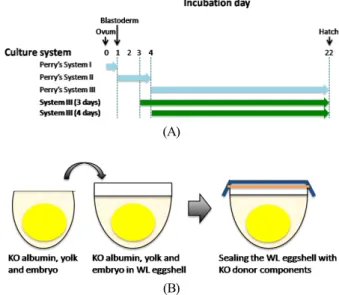
The present study was designed mainly based on Perry’s surrogate system III (Fig. 1A). Freshly laid KO eggs (38∼40
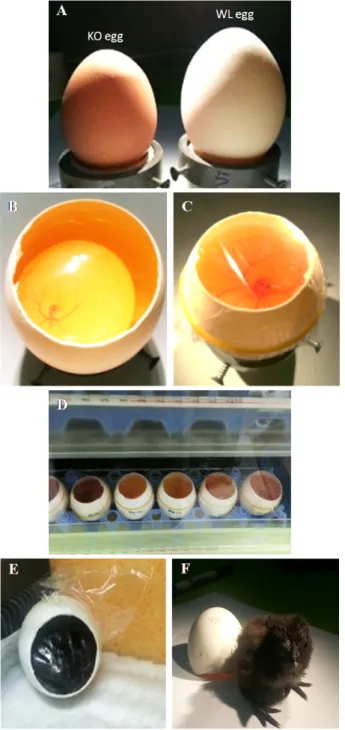
g) were incubated for 3 or 4 days. The 3-day and 4-day-old KO embryos along with albumin and yolk were carefully transferred into WL surrogate eggshells. Then, the edges of surrogate eggshell windows were sealed with cling film and tied up with a rubber band (Fig. 1B). Fig. 2 shows the original images of KO chicken culture in WL surrogate eggshells.
After transferring the KO donor components, the embryos projected with blood vessels were gently re-located to the top without damaging the airspace of the surrogate eggshells (Fig. 2B). After sealing, the eggs were incubated at 37.5℃
with 70% of humidity, and the eggs were rotated 30 degree angle at every hour (Fig. 2D). The number of live embryos was counted everyday until embryonic day 18. At embryonic day 19, the sealing film was removed and the eggs were transferred to an incubator with 37.5℃ and 60% of humidity until hatching (Fig. 2E and 2F).
RESULTS AND DISCUSSION
The present study investigated the optimal system for development and hatchability of KO chicken embryos in WL surrogate eggshells. For the fitness of development of donor embryos, WL eggshells which is larger than those of donor
(A)
(B)
Fig. 1. A) Schematic diagram of Perry’s surrogate systems and
surrogate system III (3-day-old and 4-day-old) used in this
study. B) Schematic diagram of preparation of surrogate system
for the culture of Korean Oge (KO) chickens in White Leghorn
(WL) eggshells.
Fig. 2. Culture of Korea Oge (KO) chicken embryos in White Leg- horn (WL) surrogate eggshells. (A) Eggs of KO and WL chickens.
(B) KO albumin, yolk and embryo projected with blood vessels in WL surrogate eggshell. (C) Sealing of WL surrogate eggshell with cling film. (D) Incubation of WL surrogate eggshells containing KO embryos (37.5℃ with 70% of humidity, and rotated 30° every hour. (E) Removing the cling film before hatching of the KO chick.
(F) KO chick hatched from WL surrogate eggshell.
embryos (KO) were used as a recipient for the surrogate system (Naito and Perry, 1989). Initially, KO embryos at
3-day and 4-day-old (HH stage 20 ∼24) (Hamburger and Hamilton, 1951) were transferred into WL surrogate eggshells and incubated until hatching of chicks. In this surrogate cul- ture, we monitored the development and viability of embryos, and the percentage of hatching. Most of the KO embryo development was normal in WL surrogate eggshells (Fig. 3).
For instances, feather germs were visible in the edges of wings, and eyelids were extended to eyeball at embryonic day 8. At the time close to hatching, yolk was enclosed in body cavity and chorioallantoic membrane contained less blood (Fig.
3). The viability and hatchability of KO chicken embryos in surrogate system III are shown in Table 1 and 2, respectively.
Two days of incubation after transferring the 3-day-old and 4-day-old embryos into surrogate system, their viability was 92.2% and 92.5%, respectively (Table 1). Then, a few embryos were died in the surrogate system during different develop- mental stages. Therefore, at embryonic day 14 to 21, the viability of 3-day and 4-day group was decreased from 43.8%
to 23.1% and from 55.6% to 36.0%, respectively. All viable embryos in both 3-day and 4-day group were hatched normally at embryonic day 22. However, the percentage of hatchability
Fig. 3. Normal development of Korean Oge (KO) chicken embryos
in White Leghorn (WL) surrogate eggshells. The KO embryos at
3- day and/or 4-day were transferred into WL surrogate eggshells,
and the embryo development was monitored until hatching the
chicks.
Table 1. Viability percentage of Korean Oge chicken embryos cultured in White Leghorn surrogate eggshells
Incubation day
aSurrogate system Ⅲ 3-day-old embryos(%)
b(n=84)
c4-day-old embryos(%)
b(n=76)
c3 100 -
4 95.0 100
5 92.2 94.1
6 72.8 92.5
7 70.0 87.1
8 59.3 73.7
9 59.3 70.1
10 59.3 66.3
11 55.5 58.2
12 53.0 55.6
13 48.0 55.6
14 43.8 55.6
15 39.6 53.7
16 39.6 52.1
17 34.8 52.1
18 33.4 51.1
19 33.4 48.3
20 23.1 36.0
21 23.1 36.0
22
(Hatch) 23.1(±17.5)
d36.0(±22.6)
da
Also represent the days of embryo development (Hambur- ger and Hamilton, 1951).
b
Percentage of viable KO embryos in WL surrogate egg- shells.
c
Total number of KO embryos transferred into WL egg- shell.
d
Values in brackets represent mean±S.D.
from 3-day group was 23.1% and 4-day group was 36.0%
(Table 2). These results indicates that KO embryos of different age (3-day or 4-day) could survive and develop normally in WL surrogate eggshells, but the percentage of hatchability from 3-day group and 4-day group suggests that the embryos transferred at 4-day are more stable in the
surrogate condition. Furthermore, 3-day might be not perfect Table 2. Hatchability percentage of Korean Oge chicken embryos cultured in White Leghorn surrogate eggshells
1Trials
Incubation period
3-day to hatch 4-day to hatch
n (%) n (%)
1 17 11.8 6 16.7
2 7 14.3 5 40.0
3 9 33.3 7 14.3
4 10 10.0 8 25.0
5 10 10.0 11 36.4
6 9 44.4 9 44.4
7 7 57.1 10 90.0
8 6 16.7 9 30.0
9 9 11.1 11 27.3
Mean±S.D
a23.1±17.5 36.0±22.6
a
Values represent mean±S.D.
1
Hatchability percentage was evaluated on the basis of viable embryos at 22-day of incubation.
age for transferring into surrogate system, because these em- bryos are still in the phase of early embryogenesis.
Several previous studies were also attempted to optimize
the surrogate system by applying different culture conditions
such as eggshell sizes, temperature of incubator, angle of
rotor, albumin in the eggshell, humidity etc. In comparison
with different condition of surrogate systems, also, shown
that the percentage of hatchability varied in all these trials
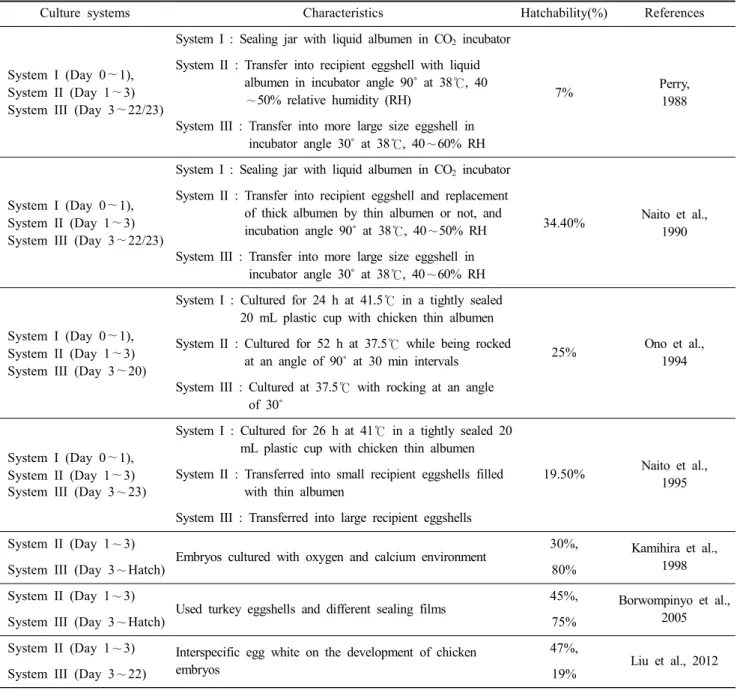
(Table 3). In this study, we wanted to identify the optimum
starting point for embryo transfer that produce higher via-
bility and hatchability. Previous studies showed that 3-day-
old embryos were easily damaged when they were transferred
(Perry, 1988). In this regard, we compared the viability from
the surrogate culture system with different developmental
timings of donor embryos. As a result, the higher percentage
of viability (36.0±22.6) was received from the 4-day group
when compared with 3-day group (23.1±17.5) (Table 2). The
percentage of hatchability was raised over 30% in certain
surrogate system used the interspecific egg white as culture
medium (Liu et al., 2012) or oxygen with calcium supplement
Table 3. Characteristics and results of different surrogate system conducted in earlier studies
Culture systems Characteristics Hatchability(%) References
System I (Day 0∼1), System II (Day 1∼3) System III (Day 3∼22/23)
System I : Sealing jar with liquid albumen in CO
2incubator
7% Perry,
1988 System II : Transfer into recipient eggshell with liquid
albumen in incubator angle 90˚ at 38℃, 40
∼50% relative humidity (RH)
System III : Transfer into more large size eggshell in incubator angle 30˚ at 38℃, 40∼60% RH
System I (Day 0∼1), System II (Day 1∼3) System III (Day 3∼22/23)
System I : Sealing jar with liquid albumen in CO
2incubator
34.40% Naito et al., 1990 System II : Transfer into recipient eggshell and replacement
of thick albumen by thin albumen or not, and incubation angle 90˚ at 38℃, 40∼50% RH System III : Transfer into more large size eggshell in
incubator angle 30˚ at 38℃, 40∼60% RH
System I (Day 0∼1), System II (Day 1∼3) System III (Day 3∼20)
System I : Cultured for 24 h at 41.5℃ in a tightly sealed 20 mL plastic cup with chicken thin albumen
25% Ono et al.,
1994 System II : Cultured for 52 h at 37.5℃ while being rocked
at an angle of 90˚ at 30 min intervals System III : Cultured at 37.5℃ with rocking at an angle
of 30˚
System I (Day 0∼1), System II (Day 1∼3) System III (Day 3∼23)
System I : Cultured for 26 h at 41℃ in a tightly sealed 20 mL plastic cup with chicken thin albumen
19.50% Naito et al., System II : Transferred into small recipient eggshells filled 1995
with thin albumen
System III : Transferred into large recipient eggshells System II (Day 1∼3)
Embryos cultured with oxygen and calcium environment
30%, Kamihira et al.,
System III (Day 3∼Hatch) 80% 1998
System II (Day 1∼3)
Used turkey eggshells and different sealing films
45%, Borwompinyo et al.,
System III (Day 3∼Hatch) 75% 2005
System II (Day 1∼3) Interspecific egg white on the development of chicken embryos
47%,
Liu et al., 2012
System III (Day 3∼22) 19%
(Kanihira et al., 1998). Also, the replacement of thick albumin by thin albumin in the surrogate eggshells produced over 30% of hatchability (Naito et al., 1990). In this study, KO embryos transferred at 4-day-old were produced over 30% of viability and hatchability. Therefore, we strongly recommend 4-day-old embryos as a stable condition for surrogate eggshell culture.
In conclusoin, KO chicken embryos are successfully trans- ferred and cultured in WL surrogate eggshells. However, the viability and hatchability of embryos transferred at 4-day-old
were higher than that of 3-day-old. Furthermore, the embryonic development of all viable embryos were normal in our surro- gate system. Our study suggests that culturing of chicken embryos from one breed in the surrogate eggshells of other breed is highly possible. This method can be also useful for the culture of embryos produced from the transgenic bioreac- tor that contains foreign protein in egg white.
ACKNOWLEDGMENTS
This work was carried out with the support of "Cooperative Research Program for Agriculture Science & Technology De- velopment (Project No. PJ010390012014)" Rural Development Administration, Republic of Korea and "Cooperative Research Program for Agriculture Science & Technology Development (Project No. PJ01053301)" Rural Development Administration, Republic of Korea.
REFERENCES