급식관리자의 개인적 감성지능이 직무태도 및 조직성과에 미치는 영향
정현영1․김현아2†
1목포대학교 식품영양학과
2경남대학교 식품영양학과
A Study on Influence of Foodservice Managers' Emotional Intelligence on Job Attitude and Organizational Performance
Hyun-Young Jung1 and Hyun-Ah Kim2†
1
Dept. of Food and Nutrition, Mokpo National University, Jeonnam 534-729, Korea
2
Dept. of Food and Nutrition, Kyungnam University, Gyeongnam 631-701, Korea
Abstract
The purposes of this study were to: a) provide evidence concerning the effects of emotional intelligence on job outcomes, b) examine the impacts of emotional intelligence on employee-related variables such as 'job sat- isfaction', 'organizational commitment', 'organizational performance', and 'turnover intention' c) identify the conceptual framework underlying emotional intelligence. A survey was conducted to collect data from foodservice managers (N=231). Statistical analyses were completed using SPSS Win (16.0) for descriptive analysis, reliability analysis, factor analysis, t-test, correlation analysis, cluster analysis and AMOS (16.0) for confirmatory factor analysis and structural equation modeling. The concept of emotional intelligence (EI) has been on the radar screens of many leaders and managers over the last several decades. The emotional intelligence is generally accepted to be a combination of emotional and interpersonal competencies that influence behavior, thinking and interaction with others. The main results of this study were as follows. The four EI (Emotional Intelligence) dimensions correlated significantly with age. The means of job satisfaction score were above the midpoint (3.04 point) scale. The organizational commitment score was above the midpoint (3.41 point) scale and was higher at 'loyalty' factor than 'commitment' factor. The means of organizational performance score were above the midpoint (3.34) scale. The correlations among the four EI (emotional intelligence) factors were significant with job satisfaction; organizational commitment, organizational performance and turnover intention. The test of hy- pothesis using structural equation modeling found that emotional intelligence produced positive effects on job attitude and job performance. Emotional intelligence enhanced organizational commitment, and in turn, manag- ers' attitude produced positive effects on organizational performance; emotional intelligence also had a direct impact on organizational performance. This study has identified the effect of emotional intelligence on organiza- tional performance and attitudes toward one's job.
Key words: emotional intelligence, job satisfaction, job commitment, organizational performance, foodservice manager
†Corresponding author. E-mail: [email protected]
†Phone: 82-55-249-2220, Fax: 82-55-245-5001
서 론
정보화 및 기술화로 인해 개인의 이성적인 면과 지적인 면, 기술적인 능력만을 강조하여 생겨난 문제를 해결하기 위해 개인의 감성적인 측면에 대한 중요성이 높아지고 있다(1).
기업은 생존경쟁에서 살아남기 위한 창의적인 능력과 함께 감성능력이 요구되어지고 있다. 과거에는 경영합리화 전략 으로써 생산성에 중점을 둔 서구 경영방식을 도입․적용하 였고, 종사자들에게는 비합리적인 요인인 감성역량보다 성 과급제와 연봉제의 도입, 인지력, 기술적 역량을 강조해왔 다. 그러나 이와 같은 경영방식은 종사자들 간에 과잉경쟁을 유발하고 기술적 역량을 지나치게 강조한 결과 조직 전체의
경쟁력보다는 개인의 위상 확보와 동료와의 경쟁에서의 우 위를 우선시하는 풍토가 조성되었다. 즉, 조직에 있어서 단 기처방 중심의 구호적인 경영혁신에 치우쳐 상호협조, 상호 신뢰 등을 상실하게 되는 문제를 야기하고 있다고 지적된 바 있다(2).
사전적인 의미로 보자면, 감성이란 외부의 물리적인 자극 에서 발생되는 감각 또는 지각으로부터 인간의 내부에서 일 어나는 고도의 심리적인 체험보다 적극적인 정서상태(op- timism) 또는 소극적인 정서상태(frustration) 등 복합적으 로 정의되고 있다(3).
감성지능(emotional intelligence)의 연구는 1920~1930년 대 Thorndike(4)에 의해 social intelligence의 필요성을 부
각시켰고, Gardner와 Stough(5)에 의하여 개인내 감성 (intrapersonal intelligence)과 개인간 감성(interpersonal intelligence)이 제시되었다. Salovey와 Mayer(6)가 “감성지 능(emotional intelligence)”을 처음 표현하면서, 감성지능이 란 “자신 및 타인 정서를 인지하고 조절할 수 있는 능력”으로 정의하였다. 1995년 Goleman의 저서「Emotional Intelli- gence」가 Time Magazine의 커버스토리로 소개됨에 따라 그 관심이 확대되었다(7). 2000년 Bar-On에 의한 EQ-i의 개념 소개와 아울러 감성지능 척도화 운동이 가속되기 시작 하였다(8). 이 책에서 감성지능이란 “개인의 심리적 안녕으 로 이끌어주는 효과적인 정서․사회적 기능화”라고 정의하 고 연령별로 척도를 개발하였으며, 처음으로 감성지능 척도 가 소개되었다(8). 감성지능의 구인들을 살펴보면 Mayer 등 (9)에 의한 MEIS(Multifactor Emotional Intelligence Scale) 와 MSCEIT(Mayer-Salovey-Caruso Emotional Intelli- gence Test)를 개발하고 요인들을 제시하였다. 제1요인인 정서 지각 요인(emotional perception), 제2요인인 정서적 사 고촉진 요인(emotional function of thought), 제3요인인 정 서 이해 요인(emotional understanding), 제4요인인 정서 관 리 요인(emotional management)으로 구성된다. Goleman (7)에 의한 감성지능의 구인은 정서이해(knowing emotions) 능력, 정서관리(managing emotions)능력, 자기 동기화 (motivating oneself)능력, 타인정서 인지(recognizing emo- tions in others)능력, 대인관계 조절(handling relationship) 능력으로 설명하였다. 1995년에 이어 1998년 Goleman 등 (10)은 5개의 감성능력에서 25개의 감성능력을 예시하였고, 이들 감성능력들을 5가지 군(자기인지군, 자기조절군, 자기 동기군, 공감대군, 사회적 기능군)으로 묶어서 제시한 바 있 다. Goleman(11)은 감성지능은 전통적 IQ보다 각 개인의 삶 과 생애의 성공을 가져다주는 주요한 지적 능력이며, 오히려 전통적 지능보다 훨씬 더 학업 성취 또는 진로 성공에 직결 된다고 주장한다. 특히, 학교나 직장에서 개인의 성공을 가 장 잘 예언할 수 있는 특성이 「감성지능」이라고 진단하고 이 감성지능은 개인의 모든 성공적 삶을 예측할 수 있는 “유 일한 변인”이며, 이는 지능을 훨씬 능가할 뿐만 아니라 심지 어 전통적인 지능의 2배 정도라고 주장하고 있다.
감성지능에 대한 연구는 대부분 교육학·심리학적 측면에 서 계속적으로 연구되어 왔다. Schutte 등(12)은 Salovey와 Mayer(6)가 제시한 자기보고식 문항으로 구성된 감성능력 과 대학생의 학기말 성적과의 관계를 확인한 결과 놀라운 상관성을 가지는 결과를 제시하였다. Goleman(7,10) 역시 여러 상황에서 일화기록 증거 또는 측정관련 자료들을 토대 로 감성지능이 IQ보다 훨씬 더 학업성적 또는 진로 성취를 더 잘 예언한다고 하였다. 감성지능을 인지적 역량 또는 정 신적 능력으로 규정하고 있는 Mayer 등(13)은 그들이 개발 한 MEIS 척도는 전통적인 지능의 준거들을 충족하고 있으 며, 그 증거로 감성지능과 언어지능이 상관이 있고 감성지능
의 공감대 요인과 일반능력과 관계가 있으며, 젊은 피험자보 다 나이든 피험자가 감성지능이 더 높다는 근거를 제시하였 다. Salovey 등(14)은 감성지능을 친사회적 행동과 깊은 관 계가 있다고 하였다. Saarni(8)는 감성지능은 능력이라기보 다 기능 또는 역량에 가까우며 사회적 교류를 통해 학습 및 발달이 가능하다고 보았다. Goleman 등(10)은 감성능력목 록(emotional competence inventory: ECI)을 개발한 바 있으 며, EQ는 IQ를 훨씬 능가하고, 학교 및 직장에서 성공을 설 명할 수 있는 가장 강력한 변량이라고 주장하였다.
최근에는 감성경영이 조직성과에 중요한 영향을 미친다 는 연구와 감성지능이 조직몰입, 조직유효성에 긍정적인 영 향을 미친다는 연구 결과들(15-18)이 보고되고 있다. Cooper (15)는 감성지능이 팀내에서의 신뢰, 팀웍, 의사소통 및 의사 결정에 있어서 긍정적인 역할을 한다고 하였으며, Lyons와 Schneider(16)는 감성지능이 높은 팀의 업무수행 능력이 높 았다고 보고하였다. You와 Kim(17)은 유치원교사들을 대상 으로 감성지능이 직무스트레스, 직무만족 및 직무성과에 미 치는 영향을 조사한 결과 유치원 교사의 감성지능이 높을수 록 직무스트레스를 적게 받았으며, 직무스트레스와 직무만 족 간에는 부의 상관성이 있음을 보여주었다. 외식업계를 대상으로 한 연구로는 Chong과 Han(18)이 외식프랜차이즈 종사자를 대상으로 감성지능이 집단응집성, 조직몰입 및 고 객지향성간의 영향관계를 규명한 연구가 거의 유일하다. 그 들의 연구에서는 감성지능의 4개의 요인에서 집단응집성에 유의한 영향을 미쳤고, 감성지능의 2개의 요인이 조직몰입 에 유의한 영향을 미쳤으며, 조직몰입은 고객지향성에 정의 영향을 주고 있는 것으로 분석되었다. 이러한 감성지능이 가지는 역할의 중요성에도 불구하고 인적자원을 중요한 핵 심요소로 하고 있는 급식업계에서는 종사원들을 대상으로 한 감성지능에 대한 연구는 찾아보기 어려운 실정이다.
따라서 본 연구에서는 급식관리자를 대상으로 감성지능 의 효과성을 규명하고자 하였다. 이를 위한 세부적인 연구 목적은 다음과 같다. 첫째, 급식관리자의 감성지능을 측정하 고 인구통계학적 변인들과의 관련성을 분석하고 둘째, 감성 지능과 직무태도, 조직 성과와의 상관관계를 분석하고 셋째, 감성지능 수준에 따른 직무태도 및 조직성과를 분석하고 마 지막으로 경로분석을 실시하여 급식관리자의 감성능력이 직무태도와 성과에 미치는 영향력과 관련성을 구조적으로 검증하고자 하였다.
대상 및 방법
연구대상
본 연구에서는 급식업체의 급식관리자를 조사 대상으로 하였다. 급식업체는 규모와 운영면에서 체계적으로 활발하 게 운영하고 있는 상위 8개의 업체를 대상으로 선정(sam- pling)하였으며, 각 업체별로 급식소 유형별(학교급식, 사업
체급식, 병원급식)로 층화표본추출방법을 이용하여 선정하 였다. 설문조사 실시 전에 급식업체 본사의 지원을 받아 연 구의 목적과 설문지 내용에 대한 개괄적인 설명을 우편과 전화설명을 이용하여 실시하였다. 이후 8개의 업체당 60점 포에 총 480부의 설문지를 배포하였으며, 급식업체의 관리 자 즉 점장이 직접 설문을 작성하게 하고 우편을 통하여 회 수하였다. 전체 480부 중 250부가 회수되었고(회수율 52.1
%) 응답이 부실한 19부를 제외하고 231부를 분석에 사용하 였다.
연구내용
본 연구의 설문지는 선행연구(19-25)들을 참고하여 재구 성 하였고, 설문조사의 대상은 위탁급식업체의 급식관리자 를 대상으로 자기 기입형식(self-administered questionnaire) 으로 조사하였다. 조사의 내용은 감성지능, 직무만족도, 조 직몰입, 이직의사, 조직성과와 일반사항으로 구성하였다.
감성지능: 감성지능은 자신 및 타인의 감성을 인지하고 이해하며, 자신의 감성을 이해하고 조절할 수 있는 능력의 정도와 자신의 감성을 활용할 줄 아는 능력으로 정의되는데 이러한 감성지능의 측정을 위하여 이미 신뢰성과 타당성이 검증된 Wong과 Law(19)가 개발한 측정문항을 수정․보완 하여 사용하였다. 설문문항은 정서지각(Self-emotional ap- praisal: SEA) 4문항, 정서이해(Other-emotional appraisal:
OEA)) 4문항, 정서적 사고 촉진(Use of emotion: UOE) 4문 항, 정서관리(Regulation of emotion: ROE) 4문항 총 16문항 으로 구성되었으며, 7점 척도(7-point Likert scale)를 이용 하여 측정하였다.
직무태도: 직무태도를 측정하기 위하여 급식관리자 스스 로의 직무만족도, 급식관리자가 본인이 속한 조직에 대한 동일시, 일체감, 신뢰와 애착의 정도를 측정하기 위한 조직 몰입도와 조직을 떠나고 싶은 정도를 측정하기 위한 이직의 사를 조사하였다. 직무만족은 ‘개인의 직무 또는 직무경험의 평가로부터 나타나는 긍정적 상태로부터 직무 그 자체와 개 인이 발견하는 보상, 충족, 만족 또는 불만족, 좌절 등으로 정의된다. 직무만족 설문 문항은 Smith 등(20), Lee와 Yang (21)의 연구를 종합하여 가장 보편적인 직무만족의 영향요 인으로 직무자체에 대한 요인, 작업조건과 관련된 요인, 상 사에 대한 요인, 동료에 대한 요인, 급여에 대한 요인, 승진기 회에 대한 요인으로 분류하여 6개의 측정항목을 조사하였 다. 조직몰입은 ‘개인이 조직과 동일시하고 공헌하는 것에 대한 상대적 강도’로 정의된다. 조직몰입의 측정도구는 Steers와 Porter가 개발하여 이미 검증된 측정도구를 본 연 구에 적합하도록 수정․보완하였다(22). 이직의사는 자발적 으로 이탈하려는 의사로 이직의사를 정의하고, 자발적 이직 의향 단계, 이직모색단계, 구체적 실천단계로 나누어 4개 문 항으로 구성하였다. 직무만족, 조직몰입, 이직의도는 5점척 도(5-point Likert scale)를 이용하여 측정하였다.
조직성과: 조직성과의 측정을 위해서는 Brewer 등(23,24)
에 의해 개발된 조직성과 평가도구를 본 연구에 맞게 수정 보완하였다. 조직성과를 평가하기 위해 조직의 초점을 내부 적 차원과 외부적 차원으로 구분하고 각 차원에 대해 구현되 는 성과를 능률성(efficiency), 효과성(effectiveness), 공정 성(fairness) 3가지 차원으로 구성하고 12개의 문항을 5점 척도(5-point Likert scale)를 이용하여 조사하였다.
일반사항: 일반사항으로는 성별, 연령, 결혼여부, 고용형 태, 학력, 직위, 급식소 유형, 종사원수, 평균급식인원에 대한 조사를 실시하였다.
자료의 통계분석
본 조사에서 수집된 자료는 SPSS Win 16.0을 이용하여 분석하였고, 자료의 분석 방법으로는 기술통계분석을 실시 하여 조직 및 개인의 인구통계학적 특성을 살펴보았고, 설문 항목의 신뢰성 및 타당성 검증을 위하여 요인분석과 Cron- bach's alpha 계수를 이용하였다. 집단별 차이 분석에는 t- 검정, 분산분석, 카이제곱 검정이 이용되었다. 가설 검증을 위하여 Pearson correlation을 사용하여 감성지능, 직무만족, 조직몰입, 조직성과, 이직의도와의 상관관계를 분석한 후 다 중 회귀 분석을 이용한 경로분석을 실시하였다. 구조방정식 모형 검증을 위해서는 AMOS(Analysis of Moment Anal- ysis) 16.0을 사용하였다.
결과 및 고찰
조사대상자의 일반사항
조사대상자인 급식관리자의 직책은 모두 점포의 운영책 임을 가지고 있는 점장으로 조사되었으며, 전체 조사대상자 231명 중 여성의 비율(88.3%)이 남성의 비율(11.7%)보다 높 았으며, 결혼한 비율(28.6%)보다 미혼의 비율(71.4%)이 더 높았다. 학력은 대부분(97.8%)이 대학졸업 이상으로 고학력 으로 조사되었다. 급식업무 경력은 1년에서 5년 사이가 45.5%, 5년에서 10년 사이가 39.8%로 조사되었다. 직무영역 은 급식관리자의 역할만을 수행하는 경우가 12.8%, 관리업 무와 영양사업무를 동시 수행하는 경우가 78.8%, 관리와 조 리업무를 수행하는 경우가 8.7%로 조사되어 급식업체 지점 을 관리하는 점장으로서 관리자의 역할과 영양사 업무를 병 행하는 비율이 가장 높게 나타났다. 고용형태는 정규직이 87.9%, 계약직이 12.1%의 비율로 관리자의 경우 정규직의 비율이 높은 비율을 나타났다. 평균 연령은 29.55세로 대부 분 20대와 30대가 높은 비율(95.2%)을 차지하고 있었다. 급 식소의 유형으로는 사업체 급식이 높은 빈도(68.8%)를 차지 했고, 인력의 규모, 1일 급식인원은 다양한 분포를 나타냈다 (Table 1)
조사도구의 신뢰도 및 타당도 검증
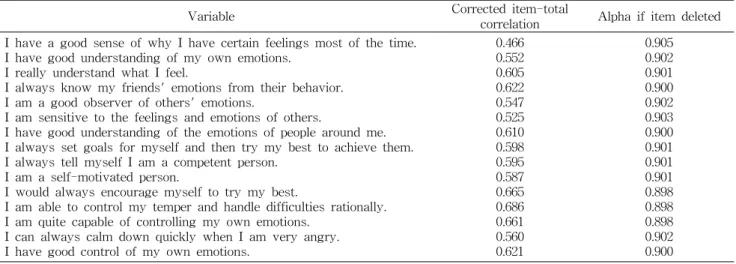
조사도구의 내적 일관성을 검증하기 위한 감성지능 측정 문항 16개의 내적일관성을 검증하는 신뢰도 측정결과, 문항
Table 1. Demographic information of the subjects (N=231)
Frequency Percentage (%)
Sex Male
Female
27 204
11.7 88.3
Age
20 through 29 30 through 39 40 through 49
141 79 11
61.0 34.2 4.8
Mean±SD 29.55±4.89
Marital status Single
Married
165 66
71.4 28.6
Education
Under high school College
University
Graduate school and over
5 69 153 4
2.2 29.9 66.2 1.7
Job status Regular worker
Contract worker
203 28
87.9 12.1
Period of working in the present company (years)
<1 1~5 5~10 10~15
>15
44 159 27 1 0
19.0 68.8 11.7 0.4 0.0 Total period of working
in the foodservice management company (years)
<1 1~5 5~10 10~15
>15
18 105 92 16 10
3.5 45.5 39.8 6.9 4.3
Job specifications
General management
General management+Dietitian General management+Cook
28 16 26
12.6 78.8 8.7
Foodservice type
School Industry Hospital
44 159 28
19.0 68.8 12.1
Number of staff
<5 5~9 10~14
>15
58 65 39 69
25.1 28.1 16.9 29.9
Mean±SD 12.73±11.84
No. of meals served per day
<500 500~1000 1000~1499
>1500
44 159 27 1
19.0 68.8 11.7 0.4
Mean±SD 823.38±765.56
전체의 Cronbach's alpha 계수는 0.891이었으나, 문항4 ‘나 는 항상 내가 행복한지 아닌지를 잘 아는 편이다’를 제거했 을 때 신뢰도가 0.906으로 증가되므로 문항4를 제거하여 15 개의 문항으로 확정지었다(Table 2).
AMOS를 이용한 확인적 요인 분석(confirmatory factor analysis)을 실시하여 타당도를 검증하였다. 확인적 요인 분 석 결과는 Fig. 1과 같고, 모형의 적합도는 x2(87)=163.453, GFI(goodness of fit index 0.90 이상일 때 바람직)=0.926, AGFI(adjusted goodness of fit index: 0.90 이상일 때 바람 직)=0.904, RMR(root mean square residual: 0.05~0.08이면 바람직)=0.048로 우수한 것으로 나타났다.
감성지능과 관련변인 분석
급식관리자의 인구통계학적 특성과 감성지능 관련성:
급식관리자의 감성지능 수준에 있어서는 급식관리자 본인 의 감정상태와 원인을 인식하고 있는 정서자각 능력과 동료 의 감정에 대해 인지하고 이해하는 능력인 정서이해 능력이 5.10점으로 4개의 감성지능 영역에서 가장 높은 점수를 보였 으며, 그 다음으로 정서적 사고촉진이 높은 점수(4.90점)로 조사되었고, 본인의 감정을 조절하고 해결하는 정서관리 능 력이 가장 낮은 점수(4.55점)로 조사되었다(Table 3).
급식관리자의 인구통계학적 특성에 따라 감성지능 수준 을 살펴보면, 급식관리자의 연령이 높아질수록 감성지능의 4요인 모두 정(+)의 상관성을 보였다. 즉 연령이 높아질수록
Table 2. Reliability analysis of measurement tool for emotional intelligence
Variable Corrected item-total
correlation Alpha if item deleted I have a good sense of why I have certain feelings most of the time.
I have good understanding of my own emotions.
I really understand what I feel.
I always know my friends' emotions from their behavior.
I am a good observer of others' emotions.
I am sensitive to the feelings and emotions of others.
I have good understanding of the emotions of people around me.
I always set goals for myself and then try my best to achieve them.
I always tell myself I am a competent person.
I am a self-motivated person.
I would always encourage myself to try my best.
I am able to control my temper and handle difficulties rationally.
I am quite capable of controlling my own emotions.
I can always calm down quickly when I am very angry.
I have good control of my own emotions.
0.466 0.552 0.605 0.622 0.547 0.525 0.610 0.598 0.595 0.587 0.665 0.686 0.661 0.560 0.621
0.905 0.902 0.901 0.900 0.902 0.903 0.900 0.901 0.901 0.901 0.898 0.898 0.898 0.902 0.900 Cronbach's alpha=0.906.
Fig. 1. Confirmatory factor analysis: emotional intelligence.
SEA1: I have a good sense of why I have certain feelings most of the time. SEA2: I have good understanding of my own emo- tions. SEA3: I really understand what I feel. OEA1: I always know my friends’ emotions from their behavior. OEA2: I am a good observer of others’ emotions. OEA3: I am sensitive to the feelings and emotions of others, OEA4: I have good understanding of the emotions of people around me. UOE1: I always set goals for my- self and then try my best to achieve them. UOE2: I always tell myself I am a competent person. UOE3: I am a self-motivated person. UOE4: I would always encourage myself to try my best.
ROE1: I am able to control my temper and handle difficulties ra- tionally. ROE2: I am quite capable of controlling my own emo- tions. ROE3: I can always calm down quickly when I am very angry. ROE4: I have good control of my own emotions.
감성지능 수준은 높아진다고 할 수 있다. Mayer 등(13)은 젊은 사람보다 나이든 사람의 감성지능이 더 높다고 주장하 였으며, 감성지능은 친사회적 행동과 깊은 관계가 있다고 하였다. Saarni(8)는 감성지능의 발달과정을 연구한 결과, 감성지능은 16~49세까지 지속적으로 증가하다가 50세부터 감소한다고 하였는데 본 연구의 연구결과와 유사한 경향을
보였다. 성별에 있어서 남성이 ‘정서적 사고촉진’과 ‘정서관 리’에서 여성에 비해서 높게 나타났으나, 이는 조사대상의 연령대가 남성이 높은 점을 고려하여 설명할 수 있다. 학력 이 높을수록 감성지능의 ‘정서지각’, ‘정서관리’ 요인에서 모 두 유의하게 높았다(p<0.05). 또한 감성지능의 ‘정서지각’,
‘정서이해’, ‘정서적 사고촉진’, ‘정서관리’와 급식업계근무경 력은 정(+)의 상관관계를 나타냈다(Table 4).
직무태도 및 조직성과 변수와 감성지능 요인간의 상관 성: 급식관리자의 직무에 대한 태도를 분석하기 위하여 직무 만족, 조직몰입, 이직의사를 분석하였다. 직무만족에 있어서 는 ‘동료들과의 관계’에 대해서는 상당히 만족하고 있었으 며, ‘자신의 업무’에 대한 만족도가 비교적 높은 편이었으나,
‘급여수준’이나 ‘승진제도’에 대해서는 불만족하고 있는 것 으로 나타나 급여나 승진 등의 근무조건 개선이 여겨졌으며,
‘전반적인 만족도’는 3.04로 ‘보통(3점)’을 약간 상회하는 정 도였다(Table 5).
조직몰입 수준에 대해 분석한 결과(Table 6), 전반적인 조직몰입의 수준은 3.41로 ‘보통(3점)’을 상회하는 수준이었 다. 조직몰입도가 특히 높은 항목은 ‘현재 회사의 선택’, ‘타 인에게의 현재 회사에 대한 평’, ‘회사에 대한 충성심’으로 분석된 반면, ‘자신이 일할 수 있는 회사 중 가장 좋은 곳이라 는 인지’, ‘상황변화에 따른 타사로의 이직 희망도’ 측면에서는 몰입도가 비교적 낮은 것으로 나타냈다. 조직몰입 요인 2가 지 중 ‘충성도’ 요인이 3.57로 ‘일체감’ 요인 3.33보다 높았다.
회사를 이직하고자 하는 견해에 따라 4단계로 나누어 조 사한 결과는 Table 7에 제시하였다. 회사를 이직하고자 하는 견해에 따라 ‘자발적 이직 의향’, ‘이직 모색단계’, ‘구체적 실 천단계: 동종업계’, ‘구체적 실천단계: 타업계’로 나누어 구분 하여 조사한 결과, 전반적인 이직 의사수준은 ‘보통(3점)’ 이 하(2.82)로 나타났고 대부분은 주로 이직 행동 단계 중 ‘자발 적 이직 의향 단계’에 머물러 있는 것으로 분석되었으며, 이 직할 경우 급식업계 내에서보다는 타업계로의 이직 희망도
Table 3. Level of emotional intelligence of foodservice manager
Variable1) Mean±SD Self-emotional appraisal (SEA)
I have a good sense of why I have certain feelings most of the time.
I have good understanding of my own emotions.
I really understand what I feel.
5.12±0.80 5.05±0.86 5.12±0.84 Subtotal 5.10±0.74
Other-emotional appraisal (OEA)
I always know my friends' emotions from their behavior.
I am a good observer of others' emotions.
I am sensitive to the feelings and emotions of others.
I have good understanding of the emotions of people around me.
5.06±0.95 5.17±0.94 5.17±1.02 4.98±0.91 Subtotal 5.10±0.81
Use of emotion (UOE)
I always set goals for myself and then try my best to achieve them.
I always tell myself I am a competent person.
I am a self-motivated person.
I would always encourage myself to try my best.
5.01±1.01 4.55±1.09 4.94±1.12 5.12±1.06 Subtotal 4.90±0.90
Regulation of emotion (ROE)
I am able to control my temper and handle difficulties rationally.
I am quite capable of controlling my own emotions.
I can always calm down quickly when I am very angry.
I have good control of my own emotions.
4.69±0.96 4.43±1.00 4.52±1.13 4.49±1.06 Subtotal 4.55±0.90
1)7 point Likert scale (1: very poor, 7: very good).
Table 4. Analysis of emotional intelligence level by demographic characteristics Self-emotional
appraisal (SEA)
Other-emotional appraisal (OEA)
Use of emotion (UOE)
Regulation of emotion (ROE)
Sex Male
Female
5.28±0.772) 5.08±0.73
5.21±0.82 5.08±0.81
5.28±0.92 4.85±0.89
4.93±0.84 4.49±0.93
t-value 1.340 0.794 2.377* 2.280*
Age1) 0.212** 0.230*** 0.301*** 0.350***
Marriage Single Married
5.04±0.76 5.24±0.65
5.04±0.82 5.22±0.78
4.92±0.91 4.86±0.89
4.49±0.93 4.68±0.91
t-value -1.861 -1.556 0.427 -1.364
Education Under high school College
University
Graduate school and over
5.67±0.62ab 4.91±0.63ab 5.19±0.77b 4.67±0.47a
5.75±0.75 5.10±0.84 5.08±0.79 4.88±0.66
5.50±1.01 4.89±0.78 4.88±0.94 5.12±1.03
5.65±0.78b 4.58±0.96ab 4.50±0.91ab 4.31±0.77a
F-value 5.872* 2.411 2.044 6.732*
Position Staff Senior staff
General manager and higher
5.06±0.71 5.16±0.81 5.18±0.78
5.06±0.80 5.05±0.91 5.22±0.81
4.81±0.93 5.09±0.73 5.06±0.87
4.40±0.92 4.81±0.91 4.81±0.87
F-value 0.681 0.813 2.386 5.560**
Job status Regular Contract
5.09±0.74 5.17±0.73
5.10±0.82 5.05±0.80
4.91±0.92 4.86±0.76
4.53±0.93 4.62±0.89
t-value -0.559 0.297 0.235 -0.639
Period of working in the present company1) -0.014 -0.10 0.032 0.123
Total period of working in the foodservice
company1) 0.143* 0.162* 0.195** 0.235***
1)Correlation coefficient. 2)Mean±SD (7-point Likert scale: 1, very poor; 7, very good).
*p<0.05, **p<0.01, ***p<0.001. a,bTukey multiple comparison.
Table 5. Means of job satisfaction scores of foodservice managers
Variables1) Mean±SD
1. Work itself 2. Co-Worker
3. Supervision & recognition 4. Pay
5. Promotion 6. Working condition
3.12±0.96 3.70±0.77 3.16±0.91 2.70±0.92 2.75±0.83 2.84±0.96
Total 3.04±0.64
1)5 point Likert scale (1: not satisfied at all, 5: extremely satisfied).
Table 6. Means of organizational commitment scores of foodservcie managers
Variables1) Mean±SD
Sense of belongs
I talk up this organization to my friends as a great organization to work for.
I am willing to put in a great deal of effort beyond that normally expected in order to help this organization be successful.
I would accept almost any type of job assignment in order to keep working for this organization.
I am extremely glad that I chose this organization to work for over others I was considering at the time I joined.
I am proud to tell others that I am a part of this organization.
I really care about the fate of this organization.
I find that my values and the organization's values are very similar.
This organization really inspires the very best in me in the way of job performance.
It would take very little change in my present circumstances to cause me to leave this organization. (R) For me this is the best of all possible organizations for which to work.
3.20±0.85 2.99±0.87 3.11±0.85 3.24±0.72 3.47±0.76 3.56±0.76 3.44±0.80 3.61±0.73 3.64±0.82 3.08±0.90
Subtotal 3.33±0.57
Loyalty
Deciding to work for this organization was a definite mistake on my part. (R) I feel very little loyalty to this organization. (R)
There's not too much to be gained by sticking with this organization indefinitely. (R)
Often, I find it difficult to agree with this organization's policies on important matters relating to this organization. (R)
I could just as well be working for a different organization as long as the type of work was similar. (R)
3.54±0.86 3.44±0.77 4.06±0.79 3.64±0.81 3.16±1.03
Subtotal 3.57±0.60
Total 3.41±0.53
1)5 points Likert scale (1: strongly disagree, 5: strongly agree).
R: Reverse coding.
Table 7. Means of turnover intention scores of foodservice managers
Variables1) Mean±SD
Thinking of quitting
Having plan and information to quit
Hoping to move other foodservice companies if I have a chance Hoping to move other fields if I have a chance
3.04±0.98 2.47±0.98 2.60±0.99 3.20±1.10
Total 2.82±0.80
1)5 points Likert scale (1: strongly disagree, 5: strongly agree).
가 높은 것으로 나타났다.
조직성과는 Brewer 등(23,24)의 조직성과 도구를 이용하 여, 조직의 초점을 내부적 차원과 외부적 차원으로 구분하고 각 차원에 대해 구현되는 성과를 능률성(efficiency), 효과성 (effectiveness), 공정성(fairness) 3가지 차원으로 구성하여 조사하였으며 결과는 Table 8에 제시하였다. 전반적인 조직 성과의 인식수준은 3.34로 ‘보통(3점)’을 상회하는 수준이었 고, 조직성과가 특히 높은 항목은 ‘비용절감 노력’으로 분석 된 반면, ‘인사관리에 있어서의 공정성’, ‘직책에 상관없이
공정한 대우’에 있어서는 상대적으로 낮은 성과를 보였다.
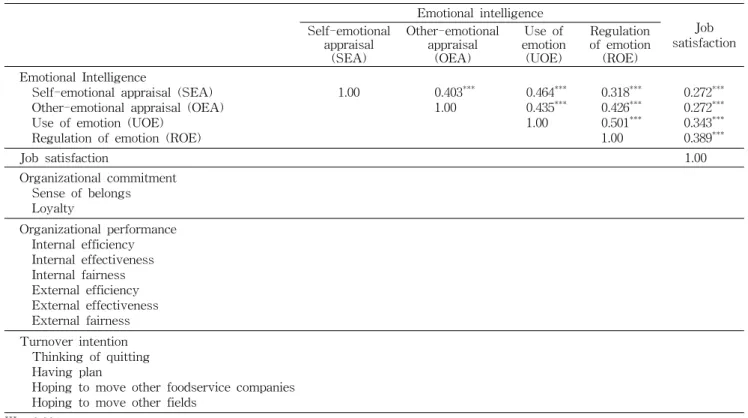
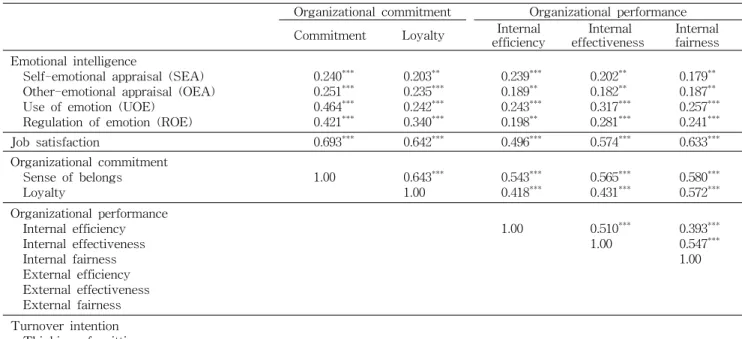
급식관리자의 감성지능 수준과 급식관리자 관련 변수인 직무만족, 조직몰입, 조직성과 이직의사간의 관련성을 파악 하기 위하여 상관분석을 실시한 결과(Table 9), 급식관리자 의 감성지능 4가지 모든 요인 ‘정서지각’, ‘정서이해’, ‘정서적 사고촉진’, ‘정서관리’는 직무만족, 조직몰입, 조직성과와는 정(+)의 상관관계 가지는 것으로 분석되었다. 감성지능 ‘정 서지각’, ‘정서이해’, ‘정서적 사고촉진’, ‘정서관리’는 이직의 사 4요인 중 ‘구체적실천단계: 타업체’와 모두 부(-)의 상관
Table 8. Means of organizational performance scores of foodservice managers
Variables1) Mean±SD
Internal efficiency
My organization has made good use of my knowledge and skills in looking for ways to become more efficient.
My organization is trying to reduce cost in managing organization and performing works.
3.25±0.77 4.00±0.74
Subtotal 3.62±0.62
Internal effectiveness
In the past two years, the productivity of my work unit has improved.
Overall, the quality of work performed by my current coworkers in my immediate work group is high.
3.52±0.86 3.36±0.77
Subtotal 3.43±0.74
Internal fairness
My organization provides fair and equitable treatment for employees and applicants in all aspects of personnel management without regard to their political affiliation, sex, hometown, marital status, age, or handicapping condition.
In general, all are treated with respect in my organization, with no regard to status and grade.
2.95±0.90
3.00±0.78
Subtotal 2.97±0.79
External efficiency
My organization has conducted business relations with outside customers very promptly.
It is rare to make big mistakes in my organization when conducting work.
3.26±0.86 3.33±0.73
Subtotal 3.30±0.73
External effectiveness
The work performed by my work unit provides the public a worthwhile return on their tax dollars.
The occurrence of goal attainment is very high in my organization.
3.29±0.78 3.30±0.79
Subtotal 3.30±0.68
External fairness
My organization provides fair and equitable services to the public, with no considering of their individual backgrounds.
The customer satisfaction toward my organization is very high.
3.48±0.85 3.40±0.79
Subtotal 3.44±0.72
Total 3.34±0.56
1)5 points Likert scale (1: strongly disagree, 5: strongly agree).
Table 9. Correlation matrix of the emotional intelligence level and job related factors Emotional intelligence
Job satisfaction Self-emotional
appraisal (SEA)
Other-emotional appraisal
(OEA)
Use of emotion
(UOE)
Regulation of emotion (ROE) Emotional Intelligence
Self-emotional appraisal (SEA) Other-emotional appraisal (OEA) Use of emotion (UOE)
Regulation of emotion (ROE)
1.00 0.403***
1.00
0.464***
0.435***
1.00
0.318***
0.426***
0.501***
1.00
0.272***
0.272***
0.343***
0.389***
Job satisfaction 1.00
Organizational commitment Sense of belongs Loyalty
Organizational performance Internal efficiency Internal effectiveness Internal fairness External efficiency External effectiveness External fairness Turnover intention Thinking of quitting Having plan
Hoping to move other foodservice companies Hoping to move other fields
***p<0.001.
Table 9. Continued
Organizational commitment Organizational performance
Commitment Loyalty Internal
efficiency Internal
effectiveness Internal fairness Emotional intelligence
Self-emotional appraisal (SEA) Other-emotional appraisal (OEA) Use of emotion (UOE)
Regulation of emotion (ROE)
0.240***
0.251***
0.464***
0.421***
0.203**
0.235***
0.242***
0.340***
0.239***
0.189**
0.243***
0.198**
0.202**
0.182**
0.317***
0.281***
0.179**
0.187**
0.257***
0.241***
Job satisfaction 0.693*** 0.642*** 0.496*** 0.574*** 0.633***
Organizational commitment Sense of belongs Loyalty
1.00 0.643***
1.00
0.543***
0.418***
0.565***
0.431***
0.580***
0.572***
Organizational performance Internal efficiency Internal effectiveness Internal fairness External efficiency External effectiveness External fairness
1.00 0.510***
1.00
0.393***
0.547***
1.00
Turnover intention Thinking of quitting Having plan
Hoping to move other foodservice companies Hoping to move other fields
Organizational performance Turnover intention External
efficiency
External effectiveness
External
fairness Thinking Having plan
Hoping to move other foodservice companies
Hoping to move other
fields Emotional intelligence
Self-emotional appraisal (SEA) Other-emotional appraisal (OEA) Use of emotion (UOE)
Regulation of emotion (ROE)
.222**
.153* .231**
.303***
.312***
.179**
.411***
.351***
.378* .217* .396**
.285***
-.118 -.131* -.185**
-.315***
-.144* -.099 -.133* -.263***
-.164* -.092 -.103 -.155*
-.173**
-.164* -.269***
-.319***
Job satisfaction .564*** .565*** .587*** -.473*** -.509*** -.380*** -.458***
Organizational commitment Sense of belongs Loyalty
.502***
.488***
.627***
.511***
.515***
.493***
-.574***
-.571***
-.527***
-.657***
-.427***
-.613***
-.520***
-.464***
Organizational performance Internal efficiency Internal effectiveness Internal fairness External efficiency External effectiveness External fairness
.440***
.480***
.523***
1.00
.515***
.602***
.500***
.555***
1.00
.492***
.564***
.527***
.644***
.647***
1.00
-.268***
-.417***
-.429***
-.390***
-.410***
-.358***
-.366***
-.358***
-.394***
-.370***
-.378***
-.386***
-.231**
-.126***
-.279***
-.260***
-.258***
-.286***
-.230***
-.304***
-.368***
-.296***
-.257***
-.287***
Turnover intention Thinking of quitting Having plan
Hoping to move other foodservice companies Hoping to move other fields
1.00 .585***
1.00
.464***
.611***
1.00
.563***
.423***
.342***
1.00
**p<0.01, ***p<0.001.
관계를 보였으며, ‘정서이해’는 ‘이직의향’과 ‘구체적 실천단 계: 타업체’와 부(-)의 상관성이 있음이 분석되었다. ‘정서관 리’는 이직의사 4요인 모두와 부(-)의 상관관계를 보였다.
이상의 결과를 종합해 볼 때, 관리자 개인의 감성지능의 수 준은 스스로의 직무만족과 조직몰입, 조직성과와 정(+)의 상 관성이 있으며, 이직의사와는 부(-)의 상관성이 있는 것으로
나타났다. 이는 노인복지관 종사자의 감성지능이 높을수록 직무수행능력이 높게 나타나 그 상관성을 보인 Park(26)의 연구결과와 유사하였다. 또한 호텔종사원들의 개인적 감성 지능이 성과에 미치는 영향을 연구한 Won(27)의 연구에서 는 감성지능이 직무역할에 미치는 유의성을 조사한 결과 감 성지능의 4영역 중 ‘정서이해’를 제외한 3영역에서 조직성과
Table 10. Comparative analysis of job attitude and organizational performance between high and low emotional intelligence level
Factor Group 1
High ability (N=93)
Group 2
Low ability (N=138) T-value
Job satisfaction 3.31±0.59 2.85±0.61 5.642***
Organizational commitment Sense of belongs Loyalty
3.59±0.53 3.75±0.58
3.16±0.53 3.43±0.58
6.128***
4.127***
Subtotal 3.65±0.49 3.25±0.49 5.981***
Organizational performance Internal efficiency Internal effectiveness Internal fairness External efficiency External effectiveness External fairness
3.74±0.60 3.68±0.65 3.18±0.83 3.52±0.73 3.56±0.70 3.70±0.69
3.53±0.62 3.28±0.75 2.84±0.73 3.14±0.68 3.11±0.61 3.26±0.68
2.446***
4.158***
3.242**
3.995***
5.112***
4.793***
Subtotal 3.56±0.56 3.19±0.50 5.180***
Turnover intention Thinking of quitting Having plan
Hoping to move other foodservice companies Hoping to move other fields
2.76±0.98 2.35±0.96 2.52±0.96 2.81±1.04
3.22±0.93 2.55±0.98 2.65±1.01 3.46±1.05
-3.600 -1.498 -1.024 -4.663***
Subtotal 2.61±0.81 2.97±0.76 -3.472**
**p<0.01, ***p<0.001.
Fig. 2. Cluster analysis by emotional intelligence level.
***p<0.001.
에 직접적으로 영향을 미치는 것으로 나타나 유사한 결과를 보였다.
감성지능 수준에 따른 군집특성: 급식관리자의 감성지 능 수준의 분석결과에서 도출된 4개의 요인을 바탕으로 평 가된 감성지능 수준을 몇 개의 동질적인 그룹으로 집단화하 기 위해 군집분석을 실시하였다. 한 대상이 일단 어느 군집 에 소속되면 다른 군집으로의 이동이 불가능한 점과 예외값 이 제거되지 않고 반드시 어느 군집에 속하게 된다는 계층적 군집분석의 한계점을 극복하고자 비계층적 군집분석으로 적절한 군집의 수를 파악한 후, K-평균 군집분석 하여 2개의 군집으로 분류하였다. 감성지능의 수준에 따른 군집화의 의 미 분석을 한 결과(Fig. 2), 군집 1에서 요인 1 ‘정서지각’,
요인 2 ‘정서이해’, 요인 3 ‘정서적 사고촉진’, 요인 4 ‘정서관 리’ 모두 높은 점수를 보여 군집 1은 ‘고능력군’, 군집 2는
‘저능력군’이라 명명하였다.
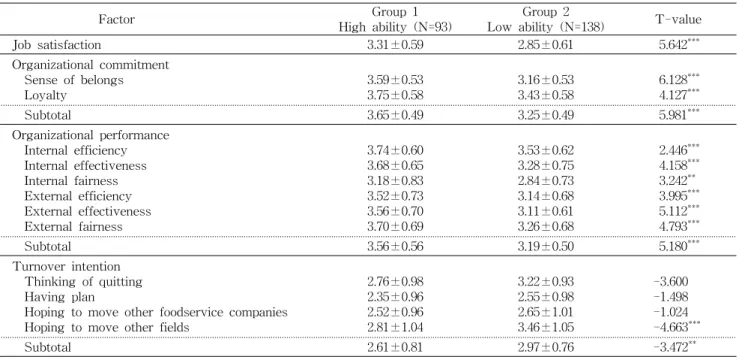
감성지능의 군집별 특성 분석을 실시한 결과(Table 10), 감성지능의 고능력군은 직무만족에 있어서 유의적으로 더 높은 것으로 나타났고(p<0.001), 조직몰입의 ‘일체감’, ‘충성 도’ 두 영역 모두에서 유의적으로 높게 나타났다(p<0.001).
조직성과의 모든 요인도 감성지능 수준이 유의적으로 높게 나타났다(p<0.001). 감성지능의 수행능력과 이직의사는 ‘구 체적 실천단계: 타업계’ 단계에서 유의적(p<0.001)으로 낮게 나타나, 감성지능의 고능력군과 저능력군의 군별 특성에 있 어서 본사근무자들의 태도와 성과가 모두 유의적으로 차이 를 나타내, 관리자의 감성 지능의 수준은 관리자들 스스로의 태도와 성과에 긍정적인 영향을 끼치는 것으로 분석되었다.
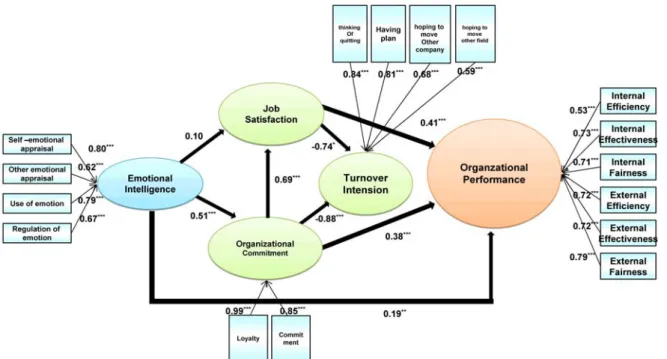
감성지능 효과성의 구조적 모형 분석: 감성지능 관련 선행 연구 이론을 근거로 본 연구에서 측정된 개념인 감성지 능의 수준과 조직 및 종사자 관련 변인, 조직성과에 대한 가설을 토대로 감성리더십의 효과성 모형을 구축하여 구조 방정식(SEM)을 이용하여 이를 검증하였다. 연구모형을 분 석해 본 결과(Fig. 3) ‘감성지능’이 ‘직무만족’에 직접적인 영 향을 주는 경로는 유의하지 않았다. 그 경로를 제거 시 Fig.
4에서 보이는 것처럼 모든 경로가 유의하게 나타나 수정하 여 최종모형을 결정하였다. 각 모형의 전반적인 적합도를 나타내는 부합지수는 x2(87)=98.536, GFI(goodness of fit index: 0.90 이상일 때 바람직)=0.950, AGFI(adjusted goodness of fit index: 0.90 이상일 때 바람직)=0.912, RMR
Fig. 3. Proposed research structural model. *p<0.05, **p<0.01,***p<0.001.
Fig. 4. Revised structural model. *p<0.05, **p<0.01, ***p<0.001.
(root mean square residual: 0.05~0.08이면 바람직)=0.022 로 모형의 적합성 준거를 충족시키고 있었다. 분석결과를 근거로 확정모형에서의 경로계수를 중심으로 검증한 결과 관리자의 감성지능의 수준은 조직몰입, 조직성과에 정(+)의 방향으로 영향을 미쳤으며, 관리자의 직무만족과 조직몰입 은 이직의사에 부(-)의 방향으로 영향을 미쳤다. 또한 관리 자의 직무만족과 조직몰입은 조직성과에 정(+)의 방향으로 영향을 미쳤다.
요 약
본 연구에서는 급식관리자를 대상으로 감성지능의 수준 에 따른 관리자의 관련 변인, 직무 태도, 조직성과와의 관련 성을 토대로 감성지능의 효과성 모형을 구축하고 구조방정 식을 이용하여 모형검증을 위하여 경로분석을 실시하였다.
감성지능은 자신 및 타인의 감성을 인지하고 이해하며, 자신 의 감성을 이해하고 조절할 수 있는 능력의 정도와 자신의