서 론
전 세계적으로 산업화가 진행되면서 빠른 인구증가와 무분별 한 개발, 환경오염, 기후변화 등으로 많은 야생동·식물들이 멸 종하거나 멸종위협에 처하고 있으며, 다양성이 급격히 감소하 는 것으로 보고되고 있다(Chapin et al., 2000; Thomas et al., 2004). 우리나라의 담수어류도 대형 댐과 보, 저수지의 건설과 하천 준설 및 정비공사, 외래종의 도입, 수질오염 등으로 인해 심각한 교란을 받고 있으며, 이로 인해 많은 어류들이 다양성 및 서식지와 개체수가 급격히 감소하면서 멸종위기에 놓이거나 일 부 종은 멸종한 것으로 보고되고 있다(Jang et al. 2006; Kwater,
2007; Ko et al., 2008; NIBR, 2011; Ko et al., 2017).
우리나라의 멸종위기종은 1998년부터 지정되어 보호받고 있 으며, 이 중 어류는 1998년 12종, 2005년 18종, 2012년 25종, 2017년 27종이 지정되었다(ME, 1998, 2005, 2012, 2017). 또한 멸종위기종들의 보전을 목적으로 2002년부터 복원연구가 수행 되었고, 지금까지 퉁사리 Liobagrus obesus 등 15종에 이르고, 이 중 13종이 인공증식으로 치어가 생산되고 자연에 방류되었 다(ME, 2005, 2006, 2009a, 2009b, 2010, 2011a, 2011b, 2012, 2013, 2014, 2016, 2018; MLTM, 2010, 2011, 2012; CHA, 2012;
WPOE, 2017, 2018). 자연에 방류된 멸종위기어종들 중 개체군 크기가 크고 지속적으로 후대가 생산되는 성공의 복원 사례는 많지 않았다(WPOE, 2017; ME, 2013, 2018).
묵납자루 Acheilognathus signifer는 잉어목(Cypriniformes),
—
67 —
http://www.fishkorea.or.kr* Corresponding author: In-Chul Bang Tel: 82-41-530-1286, Fax: 82-41-530-1638, E-mail: [email protected]
ISSn: 1225-8598 (Print), 2288-3371 (online). DoI: https://doi.org/10.35399/ISK.31.2.1
accepted: June 27, 2019
재도입을 통한 멸종위기종 묵납자루 Acheilognathus signifer
(Pisces: Cyprinidae: Acheilognathinae)의 복원성공과 서식현황
고명훈·양 현
1
·방인철2, *
고수생태연구소, 1생물다양성연구소(주), 2순천향대학교 생명시스템학과
Recovery Success and Habitat Status of the Reintroduced Endangered Species, Acheilognathus signifer (Pisces: Cyprinidae: Acheilognathinae) by Myeong-Hun Ko, Heon Yang
1and In-Chul Bang
2,* (Kosoo ecology Institute, Seoul 07952, republic of Korea;
1Institute of Biodiversity research, Jeonju 54904, republic of Korea;
2
Department of life Sciences and Biotechnology, Soonchunhyang university, asan 31538, republic of Korea)
ABSTRACT This study was conducted from 2017 to 2018 to determine habitat aspects of Acheilog na
thus signifier, an endangered species reintroduced (2010~2012) to Heukcheon Stream, a tributary of the Han gang River, Korea. A total of 329 individuals were collected in 2017 (two surveys) and 723 individuals were collected in 2018 (four surveys) at about 5 km habitat area, including the discharge station. A.
signifier’s habitat was about 0.4 to 1.2 meters deep in slow water flow upstream of the discharge area. It was a place with many boulders and cobbles. The spawning period was estimated from April to June in terms of spa w n ing behavior and collected juvenile size. Sex ratio of females (438) and males (412) was 1 : 0.94. Estimated age of A. signifier based on their total length distribution during the spawning period (April) indicated that 1-, 2-, 3-year old groups and more than 4-year-old group were 32~43 mm, 50~61 mm, 62~75 mm, and 76~89 mm, respectively. Age-specific composition costs differed depending on the timing of the collection. They were relatively high in the order of first-year (juvenile)
>third-year
>and fourth-year or higher, showing a stable age structure. Thus, A. signifier reintroduced to Heukcheon Stream has successfully settled down and formed a stable population, showing a tendency to proliferate.
Key words: Acheilognathus signifer, habitat aspects, endangered species
잉어과(Cyprinidae), 납자루아과(Acheilognathinae)에 속하는 소 형 어류로 한강수계인 임진강과 한강에만 서식하는 우리나라 고 유종이다(Choi et al., 1990; Kim, 1997; Baek, 2005; Kim, 2014).
멸종위기종으로는 2005년 환경부지정 멸종위기야생동식물 II급 으로 지정된 후 지금까지 지속되고 있다(ME, 2005, 2012, 2017).
묵납자루에 관한 연구는 Baek(2005)에 의해 지리적 분포와 서 식지 특성, 산란생태, 발생과 숙주 적응전략, 연령과 성장, 소화기 관 및 먹이생물 등에 대해 연구되었으며 이후 2010년부터 2014 년까지 복원사업의 일환으로 산란생태와 산란숙주조개 선호도, 자연잡종 및 유전자 분석, 인공증식기술개발 및 치어방류, 방류 모니터링 등에 대한 연구가 진행되었다(ME, 2010, 2011b, 2012;
Kim, 2014). 남한강 지류 흑천은 과거 묵납자루가 서식하였으나 최근에는 서석이 확인되지 않으나(Choi et al., 1990; Baek, 2005;
Kim, 2014), 서식지가 양호하여 묵납자루의 서식에 적합하다는 판정을 받아 2010년부터 2012년까지 치어 7,000개체가 재도입 (reintroduction)되었다(ME, 2010, 2011b, 2012). 재도입 이후 방 류된 묵납자루는 2010년부터 2013년까지는 매년 69~127개체 가 채집되었으나(ME, 2014) 이후 2014년과 2015년에 각각 1개 체만이 채집되고 2016년에는 채집되지 않아 개체수가 급감하였 거나 소멸된 것으로 보고되었다(ME, 2016)
본 연구는 2017년부터 2018년까지 정밀조사를 실시하여 흑 천에 재도입된 묵납자루 개체군의 정확한 서식현황을 밝히고 묵납자루 복원사업의 성공가능성과 보전대책에 대해 논의하고 자 하였다.
재료 및 방법
1. 조사 기간 및 지점
본 연구는 남한강 지류 흑천에서 1차(2017년 5월 2~3일), 2 차(2017년 10월 1~2일), 3차(2018년 4월 21~23일)와 4차(2018 년 6월 18~20일), 5차(2018년 8월 17~19일), 6차(2018년 10월 4~6일)로 나누어 묵납자루 A. signifer와 서식지환경, 동소종을 조사하였는데, 동소종은 2018년 3~6차 조사에서 출현한 어류 를 합산하였다. 조사지점은 아래와 같이 흑천의 최상류부터 하 류까지 서식지 특징과 보의 위치를 고려하여 1~1.5km 간격으 로 8개 지점을 선정하였다(Fig. 1).
St. 1: 경기도 양평군 청운면 비룡리 율리교(37°31ʹ48.51ʺN, 127°41ʹ15.71ʺE)
St. 2: 경기도 양평군 단월면 삼가리 선바위교(37°31ʹ15.50ʺN, 127°40ʹ36.12ʺE)
St. 3: 경기도 양평군 단월면 삼가리(37°31ʹ12.54ʺN, 127°
40ʹ3.42ʺE)
St. 4: 경기도 양평군 단월면 삼가리 삼가교(37°30ʹ59.72ʺN,
127°39ʹ32.42ʺE)
St. 5: 경기도 양평군 단월면 봉상리 봉상교(37°30ʹ42.59ʺN, 127°39ʹ4.39ʺE)
St. 6: 경기도 양평군 용문면 광탄리 돌보(37°30ʹ44.93ʺN, 127°38ʹ26.48ʺE)
St. 7: 경기도 양평군 용문면 광탄리 광탄교(37°30ʹ24.04ʺN, 127°37ʹ57.20ʺE)
St. 8: 경기도 양평군 용문면 마룡리 화전교(37°29ʹ16.93ʺN, 127°36ʹ25.02ʺE)
2. 채집 및 조사방법
멸종위기야생생물 II급의 묵납자루를 포획하기 위해 한강유 역환경청의 포획허가(제2017-21호, 제2018-34호)를 받은 후 채 집을 실시하였다. 조사 지점별로 200m 구간에서 여울과 소를 포함하였으며, 정량조사가 되도록 투망(망목 6×6mm, 10회) 과 족대(망목 4×4mm, 1시간), 일각망(1개, 날개 길이 10m, 망 목 4×4mm, 야간을 포함하여 12시간 정치)을 사용하여 채집하 였다. 채집된 개체는 현장에서 육안으로 동정·계수한 후 생태 계 보전을 위하여 바로 방류하였다. 어류의 동정은 Kim(1997), Kim and Park(2007), Kim et al.(2005) 등에 따랐으며 분류체계 는 Nelson(2006)에 따라 목록을 정리하였다. 묵납자루의 채집 은 정량조사에서 채집된 개체와 St. 4의 뜰채(망목 1×1mm)와 족대를 이용한 추가조사를 통하여 개체수를 확보하였으며, 채집 된 개체는 마취제(MS-222)로 마취한 후 전장과 성별 등을 조사 한 후 방류하였다. 채집시기별 전장빈도분포도를 작성하여 성장 도와 연령을 추정하였으며(Ricker, 1971), 성비는 채집된 개체의 암컷과 수컷의 비율을 계산하고 χ2 검정을 통하여 성비 1:1 유
Fig. 1. Mornitoring stations of Acheilognathus signifer in the Heuk-
cheon Stream, Hangang River, Yangpyeong-gun, Gyeonggi-do, Korea
from 2017 to 2018.
의성을 검증하였다.
서식지 환경은 중 수문학적 환경의 하폭 및 유폭, 수심은 거리 측정용 망원경(Yardage pro Tour XL, BUSHNELL, Japan)과 줄 자를 이용하였으며, 하천형은 Kani(1944)의 방법에 따라, 하상 구조는 Cummins(1962)의 방법으로 구분하였다. 이·화학적 환 경 중 기온과 수온은 디지털온도계(T-250A, ASAHI, Japan)를, 전기전도도(Conductivity)와 용존산소량(DO), pH, 염도 등은 수 질측정기(HI-9828, Romania)를 사용하여 측정하였다. 또한 서 식지에서 묵납자루의 산란숙주가 되는 석패과(Unionidae)의 조 개를 조사하였으며, Kwan(1993)에 따라 동정하였다.
결 과
1. 서식환경
연구 지역은 3~4차 하천으로 하폭이 70~150m, 유폭이 30~100m이고 수심은 0.3~1.5m였으며 보가 많이 설치되어 있어 보 위는 긴 소가, 보 아래는 긴 여울이 형성되어 있었다.
하상은 주로 돌(cobble)과 자갈(pebble), 큰돌(boulder), 잔자 갈(gravel), 모래(sand) 등의 순으로 비율이 높았다. 물은 맑았 으며 특별한 오염원은 관찰되지 않았다. 전기전도도는 대체로 110~180μs/cm였고, 염도는 0.05~0.10‰였으며, 용존산소량은 6.3~12mg/L, pH는 대체로 6.5~7.5이었다. 묵납자루 A. signifer 가 많이 채집된 St. 3은 정수역의 상류부이며 유폭 30~40m로 비교적 좁은 편이었고 물은 항상 흐르고 있었으며 하상은 큰 돌(boulder)과 돌(cobble)의 비율이 높았다. 수변부는 갯버들류 (pussy willow)와 일부 달뿌리풀 Phragmites japonica이 서식하 고 있었으며 수중에는 말즘 Potamogeton crispus이 유속이 느 린 소(pool) 가장자리 일부에 서식하고 있었다. 전기전도도와 염 도는 각각 113~170 μs/cm, 0.05~0.08‰로 비교적 낮은 편이 었고, 용존산소량은 6.4~9.2mg/L, pH는 6.5~7.3이었다. 묵납 자루의 산란숙주로 이용되는 석패과 조개는 작은말조개 Unio douglasiae sinuolatus만이 관찰되었다(Table 1).
2. 동소출현종
2018년 묵납자루가 서식지 인근을 조사한 결과 10과 38종이 채집되었으며, 우점종은 피라미 Zacco platypus(35.72%), 아우 점종은 참갈겨니 Z. koreanus(13.21%)와 긴몰개 Squalidus gra- cilis majimae(10.1%)였으며, 그 다음으로 한강납줄개 Rhodeus pseudosericeus(9.02%), 돌고기 Pungtungia herzi(7.94%), 돌마 자 Microphysogobio yaluensis(3.40%), 모래무지 Pseudogobio esocinus(2.47%), 참마자 Hemibarbus longirostris(2.31%), 납 지리 Acheilognathus rhombeus(2.09%), 참종개 Iksookimia ko-
reensis(1.75%) 등의 순이었다. 묵납자루와 같은 법정보호종
Physicochemical and hydrological environments at the monitoring stations in the Heukcheon Stream, Hangang River , Korea from 2017 to 2018 Table 1. River Stations width (m)
W ater width (m)
W ater depth (m) River type* Stream order Bottom structure (%)** W ater temperature (℃) Conductivity (μs/cm) Salinity (‰)
DO (mg/L)
pH Etcs M S G P C B 1 130 ~ 150 30 ~ 100 0.3 ~ 1.2 Bb 3 20 20 40 20 11.0 ~ 28.1 157 ~ 185 0.07 ~ 0.09 6.9 ~ 10.3 6.5 ~ 7.0 W , FW 2 120 ~ 130 40 ~ 90 0.5 ~ 1.5 Bb 3 10 20 30 40 11.5 ~ 27.4 11 3~ 174 0.05 ~ 0.07 7.9 ~ 12.5 6.5 ~ 7.9 W 3 60 ~ 80 30 ~ 40 0.3 ~ 1.4 Bb 3 20 40 40 11.7 ~ 25.3 11 3~ 170 0.05 ~ 0.08 6.4 ~ 9.24 6.5 ~ 7.3 4 130 ~ 160 40 ~ 11 0 0.3 ~ 1.2 Bb 4 10 30 50 10 11.7 ~ 26.2 153 ~ 172 0.05 ~ 0.08 7.9 ~ 10.1 6.5 ~ 7.2 W 5 80 ~ 100 30 ~ 60 0.3 ~ 1.2 Bb 4 10 30 40 20 13.7 ~ 25.1 135 ~ 170 0.06 ~ 0.08 6.5 ~ 9.5 6.5 ~ 7.0 W 6 120 ~ 130 50 ~ 60 0.3 ~ 1.5 Bb 4 10 30 20 30 10 12.5 ~ 24.9 140 ~ 172 0.06 ~ 0.08 6.5 ~ 8.5 6.6 ~ 7.0 W 7 100 ~ 120 40 ~ 60 0.5 ~ 1.5 Bb 4 20 30 30 20 12.7 ~ 26.7 157 ~ 187 0.07 ~ 0.09 6.5 ~ 11.7 6.5 ~ 6.9 W 8 130 ~ 150 40 ~ 100 0.3 ~ 1.2 Bb 4 10 10 30 50 12.5 ~ 28.8 159 ~ 205 0.07 ~ 0.10 6.3 ~ 8.8 6.4 ~ 6.9 W
*River type: by Kani(1944); **M: Mud(~
0.1mm), S: Sand(0.1~
2mm), G: Gravel(2~
16mm), P: Pebble(16~
64mm), C: Cobble(64~
256mm), B: Boulder(256<mm)~
midified Cummins(1962), W: weir; FW: fishway은 환경부 멸종위기야생생물 II급에 속하는 한강납줄개가 많 이 서식하였다. 납자루아과 어류는 한강납줄개, 묵납자루, 납지 리, 납자루 A. lanceolatus, 가시납지리 A. chankaensis, 줄납자루 A. yamatsutae, 흰줄납줄개 R. ocellatus, 각시붕어 R. uyekii 8종
이 서식하여 많은 종이 서식하고 있었다. 어식성 어종은 꺽지 Coreoperca herzi(0.81%), 얼록동사리 Odontobutis interrupta (0.45%), 동사리 O. platycephala(0.27%), 쏘가리 Siniperca sch- erzeri(0.05%), 메기 Silurus asotus(0.05%), 끄리 Opsariichthys
Table 2. List of fish species and number of individual fish collected in the Heukcheon Stream, Hangang River, Korea from April to October 2018
Scientific name and Koran name Stations
Total RA
(%)* Remarks**
1 2 3 4 5 6 7 8
Cyprinidae 잉어과
Cyprinus carpio 잉어
2 2 4 2 1 11 0.09
Carassius auratus 붕어
7 3 21 12 5 23 7 2 80 0.63
Rhodeus ocellatus 흰줄납줄개
2 1 3 0.02
Rhodeus pseudosericeus 한강납줄개
161 129 221 319 72 183 39 29 1153 9.02 EnII, E
Rhodeus uyekii 각시붕어
1 1 0.01 E
Acheilognathus lanceolatus 납자루
3 15 5 15 16 44 84 182 1.42
Acheilognathus signifer 묵납자루
3 367 14 3 1 388 3.04 EnII, E
Acheilognathus yamatsutae 줄납자루
17 17 0.13 E
Acheilognathus rhombeus 납지리
1 62 130 10 36 6 22 267 2.09
Acheilognathus chankaensis 가시납지리
24 24 0.19
Pungtungia herzi 돌고기
137 101 114 84 116 228 134 101 1015 7.94
Coreoleuciscus splendidus 쉬리
19 22 16 26 46 3 27 16 175 1.37 E
Squalidus gracilis majimae 긴몰개
158 106 69 182 54 366 194 157 1286 10.06 E
Gnathopogon strigatus 줄몰개
1 1 0.01
Hemibarbus longirostris 참마자
45 50 15 10 29 65 60 21 295 2.31
Pseudogobio esocinus 모래무지
53 42 3 17 28 104 55 14 316 2.47
Microphysogobio yaluensis 돌마자
139 51 23 35 81 74 32 435 3.40 E
Microphysogobio longidorsalis 배가사리
53 36 13 35 70 18 3 228 1.78 E
Rhynchocypris oxycephalus 버들치
15 30 10 3 60 0.47
Opsariichthys uncirostris amurensis 끄리
3 2 5 0.04
Zacco koreanus 참갈겨니
294 315 352 178 216 37 106 191 1689 13.21 E
Zacco platypus 피라미
337 473 314 1518 420 582 462 461 4567 35.72
Balitoridae 종개과
Lefua costata 쌀미꾸리
2 2 0.02
Cobitidae 미꾸리과
Misgurnus anguillicaudatus 미꾸리
2 2 4 0.03
Misgurnus mizolepis 미꾸라지
3 1 4 0.03
Koreocobitis rotundicaudata 새코미꾸리
2 1 2 2 1 2 6 2 18 0.14 E
Iksookimia koreensis 참종개
43 33 11 8 71 29 17 12 224 1.75 E
Cobitis nalbanti 점줄종개
3 3 0.02 E
Siluridae 메기과
Silurus asotus 메기
2 4 6 0.05
Silurus microdorsalis 미유기
1 1 2 0.02 E
Bagridae 동자개과
Pseudobagrus koreanus 눈동자개
1 3 21 6 24 10 12 77 0.60 E
Amblycipitidae 퉁가리과
Liobagrus andersoni 퉁가리
1 1 2 0.02 E
Centrarchidae 검정우럭과
Micropterus salmoides 배스
2 2 0.02 Ex
Centropomidae 꺽지과
Coreoperca herzi 꺽지
12 18 18 13 20 4 10 8 103 0.81 E
Siniperca scherzeri 쏘가리
4 1 1 6 0.05
Odontobutidae 동사리과
Odontobutis platycephala 동사리
17 5 9 3 34 0.27 E
Odontobutis interrupta 얼록동사리
4 3 16 9 6 9 7 4 58 0.45 E
Gobiidae 망둑어과
Rhinogobius brunneus 밀어
5 10 3 6 14 3 41 0.32 L
Number of species 20 25 22 26 22 18 26 28 38
Number of individuals 1492 1441 1680 2613 1253 1776 1302 1225 12784
*RA: relative abundance (%), **Remarks: EnII: endangered species rank II; E: endemic species; L: land-locked species; Ex: exotic species.
uncirostris amurensis(0.04%), 미유기 S. microdorsalis(0.02%), 배스 Micropterus salmoides(0.02%)가 채집되었는데, 묵납자 루 집단서식지인 St. 3에는 꺽지와 얼록동사리, 동사리, 미유기 4 종이 서식하고 있었다. 지점조사에 묵납자루는 St. 2에서 3개체, St. 3에서 367개체, St. 4에서 14개체, St. 5에서 3개체, St. 7에서 1개체가 채집되어 St. 3이 대부분을 차지하였다(Table 2).
3. 채집개체수
2017년에는 7개 지점에서 2회 조사를 실시하여 방류지점에서 약 850m 떨어진 상류역(St. 3)에서 304개체, 방류지점(St. 4)에 서 23개체, 방류지점 아래 약 1,150m 아래(St. 5)에서 2개체를 채집하여 약 2km 구간에서 모두 329개체를 채집하였다. 2018 년에는 8개 지점에서 4회 조사를 실시하여 St. 2에서 3개체, St.
3에서 702개체(추가조사 포함), St. 4에서 14개체, St. 5에서 3개 체, St. 7에서 1개체를 채집하여 방류지로부터 상류로 약 1.6km, 하류로 약 3.4km까지 약 5km 구간에서 모두 723개체를 채집 하였다(Table 3). 따라서 2017년부터 2018년까지 6회 조사에서 묵납자루는 모두 1,052개체를 채집하였고, 방류지 상류인 St. 3 에서 1,006개체(95.6%)로 대부분을 차지하고 있었으며, 방류지 점인 St. 4는 37개체(3.5%), St. 5는 5개체(0.5%), St. 2는 3개체 (0.3%), St. 7은 1개체(0.1%)를 채집하였다(Fig. 2).
4. 산란기 특징 및 연령추정, 성비
4월부터 6월까지 만 2년생 이상의 개체들에서 수컷은 입 주변 에 작인 돌기들의 추성이 나타나고 등지느러미와 뒷지느러미, 배 지느러미, 체측 등에 혼인색이 나타나고 있었으며(Fig. 2A), 암컷 은 산란관이 길게 신장되어 있었고 일부 개체는 배란된 성숙란 이 관찰되었다(Fig. 2B). 또한 이 시기에는 산란행동이 관찰되었 으며, 6월에는 10~23mm의 당년생치어가 수심이 얕은 수변부 에서 채집되었다. 따라서 산란시기는 4월에서 6월로 추정되었다.
연령과 성장을 추정하기 위해 2017년 5월부터 2018년 10월까
Table 3. Historical collected record of monitoring of Acheilognathus signifer in the Heukcheon Stream, Hangang River, Korea from 2010 to 2018 Years No.
surveys No.
stations
Stations*
Collection method Reference
1 2 3 4 5 6 7 8 Total
2010 2 1 127 127 Bait traps ME, 2010
2011 8 1 69 69 Bait traps ME, 2011
2012 8 6 0 0 122 0 0 0 122 Skimming nets, bait traps ME, 2012
2013 3 4 17 65 0 0 82 Skimming nets, long bag set nets ME, 2013
2014 4 4 0 0 1 0 1 Skimming nets, cast nets ME, 2014
2015 2 1 1 1 Skimming nets, cast nets, bait traps ME, 2016
2016 1 1 0 0 Skimming nets, cast nets, bait traps ME, 2016
2017 2 7 0 304 23 2 0 0 0 329 Skimming nets, cast nets, long bag set nets Present study 2018 4 8 0 3 702 14 3 0 1 0 723 Skimming nets, cast nets, long bag set nets Present study
*Excludes number of individuals by underwater observation (skin diving).
A
B
C
Fig. 2. Photrographs of Acheilognathus signifer (A: male, B: female)
and their habitat (C) in the Heukcheon Stream, Hangang River, Korea,
April, 2018.
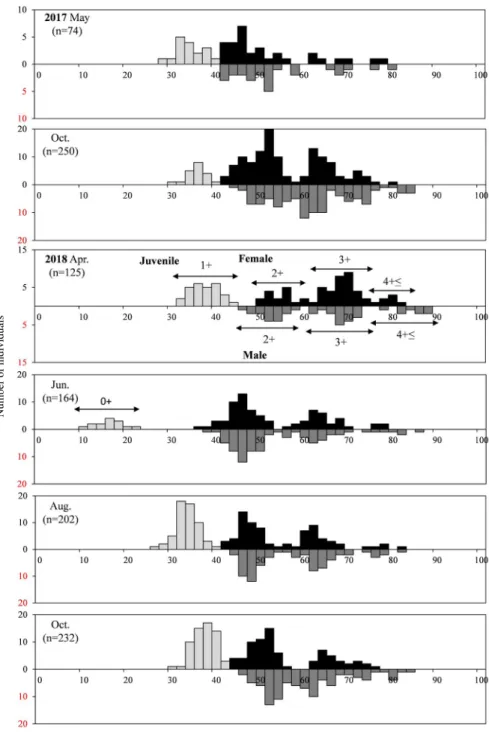
지 6회 조사를 실시하여 전장빈도분포도를 작성하였다(Fig. 3).
당년생 치어는 8월에 전장 26~41mm로, 10월에는 전장 30~43 mm로 성장하였다. 4월에 채집된 가장 작은 피크 그룹인 전장 32~43mm와 10월에 채집된 당년생의 전장크기는 거의 유사하 기 때문에 이 시기에 채집된 가장 작은 그룹은 만 1년생으로 판 단되었다. 이 치어들은 6월에 전장 36~53mm로 성장하고 암 컷에 산란관이 작게 나타나 암·수가 구별되었으며, 8월에 전장
42~55mm로, 10월에는 전장 44~57mm로 성장하였다. 이러한 10월의 전장범위는 4월의 두 번째 피크 그룹인 전장 50~61mm 와 거의 유사하기 때문에, 4월의 두 번째 피크 그룹은 만 2년생 으로 추정되었다. 이러한 성장패턴에 따라 4월의 세 번째 그룹 인 전장 62~75mm는 만 3년생, 네 번째 그룹인 전장 76~89 mm는 만 4년생 이상으로 추정되었다. 암컷과 수컷의 전장범위 는 거의 유사하였으나 만 4년생 이상의 개체들에서는 수컷이 암
Number of individuals
Total length (mm)
Fig. 3. Total length frequency distribution of Acheilognathus signifer in the Heukcheon Stream, Hangang River, Korea from 2017 to 2018.
컷보다 0~8mm 큰 개체들이 채집되어 약간의 차이를 보였다.
성비(♂/♀)는 본 조사기간에 암컷은 438개체, 수컷은 412개 체가 채집되어 0.94였으며 암·수간에 유의한 차이를 보이지 않 아 1:1이었다(P<0.05). 또한 시기별로 채집된 묵납자루의 성 비는 0.73~1.22로 약간씩 차이를 보였으나 통계적 유의성은 보 이지 않았다(P<0.05, Table 4).
5. 미소서식지
흑천에 방류된 묵납자루는 St. 3에 많이 서식하고 있었다(Fig.
3C). 성어는 유속이 있는 수심 0.4~1.2m의 큰돌과 돌 주위에 서식하였고 일부 개체가 수변부의 갯버들이나 달뿌리풀 인근에 서 확인되었다. 하지만 당년생 치어는 유속이 느리고 말즘이 서 식하는 곳에 무리를 지어 서식하고 있었으며 일부 개체만이 수 변부의 달뿌리풀 인근에 서식하고 있어 성어와 차이를 보였다.
고 찰
묵납자루 A. signifer는 한국고유종으로 한강수계인 임진강 과 한강유역의 중상류 지역에 넓게 서식하고 있는 것으로 알려 져 있다(Choi et al., 1990; Kim, 1997; Baek, 2005; Kim, 2014).
이 중 남한강 지류 흑천에서는 Choi et al.(1990)과 Baek(2005), Kim(2014)에 의해 서식이 확인되었지만, 최근 연구(Han, 2007;
Moon et al., 2010)와 제3차 전국자연환경조사(Song and Jeon, 2009a, 2009b, 2009c; Baek and Kim, 2010; Park and Hong, 2010)에서는 서식이 확인되지 않았다. 2010년부터 2012년까 지 흑천에 묵납자루는 환경부의 복원사업의 일환으로 재도입 (reintroduction)되어 10월에 모두 7,000개체가 방류되었고, 방 류 후 모니터링으로 2011년 69개체, 2012년 122개체가 확인 되었다. 2013년 모니터링에서는 4개 지점(3회 조사)에서 모 두 82개체가 채집되었는데, St. 3에서 17개체, St. 4에서 65개체 로 처음으로 방류지점 외의 지점에서 채집되었다(ME, 2013).
그러나 이후 2014년과 2015년은 방류지점에서만 각각 1개체
가 채집되고 2016년에는 아예 채집되지 않아 묵납자루의 복원 사업이 실패한 것으로 알려졌다(ME, 2014; 2016). 본 조사에 서는 2017년부터 2018년까지 모니터링을 실시한 결과 2017 년 329개체(2회 조사), 2018년 723개체(4회 조사)가 채집되 고 5km 구간(St. 2~St. 7)에 확산 분포하고 있으며, 연령분 석에서도 안정적으로 세대교번이 이루어지는 것이 확인되었 다. 따라서 흑천에 방류된 묵납자루는 안정적으로 정착하여 개 체군 크기가 크고 점점 확산되고 있어 재도입에 의한 복원사 업이 성공적인 것으로 평가되었다. 국내에 재도입으로 방류 된 종들 중 웅천천의 감돌고기 Pseudopungtungia nigra와 만 경강의 퉁사리 Liobagrus obesus, 낙동강(남강)의 얼룩새코미 꾸리 Koreocobitis naktongensis(ME, 2018), 오대산의 열목어 Brachymystax lenok tsinlingensis(WPOE, 2017) 등 만이 비교 적 개체군이 크고 안정적이고 서식하여 성공적인 복원으로 평 가된 바 있다. 국외에서도 많은 종들이 재도입되고 있지만 성 공적인 복원은 많지 않은데, 납자루아과 어류에서는 일본의 Tanakia limbata가 성공으로, A. longipinnis, A. cyanostigma는 부분성공으로, 그 외의 분류군에서는 미국의 Coregonus oxy- rinchus, Etheostoma sitikuense, Noturus baileyi, Noturus flavi- pinnis, Salvelinus confluentus와 일본의 Pseudorasbora pumila ssp. 등은 성공으로 보고되었다(IUCN, 2011).
2014년부터 2016년까지의 모니터링에서 묵납자루는 거의 채 집되지 않은 것으로 보고되었는데(ME, 2014, 2016), 이는 조사 지점 선정 및 채집도구 선정에 문제가 있었기 때문으로 추측된 다. 즉 조사지점에서 2013년(ME, 2013)과 2017~2018년에 가 장 많이 채집된 삼가교 위쪽의 St. 3이 조사지점에서 제외되었 으며, 채집도구도 2013년과 2017~2018년에서 가장 많이 포획 되는 어구인 일각망이 제외되고 족대와 투망, 유인어망으로만 조사되었다. 따라서 조사지점 및 채집방법에 따라 모니터링 결 과에 큰 차이를 보이기 때문에 종의 특성에 따라 조사지점 선정 과 채집방법을 신중하게 선택해야 할 것이며 이에 대한 조사 메 뉴얼의 제작도 필요하다고 판단되었다.
본 조사 결과 연령은 암·수 큰 차이 없이 만 4년생으로 구분 되었지만 자연서식지인 홍천강에서 비늘을 통해 연령을 추정 한 결과 만 1년생 암컷은 체장 33.35(수컷 38.96)mm, 만 2년 생 암컷은 39.87(수컷 47.24)mm, 만 3년생 암컷은 43.34(수컷 53.80)mm, 만 4년생 암컷은 49.92(수컷 59.00)mm로 나타나 (Baek, 2005) 연령수는 동일하였으나 수컷이 암컷보다 커서 본 결과와 차이를 보였다. 연령별 상대풍부도는 조사시기에 따라 차 이를 보였지만 대체로 당년생 또는 1년생이 가장 많았고 2년생, 3년생, 4년생 순으로 안정적인 연령구조를 보였다. 자연분포수역 인 홍천강 집단에서는 1년생(암컷 22%, 수컷 18%), 2년생(암컷 49%, 수컷 44%), 3년생(암컷 27%, 수컷 30%), 4년생(암컷 4%, 수컷 8%)의 구성비를 보이는 것으로 보고되어(Baek, 2005) 본 재도입 집단과 유사하였다. 산란은 4월부터 6월까지 관찰되고 치
Table 4. The sex ratio of Acheilognathus signifer in the Heukcheon
Stream, Hangang River, Korea from 2017 to 2018
Year/Month Juvenile Female Male Total Sex ratio χ
22017 May 17 31 26 74 0.84 0.44
Oct. 20 123 107 250 0.87 1.11
2018 Apr. 28 56 41 125 0.73 2.32
Jun. 14 76 74 164 0.97 0.03
Aug. 57 75 70 202 0.93 0.17
Oct. 61 77 94 232 1.22 1.69
Total 197 438 412 1047 0.94 0.80
The critical value for χ
2goodness-of-fit test of equal numbers of females and
males (df=1) at 95% significance is 3.84.
어가 6월에 전장 10~23mm, 8월에 전장 25~41mm의 개체들 이 채집되어 산란기는 4월부터 6월까지(산란성기 4~5월)로 추 정되어, 괴산집단과 단양집단이 4~7월(산란성기 4~5월)로 보고 되어 알려진 것과 유사하였으나 홍천강 집단은 5~6월로(Baek, 2005) 차이를 보였다. 묵납자루의 산란숙주는 본 지역에서 작은 말조개 Unio douglasiae sinuolatus만이 관찰되었으며 과거조사 (ME, 2011b)에서도 작은말조개만이 산란숙주로 보고된 바 있다.
홍천강 및 단양집단(Baek, 2005; Kim, 2014)은 본 결과와 동일 하게 작은말조개만을 이용하고 있었으나 괴산집단에서는 곳체 두드럭조개 Lamprotula leai와 작은말조개 Unio douglasiae를 함께 이용하여 차이를 보였는데, Kim(2014)의 결과에 따르면 이 곳에 서식하는 작은말조개와 곳체두드럭조개, 칼조개 Anodonta arcaeformis flavotincta, 작은대칭이 Lanceolaria grayana 중 조 개선택성은 곳체두드럭조개(63.6%)와 작은말조개(2.2%)를 이 용하는 것으로 보고되었고 두 종이 혼서할 경우에는 곳체두드럭 조개를 더 선호하는 것으로 보고하였다.
묵납자루 방류지점인 St. 4는 보로 형성된 소의 하류이며, St. 3 은 이 소의 상류로, 묵납자루는 2017년부터 2018년까지 St. 4에 서 37개체, St. 3에서는 1,006개체가 채집되어 하류에 방류된 묵 납자루가 상류로 이동하여 정착 번식하였다. 한편 이 지역에는 또다른 멸종위기야생생물 II급의 한강납줄개가 폭넓게 서식하고 있는데(Table 2), St. 3은 221개체, St. 4에 319개체가 채집되어 St. 4에 보다 많은 개체가 서식하고 있었다. 서식지 특징에서 St.
3은 큰돌과 돌로 이루어져 있고 수변부에 수초는 적은 반면 St.
4는 하상이 자갈과 돌로 하상 기질의 크기가 작은 반면 수변부 에 수초가 많이 서식하고 있었다. 따라서 묵납자루와 한강납줄 개의 서식개체수의 차이는 미소서식지의 차이로 기인한 것으로 추정되어 이에 대한 연구가 필요하다. 생태적 지위가 유사한 종 들은 경쟁을 피하기 위해 하상구조나 유속, 수온적응도, 먹이생 물 등을 달리하여 공존이 가능하도록 서식지 분리가 일어나는 데, 섬진강에 서식하는 칼납자루와 임실납자루는 숙주조개 선호 도(말조개 vs 부체두드럭조개 Inversiunio verrucosus, 민납작조 개 Pronodularia seomjinensis) 및 미소서식지(큰돌과 돌로 이루 어지고 유속이 있는 소 vs 수초가 많은 정수역)의 차이로(Yang, 2004), 미꾸리과 어류 중 대부분의 참종개속 어류와 기름종개 속 어류가 동소지역에 서식할 경우 유속(비교적 빠른 느린 여울 부 vs 유속이 없는 정수역)과 하상(자갈과 돌 vs 모래)의 차이로 (Ko, 2005, 2009; Ko et al., 2009), 돌상어와 꾸구리는 유속(빠른 여울 vs 느린 여울)의 차이로(Choi, 2002), 연준모치와 금강모치 는 수온의 차이(Baek et al., 2002) 등으로 서식지 분리가 일어나 는 것으로 보고되고 있다. 따라서 추후 흑천에 혼서하고 있는 묵 납자루와 한강납줄개의 서식지 특징(수초, 하상구조, 수심, 유속, 먹이생물, 숙주조개)과 미소분포, 공간활용 등을 조사하여, 동서 하는 2종의 멸종위기종에 대한 보존방안 수립을 위한 경쟁여부 및 서식지 분리 등에 대한 연구가 시급하게 필요하였다.
요 약
남한강 지류 흑천에 재도입(2010~2012년)된 묵납자루의 서 식현황을 밝히기 위해 2017년부터 2018년까지 서식현황을 조 사하였다. 조사결과 2017년(2회 조사)에는 329개체를, 2018년(4 회 조사)에는 723개체를 채집하었고, 서식범위는 방류지점을 포 함하여 약 5km 구간이었다. 묵납자루의 집단서식지는 방류지역 소의 상류부로 유속이 있고 수심 0.4~1.2m이며 큰돌과 돌이 많은 곳이었다. 산란기는 산란행동 및 당년생 치어 크기로 볼 때 4월부터 6월로 추정되었으며, 성비는 암컷 438개체, 수컷 412개 가 채집되어 1:0.94였다. 연령은 4월을 기준으로 전장 32~43 mm는 만 1년생, 50~61mm는 만 2년생, 62~75mm는 만 3년생, 76~89mm는 만 4년생 이상으로 추정되었다. 연령별 구성비는 채집시기에 따라 차이를 보였지만 1년생(또는 당년생), 2년생, 3년생, 4년생 이상의 순으로 높게 나타나 안정적인 연령구조를 보였다. 따라서 흑천에 복원을 위해 재도입된 묵납자루는 성공 적으로 정착하여 안정적인 개체군을 이루고 점점 확산되는 경 향을 보였다.
사 사
본 연구는 환경부의 ‘멸종위기 담수어류(꼬치동자개) 보전방 안 연구’, ‘멸종위기 담수어류(여울마자, 꼬치동자개) 보전 방안 연구’ 및 순천향대학교의 연구비 지원을 받아 연구되었다.
REFERENCES
Baek, H.M. 2005. Ecological studies on the Korean bitterling, Achei- lognathus signifer(Cyprinidae) in Korea. Doctoral Thesis, Kangwon National University, Chuncheon, 186pp.(in Kore- Baek, H.M. and H. Kim. 2010. The 3rd nation environment investiga-an) tion. Fresh water fishes of the Yongmun whole area. Ministry of Environment, 4pp.(in Korean)
Baek, H.M., H.B. Song, J.S. Sim, Y.G. Kim and O.K. Kwon. 2002.
Habitat segregation and prey selectivity on cohabitation fish- es, Phoxinus phoxinus and Rhynchocypris kumgangensis.
Korean J. Ichthyol., 14: 121-131.(in Korean)
CHA(Cultural Heritage Administration). 2012. Culture and resto- ration research of natural monument, Hemibarbus mylodon.
Soonchunhyang University, Asan, 48pp.(in Korean)
Chapin, F.S., E.S. Zavaleta, V.T. Eviner, R.L. Naylor, P.M. Vitousek, H.L. Reynolds, D.U. Hooper, S. Lavorel, O.E. Sala, S.E.
Hobbie, M.C. Mack and S. Diaz. 2000. Consequences of changing biodiversity. Nature, 405: 234-242.
Choi, J.S. 2002. Ecological studies of Gobiobotia brevibarba Mori
(Cyprinidae). Doctoral Thesis. Kwagwon National Univerti- ty, 103pp.(in Korean)
Choi, K.C., S.R. Jeon, I.S. Kim and Y.M. Son. 1990. Coloured illus- trations of the freshwater fishes of Korea. Hyangmun Pub- lishing Co. Ltd., Seoul, 277pp.(in Korean)
Cummins, K.W. 1962. An evolution of some techniques for the col- lection and analysis of benthic samples with special emphasis on lotic waters. Amer. Midl. Nat'l., 67: 477-504.
Han, T.J. 2007 Ichthyofauna in the Heuk stream of Gyenggi Provinc.
Master Thesis, Chonnam National University, Yeosu, 29pp.
(in Korean)
IUCN. 2001. IUCN Red list categories and criteria: Version 3.1.
IUCN Species Survival Comission. IUCN, ii+30pp.
IUCN. 2011. Global re-introduction perspectives: 2011. 251pp.
Jang, M.H., G.J. Joo and M.C. Lucas. 2006. Diet of introduced large- mouth bass in Korean rivers and potential interactions with native fishes. Ecol. Freshw. Fish., 15: 315-320.
Kani, T. 1944. Ecology of torrent-inhabiting insects, pp. 171-317. In:
Insect I(Furukawa, J., ed.). Kenkyu-sha, Tokyo.(in Japanese) Kim, H.S. 2014. Spawning ecology and conservation of the Korean
bittering, Acheilognathus signifer(Cyprinidae). Doctoral Thesis, Chonbuk National University, Jeonju, 158pp.(in Ko- rean)
Kim, I.S. 1997. Illustrated encyclopedia of fauna & flora of Korea, Vol. 37, Freshwater fishes. Ministry of Education, Yeongi, 518pp.(in Korean)
Kim, I.S. and J.Y. Park. 2007 Freshwater fishes of Korea. Kyohak Publishing, Seoul, 467pp.(in Korean)
Kim, I.S., Y. Choi, C.L. Lee, Y.J. Lee, B.J. Kim and J.H. Kim. 2005.
Illustrated book of korean fishes. Kyohak publishing, Seoul, 615p.(in Korean)
Ko, M.H. 2005. Ecological studies of Cobitis tetralineata and Ik- sookimia longicorpa(Cobitidae) in the Seomjin River, Ko- rea. Master Thesis. Chonbuk National University, 68pp.(in Korean)
Ko, M.H. 2009. Reproductive mechanisms of the unisexual dip- loid-triploid hybrid complex between the spined loach Cobitis hankugensis and Iksookimia longicorpa(Teleostei, Cobitidae) in Korea. Doctoral Thesis, Chonbuk National University, Jeonju, 160pp.(in Korean)
Ko, M.H., J.Y. Park and S.H. Kim. 2009. Habitat enviornment and feeding habitat of Iksookimia koreensis and Cobitis lutheri (Pisces: Cobitidae) in the Mangyeong River, Korea. Korean J.
Ichthyol., 21: 253-261.(in Korean)
Ko, M.H., Y.S. Kwan, K.L. Lee and Y.J. Won. 2017. Impact of human activities on changes of ichthyofauna in Dongjin River of Korea in the past 30 years. Anim. Cells Syst., 21: 207-2016.
Kwan, O.G., G.M. Park and J.S. Lee. 1993. Coloured Shells of Ko- rea. Academi publishing, Seoul, 445pp.(in Korean) Kwater. 2007. A guidebook of rivers in South Korea. Kwater, Dae-
jeon, 582pp.(in Korean)
ME(Ministry of Environment). 1998. Natural environment conserva- tion act(Law No. 5392).(in Korean)
ME(Ministry of Environment). 2005. Species conservation, resto- ration and development of propagation tecnique for the en- dangered endemic species among the freshwater fishes from Korea. Gunsan University, Gunsan, 537pp.(in Korean) ME(Ministry of Environment). 2006. Studies on the genetic diversity,
artificial propagation and restoration of a threatened national monument Fish Hemibarbus mylodon. Soonchunhyang Uni- versity, Asan, 520pp.(in Korean)
ME(Ministry of Environment). 2009a. Development of genetic di- versity analysis, culture and ecosystem restoration techniques for endangered fish, Iksookimia choii. Soonchunhyang Uni- versity, Asan, 537pp.(in Korean)
ME(Ministry of Environment). 2009b. Culture and restoration research of Pseudobagrus brevicorpus. Inland Culture Re- search Center, National Institute of Fisheries Science, 75pp.
(in Korean)
ME(Ministry of Environment). 2010. Culture and restoration of en- dangered species in the major rour river drainages. Institute of Biodiversity Research, Jeonju, 86pp.(in Korean)
ME(Ministry of Environment). 2011a. Development of culture tech- niques and construction of monitoring system for released seedlings of endangered fish Koreocobitis naktongensis.
Soonchunhyang University, Asan, 250pp.(in Korean) ME(Ministry of Environment). 2011b. Culture and restoration re-
search of endangered freshwater fish(four species include Liobagrus obesus). Soonchunhyang University, Asan, 359pp.
(in Korean)
ME(Ministry of Environment). 2012. Culture and restoration re- search of endangered freshwater fishes(five species includ- ing Liobagrus obesus). Soonchunhyang University, Asan, 269pp.(in Korean)
ME(Ministry of Environment). 2013. Post-monitoring of culture and restoration research of endangered Freshwater Fish. Soon- chunhyang University, Asan, 204pp.(in Korean)
ME(Ministry of Environment). 2014. Monitoring of endangered freshwater fish and a study on the post-management Plan.
Halla University, Wonju, 402pp.(in Korean)
ME(Ministry of Environment). 2016. A study on the establishment of master plan of endangered freshwater fish. Kumoh National Institute of Technology, Gumi, 379pp.(in Korean)
ME(Ministry of Environment). 2017. Conservation and management laws of wildlife(amendment of enforcement regulations) (Law No. 10977).(in Korean)
ME(Ministry of Environment). 2018. A study on conservation plan of endangered freshwater fish(Pseudobagrus brevicorpus).
Soonchunhyang University, Asan, 204pp.(in Korean) MLTM(Ministry of Land & Transport and Maritime Affairs). 2010.
Culture and restoration of endangered species in the major four river drainages. Soonchunhyang University, Asan, 489pp.(in Korean)
MLTM(Ministry of Land, Transport and Maritime Affairs). 2011.
Culture and restoration of endangered species in the major four river drainages II. Soonchunhyang University, Asan,
363pp.(in Korean)
MLTM(Ministry of Land, Transport and Maritime Affairs). 2012.
Culture and restoration of endangered species in the major four river drainages III. Soonchunhyang University, Asan, 423pp.(in Korean)
Moon, W.K., J.H. Han and L.G. An. 2010. Fish fauna and community analysis in Heuck Stream watershed. Korean J. Limnol., 43:
69-81.(in Korean)
Nelson, J.S. 2006. Fishes of the World. John Wiley & Sons, Inc., 601pp.
NIBR(National Institute of Biological Resources). 2011. Red data book of endangered fishes in Korea. Ministry of Environ- ment, Incheon, pp. 59-60.(in Korean)
Park, S.C. and G.S. Hong. 2010. The 3rd nation environment investi- gation. Fresh water fishes of the Jije whole area. Ministry of Environment, 4pp.(in Korean)
Ricker, W.E. 1971. Methods for assessment of fish production in freshwater. IBP hand book, 3: 112-13.
Song, H.B. and J.S. Jeon. 2009a. The 3rd nation environment investi- gation. Fresh water fishes of the Sinjeom whole area. Minis- try of Environment, 4pp.(in Korean)
Song, H.B. and J.S. Jeon. 2009b. The 3rd nation environment inves-
tigation. Fresh water fishes of the Yangdukwon whole area.
Ministry of Environment, 4pp.(in Korean)
Song, H.B. and J.S. Jeon. 2009c. The 3rd nation environment investi- gation. Fresh water fishes of the Cheongun whole area. Min- istry of Environment, 4pp.(in Korean)
Thomas, C.D., A. Cameron, R.E. Green, M. Bakkenes, L.J. Beau- mont, Y.C. Collingham, B.F.N. Erasmus, M.F. Siqueira, A.
Grainger, L. Hannah, L. Hughes, B. Huntley, A.S. Jaarsveld, G.F. Midgley, L. Miles, M.A. Ortega-Huerta, A.T. Peterson, O.L. Phillips and S.E. Williams. 2004. Extinction risk from climate change. Nature, 427: 145-148.
WPOE(Wonju Provincial Office of Environment). 2017. Culture and restoration research of endangered wildlife(Brachymystax lenok tsinlingensis). Kangwon Univeristy, Chuncheon, 45pp.
(in Korean)
WPOE(Wonju Provincial Office of Environment). 2018. Culture and restoration research of endangered wildlife(Rhodeus pseu- dosericeus)(Second year). Kangwon Univeristy, Chuncheon, 45pp.(in Korean)
Yang, H. 2004. Ecolgoy and speciation of Acheilognathus koreensis and A. somjinensis. Doctoral Thesis. Chonbuk National Uni- vertity, 100pp.(in Korean)