LED광 파장이 국화생육에 미치는 영향
임재운1·윤용철1·서광욱2·김규형3·문애경3·김현태4*
1경상대학학교 지역환경기반공학과(농업생명과학연구원), 2대한민국 특허청 식품생물자원심사과,
3한국전자통신연구원, 4경상대학교 생물산업기계공학과(농업생명과학연구원)
Effect of LED Light Wavelength on Chrysanthemum Growth
Jae un Im1, Yong Cheol Yoon1, Kwang wook Seo2, Kyu Hyeong Kim3, Ae Kyung Moon3, and Hyeon Tae Kim4*
1Dept. of Agricultural Eng., Gyeongsang National Univ. (Insti. of Agric. & Life Sci.), Jinju 660-701, Korea
2The Korean Intellectual Property Office, Daejeon 302-701, Korea
3Dept. of Electronics and Telecommunications Research Institute, Daegu 711-883, Korea
4Dept. of Bio-Industrial Machinery Eng., Gyeongsang National Univ. (Insti. of Agric. & Life Sci.), Jinju 660-701, Korea
Abstract. In this study, I was focusing on LED (Light Emitting Diode) light effect in growth of chrysanthemum.
For this reason, I formed six monochromatic lights (red 650 nm, 647 nm, 622 nm, blue 463 nm, 450 nm, white), six mixed lights sources red : blue (9 : 1, 8 : 2, 7 : 3, 6 : 4, 5 : 5) and 3 control beds in light sources ratio between rad : blue (8 : 2) including sun light. It was totally 15 control beds. Depending on light investigation time in growth, 6/6 (on/off) was highest in the length of plant, the number of leaves, the fresh dry and leaf area. But statistical signifi- cance wasn’t accepted in general. In case of monochromatic lights, length of plant and leaf area is biggest in the Blue 450 mm and the length of root is highest in RED 650 mm. Except for this 3 measuring points (length of plant, the number of leaves and fresh weight), sun light and white was highest. Besides there are monochromatic light effect but various wavelength range in light sources are needed to crop growth. In terms of mixed light resources, except for sun light, It turned out the length of plant is highest in the highest red light rate red : blue (9 : 1), and Red : white (7 : 3) is highest in fresh weight and dry weight. The sun light is the highest one in the leaf area. The results from LED light effect in growth of chrysanthemum are obviously effect on growth and building up the shape. We need to choose suitable light sources in the monochromatic lights and mixed lights for growing high quality of chrysanthe- mum or Supplemental Lighting.
Key words : chlorophyll, chrysanthemum, environmental control, greenhouse, LED (Light Emitting Diode), light quality
서 론
최근 이상기상 현상으로 인해 안정적인 식량 생산을 위해 국내뿐 만 아니라, 일본, 미국, 네덜란드 등 선진국 에서 온실의 발전된 형태인 식물공장에 대한 다양한 연 구가 진행되고 있으며, 식물공장에서는 에너지저감 등을 위해 최소한의 광조사로 작물을 생산하기 위한 목적으로 식물과 광원의 상관연구가 지속적으로 진행되고 있다.
종래에 식물 재배용 인공광원으로 형광등, 메탈등, 수은 등 및 백열등 등이 이용 되어 왔다. 하지만 종래에 이용 된 광원들은 광의 이용효율이 낮고, 생산효율이 낮으며,
광선 중에 열선을 포함하고 있어 냉방에 많은 비용이 소요되는 단점이 있다. 이러한 단점을 보완한 인공광원 중에 하나는 LED(Light Emitting Diode: 발광다이오드, LED)이다. LED는 식물 재배에 있어 광합성에 필요한 파 장만을 가지고 효과적으로 식물 재배할 수 있으며, 전력 소모량이 적어 경제적이고 반영구적으로 사용할 수 있어 LED를 이용한 연구가 활발히 진행되고 있다(MIFAFF, 2003).
LED를 이용한 연구는 상추의 생리적 반응(Hoenecke 등, 1992), 상추의 생육에 미치는 영향(Yanagi 등, 1996;
Lee 등, 2010), 들깨의 생장 및 광합성에 미치는 영향, 브로콜리 새싹의 발아, 수박 접목묘의 활착 등의 실험 등 주로 식물체의 성장에 관한 연구가 보고되어 있고 (Cho 등, 2008; Choi 등, 2003), 적색광에서 생육촉진효 과(Nishimura 등, 2006, 2007; Warrington 등, 1976;
*Corresponding author: [email protected]
*Received January 24, 2013; Revised February 18, 2013;
*Accepted February 28, 2013
Mortensen 등, 1987)와 또한 새싹채소의 기능성 증진
(Cho 등, 2008) 및 파프리카의 수확 후 착색효과증진
(Choi 등, 2009) 등 농업분야에서 LED의 적용 가능성이 계속 밝혀지고 있다. 하지만, 최근 농업에 접목되고 있 는 LED를 이용한 연구는 생육의 품질을 종합적으로 고 려한 LED 조사기술의 확립은 미흡한 실정이다(An 등, 2011).
국화는 화훼작물 가운데 3대 절화 중 하나로 약용, 행 사용, 가정용 등 다양한 용도로 소비되고 있다. 우리나 라의 경우 생산량은 장미 다음으로 많고, 재배면적과 생 산액에서는 전국에서 경남지역이 약 23% 정도로 비중이 높은 실정이다(MIFAFF, 2012). 가을국화는 온도와 광에 밀접한 관계를 가지고 있으며, 광량과 일장시간에 따라 영양생장 및 개화시기에 큰 영향을 미친다(Suh 등, 2010).
이와 같이 식물의 생장에 있어 광은 가장 중요한 요소 로써 광의 세기(조도, 빛의 밝기), 광의 지속시간(명기시 간과 암기시간), 빛의 성질(광파장) 등 3가지로 구분할 수 있다. 특히, 광의 세기는 광합성과 밀접한 관계를 갖 는데 호흡으로 배출되는 탄산가스와 광합성에 필요한 탄 산가스가 같아질 때의 광의 세기를 광보상점(光補償點, light compensation)이라 하며, 광의 세기가 증가할수록 광합성량이 증가하다가 광포화점(光飽和點, light saturation point)이 되면 더 이상 증가하지 않는다. 광합성은 식물의 생장에 가장 중요한 물질대사로 식물마다 생육정도에 따 라 최적 조건이 다르나, 광 수용체가 개화 유도나 개화시 기조절 등 형태형성에 있어 일정량의 청색광과 원적색광 이 필요하고(Hoenecke 등, 1992) 적색광은 식물체의 광 합성에 청색광은 생장에 필연적이다(Okamoto 등, 1996).
따라서 본 연구에서는 국화생육에 있어서 LED광이 미치는 영향을 구명하기 위해서 대표적인 가을국화인
‘Shinma’를 대상으로 LED광 환경에서 LED광의 효과를
구명하고자 수행하였으며, 향후 국화재배에 있어 보광이 나 고품질 국화생산을 위한 기초 연구로 수행하였다.
재료 및 방법
국화 ‘Shinma’는 2010년 10월에 마산 진산면의 국화 재배 농가에서 구입 후 경상대학교내 생태체험뜰에 설치 되어 있는 길이 20m, 폭 11m 인 1-2W 형 온실에 실험 용 베드를 이용하여 재배하였다. 재배기간은 2010년 10 월 5일~12월 13일로 약 2달간 양액재배를 하였으며, 모 종 구입 후 발근제를 사용하여 15일간 모종포트에서 발 근 시킨 후, 실험용 베드에 16주씩 삽종 하였고, 온실내 온도는 작물생육에 알맞게 18oC를 유지하도록 하였다.
Fig. 1은 실험 대상 온실(좌) 및 실험구(우)의 내부 모습 을 나타낸 것이다.
실험용 베드는 900(W) × 900(D) × 1300(H)mm 규격으 로 총 14개와 대조구(태양광)를 설치하였고, LED는 실 험용 베드내 상단에 위치하면서 국화의 생장에 따라 균 일한 광량(150~200µmol · m−2· s−1)을 조사하기 위해 국 화생장점으로부터 30cm 높이에서 유지하고 높이를 조절 할 수 있도록 설치하였다. 또한 LED의 상단 후면에는 실험구내에 동일한 환경조건 및 상부에 설치한 LED의 방열에 따른 영향을 최소화하기 위해서 배기팬을 설치하 여 실험을 수행하였다.
식물의 광합성에 이용되는 파장범위 400nm~700nm로 가시광선 범위인 380nm~760nm와 유사한 파장범위를 보이고 있고, 이 파장범위에서 광은 광합성뿐 만 아니라, 광형태형성 반응을 유도하며, 식물분야에서는 광합성유 효방사(Photosynthetically active radiation; PAR)이라 한 다. 광합성에는 식물의 엽록소가 관여하는데 엽록소에는 엽록소a와 엽록소b가 있으며, 660nm 부근과 450nm 부
Fig. 1. Picture of greenhouse and experimental system.
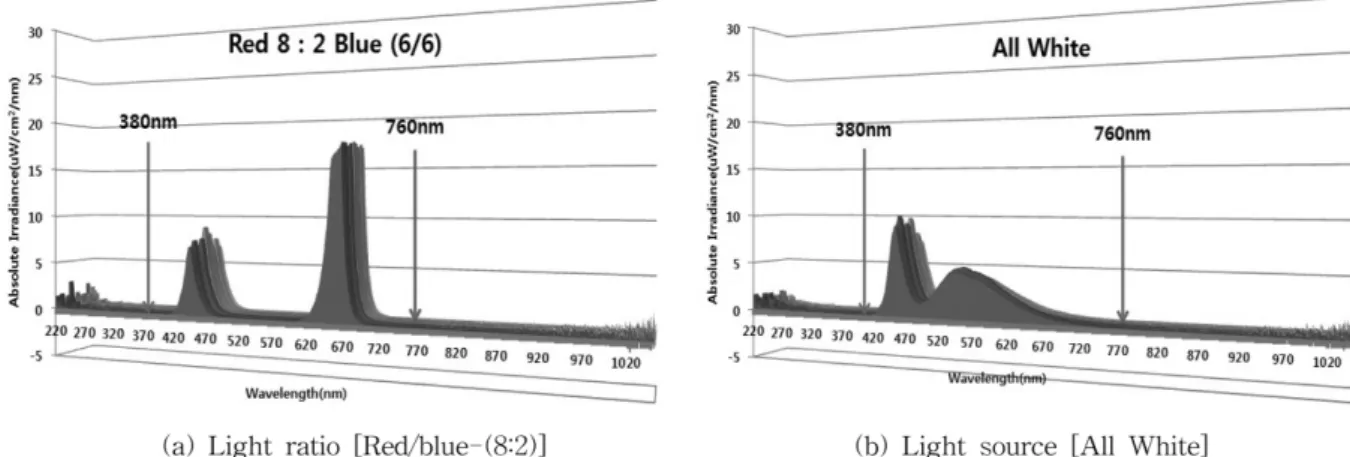
근에서 흡수되는 광량이 높아 광합성에 효율적으로 사용 되고 있다. Fig. 2는 실험에 사용된 광원이 식물의 광합 성에 이용되는 파장범위 내에 있는지 파악하고자 분광측 정기(RPS900, ILT Inc., USA) 이용하여 광원의 파장대 를 측정하였으며, 대표적으로 적색광(Red) : 청색광(Blue)- (8 : 2)과 백색광(White)의 측정한 파장대를 나타내었다.
따라서, 광원은 3W LED가 20개로 구성된 2개의 모 듈형(Power PG LED, PARUS Inc., Korea)을 사용하여 광원비율을 크게 3가지로 구성하였다. 식물의 엽록소 작 용과 광합성 작용이 활발히 일어나는 피크 파장대의 단 일 광원 구성과 파장의 조합으로 성장, 신장, 개화, 발아 등 최적 조건을 구명하기 위해 혼합광의 광원 비율을 다르게 하여 구성하였다. 단일광의 광원은 적색광(Red)
650nm, 647nm, 622nm, 청색광(Blue) 463nm, 450nm, 백색광(White)로 구성하였고, 혼합광의 광원 비율은 적 색광(Red) : 청색광(Blue)-(9 : 1, 8 : 2, 7 : 3, 6 : 4, 5 : 5)와 Fig. 2. Wavelengths of light source.
Table 1. Tests of compound light quality.
Light source Red Blue Red Blue Red Blue Red Blue Red Blue Red White
Sun light
Light ratio 9 1 8 2 7 3 6 4 5 5 7 3
Light irradiation
period 6/6
Tests
Table 2. Tests of monochromatic light quality.
Light source Red (650 nm)
Red (647 nm)
Red (622 nm)
Blue (463 nm)
Blue
(450 nm) All white
Sun light Light irradiation
period 6/6
Tests
Table 3. Tests of light irradiation period.
Light source Red Blue Red Blue Red Blue
Light ratio 8 2 8 2 8 2
Light irradiation
period 12/12 6/6 3/3
Tests
적색광(Red) : 백색광(White)-(7 : 3)으로 구성하였다. 또한 광원의 조사반복획수에 따른 LED효과를 구명하기 위해 서 광원 비율 적색광(Red) : 청색광(Blue)-(8 : 2)의 on/off 주기시간을 12/12, 6/6, 3/3으로 실험용 베드를 3개 구성 하여, 대조구(태양광)를 포함한 총 15개의 실험용 베드 를 구성하였다.
생육조사에 있어 측정항목은 국화의 직접적인 생장 상 태 변화를 파악하기 위해서 초장, 근장, 줄기 직경, 엽수, 엽록소, 생체중, 건물중, 엽면적 등을 측정하였고, 통계 분석은 통계분석용 프로그램(SAS institute Inc., USA)를 이용하여 Duncan의 다중검정 P = 0.05 수준에서 분석하 였다.
결과 및 고찰
1. 단일광원
LED 단색광원에서 적색광(Red) 및 청색광(Blue)의 파 장대에 따른 생육비교는 Table 4와 같다. 청색광(Blue)은 초장의 생장을 억제시키나(Rajapakse와 Kelly, 1992), 적 색광(Red)은 청색광(Blue)이 없는 조건에서 초장의 억제 효과가 낮다고 하였다(McMahon 등, 1991). 하지만 본 실험에서는 초장에 있어 청색광(Blue 450nm)에서 가장 길게 나타났으며, 근장과 엽수에서는 적색광(Red 650nm)
Table 4. Effects of light quality on the growth of Chrysanthemum (Monochromatic Light) Radiation
light
Plant height
(cm)
Root length
(cm)
Diameter of stem
(cm)
Leaf numbers
(ea)
Chlorophyll (mg/g FW)
Fresh weight Dry weight Leaf area (cm2)
Plant Root Plat Root
Red 650 nm 54.017ab 12.817a 0.52167a 37.000a 50.250a 35.217bc 2.7667ab 4.1167a 0.3667bc 06.283c Red 647 nm 49.483ab 10.867ab 0.57333a 35.333ab 48.433a 29.850c 1.8833b 3.8500a 0.3667bc 07.850bc Red 622 nm 53.750ab 09.400b 0.50667a 33.667ab 47.800a 28.017c 1.9833b 3.4333a 0.3000c 07.067bc Blue 463 nm 54.467ab 09.850b 0.47333a 31.667b 46.250a 27.200c 2.5833b 3.1833a 0.3833a-c 14.333a Blue 450 nm 56.467a 10.233ab 0.49333a 34.500ab 49.317a 31.933bc 2.4833b 3.7333a 0.4333a-c 13.800a All white 47.650b 11.867ab 0.54667a 35.167ab 48.783a 40.083ab 3.7667a 4.2167a 0.5500a 09.300b Sun light 52.750ab 11.017ab 0.56000a 36.333a 44.867a 43.967a 3.6667a 4.2000a 0.5000ab 12.967a
zMean separation within columns by Duncan’s multiple range test at 5% level.
Table 5. Effects of light quality on the growth of Chrysanthemum (Compound Light) Radiation light
Plant height
(cm)
Root length
(cm)
Diameter of stem
(cm)
Leaf numbers
(ea)
Chlorophyll (mg/g FW)
Fresh weight Dry weight Leaf area (cm2)
Plant Root Plat Root
Red 9 : 1 Blue 50.767ab 12.567a 0.52833a 37.167a 51.117a 41.550a 3.6000ab 4.6167ab 0.41667ab 08.933b Red 8 : 2 Blue 47.333ab 11.700a 0.57167a 38.667a 51.383a 40.000a 3.5333a-c 4.3333ab 0.45000ab 06.400b Red 7 : 3 Blue 44.333b 11.917a 0.54167a 35.667a 48.467ab 30.717b 3.1667a-c 3.5167b 0.41667ab 07.967b Red 6 : 4 Blue 45.317ab 11.417a 0.50167a 38.167a 49.983a 39.933a 2.7667bc 4.0000ab 0.33333b 08.300b Red 5 : 5 Blue 46.033ab 11.333a 0.57667a 38.000a 48.200ab 39.550a 2.6167c 3.7500b 0.31667b 09.633b Red 7 : 3 White 47.350ab 11.150a 0.50333a 37.667a 49.900a 47.150a 3.8167a 5.2500a 0.50000a 08.300b Sun light 52.750a 11.017a 0.56000a 36.333a 44.867b 43.967a 3.6667ab 4.2000ab 0.50000a 12.967a
zMean separation within columns by Duncan’s multiple range test at 5% level.
에서 가장 높게 나타났다. 이는 들깨의 초장은 청색광
(Blue)에서 신장되었고 적색광(Red)에서는 억제되었던
연구결과(Choi 등, 2003)와 유사한 것으로 판단된다. 또 한 생체중과 건물중에서는 대조구(태양광)에서 가장 높 게 나타났고, 그 다음으로 백색광(White)에서 높게 나타 났다. 적색광(Red)은 식물의 광합성에 관여하고, 청색광
(Blue)은 형태적으로 식물체의 건전한 생장에 필연적
(Okamoto 등, 1996)이라고 하였는데, 본 연구 결과와는 다르게 나타났다. 이는 생체중과 건물중에 있어 적색광 (Red)과 청색광(Blue)의 영향도 있으나 대조구(태양광)와 백생광(White)처럼 다양한 파장대의 광원이 생장에 필요 한 것으로 판단된다. 엽면적은 청색광(Blue) 463nm, 450nm 순으로 가장 높게 나타났고, 그 다음으로 대조구(태양광) 에서 높은 값을 나타냈다. 전체적으로 초장과 엽면적에 서는 청색광(Blue)에서 높게 나타났고, 근장과 엽수에서 는 적색광(Red)이 높게 나타났으며, 엽수, 생체중, 건물 중, 엽면적 등은 대조구(태양광)와 백색광(White)에서 높 게 나타나 단색광 보다 다양한 파장대의 광원을 조사해 줌으로서 높은 결과 값을 나타내었다.
2. 혼합광원
LED 혼합광원에서 광원 비율에 따른 생육비교는 Table 5과 같다. 광질은 식물체의 신초 신장, 잎의 형태
등의 생장 및 형태형성, 그리고 엽록소합성에 영향을 미 친다고 보고되었다(Wongnok 등, 2008). 본 실험에서 초 장은 적색광(Red) : 청색광(Blue)-(9 : 1)에서 가장 높게 나타났으며, 초장에 따른 생체중과 건물중에서 전체적으 로 높게 나타났다. 이처럼 적색광(Red)은 신초와 줄기생 장(Shin 등, 2008) 영향을 미친다는 보고와 일치한 결과 를 나타냈다. 그리고 청색광(Blue)은 엽록소 합성에 중 요한 요인(Moreira da Silva와 Debergh, 1997)으로 알려 진 것과는 달리 폐쇄형 육묘 시스템의 인공광 하에서 토마토와 오이 육묘 시 적색광(Red)과 적색광(Red) : 청 색광(Blue)의 혼합광에서 묘 생산에 이용 가능성이 높다 는 연구결과(Um 등, 2009)와 같이 엽록소 함량에서는 적색광(Red) : 청색광(Blue)-(8 : 2)에서 가장 높게 나타났 으며, 생체중과 건물중에서는 적색광(Red) : 백색광(White)- (7 : 3)에 가장 높게 나타났다. 이는 단색광과 마찬가지로 단색광 보다 다양한 파장대의 광원을 조사해줌으로써 생 체중과 건물중에서는 높은 결과 값을 나타내는 것으로 판단된다. 전체적으로 초장, 생체중, 건물중, 엽면적 등 에서 대조구(태양광)가 높게 나타나 광질 즉, 파장대에 대한 영향도 많이 받았지만 광량의 영향도 큰 것으로 판단된다.
3. 광조사 주기
LED 광원 비율 적색광(Red) : 청색광(Blue)-(8 : 2)에서 광 조사시간에 따른 생육비교는 Table 6과 같이 초장과 엽수에 있어 조사시간 6/6(on/off)에서 가장 길게 나타났 고, 조사시간 12/12, 3/3(on/off)는 비슷하였다. 이는 LED Chamber System을 이용한 국화 배양소식물체의 생장에 서 연속조사에 비해 명기시간 단축에 의한 생장이나 형 태제어에 효과적인 연구결과(Heo 등, 2010)와 같이 유사 하게 나타났으며, 국화 ‘Shinma‘의 경우, 단일식물의 광 수용에 있어 조사반복횟수가 4회인 6/6(on/off)에서 가장 효과적으로 판단된다. 엽록소함량에서는 조사시간이 가 장 긴 12/12(on/off) 가장 높게 나타났으며, 근장과 줄기 직경에서는 조사시간에 따른 차이가 없었고, 엽면적에서
는 조사시간이 짧을수록 엽면적이 증가하는 경향을 나타 냈다. 조사시간 6/6(on/off)에서 초장, 엽수, 생체중(상부), 엽면적이 높게 나타났지만, 전체적으로 광원의 조사시간 이 6/6(on/off) 이하일 경우 국화 생육에 큰 영향을 미치 는 것으로 보이나, 통계적인 유의성은 인정되지 않았다.
본 연구의 결과, LED 광원이 국화 생장 및 형태형성 에 영향을 미치는 것으로 나타났으며, 국화재배 시 적절 한 광원의 선택은 정상적인 생육을 위해 필요하며 특히, 일조량이 부족하여 보광의 목적이나 고품질의 국화를 생 산하기 위해서 필요하다고 판단된다. 따라서 이러한 결 과는 향후 국화재배에 있어 보광이나 고품질 국화생산을 위한 기초 자료로 이용할 수 있을 것이다.
적 요
국화생육에 있어서 LED광이 미치는 영향을 구명하기 위해서 국화 ‘Shinma’를 대상으로 단일광 적색광(Red) 650nm, 647nm, 622nm, 청색광(Blue) 463nm, 450nm, 백색광(White)과 혼합광(적색광(Red) : 청색광(Blue)-(9 : 1, 8 : 2, 7 : 3, 6 : 4, 5 : 5), 적색광(Red) : 백색광(White)-(7 : 3) 그리고 광원의 조사시간에 따른 LED효과를 구명하고자 광원 비율 적색광(Red) : 청색광(Blue)-(8 : 2)의 컨트롤 베드를 3개로 구성하고, 대조구(태양광)를 포함하여 총 15개의 컨트롤 베드를 구성하여 수행하였다. 광 조사시 간에 따른 생육에서는 6/6(on/off)에서 초장, 엽수, 생체 중, 엽면적이 높게 나타났지만, 전체적으로 통계적인 유 의성은 인정되지 않았다. 단일광원의 경우 청색광(Blue)
450nm에서 초장과 엽면적이 가장 크게 나타났고, 근장
에서는 적색광(Red) 650nm에서 가장 높게 나타났다. 그 외의 측정항목에서는 대조구(태양광)와 백색광(White)에 서 높게 나타나, 단일광원에 대한 영향도 있지만, 다양 한 파장대의 광원도 작물 생육에 필요한 것으로 판단된 다. 혼합광의 경우 단일광과 달리 대조구(태양광)를 제외 하고 적색광(Red)의 비율이 가장 높은 적색광(Red) : 청 색광(Blue)-(9 : 1)에서 초장이 가장 높게 나타났으며, 생
Table 6. Effects of light quality on the growth of Chrysanthemum (Light Irradiation period).
Radiation light
Plant height
(cm)
Root length
(cm)
Diameter of stem
(cm)
Leaf numbers
(ea)
Chlorophyll (mg/g FW)
Fresh weight Dry weight
Leaf area (cm2)
Shoot Root Shoot Root
Red 8 : 2 Blue
(12/12) 35.467b 12.783a 0.57167a 37.167ab 59.000a 36.967ab 5.1833a 3.8833a 0.56667a 6.450b Red 8 : 2 Blue
(6/6) 47.333a 11.700a 0.57167a 38.667a 51.383b 40.000a 3.5333b 4.3333a 0.45000b 8.200a Red 8 : 2 Blue
(3/3) 36.750b 14.283a 0.53500a 34.500b 52.383b 32.980b 3.4833b 3.6167a 0.41667b 8.700a
zMean separation within columns by Duncan’s multiple range test at 5% level.
체중과 건물중에서는 적색광(Red) : 백색광(White)-(7 : 3) 에서 가장 높게 나타났다. 그 다음으로는 대조구(태양광) 에서 높게 나타났으며, 엽면적에 있어 대조구(태양광)가 가장 높게 나타났다.
국화생육에 있어서 LED광이 미치는 영향을 구명한 결과 국화의 생장 및 형태형성에 분명히 영향을 미치는 것으로 보였으며, 단일광과 혼합광에 대해 적절한 광원 의 선택은 보광의 목적이나 고품질 국화생산을 위해 필 요하다고 판단된다.
주제어 : 광원, 광질, 국화, 엽록소, 온실, 환경제어
사 사
본 연구는 한국전자통신연구원 위탁과제 연구비에 의 해 수행되었음.
Literature Cited
An, C.G., Y.H. Hwang, J.U. An, H.K. Yoon, Y.H. Chang, G.M.
Shon, and S.J. Hwang. 2011. Effect of LEDs (Light Emit- ting Diodes) irradiation on growth of paprika (Capsicum annuum ‘Cupra’). J. Bio-Env. Cont. 20:253-257 (in Korean).
Cho, J.Y., D.M. Son, J.M. Kim, B.S. Seo, S.Y. Yang, B.W.
Kim, and B.G. Heo. 2008. Effects ofvarious LEDs on the seed germination, growth and physiological activities of rape (Brassica napus) sprout vegetable. Korean J. Plant Res.
21(4):304-309 (in Korean).
Choi, I.L., J.H. Won, H.J. Jung, and H.M. Kang. 2009. Effect of red LED, blue LED and UVa light sources on coloration of paprika fruits. J. Bio-Env. Cont. 18:431-435 (in Korean).
Choi, Y.W. 2003. Effectofred, blue, and Far - red LEDs for night break on growth, flowering, and photosynthetic rate in Perilla ocymoides. J. Kor. Soc. Hort. Sci. 44(4):442-446 (in Korean).
Choi, Y.W., C.K. Ahn, J.S. Kang, B.G. Son, and I.S. Choi.
2003. Growth, photomorphogenesis, and photosynthesis of Perilla grown under red, blue light emitting diodes and light intensities. J. Kor. Soc. Hort. Sci. 44(3):281-286 (in Korean).
Heo, J.W., Y.B. Lee, Y.S. Chang, J.T. Lee, and D.B. Lee.
2010. Effects of light qwality and lighting type using an LED chamber system on chrysanthemum growth and devel- opment cultured in vitro. J. Environ Agric. 29(4):374-380 (in Korean).
Hoenecke, M.E., R.J. Bula, and T.W. Tibbitts. 1992. Impor- tance of blue photon levels for lettuce seedlings grown under red-light-emitting diodes. Hort. Sci. 27:427-430.
Lee, J.G., S.S. Oh, S.H. Cha, and Y.A. Jang. 2010. Effects of
red/blue light ratio and short-term light quality conversion on growth and anthocyanin contents of baby leaf lettuce. J.
Bio-Env. Cont. 19(4):351-359 (in Korean).
McMahon, M.J., J.E. Kelly, and D.R. Decoteau. 1991. Growth of Dendranthema × grandiflorum (Ramat.) Kitamura under various spectral filters. J. Amer. Soc. Hort. Sci. 116(6):950- 954.
Moreira da Silva, M.H. and P.C. Debergh. 1997. The effect of light quality on the morphogenesis of in vitro cultures of Azorina vidalii (Wats.) Feer. Plant Cell, Tissue Organ Cul- ture 51:187-193.
Mortensen, L.M. and E. Stromme. 1987. Effects of light qual- ity on some greenhouse crops. Sci. Hort. 33:27-36.
Nishimura, T., S.M.A. Zobayed, T. Kozai, and E. Goto. 2006.
Effect of light quality of blue and red fluorescent lampson growth of St. John’s wort (Hypericum perforatum L.) J.
Shita 18:225-229.
Nishimura, T., S.M.A. Zobayed, T. Kozai, and E. Goto. 2007.
Medicinally important secondary metabolites and growth of Hyperricum perforatum L. plants as affected by light qual- ity and intensity. Environ. Control Biol. 45:113-120.
Okamoto, K., T. Yanagi, S. Takita, M. Tanaka, T. Higuchi, Y.
Ushida, and H. Watanabe. 1996. Development of plant growth apparatus using blue and red LED as artificial light source. Acta Hort. 440:111-116.
Rajapakse, N.C. and J.W. Kelly. 1992. Regulation of chrysan- themum growth by spectral filters. J. Amer. Soc. Hort. Sci.
117(3):481-485.
Shin, K.S., H.N. Murthy, J.W. Heo, E.J. Hahn, and K.Y. Paek.
2008. The effect of light quality on the growth and develop- ment of in vitro cultured Doritaenopsis plants. Acta Phys- iol. Plant 30:339-343 (in Korean).
Suh, W.M., J.W. Leem, Y.J. Kim, Y.B. Min, H.T. Kim, M.R.
Huh, and Y.C. Yoon. 2010. Heating effect by electric radia- tor in greenhouse of chrysanthemum cultivation. J. Agri. &
Life Science 44(4):79-85 (in Korean).
Um, Y.C., Y.A. Jang, J.G. Lee, S.Y. Kim, S.R. Cheong, S.S.
Oh, S.H. Cha, and S.C. Hong. 2009. Effects of selective light sources on seedling quality of tomato and cucumber in closed nursery system. J. Bio-Env. Cont. 18:370-376 (in Korean).
Warrington, I.J. and K.J. Mitchell. 1976. The influence of blue and red-biased light spectra on the growth and development of plants. Agric. Meteorol. 16:247-262.
Wongnok, A., C. Piluek, and S. Tantivivat. 2008. Effects of light emitting diodes on micropropagation of Phalaenopsis orchids. Acta Hort. 788:149-156.
Yanagi, T., K. Okamoto, and S. Takita. 1996. Effects of blue, red, and blue/red lights of two different PPF levels on growth and morphogenesis of lettuce plants. Acta Hort.
440:117-122.