*Corresponding author: Sun-Ju Kim
Phone: +82-42-821-6738; Fax: +82-42-821-7142;
E-mail: [email protected]
Korean J Environ Agric. 2018;37(2):79-86. Korean Online ISSN: 2233-4173
Published online 2018 June 27. https://doi.org/10.5338/KJEA.2018.37.2.13 Print ISSN: 1225-3537
다양한 광원이 배추 내 Carotenoid와 Glucosinolate 함량에 미치는 영향
성호영, 조이경, 천진혁, 우현녕, 김선주*
충남대학교 농업생명과학대학 생물환경화학과
Effects of Various Light Sources on the Carotenoid and Glucosinolate Contents in Chinese Cabbage ( Brassica rapa L. ssp. pekinensis )
Ho-Young Sung, Lee-Kyeong Jo, Jin-Hyuk Chun, Hyun-Nyung Woo and Sun-Ju Kim
*(Department of Bio- Environmental Chemistry, College of Agriculture and Life Sciences, Chungnam National University, Daejeon 34134, Korea)
Received: 25 April 2018/ Revised: 23 May 2018/ Accepted: 21 June 2018 Copyright ⓒ 2018 The Korean Society of Environmental Agriculture
This is an Open-Access article distributed under the terms of the Creative Commons Attribution Non-Commercial License (http://creativecommons.org/licenses/by-nc/3.0) which permits unrestricted non-commercial use, distribution, and reproduction in any medium, provided the original work is properly cited.
ORCID Sun-Ju Kim
http://orcid.org/0000-0003-4872-9637
79
Abstract
BACKGROUND: Chinese cabbage biosynthesizes various phytochemicals including carotenoids and glucosinolates.
Environmental stress has a major effect on the growth and yields of vegetables, and can significantly affect nutritionally important phytochemicals. Phytochemicals of plants are influenced by light, temperature, carbon dioxide, and growing conditions. The aim of this study was to investigate the effect of various light sources on carotenoid and glucosinolate contents in Chinese cabbage.
METHODS AND RESULTS: [Experiment I] Set the control (field control, FC) on the ground. Using acrylic sunlight, experiments were set up transparency box (field transparency, FT), red box (field red, FR) and blue box (field blue, FB). [Experiment II] Set the control (chamber control, CC) in the greenhouse. Using plant growth chamber with artificial light, experiments were set up LED red (chamber red, CR), LED blue (chamber blue, CB), LED mixed red+blue (chamber red+blue, CRB) and fluorescent (chamber fluorescent, CF). After plant growth, Chinese
cabbage was harvested at 110 days after sowing (DAS). The status of plants growth (leaf length, width, fresh weight etc.) was immediately investigated. Carotenoid and GSL contents were analyzed by HPLC. [Experiment Ⅰ] Results documented that the ranges of total carotenoid contents were 25.39 ~ 58.80 mg/kg dry wt for lutein, 0.84~ 4.22 mg/kg dry wt for zeaxanthin, and 3.85~18.71 mg/kg dry wt for
β-carotene. Lutein was the highest for the content and the largest for the variation as well. [Experiment II] Results documented that the ranges of total carotenoid contents were 24.66~137.96 for lutein, 2.51~20.65 for zeaxanthin, and 8.40~49.80 mg/kg dry wt for
β-carotene. The total carotenoid contents of CR (156.62) and CB (115.90) were 1.6~2.3 times larger than the other treatments, and
β-carotene content was about twice as high as that of the other treatments on the CR (38.74 mg/kg dry wt.). [Experiment I]
Total GSL content was the highest in FT (19.76) that was higher 1.7 times than the lowest treatment (11.39 μmol/g dry wt.). [Experiment II] The total content of GSL was highest in CRB (4.19) and lowest in CF (2.88 μmol / g dry wt.). In the CRB, total GSL contents (4.19 μmol/g dry wt.) was the highest.
CONCLUSION: Total and individual carotenoid and GSL contents in Chinese cabbage show significant differences under different light sources. Red and blue lights contribute
Research Article Open Access
cabbage. It is predicted that the application of good light source enhances the accumulation of functional compounds.
Key words: Carotenoids, Chinese cabbage, Glucosinolates, Light sources
서 론
배추( Brassica rapa L. ssp. pekinensis )는 배추과 (Brassicaceae)에 속하는 두해살이 잎줄기채소로 국내 채소 류 소비량의 25%를 차지하고 있는 우리나라의 대표적인 채 소로 기능성 물질인 carotenoids와 glucosinolates(GSLs)를 포함하고 있다(Hwang, 2010).
LED (Light-emitting diode)는 다른 인공 광원인 형광 등, 백열등 등에 비해 열 발생과 전력소모량이 적으면서 수명 도 길다. 또한 다른 광원에 비해 식물체 생장 및 유효 광합성 에 대해 필요한 특정 파장을 혼합한다거나 혼합 비율을 임의 로 조절 가능하여 작물 재배 연구에 많이 이용되고 있다(Heo et al ., 2013). LED를 사용하여 특정 파장을 혼합하는 등의 기술을 사용한 식물 재배는 식물체 내의 생리학적 반응과 carotenoid, GSL와 같은 이차대사산물 생산에 여러 가지 중 요한 영향을 미친다(Lefsrud et al ., 2008). 빛의 파장 중 적 색광(630 ~ 780 nm)은 엽록소가 광합성 중에 흡수하는 파장 인 660 nm에 근접하기 때문에 식물 생장에 아주 유효하며, 식물 재배 시 단일 적색 LED광에서 자란 식물은 단일 청색 LED광에서 자란 작물보다 엽수가 많았고 초장이 길었으며 식물생장에 현저한 차이를 보였다(Matsuda et al ., 2004;
Massa et al ., 2008). 빛의 파장 중 청색광(450~500 nm) 역 시 식물 줄기신장, 잎의 기공 개폐, CO
2교환과 같은 식물 생 장에 중요한 역할을 담당한다(Schwartz and Zeiger, 1984).
적색광에 청색광을 혼합하면 잎에서 기공 전도도와 광합성 효율이 증가함을 밀 재배 실험을 통해 보고되었고(Goins et al ., 1997), 이러한 실험결과는 청색광 역시 잎의 광 형태 형 성과 건물 생산에서 중요한 역할을 한다는 것을 보여준다 (Yorio et al ., 2001; Matsuda et al ., 2004).
Carotenoid는 기본 골격이 탄소 40개로 이루어진 유기분 자이며 polyene chain과 최대 15개 중합된 이중 결합을 가 진다(Hirschberg, 2001). 배추과에 함유된 carotenoid는 생 리활성물질로 중요성을 가질 뿐 아니라, 강력한 항산화 활성 이 있어 각종 질병으로부터 신체를 보호하는 역할을 한다 (Miglio et al ., 2008). Carotenoid는 청색광(400~500 nm) 을 흡수하여 엽록소로 전달하는 식물 생육에 필수적인 광 수 확(light harvesting)에 관여하고 항산화 기작인 광 보호 기 능을 통해 활성산소 생성을 방지하고 세포막 손상을 방지한 다(Lee et al ., 2010).
GSLs는 배추과 식물들의 이차대사산물로서 황과 질소를
et al ., 2001), methionine으로부터 유래한 aliphatic GSLs, tryptophan으로부터 유래한 indolic GSLs, phenylalanine 으로부터 유래한 aromatic GSLs 이렇게 3가지로 분류된다 (Halkier and Du, 1997; Huseby et al ., 2013). 배추과 작 물이 항암 효과를 갖는 것은 GSL 함유와 밀접한 연관이 있 는 것으로 연구되고 있는데 이러한 배추과 식물체 내의 GSL 함량은 기후조건, 영양상태, 재배방법 등에 따라 차이가 있다 (Fenwick et al ., 1983).
최근 온실 및 스마트 농업이 발달 하여 재배환경 조건 제 어가 가능하기 때문에 LED 및 형광등을 사용하여 광 조건 제어가 가능해졌다. 그렇지만 LED만을 사용한 경우 초기 설 비투자가 노지 재배에 비해 수십 배의 비용이 소모되며 광량 이 충분하지 않을 때도 있다. 이에 본 논문에서는 자연광과 인공광을 병행하여 응용하고자 하였다. 따라서 본 연구는 다 양한 광원을 이용해 결구 배추 내 carotenoid와 GSL 함량 변화를 알아보기 위해 아크릴 상자 3종류(적, 청, 투명)를 이 용한 태양광 실험[실험 I]과 식물 생장기(growth chamber) 내에서 LED(적, 청, 적+청 혼합)와 형광등을 이용하여 인공 광원 실험[실험 II] 2가지를 수행하였다.
재료 및 방법
시약
Ethanol (C
2H
5OH), Hexane (C
6H
14)은 Fisher Scientific Korea, Ltd. (Seoul, Korea)에서, dichloromethane (C
2H
5Cl
2) 은 Merck KGaA (Dermstadt, Germany)에서 구입하였다.
Acetonitrile (CH
3CN), methanol (CH
3OH)은 J.T. Baker Chemical Co. (Phillipsburg, NJ, USA)것을, ethyl acetate (CH
3COOC
2H
5)는 Burdick & Jackson (Ulsan, Korea)것 을 사용하였다. Sodium acetate (NaC
2H
3O
2․3H
2O)은 Samchun Pure Chemical Co., Ltd. (Pyeongtaek, Korea)에서, potassium hydroxide (KOH)는 Daejung Chemicals &
Metals Co., Ltd. (Siheung, Korea)에서 구입하였다. 루테 인과 제아크산틴 표준품은 Sigma-Aldrich Chemical Co.
(St Louis, MO, USA)것을, α-카로틴과 β -카로틴 표준품은 Wako Pure Chemical Industries, Ltd. (Osaka, Japan)것 을 사용하였다. 컬럼 충진물인 DEAE-Sephadex A-25는 GE Healthcare Bio-Sciences AB (Uppsala, Sweden)에 서, Sinigrin (2-propenyl GSL)과 aryl sulfatase (type H-1, EC 3.1.6.1)는 Sigma-Aldrich Chemical Co. (St Louis, MO, USA)에서 구입하였다.
아크릴 상자(field)를 이용한 태양광 실험 [실험 Ⅰ]
㈜배추와 육종의 종자를 사용하였고, 충남대학교 농업생
명과학대 유리온실에서 2015년 8월 10일에 파종하였다. 파종
Fig. 1. Sunlight with acrylic treatment of experiment group.
(a), red acryl; (b), blue acryl; (c), clear acryl (Experiment I).
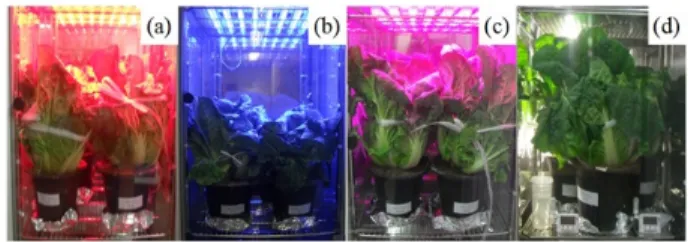
Fig. 2. Artificial light source (LED) treatment of experiment group. (a), chamber red light (CR); (b), chamber blue light (CB); (c), chamber red+blue light (CRB); (d), chamber fluorescent lamp (CF) (Experiment II).
은 트레이(plug tray, 50구)에 원예용 상토(High, ㈜부농, 경주, 한국)를 채운 후 물을 적시고, 핀셋을 이용해 작은 구멍 을 만든 후 배추 종자를 심은 다음 다시 상토로 덮어주었다.
습도를 유지하기 위해 신문지로 덮고, 물로 적신 후 싹이 나 면 신문지를 제거하였다. 파종 30일 후(DAS, day after sowing)에 50개 유묘 중 48개를 골라 노지에 이식하였다. 대 조구(field control, FC)를 노지에 있는 배추로 하고, 실험구 는 투명(field transparency, FT), 적색(field red, FR), 청 색(field blue, FB)의 아크릴 상자를 씌워 4주간 광처리를 진 행한 후(Fig. 1), 110 DAS에 수확하였다. 수확한 배추는 생 육상태(가식부 중 가장 큰 잎의 엽장, 엽폭, 생체중)를 측정한 뒤 -70℃ 급속 초저온 냉동고(SFDSF 12, Samwon Freezing Engineering Co., Busan, Korea)에 보관하여 동결건조한 후에 막자와 막자사발로 분말하였다.
식물 생장기(growth chamber)를 이용한 인공광원 실 험 [실험 Ⅱ]
인공광원 실험에서는 태양광 재배실험과 같은 일시에 배 추를 파종하여 유묘를 키우고, 36 DAS에 소형 포트(15×
15×19 cm
3)로 이식하여 충남대학교 농업생명과학대학 부속 유리온실에 두었다. 대조구(chamber control, CC)는 온실에 서 계속 재배하였고 실험구는 식물생장환경조절장치(Growth Chamber) 내에서 LED 적색광(chamber red, CR), LED 청색광(chamber blue, CB), LED 적+청 혼합광(chamber red+blue, CRB), 형광등(chamber fluorescent, CF)으로 7 일간 처리하였다(103 DAS~109 DAS)(Fig. 2). 평균 광량은 160~180 μmol ․ m
-2․ s
-1, 광주기는 주/야 11/13 h, 온도는 식물 생장기의 자동 온도조절 시스템을 이용하여 주/야 12/
10℃로 설정하였으며 상대습도는 60~70%를 유지하였다. 총 재배 기간이 110 DAS 이었다. 수확한 배추는 생육상태(엽장, 엽폭, 생체중)를 측정한 뒤 -70℃ 급속 초저온 냉동고(SFDSF 12, Samwon Freezing Engineering Co., Busan, Korea)에 보관하여 동결건조한 후에 막자와 막자사발로 분말하였다.
Carotenoid 추출 및 HPLC 분석
분말 시료 500 mg을 칭량하여 50 mL-Falcon tube에 넣 고 ethanol 5 mL를 넣은 후, 진동혼합(vortex)하여 항온수 조(75℃)에서 5분간 진탕하였다. 이후 80% KOH 1.5 mL를 넣고 진동혼합하여 다시 한 번 항온수조(75℃)에서 10분간 진탕하였다. 진탕 후 얼음에 넣고 반응이 정지할 수 있을 만 큼 충분히 정치시켰다. 그리고 초순수와 hexane을 각 2.5 mL를 넣고 진동혼합(vortex)한 뒤, 원심분리(3,000 rpm, 3
min)를 실시하였고 분리된 상층액(hexane층)을 수거하였다.
위 과정을 동일하게 2회 더 반복하여, 총 3회 실시하였고 각 상층액을 수거하여 합하였다. 합한 상층액은 감압 농축기(4 0℃)로 농축한 후에, dichloromethane : methanol= 50:50 (v/v) 1 mL를 넣고 sonicator에서 충분히 재용해 하였다.
이 재용해한 용액을 0.45 μm hydrophilic PTFE syringe filter (직경 13 mm)로 여과한 후, HPLC용 갈색 vial병에 담아 HPLC로 분석하였다. Carotenoid의 분석 컬럼은 YMC carotenoid C30 column (250×4.6 mm I.D., particle size 5 μm)을 사용하였고 HPLC (Perkin Elmer Flexar, Inc., MA, USA)를 이용하여 분석하였다. 검출 파장(detective wavelength) 454 nm, 유량(flow rate) 1.0 mL/min, 컬럼 온도(column temperature) 40℃로 설정하여 분석하였고, 시료는 10.0 μL 주입하였다. 이동상 용매는 solvent A [water:
methanol=25:75 (v/v)]와 solvent B (ethyl acetate)로 사용 하였다. 용매 구배는 solvent B를 60%로 시작하여 4분에 70%까지 증가시켰으며, 9분에 75%로 증가시켜 이후 20분까 지 유지시켰고, 23분에 100%까지 증가시켜 28분까지 유지시 키고, 28.1분에 60%까지 급격히 감소시킨 후 35분까지 유지시 켰다. 외부표준물질은 4가지(루테인, 제아크산틴, α-카로틴, β - 카로틴)를 사용하였고 이에 대응하는 각 시료의 HPLC 피크 면적(area)을 비교하여 정량하였다.
GSL 추출 및 HPLC 분석
분말 시료 100 mg을 칭량하여 2.0 mL-Eppendorf tube
에 넣고, 70%(v/v) boiling methanol 1.5 mL를 넣어 진동
혼합(vortex)하였다. 진동혼합 후 항온수조(75℃)에서 5분간
조(crude) GSLs를 추출하였다. 이 후 2.0 mL-Eppendorf
tube를 원심분리(12,000 rpm, 4℃, 10 min)하였고 분리된
상층액은 시험관(test tube)에 수거하였다. 위 과정을 동일하
게 2회 더 반복하여, 총 3회 실시하였고 각 상층액을 수거하
여 합하였다. Mini-column (1000 μL pipet tip)은 아래 부
분을 탈지면으로 막은 다음 활성화된 DEAE Sephadex
A-25를 5 cm가량 채운 뒤 GSLs 조 추출물(crude extract)
을 pasteur pipet으로 로딩 하였다. 추출물이 빠져나가면 초
순수 2 mL를 pasteur pipet으로 로딩 하였다. Mini-column
아래 끝 부분을 paraffin film으로 새어나가지 않게 막고,
aryl sulfatase solution 75 μL을 넣은 뒤 16~18시간 동안
상온에 정치 한 후, 2.0 mL-Eppendorf tube에 초순수 0.5
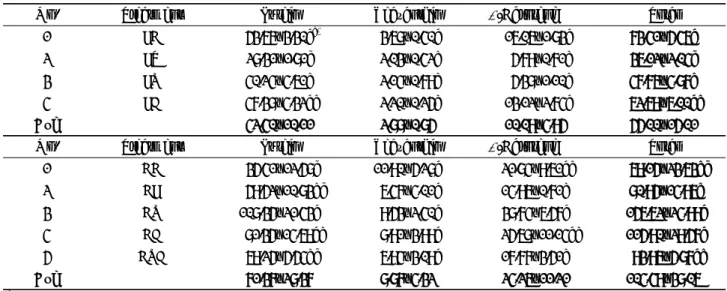
FT 24.0±1.53a 14.3±1.31c 41.0±3.32a 18.0±1.03b 11.8±0.57b 0.39±0.06b 135±19.6a 10.0±0.2b 92.4±1.22a FR 30.0±4.13a 18.0±1.94bc 42.3±3.96a 19.9±5.56a 12.8±1.71ab 0.73±0.46ab 150.5±63.4a 10.6±2.2b 92.8±1.03a FB 27.8±3.83a 19.1±3.41ab 41.5±4.15a 19.1±1.07a 13.0±1.64ab 0.55±0.15b 149±66.8a 10.2±2.9b 92.7±1.11a CC 39.6±3.622a 27.3±4.01a 41.8±3.77a 24.4±0.43ab 16.5±1.10a 2.80±0.40a 275.8±31.35a 14.8±1.99a 94.63±0.3a CF 36.3±5.93a 24.4±4.30a 43.7±3.40a 23.1±1.44ab 13.6±1.15ab 2.10±0.21ab 280.2±15.92a 17.3±1.09a 93.81±0.3ab CR 34.5±2.47a 25.78±10.20a 45.0±1.58a 19.2±2.11bc 11.3±1.66bc 1.40±0.38b 189.3±17.82b 13.4±1.95a 92.96±0.4ab CB 33.6±4.09a 22.08±2.88a 43.5±3.50a 17.2±2.04c 8.8±0.65c 1.10±0.35b 170.0±29.83b 12.2±0.71a 92.7±0.8b CRB 37.78±3.01a 25.82±4.48a 44.0±1.41a 25.8±4.48a 12.1±2.13b 1.50±0.66b 205.9±47.46ab 14.0±2.24a 93.01±1.1ab
a)Within each column values follow by the same small letters are not significantly different at P<0.05, using Tukey’s multiple-range test. (n=4, except for CF n=3). Each means that FC, field control; FT, field transparency; FR, field red; FB, field blue; CC, chamber control; CF, chamber fluorescent; CR, chamber red; CB, chamber blue; CRB, chamber red+blue.
mL로 3회 반복하여 용출하였다. 용출시킨 시료는 0.45 μm hydrophilic PTFE syringe filter로 여과한 후, HPLC용 갈 색 vial병에 담아 HPLC로 분석하였다. GSL의 분석 컬럼은 Inertsil ODS-3 column (150×3.0 mm I.d., particle size 3 μm), 가드 컬럼은 Inertsil ODS-2 Cartridge Guard column E (10×2.0 mm I.d., particle size 5 μm)(GL Science, Tokyo, Japan)을 사용하였고 HPLC (Agilent Technologies, CA, USA)를 이용하여 분석하였다. 분석조건 은 검출 파장(detection wavelength) 227 nm, 유량(flow rate) 0.4 mL/min, 컬럼 온도(column temperature) 40°C 로 설정하여 분석하였다. 시료는 10.0 μL 주입하였다. 이동상 용매는 solvent A (초순수)와 solvent B (acetonitrile, CH3CN)를 사용하였다. 용매 구배는 solvent B를 기준으로 실시하였고, 총 27분간의 분석 시간이 소요되었다. Solvent B는 처음 2분까지는 0%로 유지시키고 7분에 0%에서 10%로 증가시키고, 16분에는 10%에서 31%로 증가시켰다. 19분에 는 31%를 유지시키고 21분까지 31%에서 0%로 감소, 27분 에는 0%를 유지시켰다. GSL 함량은 각 시료를 3반복으로 분 석하고 외부표준물질인 sinigrin의 HPLC 피크 면적(area)을 비교하여 각 성분의 response factor를 반영 후 정량하였다 (ISO 9167-1, 1992).
통계 분석
생육조사 및 carotenoid, GSL 분석 결과는 Microsoft Office Excel 2010을 이용하여 각 성분에 대한 함량의 평균 값(average value)과 표준편차(SD, standard deviation)를 구하였다. 통계처리 프로그램은 IBM SPSS
Ⓡ21 Statistics을 사용하였고, 사후 분석은 유의수준( P )은 0.05 이하로 설정하 여 Tukey 검정법을 사용하였다.
결과 및 고찰
배추의 생장
[실험 I] 아크릴 상자를 이용한 태양광 실험에서 대조구
(field control, FC), 투명(field transparency, FT), 적색(field red, FR), 청색(field blue, FB) 중에 엽장은 FR 처리구 (30.0)에서 가장 길었으며 FT 처리구(24.0 cm)에서 가장 짧 았다(Table 1). 엽수는 FR 처리구(42.3)에서 가장 많았고 FC 처리구(35.3 장)에서 가장 적었다. 적색광(640~690 nm) 파 장은 광합성을 촉진시키는 파장이며 청색광(420~470 nm) 파장은 잎의 형태형성을 촉진시키는 파장이라는 연구결과가 있는데(Bang et al ., 2012), [실험 I]에서도 FR 처리구(18.0) 보다 FB 처리구(19.1 cm)에서 엽폭이 넓고 형태 형성이 컸 다. FT 처리구에서 구고(18.0 cm)와 구폭(11.8 cm)이 다른 처리구보다 가장 작았다. 생체중은 FC 처리구(225)가 가장 높았으며 FT 처리구(135 g)가 가장 낮았고, 건조중 또한 FC 처리구(17.0)에서 가장 높았고 FT 처리구(10 g)에서 가장 낮 았다.
[실험 II] 식물 생장기(growth chamber) 내에서 LED (적, 청, 적+청 혼합)와 형광등을 이용한 인공광원 실험에서 대조구(chamber control, CC), 형광등(chamber fluorescent, CF), LED 적색광(chamber red, CR), LED 청색광(chamber blue, CB), LED 적+청 혼합광(chamber red+blue, CRB) 중에 엽장은 CC 처리구(39.6)에서 가장 길었으며, 엽폭은 CC 처리구(27.3)에서 가장 넓었다. 엽수는 CR 처리구(45.0) 에서 가장 많았다. 생체중은 CF 처리구(280.2)에서 가장 높 았다. 형광등 조사는 LED 광원에 비해 광파장 대역이 다양하 기 때문에 작물의 생육에 좋다고 보고되었는데(Park et al ., 2012), [실험 II]에서도 생체중을 비롯한 구고, 구폭, 구중에 서도 LED 처리구에 비해 높은 경향이 나타났다.
아크릴 상자의 파장 분석
적색 아크릴을 상자의 파장을 분석한 결과, 가시광선에서 청색계열의 파장대의 투과율은 20~30%였고 적색계열 파장 대인 630~780 nm에서는 투과율이 90%로 나타났다(Fig. 3).
청색 아크릴 상자의 파장은 가시광선에서 적색계열 파장대의
투과율은 20~30%였고 청색계열 파장대인 430~490 nm에서
는 투과율이 75~85%로 나타났다. 투명 아크릴 상자 파장 분
Fig. 3. Transmittance of acrylic box. (a), red acrylic box; (b), blue acrylic box; (c), transparent acrylic box.
Fig. 4. HPLC chromatograms of carotenoids separated from Chinese cabbage. (a), Carotenoid standards; (b), CRB treatment. Peak 1, Lutein; 2, Zeaxanthin; 3, α -carotene; 4,
β
-carotene.No. Treatment Lutein Zeaxanthin
β -Carotene
Total1 FC 53.67±3.30aa) 3.68±0.40a 16.06±1.83a 73.41±5.46a
2 FT 28.31±1.81c 2.03±0.42b 5.79±0.71b 36.12±2.04c
3 FR 40.24±4.61b 2.14±0.79b 5.38±1.10b 47.76±4.87b
4 FB 47.38±4.32ab 2.20±0.25b 13.12±2.74a 62.69±6.00ab
Ave 42.40±10.11 2.88±0.85 10.09±4.95 55.00±15.01
No. Treatment Lutein Zeaxanthin
β -Carotene
Total1 CC 35.41±12.58c 11.90±5.28a 21.84±9.61ab 69.15±23.63bc
2 CF 59.52±10.83bc 6.47±4.01a 14.96±0.71b 80.95±14.96b
3 CR 108.35±21.43a 9.53±2.40a 38.74±6.57a 156.62±24.99a
4 CB 81.35±14.69ab 8.91±3.99a 25.68±11.14ab 115.90±29.57a
5 CRB 69.25±5.54bc 6.94±3.09a 17.77±3.51b 93.96±5.87ab
Ave 71.37±28.37 8.87±4.32 24.26±11.21 104.49±38.06
a)Within each column values follow by the same small letters are not significantly different at
P
< 0.05, using Tukey’s multiple-range test. (n
=4, except for CFn
=3).Each means that FC, field control; FT, field transparency; FR, field red; FB, field blue. CC, chamber control; CF, chamber fluorescent; CR, chamber red; CB, chamber blue; CRB, chamber red+blue.
Table 2. Carotenoid contents (mg/kg dry wt.) of various light source treatment in Chinese cabbage (Experiment I and II)
석에서는 가시광선의 모든 파장대의 투과율이 90%가 넘었다.
즉 정확한 파장의 파장의 선택적 투과는 어려우나 적색 아크 릴 상자 같은 경우는 적색계열의 파장대에 투과가 잘 되었고, 청색 아크릴 상자 같은 경우는 청색계열의 파장대가 투과가 잘 되었다. 그리고 각 아크릴 상자의 파장은 가시광선의 흡수 파장은 다르지만 자외선 영역에서의 흡수 파장은 유사하였다.
광원에 따른 carotenoid 함량
배추 내 carotenoid를 HPLC로 분석한 결과, carotenoid 중 3종류(루테인, 제아크산틴, β- 카로틴)가 검출되었다(Fig. 4).
[실험 I]에서 배추의 총 carotenoid 함량 범위는 루테인 25.39~58.80, 제아크산틴 0.84~4.22, β- 카로틴 3.85~18.71 mg/kg dry wt.이었다(Table 2). 루테인의 함량은 FC 처리구 가 53.67로 가장 높았고, FT 처리구가 28.31 mg/kg dry wt.
로 가장 낮았다. β- 카로틴의 함량은 FC 처리구에서 가장 높았 고 (16.06), 광원 처리구에서는 FB 처리구(13.12)가 FR 처리구 (5.38), FT 처리구(5.79 mg/kg dry wt.)보다 약 2.4배 높았다.
[실험 I]의 carotenoid 함량은 모두 FC 처리구에서 가장 높았
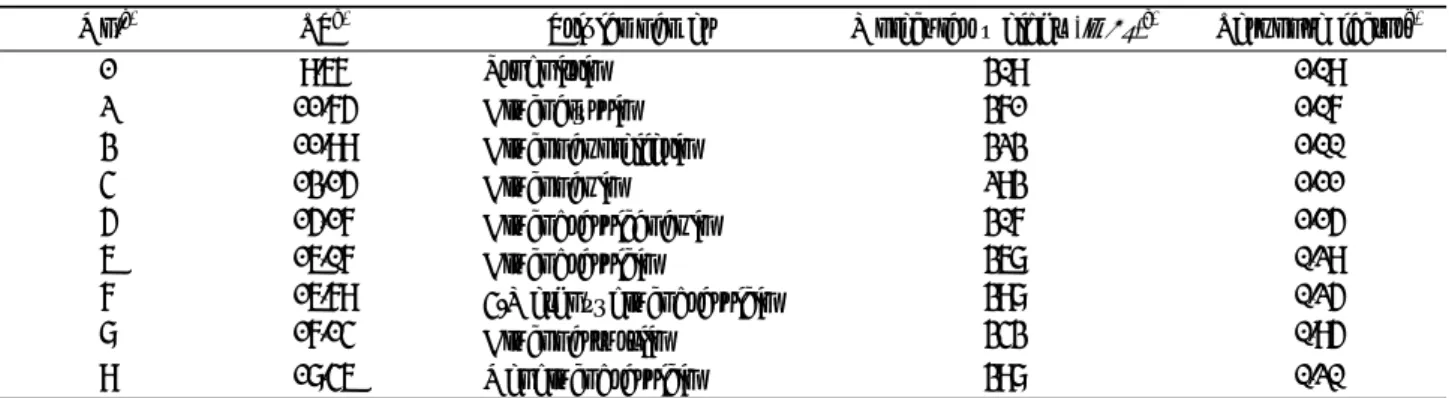
2 11.75 Glucoalyssin 371 1.07
3 11.99 Gluconapoleiferin 323 1.00
4 13.15 Gluconapin 293 1.11
5 15.17 Glucobrassicanapin 307 1.15
6 16.07 Glucobrassicin 368 0.29
7 16.79 4-Methoxyglucobrassicin 398 0.25
8 17.14 Gluconasturtiin 343 0.95
9 18.46 Neoglucobrassicin 398 0.20
a)No, the elution orders of HPLC analysis. b)RT,retentiontime (min).
c)As a desulfo-glucosinolate. d)The international organization for standardization (ISO 9167-1,1992).
Fig. 5. HPLC chromatograms of glucosinolates separated from Chinese cabbage. (a), sun-light (field control) and (b), artificial-light (growth chamber control). Peak 1, Progoitrin; 2, Glucoalyssin; 3, Gluconapoleiferin; 4, Gluconapin; 5, Glucobrassicanapin; 6, Glucobrassicin; 7, 4-Methoxyglucobrassicin;
8, Gluconasturtiin; 9, Neoglucobrassicin.
는데 그 이유는 아크릴 상자로 인해 태양빛의 자외선을 강하 게 받았기 때문인 것으로 판단되며, 이는 다른 실험에서 나타 난 결과인 식물은 때때로 잎에서 α -카로틴과 β- 카로틴의 비율 이 태양빛을 덜 받은 그룹에 비해 낮거나 α -카로틴이 거의 검 출되지 않았던 결과(Susan and Olle, 1990)와 유사한 것으로 판단된다. 또한 본 실험에 사용된 노지의 영양 균형 및 기후조 건, 토양 배수 문제와 같은 타 조건의 변수에서 기인한 것이라 사료되어 좀 더 많은 연구가 필요할 것으로 판단된다.
[실험 II]에서 배추의 총 carotenoid 함량 범위는 루테인 24.66~137.96, 제아크산틴 2.51~20.65, β- 카로틴 8.40~49.80 mg/kg dry wt. 이었다(Table 2). 루테인의 함량은 108.35 mg/kg dry wt.로 가장 높았다. β- 카로틴의 함량은 CR 처 리구에서 38.74로 가장 높았고, CF 처리구에서 14.96 mg/kg dry wt.로 가장 낮았다.
총 carotenoid 함량은 CR 처리구(156.62)와 CB 처리구 (115.90 mg/kg dry wt.)가 다른 처리구보다 약 1.6~2.3배 높았는데, 이것은 적색광과 청색광이 식물의 이차대사산물의 생산과 축적에 관여하는 유전자 발현을 유도하거나 촉진한다 는 보고와 관련된 것으로 보인다(Kim et al ., 2013). CR 처 리구에서 특히 β- 카로틴 함량이 높은 결과는 적색광이 β- 카 로틴 발현을 유도하였다는(Wu et al ., 2007) 이전의 생리학 적 연구와도 상응하는 결과였다. [실험 I]의 처리구보다 [실험 II]의 처리구에서 carotenoid 함량이 높았는데, 이것은 LED 나 형광등을 이용해 보광 가능하며 특정 광질을 선택적으로 조사 할 수 있는 인공광원이 효과적이며 작물발아 및 생장, 기능성물질의 함유량 증가와 상관관계가 있다(Heo et al ., 2010)는 연구 결과와 유사한 것으로 판단된다.
광원에 따른 GSL 함량
배추 내 GSLs를 HPLC로 분석한 결과, 9종의 GSLs (progoitrin, glucoalyssin, gluconapoleiferin, gluconapin, glucobrassicanapin, glucobrassicin, 4-methoxyglucobrassicin, gluconasturtiin, neoglucobrassicin)를 분리 및 동정 하였 다(Table 3 and Fig. 5). [실험 I]의 총 GSL 함량은 FT 처리 구가 19.76으로 가장 높았고, FR 처리구가 11.39 μmol/g dry
wt.로 가장 낮았다(Table 4). FT 처리구의 glucobrassicin 함
량은 3.74로 FR 처리구의 glucobrassicin 함량 1.68 μmol/g
dry wt.보다 약 2배 높았다. Glucobrassicin은 indole-
3-carbinol의 전구체로, indole-3-carbinol은 배추과 특이 이
차대사산물 중 주요한 항암예방물질 중 하나이다(Zhang
et al ., 1994). 또한 사람에게 광범위한 암 억제 및 예방 효
과를 가지며 식물의 방어 기작에도 관여한다는 보고가 있었
다(Brew et al ., 2009; Pedras et al ., 2006). FT 처리구의
neoglucobrassicin 함량은 8.58 μmol/g dry wt.으로 다른
처리구에 비해 약 3배 높았다. [실험 Ⅰ]의 GSL 성분 비율은
neoglucobrassicin이 FC 처리구에서 25%, FT 처리구에서
No. Trivial names Sun-lights with acrylic treatment
FC FT TR FB
1 Progoitrin 1.02±0.07ba) 1.16±0.04a 1.02±0.02b 0.98±0.04b
2 Glucoalyssin 0.22±0.00a 0.24±0.01a 0.17±0.01b 0.15±0.01b
3 Gluconapoleiferin 0.90±0.07b 1.21±0.05a 0.89±0.02b 0.93±0.08b
4 Gluconapin 0.20±0.02a 0.13±0.01b 0.18±0.02a 0.16±0.01ab
5 Glucobrassicanapin 0.70±0.01a 0.37±0.02c 0.57±0.01b 0.53±0.03b
6 Glucobrassicin 2.44±0.14b 3.74±0.10a 1.68±0.04c 1.89±0.08c
7 4-Methoxyglucobrassicin 2.67±0.15c 3.67±0.12a 3.31±0.10b 3.46±0.17ab
8 Gluconasturtiin 0.69±0.03a 0.67±0.03a 0.68±0.02a 0.60±0.02b
9 Neoglucobrassicin 2.93±0.21c 8.58±0.11a 2.88±0.06c 3.39±0.28b
Total 11.75±0.64bc 19.76±0.42a 11.39±0.18c 12.10±0.17b
No. Trivial names LED-light treatment
CC CF CR CB CRB
1 Progoitrin 0.39±0.01a 0.17±0.01b NDb) 0.18±0.01b 0.25±0.02b
2 Glucoalyssin 0.14±0.01a 0.05±0.00b ND 0.05±0.00b 0.05±0.00b
3 Gluconapoleiferin 0.37±0.02a 0.19±0.01c 0.14±0.01c 0.26±0.01b 0.29±0.02b
4 Gluconapin 0.09±0.01b ND 0.33±0.06a ND 0.28±0.00b
5 Glucobrassicanapin 0.34±0.01a 0.10±0.02d 0.08±0.01d 0.13±0.01c 0.19±0.01b
6 Glucobrassicin 0.28±0.01c 0.22±0.00d 0.32±0.01b 0.41±0.02a 0.32±0.02b
7 4-Methoxyglucobrassicin 2.56±0.12a 1.74±0.03b 1.33±0.06c 1.82±0.04b 2.34±0.09a
8 Gluconasturtiin ND 0.14±0.02a 0.18±0.03a 0.16±0.00a 0.16±0.01a
9 Neoglucobrassicin 0.43±0.01c 0.31±0.01c 0.57±0.02b 0.75±0.08a 0.56±0.04b
Total 4.59±0.17a 2.88±0.03c 2.95±0.10c 3.76±0.08b 4.19±0.16a
a)Within each column values follow by the same small letters are not significantly different at
P
<0.05, using Tukey’s multiple-range test (n
=4). Each means that FC, field control; FT, field transparency; FR, field red; FB, field blue. CC, chamber control; CF, chamber fluorescent; CR, chamber red; CB, chamber blue; CRB, chamber red+blue.b)ND, not detected.
Table 4. Glucosinolate contents (μmol/g dry wt.) of various light source treatment in Chinese cabbage (Experiment I and II)
43%로 가장 높았고, 4-methoxyglucobrassicin이 FR 처리 구와 FB 처리구에서 29%로 가장 높았다.
[실험 II]의 총 GSL 함량은 CC 처리구(4.59)와 CRB 처 리구(4.19)에서 높았고, CF 처리구(2.88 μmol/g dry wt.)에 서 가장 낮았다(Table 4). Gluconapin은 CR 처리구(0.33)와 CRB 처리구(0.28)에서 CC 처리구(0.09 μmol/g dry wt.)보 다 약 3.5배 높았으며, 발암 물질을 억제하는 isothiocyanate 의 전구체로 알려져 있다(Padilla et al ., 2007). CRB 처리구 에서는 모든 GSL 성분이 검출되었고, 총 GSL 함량(4.19 μ mol/g dry wt.)이 다른 실험구보다 1.4배 높았다. [실험 II]의 GSL 성분 비율은 모든 처리구에서 4-methoxyglucobrassicin 이 45~60%로 가장 높았고, neoglucobrassicin이 9~20%로 두 번째로 높았다. [실험 I]의 GSL 함량은 FT 처리구에서 전 반적으로 높았는데 이것은 투명 아크릴이 가시광역 전 파장 에 높은 투과율을 보였기 때문에 함량이 높아진 것으로 판단되 며, [실험 II]에서는 복합광인 CRB 처리구에서 단일광인 CR, CB 처리구에 비해 GSL 함량이 높았다. 상기 연구의 결과는 다양한 광원별 이차대사산물의 함량분석이나 단일 또는 혼합 (적색+청색) 파장 영역의 선택이 가능한 LED를 적절히 이용할 수 있는 조건을 규명함으로써 함량 분석에 관해 광원을 효과적
으로 적용할 수 있을 것이며, 배추 이외 다른 배추과 작물이 나 다양한 작물의 재배에도 응용 가능할 것으로 판단된다.
Note
The authors declare no conflict of interest.
Acknowledgement
This work was supported by research fund of Chungnam National University.
References