발광다이오드 처리가 서양민들레의 항산화 활성 및 기능성 성분 함량에 미치는 영향
류재혁*,**·서경순***·국용인****·문제학*****·마경호******
최성규****·나의식*·이성춘*·배창휴*†
*순천대학교 생명산업과학대학 웰빙자원학과, **한국원자력연구원 첨단방사선과학연구소 방사선육종연구팀,
***장흥군 버섯산업연구원, ****순천대학교 생명산업과학대학 한약자원개발학과,
*****전남대학교농업생명과학대학 식품공학과 및 기능성식품연구센터, ******국립농업과학원 농업유전자원센터
Effects of LED (Light-Emitting Diode) Treatment on Antioxidant Activities and Functional Components in Taraxacum officinale
Jai Hyunk Ryu*,**, Kyoung Sun Seo***, Yong In Kuk****, Jae-Hak Moon*****, Kyung Ho Ma******
Seong Kyu Choi****, Eui Shik Rha*, Sheong Chun Lee* and Chang-Hyu Bae*†
*Department of Bioresources Science, Sunchon National University, Suncheon 540-742, Korea.
**Advanced Radiation Technology Institute, Korea Atomic Energy Research Institute, Jeongeup 580-185, Korea.
***Jangheung-county Mushroom Research Institute, Jangheung 529-851, Korea.
****Department of Development in Oriental Medicine Resource, Sunchon National University, 255 Jungangno, Suncheon 540-742, Korea.
*****Department of Food Science & Technology, and Functional Food Research Center, Chonnam National University, Gwangju 500-757, Korea.
******National Agrobiodiversity Center, National Academy of Agricultural Science, RDA, Suwon 441-110, Korea.
ABSTRACT : This study was conducted to evaluate the effect of light spectrum using red (660㎚), blue (460 ㎚), red and blue mixed (Red : Blue = 6 : 4) LED (light-emitting diode), and fluorescent lamp on antioxidant activities and functional components of dandelion (Taraxacum officinale). Total polyphenol contents in dandelion irradiated with the red and blue mixed or the red LED were 121.77㎎/100 g or 115.36 ㎎/100 g, respectively, which were greater than those in dandelion treated with blue LED and fluorescent lamp. Asparagine showed the highest content among amino acids in leaves and roots regardless of treatments. Total amino acid was the highest when illuminated with the red LED. DPPH (1,1-diphenyl-2-pic- rylhydrazyl) radical-scavenging activity and SOD (super oxide dismutase) activity of ethanol extracts were increased under all of the LED treatments compared with fluorescent lamp, and the antioxidant activities were increased by the red and the mixed LED illumination. The results indicate that application of the red and the mixed LED illumination promote antioxi- dant activity and increase functional components during cultivation of dandelion.
Key Words : Taraxacum officinale, LED Illumination, Antioxidant Activities, Functional Components
서 언
민들레 (Taraxacum officinale)는 국화과 (Compositae)에 속 하는 다년생 초본 식물로 서양에서는 노이로제와 복통, 항산화 , 항균, 이뇨에 사용되어 왔다 (Yun and Kim, 2010; Jeon et al., 2010; Lee and Lee, 2008). 한방에서는 포공영 (蒲公英)으 로 민들레 또는 기타 동속식물의 전초를 개화전·후 (봄, 여 름)에 채취하여 건조한 것을 淸熱解毒, 利尿散結 등의 효능으
로 解熱, 利尿, 健胃, 祛痰, 解毒에 사용하여 왔다 (The Korean Herbal Pharmacopoeia, 2011; Ryu and Bae, 2011;
Lee and Lee, 2008). 약리작용으로는 항세균, 항진균작용, 면역 증강작용, 항암작용이 있다. 잎에는 고미성분인 glycoside류와 칼륨, 칼슘, 철분, carotenoid가 함유되어 있고, 뿌리에는 고미 (苦味) 성분인 taraxacin과 inulin의 함량이 높으며, carotenoid 성분인 taraxathin, triterpene 성분인 taraxol 등이 함유되어 있 다 (Yun and Kim, 2010; Williams et al., 1996). 영양 성
†Corresponding author: (Phone) +82-61-750-3214 (E-mail) [email protected]
Received 2012 April 3 / 1st Revised 2012 May 1 / 2nd Revised 2012 May 25 / Accepted 2012 June 7
분으로는 비타민과 무기질이 풍부하고, 지방함량과 칼로리가 낮아 현대인들에게 좋은 식품이다 (Grieve, 1994). 또한 민들 레는 독성이 없기 때문에 예로부터 부작용에 대한 기록도 없 고 사용량에 있어 제한을 받지 않았으며, 서양민들레의 경우 미국에서 GRAS (generally recognized as safe) 등급을 받을 정도로 안전하다고 알려져 있다 (Duke, 1992). 특히 민들레는 부위별로 hydroxycinnamic acid, chlorogenic acid, caffeic acid 등과 같은 페놀성 화합물을 함유하고 있어, 항균, 항염증, 항산화, 항암, 항당뇨, 면역 관련 활성, 위장보호 효과 등 다 양한 생리활성을 나타내는 것으로 국내·외에서 연구되어 왔 다 (Kim and Kim, 2011; Heo and Wang, 2008; Lee and Lee, 2008; Katrin et al., 2006; Han et al., 2005).
약용유전자원의 활용가치는 기능성물질의 종류와 양에 따라 좌우되는데, 식물의 기능성 물질의 함량을 높이기 위한 효과적 인 방법 중의 하나는 광을 제어하는 방법이다 (Keppler and Humpf, 2005; Fankhauser and Chory, 1997; Chory et al., 1996). 광 제어 방법 중 LED (발광다이오드)는 작물 재배에서 목적에 따라 맞춤식 광으로 제어할 수 있어 연중생산이 가능한 장점이 있다 (Brown et al., 1995). 종자에서 발아하는 식물에서 는 광수용성 단백질인 phytochrome에 영향을 미치게 되고, 결 과적으로 생장과 형태 및 색소형성의 에너지원과 조절인자로 작용하며 생리활성 물질의 생성에도 영향을 미치게 된다 (Hopkins, 1999; Fankhauser and Chory, 1997). LED 처리와 약용작물의 항산화 활성 및 기능성 성분 함량 변화에 관한 연 구는 가시오갈피 (Eleutherococcus senticosus), 인삼 (Panax quinquefolius) 등에서 보고 (Jeong et al., 2009; Fournier et al., 2003)되어 광의 제어로 작물의 기능성 관련 물질과 아미노산 함 량을 증진시킬 수 있는 사실이 확인되고 있다 (Cha et al., 2011). 이에 본 연구에서는 LED 광 조사가 유용약용 작물인 민 들레의 항산화 활성 및 기능성 물질의 함량 변화를 조사하여 기 능성분 향상 식물자원 개발의 가능성을 파악하고자 하였다.
재료 및 방법
1. 식물재료
실험용 종자는 한미프러그에서 구매한 서양민들레 품종 골
든볼 (T. officinale cv. Goldenboll)을 정선 후 4℃에 냉장 보 관하면서 실험용 재료로 이용하였다.
2. 광질처리 및 재배
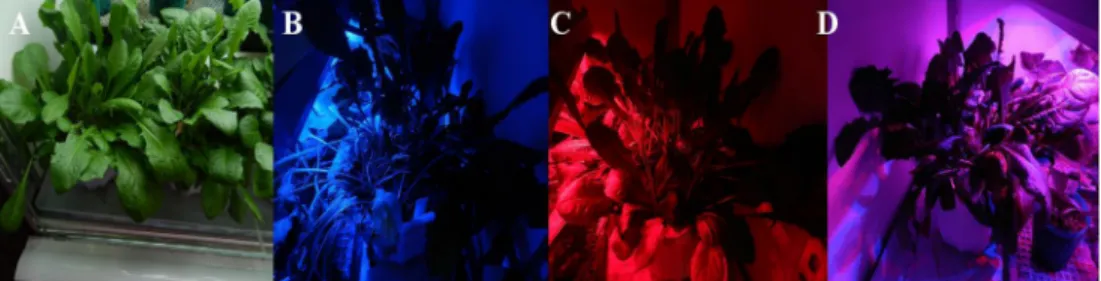
민들레의 생리활성에 미치는 광질에 효과를 구명하고자 직 경 20 ㎝ pot에 각 파장별로 50개체 6반복 (각 파장별 300개 체)으로 원예용 상토 (흥농종묘 원예용 상토 1호)에 파종한 후 다인바이오 (Dyne Bio, Korea)에서 제작한 식물재배 연구용 LED 광원으로 청색광 (460 ㎚; Code: DYLED 31), 적색광 (660㎚; Code: DYLED 21), 그리고 국화과 작물 재배에 적합 하다고 보고된 (Jeon et al., 2010; Lee et al., 2010) 적색광과 청색광 6 : 4 혼합광 (적 : 660 ㎚, 청 : 460 ㎚; Code : DYLED 44)을 처리하여 대조구인 형광등과 비교하였으며 (Fig. 1), 광량 은 Quantum sensor (Li-COR, Lincoln, USA)로 측정하여 38 ± 2 umol/m2/s로 조절하였다. 식물재배는 25 ± 2로 유지되는 암상태의 배양실에서 14시간/일로 LED 및 형광등을 조명하면 서 관수로만 재배하였다.
3. 기능성 성분 함량 분석 1) 총 페놀성 화합물 함량 측정
LED 조사에 따른 시료들의 총페놀성 화합물의 함량은 시료 10 g을 취해 70% methanol 50 ㎖ 로 환류 추출한 후 총페놀 성 화합물의 함량은 Folin-Denis법 (Joslyn, 1970)에 따라 정 량하였다. 추출물을 희석한 검액에 Folin시약 2 ㎖를 첨가하 고 3분후에 10% Na2CO3 5㎖ 를 가해 혼합하여 발색시켰다.
1시간 후에 발색된 색을 700 ㎚에서 흡광도를 측정하였으며, 표준물질 tannin (Sigma, USA)을 기준으로 환산하였다.
2) 아미노산 분석
아미노산 분석은 Daniel and Steven (1993), Steven and Dennis (1993)의 방법에 따라 분해 및 유도체화 과정을 거친 후 HPLC (Agilent Technologies 1200 Series, Agilent., USA) 로 분석하였다. 시료 1 g을 시험관에 넣고, 6 N HCl 용액 10㎖를 가한 후 110℃에서 24시간 가수분해시켜서 얻은 분해 액을 원심분리하고, 상징액을 50℃에서 농축하여 염산과 물을 완전히 제거한 후, 20 mM HCl (pH 2.2) 용액을 사용하여
Fig. 1. Experimental view of light treatment. A, Control-Fluorescent light B, Blue (460 nm); C, Red (660 nm); D, Blue and Red (Blue : Red = 6:4).
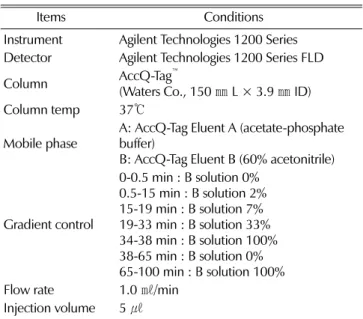
5㎖로 정용한 다음, 0.45 µm membrane filter로 여과하고, 여 액을 취하여 AccQ-Tag 시약을 사용해 유도체화시킨 후, HPLC 용 분석 시료로 사용하였다. 분석조건은 Table 1과 같고, 아미 노산 함량 계산은 integrator에 의한 외부표준법으로 하였다.
4. 항산화 활성
1) DPPH radical-scavenging 활성
전자 공여능 측정은 Abe 등 (2000), Yamachuchi 등 (1998), Blois (1958)의 방법에 따라 각 추출물의 DPPH (1,1-diphenyl-2-picrylhydrazyl) radical-scavenging 효과로 제시 하였다. 즉, 일정 농도의 시료 2 ㎖에 2×10⁻⁴ M DPPH용액 (dissolved in 99% methanol, Sigma, USA) 1㎖를 가하고, vortex mixing하여 37℃ 암소에서 30분간 반응시켰다. 이 반 응액을 흡수분광광도계를 사용하여 517 ㎚에서 흡광도를 측 정하였다. 시료의 농도별 전자공여능 (electron donating ability, EDA%)을 측정하여 반응 용액 중의 DPPH 50%를 scavenging하는 농도 (IC50; The half maximal inhibitory concentration)로 각 시료의 항산화능을 제시하였으며, 3회 반 복 실험하여 얻은 결과를 평균과 표준편차로 나타내었다.
Sample O.D.: Absorbance of sample Control O.D.: Absorbance of control
2) SOD 활성
SOD (super oxide dismutase) 활성은 Marklund와 Marklund (1974)의 방법에 따라 시료 20 ㎕에 20 ㎕의 증류
수를 첨가한 후, WST (Water soluble tetrazolium salt, Roche Molecular Biochemicals, Basel, Switzerland) 용액을 각각의 tube에 10 mmol/ℓ 첨가하여 10초간 혼합시키고 37℃
에서 20분간 반응시킨 후, micro reader 파장 450 ㎚에서 흡 광도를 측정하였다. 활성산소억제활성의 계산은 아래 식을 이 용하였다.
결과 및 고찰
1. 기능성 성분함량의 변화 1) 총 페놀성 화합물 함량
LED 조사에 따른 시료들의 총 페놀성 화합물 함량을 측정 한 결과 혼합광 처리구가 121.77 ㎎/100 g으로 가장 높았으며, 적색광 처리구도 115.36 ㎎/100 g을 나타내어 대조구의 101.23㎎/100 g보다 함량이 높게 나타났다 (Table 2). 이는 Amaranthus (Amaranthus spp.)의 새싹 재배시 LED 광질이 새 싹의 메탄올 추출물의 총페놀화합물 함량 변화에 미치는 영향 을 조사한 결과 적색 + 청색광이 황색광, 적색광 처리보다 높게 나타난 것 (Cho et al., 2008)과 Lee 등 (2010)이 청색과 적색 을 동일하게 혼합한 광 처리가 상추 (Lactuca sativa L.)의 페놀성 화합물 중 하나인 안토시안 함량을 높인 결과와 유사 하였다. 일반적으로 페놀성 물질은 다양한 구조와 분자량을 가 지며, 이것들의 phenolic hydroxyl이 단백질처럼 거대분자와 결합하여 항산화, 항균, 그리고 항암 등의 생리기능을 가진다 고 알려져 있다 (Kim and Kim, 2011; Lee et al., 2011;
Katrin et al., 2006; Han et al., 2005). 그러므로 페놀성 화합 물의 함량이 높을수록 기능성 물질로 유용하게 활용할 수 있다 는 점에서 적색 + 청색광 LED의 처리와 적색광 처리로 총 페 놀화합물의 함량을 증가시켜 기능성 증대작물의 생산이 가능할 것으로 생각된다.
EDA (%) = Control O.D.Control O.D.− Sample O.D. × 100
SOD activity (inhibition rate %) =
(A blank 1− A blank 3) − (A sample − A blank 2)(A blank 1× A blank 3) × 100 Table 1. Operating condition of HPLC for amino acids analysis of
LED irradiated T. officinale cv. Goldenboll.
Items Conditions
Instrument Agilent Technologies 1200 Series Detector Agilent Technologies 1200 Series FLD
Column AccQ-Tag™
(Waters Co., 150㎜ L × 3.9 ㎜ ID) Column temp 37℃
Mobile phase
A: AccQ-Tag Eluent A (acetate-phosphate buffer)
B: AccQ-Tag Eluent B (60% acetonitrile)
Gradient control
0-0.5 min : B solution 0%
0.5-15 min : B solution 2%
15-19 min : B solution 7%
19-33 min : B solution 33%
34-38 min : B solution 100%
38-65 min : B solution 0%
65-100 min : B solution 100%
Flow rate 1.0㎖/min Injection volume 5㎕
Table 2. Contents of total polyphenols from T. officinale cv.
Goldenboll cultivated with different kinds of LED irradiation.
Samples Contents (㎎/100 g)
Control† 101.23 ± 4.69*b**
Blue LED 98.09 ± 6.43bc
Red LED 115.36 ± 4.42a
Blue+Red LED‡ 121.77 ± 5.56a
†Fluorescent lamp irradiation.
‡Blue and Red (6:4) LED irradiation.
*All values are mean ± SD (n = 3).
**Means with the same letters within a column are not significantly different at P<0.05, according to Duncan’s multiple range test.
2) 아미노산
LED 조사에 따른 시료들의 아미노산 함량을 분석한 결과는 Table 3과 4에서 보는 바와 같다. 처리구 모두에서 asparagine, proline, serine, threonine, glutamic acid, arginine 등이 주요 아미노산으로 나타났다. 처리구에 따른 총 아미노산 함량은 지 상부의 경우 적색 LED 시험구에서 1,851.37 ㎎/100 g로 가장 높은 함량을 보였으며, 적색 + 청색 LED 시험구도 1,763.40 ㎎/
100 g로 청색 LED 시험구와 대조구인 형광등 처리에 비하여 높은 유리아미노산 함량을 나타내었다. 민들레 지하부의 유리 아미노산 함량에서도 적색 LED 시험구가 2,598.92 ㎎/100 g으 로 가장 많은 유리아미노산 함량을 나타내었으며, 적색+청색 LED 시험구 또한 2,590.58 ㎎/100 g의 높은 함량을 나타내어 적색광 조사에 의해 단백질의 합성이 활성화되는 것으로 추 정된다. Cha 등 (2011)은 콩나물에 다양한 파장의 LED광 조 사로 암재배 보다 높은 유리아미노산 함량을 나타내었고 470㎚ 파장의 광 조사에서 가장 크게 증가하여, 유리 아미노 산 함량에 대한 LED 광원의 효과는 대상 식물 종류에 따라 차이가 있음을 알 수 있다.
종류별 아미노산 조성 비율은 asparagine이 892.36~
1,624.32㎎/100 g으로 총 아미노산에서 약 50% 이상의 비율 을 차지하여 주요 아미노산으로 확인되었다. Aspartic acid와
arginine 또한 586.32~758.35 ㎎/100 g과 586.44~850.18 ㎎/
100 g으로 함량이 많았다. 이는 Kang 등 (2000) 이 농가에서 재배된 서양민들레를 대상으로 총 아미노산 함량을 조사한 결 과 유리아미노산 전체 함량은 뿌리가 2,710.66 ㎎/100 g으로 잎 의 1,476.68 ㎎/100 g 보다 높은 함량을 나타내고, asparagine, arginine, serine, proline 등을 많이 함유한 결과와 일치하였다.
또한, 유리아미노산 함량이 돌산갓, 더덕 등 다른 약용식물 및 채소류 보다 높았으며, 특히 피로회복, 숙취해소에 효과가 있 는 것으로 알려진 asparagine이 풍부하여 민들레를 건강보조식 품 및 숙취해소음료의 재료로 이용할 경우 효과가 높을 것으 로 사료된다 (Kim and Kim, 2011; Han et al., 2010; Han et al., 2005; Kang et al., 2000).
3) 항산화 활성
LED 광원별 조사에 따른 시료들의 DPPH radical- scavenging 효과를 측정하여 시료들의 항산화 활성정도를 IC50
(The half maximal inhibitory concentration) 값으로 정리한 결과는 Table 5와 같다.
시료별 DPPH radical-scavenging 활성은 적색광 처리구에서 높았으며, 대조구와 청색광 처리구는 상대적으로 약하였다.
IC50 값을 살펴보면 적색광 처리구 14.64 ± 3.22 ㎍/㎖, 혼합광 Table 3. Contents of free amino acids in aerial parts of T. officinale
cv. Goldenboll cultivated with different kind of LED irradiation.
Components Control Blue LED Red LED Blue + Red LED§
㎎/100 g
Aspartic acid 85.14 75.63 90.35 94.63
Asparagine 932.74 892.36 987.23 964.56
Serine 106.46 125.55 145.75 132.62
Glutamic acid 98.44 97.65 105.67 128.73
Glycine 45.07 55.28 48.45 53.62
Histidine 13.86 23.50 11.97 18.38
Arginine 13.12 15.64 20.18 18.27
Threonine 71.44 76.23 82.02 65.22
Alanine 14.14 10.25 14.43 15.26
Proline 112.12 112.36 123.87 118.49
Tyrosine ND‡ ND ND ND
Cystine 8.70 12.62 16.88 11.85
Valine 36.35 53.84 95.57 54.62
Methionine ND ND ND ND
Lysine 13.04 13.89 20.32 15.16
Isoleucine 29.93 22.64 36.17 24.56
Leucine 31.55 32.96 41.63 34.88
Phenylalanine 15.71 19.30 10.88 12.55
TAA† 1,712.1 1,620.4 1,840.49 1,750.85
†Total free amino acids.
‡Not detected.
§Blue and Red (6:4) LED irradiation.
Table 4. Contents of free amino acids in root of T. officinale cv.
Goldenboll cultivated with different kinds of LED irradiation.
Components Control Blue LED Red LED Blue + Red LED§
㎎/100 g
Aspartic acid 41.60 50.32 41.2 52.3
Asparagine 1,573.44 1,538.27 1,624.32 1,594.14
Serine 207.53 196.34 209.98 205.72
Glutamic acid 95.21 104.34 115.17 124.35
Glycine 42.18 39.13 32.51 37.92
Histidine 30.31 30.23 33.45 40.12
Arginine 77.91 86.44 83.43 92.67
Threonine 68.89 69.65 66.58 77.32
Alanine 19.10 21.81 16.54 18.92
Proline 163.80 168.93 227.5 196.54
Tyrosine ND‡ ND ND ND
Cystine 12.15 19.56 28.41 32.58
Valine 23.46 36.24 12.64 9.73
Methionine ND ND ND ND
Lysine 12.03 14.23 16.55 13.28
Isoleucine 16.73 18.32 24.35 27.21
Leucine 32.22 36.36 42.37 41.94
Phenylalanine 16.46 18.56 23.92 25.84
TAA† 2,516.56 2,430.17 2,575 2,564.74
†Total free amino acids.
‡Not detected.
§Blue and Red (6:4) LED irradiation.
처리구 16.73 ± 1.06 ㎍/㎖, 청색광 처리구 18.12 ± 0.14 ㎍/㎖
및 대조구 19.31 ± 2.92 ㎍/㎖ 순으로 낮았다.
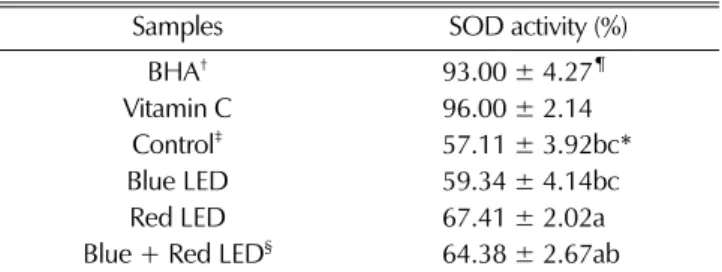
SOD 활성은 적색 LED 시험구의 SOD활성이 67.41%로 가 장 높았으며, 혼합광 LED 처리구 64.38%, 청색 LED 처리구 59.34% 및 대조구 57.11% 순으로 활성이 높아 DPPH radical-scavenging 활성의 경향과 일치하였다 (Table 6).
본 연구에서 총 폴리페놀함량과 항산화활성이 적색 LED 시 험구와 혼합광 LED 시험구에서 두드러지게 나타났고, 다른 시험구들에서도 총 페놀성 화합물의 함량과 항산화 활성과의 관계가 부분적으로 일치함을 확인하였다. 또한 Fournier 등 (2003)은 적색광을 조사하여 인삼의 대표적인 항산화 물질인 사포닌 함량을 증가시킨 것으로 보고하였으며, Guo 등 (2008) 은 약용식물 16종의 총 폴리페놀함량과 항산화활성을 비교하 여 총 폴리페놀함량과 항산화활성 간에는 정의 상관관계를 보 였다고 보고한 바 있다. 따라서 항산화 활성의 기여도가 높은 화합물군인 페놀성분 함량의 증가가 적색광과 혼합광의 DPPH radical-scarenging 활성과 SOD 활성의 향상에 영향을 미치는 것으로 판단되었다. Ryu (2012)는 본 연구와 동일한 식물재료 와 LED 광을 처리하여 생육특성을 조사한 결과, 엽수를 제외 한 초장, 엽수, 근장이 증가하여 생체중이 적색광은 생체중이 대조구 보다 37% 증가하였으며, 청색광과 혼합광에서도 24%
이상 증가하였다. 이외에도 적색광이 많이 포함된 광질에서 보 고된 민들레의 생육 촉진 효과 (Jeon et al., 2010)와 본 연구 의 결과를 종합하면 적색 LED 처리로 고부가가치 민들레 소 재의 대량 생산이 가능할 것으로 판단된다.
고부가가치 소재의 개발을 위해 유용약용 작물인 민들레에 청색, 적색, 혼합광 LED를 조사하여 기능성물질의 함량 및 항 산화 활성의 변화를 비교 조사한 결과 일반적으로 항산화 활 성의 기여도가 높은 화합물군인 페놀성 성분의 함량과 아미노
산 함량이 적색광과 혼합광 처리에서 높게 나타났으며, DPPH radical-scarenging 활성과 SOD 활성 또한 적색광과 혼합광에 서 높았다. 이상의 결과로부터 적색광과 혼합광 조사에 의해 페놀성 화합물이 증가되어 항산화 활성의 향상에 영향을 미치 는 것으로 판단되어진다.
감사의 글
이 논문은 2011년 농림수산식품부 자유응모형 과제 (과제번 호 110040-2) 지원에 의해 이루어진 것으로 이에 감사를 드립 니다.
LITERATURE CITED
Abe N, Nemoto A, Tsuchiya Y, Hojo H and Hirota A. (2000).
Study of the 1.1-diphenyl-2-picrylhydrazyl radical scavenging mechanism for a 2-pyrone compound. Bioscience, Biotechnology and Biochemistry. 64: 306-333.
Blois MS. (1958). Antioxidant determination by the use of a stable free radical. Nature. 26:1199-1744.
Brown CS, Schuerger AC and Seger JC. (1995). Growth and photom- orphogenesis of pepper plants under red light-emitting diodes with supplemental blue or far-red lighting. Horticultural Science. 120:808-813.
Cha MJ, Park EH, Kang CH and Kwang HB. (2011). Effects of various wavelength on the hardness and the free amino acid contents of soybean sprouts. Korean Journal of Environmental Agriculture. 30:402-408
Cho JY, Son DM, Kim JM, Seo BS, Yang SY, Kim BW and Heo BG. (2008). Effects of LEDs on the germination, growth and physiological activities of amaranth sprouts. Korean Journal of Horticultural Science & Technology. 26:106-112.
Chory J, Cook RK, Elich T, Fankhauser C, Li J, Nagpal P, Neff M, Pepper A, Poole D, Reed J and Vitart V. (1996).
From seed germination to flowering, light controls plant Table 5. DPPH radical-scavenging activities of extracts from T.
officinale cv. Goldenboll cultivated with different kinds of LED irradiation.
Samples IC50 (㎍/㎖)†
BHA‡ 55.43 ± 0.02#
Vitamin C 53.91 ± 0.01
Control§ 19.31 ± 2.92a*
Blue LED 18.12 ± 0.14a
Red LED 14.64 ± 3.22bc
Blue+Red LED¶ 16.73 ± 1.06b
†Inhibitory activity was expressed as the mean of 50% inhibitory concentration of triplicate determines, obtained by interpolation of concentration-inhibition curve.
‡BHA: Butylated hydroxy ani-sole.
§Control: Fluorescent lamp irradiation.
¶Blue and Red (6:4) LED irradiation.
#All values are mean ± SD (n = 3).
*Means with the same letters within a column from control to blue + red LED are not significantly different at P<0.05, according to Duncan’s multiple range test.
Table 6. SOD activity of ethanol extracts from T. officinale cv.
Goldenboll cultivated with different kinds of LED irradiation.
Samples SOD activity (%)
BHA† 93.00 ± 4.27¶
Vitamin C 96.00 ± 2.14
Control‡ 57.11 ± 3.92bc*
Blue LED 59.34 ± 4.14bc
Red LED 67.41 ± 2.02a
Blue + Red LED§ 64.38 ± 2.67ab
†BHA: Butylated hydroxy anisole.
‡Control: Fluorescent lamp irradiation.
§Blue and Red (6:4) LED irradiation.
¶All values are mean ± SD (n = 3).
*Means with the same letters within a column from control to blue + red LED are not significantly different at P<0.05, according to Duncan’s multiple range test.
development via the pigment phytochrome. Proceedings of the National Academy of Sciences of the United States of America.
93:12066-12071.
Daniel JS and Steven AC. (1993). Sensitive analysis of cystine/
cysteine using 6-aminoquinolyl-N-hydroxysuccinimidy carbamate (AQC) derivatives. Techniques in Protein Chemistry. 4:299-306.
Duke JA. (1992). Handbook of phytochemical constituents of GRAS herbs and other economic plants. CRC Press. New York, U.S.A. p.243-244.
Fankhauser C and Chory J. (1997). Light control of plant development. Annual Review of Cell and Developmental Biology. 13:203-229.
Fournier AR, Proctor JTA, Gauthier L, Khanizadeh S, Belanger A, Gosselin A and Dorais M. (2003). Understory light and root ginsenosides in forest-grown Panax quinquefolius.
Phytochemistry. 63:777-782.
Grieve FRHS. (1994). A Modern Herbal. In Grieve M. and Leyel C. F. (ed.), Tiger Books International. London, United Kingdom. p.247-255.
Guo DJ, Cheng HL and Yu PH. (2008). Antioxidative activities and total phenolic contents of tonic Chinese medicinal herbs.
Inflammopharmacology. 16:201-207.
Han SH, Hwang JK, Park SN, Lee KH, Ko KI, Kim KS and Kim KH. (2005). Potential effect of solvent fractions of Taraxacum mongolicum H. on protection of gastric mucosa.
Korean Journal of Food Science and Technology. 37:84-89.
Han EK, Lee JY, Jung EJ, Jin YX and Chung CK. (2010).
Antioxidative activities of water extracts from different parts of Taraxacum officinale. Food Science and Nutrition. 39:1580- 1586.
Heo SI and Wang MH. (2008). Antioxidant activity and cytotoxicity effect of extracts from Taraxacum mongolicum H.
Pharmacognosy. 39:255-259.
Hopkins WG. (1999). Introduction to Plant Physiology. 2nd Edition. John Wiley & Sons. New York, U.S.A. p.261-263.
Jeon SH, Son D, Ryu YS, Kim SH, Chung JI, Kim MC and Shim SI. (2010). Effect of presowing seed treatments on germination and seedling emergence in Taraxacum platycarpum.
Korean Journal of Medicinal Crop Science. 18:9-14.
Jeong JH, Kim YS, Moon HK, Hwang SJ and Choi YE.
(2009). Effects of LED on growth, morphogenesis and eleutheroside contents of in vitro cultured plantlets of Eleutherococcus senticosus Maxim. Korean Journal of Medicinal Crop Science. 17:39-45.
Joslyn MA. (1970). Methods in food analysis. Academic Press.
New York, U.S.A. p.710-711.
Kang MJ, Seo YH, Kim JB, Shin SR and Kim KS. (2000). The chemical composition of Taraxacum officinale consumed in Korea. Korean Journal of Food & Cookery Science. 16:182- 187.
Katrin S, Carles R and Schieber A. (2006). Taraxacum-A review
on its phytochemical and pharmacological profile.
Ethnopharmacology. 107:313-323.
Keppler K and Humpf HU. (2005). Metabolism of anthocyanins and their phenolic degradation products by the intestinal microflora. Bioorganic & Medicinal Chemistry. 13:5195-5205.
Kim TW and Kim TH. (2011). Pancreatic lipase inhibitors in the roots of Taraxacum ohwianum, a herb used in korean traditional medicine. Food Preservation. 18:53-58.
Lee HH and Lee SY. (2008). Cytotoxic and antioxidant effects of Taraxacum coreanum Nakai. and T. officinale WEB. extracts.
Korean Journal of Medicinal Crop Science. 16:79-85.
Lee JG, Oh SS, Cha SH, Jang YA, Kim SY, Um YC and Cheong SR. (2010). Effects of Red/Blue light ratio and short- term light quality conversion on growth and anthocyanin contents of baby leaf lettuce. Bio-Environment Control. 19:351- 359.
Lee KI, Yang SA and Kim SM. (2011). Antioxidative and nitric oxide production inhibitory activities of Lespedeza bicolor stem extracts depending on solvents. Korean Journal of Medicinal Crop Science. 19:368-372.
Marklund S and Marklund G. (1974). Involvement of superoxide anion radical in the oxidation of pyrogallol and a convenient assay for superoxide dismutase. Biochemistry. 47:467-474.
Ryu JH. (2012). Growth and development characteristics and genetic diversity analysis of genus Taraxacum accessions collected in Korea. Sunchon National University. Ph.D. Thesis.
Suncheon, Korea. p.57-61.
Ryu JH and Bae CH. (2011). Genetic diversity and relationship analysis of Taraxacum officinale Weber and Taraxacum coreanum Nakai accessions based on inter-simple sequence repeats (ISSR) markers. Korean Journal of Medicinal Crop Science. 19:149-156.
Steven AC and Dennis PM. (1993). Synthesis of a fluorescent derivatizing, 6-aminoquinoly-N-hydroxysuccinimidyl carbarmate and its application for the analysis of hydrolysate amino acid via high-performance liquid chromatography. Analytical Biochemistry.
211:1-9.
The Korean Herbal Pharmacopoeia. (2011). TARAXACI HERBA. Korea Food and Drug Adminstration. Seoul, Korea.
p.371.
Williams CA, Goldstone F and Greenham J. (1996). Flavonoids, cinnamic acids and coumarins from the different tissues and medicinal preparations of Taraxacum officinale. Phytochemistry.
42:121-127.
Yamachuchi T, Takamura H, Matoba T and Terao J. (1998).
HPLC method for evalution of the free radical-scavenging activity of foods by 1.1-diphenyl-2-picrylhydrazyl. Bioscience, Biotechnology and Biochemistry. 62:1201-1204.
Yun KW and Kim MY. (2010). Korean Medicinal Plants.
Shinkwang Publishing Company. Seoul, Korea. p.502-503.