접수일자 : 2014. 11. 07 심사완료일자 : 2014. 12. 17 게재확정일자 : 2014. 12. 30
* Corresponding Author Yeon-ho Chung(E-mail:[email protected], Tel:+82-51-629-6236)
Department of Information and Communications Engineering, Pukyong National University, Busan 608-737, Korea
Open Access
http://dx.doi.org/10.6109/jkiice.2015.19.3.507
print ISSN: 2234-4772 online ISSN: 2288-4165 한국정보통신학회논문지(J. Korea Inst. Inf. Commun. Eng.) Vol. 19, No. 3 : 507~513 Mar. 2015준직교 공간시간 블록부호를 적용한 32x32 전율 대규모 MIMO 시스템
킨자치윈 · 정연호*
32x32 Full-Rate Massive MIMO Using Quasi-Orthogonal Space-Time Block Code (QOSTBC)
Khin Zar Chi Winn · Yeon-ho Chung
*Department of Information and Communications Engineering, Pukyong National University, Busan 608-737, Korea
요 약
본 논문은 최대 32개의 송수신 안테나를 사용하는 준직교 공간시간 블록부호 (QOSTBC) 를 적용한 대규모 MIMO 시스템을 제안한다. QOSTBC 는 전송율 및 복호 복잡성에 있어서 장점을 가지고 있으며 2개 이상의 송수신
안테나를 적용한 MIMO 시스템에서는 중요한 전송다이버시티 기술이다. 대규모 MIMO 는 매우 많은 송수신 안테
나를 적용한 MIMO 시스템이며 최소한 15개 이상의 안테나를 적용하여야 한다. 본 논문은 다양한 안테나 구성 (2x2, 4x4, 8x8, 16x16, 32x32) 으로 QOSTBC를 적용한 대규모 MIMO 를 제안하며 BPSK 변조를 적용하여 성능을 분석하 였다. 기존 대규모 MIMO 시스템과 비교하여 QOSTBC를 적용한 대규모 MIMO 에서는 송수신 안테나 개수 증가에 따른 다이버시티 이득이 증가하면서 높은 성능 개선 효과를 확인할 수 있었다.
ABSTRACT
In this paper, we present the bit-error rate (BER) performance of quasi-orthogonal space-time block code (QOSTBC) massive multiple-input multiple-output (MIMO) system employing up to 32 transmit and receive antennas. The QOSTBC, due to its advantages in transmission rate and decoding complexity, is an important transmit diversity scheme for more than 2 transmit antennas. As massive MIMO implies very large number of antennas, practically at least more than 15 antennas, a different number of transmit and receive antennas (i.e. 2×2, 4×4, 8×8, 16×16 and 32×32) using QOSTBC for the massive MIMO system are considered. The BER performance of the massive MIMO with antennas up to 32×32 using BPSK modulation scheme is analyzed. Simulation results show that the full-rate massive MIMO systems with QOSTBC give a significant performance improvement due to increasing diversity effect, compared with previously considered massive MIMO systems.
키워드 : 대규모 MIMO, MIMO, 준직교공간시간블럭부호, 전율
Key word : Massive MIMO, MIMO, Quasi-orthogonal STBC, Full-Rate
Ⅰ. Introduction
As mobile communication systems evolve, higher transmission data rate, higher spectral efficiency and higher reliability requirements have been an important issue. To meet these requirements, massive multiple- input multiple-output (MIMO) technology has become an attractive field of research and massive MIMO can be built with inexpensive, low-power components [1].
Massive MIMO communication is widely considered to be an appropriate to achieve much higher bandwidth efficiency and improve the performance reliability of modern wireless communication [2]. The massive MIMO transmission of signal processing is performed in time and spatial dimensions by utilizing multiple, spatially distributed antennas at both transmitting and receiving sides.
In addition, combining with space-time codes (STC) [3], the usage of multiple antennas offers not only enormous spectral efficiencies but also a significant improvement in system performance. STC techniques such as Alamouti’s space-time block code (STBC) that combine coding, modulation and signal processing in wireless communication, have been used to achieve spatial diversity and improve the bit-error rate (BER) performance [4-6]. The transmit diversity scheme proposed by Alamouti [7] is a simple and effective orthogonal space-time block codes (OSTBCs or STBCs) of the full rate with two transmit antennas for the system.
OSTBCs [8] based on orthogonal design are the most interesting schemes among space-time codes. They can significantly improve signal quality in quasi-static MIMO channel due to their full-diversity property.
Unfortunately, for more than 2 transmit antennas, the rate of the OSTBC [9], defined by the number of symbols transmitted divided by the number of time slots used by the OSTBC, cannot be larger than 3/4 [10]. However, we can achieve the rate larger than 3/4 for more than 2 transmit antennas using Quasi-Orthogonal STBC (QOSTBC) methods [11]. The QOSTBC is a very attractive transmit diversity scheme in terms of rate and
decoding complexity. In [12], however, the number of transmit antennas for a rate-one QOSTBC was limited to 8. For massive MIMO systems, however, the number of antennas must be larger than at least 15. Therefore, a more thorough investigation in a true massive MIMO configuration with a large number of antennas still needs to be reported.
In this paper, we present a true massive MIMO with a large number of transmit and receive antennas up to 32 and perform comparative evaluation over different configurations. The main idea of increasing antennas is to increase the capacity with increasing error performance, i.e. decreasing BER. Therefore, we focus on BER reduction with full rate for a large number of antennas.
The rest of the paper is organized as follows. We explain about the massive MIMO system model in Section 2. The space-time block code is discussed in Section 3. Section 4 describes quasi-orthogonal space- time block code. In Section 5, simulation results are presented. Finally, conclusions are drawn in Section 6.
Ⅱ. Massive MIMO System Model
Recently, massive MIMO systems, or large-scale antenna systems, have been investigated as new cellular network architecture for next generation high-speech wireless communications with several attractive characteristics. Massive MIMO can improve spectrum efficiency (SE), energy efficiency (EE) and reliability just by configuration massive antenna arrays at the existing base stations (BSs), which has been seen as a promising technology for future wireless communication systems [13]. This great potential of massive MIMO has stimulated great interest from both academics and industry.
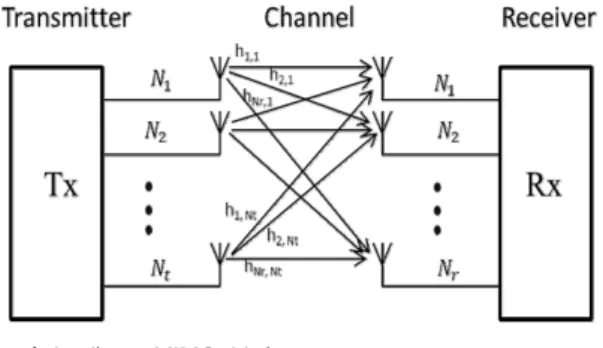
Let N
tdenote the number of antenna elements at the
transmitter, and N
rthe number of antenna elements at the
receiver. The channel with N
routputs and N
tinputs is
referred to a N
r×N
tmatrix. The MIMO system model can
be represented as
(1)
where ∈
×denote the received complex vector,
∈
×is the complex vector representing the transmitted signal. ∈
×is the complex channel matrix and ∈
×is the noise vector, whose components are complex circular symmetric Gaussian with zero mean and unit variance, where σ
vis the standard deviation of the noise at that receiver, given by
) SNR / 1
= (
σv
for unit signal power. The signal-to-noise ratio (SNR) is defined as SNR=E
b/N
owhen BPSK is employed. Fig. 1 depicts such MIMO system block diagram.
그림 1. 대규모 MIMO 블럭도
Fig. 1 Block diagram of massive MIMO system
Ⅲ. Space-Time Block Code
The term STBC, in general, is used to describe transmission schemes capturing these high data rates attainable by MIMO channels [14]. The STBC matrix has columns equal to the number of the transmit antennas and rows equal to the number of the time slots required to transmit the data. The STBC is represented by a matrix, where T denotes the number of time slots [15] and k refers to the number of independent complex information symbols in the codeword which are transmitted per time slot T. The code rate of STBC is defined as k/T. The
channel with N
rreceiver antenna and N
ttransmitter antenna is modeled by a matrix.
⎥ ⎥
⎥ ⎥
⎥
⎦
⎤
⎢ ⎢
⎢ ⎢
⎢
⎣
⎡
t t t
TN T
T
N N
u u
u
u u
u
u u
u
L M M
M
L L
2 1
2 22
21
1 12
11
(2)
where u
ijdenotes information data symbol transmitted at time slot i and from jth transmit antenna. The orthogonal code was shown in [8] that rate-1 generalized real orthogonal designs (ODs) and rate-3/4 generalized complex orthogonal designs exist for any dimension. In addition, rate-3/4 complex orthogonal designs were provided for the specific dimensions of two, three, and four. For real ODs, every entry of the code matrix is a linear combination of the information symbols. For example, the codeword matrices of the 2×2 and 4×4 real orthogonal designs are given by
⎥ ⎦
⎢ ⎤
⎣
⎡
= −
1 2
2 1
2
u u
u
R u (3)
⎥ ⎥
⎥ ⎥
⎦
⎤
⎢ ⎢
⎢ ⎢
⎣
⎡
−
−
−
−
−
= −
1 2 3 4
2 1 4 3
3 4 1 2
4 3 2 1
4
u u u u
u u u u
u u u u
u u u u
R (4)
In complex ODs, both the information symbols and their conjugates are utilized. The ith column of the code matrix can contain either the information symbols u
1,…, u
T, or their conjugates u
1*, …, u
T*only. The space-time block code proposed by Alamouti [7] uses the complex orthogonal design. Orthogonal structure of code matrix of Alamouti scheme expressed in (5) achieves full-rate and full diversity.
⎥ ⎦
⎢ ⎤
⎣
⎡
= −
*1
* 2
2 1
2
u u
u
C u (5)
Here, two time slots are required to transmit two symbols. Thus, k=2 and T=2. The Alamouti code is the first STBC that provides full diversity at full data rate when transmitter has two antennas and simple linear processing under the assumption of no channel state information at the transmitter (CSIT) but perfect channel state information at the receiver (CSIR) [8]. It has been generalized for four transmit antennas as given in equation (6)
⎥ ⎥
⎥ ⎥
⎥ ⎥
⎥ ⎥
⎥ ⎥
⎥
⎦
⎤
⎢ ⎢
⎢ ⎢
⎢ ⎢
⎢ ⎢
⎢ ⎢
⎢
⎣
⎡
−
−
−
−
−
−
−
−
−
−
−
−
=
* 1
* 2
* 3
* 4
* 2
* 1
* 4
* 3
* 3
* 4
* 1
* 2
* 4
* 3
* 2
* 1
1 2 3 4
2 1 4 3
3 4 1 2
4 3 2 1
4
u u u u
u u u u
u u u u
u u u u
u u u u
u u u u
u u u u
u u u u
C (6)
Ⅳ. Quasi-Orthogonal Space-Time Block Code
Alamouti code provides the full rate with full diversity for two antennas. Although Alamouti code can be further generalized for more than two antennas by using the concept of orthogonal designs, unfortunately, it does not provide any coding gain nor achieve a rate larger than 3/4 [16]. It is also proved in [17] that a complex orthogonal design and corresponding STBC which provide full diversity and full transmission rate is not possible for more than two antennas. Alamouti scheme is the only example of a full-rate full-diversity complex STBC using orthogonal designs.
QOSTBC is a full rate STBC for more than two transmit antennas. To design full rate codes with complex constellation, we consider codes with a decoding pair of symbols [17]. Such non-orthogonal codes for the 4 transmit antennas given in equation (7) are called QOSTBC.
⎥ ⎥
⎥ ⎥
⎦
⎤
⎢ ⎢
⎢ ⎢
⎣
⎡
−
−
−
−
−
= −
1 2 3 4
* 2
* 1
* 4
* 3
* 3
* 4
* 1
* 2
4 3 2 1
4
u u u u
u u u u
u u u u
u u u u
Q (7)
In this code matrix column 1 and 2 as well as columns 3 and 4 are orthogonal to each other. We represent the ith column of above matrix by z
i. Then, for any intermediate variable u
1, u
2, u
3, u
4, we have
0 ) , ( ) , ( ) , ( ) ,
(
z
1z
2 =z
1z
3 =z
2z
4 =z
3z
4 =(8)
In (8), subspace created by z
1and z
4is non-orthogonal to the subspace created by z
2and z
3. This is why they are called quasi-orthogonal STBC codes.
Although Jafarkhani [17] built the transmission matrix for 8 transmit antennas from 4 antennas, the 8x8 matrix cannot provide more than ¾ rate code. For example, we compare two quasi-orthogonal STBCs with different rates for eight transmit antennas. The Jafarkhani QOSTBC for 8 transmit antennas (N
t) to send 6 information symbols (k) in 8 time slots that use T time slots is shown in (10) [17].
The rate R of this QOSTBC code is,
4 3 8 6 =
=
= T
R k (9)
⎥⎥
⎥⎥
⎥⎥
⎥⎥
⎥⎥
⎥
⎦
⎤
⎢⎢
⎢⎢
⎢⎢
⎢⎢
⎢⎢
⎢
⎣
⎡
−
−
−
−
−
−
−
−
−
−
−
−
−
−
−
−
−
−
−
−
1
* 2
* 3 4
* 5
* 6
2
* 1
* 3 5
* 4
* 6
3
* 1
* 2 6
* 4
* 5
3 2 1 6
5 4
4
* 5
* 6 1
* 2
* 3
5
* 4
* 6 2
* 1
* 3
6
* 4
* 5 3
* 1
* 2
6 5 4 3
2 1
0 0
0 0
0 0
0 0
0 0
0 0
0 0
0 0
n n n n
n n
n n n
n n n
n n
n n n
n
n n n n
n n
n n n n
n n
n n n
n n n
n n
n n n
n
n n n n
n n
J
8=
(10)
The proposed design of transmission matrix for the
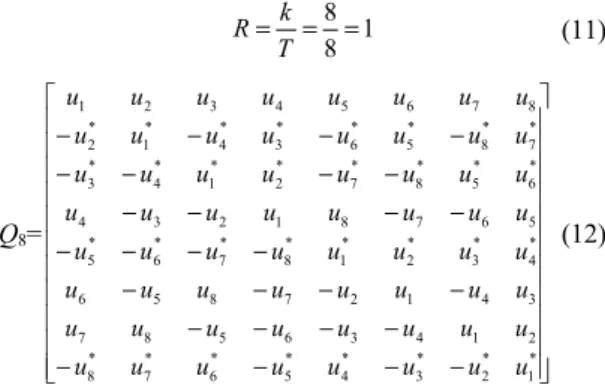
same transmit antennas is shown in (12). This matrix is
clearly a QOSTBC and sends k=8 information symbols
in 8 time slots. Therefore, the rate of this QOSTBC
code is
8 1 8 =
=
= T
R k (11)
Q
8=
⎥⎥
⎥⎥
⎥⎥
⎥⎥
⎥⎥
⎥
⎦
⎤
⎢⎢
⎢⎢
⎢⎢
⎢⎢
⎢⎢
⎢
⎣
⎡
−
−
−
−
−
−
−
−
−
−
−
−
−
−
−
−
−
−
−
−
−
−
−
−
−
−
−
−
* 1
* 2
* 3
* 4
* 5
* 6
* 7
* 8
2 1 4 3 6 5 8 7
3 4 1 2 7 8 5 6
* 4
* 3
* 2
* 1
* 8
* 7
* 6
* 5
5 6 7 8 1 2 3 4
* 6
* 5
* 8
* 7
* 2
* 1
* 4
* 3
* 7
* 8
* 5
* 6
* 3
* 4
* 1
* 2
8 7 6 5 4 3 2 1
u u u u u u u u
u u u u u u u u
u u u u u u u u
u u u u u u u u
u u u u u u u u
u u u u u u u u
u u u u u u u u
u u u u u u u u
(12)
The BER performance of QOSTBC in massive MIMO is evaluated through simulations and the results are discussed in the next section.
Ⅴ. Simulation Results
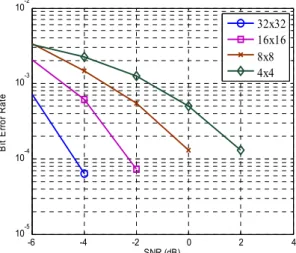
In this section, computer simulations are conducted to investigate the BER performance of the massive MIMO system. When we increase the QOSTBC matrix size (see in (12)), we evaluate the BER performance according to the matrix size (i.e., the number of antennas). It should be noted that for increasing the number of antennas, the STBC code should be matched to the antenna number. In the simulation, we increased the number of antennas up to 32, by designing the QOSTBC code into the size of 32×32. In order to examine the BER performance, the massive MIMO system using QOSTBC with 1×1, 2×2, 4×4, 8×8, 16×16 and up to 32×32 number of antennas is implemented and the results are shown in Figs. 2 and 3.
In this simulation, the modulation used is BPSK and the total transmit signal power was equally divided by the number of antennas. The channel is assumed to be an Additive White Gaussian Noise (AWGN) channel.
The results are observed with the assumption that the channel state information is perfectly known to the receiver. The parameters used in the simulation are shown in Table 1.
표 1. 시뮬레이션 파라미터
Table. 1 Parameters of the Simulation
Parameters Specification
No. of transmitter antennas 1, 2, 4, 8, 16, 32 No. of receiver antennas 1, 2, 4, 8, 16, 32
Data Length 1024 bits
Number of packets 100
Modulation Technique BPSK
Channel AWGN
Simulations are carried out for evaluating performances with different SNR values. Figs. 2 and 3 show a significant performance improvement when the number of transmit and receive antennas increases. Also, a greater performance improvement is observed with increased SNR.
-2 0 2 4 6 8
10-5 10-4 10-3 10-2 10-1 100
SNR (dB)
Bit Error Rate
1x1 2x2 4x4 8x8
그림 2. 1×1, 2×2, 4×4 및 8×8 대규모 MIMO 성능
Fig. 2 Performance of massive MIMO system with 1×1,
2×2, 4×4 and 8×8 antennasFig. 2 shows BER performance of the massive
MIMO using QOSTBC with 1×1, 2×2, 4×4 and 8×8
number of antennas. As can be seen in Fig. 2, increasing
the number of antennas results in significant BER
performance. In case of higher SNRs, BER decreases
drastically. It is important to note that the performances
of massive MIMO increase with a higher number of
transmit and receive antennas. This is due to diversity
from a large number of transmission paths deliberately
created. In the 8×8 configuration, the BER performance shows nearly 10
-4at a SNR value of 0dB.
-6 -4 -2 0 2 4
10-5 10-4 10-3 10-2
SNR (dB)
Bit Error Rate
32x32 16x16 8x8 4x4
그림 3. 32×32, 16×16, 8×8 및 4×4 대규모 MIMO 성능
Fig. 3 Performance of massive MIMO system with
32×32, 16×16, 8×8 and 4×4 antennasFig. 3 illustrates the comparison of the BER perfor- mances of massive MIMO with 4×4, 8×8, 16×16 and 32×32 number of transmit and receive antennas using QOSTBC. The BER performances increase as more antennas at both sides are employed. The best BER performance is achieved with the 32×32 configuration as expected. Therefore, it can be said that an increasing number of antennas in massive MIMO provide significant increase in diversity gain and subsequently BER improvement.
Ⅵ. Conclusions
We have presented the BER performance of massive MIMO systems with up to 32×32 antenna configuration using QOSTBC. The performances are compared with a different number of transmit and receive antennas under the BPSK modulation scheme. Simulation results for QOSTBC in massive MIMO show a consistent performance improvement with increasing number of
transmit and receive antennas.
It is concluded that QOSTBC shows full rate and is an adequate modulation format for massive MIMO. The work for massive MIMO performance evaluation under fading conditions as well as with imperfect channel state information can be undertaken. In addition, a field test of the proposed system could be of interest as future works.
Acknowledgment
This work was supported by a Research Grant of Brain Busan (BB) 21 Project (2014 year)
REFERENCES
[ 1 ] J. Mohinder, Space-time Codes and MIMO Systems, 1st ed.
Artech House, 2004.
[ 2 ] V. Branka and Y. Jinhong, Space-Time Coding, 1st ed.
New York, NY: Wiley, 2003.
[ 3 ] J. F. Gerard, “Layered space-time architecture for wireless communication in a fading environment when using multi-element antennas,” Bell Labs Tech. Journal, vol. 1, pp. 41-59, 1996.
[ 4 ] H. C. Jin, K. N. Chee, K. N. Nor, and M. A. Borhanuddin,
“Dynamic transmit antenna shuffling scheme for MIMO wireless communication systems,” Journal of Convergence, vol. 4, pp. 7-14, 2012.
[ 5 ] P. Lee, J. Jeong, N. Saxena, and J. Shin, “Dynamic reservation scheme of physical cell identity for 3GPP LTE femtocell systems,” Journal of Information Process System, vol. 5, pp. 207-220, 2009.
[ 6 ] H. C. Jin, K. N. Chee, K. N. Nor, and M. A. Borhanuddin,
“A low computational complexity V-BLAST/STBC detection mechanism in MIMO system,” Human-centric
Computing and Info. Sciences, vol. 4, pp. 1-28, 2014.
[ 7 ] S. Alamouti, “A simple transmit diversity technique for wireless communications,” IEEE J. Select. Areas
Commun., vol. 16, pp. 1451-1458, 1998.
[ 8 ] V. Tarokh, H. Jafarkhani and A. R. Calderbank, “Space- Time block codes from orthogonal designs,” IEEE Trans.
Inf. Theory, vol.45, pp. 1456-1467, 1999.
[ 9 ] V. Tarokh, N. Seshadri, and A. R. Calerbank, “Space-time codes for high data rate wireless communication:
performance criterion and code construction,” IEEE Trans.
Inf. Theory, vol. 44, pp. 744-765, 1998.
[10] H. Wang and X. G. Xia, “Upper bounds of complex orthogonal space time block codes,” IEEE Trans. Inf.
Theory, vol. 49, pp. 2788-2796, 2003.
[11] N. Sharma and C. B. Papadias, “Improved quasi-orthogonal codes through constellation rotation,” in Proceeding of
IEEE International Conference on Acoustics, Speech and Signal, Orlando, FL, USA, pp. 3968-3971, 2002.
[12] C. B. Papadias and G. J. Foschini, “Capacity-approaching space time codes for systems employing four transmitter antennas,” IEEE Trans. Inf. Theory, vol. 49, pp. 726-732, 2003.
[13] T. L. Marzetta, “Noncoorperative cellular wireless with unlimited numbers of base station antennas,” IEEE Trans.
Wireless Commun., vol. 9, pp. 3590-3600, 2010.
[14] M. Samuel and M. Fitz, “Multi-strata codes: space-time block codes with low detection complexity,” IEEE Trans.
Commun., vol. 58, pp. 1080-1089, 2010.
[15] S. K. Mohammed, A. Zaki, A. Chockalingam and B. S.
Rajan, “High-rate space-time coded large-MIMO systems:
low complexity detection and channel estimation,” IEEE J.
Sel. Topics Signal Process, vol. 3, pp. 958-974, 2009.
[16] S. N. Diggavi, N. Al-Dhahir, A. Stamoulis and A. R.
Calderbank, “Great expectations: the value of spatial diversity in wireless networks,” in Proceeding of IEEE, vol. 92, pp. 219-270, 2004.
[17] H. Jafarkhani, “A quasi-orthogonal space-time block code,”
IEEE Trans. Commun., vol. 49, pp. 1-4, 2001.
킨자치윈 (Khin Zar Chi Winn)
2011년 Department of Information Technology, Technological University (Thanlyin), Myanmar (공학사) 2015년 부경대학교 정보통신공학과 (공학석사)
※관심분야 : OFDM, MIMO, massive MIMO
정연호(Yeon‑ho Chung)
1984년 경북대학교 전자공학과 (공학사) 1992년 영국 Imperial College London (공학석사) 1996년 영국 Liverpool University (공학박사) 2006년 미국 Pennsylvania State University 객원교수 2001년 ~ 현재 부경대학교 정보통신공학과 교수
※관심분야 : 가시광통신 기술, 적응 변복조, OFDM