비간섭 비직교 다중접속: 삼중 2PAM의 최약 채널 사용자의 BER 향상 관점에서
정규혁*
Non-interfering Non-orthogonal Multiple Access: With Application to Improving BER of Weakest Channel User in 3-User 2PAM
Kyu-Hyuk Chung*
요 약
본 논문은 수용 가능한 강 채널 사용자들의 BER 손실로, 최약 채널 사용자의 BER 성능을 향상하기 위하 여, 3명의 사용자의 비간섭 비직교 다중 접속을 제안한다. 먼저, 3명의 사용자의 비간섭 비직교 다중 접속을 설계하고, 제안된 기법의 BER의 폐쇄형 표현 식을 유도한다. 다음, 수치적 결과를 통해, 적은 강 채널 사용자 들의 BER 손실로, 최약 채널 사용자의 BER 성능이 크게 향상되는 것을 입증한다. 결론적으로, 비간섭 2PAM 은 5G 시스템의 비직교 다중접속에서 고려될 수도 있다.
ABSTRACT
This paper proposes a 3-user non-interfering binary pulse amplitude modulation(2PAM) and non-orthogonal multiple access(NOMA) scheme, to improve the bit-error rate(BER) performance of the weakest channel user with the tolerable BER loss of the stronger channel users. First, we design the 3-user non-interfering 2PAM NOMA, and then derive the closed-form expressions for the BERs of the proposed scheme. Numerical results are also presented to demonstrate that the BER of the weakest channel user improves greatly, with the small BER losses of the stronger channel users. As a result, the non-interfering 2PAM could be considered in NOMA of 5G systems.
키워드
NOMA, User Fairness, 5G, Superposition Coding, Successive Interference Cancellation, Power Allocation 비직교 다중 접속, 사용자 공평성, 5G, 중첩 코딩, 순차적 간섭 제거, 전력 할당
* 교신저자 : 단국대학교 소프트웨어학과 ㆍ접 수 일 : 2021. 06. 05
ㆍ수정완료일 : 2021. 07. 11 ㆍ게재확정일 : 2021. 08. 17
ㆍReceived : Jun. 05, 2021, Revised : Jul. 11, 2021, Accepted : Aug. 17, 2021 ㆍCorresponding Author : Kyu-Hyuk Chung
Dept. Software Science, Dankook University, Email : [email protected]
Ⅰ. Introduction
The concept of channel sharing in the fifth-generation(5G) wireless networks has obtained a great deal of attention in improving system capacity and spectral efficiency[1, 2], in comparison to orthogonal
multiple access(OMA)[3-5]. Non-orthogonal multiple access(NOMA) technology uses such channel sharing over time or frequency[6, 7]. In addition, super-ultra low latency is a advantage of NOMA[8]. The NOMA network was evaluated in terms of the bit-error rate(BER)[9], and the outage probability was studied in http://dx.doi.org/10.13067/JKIECS.2021.16.4.585
NOMA-based multi-carrier wireless systems[10].
Meanwhile, the Nakagami-m fading BER expression was derived[11], and the exact Nakagami-m fading BER expression was studied[12]. The Rayleigh fading symbol error rate(SER) expression was investigated[13]. The optimal power control was studied based on individual QoS constraints[14] and energy harvesting was considered in NOMA[15]. In addition, single-user decoding has been proposed for discrete-input lattice-based NOMA[16-19]. On the other hand, correlated information sources were studied in NOMA[20, 21]. In addition, negative correlation for NOMA was investigated[22], and achievable data rate of NOMA with binary phase shift keying modulation was derived[23]. Single-user decoding receivers were proposed for NOMA with correlated information sources[24]. In [25], the achievable rate region was studied for NOMA with correlated information sources.
However, although NOMA has the high system capacity and increased spectral efficiency owing to channel sharing of users, such channel sharing induces inter-user interference among users. The weakest channel gain user suffers the degradation of BER owing to the weak channel gain. In addition, the inter-user interference, which can not be removed because the weakest channel gain user can not perform SIC, also degrades the BER of the weakest channel gain user.
Thus this paper proposes a non-interfering binary pulse amplitude modulation(2PAM) to improve the BER performance of the weakest channel user with the tolerable BER losses of the stronger channel users.
First, we design the 3-user non-interfering 2PAM NOMA, and then derive the analytical expressions for the BERs of the proposed scheme. Then numerical results are presented to demonstrate that the BER of the weakest channel user improves greatly, with the small BER losses of the stronger channel users.
Notably, the proposed scheme is well consistent with the main NOMA principle of user-fairness.
The remainder of this paper is organized as follows.
In Section II, the system and channel model are
described. The design and the performance analysis are presented in Section III. The results are presented and discussed in Section IV. Finally, the conclusions are presented in Section V.
Ⅱ. System and Channel Model In a cellular downlink NOMA network, three users are assumed to experience block fading. A base station and three users are within a cell. The Rayleigh fading channel gain between the mth user and the base station is denoted by with ∣∣, where
represents the expectation of a random variable(RV) ,
. The channels are sorted as ≥ ≥ . The base station sends the superimposed signal
, where is the message for the mth user with average unit power, ∣∣ ,
is the power allocation coefficient for the non-interfering 2PAM (we use for the standard 2PAM), with , and is the average total allocated power. The correlation coefficient between the ith and jth users is denoted by . Hence for a average total transmitted power at the base station,
is scaled as
(1)
The observation at the mth user is given by
(2)
where ∼ is additive white Gaussian noise(AWGN) at the mth user.
Ⅲ. Non-interfering 2PAM NOMA 3.1 Design
First, we observe that the interfering effects of the standard 2PAM ∈ , with the bits
∈, as follows:
(3)
Such inter-user interference degrades severely the BER performance of the weakest channel gain user, who can not perform SIC and has the very weak channel condition. Thus, the non-interfering 2PAM is designed as
(4)
3.2 BER Derivation
In this subsection, we derive the BERs for three users. We start the BER of the weakest channel gain user. The likelihood for the third user is expressed as
∣ ∣
(5)
Based on the maximum-likelihood (ML), the optimum detection is expressed as
argmax
∈
∣ ∣ (6) Then we solve the equal likelihood equation:
∣ ∣ ∣ ∣ (7) which has the one exact decision boundary . Then, the decision regions are given by
(8) Therefore, the BER performance for the third user is derived as
(9)
where we use the following notation:
(9) Similarly, after SIC is performed, the BERs for the second and first user are given as
(10)
and
(11)
Fig. 1 Comparison of BERs of non-interfering 2PAM and standard 2PAM for third user.
Ⅳ. Results and Discussions
We present the BERs of the 3-user non-interfering 2PAM NOMA scheme over the power allocation ranges, which are used in typical NOMA systems, compared to those of the 3-user standard 2PAM in [9].
It is assumed that , and . We consider the average total transmitted signal power to noise power ratio(SNR) dB.
First, in Fig. 1, for the third user, we depict the BER of the non-interfering 2PAM, compared to that of the standard 2PAM, for the power allocation ranges of significance. As shown in Fig. 1, the BER of the non-interfering 2PAM improves greatly with respect to that of the standard 2PAM, over the entire power allocation ranges of interest.
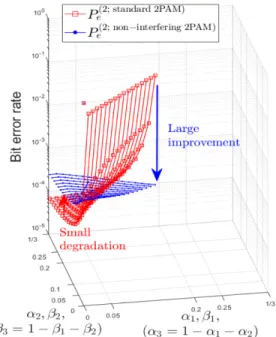
Second, in Fig. 2, for the second user, we observe that for some power allocation ranges, the BER of
the non-interfering 2PAM improves a lot,
Fig. 2 Comparison of BERs of non-interfering 2PAM and standard 2PAM for second user.
w
hereas for the other power allocation ranges, the BER of the non-interfering 2PAM degrades a little
compared to that of the standard 2PAM.
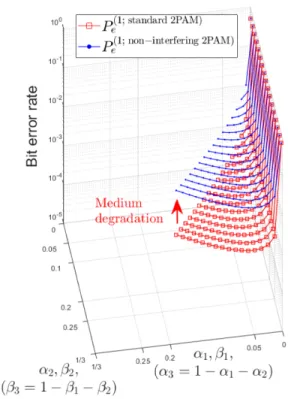
Third, as shown in Fig. 3, for the first user, the BER of the non-interfering 2PAM degrades slightly with respect to that of the standard 2PAM, over the whole power allocation ranges of interest.
Based on Fig. 1, Fig. 2, and Fig. 3, we demonstrate that the non-interfering 2PAM improves greatly the BER of the weakest channel gain user, with tolerable BER degradation of the stronger channel gain users.
Remark that the BER of the second user improves or degrades, depending on the power allocation.
It should be noted that the proposed non-interfering 3-user 2PAM NOMA is well consistent with the user-fairness principle in NOMA.
Fig. 3 Comparison of BERs of non-interfering 2PAM and standard 2PAM for first user.
Ⅴ. Conclusion
This paper proposed the 3-user non-interfering 2PAM NOMA scheme, to improve the BER performance of the weakest channel user with the tolerable BER losses of the stronger channel users.
First, we designed the 3-user non-interfering 2PAM NOMA, and then derived the analytical expressions for the BERs of the proposed scheme. Numerical results were also presented to demonstrate that the BER of the weakest channel user improves greatly, with the small BER losses of the stronger channel users. In addition, the proposed 3-user non-interfering 2PAM NOMA scheme reinforces the user-fairness principle of NOMA.
As a result, the non-interfering 2PAM could be a promising modulation scheme in NOMA of 5G systems.
References
[1] Y. Saito, Y. Kishiyama, A. Benjebbour, T.
Nakamura, A. Li, and K. Higuchi,
“Non-orthogonal multiple access (NOMA) for cellular future radio access,” in Proc. IEEE 77th Veh. Technol. Conf. (VTC Spring), Dresden, Germany, June 2013, pp. 1-5.
[2] Z. Ding, Y. Liu, J. Choi, Q. Sun, M. Elkashlan, C.-L. I, and H. V. Poor, ``Application of non-orthogonal multiple access in LTE and 5G networks,'' IEEE Commun. Mag., vol. 55, no. 2, Feb. 2017, pp. 185-191.
[3] M. Yang, "An adaptive tone reservation scheme for PAPR reduction of OFDM signals," J. of the Korea Institute of Electronic Communication Sciences, vol. 14, no. 5, Oct. 2019, pp. 817-824.
[4] H. Ahn and M. Yang, "Analysis of Automatic Neighbor Relation Technology in Self Organization Networks of LTE," J. of the Korea Institute of Electronic Communication Sciences, vol.
14, no. 5, Oct. 2019, pp. 893-900.
[5] K. Zhang and H. Suh, "An analysis of multiuser diversity technology in the MIMO-OFDM system," J. of the Korea Institute of Electronic Communication Sciences, vol. 14, no. 6, Dec. 2019, pp. 1121-1128.
[6] L. Dai, B. Wang, Y. Yuan, S. Han, C.-L. I, and Z. Wang, "Non-orthogonal multiple access for 5G: Solutions, challenges, opportunities, and future research trends," IEEE Commun. Mag., vol.
53, no. 9, Sept. 2015, pp. 74-81.
[7] Q. Wang, R. Zhang, L.-L. Yang, and L. Hanzo,
"Non-orthogonal multiple access: A unified perspective," IEEE Wireless Commun., vol. 25, no.
2, Apr. 2018, pp. 10-16.
[8] D. Wan, M. Wen, F. Ji, H. Yu, and F. Chen,
"Non-orthogonal multiple access for cooperative communications: Challenges, opportunities, and trends," IEEE Wireless Commun., vol. 25, no. 2, May 2018, pp. 109-117.
[9] M. Aldababsa, C. Göztepe, G. K. Kurt, and O.
Kucur, "Bit error rate for NOMA network," IEEE Commun. Lett., vol. 24, no. 6, June 2020, pp.
1188-1191.
[10] A.-A.-A. Boulogeorg, N. D. Chatzidiamantis, and G. K. Karagiannid, "Non-orthogonal multiple access in the presence of phase noise," IEEE
Commun. Lett., vol. 24, no. 5, May 2020, pp.
1133-1137.
[11] L. Bariah, S. Muhaidat, and A. Al-Dweik, "Error Probability Analysis of Non-Orthogonal Multiple Access Over Nakagami-m Fading Channels,"
IEEE Trans. Commun., vol. 67, no. 2, Feb. 2019, pp. 1586-1599.
[12] T. Assaf, A. Al-Dweik, M. E. Moursi, and H.
Zeineldin, "Exact BER Performance Analysis for Downlink NOMA Systems Over Nakagami-m Fading Channels," IEEE Access, vol. 7, 2019, pp.
134539-134555.
[13] I. Lee and J. Kim, "Average Symbol Error Rate Analysis for Non-Orthogonal Multiple Access With M-Ary QAM Signals in Rayleigh Fading Channels," IEEE Commun. Lett., vol. 23, no. 8, Aug. 2019, pp. 1328-1331.
[14] Z. Yang, W. Xu, C. Pan, Y. Pan, and M. Chen,
"On the optimality of power allocation for NOMA downlinks with individual QoS constraints," IEEE Commun. Lett., vol. 21, no. 7, July 2017, pp. 1649-1652.
[15] Z. Yang, W. Xu, Y. Pan, C. Pan, and M. Chen,
"Energy efficient resource allocation in machine-to-machine communications with multiple access and energy harvesting for IoT," IEEE Internet Things J., vol. 5, no. 1, Feb. 2018, pp. 229-245.
[16] M. Qiu, Y.-C. Huang, and J. Yuan, “Downlink non-orthogonal multiple access without SIC for block fading channels: an algebraic rotation approach,” IEEE Trans. Wireless Commun., vol.
18, no. 8, Aug. 2019, pp. 3903-3918.
[17] M. Qiu, Y.-C. Huang, J. Yuan, and C.-L. Wang,
“Lattice-partition-based downlink non-orthogonal multiple access without SIC for slow fading channels,” IEEE Trans. Commun., vol. 67, no. 2, Feb. 2019, pp. 1166-1181.
[18] Z. Dong, H. Chen, J. Zhang, and L. Huang, "On non-orthogonal multiple access with finite-alphabet inputs in Z-channels," IEEE J. Sel.
Areas Commun., vol. 35, no. 12, Dec. 2017, pp.
2829-2845.
[19] Z. Dong, H. Chen, J. Zhang, L. Huang, and B.
Vucetic, "Uplink non-orthogonal multiple access with finite-alphabet inputs," IEEE Trans. Wireless Commun., vol. 17, no. 9, Sept. 2018, pp.
5743-5758.
[20] K. Chung, “Optimal detection for NOMA
systems with correlated information sources of interactive mobile users,” J. of the Korea Institute of Electronic Communication Sciences, vol. 15, no.
4, Aug. 2020, pp. 651-657.
[21] K. Chung, “Improved BER performance of non-orthogonal multiple access system for interactive mobile users: maximum likelihood detection perspective,” J. of the Korea Institute of Electronic Communication Sciences, vol. 15, no. 5, Oct. 2020, pp. 865-872.
[22] K. Chung, “On negative correlation bit-to-symbol(:
B2S) mapping for NOMA with correlated information sources in 5G systems,” J. of the Korea Institute of Electronic Communication Sciences, vol. 15, no. 5, Oct. 2020, pp. 881-888.
[23] K. Chung, “Analysis of achievable data rate under BPSK modulation: CIS NOMA perspective,” J. of the Korea Institute of Electronic Communication Sciences, vol. 15, no. 6, Dec. 2020, pp. 995-1002.
[24] K. Chung, “Analyses on achievable data rate for single-user decoding(SUD) receiver: with application to CIS NOMA strong channel user,”
J. of the Korea Institute of Electronic Communication Sciences, vol. 15, no. 6, Dec. 2020, pp. 1003-1010.
[25] K. Chung, “NOMA for correlated information sources in 5G systems,” IEEE Commun. Lett., vol.
25, no. 2, Feb. 2021, pp. 422-426.
저자 소개
정규혁(Kyu-Hyuk Chung) 1997년 성균관대학교 전자공학과 졸업(공학사)
1998년 Univ. of Southern California 전기공학과 졸업(공학 석사)
2003년 Univ. of Southern California 전기공학과 졸업(공학박사)
2005년 ~현재 단국대학교 SW융합대학 소프트웨어 학과 교수
※ 관심분야 : 5G이동통신시스템, 비직교다중접속