G 대학 대학생 핵심역량 설정에 관한 융합연구
김창규1, 장기덕2, 전열어3*
1김천대학교 방사선학과, 2김천대학교 유아교육과, 3김천대학교 간호학과
A Convergence Study on the Core Competencies of students: G university
Chang-Gyu Kim
1, Kee-Duck Jang
2, Yeol-Eo Chun
3*1
Department of Radiological Science, Gimcheon University
2
Department of Early Childhood Education, Gimcheon University
3
Department of Nursing, Gimcheon University
요 약 본 연구는 대학생 핵심역량을 기초하여 학생들에게 다양한 교육기회를 제공하고 산업변화에 따른 산업인력 수요에 적합한 대학인력 양성이 가능하도록 대학생의 핵심역량을 설정하고자 시도되었다. 연구절차는 핵심역량에 대한 문헌고찰과 학생, 교수, 산업체, 학부모 대상의 핵심역량의 중요도에 대한 조사 및 전문가의 타당도를 통해 대학생 핵심역량을 설정하였 다. 연구결과 문헌고찰을 통해 14개의 역량을 도출하였으며, 재학생, 졸업생, 교수 대상으로 중요도와 전문가 타당도를 통해 창의력, 문제해결능력, 자기주도능력의 종합적 문제해결역량, 전문지식보유능력, 정보처리능력, 기술활용능력의 산업체맞춤 전문역량, 배려․섬김인성, 사회봉사의 실천․나눔역량, 의사소통능력의 의사소통역량, 자기관리능력, 대인관계능력, 리더 십, 외국어 능력, 글로벌 역량의 글로컬 리더십의 최종 5대 핵심역량과 세부 14개 하위 역량이 설정되었다. 본 연구결과에 기초하여 교육과정 개발과 운영에 적용하여 대학생들의 역량을 증진시키고, 향후 역량측정도구 개발을 통해 역량증진 정도 를 파악하는 것이 필요하다.
주제어 : 융합, 역량, 핵심역량, 대학생, 역량설정
Abstract
This research is based on core competency in order to provide diverse educational opportunities and to train compatible human resources according to industrial change. The research set up the core competency of university students according to document research and the importance of core competency of students, professors, faculty and parents. As a result, a total of 14 competencies were deducted by importance and validation from enrolled students, graduated students and professors. A total of 5 core competencies and 14 detailed competencies were deducted. Creativity, problem solving ability, self-directed overall problem solving abilities, expertise ability, data processing ability, technology application according to industry, consideration and serving character, community service, communicational ability, self-management, inter personal relationship, foreign language ability, global, leadership and competence were the 14 elements of this research. Based on the result of this study, it is necessary to improve the competence of university students by applying them to the curriculum development and operation and to find out the extent of the students competence enhancement through the development of future capacity measuring tools.Key Words :
Convergence, competence, Core competence, College student, Competency setting*Corresponding Author : Yeol-Eo Chun([email protected]) Received April 3, 2018
Accepted July20, 2018
Revised July 13, 2018 Published July 28, 2018
1. 서론
1.1 연구의 필요성
산업사회는 지식 정보화 사회를 기반으로 산업이 빠 르게 변화하고 있다. 오늘날 세계는 지식기반 사회를 지 나 4차 산업혁명의 시대에 진입해 있으며, 기술간 융합과 창의적 혁신적 아이디어가 새로운 부를 창출하는 창조경 제가 실현되고 있다[1]. 급변하는 산업의 변화에 따라 인 력 양성 측면에서도 산업사회에 적응할 수 있는 새로운 인재양성의 모습을 요구하고 있으며, 기존인재와의 차별 화된 21세기형 인재를 요구하고 있다. 최근 산업체는 인 력 채용과정에서도 역량을 기준으로 인재를 선발하고 있 으며[2] 변화하는 조직에 경쟁력을 신장할 수 있는 역량 을 갖춘 인재를 선호하고 있다.
이에 대학은 시대가 요구하는, 나아가 시대를 선도하 는 보편가치를 정립하고, 국가사회의 성숙한 발전을 위 한 지식과 지혜를 창출하는 곳으로[3], 새로운 대학에 대 한 구상을 펼침에 있어 사회의 변화와 미래의 트렌드를 고려하여 미래의 변화하는 환경에서 요구하는 핵심 역량 을 갖춘 인력을 체계적으로 육성, 배출해야 한다[4]. 또한, 대학이 종전과 같이 특정 전공분야의 지식이나 기술을 제공하는 것만으로는 졸업생들이 지식과 기술의 변화 및 고용시장의 변화에 적극 대응하는 데 한계가 있음에 따 라, 범 직종분야에서 요구되는 공통적인 핵심 역량을 제 공할 것이 강조되고 있는 것이다[5, 6]. 대학은 미래의 변 화에 요구되는 역량을 갖춘 우수한 인재를 전략적이고 체계적으로 육성하기 위해서는 우선, 필요한 역량을 타 당하게 규명하고, 도출된 역량을 토대로 학습지원체계 구축 및 교육 프로그램의 개발 등이 이루어져야 한다.
최근 대학생의 핵심역량에 관한 정의와 핵심역량에 관한 연구가 다양하게 수행되고 있으며, 핵심역량이란 다양한 상황에서 문제를 효율적으로 해결하기 위한 역량 으로 학습자에게 필요로 하는 지식, 기술, 태도를 말하며 [7], 특정한 지식과 기술을 의미하는 것이 아니라 다양한 환경에서 문제를 해결해 나갈 수 있는 지식과 기술, 그리 고 뒷받침되는 태도를 포괄하는 개념이다[8]. 이것은 자 신의 고유하고 독특한 역량이기 보다는 교육을 통하여 누구나 도달할 수 있는 기본적이고 보편적이며 통합적인 역량이다[9,10].
최근 학부교육선진화 선도대학지원사업(ACE)와 대학 교육역량강화지원 사업은 대학생의 핵심역량에 대한 관
심을 고조시키고 있으며, 21세기 대학 교육의 방향은 창 의적 능력을 발휘할 수 있는 인재의 특성과 그들이 필수 적으로 갖추어야 할 미래의 핵심역량을 중심으로 재편되 어야 할 것이다.
핵심역량은 지식과 창의성, 사회성, 인성의 중요성을 부각하여 인지적 역량과 비인지적 역량을 균형적으로 함 양하는 것을 강조하고 있으며[9], 고등교육과정에서 필요 한 핵심역량으로 전공분야와 함께 의사소통능력, 문제해 결능력, 자기주도적 학습능력으로 제시하였다[11,12]. 또 한 지식과 정보를 기반으로 성장 가능한 잠재력, 창의적 사고와 리더십, 도덕성과 원만한 대인관계, 문제해결력과 도전정신을 갖추어야 한다[13]고 하였다.
따라서 본 연구에서는 산업체에 필요로 하는 인재를 양성하기 위해 대학생들에게 대학생활에서 성취해야 할 역량들이 무엇인지를 파악하고 균형감 있는 역량들을 성 취할 수 있도록 하는데 목적이 있다.
1.2 연구의 목적
본 연구는 대학생의 핵심역량을 설정하고자 시도되었 으며, 대학생 핵심역량을 기초하여 학생들에게 다양한 교육기회를 제공하고 대학생활에서 목표된 역량을 성취 할 수 있는 교육체제를 갖출 수 있도록 하는데 있다. 또 한 산업체는 산업변화에 따른 산업인력 수요에 적합한 대학인력 양성이 가능하도록 하는데 목적이 있다.
2. 연구방법
2.1 연구 설계
본 연구는 대학생의 핵심역량을 설정하기 위한 서술 적 조사연구이다.
2.2 용어 정의 2.2.1 핵심역량
핵심역량은 성공적으로 특정업무를 수행하는데 있어 서 효과를 극대화하기 위해 필요로 하는 지식, 기술, 태 도, 지적전략을 포괄하는 통합적인 능력을 의미한다[14].
본 연구에서 대학생 핵심역량은 학생이 대학생활의 다양 한 활동을 통해서 성취되어야 할 주요한 역량을 의미한 다.
2.3 자료분석
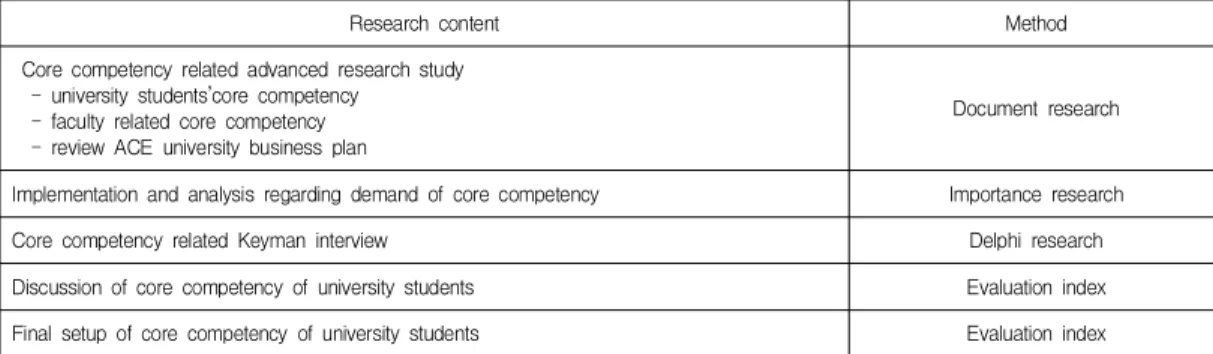
대학생 핵심역량 설정을 위해 첫째, 대학생, 산업체 대 상 핵심역량 선행연구 검토, ACE 사업 계획서 등을 검토 하여 재설정을 위한 타당한 근거를 확인하였다. 둘째, 교 내 교수들로 구성된 핵심역량 전문가를 통해 핵심역량 설정과정에 대한 의견수렴을 하였다. 셋째, 학생, 교수, 산업체, 학부모 대상의 핵심역량 수요조사를 통해 핵심 역량 설정의 객관적인 근거를 확인하였다. 넷째, 잠정적 으로 설정된 핵심역량의 구조를 KEY맨 인터뷰, 심리측 정 전문가, 교육과정 교수, 핵심역량 교육 교수 등 외부 전문가 자문을 받아 핵심역량 설정의 타당도를 확인하였다.
2.4 윤리적 고려
본 연구 과정에서 자료수집 전에 연구 대상자에게 연 구의 목적과 내용을 설명하였다. 설문지와 함께 첨부한 동의서에는 자의에 따라 연구에 참여가 가능하며, 언제
든지 철회 가능하고, 응답한 내용은 연구 목적 외의 다른 목적으로 사용되지 않을 것이며, 개인의 비밀이 보장된 다는 설명과 연구자의 이름 및 연락처를 기재하였다. 동 의서에 서명한 뒤 설문지에 답하게 하여 대상자의 윤리 적 측면을 고려하였다.
3. 연구결과 및 논의 3.1 대학생 핵심역량 설정을 위한 문헌고찰
3.1.1 역량개념에 관한 문헌고찰
역량에 대한 개념에 대하여 1970년대부터 최근의 경 향까지 문헌고찰 한 결과 1970년대는 역량이란 지능보다 역량이 직업수행이나 성공적인 삶에 대한 예측력이 더 높으며 심리적 행동적 특성을 나타내는 넓은 의미로 제 안되었으나 1980년~1990년대에는 기업교육과 인사관리 영역에서 역량에 대한 관심을 보였으며, 직무를 수행함
Research content Method
Core competency related advanced research study - university students’core competency
- faculty related core competency - review ACE university business plan
Document research
Implementation and analysis regarding demand of core competency Importance research
Core competency related Keyman interview Delphi research
Discussion of core competency of university students Evaluation index
Final setup of core competency of university students Evaluation index
Table 1. Core competency setting schedule
Researcher Competency Definition
White(1959) Individual characters and abilities that relate with high motivation and are effective with environmental change McClland(1973) Individual immanent character that predicts high results out in the field
Boyatizs(1982) Effective actions, general knowledge, skill, character, social role that indicates high outcome Corbin(1993) Ability to include certain things that are individually able and affordable for preferred goals and results Duvious(1993) Individual characteristics that one uses to successfully fulfill roles throughout life
Spencer..&..Spencer(1993) Individual immanent character such as motives that relate with productive results at a certain situation, self concept, knowledge and abilities
Parry(1996) An array of improvable knowledge, skills and attitude that can be measured through performance standards and effects individual business
OECD(2002) Ability to satisfy complex demands or the ability to fulfill activities and tasks
J.M.Kim(2001) Knowledge, skills and attitudes that are demanded for an effective result in a systematic and organized environment
Table 2. Competency literature review
에 있어 우수한 성과를 내도록 하는 것으로 인식하였다.
2000년대는 OECD의 ‘DeSeCo(The Definition and Selection of Key Competences)’ 프로젝트를 통해 특정 직업이나 직무에 초점을 둔 역량과 구별하기 위해 핵심 역량이란 개념이 도입되었다[15]. 최근에는 역량의 중요 성에 대해 사회적, 국가적으로 관심을 갖게 되었으며, 직 업세계 뿐 만 아니라 학교 맥락에서도 역량의 의미와 문 제를 중요하게 다루게 되었다. 역량에 대한 개념에 대한 문헌고찰은 다음 Table 2와 같다.
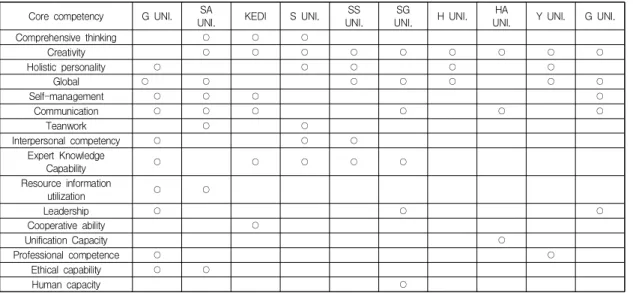
3.1.2 핵심역량에 관한 선행연구의 문헌고찰 고등교육에서 요구하는 핵심역량에 대한 문헌고찰을 살펴보면 Table 3과 같다. 고등교육에서 요구하는 대학 생 핵심역량은 초중등단계에서 심화된 핵심역량과 직업 기초능력이 포함되어 설정되었으며, 호주 시드니 대학은 학문적 수월성, 세계시민, 평생학습을, 퀸즈랜드 대학은 지식, 의사소통능력, 창의력, 비판적 판단능력, 윤리적사 회적 책임감[16]을, 뉴질랜드는 자기관리, 타인과 관계형 성, 참여 및 공헌, 사고하기, 언어, 상징, 텍스트 활용[17]
을 핵심역량으로 설정하였다.
한국교육개발원 전공지식, 사고력, 의사소통능력, 자 기주도 학습능력, 리더십, 문제해결력, 협동능력을 고등 교육의 핵심역량으로 설정하였으며[10], S대학교는 전공 지식, 논리적 사고력, 학습능력, 창의성, 리더십, 대인관계 능력, 가치관 및 태도를, 성균관대학교는 리더, 인문, 창 의, 학문, 소통, 글로벌을, SG대학교는 재성, 인성, 영성을
[18], [19]의 대학생 핵심역량연구에서는 자기주도학습력, 인성 및 사회적응력, 조직혁신능력, 지식창출능력, 글로 벌 문화개방성, 열정과 도전정신을 설정하였다.
3.1.3 직업기초능력에 관한 문헌고찰
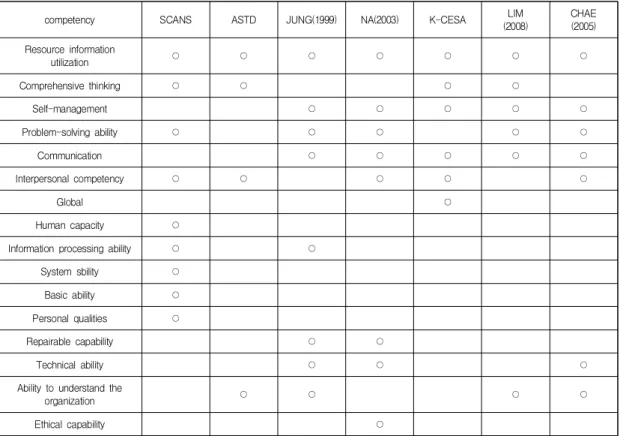
직업기초능력에 관한 문헌고찰 결과는 Table 4와 같다.
미국은 SCANS(Secretary’s Commission on Achieving Necessary Skills)의 직업기초능력으로 실제 현장에서 높 은 수준의 직무수행을 보이는 근로자 중심으로 조사한 결과 자원활용능력, 대인관계능력, 정보처리능력, 시스템 능력, 기술활용능력, 기초능력, 사고력, 개인적 자질 등 8 개의 직업기초능력을 제시하였다[20]. [21]연구에서는 직 업기초능력으로는 의사소통능력, 수리능력, 문제해결능 력, 자기관리 및 개발능력, 자원활용능력, 대인관계능력, 정보능력, 기술능력 조직이해능력, 직업윤리 등을 제시하 였다. [20]에서는 의사소통 역량, 자원정보기술의 활용역 량, 대인관계역량, 글로벌역량, 종합적사고력, 자기관리 역량을 설정하였으며, [22]의 연구에서 직업세계에서 요 구하는 역량으로는 의사소통역량, 자원․정보․기술의 활용 역량, 문제해결력, 맥락과 환경에 대한 이해능력, 종 합적사고력, 자기관리역량을 제시하였다.
이상의 문헌고찰을 통해 핵심역량의 개념은 OECD의 개념 정의와 유사한 일반적이고 포괄적인 역량으로 간주 하고 있으며, 지적능력, 인성, 기술 등을 포괄하는 다차원 적 개념으로 향후 직업세계를 포함한 미래의 삶에 성공 적으로 대처하기 위해 필수적으로 요청되는 능력으로 정
Core competency G UNI. SA
UNI. KEDI S UNI. SS
UNI.
SG
UNI. H UNI. HA
UNI. Y UNI. G UNI.
Comprehensive thinking ○ ○ ○
Creativity ○ ○ ○ ○ ○ ○ ○ ○ ○
Holistic personality ○ ○ ○ ○ ○
Global ○ ○ ○ ○ ○ ○ ○
Self-management ○ ○ ○ ○
Communication ○ ○ ○ ○ ○ ○
Teanwork ○ ○
Interpersonal competency ○ ○ ○
Expert Knowledge
Capability ○ ○ ○ ○ ○
Resource information
utilization ○ ○
Leadership ○ ○ ○
Cooperative ability ○
Unification Capacity ○
Professional competence ○ ○
Ethical capability ○ ○
Human capacity ○
Table 3. Core Competency literature review
의하고 있다. 대학생 핵심역량 속성으로는 초중등교육단 계에서 습득된 기초 소양의 심화 및 발전과 미래직업세 계에 진입하기 위해 필요한 직업기초능력을 포함하여, 학과의 특성에 제한되지 않는 일반적 공통적 역량, 인성 적 태도와 성향의 인성적 역량, 분석적 사고와 문제해결 력 등의 인지적 역량, 리더십과 대인관계 등의 사회적 역 량을 요구하고 있다. 또한 전공분야에 대한 지식과 성취, 글로벌 역량, 창의적 역량을 강조하고 있으며, 대학의 인 재상과 건학이념 등을 강조하고 있다. 직업기초능력으로 외국어 능력과 다문화이해 등 글로벌 역량과 정보자원활 용, 종합적 사고, 자기관리, 문제해결, 의사소통 역량으로 강조하고 있다. 이상의 문헌고찰을 통해 창의력, 문제해 결능력, 전문지식 보유능력, 정보처리능력, 기술활용능 력, 외국어 능력, 자기주도능력, 자기관리능력, 배려, 섬김 인성, 글로벌역량, 사회봉사, 의사소통능력, 대인관계능 력, 리더십의 총 14개의 역량을 도출하였다.
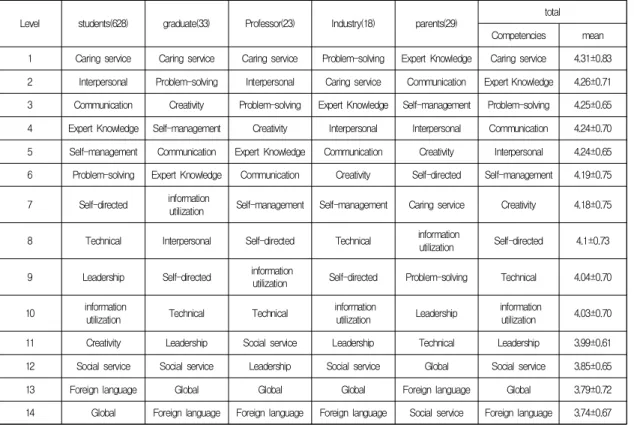
3.2 대상자별 핵심역량의 중요도 조사 결과 대학생 핵심역량 설정을 위해 문헌고찰을 통해 설정
된 14개의 역량을 리커트 5점 척도로 학생, 교수, 졸업생, 산업체, 학부모 대상으로 중요도에 대하여 수요조사를 실시한 결과는 Table 5와 Table 6과 같다.
characteristic category frequency Percentage(%)
sex male 212 33.8
female 416 66.2
grade
grade 1 225 35.0
grade 2 17 27.5
grade 3 156 24.8
grade 4 74 11.8
Table 5-1. General characteristics(students) N=628
characteristic category frequency Percentage (%)
sex male 12 36.4
Table 5-2. General characteristics(graduated) N=33
competency SCANS ASTD JUNG(1999) NA(2003) K-CESA LIM
(2008)
CHAE (2005) Resource information
utilization ○ ○ ○ ○ ○ ○ ○
Comprehensive thinking ○ ○ ○ ○
Self-management ○ ○ ○ ○ ○
Problem-solving ability ○ ○ ○ ○ ○
Communication ○ ○ ○ ○ ○
Interpersonal competency ○ ○ ○ ○ ○
Global ○
Human capacity ○
Information processing ability ○ ○
System sbility ○
Basic ability ○
Personal qualities ○
Repairable capability ○ ○
Technical ability ○ ○ ○
Ability to understand the
organization ○ ○ ○ ○
Ethical capability ○
Table 4. Basic skills literature review
characteristic category frequency Percentage(%)
sex
male 19 82.6
female 4 17.4
position
assistant 6 26.1
associate 11 47.8
professor 5 21.7
etc 1 4.3
Table 5-3. General characteristics(Professor) N=23
characteristic category frequency Percentage(%)
sex male 21 72.4
female 8 27.6
grade
grade 1 10 34.5
grade 2 9 31.0
grade 3 6 20.7
grade 4 4 13.8
Table 5-5. General characteristics(parents) N=29
재학생, 졸업생, 교수 대상으로 중요성을 살펴본 결과 배려와 섬김, 대인관계 역량이 가장 높게 나타났으며, 산 업체 대상으로는 문제해결과 배려와 섬김, 학부모는 전 문지식과 의사소통에 대한 중요도가 높게 나타났다. 반 면 재학생, 졸업생, 교수, 산업체에서 가장 중요도가 낮게 나타난 역량은 외국어와 글로벌 역량이였으며, 학부모는 외국어와 사회봉사역량이 가장 낮게 나타났다.
3.3 전문가 인터뷰 및 타당도 조사 결과
문헌고찰을 통해 잠정적으로 설정된 핵심역량을 심리 측정 전문가, 교육과정 교수, 핵심역량 교육 교수 등 대학 교육의 전문가 10명을 대상으로 KEY맨 인터뷰, 핵심역 량 설정의 타당도를 확인한 결과는 Table 7과 같다. 문제 해결과 전문지식에 대한 타당도가 가장 높게 나타났으며, 정보처리, 외국어, 의사소통역량이 가장 낮게 나타났다.
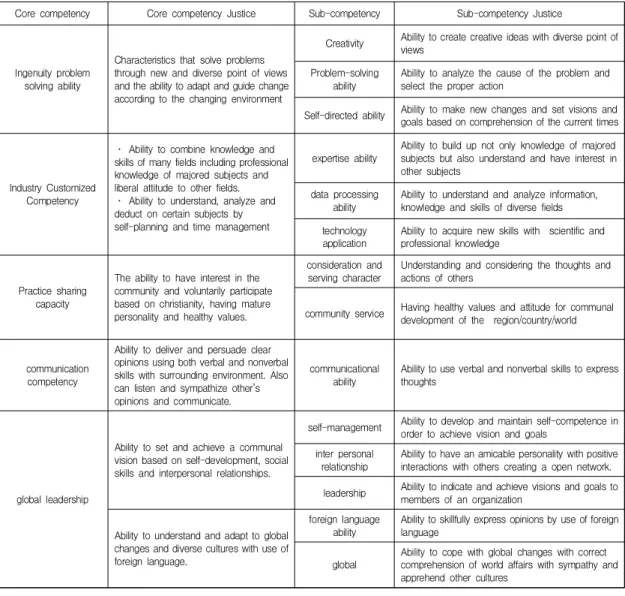
문헌고찰을 통한 대학생 핵심역량을 대상자별 중요도 조 사와 전문가 타당도 분석 결과 창의력, 문제해결능력, 자 기주도능력의 종합적 문제해결역량, 전문지식보유능력,
female 21 63.6
graduates year
~1999년 5 15.1
2000~ 2016 28 84.9
Agency
major 1 3.0
public 2 6.0
small bus. 1 3.0
education 25 75.8
small bus. 1 3.0
hospital 3 9.1
career
under 1 12 36.4
1~2y 9 27.3
2~3 3 9.1
3~5 3 9.1
5~10 4 12.1
more than 10 2 6.1
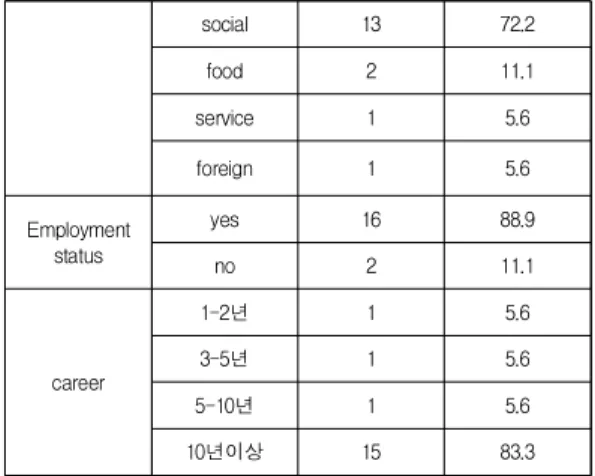
characteristic category frequency Percentage (%)
Agency
major 1 5.6
public 1 5.6
education 1 5.6
small bus. 1 5.6
hospital 11 61.1
personal 2 11.1
social 1 5.6
Sectors education 1 5.6
Table 5-4. General characteristics(Industry) N=18
social 13 72.2
food 2 11.1
service 1 5.6
foreign 1 5.6
Employment status
yes 16 88.9
no 2 11.1
career
1-2년 1 5.6
3-5년 1 5.6
5-10년 1 5.6
10년이상 15 83.3
정보처리능력, 기술활용능력의 산업체맞춤전문역량, 배 려․섬김인성, 사회봉사의 실천․나눔역량, 의사소통능 력의 의사소통역량, 자기관리능력, 대인관계능력, 리더
십, 외국어 능력, 글로벌 역량의 글로컬 리더십의 최종 5 대 핵심역량과 세부 14개 하위 역량이 설정되었으며, 이 는 Table 8과 같다.
Level students(628) graduate(33) Professor(23) Industry(18) parents(29)
total Competencies mean 1 Caring service Caring service Caring service Problem-solving Expert Knowledge Caring service 4.31±0.83 2 Interpersonal Problem-solving Interpersonal Caring service Communication Expert Knowledge 4.26±0.71 3 Communication Creativity Problem-solving Expert Knowledge Self-management Problem-solving 4.25±0.65 4 Expert Knowledge Self-management Creativity Interpersonal Interpersonal Communication 4.24±0.70 5 Self-management Communication Expert Knowledge Communication Creativity Interpersonal 4.24±0.65 6 Problem-solving Expert Knowledge Communication Creativity Self-directed Self-management 4.19±0.75
7 Self-directed information
utilization Self-management Self-management Caring service Creativity 4.18±0.75
8 Technical Interpersonal Self-directed Technical information
utilization Self-directed 4.1±0.73
9 Leadership Self-directed information
utilization Self-directed Problem-solving Technical 4.04±0.70
10 information
utilization Technical Technical information
utilization Leadership information
utilization 4.03±0.70
11 Creativity Leadership Social service Leadership Technical Leadership 3.99±0.61
12 Social service Social service Leadership Social service Global Social service 3.85±0.65
13 Foreign language Global Global Global Foreign language Global 3.79±0.72
14 Global Foreign language Foreign language Foreign language Social service Foreign language 3.74±0.67
Table 6. Core competency importanceSubject Creati
v ity
Proble m-sol ving
Expert Knowle dge
infor ma tion
Techni cal
Foreig n langua
ge
Self-di rected
Self-m anage ment
Caring servic e
Global Social servic e
Comm unicati on
Interpe rsonal
Leader ship
1 O O
2 O O O O O O
3 O O O O
4 O O O O O O O O
5 O O O
6 O O O O O
7 O O O O O O
8 O O O O O O O O O
9 O O O O O
10 O O O O O
total 5 6 6 2 5 2 4 2 3 4 3 2 3 6
Table 7. Expert Interview and Validity
4. 결론 및 제언
본 연구는 대학생 핵심역량을 기초하여 학생들에게 다양한 교육기회를 제공하고 대학생활에서 목표된 역량 을 성취할 수 있는 교육체제 마련과 산업변화에 따른 산 업인력 수요에 적합한 대학인력 양성이 가능하도록 대학 생의 핵심역량을 설정하고자 시도되었다. 연구절차는 핵 심역량에 대한 문헌고찰과 학생, 교수, 산업체, 학부모 대 상의 핵심역량의 중요도에 대한 조사 및 전문가의 타당 도를 통해 대학생 핵심역량을 설정하였다.
첫째, 문헌고찰을 통해 창의력, 문제해결능력, 전문지 식 보유능력, 정보처리능력, 기술활용능력, 외국어 능력,
자기주도능력, 자기관리능력, 배려, 섬김·인성, 글로벌역 량, 사회봉사, 의사소통능력, 대인관계능력, 리더십의 총 14개의 역량을 도출하였다.
둘째, 재학생, 졸업생, 교수 대상으로 중요성을 살펴본 결과 배려와 섬김, 대인관계 역량이 가장 높게 나타났으 며, 산업체 대상으로는 문제해결과 배려와 섬김, 학부모 는 전문지식과 의사소통에 대한 중요도가 높게 나타났다.
반면 재학생, 졸업생, 교수, 산업체에서 가장 중요도가 낮 게 나타난 역량은 외국어와 글로벌 역량이였으며, 학부 모는 외국어와 사회봉사역량이 가장 낮게 나타났다.
셋째, 전문가타당도를 분석한 결과 문제해결과 전문지 식에 대한 타당도가 가장 높게 나타났으며, 정보처리, 외
Core competency Core competency Justice Sub-competency Sub-competency Justice
Ingenuity problem solving ability
Characteristics that solve problems through new and diverse point of views and the ability to adapt and guide change according to the changing environment
Creativity Ability to create creative ideas with diverse point of views
Problem-solving ability
Ability to analyze the cause of the problem and select the proper action
Self-directed ability Ability to make new changes and set visions and goals based on comprehension of the current times
Industry Customized Competency
․ Ability to combine knowledge and skills of many fields including professional knowledge of majored subjects and liberal attitude to other fields.
․ Ability to understand, analyze and deduct on certain subjects by self-planning and time management
expertise ability
Ability to build up not only knowledge of majored subjects but also understand and have interest in other subjects
data processing ability
Ability to understand and analyze information, knowledge and skills of diverse fields technology
application
Ability to acquire new skills with scientific and professional knowledge
Practice sharing capacity
The ability to have interest in the community and voluntarily participate based on christianity, having mature personality and healthy values.
consideration and serving character
Understanding and considering the thoughts and actions of others
community service Having healthy values and attitude for communal development of the region/country/world
communication competency
Ability to deliver and persuade clear opinions using both verbal and nonverbal skills with surrounding environment. Also can listen and sympathize other’s opinions and communicate.
communicational ability
Ability to use verbal and nonverbal skills to express thoughts
global leadership
Ability to set and achieve a communal vision based on self-development, social skills and interpersonal relationships.
self-management Ability to develop and maintain self-competence in order to achieve vision and goals
inter personal relationship
Ability to have an amicable personality with positive interactions with others creating a open network.
leadership Ability to indicate and achieve visions and goals to members of an organization
Ability to understand and adapt to global changes and diverse cultures with use of foreign language.
foreign language ability
Ability to skillfully express opinions by use of foreign language
global
Ability to cope with global changes with correct comprehension of world affairs with sympathy and apprehend other cultures
Table 8. College students Core competency
국어, 의사소통역량이 가장 낮게 나타났다.
이상의 연구절차를 통해 창의력, 문제해결능력, 자기 주도능력의 종합적 문제해결역량, 전문지식보유능력, 정 보처리능력, 기술활용능력의 산업체맞춤전문역량, 배려·
섬김인성, 사회봉사의 실천․나눔역량, 의사소통능력의 의사소통역량, 자기관리능력, 대인관계능력, 리더십, 외 국어 능력, 글로벌 역량의 글로컬 리더십의 최종 5대 핵 심역량과 세부 14개 하위 역량이 설정되었다.
본 연구 결과를 토대로 다음과 같이 제언하고자 한다.
첫째, 설정된 대학생핵심역량을 진단 할 수 있는 진단 평가 도구 개발의 연구가 필요하다.
둘째, 설정된 대학생 핵심역량을 기반으로 한 교육과 정 개발과 효과에 대한 연구가 필요하다.
셋째, 설정된 대학생 핵심역량을 기반으로 산업체 및 진로관련 성과에 대한 연구가 필요하다.
REFERENCES
[1] Y. D. Cho. & J. G. KIm. (2017). The Age of Fourth Industrial Revolution: Challenges and Orientations of Citizenship Education.
Theory and Research in Citizenship Education, 49(4), 219-239.
[2] M. K. Jeong. (2010). A study on the relationship among
Core Competency of University st udents, Campus Life Adjustment and Car eer Attitude Maturity, Psychology
Major Graduate School, Yeungnam University, Deagu.[3] Seoul National University(2013). New year address 2013.
http://www.snu.ac.kr/president/speeches?bm=v&bbsidx
=116477
[4] J. D. Seo. (2010). Five Things to Open Future
Universities. University education, 163.
[5] DEST(2002). Striving for quality: Learning, teaching
and scholarship. Australia Department of Education,
Science and Training.[6] S. T. Kim. (2009). A Study on the Performance Evaluation System for Key Competencies of University Students. korean public administration quarterly 21(2), 599-626.
[7] p. McLagan, (1996). Great ideas revisited: Job competency models. Training & Deve, 50(1), 60-65.
[8] M. S. Jin. (2013). An exploratory study on inequality of core competence of college students in Korea, Korean
journal of sociology of education. 24(1), 105-127.
[9] Korean Educational development Institute(2011).
Education strategy to foster creative talent for the 21st century. Research report of Korean Educational
development Institute. RR2011-01.
[10] A. H. Lee & M. S. Choi. (2014). Analysis of the Research Trend on the College Students` Key Competencies and Diagnosis Tools. The Korea Society for Educational
Technology, 20(4), 561-588.
[11] Korean Educational development Institute(2002).
(The)research on the national standards of life skill and quality management for learning system. Research
report of Korean Educational development Institute.
RR2002-19. 243-257.
[12] E. J. Kim & M. H. Seong. (2016). Influence of Personality Development of College Students on Core Competences -Focusing on Humanistic, Global, Creative Convergence, Service and Devotion, Communication and Cooperation Competences. Journal of Ethics Education
Studies, 40, 133-156.
[13] S. A. Kwon. (2009). Admission officer's present
situation and perception of admission officer system.
Dep of Education, Ewha Womans Univisity. Seoul.
[14] M. S. Jung. (2014). A Structural Equation Model on
Core Competencies of Nursing Students, Dept. of
Nursing The Graduate School of Chung-Ang University., Seoul.[15] Korea Democracy Foundation(2005). DeSeCo Project :
Core Competency Definition and Selection Project Summary: OECD.
[16] M. J. Park. (2008). A New Approach to Curriculum Development in Higher Education: Competence-based Curriculum, The Journal of Curriculum Studies, 26(4), 173-197.
[17] Korea Institute for Curriculum and Evaluation(2008).
The Core Competency needs in the Professional World.
Research report of Korea Institute for Curriculum and Evaluation, ORM. 2008-14.
[18] So Gang University(2013). 2013 annual report.
[19] S. M. Park. (2011). Analysis of Core Competencies as An Element of Vocational Ability, Korean society for the
study of vocational education, 30(3). 327-351.
[20] Korea Research Institute for Vocational Education &
Training(1999). Analysis of the national core curriculum on key competencies needed for the workforce. Research
report of Korea Research Institute for Vocational Education & Training, 7-199.
[21] S. L. Na, S. M. Jang, W. S. Seo, J. M. Kim, S. Lee, G.
Y. Kim & S .T. Jeong(2003). Basic skills required for industrial workers. Korean Journal of Agricultural
Education, 36(4), 139-158.
[22] Korea Institute for Curriculum and Evaluation(2008). A Study on the Vision of Elementary and Secondary Education Curriculum to Promote Core Competencies of Future Koreans(2). Research report of Korea Institute
for Curriculum and Evaluation, RR 2008-7-1
김 창 규(Chang-Gyu Kim) [정회원]
▪1994년 8월 : 충남대학교 대학원 (석사)
▪2003년 8월 : 한남대학교 대학원 물리학과 (이학박사)
▪2001년 3월 ∼ 현재 : 김천대학교 방사선학과 교수
▪2016년 11월 ∼ 현재 : 김천대학교 에너지기술융합 연 구소장
▪관심분야 : 의료융합교육, 의료융합영상, 에너지융합기술
▪E-Mail : [email protected]
장 기 덕(Kee-Duck Jang) [정회원]
▪2006년 2월 : 계명대학교 교육대학 원(교육상담석사)
▪2011년 2월 : 계명대학교 일반대학 원 교육학과(교육상담박사)
▪2012년 8월 ∼ 2016년 2월(이전):
영진전문대학 유아교육과 교수
▪2016년 3월 ∼ 현재 : 김천대학교 유아교육과 교수
▪관심분야 : 상담, 아동보육, 브레인짐
▪E-Mail : [email protected]
전 열 어(Yeol-Eo Chun) [정회원]
▪2006년 2월 : 이화여자대학교 일반 대학원 간호학과 (간호학석사)
▪2010년 2월 : 이화여자대학교 일반 대학원 간호학과 (간호학박사)
▪2013년 3월 ∼ 현재 : 김천대학교 간호학과 교수
▪관심분야 간호행정, IT 공학, 임상실습
▪E-Mail : [email protected]