Antimicrobial and Antifungal Activities of Lisianthus (Eustoma grandiflorum) Essential Oil
Keunho Ji, Dong Kwang Kim and Young Tae Kim*
Department of Microbiology, Pukyong National University, Busan 48513, Korea
Received February 17, 2017 /Revised March 20, 2017 /Accepted March 27, 2017
Essential oils are fragrant oils extracted from the leaves, stems, peels, petals and roots of aromatic plants cultivated by natural means or using organic agricultural techniques. Essential oils have com- monly been used as antibacterial and antifungal agents. In the present study, essential oil was ex- tracted from lisianthus (Eustoma grandiflorum [Raf.] Shinn.) and tested for antifungal activities against three eumycetes (Penicillium pinophilum, Chaetomium glogosum and Aspergillus niger). Lisianthus essen- tial oil showed high antifungal activities against three eumycetes, especially against Aspergillus niger, for which the resulting minimum inhibitory concentration (MIC) was 0.005 mg/ml. In addition, the extracted essential oil was shown to have antimicrobial activity against ten intestinal pathogenic bac- teria (Escherichia coli, Salmonella typhimurium, Klebsiella pneumonia, Staphylococcus aureus, Bacillus cereus, Listeria monocytogenes, Pseudomonas aeruginosa, Bacillus subtilis, Enterococcus faecalis and Vibrio para- haemolyticus) according to the disc diffusion method and was also shown to exhibit strong antibacterial activity against an additional three pathogenic bacteria (Bacillus subtilis, Listeria monocytogenes and Vibrio parahaemolyticus). These results indicate that lisianthus essential oil could be used as an anti- biotic against harmful bacteria that produce intestinal illnesses. From the present study, we suggest that lisianthus extracts can be utilized as potential antifungal and antibacterial agents and for the de- velopment of pharmaceutical and cosmetic products.
Key words : Antifungal, antimicrobial, essential oil, lisianthus
*Corresponding author
*Tel : +82-51-629-5616, Fax : +82-51-629-5619
*E-mail : [email protected]
This is an Open-Access article distributed under the terms of the Creative Commons Attribution Non-Commercial License (http://creativecommons.org/licenses/by-nc/3.0) which permits unrestricted non-commercial use, distribution, and reproduction in any medium, provided the original work is properly cited.
Journal of Life Science 2017 Vol. 27. No. 4. 430~434 DOI : https://doi.org/10.5352/JLS.2017.27.4.430
서 론
에센션 오일은 방향성 식물의 잎, 줄기, 꽃, 뿌리 등 다양한 부분에서 생산되는 천연 유기물질로써 항균, 항진균 등의 효 과를 갖고 있는 것으로 알려져 있다[7]. 따라서 식물 유래 에센 셜 오일을 이용한 화장품 및 향장품으로써의 사용이 증가하고 있는 추세이며, 최근에는 의약품 제제로써의 사용 가능성에 대한 연구가 활발히 진행되고 있다. 과거 수년간 에센셜 오일 의 생물학적 활성에 관한 연구가 수행되어 왔으며[2, 3, 16], 항미생물 제제 연구 및 항진균 제제로의 활용에 관한 연구도 수행되었다[1, 15]. 현재 항진균제의 사용에 따른 부작용을 줄 이기 위해서 새로운 항진균 활성 물질을 다양한 생물자원으로 부터 탐색하고 있으며 에센셜 오일을 이용한 항진균 물질 탐 색에 관한 연구가 활발히 진행되고 있으나 리시안셔스 추출물 을 이용한 연구는 진행된 바가 없다[18, 19]. 항진균성 물질은 대체 농약 개발을 위해 연구가 진행되기 시작하였으며[9, 12,
22], 다수의 항진균성 물질이 개발되었다[17, 21, 27]. 현재 연구 중인 항진균성 물질은 대부분 세균에 의해 생산되는 것이며 Bacillus subtilis, Pseudomonas 등에서 항진균 물질인 iturin, ba- cillomycin, mycosubtilin, pyroliniturin, pyoluteorin 등이 생 산되고 있다[5, 4, 10, 13, 14]. 리시안셔스는 미국의 중부 및 남부의 토착 식물로써 prairie gentian 또는 Texas bluebell로 도 알려져 있다[25]. 리시안셔스를 이용한 연구는 꽃잎의 색 향상, 꽃잎 색 변화 등 꽃 자체에 관한 연구가 많이 진행되었으 며, 추출물을 이용한 연구는 상대적으로 제한적이다[11, 23].
따라서 본 연구에서는 여름철에 쉽게 구할 수 있는 리시안셔 스로부터 에센셜 오일을 추출하고, 추출된 물질의 항진균 및 항균 활성을 연구하여 새로운 항진균제 및 항균제 개발에 대 한 기초 연구 자료를 제시하고자 한다.
재료 및 방법
사용 균주
항진균력의 평가를 위해 사용된 진균은 우리 생활 환경에
널리 분포하는 대표적인 3종의 진균(Penicillium pinophilum,
Chaetomium globosum, Aspergillus niger)을 사용하였다. 장내
유해 세균에 대한 항균력 평가를 위해 10종의 병원균(Escher-
ichia coli, Salmonella typhimurium, Klebsiella pneumonia, Staphy-
lococcus aureus, Bacillus cereus, Listeria monocytogenes, Pseudo-
Table 1. List of strains and growth conditions used for antifungal and antimicrobial activity test
Strain Growth conditions
Fungi
Penicillium pinophilum KCCM 60085 Chaetomium globosum KCCM 31212 Aspergillus niger KCCM 11239
Harrold’s M40Y, 24℃
Mineral Salts Agar, 24℃
Malt Extract Agar, 24℃
Gram Positive Bacteria
Bacillus cereus KCCM 11204 Bacillus subtilis KCCM 11779 Listeria monocytogenes KCCM 40307 Enterococcus faecalis KCCM 12448 Staphylococcus aureus KCCM 11593
Nutrient Agar (Difco), 30℃
Nutrient Agar (Difco), 30℃
Brain Heart Infusion Agar (Difco), 37℃
Brain Heart Infusion Agar (Difco), 37℃
Nutrient Agar (Difco), 37℃
Gram Negative
Bacteria
Klebsiella pneumonia KCCM 11418 Escherichia coli KCTC 1116
Salmonella typhimurium KCCM 40253 Pseudomonas aeruginosa KCCM 11266 Vibrio parahaemolyticus KCCM 11965
Nutrient Agar (Difco), 37℃
Nutrient Agar (Difco), 37℃
IFO Medium 802, 30℃
Nutrient Agar (Difco), 37℃
Nutrient Agar (Difco) + 3% NaCl, 37℃
monas aeruginosa, Bacillus subtilis, Enterococcus faecalis, Vibrio parahaemolyticus)을 사용하였다. 실험에 사용한 균주는 한국미 생물보존센터(KCCM)에서 분양 받아 사용하였다(Table 1).
균주 배양 및 배양 조건
진균은 Potato Dextrose Agar (PDA; Becton, Dickinson and Company, MD 21152 USA)에 streak후 37℃의 incubator 에서 48 hr 전배양한 후 사용하였다. 병원균의 배양은 Table 1에 요약한 내용과 같이 각 균주의 배양 최적 조건에 따라서 실험하였다. 항세균력 측정은 Muller Hilton broth (MH Broth; Becton, Dickinson and Company, MD 21152 USA)를 이용하였다.
에센셜 오일 추출
항진균 및 항세균 활성을 확인하기 위하여 솔벤트 추출법을 이용하여 꽃으로부터 에센셜 오일을 추출하였다. 무균 상태로 만들기 위해 멸균증류수 및 PBS를 이용하여 꽃잎을 세척하고, 동결 건조 후 분쇄하였다. 분쇄한 꽃잎 10 g에 500 ml의 에탄올 을 첨가한 후 가열하여 추출한 후 에탄올을 제거하여 에센셜 오일을 획득하였다. 이렇게 얻어진 에센셜 오일을 absolute라 고 한다. 추출된 리시안셔스 앱솔루트(Lisianthus absolute)를 회전감압농축기를 이용하여 70℃에서 추출물의 농도를 100 mg/ml이 되도록 농축한 후 실험에 사용하였다.
항진균력 측정
진균이 도말 된 배지에 농축된 100 mg/ml 농도의 추출물을 처리하여 꽃잎 추출물의 항진균 효과를 확인하였다. 억제능이 확인된 추출물의 농도별 억제 활성을 CLSI (Clinical and Laboratory Standards Institute)의 표준방법에 따라 disc dif- fusion method를 이용하여 측정하였다. 꽃잎 추출물의 초기 농도를 1 mg/ml로 처리한 후 사용하였으며, 추출물을 단계별
로 10진법으로 희석하여 억제능을 확인하였다.
항세균력 측정
꽃잎 추출물의 항균 효과를 알아보기 위해 10종의 병원균을 사용하였다. 각각의 병원균이 도말된 Muller Hilton Agar에 농도별 추출물이 처리된 paper disc를 사용하여 항균력을 확 인하였으며, 추출물 농도는 10 mg/ml, 1 mg/ml, 0.1 mg/ml 를 사용하였다.
리시안셔스 앱솔루트의 안정성
리시안셔스 추출물의 온도 및 pH 처리에 대한 안정성을 조사하였다. 온도에 대한 영향을 알아보기 위하여 100 mg/ml 농도의 리시안셔스 앱솔루트를 25℃, 37℃, 42℃, 70℃에서 30 분간 열처리한 후 활성을 측정하였다. pH에 대한 영향을 알아 보기 위하여 추출물을 5N HCl과 5N NaOH를 사용하여 pH 3.0~10.0으로 조정하여 25℃에서 2시간 동안 처리한 후 활성을 측정하였다. 각 실험의 대조군은 아무런 처리를 하지 않은 100 mg/ml 농도의 리시안셔스 앱솔루트를 사용하였으며 억제환 의 직경을 측정하여 비교하였다.
결과 및 고찰
리시안셔스 앱솔루트의 항진균 효과
리시안셔스 앱솔루트의 항진균 효과를 검증하기 위해 추출
물을 100 mg/ml 농도로 농축한 다음, 진균인 A. niger, P. pino-
philum, C. globosum에 처리한 결과, 이들 진균의 성장을 억제
하는 억제환이 확인되었다(Fig. 1). 또한 시험 진균에 대한 리
시안셔스 앱솔루트의 최소 억제 농도(MIC)는 3종 모두 0.005
mg/ml 농도로 나타났다(Table 2). 정 등의 연구에 따르면 죽
순대 정유의 경우 Candida species에 대해 2%의 MIC를 보였고
[20], 또한 지 등의 연구에 따르면 석류 껍질 추출물의 경우
A B
C
Fig. 1. Antifungal activities of Lisianthus absolute (1 mg/ml) against Chaetomium globosum (A), Aspergillus niger (B), and Penicillium pinophilum (C).
Table 2. MIC values of Lisianthus absolute Concentration
(mg/ml)
Chaetomium globosum
Aspergillus niger
Penicillium pinophilum 1
0.1 0.01 0.009 0.008 0.007 0.006 0.005 0.004
++
++
+ + + + w w -
++
++
+ + + + w w -
++
++
+ + + + w w - Activity was expressed as the diameter of inhibition zone. ++;
strong activity (above 15.0 mm), +; activity (5.0~10.0 mm), w;
weak activity (below 5.0 mm), -; no activity.
A B
C
Fig. 2. Antimicrobial activities of Lisianthus absolute (1 mg/ml) tested form Bacillus subtilis (A), Vibrio parahaemolytius (B), and Listeria monocytogenes (C).
Epidermophyton floccosum, Trichophyton mentagrophytes 와 Trichophyton rubrum에서 0.01 mg/ml 의 MIC 값을 나타낸다 고 보고되었다[6]. 리시안셔스의 경우 플라보노이드의 대사 조 절을 통한 화색 변경 실험 에는 사용된 적이 있지만[11] 항균 효과나 항진균 효과에 대한 연구는 보고된 바가 없다[26]. 따라 서 리시안셔스 추출물의 항진균 활성을 다른 종의 추출물의 항진균 활성 연구 결과와 비교해 보았을 때 비슷한 MIC농도 를 보여주고 있다. 따라서 리시안셔스 추출물의 진균의 성장 을 억제하는 항진균 활성을 이용하여 새로운 항진균 제제 개 발에 활용 될 수 있다고 사료된다.
리시안셔스 앱솔루트의 항세균 효과
10종의 장내 유해세균에 대한 추출물의 항균 효과를 확인한
결과 B. subtilis, V. parahaemolyticus, L. monocytogenes에 대해 항균 효과를 확인하였다(Fig. 2). 이들 균주에 대한 최소억제농 도를 확인하기 위하여 추출물을 10진법으로 희석하여 측정하 였다. 1 mg/ml 농도에서는 3종의 병원균 모두에서 억제능이 확인되었으나, 0.1 mg/ml 농도에서는 B. subtilis에서만 억제 능이 확인되었다. 또한, 항균 활성이 가장 강하게 나타나는 B. subtilis에 대한 최소 억제 농도(MIC)는 0.01 mg/ml로 나타 났다(Table 3). 박 등의 연구에 따르면 산벚나무 에탄올 추출물 이 E. coli와 B. subtilis에서는 항균활성을 나타내지 못하였으나 Propionibacterium acnes에서 4 mg/disc 농도로 처리했을 때 활 성을 나타냈다는 연구 결과가 있다[24]. 또한 진달래 꽃잎 추출 물이 Helicobacter pylori에 대해0.05 mg/ml 농도에서 활성을 나타낸다는 보고가 있다[8]. 본 연구에서 사용된 리시안셔스 앱솔루트의 경우, B. subtilis, V. parahaemolyticus, L. mono- cytogenes에 대해 항균 효과가 있음을 확인하였으며, 이는 리시 안셔스 추출물을 이용한 항균 활성에 관한 최초의 연구 결과 보고이다.
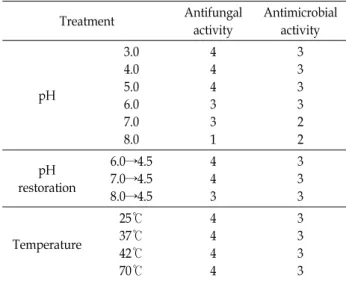
항진균 및 항세균 물질의 안정성
리시안셔스로부터 추출한 리시안셔스 앱솔루트의 온도에
대한 안정성 실험에서 25℃, 37℃, 42℃, 70℃에서 30분간 열처
리한 후에도 활성을 유지하여 온도에 안정한 물질임을 알 수
있다. 또한 pH의 영향을 조사한 결과, pH 3.0~5.0 구간에서는
활성을 유지하였다. 그리고 pH가 높아질수록 활성이 떨어지
는 경향을 보였으나 활성을 가지는 pH 범위로 복원시킬 경우
활성을 회복하였다(Table 4). 따라서 리시안셔스로부터 추출
한 리시안셔스 앱솔루트의 pH 및 온도에 대한 안정성이 검증
Table 3. Antimicrobial activities of Lisianthus absolute
Bacterial strains 10 mg/ml 1 mg/ml 0.1 mg/ml 0.01 mg/ml 0.001 mg/ml
Escherichia coli Salmonella typhimurium Klebsiella pneumonia Staphylococcus aureus Bacillus cereus Listeria monocytogenes Pseudomonas aeruginosa Bacillus subtilis Enterococcus faecalis Vibrio parahaemolyticus
- - - - - + - + - +
- - - - - + - + - +
- - - - - - - + - -
- - - - - - - + - -
- - - - - - - - - - Note. +; activity, -; no activity.
Table 4. Effects of pH, temperature, and enzyme treatment on the activities of Lisianthus absolute
Treatment Antifungal
activity
Antimicrobial activity
pH
3.0 4.0 5.0 6.0 7.0 8.0
4 4 4 3 3 1
3 3 3 3 2 2 pH
restoration
6.0→4.5 7.0→4.5 8.0→4.5
4 4 3
3 3 3
Temperature
25℃
37℃
42℃
70℃
4 4 4 4
3 3 3 3
되었고, P. pinophilum, C. globosum, A. niger에 대한 항진균력 을 가짐과 동시에 B. subtilis, L. monocytogenes, V. paragaemoly- ticus의 성장을 억제하므로 균류 및 세균 유래의 식중독 예방에 효과가 있는 생물학적 항균제 개발에 응용될 수 있다고 사료 된다.
감사의 글
이 논문은 부경대학교 자율창의연구비(2015)에 의하여 연 구되었음.
References
1. Apisariyakul, A., Vanittanakom, N. and Buddhasukh, D.
1995. Antifungal activity of turmeric oil extracted from Curcuma longa (Zingiberaceae). J. Ethnopharmacol. 49, 163- 169.
2. Baratta, M. T., Dorman, H., Deans, S. G., Figueiredo, A. C.,
Barroso, J. G. and Ruberto, G. 1998. Antimicrobial and anti- oxidant properties of some commercial essential oils. Flav.
Fragr. J. 13, 235-244.
3. Beesley, A., Hardcastle, J., Hardcastle, P. and Taylor, C.
1996. Influence of peppermint oil on absorptive and secre- tory processes in rat small intestine. Gut 39, 214-219.
4. Besson, F., Hourdou, M. L. and Michel, G. 1990. Studies on the biosynthesis of iturin, an antibiotic of Bacillus subtilis, and alipopeptide containing β-hydroxy fatty acids. Biochim.
Biophys. Acta 1036, 101-106.
5. Besson, F. and Michel, G. 1989. Mycosubtilins B and C: mi- nor antibiotics from mycosubtilin-producer Bacillus subtilis.
Microbios 62, 93-99.
6. Chee, H. Y., Kim, H. and Lee, M. H. 2009. In vitro antifungal activity of limonene against Trichophyton rubrum. Mycobiology 37, 243-246.
7. Chee, H. Y. and Lee, E. H. 2004. Antifungal activity and inhibitory modes of volatile vapours of essential oils.
Mycobiology 32, 102-104.
8. Cho, Y. J., Ju, I. S., Chun, S. S., An, B. J., Kim, J. H., Kim, M. U. and Kwon, O. J. 2008. Screening of biological activities of extracts from Rhododendron mucronulatum Turcz. flowers.
J. Kor. Soc. Food Sci. Nutr. 37, 276-281.
9. Cook, R. J. 1985. Biological control of plant pathogens: theo- ry to application. Phytopathology 75, 25-29.
10. Corbell, N. and Loper, J. 1995. A global regulator of secon- dary metabolite production in Pseudomonas fluorescens Pf-5.
J. Bacteriol. 177, 6230-6236.
11. Davies, K. M., Bradley, J. M., Schwinn, K. E., Markham, K.
R. and Podivinsky, E. 1993. Flavonoid biosynthesis in flower petals of five lines of lisianthus (Eustoma grandiflorum Grise.). Plant Sci. 95, 67-77.
12. Davison, J. 1988. Plant beneficial bacteria. Nature Biotechnol.
6, 282-286.
13. Duffy, B. K. and Défago, G. 1999. Environmental factors modulating antibiotic and siderophore biosynthesis by Pseudomonas fluorescens biocontrol strains. Appl. Environ.
Microbiol. 65, 2429-2438.
14. Eshita, S. M., Roberto, N. H., Beale, J. M., Mamiya, B. M.
and Workman, R. F. 1995. Bacillomycin Lc, a new antibiotic of the iturin group: isolation, structures, and antifungal ac-
초록:리시안셔스 유래 에센셜 오일의 항세균 및 항진균 효과
지근호․김동광․김영태*
(부경대학교 미생물학과)
에센셜 오일은 자연에서 성장하거나 유기농법으로 재배된 방향성 식물의 잎, 줄기, 껍질, 꽃잎, 뿌리 등에서 추 출한 방향유를 말하며, 천연 물질로써 항균, 항진균 등의 효과를 가진다. 본 연구에서는 리시안셔스(Eustoma gran- diflorum (Raf.) Shinn.)를 이용하여 에센셜 오일을 추출하여 생활 속에 흔하게 존재하는 3종의 진균 Penicillium pi- nophilum, Chaetomium globosum, Aspergillus niger에 대한 항진균 활성을 측정하였다. 리시안셔스에서 추출한 에센 셜 오일은 항진균 활성을 나타냈으며 특히, A. niger에 대해 높은 항진균 활성을 보였으며, 최소 억제 농도(MIC)의 결과는 A. niger에서 0.005 mg/ml로 나타났다. 추출된 에센셜 오일은 대표적인 10종의 병원균(Escherichia coli, Salmonella typhimurium, Klebsiella pneumonia, Staphylococcus aureus, Bacillus cereus, Listeria monocytogenes, Pseudomonas aeruginosa, Bacillus subtilis, Enterococcus faecalis, Vibrio paragaemolyticus)에 대한 항세균 효과를 측정 하였으며, 디스크 확산법을 이용하여 측정하였다. 리시안셔스에서 추출한 에센셜 오일은 병원균 B. subtilis, L.
monocytogenes, V. paragaemolyticus에서 강력한 항균 작용을 나타내었다. 이러한 결과는 리시안셔스에서 추출한 에 센셜 오일이 장내 병원균에 대한 항생제로 사용 가능함을 나타내고 있다. 본 연구를 통해 리시안셔스 추출물이 의약품 및 화장품을 개발하는데 있어 잠재적인 항진균제 및 항세균제로 사용될 수 있을 것으로 사료된다.
tivities of the congeners. J. Antibiotics 48, 1240-1247.
15. Filipowicz, N., Kamiński, M., Kurlenda, J., Asztemborska, M. and Ochocka, J. R. 2003. Antibacterial and antifungal ac- tivity of juniper berry oil and its selected components.
Phytotherapy Res. 17, 227-231.
16. Hayashi, K., Kamiya, M. and Hayashi, T. 1995. Virucidal effects of the steam distillate from Houttuynia cordata and its components on HSV-1, influenza virus, and HIV. Planta Medica. 61, 237-241.
17. Hotta, K., Ogata, T., Ishikawa, J., Okanishi, M., Mizuno, S., Morioka, M. and Okami, Y. 1996. Mechanismm of multiple aminoglycoside resistance of kasugamycin-producing Streptomyces kasugaensis MB273: involvement of two types of acetyltransferases in resistance to astromicin group antibiotics. J. Antibiotics 49, 682-688.
18. Jain, P. and Agrawal, S. 1978. Notes on the activity of some odoriferous organic compounds against some keratinophilic fungi. Trans. Br. Mycol. Soc. 19, 197.
19. Jain, S. and Agrawal, S. 2002. Fungistatic activity of some perfumes against otomycotic pathogens. Mycoses 45, 88-90.
20. Jung, S. W. 2012. Antifungal effect of Bamboo (Phyllostachys pubescens) essential oil on Candida species. Graduate School.
Inje University.
21. Kuhnt, M., Bitsch, F., Ponelle, M., Sanglier, J. J., Wang, Y.
and Wolff, B. 1998. Microbial conversion products of lep- tomycin B. Appl. Environ. Microbiol. 64, 714-720.
22. Larsen, S. H., Berry, D. M., Paschal, J. W. and Gilliam, J.
M. 1989. 5-Hydroxymethylblasticidin S and blasticidin S from Streptomyces setonii culture A83094. J. Antibiotics 42, 470-471.
23. Markham, K. R. and Ofman, D. J. 1993. Lisianthus flavonoid pigments and factors influencing their expression in flower colour. Phytochemisty 34, 679-685.
24. Park, J. M., Lee, J. Y., Park, T. S., Hyun, S. J., Kim, H. H., Cho, Y. J. and An, B. J. 2008. A study on the cosmeceutical activities of Prunus Sargentii R. J. Kor. Soc. Appl. Biol. Chem.
51, 70-78.
25. Shinners, L. H. 1957. Synopsis of the genus Eustoma (Gentia- naceae). Southwest. Nat. 2, 38-43.
26. Tomas-Barberan, F. A., Maillard, M. and Hostettmann, K.
1988. Antifungal flavonoids from the leaf surfaces of Helichrysum nitens and from the stem bark of Erythrina berteroana. Prog. Clin. Biol. Res. 280, 61.
27. Uramoto, M., Kim, C. J., Shin-Ya, K., Kusakabe, H., Isono, K., Phillips, D. R. and Mccloskey, J. A. 1991. Isolation and characterization of phosmidosine a new antifungal nucleo- tide antibiotic. J. Antibiotics 44, 375-381.