12주 규칙적인 유산소 트레이닝이 제 2형 당뇨(T2DM) 환자의 간 효소(Hepatic enzyme)에 미치는 영향
김영일․곽이섭1*
연세대학교 체육교육과, 1동의대학교 체육학과
Received March 12, 2009 /Accepted June 13, 2009
Effects of 12 Weeks Regular Aerobic Training on Hepatic Enzyme in Type 2 Diabetes Mellitus (T2DM) patients. Young-Il Kim and Yi-Sub Kwak
1*. Department of Physical Education, Yonsei University, Seoul, 120-749 Korea,
1Department of Physical Education, Dong-Eui University, Busan, 614-714 Korea - The purpose of the this study was to examine the effects of 12 weeks of regular aerobic exercise training on hepatic enzymes in type 2 diabetes mellitus (T2DM) patients. The subjects consisted of 13 mid- dle-aged male type 2 diabetes mellitus (T2DM) patients, all of whom had no other complications.
Subjects participated in regular aerobic exercise training for 12 weeks, in which they started to ex- ercise for 20~60 min, at 60~80% HR
max(exercise intensity was increased gradually), per day, 3~5 times a weeks. The results after 12 weeks were compared to baseline values. Weight and BMI, % body fat, and fasting glucose significantly decreased, and
peakVO
2, exercise time (ET) significantly increased after 12 weeks of aerobic exercise training. On the other hand, there were no significant differences in hepatic enzymes of Albumin, Total bilirubin, Alkaline phosphatate, AST, and ALT after training compared to baseline values. Conclusively, 12 weeks of aerobic exercise training may result in a de- crease of insulin resistance factors (Weight, BMI, % body fat, fasting glucose) and an increase of aero- bic capacity, but hepatic enzymes did not significantly decrease in middle age T2DM patients.
Key words : Type 2 diabetes mellitus (T2DM), hepatic enzyme (HE), exercise time (ET)
*Corresponding author
*Tel:+82-51-890-1546, Fax:+82-51-890-2157
*E-mail : [email protected]
서 론
대표적인 대사성 질환인 당뇨는 2025년에는 전 세계적으로 약 3억명 이상에 다다를 것이며 그 중 85%를 제 2형 당뇨(type 2 diabetes mellitus, T2DM)가 차지할 것이며[9], 우리나라에 서도 유병률은 계속 증가하는 추세이다. 당뇨는 질환 자체 보 다고 당뇨로 인한 합병증 동반이 더 중요시 되며.이는 당뇨로 인해 높아진 혈당이 신경변증과 망막증, 신 병증, 대혈관과 미세혈관병증을 포함하는 합병증을 야기 때문이다. 현재까지 당뇨 합병증은 거의 대부분의 심혈관계질환(cardiovascular disease, CVD)에 대한 예방에 주로 초점이 맞춰져 있으며[12].
당뇨환자에서 빈번히 나타나는 합병증은 자율신경병증[10]과 신증[11] 및 산화적 스트레스로 인한 간 기능의 저하[4]로 나 눌 수 있다. 당뇨환자에서 간 기능 이상의 역학보고[19]를 살 펴보면 기존의 간질환이 없는 당뇨환자(175명)를 대상으로 간 기능 검사시 알부민(Albumin), AST (GOT), ALT (GPT), 알카 포스타제(Alka phospathase), 총 빌리루빈(total bilirubin)을 측정한 결과 57%에서 하나 이상의 간 효소가 이상을 나타냈 으며 27%에서는 두개 이상 나타냈다. 또한 제 1형 당뇨에 비 해 제 2형 당뇨환자(T2DM)에서 ALT가 5.3% 높게 나타났다.
Erbey 등(2000)은 18,825명을 대상으로 ALT 상승 빈도가 당뇨 가 없는 사람에 비하여 제 2형 당뇨(T2DM)에서 7.8% 높음을 보고하였다[7]. 이렇듯 제 2형 당뇨환자(T2DM)에서 간 기능 이 중요시 되는 이유는 비알콜성 지방간(nonalcoholic fatty liver disease, NAFLD)의로 주로 발전되며[2], 결국 당뇨와 고 혈압, 고지혈증과 같은 위험인자가 동반됨에 따라 비알콜성 지방간염(nonalcoholic steatohepatitis, NASH)로 진행되기 때문이다[24].
간은 인체에서 음식과 지방조직으로부터 제공된 혈청지방
산을 이용하여 인지질 및 중성지방, 콜레스테롤을 합성하며
글루코스 항상성(glucose homeostasis)을 유지시켜 운동과
관련된 에너지를 생성 및 저장하는 역할을 담당하며 간 기능
검사로 통칭하는 간의 생화학적 검사는 간단하고 저렴하며
고유의 의미를 가지고 있어 간 질환이 의심되거나 이미 가지
고 있는 환자에게 유용한 하게 사용될 수 있다. 간의 생화학
검사로 일반적으로 임상적으로 널리 이용되는 alanine trans-
ferase (ALT), asparatate aminnotransferase (AST), alkalne
phosphatase (ALP), total bilirubin (TB), gamma-glutamyl-
transpeptidase (GGT) 및 albumine이 사용된다[12]. 지금까
지 간 기능에 관한 연구는 정상인[14,17]을 대상으로 한 일회
성 연구가 대부분을 차지하며 제 2형 당뇨 환자(T2DM)를 대
상으로 규칙적인 트레이닝이 간 효소에 어떤 영향을 미치는
지에 대한 보고는 미흡한 실정이다.
따라서 본 연구의 목적은 첫째, 제 2형 당뇨 환자(type 2 diabetes mellitus, T2DM)에서 저하된 간 기능을 파악하는 것 이며 둘째, 규칙적인 12주 유산소 운동이 간 효소에 어떠한 효과를 미치는지에 대해 검증하여 제 2형 당뇨 환자(T2DM)의 운동처방시 기초자료로 활용하는데 있다.
재료 및 방법
연구 대상
본 연구는 Y대학병원 내과(당뇨 클리닉)에 내원하는 제 2형 당뇨(T2DM) 환자 남자 13명을 대상자로 하였다. 피험자 선정 은 모두 자발적 참여 의사를 밝히는 대상자들로 무선 표집 하였으며, 제 2형 당뇨(T2DM)와 비만 이외의 심혈관계 기능 이상 등과 같은 질병을 최근이나 이전에 경험한 사람은 대상 자에서 제외 하였다. 또한 이 전의 가족력이나 병력에서도 알 콜성 또는 비알콜성 지방간(nonalcoholic fatty liver disease, NAFLD)으로 판정 받은 자는 없었다.
연구 방법
본 연구의 실험절차는 피험자 13명을 선정하고 기본검사를 통해 피험자들의 신체적 특성 및 최대산소섭취량(VO
2max)을 측정하였다. 기본검사를 토대로 2주 후부터 유산소 운동프로 그램을 주 3~5회, 30~60분간 실시하였다. 운동부하 검사 (GXT)는 12주 유산소운동프로그램 적용 전․후 실시하였으 며, 제 2형 당뇨환자의 심장기능을 파악하기 위해 안정시와 운동중, 회복기의 심전도(ECG)를 모니터하였다.
체지방 측정
체지방 측정은 체지방측정계(model 310, biodynamics, U.S.A.)를 통하여 피험자가 누운 상태에서 우측 손등과 손목, 우측 발등과 발목에 전극 4개를 부착하고 손등과 발등에 고주 파(500 KHZ) 정전류(1mA)를 계속해서 흘려주고 손목과 발목 간의 임피던스를 측정하여 체지방률을 구하는 방법으로 시행 하였다.
12주 유산소 트레이닝 방법
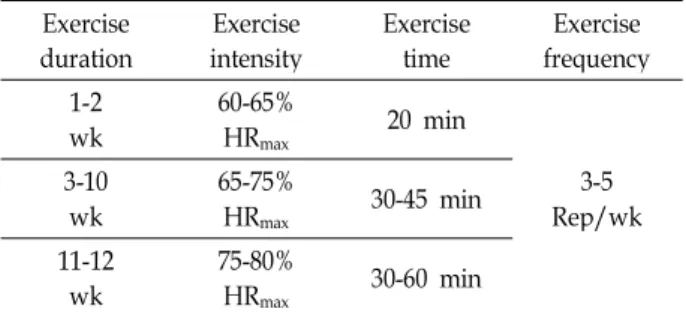
유산소 운동프로그램의 운동형태는 트레드밀 걷기 및 달리기 12주간 구성하였고, 운동강도는 각 피험자들의 운 동부하 검사에서 측정한 최고심박수(HR
max)을 바탕으로 50
~70%의 설정하였고 처음 1~2주 운동 프로그램은 초기훈 련기(50~55%)로 정하고, 다음 3~10주 운동 프로그램은 향상훈련기(55~65%), 마지막 11~12주는 유지훈련기(65~
70%)로 정하였다. 운동시간은 운동을 처음 시작하는 초기 훈련기에는 20분, 향상훈련기에는 30~45분, 유지훈련기에 는 30~60분으로 하였고 운동 빈도는 주 3~5회 실시하였 다(Table 1).
Table 1. Exercise program Exercise
duration Exercise
intensity Exercise
time Exercise frequency 1-2wk 60-65%
HRmax 20 min
3-5 Rep/wk 3-10
wk 65-75%
HRmax 30-45 min 11-12
wk 75-80%
HRmax 30-60 min
생화학적 간 기능 요소 분석 방법
약 12시간 정도 공복상태를 유지하도록 한 후, 혈액은 Y 대학병원의 임상병리과에서 헤파린으로 처리된 일회용 주사 기를 사용하여 상완정맥(anttcubital vein)에서 22gage neddle 을 사용하여 총 15ml를 채혈하였다. 혈액량은 Y 대학병원의 임상 병리과에서 분석하였고, alanine transferase (ALT), as- paratate aminnotransferase (AST), alkaline phosphates (ALP)은 ultraviolet (UV) method를 사용하였고 total bilir- ubin (TB), albumin (ALB)은 Urease-UV method 사용하여 BM/Hitachi 747로 분석하였다.
자료 처리 방법
본 실험의 결과는 SPSS 통계 package (ver 12.0)을 이용하여 각각의 실험에 따른 요인들의 변화를 알아보기 위해 기술통계 량(평균과 표준편자)을 산출하고 12주 유산소 운동프로그램 적용 전․후의 생리적 변인들의 유의한 차이를 알아보기 위해 대응분석(Paired t-test)을 통해 통계적 유의수준 0.05로 검증 하였다.
결 과
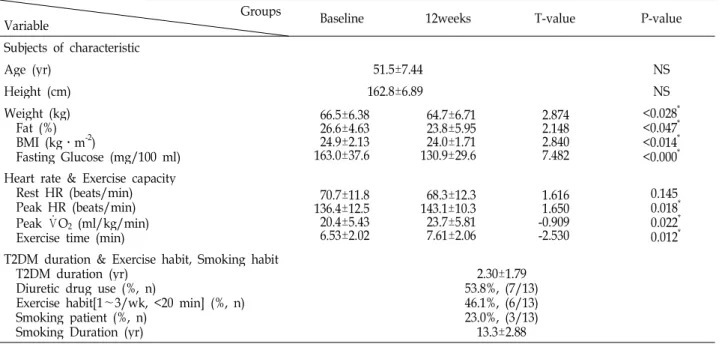
대상자의 신체적 특성 및 심박수, 최고산소헙취량, 운동시간 제 2형 당뇨(T2DM) 환자의 신체적 특성은 Table 2에서 나 타냈다. 체중(kg) 및 체지방률(%body fat), 체질량지수(BMI), 공복시 혈당(fasting glucose)은 12주 트레이닝 전에 비해 트 레이닝 후 유의하게(P<0.05) 감소하였다. 또한 운동시 최고심 박수(peak HR)와 최고산소섭취량(peak VO
2), 운동시간 (exercise time)은 12주 트레이닝 전에 비해 트레이닝 후, 유 의하게(P<0.05) 증가하였다.
12주 유산소 트레이닝 후, 간 효소의 변화
제 2형 당뇨집단의 간 기능과 신장 기능은 Table 3에서 나타
냈다. 혈중 간 기능을 나타내는 요인들 중 알부민(albumin),
토탈빌리루빈(total bilirubine), 알카포스타아제(alkline phos-
phatate), ALT, AST는 12주 트레이닝 전에 비해 트레이닝 후
증진됨을 나타냈지만 통계적으로 유의한(P<0.05) 차이는 나타
Table 2. Characteristic of subject & Changes of physical characteristics (Mean±SD) Groups
Variable Baseline 12weeks T-value P-value
Subjects of characteristic
Age (yr) 51.5±7.44 NS
Height (cm) 162.8±6.89 NS
Weight (kg) Fat (%) BMI (kg․m-2)
Fasting Glucose (mg/100 ml)
66.5±6.38 26.6±4.63 24.9±2.13 163.0±37.6
64.7±6.71 23.8±5.95 24.0±1.71 130.9±29.6
2.874 2.148 2.840 7.482
<0.028*
<0.047*
<0.014*
<0.000* Heart rate & Exercise capacity
Rest HR (beats/min) Peak HR (beats/min) Peak
V
O2 (ml/kg/min) Exercise time (min)70.7±11.8 136.4±12.5 20.4±5.43 6.53±2.02
68.3±12.3 143.1±10.3 23.7±5.81 7.61±2.06
1.616 1.650 -0.909 -2.530
0.145 0.018* 0.022* 0.012* T2DM duration & Exercise habit, Smoking habit
T2DM duration (yr) Diuretic drug use (%, n)
Exercise habit[1~3/wk, <20 min] (%, n) Smoking patient (%, n)
Smoking Duration (yr)
2.30±1.79 53.8%, (7/13) 46.1%, (6/13) 23.0%, (3/13)
13.3±2.88 Values are mean±S.E. NS: * P<0.05
Table 4. Establish of clinical hepatic enzyme in Baseline and 12weeks aerobic exercise training
Variable Albumin
(g/dl) Total bilirubin
(mg/dl) Alkaline
phosphatate (IU/l) AST
(IU/l) ALT
(IU/l)
Time Pre Post Pre Post Pre Post Pre Post Pre Post
Total (N=13) patients Ab(1/13) Ab(0/13) Ab(2/13) Ab(1/13) Ab(0/13) Ab(0/13) Ab(2/13) Ab(1/13) Ab(1/13) Ab(1/13) Ab: abnormal
Table 3. The changes of hepatic enzymes in Baseline and 12weeks aerobic exercise training
Groups
Variable Baseline 12 wk T-
value P- value Albumin (g/dl) 4.96±0.18 4.83±0.16 1.418 0.199 Total bilirubin (mg/dl) 1.10±0.53 0.91±0.25 1.298 0.235 Alkaline phosphatate
(IU/l) 78.3±16.5 77.7±19.0 0.127 0.902 AST (IU/l) 18.5±11.0 17.7±9.64 0.363 0.728 ALT (IU/l) 22.1±17.7 21.3±15.2 .313 0.763
내지 못하였다.
대상자 간 기능의 임상적 평가 결과
제 2형 당뇨집단의 간 기능 및 신장 기능의 임상평가는 Table 4에서 나타냈다. 간 기능의 지표인 총 단백질(total pro- tein) 트레이닝 전에 비정상(abnormal)을 나타낸 대상자는 2명 이 었고 12주 트레이닝 후 정상치를 나타냈다. 알부민 (albumin)은 트레이닝 전에 비정상(abnormal)을 나타낸 대상 자는 1명이었고 12주 트레이닝 후 정상치를 나타냈다. 총 빌리
루빈(total bilirubin)은 트레이닝 전에 비정상(abnormal)을 나 타낸 대상자는 2명이 었고 12주 트레이닝 후 비정상을 나타낸 대상자는 1명으로 감소함을 나타냈다. ALT는 트레이닝 전에 비정상(abnormal)을 나타낸 대상자는 2명이 었고 12주 트레이 닝 후 비정상을 나타낸 대상자는 1명으로 감소함을 나타냈다.
고 찰
AST와 ALT는 대부분이 간에 존재하나 심장과 근육에서
상당량을 가지고 있으며 이러한 기관들에 문제가 발생할 때
이러한 효소들의 두드러진 증가현상을 보인다[22]. AST와
ALT의 유출은 간 질환과 관계가 있으며 운동으로 인한 이들
의 혈액 내 방출은 myocyte 손상을 나타낸다[3,13]. 운동과 관
련되어 살펴보면 일회성 운동은 운동강도가 증가함에 따라
AST와 ALT를 증가시키지만 시간이 지나면서 점차 안정 시
수준으로 회귀함을 나타냈고[15,17] 정상인을 대상으로 4주간
[5]과 12주 유산소 트레이닝에 따른 비만자[13]에서 감소함을
나타냈지만 유의한 차이는 없었다는 연구로 나뉜다. 또한 간
질환자를 대상으로 12주 운동 트레이닝은 간 기능요소의 증진
을 가져왔다[18]. 본 연구에서도 AST와 ALT 모두 12주 트레이
닝에 따라 감소함을 나타냈지만 통계적으로 유의한 차이는 나타내지 못했다.
또한 본 연구의 결과는 이 전의 선행연구[7,19]들과 같이 제 2형 당뇨 환자(T2DM)에서 13명중 임상적 정상수치를 벗어 난 대상자가 AST는 2명, ALT는 1명으로 나타났다. 12주 유산 소 트레이닝 후에는 AST의 임상적 수치를 벗어난 대상자는 전체 2명에서 1명으로 줄었지만 ALT는 그렇지 못하였다. 따 라서 이러한 결과로 볼 때, 제 2형 당뇨 환자(T2DM)에서 규칙 적인 트레이닝이 간 기능 요인이 감소함에 따라 분명히 영향 을 미치기는 하였으나 12주 운동 트레이닝 자체가 ALT를 개 선시키지는 못하였다. 따라서 트레이닝 효과를 검증하기 위해 선 더 많은 피험자를 대상으로 한 연구가 뒷받침 돼야 한다고 생각된다.
알부민(Albumin)은 혈장에 존재하는 단백의 65%를 차지하 며 반감기는 19-21일이다. 혈장내농도는 아미노산의 공급, 혈 장의 삼투압, 싸이토카인(IL-6), 알부민의 합성속도와 혈장의 volume에 의해 결정된다. 저 알부민혈증은 혈장용적과 알부 민 합성에 의해 좌우되는 경우가 많으며 가장 흔한 경우는 만성간질환 및 복수와 관련된 것으로 급성 간질환에서는 드물 게 관찰된다.
Yang 등(1998)은 일회성 운동후 알부민(albumin)이 상승하 는 이유는 교질삼투압(oncotic pressure)의 증가로 인한 혈관 내막 팽창 때문이라 보고하였다[23]. 본 연구에서 알부민 (albumin)은 12주 트레이닝 후, 감소함을 나타냈으며 임상적 비정상 수치를 나타낸 1명이 12주 트레이닝에 따라 정상으로 돌아온 것으로 보아 트레이닝인해 알부민(albumin) 수치가 정 상으로 회기한 것으로 사료된다(Table 4).
총 빌리루빈(total bilirubin)과 Bilirubin은 heme의 주요 분 해산물로서 하루 250-350 mg이 생성되며 담도계로 배설되기 위해서는 비수용성형태에서 수용성인 bilirubin mono- 혹은 di-glcuronide형태로 포합되는 과정이 필요하다. 또한 임상적 으로는 비포합형과 포합형으로 나뉘며 비포합형 빌리루빈혈 증은 용혈성질환, 간경변 등 그 원인이며 전체인구의 약 5%를 차지하고 있는 Gilbert’s syndrome은 bilirubin-UGT의 감소로 인한 비포합형 빌리루빈혈증의 대표적 예이다[19]. 본 연구에 서 총 빌리루빈(total bilirubin)은 12주 트레이닝으로 인해 감 소함을 나타냈으나 통계적으로 유의하지는 못하였다. Devries 등(2008)은 12주 유산소 운동을 통해 빌리루빈(bilirubin)의 감 소를 가져왔으며 높아진 빌리루빈(bilirubin) 레벨은 사망을 야기하는 유의한 예측인자라 보고[6]하였다.
제 2형 당뇨 환자(T2DM)의 임상적 판단에서 빌리루빈 (total bilirubin)의 비정상은 전체 13명 중 2명(15%)으로 나타 났고 12주 유산소 트레이닝에 따라 2명중 1명만이 정상치로 돌아와 앞의 AST 결과와 마찬가지로 규칙적인 트레이닝이 영 향을 미치쳤다고 생각되나 12주 운동 트레이닝 자체가 빌리루 빈(total bilirubin)를 개선시키지는 못하였다고 사료된다.
알카포스타아제(alkline phosphatase, ALP)는 거의 모든 조직에 존재하는 효소로서 태반, 회장, 신장, 뼈, 간에 존재한 다. ALP가 증가되면 이것이 간질환으로 인한 것인지를 감별 하는 것이 중요하다. 임상적으로는 ALP 상승과 동시에 5’- nucleotidase나 GGT의 상승이 동반되어 있으면 ALP의 상승 을 간에서 유래한 것으로 추측할 수 있다[25]. 또한 ALP의 경한 상승은 간염이나 간 경변증과 같은 간 질환에서 관찰되 며 Albahrani 등(2006)의 보고[1]에서는 대조군에 비하여 비 만자에서 간의 ALP가 높음을 나타냈다. 본 연구에서 알카포 스타아제(ALP)의 임상적 수치 비정상은 제 2형 당뇨(T2DM) 환자 13명 중 없었으며 12주 유산소 트레이닝에 따라 ALP 수치의 감소를 나타냈지만 유의한 차이를 나타내지는 못했 다. 앞의 ALT 결과와 마찬가지로 규칙적인 트레이닝에 의해 감소함을 나타내기는 하였으나 12주 운동 트레이닝 자체가 ALP를 개선시키지는 못하였다고 사료된다(Table 4).
본 연구의 제한점 중 하나는 제 2형 당뇨(T2DM) 환자에서 12주 트레이닝에 의해 각각의 간 효소들이 감소한 기전을 설 명하지 못한 것이다. 이는 대다수의 제 2형 당뇨(T2DM) 환자 에서 감소된 간 효소들의 주 된 원인이 인슐린 저항성(insulin resistance)에 있으며[20], 이는 간에서 유리 지방산(free faty acids)을 축척하여 간세포에 바람직하지 못한 영향을 미치므 로 볼 때[16], 결국 간 기능 효소들이 트레이닝에 의해 조금이 라도 감소된 것은 포괄적인 면에서 보면 12주 유산소 트레이 닝이 제 2형 당뇨(T2DM) 환자의 공복 시 혈당을 감소시키고 결과적으로 인슐린저항성(insulin resistance)을 감소시켜 간 기능 효소들에 영향을 미친 것으로 사료된다[20].
신체적 특성 및 심박수, 최고산소섭취량, 운동시간 본 연구에서 12주 트레이닝 전에 비해 트레이닝 후, 체중 및 체지방률(% fat), 체질량지수(BMI), 공복 시 혈당(fasting glucose)은 감소하였고 운동 시 최고 심박수와 최고산소섭취 량(peakVO
2)과 운동시간(exercise time)은 유의하게 증가하였 다. 이는 제 2형 당뇨(T2DM)에서 대표적인 운동 트레이닝 효 과이며 이전의 연구들에서도 잘 나타나 있다[8,15,21].
요 약
본 연구에서는 12주 유산소 트레이닝 전에 비해 트레이닝
후, 간 기능을 나타내는 효소들이 모두 감소함을 나타냈으나
모두 통계적으로 유의한 차이는 나타내지 못했으며 이는 트레
이닝이 간 기능에 영향을 미치지 못한 선행연구[5,15]들에서와
같은 결과를 나타냈다. 하지만 부분적으로 전체 대상자 13명
중 3명(23%)의 간 효소들 즉, 임상적 비정상을 나타낸 알부민
(albumin), 토탈빌리루빈(total bilirubine), AST가 트레이닝
후, 정상적인 임상수치로 돌아와 규칙적인 12주 유산소 트레
이닝이 제 2형 당뇨(T2DM) 환자의 간 효소에 통계적으로 유
의한 차이는 나타내지 못했지만 임상적 판단 수치에 영향을 미친 것은 사실이다. 하지만 모든 비정상적인 간 기능 효소가 정상으로 회기한 것도 아니며 통계적으로 유의한 차이도 나지 못했기 때문에 제 2형 당뇨환자(T2DM)의 간 기능 효소를 증 진시키는 데 있어 운동 트레이닝의 효과는 성급히 판단하기 어려우며 운동 강도와 기간 등 좀 더 세분화고 다양한 연구가 필요하다고 생각된다.
References
1. Albahrani, A. I., J. J. Usher, E. Marks, L. Ranganath, and A. Shenkin. 2007. Atypical presentation of a middle age male with severe hypertriglyceridaemia: a case report.
Journal of medicine
14, 1:51.2. Amarapurkar, D. and H. S. Das. 2002. Chronic liver disease in diabetes mellitus.
Tropical gastroenterology
23, 3-5.3. Apple, F. S. and M. Rhodes. 1988. Enzymatic estimation of skeletal muscle damage by analysis of changes in serum creatine kinase.
Journal of applied physiology
65, 2598-2600.4. Cai, H., and D. G. Harrison. 2000. Endothelial dysfunction in cardiovascular disease: the role of oxidant stress.
Circulation research
87, 540-844.5. Chuang, C. C., W. C. Chen, S. Y. Lee, and K. T. Wang.
1996. The effect of blood AST, ALT and lactate after short and middle distance exercise training.
The Kaohsiung journal of medical sciences
12, 544-548.6. Devries, M. C., I. A. Samjoo, M. J. Hamadeh, and M. A.
Tarnopolsky. 2008. Effect of endurance exercise on hepatic lipid content, enzymes and adiposity in men and women.
Obesity
(Silver Spring). 16, 2281-2288.7. Erbey, J. R., C. Silberman, and E. Lydick. 2000. Prevalence of abnormal serum alanine aminotransferase levels in obese patients and patients with type 2 diabetes.
The American journal of medicine
109, 588-590.8. Hatunic, M., F. Finucane, N. Burns, D. Gasparro, and J. J.
Nolan. 2007. Vascular inflammatory markers in early-onset obese and type 2 diabetes subjects before and after three months' aerobic exercise training.
Diabetes & vascular disease research
4, 231-234.9. IDF. 2003. International Diabetes federation. pp.17-71. 2nd (eds.), International Diabetes federation. Belgium.
10. Jordan, W. R. 1963. Neuritic manifestation in diabetes mellitus.
Archives of internal medicine
57, 123-129.11. Klein, R., B. E. Klein, S. E. Moss, M. D. Davis, and D. L.
DeMets. 1984. The Wisconsin epidemiologic study of dia- betic retinopathy. II. Prevalence and risk of diabetic retinop- athy when age at diagnosis is less than 30 years.
Archives of ophthalmology
102, 520-526.12. Kleinman, J. C., R. P. Donahue, M. I. Harris, F. F. Finrcane,
J. H. Madaus, and D. B. Brock. 1988. Mortality among dia- betes in a national sample.
American journal of epidemiology
128, 389-401.13. Koutedakis, Y., A. Raafat, N. C. Sharp, M. N. Rosmarin, M. J. Beard, and S. W. Robbins. 1993. Serum enzyme activ- ities in individuals with different levels of physical fitness.
The Journal of sports medicine and physical fitness
33, 252-257.14. Larson-Meyer, D. E., B. R. Newcomer, L. K. Heilbronn, J.
Volaufova, S. R. Smith, A. J. Alfonso, M. Lefevre, J. C. Rood, D. A. Williamson, and E. Ravussin. 2008. Effect of 6-month calorie restriction and exercise on serum and liver lipids and markers of liver function.
Obesity
. 16, 1355-1362.15. Mashiko, T., T. Umeda, S. Nakaji, and K. Sugawara. 2004.
Effects of exercise on the physical condition of college rugby players during summer training camp.
British journal of sports medicine
38, 186-190.16. Neuschwander-Tetri, B. A. and S. H. Caldwell. 2003.
Nonalcoholic steatohepatitis: summary of an AASLD Single Topic Conference.
Hepatology
37, 1202-1219.17. Pettersson, J., U. Hindorf, P. Persson, T, Bengtsson, U.
Malmqvist, V. Werkström, and M. Ekelund. 2007. Muscular exercise can cause highly pathological liver function tests in healthy men.
British journal of clinical pharmacology
65, 253-259.18. Ritland, S., C. F. Petlund, T. Knudsen, and S. Skrede. 1983.
Improvement of physical capacity after long-term training in patients with chronic active hepatitis.
Scandinavian journal of gastroenterology
18, 1083-1087.19. Salmela, P. I., E. A. Sotaniemi, M. Niemi, and O.
Mäentausta. 1984. Liver function tests in diabetic patients.
Diabetes care
7, 248-254.20. Shimomura, I., M. Matsuda, R. E. Hammer, Y. Bashmakov, M. S. Brown, and J. L. Goldstein. 2000. Decreased IRS-2 and increased SREBP-1c lead to mixed insulin resistance and sensitivity in livers of lipodystrophic and ob/ob mice.
Molecular cell
6, 77-86.21. Svacinová, H., M. Nováková, Z. Placheta, M. Kohzuki, M.
Nagasaka, N. Minami, P. Dobsák, and J. Siegelová. 2008.
Benefit of combined cardiac rehabilitation on exercise ca- pacity and cardiovascular parameters in patients with type 2 diabetes,
The Tohoku journal of experimental medicine
215, 103-111.22. Takeda, Y., A. Ichihara, H. Tanioka, and H. Inoue. 1964.
The biochemistry of animal cells. i. the effect of cortico- teroids on leakage of enzymes from dispersed rat liver cells.
The Journal of biological chemistry
239, 3590-3596.23. Yang, R. C., G. W. Mack, R. R. Wolfe, and E. R. Nadel.
1998. Albumin synthesis after intense intermittent exercise in human subjects.
Journal of applied physiology
84, 584-592.24. Yu, A. S. and E. B. Keeffe. 2002. Nonalcoholic fatty liver disease.