Expression System for Optimal Production of Xylitol Dehydrogenase (XYL2) in Saccharomyces cerevisiae
Hoe-Myung Jung
1and Yeon-Hee Kim
1,2*
1
Department of Smart bio-health, Dong-Eui University, Busan 47340, Korea
2
Divison of Applied Bioengineering, Biomedical Engineering and Biotechnology Major, Dong-Eui University, Busan 47340, Korea Received August 16, 2017 /Revised October 24, 2017 /Accepted November 22, 2017
In this study, the xylitol dehydrogenase (XYL2) gene was expressed in Saccharomyces cerevisiae as a host cell for ease of use in the degradation of lignocellulosic biomass (xylose). To select suitable expression systems for the S.XYL2 gene from S. cerevisiae and the P.XYL2 gene from Pichia stipitis, pGMFα-S.XYL2, pGMFα-P.XYL2, pAMFα-S.XYL2 and pAMFα-P.XYL2 plasmids with the GAL10 promoter and ADH1 promoter, respectively, were constructed. The mating factor α (MFα) signal sequence was also con- nected to each promoter to allow secretion. Each plasmid was transformed into S. cerevisiae SEY2102△
trp1 strain and the xylitol dehydrogenase activity was investigated. The GAL10 promoter proved more suitable than the ADH1 promoter for expression of the XYL2 gene, and the xylitol dehydrogenase ac- tivity from P. stipitis was twice that from S. cerevisiae. The xylitol dehydrogenase showed NAD
+-de- pendent activity and about 77% of the recombinant xylitol dehydrogenase was secreted into the peri- plasmic space of the SEY2102△trp1/pGMFα-P.XYL2 strain. The xylitol dehydrogenase activity was in- creased by up to 41% when a glucose/xylose mixture was supplied as a carbon source, rather than glucose alone. The expression system and culture conditions optimized in this study resulted in large amounts of xylitol dehydrogenase using S. cerevisiae as the host strain, indicating the potential of this expression system for use in bioethanol production and industrial applications.
Key words : Pichia stipitis, promoter strength, Saccharomyces cerevisiae, secretion production, xylitol dehydrogenase
*Corresponding author
*Tel : +82-51-890-2281, Fax : +82-504-033-6356
*E-mail : [email protected]
This is an Open-Access article distributed under the terms of the Creative Commons Attribution Non-Commercial License (http://creativecommons.org/licenses/by-nc/3.0) which permits unrestricted non-commercial use, distribution, and reproduction in any medium, provided the original work is properly cited.
Journal of Life Science 2017 Vol. 27. No. 12. 1403~1409 DOI : https://doi.org/10.5352/JLS.2017.27.12.1403
서 론
출아효모 Saccharomyces cerevisiae는 매우 효율적인 에탄올 생산 균주로 알려져 있지만 lignocellulosic materials로부터 에 탄올 생산을 위해 적합한 xylose를 발효할 수 없다는 단점이 있다. 따라서 woody plant materials로부터 xylose를 효율적 으로 발효할 수 있는 S. cerevisiae는 효과적인 biofuel 생산에 직접적으로 사용될 수 있으므로, 이러한 균주의 구축은 주요 한 산업적 관심사가 되고 있다[5, 26]. 비록 S. cerevisiae 가 다른 여러 효모들(Pichia stipitis, Candida shehatae)과 달리 xylose에 서 성장이나 발효를 할 수 없다고 할 지라도 매우 느리게는 xylose를 대사한다는 것도 보고 되어지고 있다[24]. Xylose의 대사에는 일반적으로 3개의 cytosolic enzymes (xylose reduc- tase, xylitol dehydrogenase, and xylulokinase)이 관여하는 pathway가 이용되고, 이 효소들에 의해서 xylose는 pentose
phosphate pathway를 통해 대사가 가능한 xylulose 5-phos- phate로 전환이 가능해진다[7]. S. cerevisiae에서 xylose uptake 는 glucose transporters의 일부를 통해 이루어진다고 알려져 있고[15], xylose reductase (GRE3, YHR104W), xylitol de- hydrogenase (XYL2, YLR070C)와 xylulokinase (XKS1, YGR194c)의 효소 활성도 S. cerevisiae에서 보고되어 지고 있 다. S. cerevisiae는 상대적으로 xylose 이용은 잘 못하는데, xy- lulokinase의 활성이 좋기 때문에 xylulose의 존재 하에서는 잘 자랄 수 있다고 보고되고 있다[4, 22]. 하지만 S. cerevisiae에 서 xylitol dehydrogenase의 활성에 관해서는 의견이 분분했 다. Batt et al. [2]는 S. cerevisiae에서 xylitol dehydrogenase 활성이 있음을 보고했고, 반면에 van Zyl et al. [23]은 xylitol dehydrogenase의 활성이 세포에서 검출되지 않았다고 보고 했다. 이러한 활성의 차이를 보이는 것은 xylitol dehydrogen- ase가 배양 조건에 따라 활성이 달라지기 때문인데, glucose 존재 하에서 세포가 자랄 때는 xylitol dehydrogenase 활성이 검출되지 않고, xylose가 배지 중에 존재할 때에만 xylitol de- hydrogenase의 활성을 나타내기 때문인 것으로 보고되었다 [20]. 이는 xylitol dehydrogenase의 발현율(expression level) 이 당(glucose, xylose)에 의해 조절된다는 것을 의미한다.
Xylitol dehydrogenase (XDH)를 코드하는 XYL2 유전자는
medium-chain dehydrogenase/reductase superfamily (polyol
dehydrogenase family)의 member [19, 21]로 아연(zinc)을 포 함하고 있다고 알려져 있다. MDR 효소들은 전형적으로 cata- lytic domain과 nicotinamide cofactor (NAD
+or NADP
+)의 결합을 위한 second domain을 가지며, 아연이 존재할 때 ac- tive site에서 촉매작용에 관여하게 된다[23]. Xylitol dehydro- genase의 경우, cofactor의 종류에 따라 xylitol을 L-xylulose로 전환시키는 NADP-linked xylitol dehydrogenase (EC 1.1.1.10) 와 xylitol을 D-xylulose로 전환시키는 NAD-linked xylitol de- hydrogenase (EC 1.1.1.9)로 나눌 수 있다[1]. 일반적으로 xy- lose로부터 D-xylulose의 생산을 위해서 NADPH를 cofactor 로 쓰는 xylose reductase와 NAD
+를 cofactor로 쓰는 xylitol dehydrogenase를 사용하게 되는데 이 경우 intracellular re- dox imbalance가 생기게 된다. 따라서 S. cerevisiae와 P. stipitis 균주 유래 효소들의 redox balance 유지 및 효율적인 D-xylu- lose 생산을 위해 mutation 등의 방법을 통해 NADP
+-depend- ent xylitol dehydrogenase를 발현시켜 보고하고 있다[8, 18].
따라서 많은 연구는 mutated-xylitol dehydrogenase를 구축하여 coenzyme recycling에 초점을 맞추어 연구가 진행되고 있다.
S. cerevisiae는 고등생물세포와 유사한 번역 후 수식계가 있
어 folding, disulfide 결합 등 단백질의 구조와 기능이 천연상 태로 생산된다. 또한 효모는 대장균에 비해 유전자 재조합 단 백질을 더 효율적으로 세포 밖으로 분비 생산하여 단백질의 분리 정제에 도움을 줄 수 있다[17]. 따라서 lignocellulosic material (xylose)을 효과적으로 에탄올 생산에 사용하기 위해 서는 xylose에서 생성된 xylitol의 축척을 막고 D-xylulose로의 전환을 촉진시키기 위한 xylitol dehydrogenase의 활성을 높 이는 것과 효모를 숙주세포로 한 대량 생산이 요구된다. 또한 생산된 xylitol dehydrogenase의 효율적인 정제를 위해서도 배지 내로의 분비생산이 필요한데 효모로부터 재조합 단백질 의 분비생산을 위해서는 효모의 분비서열을 이용하는 것이 효과적이다[10]. 실제로 xylitol dehydrogenase의 발현을 con- stitutive promoter를 사용하여 조절하여 xylitol accumulation 을 낮추고, ethanol production yield를 증가시킨 결과도 보고 되었고[12], 발현시키고자 하는 유전자의 특성에 따라 발현에 적합한 promoter (constitutive or inducible promoter)와 유전 자의 combination이 달라진다는 결과도 보고하였다[11]. 따라 서 본 연구에서는 S. cerevisiae와 P. stipitis의 XYL2 유전자 (S.XYL2 and P.XYL2 gene)를 inducible promoter인 GAL10 (galactose inducible) promoter와 constitutive promoter인
ADH1 (constantly expression) promoter를 이용하여 발현시키고, xylitol dehydrogenase의 발현 생산에 가장 적합한 pro- moter와 유전자 발현시스템(expression system)을 구축하고 자 하였다.
재료 및 방법
사용 균주 및 plasmids
Plasmid 구축 및 증폭을 위한 Escherichia coli 숙주세포는 DH5α를 사용하였고, 효모 숙주세포는 Saccharomyces cer-
evisiae SEY2102 (MATα ura3-52 leu2-3 leu2-112 his4-519 suc2△9)의 TRP1 (ORF 0.7kb)유전자가 KanMX 유전자로 대체되어 TRP1 유전자가 결실된 SEY2102△trp1 균주를 사용하였다. 효
모 S. cerevisiae와 P. stipitis의 XYL2 유전자 발현을 위한 발현 plasmid는 유도성 promoter인 GAL10 promoter를 포함하는 pGMFα-S.XYL2와 pGMFα-P.XYL2를 구성적 promoter인 ADH1 promoter를 포함하는 pAMFα-S.XYL2와 pAMFα-P.XYL2 plasmid를 사용하였다. 이들 plasmid는 선별마커로 URA3 유 전자를 함유하고 있어 uracil 영양요구성 변이주 효모세포 (ura3-52)를 숙주세포로 사용할 수 있다.
재조합 plasmid 구축 및 형질전환
GAL10 promoter를 이용하여 S. cerevisiae의 XYL2 유전자
(S.XYL2)와 P. stipitis의 XYL2 유전자(P.XYL2)의 과발현을 위 한 plasmid를 구축하기 위해서 pGMFα-XYLP plasmid [10]를 vector로 사용하였고, 각각 SEY2102△trp1과 P. stipitis (KCTC 7230) 균주의 genomic DNA를 주형으로 S.XYL2-F (5’-AGGT GTTCCTCTAGATAAGAGAACTGACTTAACTACA-3’)와 S.XYL2-R (5’-TTCGTTCAAGTC GACTCATTCCGGGCCCT C-3’), P.XYL2-F (5’-AGGTGTTCCTCTAGATAAGAGAACT GCTAACCC TTCC-3’)와 P.XYL2-R (5’-TTCGTTCAAGTCG ACTTACTCAGGGCCGTC-3’) primer set를 이용하여 S.XYL2 와 P.XYL2 유전자를 증폭하였다. Primer는 각각 XbaI과 SalI 제한효소서열을 포함한 22bp vector서열을 포함하도록 디자 인되었고, pGMFα-XYLP plasmid (vector)는 XbaI과 SalI 제한 효소로 처리하여 cloning에 사용하였다. Cloning을 위해서 vector와 증폭된 XYL2 유전자의 일부분의 overlap region을 사용하여 fusion시키는 In-fusion cloning (Clonetech)법을 이 용하였다
ADH1 promoter를 이용하여 S.XYL2 유전자와 P.XYL2 유
전자를 과발현 시키기 위한 plasmid의 구축을 위해서는 pVT- 103U plasmid [25]를 vector로 사용하였고, pGMFα-S.XYL2와 pGMFα-P.XYL2 plasmid를 주형으로 pAMFα-F (5’-GCTGGA TCCTCTAGAATGAGATTCCCATCC-3’)와 pAS.XYL2-R (5’- TGCTGCAGGCTCGAGTCATTCCGGGCCCTC-3’), pAP.XYL2 -R (5‘-TGCTGCAGGCTCGAGTTACT CAGGGCCGTC-3’) primer를 이용하여 S.XYL2와 P.XYL2 유전자를 증폭하였다.
pVT-103U plasmid를 BamHI과 XhoI 제한효소로 처리하여
vector로 사용하였고, In-fusion cloning 법을 이용하여 재조합
plasmid를 구축하였다. 이렇게 구축된 재조합 plasmid는 E.coli
DH5α에서 증폭, 추출되었고, S. cerevisiae 균주로 형질전환을
위해서는 salmon testes 유래의 single-stranded carrier DNA를
사용하는 high efficiency transformation법[6]을 이용하였다.
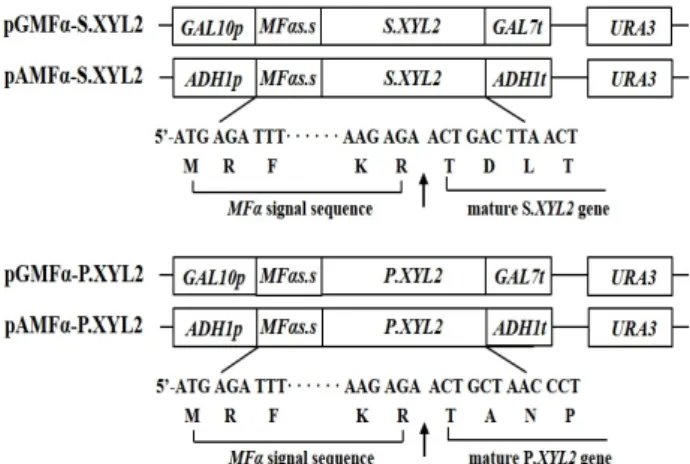
Fig. 1. Schematic of the xylitol dehydrogenase expression plas- mids, pGMFα-S.XYL2, pAMFα-S.XYL2, pGMFα-P.XYL2 and pAMFα-P.XYL2. The nucleotide sequence and de- duced amino acid sequence of the junction site between MF α signal sequence and the XYL2 gene are indicated and the endopeptidase cleavage site is denoted by an arrow.
배지 조성 및 배양조건
S. cerevisiae 균주의 증식배지로는 YPD 배지(1% yeast ex-
tract, 2% peptone, 2% glucose)를 사용하였으며, 유전자 발현 유도 시에는 YPDG 배지(1% yeast extract, 2% peptone, 1%
glucose, 1% galactose)를 사용하였다. 또한 탄소원의 종류 및 조성에 따른 유전자 발현률 비교를 위해서는 YPD(2%)G(2%), YPDGX (2% xylose) 및 YPG(2%)X(2%) 배지 등을 사용하였다.
형질전환체의 선별을 위한 배지로는 YNBCAD 배지(0.67%
yeast nitrogen base w/o amino acid, 0.5% casamino acid, 2% glucose)를 사용하였다. 재조합 효모 균주는 5 ml YPD 배 지에서 16~24시간 동안 전배양 한 후 10 ml YPDG 배지에 접종(initial OD
6000.1)하여 30℃, 190 rpm에서 48시간 또는 72시간 배양하였다.
Xylitol dehydrogenase (XDH)의 효소활성 측정 Xylitol dehydrogenase의 효소활성 측정을 위하여 YPDG 배지에서 48시간 배양한 배양액을 3,000 rpm으로 원심분리하 여 얻은 균체 침전물에 Y-PER (Yeast Protein extraction re- agent, Thermo Fisher Scientific)을 첨가하여 단백질을 추출하 였다. 2 ml의 Y-PER을 균체에 첨가하여 상온에서 20분간 반응 시킨 후 균체와 동량의 glass beads (0.4~0.6 mm)를 추가하여 3회~10회정도 vortexing하고, 원심분리하여 상등액을 분리 한 다음 현미경 관찰을 통해 세포 파쇄 여부를 확인하였다. Peri- plasmic space (P)와 cytoplasmic space (C)의 효소액을 분리하 기 위해서는 Y-PER만 첨가하여 반응시킨 후, 상등액(P)을 분 리하고 남은 원형질체에 다시 한번 동량의 Y-PER와 glass beads를 추가하여 완전히 균체를 파쇄(C)하였다. 분리된 상등 액 및 세포추출물 내의 protein 농도는 Bradford법[3]으로 정 량하였고, BSA (Bovine Serum Albumin)를 표준물질로 0 mg/ml, 0.2 mg/ml, 0.4 mg/ml, 0.6 mg/ml, 0.8 mg/ml, 1.0 mg/ml의 양만큼 첨가하여 표준적정곡선을 작성하였다. Xylitol dehydrogenase의 효소활성 측정은 0.7 ml의 50 mM Tris buf- fer (pH 9.0), 0.1 ml cell extract, 0.1 ml 2 mM NAD(P)
+를 포함하는 reaction solution을 1분간 25℃에서 반응하고, 0.1 ml의 1 M xylitol의 기질을 첨가한 후 340 nm에서의 흡광값의 변화량을 2분간 모니터링하여 측정하였다[13]. 1 unit는 1분간 1 μmol NAD(P)
+를 전환하는 효소의 양으로 정의하였다.
RT-PCR을 통한 XYL2 유전자 발현률 조사
SEY2102△trp1 균주와 각각의 형질전환체에서 S.XYL2와
P.XYL2 유전자의 발현률을 비교하기 위하여 RT-PCR을 수행하였다. Trizol method [9]를 통해 각 효모 균주의 total RNA를 추출하였고, Hyperscript
™First strand synthesis Kit (Gene All
Ⓡ)를 사용하여 cDNA를 합성하였다. cDNA합성 조건은 2 μg의 total RNA와 Oligo dT를 첨가한 14 μl를 65℃에서 5분간 반응 후, ice에서 1분간 cooling하고 10x RTase reaction buffer
2 μl, 0.1M DTT 1 μl, Hyperscript
™Reverse Transcriptse (200 U/μl) 1 μl, ZymAll
™RNase Inhibitor 1 μl를 첨가하여 55℃에 서 60분간 반응 후, 85℃에서 5분 반응하여 ice에서 cooling 하 였다. 합성된 cDNA는 PCR의 주형으로 사용되었고, S.XYL2및
P.XYL2 유전자의 증폭을 위해 S.XYL2-F와 S.XYL2-R, P.XYL2-F와 P.XYL2-R primer set을 사용하였다. Actin 단백질을 코드 하는 ACT1 유전자는 internal control로서 ACT1-F (5’-ATCC AAGAGAGGTATCT-3’)와 ACT1-R (5’-CACACTTCATGAT GGAG-3’) primer를 사용하여 증폭되었다. 전기영동 후 각각 signal intensity는 Scion image (http://www.scioncorp.com/) program을 이용하여 비교 분석하였다[14].
결과 및 고찰
Xylitol dehydrogenase (XDH) 발현을 위한 plasmid 구축
효모 유래 분비 서열을 이용하여 S.XYL2와 P.XYL2 유전자
를 유도적, 구성적으로 발현·분비시키기 위하여 GAL10 pro-
moter와 ADH1 promoter 하류에 각각 mating factor α (MFα)
signal sequence와 S.XYL2와 P.XYL2 유전자를 cloning하여
pGMFα-S.XYL2 (7.44 kb), pGMFα-P.XYL2 (7.34 kb), pAMFα-
S.XYL2 (8.3 kb)와 pAMFα-P.XYL2 (8.4 kb) plasmid를 구축하
였다(Fig. 1). 각 유전자의 coding region (S. XYL2 유전자의
TDLT와 P.XYL2 유전자의 TANP로 시작되는 아미노산서열로
시작되는 영역)은 MFα 분비서열(MFαs.s)의 염기성 아미노산
잔기 Lys-Arg (KR) 뒤에 연결되도록 design되었고, 번역 후
분비과정 중 효모세포내의 KEX2 protease (yeast endopepti-
dase) [16]에 의해 절단되어 성숙형(mature form)의 xylitol de-
Table 1. Comparison of cell growth (DCW) and xylitol dehydrogenase (XDH) activity according to cofactors (NAD
+and NADP
+) and promoters in each transformant
Strains Dry cell weight (DCW) XDH activity (unit/mg)
NAD
+NADP
+SEY2102△trp1 SEY2102△trp1/pGMFα-S.XYL2 SEY2102△trp1/pAMFα-S.XYL2 SEY2102△trp1/pGMFα-P.XYL2 SEY2102△trp1/pAMFα-P.XYL2
5.53 5.91 6.63 5.13 6.36
0.001 0.023 0.004 0.056 0.007
0.0004 0.003 0.001 0.013 0.002 Each transformant was cultivated in YPD and YPDG medium for 48 hr.
Fig. 2. Analysis of the transcription levels of xylitol dehydrogen- ase gene using RT-PCR. Total RNA was isolated from S. cerevisiae SEY2102△trp1 transformants. cDNA was synthesized from total RNA by RT-PCR. The S.XYL2, P.XYL2 and ACT1 (internal control) genes were ampli- fied by PCR using each cDNA as template, and the prod- ucts were visualized by agarose gel electrophoresis. Lane l: SEY2102△trp1/pGMFα-S.XYL2 transformant, lane 2:
SEY2102△trp1/pAMFα-S.XYL2 transformant, lane 3: SEY 2102△trp1/pGMFα-P.XYL2 transformant, lane 4: SEY2102
△trp1/pAMFα-P.XYL2 transformant.
hydrogenase가 세포 밖으로 분비될 수 있다.
Promoter와 cofactor에 따른 xylitol dehydrogenase 활성비교
구축된 pGMFα-S.XYL2, pGMFα-P.XYL2, pAMFα-S.XYL2 와 pAMFα-P.XYL2 plasmid를 각각 S. cerevisiae SEY2102△
trp1 균주에 형질전환하여 YNBCAD배지에서 1차 선별하였 다. 각 5개~10개의 형질전환체를 선별하여 XYL2 유전자의 유 무를 확인해보기 위해 colony PCR을 수행한 결과, 모든 형질 전환체에서 XYL2 유전자가 증폭되었음을 알 수 있었다(data not shown). 다음으로 각 형질전환체들 중 1개의 형질전환체 를 선별하여 YPDG 배지에서 48시간 배양한 후 xylitol de- hydrogenase 활성을 비교해보았다(Table 1). 먼저 promoter에 따른 xylitol dehydrogenase 활성을 조사해 본 결과, ADH1 promoter보다 GAL10 promoter를 사용하였을 때 xylitol de- hydrogenase 활성이 5.8~8배 정도 증가됨을 확인 할 수 있었 는데, 이는 XYL2유전자의 source에 상관없이 GAL10 pro- moter가 XYL2유전자의 발현에 더욱 적합함을 보여주는 것이 다. 또한 xylitol dehydrogenase 활성에 영향을 미치는 co- factor의 종류(NAD
+and NADP
+)에 따른 효소활성을 비교해 본 결과, S.XYL2 유전자와 P.XYL2 유전자 모두 NAD
+를 co- factor로 사용하였을 경우에 효소 활성이 3.5~7.7배 정도 높게 나옴을 알 수 있었다. XYL2 유전자의 source 에 따른 xylitol dehydrogenase의 활성 정도를 promoter와 cofactor의 영향을 반영하여 최종적으로 비교해 보면, P. stipitis 유래의 XYL2 유 전자(P.XYL2)는 S. cerevisiae 유래 XYL2 유전자(S.XYL2) 보다
S. cerevisiae 숙주세포에서 약 2배 이상 높게 발현됨을 알 수있었다. 따라서 S. cerevisiae 균주를 숙주세포로 사용하여 재조 합 xylose dehydrogenase의 과발현을 유도하기 위해서는 유 도적 promoter인 GAL10 promoter를 사용하는 것이 효율적이 며, P. stipitis 유래의 xylitol dehydrogenase 효소활성이 더 높 았으며, 효소활성의 증가를 위해 cofactor로 NAD
+가 적합함 을 확인하였다.
RT-PCR을 통한 xylitol dehydrogenase 발현율 비교
XYL2 유전자의 과발현에 ADH1 promoter를 사용했을 때보다 GAL10 promoter를 사용했을 때가 xylitol dehydrogen- ase의 활성이 높아지고, 특히 P. stipitis 유래의 P.XYL2 유전자 발현이 상대적으로 증가되었음을 확인 할 수 있었는데, 이것 이 XYL2 유전자의 transcription level의 증가인지 단백질 활 성 증가의 영향인지 확인해보기 위해 RT-PCR을 수행하였다.
SEY2102△trp1/pGMFα-S.XYL2 균주, SEY2102△trp1/pAMF
α-S.XYL2 균주, SEY2102△trp1/pGMFα-P.XYL2 균주 및
SEY2102△trp1/pAMFα-P.XYL2 균주로 부터 total RNA를 추
출하고, cDNA 합성 후, S.XYL2, P.XYL2 유전자와 ACT1 유전
자를 증폭하는 primer set로 PCR을 수행하였다. 그 결과, S.XYL2
유전자와 P.XYL2 유전자 모두 ADH1 promoter 보다 GAL10
promoter를 사용했을 때 각 유전자의 transcription level이 약
4배정도 증가되었음을 확인할 수 있었고(Fig. 2), 또한 P.XYL2
유전자의 transcription level이 S.XYL2 유전자보다 약 1.7배
정도 더 높게 나옴을 알 수 있었다(Fig. 2, lane 1 and 3). 따라서
SEY2102△trp1/pGMFα-P.XYL2 균주에서 xylitol dehydroge-
nase의 효소활성이 높게 나타난 것은 GAL10 promoter에 의해
조절된 P.XYL2 유전자의 transcription level의 증가에 의한
것으로 S. cerevisiae를 숙주세포로 하여 도입한 P.XYL2 유전자
가 숙주세포 내에서 정상적인 전사, 번역시스템을 통해 발현
되고 있음을 확인할 수 있었다.
Fig. 3. Analysis of xylitol dehydrogenase (XDH) activity (unit/
mg-protein) in various transformants. The transformants were cultivated in YPD and YPDG medium for 48 hr and enzyme solution from medium (extracellular frac- tion) and cell extract (periplasmic and cytoplasmic frac- tion) was used for analysis of XDH activity. E: extracel- lular fraction, P: periplasmic fraction, C: cytoplasmic frac- tion, G-S.Xyl2: SEY2102△trp1/pGMFα-S.XYL2 trans- formant, A-S.Xyl2: SEY2102△trp1/pAMFα-S.XYL2 trans- formant, G-P.Xyl2: SEY2102△trp1/pGMFα-P.XYL2 trans- formant, A-P.Xyl2: SEY2102△trp1/pAMFα-P.XYL2 trans- formant.
Table 2. Comparison of cell growth (DCW) and xylitol dehydrogenase (XDH) activity according to carbon sources composition in SEY2102△trp1/pGMFα-P.XYL2 transformant
Carbon sources 48 hr cultivation 72 hr cultivation
Dry cell weight (DCW) XDH activity (unit/mg) Dry cell weight (DCW) XDH activity (unit/mg) YPD(1%)G(1%)
YPD(2%)G(2%) YPD(1%)G(1%)X(2%)
YPG(2%)X(2%)
5.33 7.56 6.02 3.15
0.059 0.071 0.078 0.025
5.21 8.71 7.18 4.56
0.057 0.079 0.083 0.032 The transformant was cultivated in YPDG, YPDGX and YPGX medium for 48 hr and 72 hr.
재조합 xylitol dehydrogenase의 secretory efficiency 비교
Xylitol dehydrogenase의 효율적인 분비발현을 위해서 각 각의 plasmid 구축 시, S. cercevisiae의 MFα signal sequence (s.s)를 S.XYL2 유전자 및 P.XYL2 유전자의 앞에 도입하였다.
따라서 MFα s.s에 의한 재조합 xylitol dehydrogenase의 분비 효율을 각각의 형질전환주에 대해서 비교해보았다. 먼저, 각 형질전환주를 YPD배지(SEY2102△trp1/pAMFα-S.XYL2 균 주와 SEY2102△trp1/pAMFα-P.XYL2 균주 배양)와 YPDG배 지(SEY2102△trp1/pGMFα-S.XYL2 균주와 SEY2102△trp1/
pGMFα-P.XYL2 균주 배양)에서 48시간 배양한 후, 배양상등 액(E, extracellular fraction)과 세포추출물(P+C, P, periplasmic fraction; C, cytoplasmic fraction)에서의 효소활성을 조사해보 았다(Fig. 3). 그 결과, 모든 형질전환균주에서 세포 밖(배지)으 로 분비되는 xylitol dehydrogenase의 활성은 확인 할 수 없었 으며, 대부분 세포 내에 활성을 가지고 있음을 확인하였다.
하지만 세포추출액을 periplasmic space와 cytoplasmic space 로 나누어서 조사해 본 결과, SEY2102△trp1/pGMFα-P.XYL2 균주의 경우 효소활성의 약 77%가 periplasmic space에서 관 찰되었으며, 이는 분비서열에 의해 cytosol에서 periplasmic space까지 xylitol dehydrogenase가 분비되었음을 알 수 있었 다. 이는 xylitol dehydrogenase 단백질을 구성하는 아미노산 의 charge 및 분비를 위한 다양한 factor의 영향에 의해 분비효 율이 감소했을 가능성을 생각해 볼 수 있고, 분비서열의 사용 에 의해서 다른 형질전환균주에서도 약 50%~61% 단백질을 periplasmic space까지 분비시킬 수 있음을 확인할 수 있었다.
Xylan을 xylose로 분해하는 β-xylosidase 효소의 경우에도 MFα s.s에 의한 분비 생산을 유도했을 때, β-xylosidase단백질 이 periplasmic space까지만 분비되는 것을 확인 할 수 있었는 데, 이 또한 β-xylosidase를 구성하는 소수성 아미노산의 비율 과 막 투과성의 변화에 의한 것임을 알 수 있었다(data not shown).
탄소원에 따른 xylitol dehydrogenase의 활성변화 조사
S. cerevisiae에서 xylitol dehydrogenase의 활성이 배지 중의탄소원(glucose, galactose and xylose)에 의해 조절되고 변화
할 수 있다는 몇몇 보고[2, 20, 23]에 근거하여, 재조합 xylitol
dehydrogenase 생산에 최적인 SEY2102△trp1/pGMFα-P.XYL2
균주를 사용하여 다양한 배지조성과 조건에서 xylitol de-
hydrogenase의 활성 변화를 조사해보았다. 먼저 GAL10 pro-
moter의 유도를 위해 사용하는 galactose 농도와 재조합 균주
의 성장을 위한 glucose의 농도를 각각 1%에서 2%로 증가시
켰을 경우, xylitol dehydrogenase의 활성은 약 20~34% 정도
증가되었음을 알 수 있었다. 다음으로 전체적인 탄소원의 농
도를 4%로 고정하고 xylose를 추가하여 xylitol dehydrogen-
ase의 활성증가를 비교해 본 결과, YPD(1%)G(1%) 배지에서의
경우보다는 약 32~41%의 효소활성 증가를 보였고, YPD(2%)
G (2%) 배지에서의 경우와 비교하였을 때는 약 5~10%정도의
활성 증가를 보임을 확인 할 수 있었다. 하지만 glucose가 배지
중에 존재하지 않고 galactose와 xylose만 첨가한 배지에서는
세포의 성장속도 및 xylitol dehydrogenase 효소활성의 저하
(약 46~58% 활성감소)됨이 관찰되었다(Table 2). 이러한 결과
로 기존에 보고[2, 20, 23]된 S. cerevisiae 유래의 xylitol de-
hydrogenase와는 달리, P. stipitis 유래의 재조합 xylitol de- hydrogenase는 glucose와 xylose가 공존할 때 최대의 효소활 성을 보인다는 것을 확인 할 수 있었다. 따라서 xylan 또는 xylose로부터 바이오에탄올 생산을 위해 배지 중에 xylose가 첨가될 때 더 효율적인 xylitol dehydrogenase 활성 증가를 기대 할 수 있을 것이다.
본 연구에서는 lignocellulosic biomass (xylose)를 이용한 바이오에탄올 생산 및 부산물의 효과적인 이용을 위해 xylitol dehydrogenase의 과발현시스템을 구축하였다. 효율적으로 xylitol dehydrogenase를 분비 생산하기 위한 promoter의 선 별, 유전자의 선별 및 탄소원에 대한 영향을 비교 분석하여 최적의 발현 조건을 제시하였으며, S. cerevisiae를 숙주세포로 하여 외래 유전자의 발현이 잘 조절되고 있음을 확인 할 수 있었다. 따라서, 본 연구에서 최적화한 발현 시스템은 xylose 뿐만 아니라 다양한 biomass를 이용한 bioethanol 생산을 위 한 관련 단백질의 발현 분비시스템 구축 및 대량생산에도 응 용될 수 있을 것이라 생각된다.
감사의 글
본 논문은 2014년도 정부(미래창조과학부)의 재원으로 한 국연구재단의 지원을 받아 수행된 기초연구사업(과제번호:
2014R1A1A1003519)입니다. 연구비 지원에 감사 드립니다.
References