* 본 연구는 2002년도 건국대학교 신임교수 학술연구비로 수행된 결과임.
- 1 -
초등학교내 식물 식재현황 조사연구*
- 충주시 10개 초등학교를 대상으로 -
윤용한1)․김원태1)
1)건국대학교 자연과학대학 산림과학과
A Study on the Field Survey of Plant Species of Elementary School*
- The Case Study on 10 Elementary Schools in Chungju City -
Yoon, Yong-Han
1)and Kim, Won-Tae
1)1)Dept. of Forest Sci., College of Natural Sci., Konkuk University.
ABSTRACT
This study was conducted to investigate the plants status of the landscape plant species of 10 elementary schools in the Chungju city, and to obtain the fundamental informations for proper use of planting system in the elementary school landscape.
The results are summarized as follows:
1. 199 species were planted in the 10 elementary schools. It was constituted 89 of woody plants, 108 of herbaceous plants and 2 of others. The average number of plants per school was about 60 species. The rate of plants species of Evergreen Trees to the Deciduous was 23:60 and the rate the trees to the shrubs was 59:24.
2. Almost the same species were planted in school landscaping zone. Juniperus chinensis var.
kaizuka, Ginkgo biloba, Zelkova serrata were mainly planted in the species of trees. To improve the present conditions of school landscape should be considered for the purpose of function and the aspect of ecology.
3. To see the selected school trees and flowers, Zelcova serrata was selected to the school tree in the 4 of schools. Ginkgo biloba was selected 3 of schools, the others were Juniperus chinensis, Pinus densiflora, etc. Rhododendron lateritium was appointed to the school flower in the 6 of schools, the others were Rosa spp., Forsythia koreana etc. To set the school tree and flower consider the preserved trees of the community.
Key Word:Landscape plant, School outdoor environment, School landscape, Plant using system.
Ⅰ. 서 론
자연과 접할 기회가 극히 부족한 도시 어린들 이 가장 쉽게 자연을 접하여 자연의 원리를 터 득할 수 있는 일차적인 장소는 학교 조경공간 즉, 학교옥외환경이다. 학교옥외환경은 국민의 30% 이상을 차지하는 학생들과 교직원들이 일 상생활의 절반 이상을 보내는 생활공간(文部省, 1999)이자 학교의 뜰이며, 어린이를 위한 장소 로서 자연의 요소와 직접적인 상호작용 가능성 을 높여준다는 점에서 중요한 의미를 갖는다(정 성혜, 1998). 또한, 도시계획 시설기준에 관한 규 칙 제94조 학교의 결정기준에 의하면 초등학교 는 근린주거구역단위로 설치하되, 근린주거구역 의 중심시설이 되어야 한다고 규정되어 있다.
따라서, 초등학교의 위치가 근린주거구역에 미 치는 영향은 지대할 것이라 예상할 수 있다. 학 교가 교육의 장임은 두말할 나위 없으나 현대에 와서는 학교가 지역사회의 중심이 되어야 할 필 요성이 더욱 제기되고 있다. 특히 최근 학교옥 외환경에 대한 환경 교육적 측면의 중요성과 함 께 근린 주거구역내 중요한 녹지자원으로서의 가치(이상호, 1997)와 지역공동체 문화교류의 장 으로서 학교공원에 대한 인식(차혜연, 1999) 등 학교옥외환경의 다양한 활용가능성에 대한 논 의가 활발하게 이루어지고 있다.
이러한 점들을 고려해 볼 때 학교옥외환경에 서 식물이 차지하는 비중이 높다고 판단된다.
따라서 본 연구는 충주시 10개 초등학교를 대상 으로 식물 식재현황을 조사․분석하여 향후 초 등학교의 건물과 토지이용에 따른 기능적이고, 생태적인 식물이용을 위한 기초 자료를 제공하 는데 목적이 있다.
Ⅱ. 연구범위 및 방법
본 연구의 범위는 충주교육청 관할 총 40개 초 등학교 중 설립년도, 규모, 학생수, 위치 및 거리 등을 고려하여 선정한 시내권역 5개교와 시외권 역 5개교를 대상으로 하였다. 시내권역 대상학교 는 성남, 남산, 용산, 목행, 단월이고, 시외권역
대상학교는 주덕, 수회, 대미, 앙성, 노은초등학 교이다. 연구의 조사기간은 2003년 6월 1일부터 7월 31일까지 2개월간 현지답사를 통해 식재되 어 있는 식물종과 그 성상을 조사하였다. 식물의 식재현황 조사는 초본류와 목본류로 구분하여 조사하였으며, 초본류는 다시 1․2년생초본, 다 년초, 구근류, 채소류, 식용작물, 특용작물, 산야 초, 수생식물로 분류하였다. 목본류는 성상별로 조사․분류하였으며, 대나무류와 열대 및 관엽 식물은 기타식물로 분류하였다. 조사구역은 학 교부지 중 건물과 부속건물 그리고 운동장을 제 외한 전지역을 식물 식재구역으로 보고 진입부 (정문주변), 본관주변부, 교실전면, 교실측면 및 후면으로 구분하여 조사하였다.
Ⅲ. 결과 및 고찰
1. 초등학교내 식물 식재현황 분석
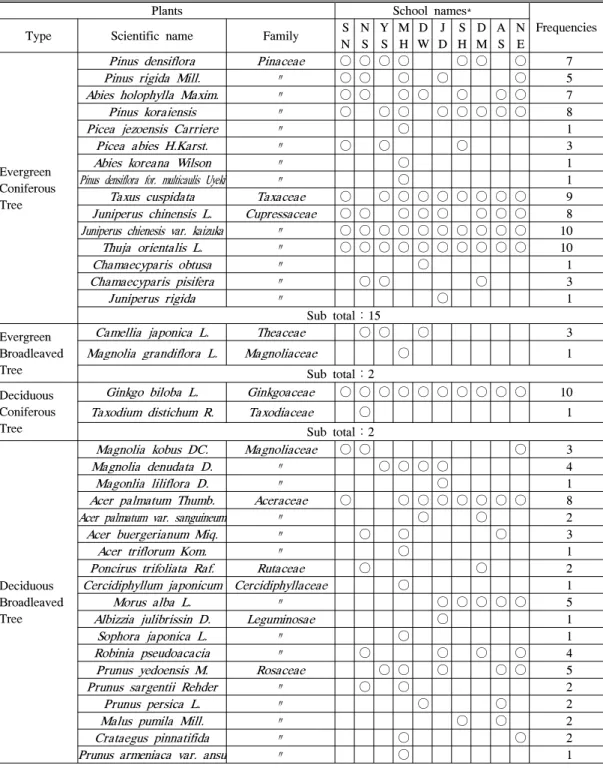
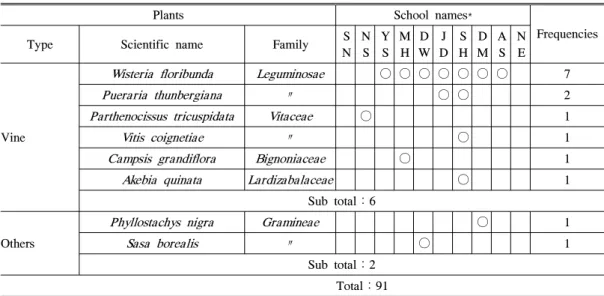
충주시 10개 초등학교에 식재되어 있는 식물 은 Table 1과 Table 2에 나타난 바와 같이 목본 류 89종, 초본류 108종, 기타식물 2종으로 총 199종이었다. 목본류의 경우 출현빈도는 가이쯔 까향나무, 측백나무, 은행나무, 느티나무, 회양 목, 무궁화가 10개교에 식재되어 있어 가장 높 았고, 다음으로 주목, 옥향나무, 장미 9개교, 잣 나무, 향나무, 단풍나무, 버즘나무, 사철나무, 개 나리 8개교, 소나무, 전나무, 철쭉, 등나무 7개교 등의 순이었다. 초본류의 경우 출현빈도는 호박 과 잔디가 10개교에 식재되어 있어 가장 높았 고, 다음으로 국화 9개교, 산국, 붓꽃 7개교 등의 순이었다.
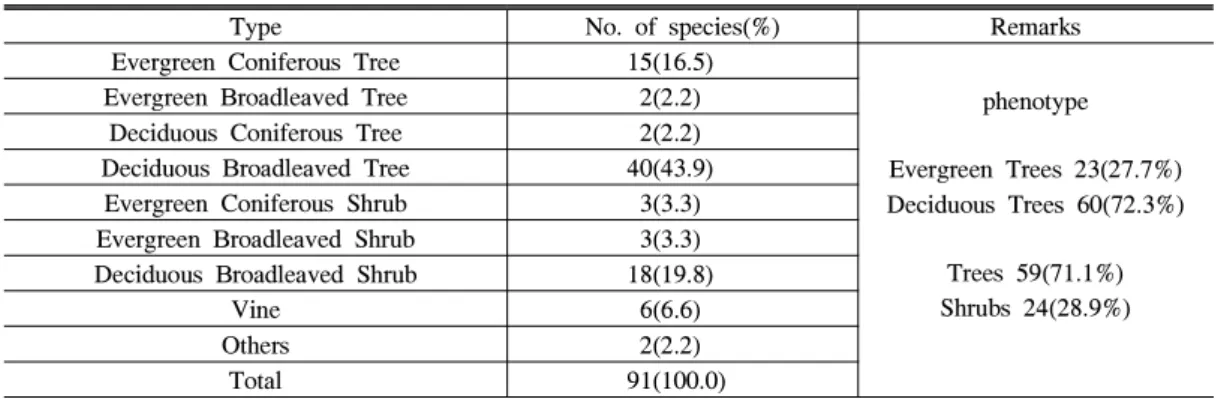
식재된 목본류를 성상별로 보면 Table 3에 나 타난 바와 같이 낙엽활엽교목이 40종으로 가장 많았고, 그 다음으로 낙엽활엽관목 18종, 상록침 엽교목 15종 순이었다. 이를 종합하여 상록수와 낙엽수의 비율(만경목, 기타 제외)을 수종별로 보면 상록수는 23개 수종으로 전체 수종의 27.7%이며, 낙엽수는 60개 수종에 72.3%를 나타 내 각 초등학교의 식재 수종 패턴이 낙엽수에 편 중되어 있음을 알 수 있었다. 또한 교목과 관목 의 비율(만경목, 기타 제외)을 수종별로 보면 교
Plants School names*
Frequencies Type Scientific name Family S
N N S Y
S M H D
W J D S
H D M A
S N E
Evergreen Coniferous Tree
Pinus densiflora Pinaceae ○ ○ ○ ○ ○ ○ ○ 7
Pinus rigida Mill. 〃 ○ ○ ○ ○ ○ 5
Abies holophylla Maxim. 〃 ○ ○ ○ ○ ○ ○ ○ 7
Pinus koraiensis 〃 ○ ○ ○ ○ ○ ○ ○ ○ 8
Picea jezoensis Carriere 〃 ○ 1
Picea abies H.Karst. 〃 ○ ○ ○ 3
Abies koreana Wilson 〃 ○ 1
Pinus densiflora for. multicaulis Uyeki 〃 ○ 1 Taxus cuspidata Taxaceae ○ ○ ○ ○ ○ ○ ○ ○ ○ 9 Juniperus chinensis L. Cupressaceae ○ ○ ○ ○ ○ ○ ○ ○ 8 Juniperus chienesis var. kaizuka 〃 ○ ○ ○ ○ ○ ○ ○ ○ ○ ○ 10 Thuja orientalis L. 〃 ○ ○ ○ ○ ○ ○ ○ ○ ○ ○ 10
Chamaecyparis obtusa 〃 ○ 1
Chamaecyparis pisifera 〃 ○ ○ ○ 3
Juniperus rigida 〃 ○ 1
Sub total:15 Evergreen
Broadleaved Tree
Camellia japonica L. Theaceae ○ ○ ○ 3
Magnolia grandiflora L. Magnoliaceae ○ 1 Sub total:2
Deciduous Coniferous Tree
Ginkgo biloba L. Ginkgoaceae ○ ○ ○ ○ ○ ○ ○ ○ ○ ○ 10
Taxodium distichum R. Taxodiaceae ○ 1
Sub total:2
Deciduous Broadleaved Tree
Magnolia kobus DC. Magnoliaceae ○ ○ ○ 3
Magnolia denudata D. 〃 ○ ○ ○ ○ 4
Magonlia liliflora D. 〃 ○ 1
Acer palmatum Thumb. Aceraceae ○ ○ ○ ○ ○ ○ ○ ○ 8
Acer palmatum var. sanguineum 〃 ○ ○ 2
Acer buergerianum Miq. 〃 ○ ○ ○ 3
Acer triflorum Kom. 〃 ○ 1
Poncirus trifoliata Raf. Rutaceae ○ ○ 2
Cercidiphyllum japonicum Cercidiphyllaceae ○ 1
Morus alba L. 〃 ○ ○ ○ ○ ○ 5
Albizzia julibrissin D. Leguminosae ○ 1
Sophora japonica L. 〃 ○ 1
Robinia pseudoacacia 〃 ○ ○ ○ ○ 4
Prunus yedoensis M. Rosaceae ○ ○ ○ ○ ○ 5
Prunus sargentii Rehder 〃 ○ ○ 2
Prunus persica L. 〃 ○ ○ 2
Malus pumila Mill. 〃 ○ ○ 2
Crataegus pinnatifida 〃 ○ ○ 2
Prunus armeniaca var. ansu 〃 ○ 1
SN; Seong Nam, NS; Nam San, YS; Yong San, MH; Mok Haeng, DW; Dan Wol, JD; Ju Deok, SH; Su Heo, DM; Dae Mi, AS; Ang Seong, NE; No Eun
Table 1. Status of the planted species(woody plants & others) in the 10 elementary schools.
목은 59개 수종으로 71.1%, 관목은24개 수종으 로 28.9%를 나타내 교목에 편중된 경향을 보였
다. 이것을 남정철(2002)의 부산시 초등학교 연 구결과인 수종별 상록수(49.5%):낙엽수(50.5%)
Plants School names*
Frequencies Type Scientific name Family S
N N S Y
S M H D
W J D S
H D M A
S N E
Deciduous Broadleaved Tree
Prunus salicina Lindl. Rosaceae ○ 1
Chaenomeles sinensis 〃 ○ ○ ○ ○ 4
Sorbus commixta Hedl. 〃 ○ 1
Malus sieboldii Rehder 〃 ○ 1
Diospyros kaki Thunb. Ebenaceae ○ ○ ○ 3 Zizyphus jujuba var. inermis Rehder Rhamnaceae ○ ○ ○ 3
Castanea crenata Fagaceae ○ ○ ○ ○ 4
Quercus acutissima C. 〃 ○ ○ 2
Quercus dentata Thunb. 〃 ○ ○ 2
Fraxinus rhynchophylla H. Oleaceae ○ 1
Chionanthus retusa Lindl. 〃 ○ ○ ○ 3
Zelkoba serrata Makino Ulmaceae ○ ○ ○ ○ ○ ○ ○ ○ ○ ○ 10
Salix koreansis Andersson Salicaceae ○ 1
Populus nigra var. italica 〃 ○ ○ 2
Cornus kousa F. Bureger Cornaceae ○ ○ ○ 3
Cornus officinalis 〃 ○ ○ 2
Lagerstroemia indica L. Lythraceae ○ ○ 2 Platanus orientalis L. Platanaceae ○ ○ ○ ○ ○ ○ ○ ○ 8
Juglans sinensis Juglandaceae ○ 1
Carpinus turczaninovii Betulaceae ○ 1
Rhus verniciflua Stokes Anacardiaceae ○ ○ ○ ○ 4 Sub total:40
Evergreen Coniferous Shrub
Taxus caespitosa Nakai Taxaceae ○ ○ 2
Juniperus chinensis var. sargentii Henry Cupressaceae ○ ○ 2 Jniperus chinensis var. globosa 〃 ○ ○ ○ ○ ○ ○ ○ ○ ○ 9
Sub total:3 Evergreen
Broadleaved Shrub
Euonymus japonica Thunb. Celastraceae ○ ○ ○ ○ ○ ○ ○ ○ 8 Buxus microphyll Nakai Buxaceae ○ ○ ○ ○ ○ ○ ○ ○ ○ ○ 10 Rhododendron lateritium Ericaceae ○ ○ ○ ○ ○ ○ ○ ○ ○ 9
Sub total:3
Deciduous Broadleaved Shrub
Rosa spp. Rosaceae ○ ○ ○ ○ ○ ○ ○ ○ ○ 9
Prunus tomentosa Thunb. 〃 ○ 1
Prunus glandulosa for. albiplena 〃 ○ 1
Cercis chinensis Bunge Leguminosae ○ ○ ○ ○ 4 Hibiscus syriacus L. Malvaceae ○ ○ ○ ○ ○ ○ ○ ○ ○ ○ 10 Abeliophyllum distichum N. Oleaceae ○ ○ ○ 3
Ligustrum obtusifolium 〃 ○ ○ ○ ○ ○ ○ 6
Syringa oblata var. dilatata 〃 ○ ○ ○ 3
Forsythia koreana Nakai 〃 ○ ○ ○ ○ ○ ○ ○ ○ 8 Rhododendron mucronulatum Ericaceae ○ ○ 2 Rhododendron schlippenbachii Maxim. 〃 ○ ○ ○ ○ ○ ○ ○ 7 Viburnum opulus L. Carprifoliaceae ○ ○ ○ 3
Weigela subsessilis L.H.Bailey 〃 ○ 1
Lycium chinense Mill. Solanaceae ○ ○ 2
Paeonia suffruticosa Andr. Paenoiaceae ○ ○ 2
Elaeagnus umbellata Elaeagnaceae ○ 1
Hydrangea macrophylla Ser. Saxifragaceae ○ ○ 2
Lindera obtusiloba Lauraceae ○ 1
Sub total:18 Table 1. Continued.
Plants School names*
Frequencies Type Scientific name Family S
N N S Y
S M H D
W J D S
H D M A
S N E
Vine
Wisteria floribunda Leguminosae ○ ○ ○ ○ ○ ○ ○ 7
Pueraria thunbergiana 〃 ○ ○ 2
Parthenocissus tricuspidata Vitaceae ○ 1
Vitis coignetiae 〃 ○ 1
Campsis grandiflora Bignoniaceae ○ 1
Akebia quinata Lardizabalaceae ○ 1
Sub total:6
Others
Phyllostachys nigra Gramineae ○ 1
Sasa borealis 〃 ○ 1
Sub total:2 Total:91 Table 1. Continued.
Plants School names*
Frequencies Type Scientific name Family S
N N S Y
S M H D
W J D S
H D M A
S N E
Annuals
&
Biennials
Callistephus chinensis Compositae ○ ○ ○ ○ ○ ○ 6
Calendula arvensis 〃 ○ 1
Zinnia elegans 〃 ○ ○ ○ ○ 4
Cosmos bipinnatus 〃 ○ ○ ○ ○ 4
Helianthus annuus 〃 ○ ○ 2
Carthamus tinctorius 〃 ○ 1
Coreopsis drummondii 〃 ○ 1
Mirabilis jalapa Nyctaginaceae ○ 1
Portulaca grandiflora Portulacaceae ○ ○ ○ 3 Petunia hybrida Solanaceae ○ ○ ○ ○ ○ ○ 6 Celosia cristata Amaranthaceae ○ ○ ○ ○ ○ ○ 6
Gomphrena globosa 〃 ○ 1
Salvia officinalis Labiatae ○ ○ ○ ○ ○ 5
Viola tricolor L. var. hortensis Violaceae ○ ○ 2 Impatiens balsamina Balsaminiaceae ○ ○ ○ ○ ○ 5
Campanula punctata Campanulaceae ○ 1
Pharbits nil Convolvulaceae ○ ○ ○ ○ ○ ○ 6 Sub total:17
Table 2. Status of the planted species(herbaceous plants) in the 10 elementary schools.
식재율 및 교목(61.9%):관목(38.1%) 식재율과 비교하여 보면 기후 조건으로 인한 현저한 차이
를 보이고 있음을 알 수 있었다. 초본류에 있어 서는 다년초가 41종으로 가장 많았고, 그 다음으
Plants School names*
Frequencies Type Scientific name Family S
N N S Y
S M H D
W J D S
H D M A
S N E
Perennials
Chrysanthemum morifolium Compositae ○ ○ ○ ○ ○ ○ ○ ○ ○ 9 Chrysanthemum zawadskii var. latilobum 〃 ○ ○ ○ ○ ○ 5
Ligularia fischeri 〃 ○ ○ 2
Aster koraiensis 〃 ○ ○ ○ ○ 4
Leibnitzia anandria 〃 ○ 1
Syneilesis palmata 〃 ○ 1
Chrysanthemum boreale 〃 ○ ○ ○ ○ ○ ○ ○ 7
Ixeris chinensis var. strigosa 〃 ○ 1
Iris sanguinea Iridaceae ○ ○ ○ ○ ○ ○ ○ 7
Iris savatieri 〃 ○ 1
Iris ensata var. spontanea 〃 ○ ○ 2
Belamcanda chinensis 〃 ○ ○ ○ ○ 4
Hosta longipes Liliaceae ○ ○ 2
Hemerocallis fulva 〃 ○ ○ ○ ○ 4
Hemerocallis dumortieri 〃 ○ 1
Polygonatum odoratum var. pluriflorum 〃 ○ ○ ○ 3
Liriope platyphylla 〃 ○ 1
Convallaria keiskei 〃 ○ 1
Hosta plantaginea 〃 ○ 1
Arisaema amurense var. serratum Araceae ○ 1
Acorus calamus var. angustatus 〃 ○ 1
Lychnis cognata Coryophyllaceae ○ 1
Dianthus chinensis 〃 ○ ○ 2
Dianthus superbus var. longicalycinus 〃 ○ 1 Dicentra spectabilis Fumariaceae ○ ○ ○ 3
Hanabusaya asiatica Campanulaceae ○ 1
Campanula takesimana 〃 ○ 1
Aquilegia buergeriana var. oxysepala Ranunculaceae ○ ○ ○ 3
Aquilegia flabellata var. pumila 〃 ○ 1
Pulsatilla koreana 〃 ○ ○ ○ ○ 4
Caltha palustris var. membranacea 〃 ○ 1
Potentilla fragarioides var. major Rosaceae ○ 1 Veronica rotunda var. coreana Scrophulariaceae ○ ○ 2
Sedum kamtschaticum Crassulaceae ○ ○ 2
Sedum erythrostichum 〃 ○ 1
Primula sieboldi Primulaceae ○ 1
Viola mandshurica Violaceae ○ ○ 2
Physalis alkekengi var. francheti Solanaceae ○ ○ ○ 3
Solanum melongend L. var. pumilio 〃 ○ 1
Scutellaria indica Labiatae ○ 1
Phlox paniculata Polemoniaceae ○ 1
Sub total:41 Table 2. Continued.
Plants School names*
Frequencies Type Scientific name Family S
N N S Y
S M H D
W J D S
H D M A
S N E
Bulb
Canna L. Cannaceae ○ 1
Lilium tigrinum Liliaceae ○ ○ 2
Lycoris squamigera Amaryllidaceae ○ 1
Lycoris radiata 〃 ○ ○ 2
Sub total:4
Vegetables
Allium fistulosum Liliaceae ○ ○ 2
Allium tuberosum 〃 ○ ○ 2
Lagenaria leucantha Cucurbitaceae ○ 1
Cucurbita moschata 〃 ○ ○ ○ ○ ○ ○ ○ ○ ○ ○ 10
Lagenaria leucantha var. gourda 〃 ○ ○ 2
Solanum melongena Solanaceae ○ ○ 2
Capsicum annuum 〃 ○ ○ ○ ○ 4
Platycodon grandiflorum Campanulaceae ○ ○ 2 Sub total:8
Foodcrops
Oryza sativa Gramineae ○ ○ ○ 3
Sorghum bicolor 〃 ○ 1
Zea mays 〃 ○ ○ ○ 3
Avena sativa 〃 ○ 1
Glycine max Leguminosae ○ ○ ○ ○ 4
Phaseolus vulgaris var. humilis 〃 ○ ○ 2
Phaseolus vulgaris 〃 ○ 1
Pisum sativum 〃 ○ 1
Ipomoea batatas Convolvulaceae ○ 1
Perilla frutescens var. japonica Labiatae ○ ○ ○ ○ ○ 5
Sesamum indicum Pedaliaceae ○ 1
Sub total:11 Industrial
crops
Lufa cylindrica Cucurbitaceae ○ ○ 2
Ricinus communis Euphorbiaceae ○ ○ ○ 3
Sub total:2
Weeds
Setaria viridis Gramineae ○ ○ ○ ○ ○ 5
Digitaria sanguinalis 〃 ○ ○ ○ ○ 4
Zoysia japonica 〃 ○ ○ ○ ○ ○ ○ ○ ○ ○ ○ 10 Miscanthus sinensis var. purpurascens 〃 ○ ○ 2 Erigeron canadensis Compositae ○ ○ ○ ○ 4
Erigeron annuus 〃 ○ ○ 2
Taraxacum mongolicum 〃 ○ ○ ○ ○ ○ ○ 6
Taraxacum officinale 〃 ○ 1
Artemisia princeps var. orientalis 〃 ○ ○ ○ ○ ○ ○ 6 Cirsium japonicum var. ussuriense 〃 ○ ○ 2
Youngia sonchifolia 〃 ○ ○ ○ ○ 4
Trifolium repens Leguminosae ○ ○ ○ ○ ○ ○ 6
Aeschynomene indica 〃 ○ 1
Cassia mimosoides var. nomame 〃 ○ 1
Pteridium aquilinum var. latiusculum Pteridaceae ○ 1 Table 2. Continued.
Plants School names*
Frequencies Type Scientific name Family S
N N S Y
S M H D
W J D S
H D M A
S N E
Weeds
Sedum sarmentosum Crassulaceae ○ ○ ○ 3
Prunella vulgaris var. lilacina Labiatae ○ ○ 2 Cerastium fischerianum Caryophyllaceae ○ 1 Chenopodium album var. centrorubrum Chenopodiaceae ○ ○ ○ 3
Erysimum cheiranthoides Cruciferae ○ 1
Carex dispalata Cyperaceae ○ ○ 2
Sub total:22
Hydrophytes
Eichhornia crassipes Pontederiaceae ○ ○ 2
Typha orientalis Typhaceae ○ 1
Spirodela polyrhiza Lemnaceae ○ 1
Sub total:3 Total:108
Table 3. Classification of woody species by phenotype.
Type No. of species(%) Remarks
Evergreen Coniferous Tree 15(16.5)
phenotype Evergreen Trees 23(27.7%) Deciduous Trees 60(72.3%)
Trees 59(71.1%) Shrubs 24(28.9%) Evergreen Broadleaved Tree 2(2.2)
Deciduous Coniferous Tree 2(2.2) Deciduous Broadleaved Tree 40(43.9) Evergreen Coniferous Shrub 3(3.3) Evergreen Broadleaved Shrub 3(3.3) Deciduous Broadleaved Shrub 18(19.8)
Vine 6(6.6)
Others 2(2.2)
Total 91(100.0)
Table 2. Continued.
로 산야초 22종, 1․2년생초본 17종, 식용작물 11 종, 채소류 8종 등의 순이었다.
Table 4에 나타난 바와 같이 각 학교별 식물 식재현황을 살펴보면 가장 많은 식물종이 식재 된 초등학교는 목행으로서 108종이 심겨져 있 었으며, 그 다음으로 앙성 68종, 대미 63종 순이 었고, 용산의 경우 가장 적은 28종으로 나타나 학교간 심한 차이를 보였다. 평균적으로 학교당 약 60종이 식재된 것으로 조사되었다.
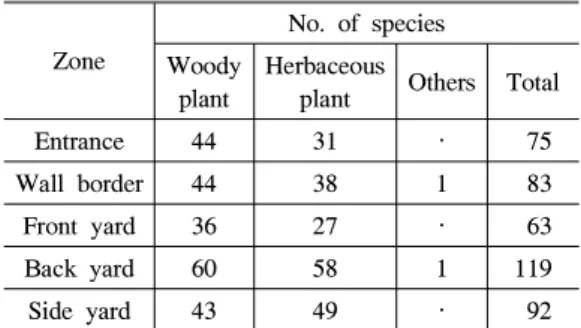
2. 초등학교내 구역별 식물 식재현황 분석 Table 5에 나타난 바와 같이 조사된 구역별 식물 식재현황은 진입부 75종, 본관주변 83종, 정면부 63종, 측면부 119종, 후면부 92종이었다.
가장 많은 식물종이 식재된 구역은 측면부로 다
양한 초본류와 목본류가 식재되어 있었으며, 정 면부의 경우 가장 적은 식물종이 식재된 것으로 조사되었다.
Table 4. Planting status in the 10 elementary schools.
School name*
No. of species Woody
plant Herbaceous
plant Others Total
SN 27 18 ․ 45
NS 32 16 ․ 48
YS 18 10 ․ 28
MH 54 54 ․ 108
DW 27 34 1 62
JD 32 26 ․ 58
SH 37 24 ․ 61
DM 33 29 1 63
AS 29 36 ․ 68
NE 29 31 ․ 60
See Table 1.
Zone Woody plant Herbaceous plant
Entrance
Juniperus chienesis var. kaizuka Ginkgo biloba Euonymus japonica Buxus microphylla var. koreana
Rhododendron lateritium
Callistephus chinensis Cosmos bipinnatus
Celosia cristata
Wall border
Juniperus chienesis var. kaizuka Taxus cuspidata Jniperus chinensis var. globosa Buxus microphylla var. koreana
Rhododendron lateritium
Petunia hybrida Salvia officinalis Zoysia japonica
Front yard
Pinus rigida Ginkgo biloba Acer palmatum Zelkoba serrata Hibiscus syriacus
Chrysanthemum morifolium Chrysanthemum boreale
Iris sanguinea
Back yard
Thuja orientalis Ginkgo biloba Zelkoba serrata Buxus microphylla var. koreana
Forsythia koreana
Callistephus chinensis Pharbits nil Chrysanthemum morifolium
Side yard
Juniperus chienesis var. kaizuka Ginkgo biloba Acer palmatum Hibiscus syriacus Forsythia koreana
Zinnia elegans Impatiens balsamina
Hemerocallis fulva Table 6. Planted main species of each zone.
Table 5. Planting status of each zone.
Zone
No. of species Woody
plant Herbaceous
plant Others Total
Entrance 44 31 ․ 75
Wall border 44 38 1 83
Front yard 36 27 ․ 63
Back yard 60 58 1 119
Side yard 43 49 ․ 92
Table 6에 나타난 바와 같이 구역별 주요 식 물종을 조사한 결과 몇몇 식물종 중심으로 식재 되어 구역별 특성을 찾아볼 수 없었다. 그 예로 가이쯔까향나무, 은행나무 등은 특정 구역에 나 타나는 것이 아니라 대부분의 구역에 공통적으 로 나타났는데 이는 구역특성을 고려한 식재가 아니라 획일적인 식재에서 연유된 것이다. 이러
한 문제는 심진구(1980)의 연구에서도 보고된 바 있으며, 비단 초등학교뿐만 아니라 우리나라 전체 조경식물 이용현상에서도 나타나는 현상 이라 하겠다(이동철, 1986). 따라서, 학교의 건물 과 토지이용에 따른 기능적이고, 생태적인 측면 을 고려하지 않은 현재의 학교 식물이용은 앞으 로 개선되어야 할 점으로 생각된다.
3. 초등학교의 교목․교화분석
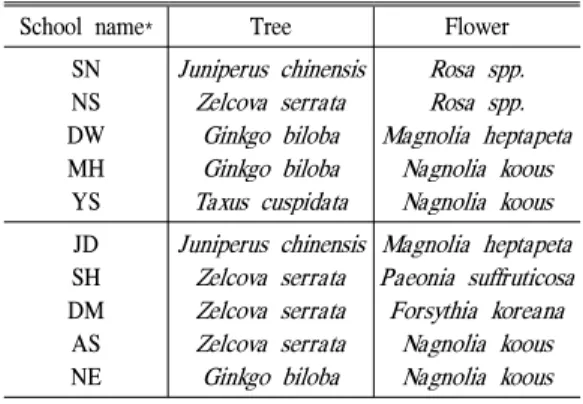
각 학교의 교목과 교화를 조사한 결과는 Table 7에 나타난 바와 같다. 교목으로는 느티나무가 4 개교, 은행나무가 3개교, 향나무, 주목, 소나무가 각각 1개교이며, 교화로는 목련(백목련 포함)이 6개교, 장미가 2개교, 모란과 개나리가 각각 1개 교였다. 이를 다른 지역의 연구결과와 비교해 보 면 광주지역(심우경, 1983)의 초등학교 교목으로 는 향나무, 히말라야시다, 동백, 소나무, 은행나
Table 7. School tree and flower of the 10 elementary schools.
School name* Tree Flower SN
DWNS MHYS
Juniperus chinensis Zelcova serrata
Ginkgo biloba Ginkgo biloba Taxus cuspidata
Rosa spp.
Rosa spp.
Magnolia heptapeta Nagnolia koous Nagnolia koous SHJD
DMAS NE
Juniperus chinensis Zelcova serrata Zelcova serrata Zelcova serrata Ginkgo biloba
Magnolia heptapeta Paeonia suffruticosa Forsythia koreana
Nagnolia koous Nagnolia koous See Table 1.
무, 교화로는 국화, 철쭉, 장미, 동백, 개나리를, 목포지역(조영환, 1987)의 초등학교는 향나무, 히말라야시다, 동백나무를 교목으로, 동백, 국화, 철쭉을 교화로 지정한 학교가 많았다. 그리고 인 천지역(신중관, 1990)의 국민학교 교목으로 은행 나무, 현사시나무, 교화로 장미, 개나리, 무궁화, 목련, 국화를 지정한 것으로 조사 보고된 바 있 다. 이를 종합하여 볼 때 지역여건에 따라 약간 의 차이는 있으나 비슷한 경향을 보였다. 이와 같은 교목이나 교화로 선정되는 이유는 이들 식 물들이 가지는 상징성에 기인한다고 판단된다.
그러나 향후 교목․교화 선정에 있어서 그 지역 의 기후 및 향토성, 학교의 개교이념이나 역사와 전통 등 학교 및 지역의 특수여건을 고려한 수종 선택의 다양화를 시도할 필요가 있겠고, 교목 및 교화를 중심으로 애교심을 고취할 수 있도록 신 중한 수종선정과 식재관리에 많은 배려가 있어 야 하겠다.
Ⅳ. 적 요
본 연구는 충주시 10개 초등학교를 대상으로 식물 식재현황을 조사․분석하여 향후 초등학 교의 건물과 토지이용에 따른 기능적이고, 생태 적인 식물이용을 위한 기초 자료를 제공하고자 수행하였으며, 얻어진 연구결과는 다음과 같다.
충주시 10개 초등학교에 식재되어 있는 식물 은 목본류 89종, 초본류 108종, 기타식물 2종으
로 총 199종이었다. 평균적으로 학교당 약 60종 이 식재된 것으로 조사되었다.
식재된 목본류를 성상별로 보면 낙엽활엽교목 이 40종으로 가장 많았고, 그 다음으로 낙엽활엽 관목 18종, 상록침엽교목 15종 등의 순이었다.
상록수와 낙엽수의 비율(만경목, 기타 제외) 을 수종별로 보면 상록수는 23개 수종으로 전체 수종의 27.7%이며, 낙엽수는 60개 수종에 72.3%
를 나타내 각 초등학교의 식재 수종 패턴이 낙 엽수에 편중되어 있음을 알 수 있었다. 교목과 관목의 비율(만경목, 기타 제외)을 수종별로 보 면 교목은 59개 수종으로 71.1%, 관목은 24개 수종으로 28.9%를 나타내 교목에 편중된 경향 을 보였다.
조사된 구역별 식물 식재현황은 진입부 75종, 본관주변 83종, 정면부 63종, 측면부 128종, 후 면부 95종이었다. 가장 많은 식물종이 식재된 구역은 측면부로 다양한 초본류와 목본류가 식 재되어 있었으며, 정면부의 경우 가장 적은 식 물종이 식재된 것으로 조사되었다.
각 학교의 교목과 교화를 조사한 결과 교목으 로는 느티나무가 4개교, 은행나무가 3개교, 향 나무, 주목, 소나무가 각각 1개교이며, 교화로는 목련(백목련 포함)이 6개교, 장미가 2개교, 모란 과 개나리가 각각 1개교였다.
인 용 문 헌
남정철. 2000. 초등학교 식재 식물 현황에 관한 연 구 - 부산시 15개 초등학교를 대상으로 - 동아대학교대학원 석사학위논문.
신중관. 1990. 국민학교 학교원 조성을 위한 기 초조사연구 - 인천시 국민학교의 식재현 황을 중심으로 -고려대학교 대학원 석사 학위논문.
심우경. 1983. 학교의 옥외환경 개선을 위한 조 경학적 기초연구(1) - 광주시 학교환경의 개황과 식재를 중심으로 - 한국조경학회 지 11(2):155-181.
심진구. 1980. 국민학교의 내재한 문제와 그 해 결 방안. 인천교대논문집 15:189-206.
이동철. 1986. 우리나라 조경공사의 조경수목실 태에 관한 연구. 성균관대학교 대학원 석 사학위논문.
이상호. 1997. 서울시 녹색네트워크 형성을 위한 녹지확충방안. 서울:서울시정개발연구원.
정성혜. 1998. 학교조경의 해외사례와 경향. 환경 과 조경. 127:54-58.
조영환․박천호. 1987. 국민학교 조경에 있어서 의 식물이용체계에 관한 연구-목포시내
15개 국민학교를 대상 으로 - 한국조경학 회지 15(2):1-21.
차혜연. 1999. 학교공원 제도 도입에 관한 연구 - 서울시 강동구 강덕초등학교와 고덕중학교 를 중심으로 - 고려대학교 대학원 석사학위 논문.
文部省. 1999. 綠豊かな學校づくり-屋外運動場等の芝生 化․植栽- 동경:ソフトサイエンス社.
接受 2004年 8月 10日