Korean J Environ Agric (2012) Online ISSN: 2233-4173 Vol. 31, No. 2, pp. 97-103 http://dx.doi.org/10.5338/KJEA.2012.31.2.97 Print ISSN: 1225-3537
Health Risk Assessment through Residents Exposure to Toxic Metals in Soil and Groundwater in the Vicinity of Sanyang Metal Mine
Jeong-Hun Park,
1* Kyoung-Kyoon Choi
21Department of Environmental Engineering, Chonnam National University, Gwangju 500-757, Republic of Korea
2Soil Technology Research Institute, Chonnam National University, Gwangju 500-757, Republic of Korea
Received: 18 May 2012 / Accepted: 17 June 2012
ⓒ 2012 The Korean Society of Environmental Agriculture
*교신저자(Corresponding author),
Phone: +82-62-530-1855; Fax: +82-62-530-0856;
E-mail: [email protected]
97
Abstract
BACKGROUND: Metal mines were actively developed in the early twentieth century in Korea; however, most of these mines were closed and abandoned without proper management. Therefore, toxic metal contamination in the vicinity of Korean abandoned metal mines has been reported. A risk assessment for these metals was performed for residents near by abandoned Sanyang metal mine.
METHODS AND RESULTS: Soil and groundwater samples were collected from May to October 2007 around the mine.
After pretreatment of these samples, metal concentrations were measured and then a risk assessment was performed using the Korean soil-contamination risk assessment guidelines.
Cancer risk was the highest from inhalation of Pb-contaminated soil, followed in descending order by As-contaminated soil inhalation and water ingestion. The sum of carcinogenic risks was 3.35×10
-3. The noncarcinogenic risk was observed for inhalation of Hg-contaminated soil (5.71).
CONCLUSION: Inhalation of soil in dust was the principal pathway to cause the health risk and most of the risk was attributed to As, Pb,Cd, and Hg contamination.
Key Words: Heavy metals, Mining, Phytoaccumulation, Risk assessment, Soil
Introduction
Metal mines were actively developed in the early twentieth century in Korea; however, most of these mines were closed and abandoned without proper management in the 1970s because of economic conditions and the exhaustion of ore reserves (Kim et al., 2005). Currently, 936 abandoned metal mines exist in Korea (Susaya et al., 2010), and preliminary investigations for soil contamination in mines have been performed. Recently, precise investigations for approximately 300 mines have been performed over the three years from 2007 to 2009. It has been reported that heavy metal contamination is one of primary environmental problems around the abandoned mines (Susaya et al., 2010). However, risk assessments for those mines have been rarely performed.
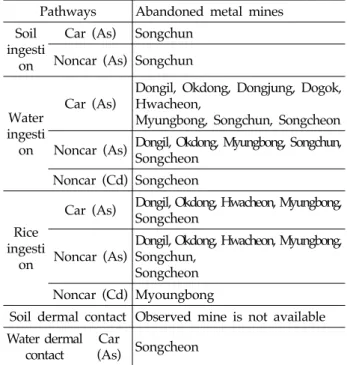
The reported risks for humans in the vicinity of several metal mines have been summarized in Table 1. Rice and water ingestion were the primary pathways for As or Cd exposure and posed both carcinogenic and noncarcinogenic health risks to residents in the Dongil (Lee and Chon, 2005; Lee et al., 2006), Okdong (Lee and Chon, 2005), Dongjung (Lee and Chon, 2005), Dokok (Lee and Chon, 2005), Hwacheon (Lee and Chon, 2005), Myungbong (Lee and Chon, 2003), Songchun (Lee et al., 2006), and Songcheon (Lee et al., 2005b;
Lim et al., 2008) mine areas. Carcinogenic and noncarcinogenic health risks from As ingestion with soil were observed only in the Songchun (Lee et al., 2006) mine area. Carcinogenic health risk by dermal contact with As-contaminated water was observed
Open Access
Research Article
only in the Songcheon (Lim et al., 2008) mine area.
Farmer may be exposed to dust through agricultural activities, nonetheless, none of these reports considered the pathway of dust inhalation.
Pathways Abandoned metal mines Soil
ingesti on
Car (As) Songchun Noncar (As) Songchun
Water ingesti
on
Car (As)
Dongil, Okdong, Dongjung, Dogok, Hwacheon,
Myungbong, Songchun, Songcheon Noncar (As) Dongil, Okdong, Myungbong, Songchun,
Songcheon Noncar (Cd) Songcheon
Rice ingesti
on
Car (As) Dongil, Okdong, Hwacheon, Myungbong, Songcheon
Noncar (As)
Dongil, Okdong, Hwacheon, Myungbong, Songchun,
Songcheon Noncar (Cd) Myoungbong
Soil dermal contact Observed mine is not available Water dermal
contact
Car
(As) Songcheon
Car: carcinogenic risk, Noncar: noncarcinogenic risk, Parenthesis is the risk metal.
Table 1. Abandoned metal mines with carcinogenic and non- carcinogenic risks through exposure pathways of target metals
The abandoned Sanyang metal mine was selected for an assessment of health risk for residents in the vicinity of the mine. The purpose of this study was to investigate the metal contamination levels of soil and groundwater, to estimate the daily intake of metals, to estimate carcinogenic and noncarcinogenic risks by various metal pathways including inhalation of dust, and to assess the risks for residents in the vicinity of the abandoned Sanyang metal mine following Korean soil-contamination risk assessment guidelines.
Materials and Methods
Investigation of metal contamination
The Sanyang Au-Ag mine is located in Banseok-ri, Boseong-gun, Chonnam in a southwestern province of South Korea. The geology of this mine is classified as Cretaceous granite. Granitic gneiss is composed of biotite, quartz, muscovite, plagioclase, and feldspar. This mine had been developed to exploit gold and silver from 1935 to 1957. After closure of the mine in 1992,
tailings and waste rock were left behind without proper environmental treatment. The mining wastes have been dispersed down into paddy fields by water and wind near the mine (Jo, 2001).
Soil samples were collected from agricultural fields and groundwater samples were collected from wells for residents in the vicinity of the mine. All these samples were collected from May to October 2007.
Contaminant analysis of soil was performed according to the Korean Standard Test (KST) Methods for Soils (MOE, 2007). All soil samples were air-dried and sieved to-10 mesh (< 2 mm). Ten grams of sieved soil was extracted with 50 mL of 0.1 Nand 1 N HCl for analysis of Cd, Pb, Cu, and Cr and As, respectively. The extracted solution was filtrated through 5B filter paper (Advantec, Toyo Roshi Kaisha, Japan). For Zn analysis, dried soils were pulverized and sieved to-100 mesh(< 0.15 mm). 3 g of sieved soil was digested with 28 mL of 3:1 HCl/HNO
3solution (aqua regia) for one hour at 70℃. The extracted or digested solution was filtrated through 5B filter paper, and the concentrations of metals were then measured by inductively coupled plasma-atomic emission spectrometry (ICP-AEX) (2100DV, Perkin-Elmer). Sampled soil was used in a Direct Mercury Analyzer (DMA-80, Milestone) for Hg analysis.
Groundwater used as drinking water was sampled around the mine area. The samples were filtered through a 0.45 μm membrane (PTFE Smart Por, Woongki science, South Korea), then acidified with concentrated HNO
3, and finally the metal concentrations in the water samples were measured using inductively coupled plasma-mass spectrometry (ICPM-8500, Shimadzu, Japan).
Health risk assessment
The purposes of risk assessment are to provide information to decision-makers about the consequences of possible actions, the source treatment and disposal options, the remediation of contaminated sites, and the cleanup standards. The risk assessment consisted of four main analyses: hazard identification, exposure assessment, toxicity (dose-response) assessment, and risk characterization (NRC, 1983).
Hazard identification
To identify hazards, soils and groundwater used
for drinking were collected from the vicinity of the
mine. The concentrations of metals in those samples
were measured.
Exposure assessment
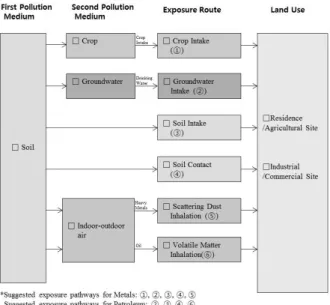
Fig. 1 shows the exposure pathways of contaminated soils to human as expressed in the Korean guidelines (MOE, 2009). Four pathways (groundwater ingestion as drinking water, soil ingestion, and soil contact and dust inhalation through outdoor and indoor air)are suggested for metal exposure in the Korean guidelines.
In exposure assessment, the average daily intake (ADI) was calculated by summing the intakes of toxic metals through the suggested pathways. The intake of metals with exposure can be quantitatively calculated using the formula in Table 2. The input parameters in Table 3 were used to determine the ADI values via human exposure pathways such as inadvertent soil ingestion, soil dermal contact, groundwater ingestion, and dust inhalation (MOE, 2009).
Fig. 1. Suggested exposure pathways of contaminants in soils to humans (MOE, 2009).
Exposure pathways Average daily intake Ingestion of soil
Ingestion of water
Is = (Cs × IR ×EF × ED)/(BW × AT) Iw = (Cw × IR × EF × ED)/(BW × AT) Dermal contact with
soil
Ids = (Cs × CF × SAe × AF × ABs
× EF × ED)/(BW × AT)
Inhalation of dust Iid = (TSP × frs × CRi × t × tf) × Cs
× fr × fa × EF × ED/(BW × AT) C = concentration of metal in the medium (Cs for soil and Cw for water), and other parameters and factors are as listed in Table 3.
Table 2. Equations of average daily intake with different exposure pathways (units in mg/kg-day)
Toxicity (dose-response) assessment
Dose-response relationships for carcinogens are reported as lifetime incidence of cancer (i.e., probability) versus dose. The slope factor (SF) represents the carcinogenic potency of the chemical. Unlike carcinogens, there is a threshold effect for noncarcinogens. In other words, below a specific dose, no adverse health effect occurs in exposed populations. This threshold is defined as reference dose (RfD). Carcinogenic and noncarcinogenic risks for contaminants were estimated using SF and RfD respectively as given in the Korean guidelines (MOE, 2009). As, Cd and Pb are classified as carcinogenic metals, and the other metals are classified as noncarcinogens.
Risk Characterization
Risk characterization is quantitatively expressed by carcinogenic risk and noncarcinogenic risk. Carcinogenic risk may be defined as the average daily intake (calculated in the exposure assessment) multiplied by the carcinogenic slope factor (selected by the toxicity assessment) and can be calculatedusing the following formula:
Carcinogenic risk = I (average daily intake) × SF where the values of SF for As, Cd and Pb were as given in the Korean guidelines. The estimated value is the probability of an individual’s developing any type of cancer from lifetime exposure to carcinogenic chemicals.
The total carcinogenic risk equals the sum by exposure route to carcinogenic risks from all individual substances.
The acceptable or tolerable total risk for regulatory purposes is in the range of 10
-6-10
-4(MOE, 2009).
Noncarcinogenic risk is normally characterized in terms of a hazard index. This index is defined as the ratio of the average daily intake from exposure (calculated in the exposure assessment) to the reference concentration (selected by the toxicity assessment) and can be calculated as follows:
Hazard index (HI, non-carcinogenic risk) = I / RfD where the values of RfD for metals were as given in the Korean guidelines. For exposure to multiple noncarcinogens, the hazard index scores for all noncarcinogens are summed to provide the final measure of the risk for noncarcinogenic adverse effects. If the sum of hazard indices exceeds 1.0, this implies that the contaminants had noncarcinogenic adverse effects.
Results and Discussion
44 soils (32 from paddies and 12 from farmland
soils) and two groundwater sources were sampled
from the vicinity of the mine. The mean concentrations of As, Cu, Cu, Pb, Zn, and Hg in these media are shown in Table 4. All metals measured were detected in soils, and the Zn concentration was the highest as 69 mg/kg. As and Zn metals were detected in the groundwater.
Estimated daily metal intake rates from the various media are shown in Table 5. The parameters shown
in Table 3, which are listed in the Korean guidelines (MOE, 2009), were used to estimate the daily intake rate. The daily intake rate of metals was the highest for Zn, followed in descending order by As, Pb, Cd, Hg and Cu. The metal intake rate through the various pathways was the highest for inhalation of soil in dust, followed in descending order by groundwater ingestion, soil ingestion, and soil contact.
Factor/Parameter Symbol Media Units Residents
Exposure duration ED all years Carcinogen-70
Non-carcinogen-30
Exposure Frequency EF all days/year, events/year 365
Averaging time AT all days ED×EF
Body weight BW all kg 60
Ingestion rate IR
soil kg/day 0.0001
water L/day 2
Skin area exposed SAe soil cm2 5700
Adherence factor AF soil mg/cm2 0.07
Absorption factor ABS soil-As /event 0.03
soil-Cd /event 0.001
Total suspended particle TSP soil mg/m3
Indoor 0.07
outdoor 0.053
Soil fraction in dust frs soil -
indoor 0.8
outdoor 0.5
Inhalation rate Cri soil m3/day 20
Exposure time/day t soil h/d 8
Exposure ratio tf soil -
indoor 2.86
outdoor 0.143
Retention factor
particles in lung fr soil 0.75
Relative Absorption factor fa soil 1
Table 3. Parameters used for an adult Korean farmer (EPA, 1997; MOE, 2009)
Type Number of Samples Conc. As Cd Cu Pb Zn Hg
soil 44 mg/kg 5.53±10.0 0.44±2.3 2.19±1.6 3.09±3.9 69.2±37 3.6E-2±0.19
water 2 mg/L 6.5E-3 0 0 0 0.07 0
Table 4. Concentrations of metals in media around the abandoned Sanyang metal mine
Type Pathway Unit As Cd Cu Pb Zn Hg Total
soil ingestion mg/kg-d 9.23E-6 7.43E-7 3.65E-6 5.15E-6 1.15E-4 6.0E-8 1.34E-4
contact 1.10E-6 2.96E-9 1.10E-6
inhalation 7.55E-2 6.08E-3 0.0 0.042 0.944 4.91E-4 1.07
subtotal 7.55E-2 6.08E-3 3.65E-6 0.042 0.944 4.91E-4 1.07
water ingestion 2.17E-4 0 0 0 2.33E-4 0 4.5E-4
subtotal 2.17E-4 0 0 0 2.33E-4 0 4.5E-4
Total 7.58E-2 6.08E-3 3.65E-6 0.042 0.944 4.91E-4 1.07
Table 5. Daily intake water of metals from each medium
Estimated carcinogenic risks of metals from the various media are shown in Table 6. Slope factors of As and Pb for ingestion of soil and water were given as 1.5 and 0.0085 respectively in the Korean guidelines.
The slope factor of As for soil contact was given as 61.
The slope factors of As, Cd, and Pb for soil inhalation were given as 0.015, 0.0063, and 0.042 respectively.
The cancer risk of metals was the highest for lead (Pb)
(1.77×10
-3), followed in descending order by As and Cd. Cancer risk by pathway was the highest for soil inhalation, followed in descending order by groundwater ingestion, soil contact, and soil ingestion. Considering both metals and pathways, cancer risk was highest from inhalation of Pb-contaminated soil, followed by inhalation of As-contaminated soil and ingestion of As-contaminated water.
Type Pathway As Cd Pb Zn Hg Total
soil ingestion SF 1.5 8.5E-3 - -
risk 1.38E-5 4.38E-8 1.39E-5
contact SF 61 - - - -
risk 6.74E-5 6.74E-5
inhalation SF 0.015 6.3E-3 0.042 - -
risk 1.13E-3 3.83E-5 1.77E-3 2.94E-3
subtotal 1.21E-3 3.83E-5 1.77E-3 3.02E-3
water ingestion SF 1.5 - 8.5E-3 - -
risk 3.25E-4 3.25E-4
subtotal 3.25E-4 0 0 0 0 3.25E-4
Total 1.54E-3 3.83E-5 1.77E-3 0 0 3.35E-3
※SF (kg-day/mg): Safety Factors are from the Korean guidelines (MOE, 2009)
Table 6. Carcinogenic risk estimates via metal exposure pathways around abandoned mines
Carcinogenic risk is the probability of an individual developing any type of cancer from lifetime exposure to carcinogenic chemicals. The acceptable or tolerable total risk for regulatory purposes is in the range of 10
-6-10
-4(MOE, 2009). Considering 10
-4as an acceptable risk, which means that one additional case in 10,000 people is acceptable, there was considerable carcinogenic risk because of As and Pb in this area. The cancer risks frominhalation of Pb-contaminated soil, inhalation of As-contaminated soil, and ingestion of As-contaminated groundwater exceeded the acceptable risk. However, the risks from ingestion of soil and contact with soil
did not exceed the acceptable risk. The sum of all carcinogenic risks was 3.34×10
-3. This value is equivalent to the probability that approximately three cancers per 1,000 people will occur. Most of the risk was due to Pb and As contaminations, and therefore, Pb and As were considered to be the principal carcinogens for humans in this area.
It has been reported that the residents around the
following mines have been exposed to carcinogenic
health threats: Dongil, Okdong, and Hwacheon mines
due to ingestion of As-contaminated water and soil (Lee
and Chon, 2005); Dongil, Dongjung, Myungbong, and
Songchun mines due to ingestion of As-contaminated water (Lee et al ., 2006); Myungbong mine due to ingestion of As-contaminated rice(Lee et al ., 2008);
Songchun mine due to ingestion of As-contaminated soil, water, and crops (Lim et al ., 2008); and Okdong and Hwacheonmines due to ingestion of As-contaminated rice and water (Lee et al ., 2005a). Carcinogenic risk in the Koran abandoned mine area by ingestion of contaminated soil, water, and crops has been reported as mentioned above; however, the risk of As and Pb contamination by inhalation of contaminated soil has not been reported up to now. In this study, exceeded cancer risk was observed from inhalation of Pb-and As-contaminated soil in abandoned Sanyang mine. The risk of inhalation of metal-contaminated soil should be considered in a carcinogenic risk assessment along with ingestion of water and crops in abandoned mine areas.
Estimated noncarcinogenic risks of metals from the various media studied are shown in Table 7. The reference dose (RfD) values of As, Cd, Pb, Zn, and Hg for intake from soil and water were given in the Korean guidelines. The noncarcinogenic risk (hazard index, or HI) of metals was the highest for mercury (Hg), with a value of 5.71, followed in descending order by As, Pb, Cd, and Zn. By pathway, the highest noncarcinogenic risk was in the inhalation of soil (5.71), followed in descending order by ingestion of water, ingestion of soil, and contact with soil. Considering both metals and pathways, the risk was the highest for inhalation of Hg-contaminated soil (5.71), followed in descending order by ingestion of As-contaminated water (0.72) and ingestion of As-contaminated soil (3.08×10
-2).
Type Pathway As Cd Cu Pb Zn Hg Total
soil ingestion RfD 3.0E-4 5.0E-4 - 5.0E-4 0.3 3.0E-4
HI risk 3.08E-2 1.49E-3 1.03E-2 3.84E-4 2.0E-4 4.31E-2
contact RfD 3.0E-4 5.0E-4 - 5.0E-4 0.3 2.1E-5
HI risk 3.81E-3 2.28E-4 0 0 0 4.04E-3
inhalation RfD - - - 8.6E-5
HI risk 0 0 0 0 5.71 5.71
subtotal 3.46E-2 1.71E-3 1.03E-2 3.84E-4 5.71 5.75
water ingestion RfD 3.0E-4 5.0E-4 - 5.0E-4 0.3 3.0E-4
HI risk 0.722 0 0 7.78E-4 0 0.723
subtotal 0.722 0 0 7.78E-4 0 0.723
Total 0.757 1.71E-3 0 1.03E-2 1.16E-3 5.71 6.48
※RfD (mg/kg-day): Reference Dose values are from the Korean guidelines (MOE, 2009) Table 7. Noncarcinogenic risk estimates via metal exposure pathways around abandoned mines