27(11); 1105~1115; November 2018 https://doi.org/10.5322/JESI.2018.27.11.1105
ORIGINAL ARTICLE
Characteristics of Aquatic Ecosystem Environment in Seosan Reservoir, Korea
Dohun Lim, Yoonjin Lee
1)*Konkuk University, Department of Civil and Environmental Engineering, Seoul 05029, Korea
1)
Konyang University, College of General Education, Daejeon 35365, Korea
Abstract
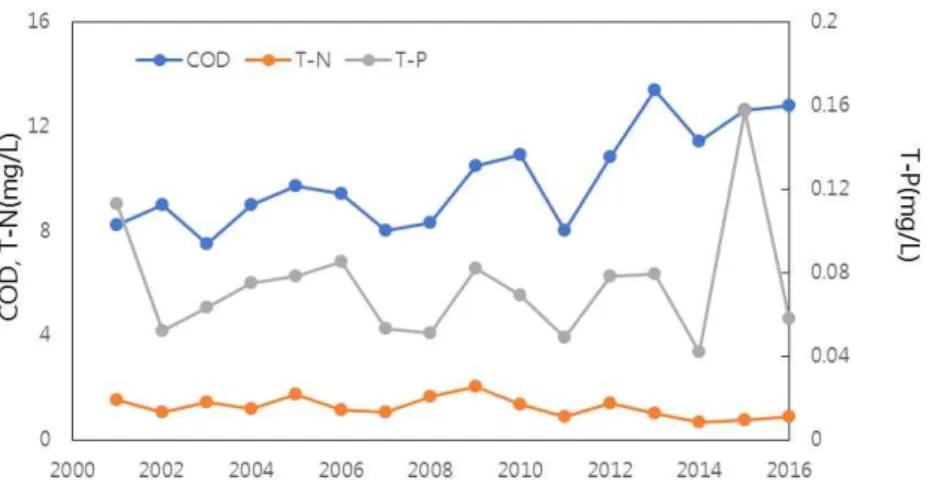
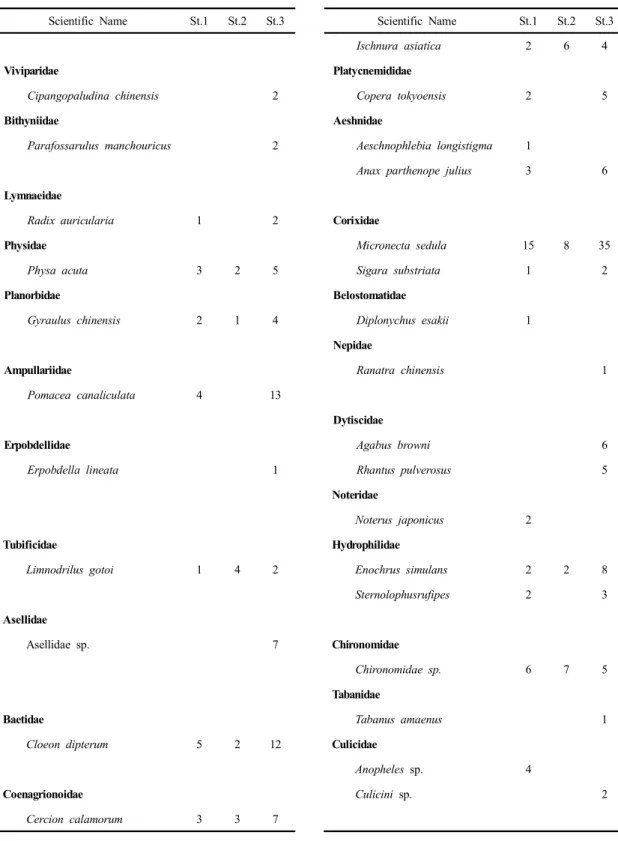
The aim of this study was to collect crucial data for the improvement of water quality and ecosystem conservation by analyzing water samples, sediments, benthic macroinvertebrates, and fish in the Seosan reservoir. The average values of water quality parameters from 2001 to 2016 were a chemical oxygen demand of 10 mg/L, total nitrogen of 1.22 mg/L, and total phosphorus of 0.074 mg/L. Cadmium was detected in the range of 0.531–0.748 mg/kg in the reservoir sediment. Fish belonging to 6 families and 9 species were identified in the reservoir. The dominant species were Carassius auratus and Micropterus salmoides. Benthic macroinvertebrates belonging to 22 families and 28 species were identified. The ecological score of the benthic macroinvertebrate community was 15 inside the reservoir (St. 2). Micropterus salmoides, an invasive alien species, was determined to be the subdominant fish species based on the number of captures, and the presence of the invasive species, Sicyos angulatus L. and Paspalum distichum L. was confirmed among the land flora.
Key words : Nutrient release, Agricultural reservoir, Reservoir management, Eutrophication
1. Introduction 1)
Many agricultural reservoirs were constructed in the 1970s and over 60% of the water used for agriculture is currently supplied by these reservoirs. Reservoirs exhibit ecosystem disturbances because of eutrophication arising from increased phytoplankton populations. Nutrient salts and organic matter from point pollution sources, such as stock breeding facilities, or nonpoint pollution sources, such as farmland, in the surrounding areas accumulate in the reservoir, contributing to ecosystem deterioration and the occurrence of offensive smells owing to algal
blooming. Water quality in the reservoir can be affected by various factors such as the lake scale, flow in the water body, climate, pollutant sources in the watershed, and water circulation (Kim and Hwang, 2004, Youn et al., 2008).
In Korea, rain mainly occurs during the summer, and massive pollutant inflows from nonpoint pollution sources occur during the rainy season. Reservoirs located in rural or mountainous territories have long storage times until the water is utilized for irrigation.
Thus, pollutants that flow in to the reservoir with the rain water accumulate and adversely affect the water quality via excessive nutrient concentrations.
Received 4 October, 2018; Revised 22 October, 2018;
Accepted 24 October, 2018
*