• 검색 결과가 없습니다.

Evaluation of Water Quality Characteristics and Ecosystem Health of Yongpung Reservoir, Korea

N/A
N/A
Protected

Academic year: 2021

Share "Evaluation of Water Quality Characteristics and Ecosystem Health of Yongpung Reservoir, Korea"

Copied!
12
0
0

로드 중.... (전체 텍스트 보기)

전체 글

(1)

Evaluation of Water Quality Characteristics and Ecosystem Health of Yongpung Reservoir, Korea

Dohun Lim*, Yoonjin Lee**

, and Kyung Kim***

*Korea Natural Environment Institute

**College of General Education, Konyang University

***College of Environmental Engineering, Anyang University

ABSTRACT

Objectives: The Yongpung reservoir in Korea is a crucial facility that supplies water to farms in its surrounding 2 km

2

area. However, its water quality is not suited to the needs of current residents who wish for the availability of environmentally friendly agricultural products and desire to use the waterfront area. The aim of this research was to evaluate the reservoir’s fish and benthic macroinvertebrate distributions and determine its water quality and the heavy metal content in its sediment. This basic data can be used to establish environmentally protective plans for the Yongpung reservoir.

Methods: Six sites were selected for analysis in this investigation. Three points (YP-1, YP-2, and YP-3) were evaluated for water quality and metal content in sediments; they were located upstream, midstream, and downstream of the reservoir. Samplings of the fish and benthic macroinvertebrate populations were performed at three other sites: St. 1, St. 2, and St. 3.

Results: Based on chemical oxygen demand (COD) and total nitrogen (T-N) data, the quality of the Yongpung reservoir water corresponds to Class VI (very poor) according to Korea’s lake environmental standards. The lead levels measured in the sediment at the midstream and downstream points of the reservoir were 76.7 and 72.7 mg/kg, respectively, while 8 orders, 15 families, and 16 species of benthic macroinvertebrates were identified in the reservoir. The ecological score of the benthic macroinvertebrate community (ESB) was between 8 and 23, denoting poor to very poor environmental conditions. Further, 4 families and 7 species of fish were identified in the reservoir, with Cyprinidae accounting for 94.3% of all observed freshwater fish.

Conclusion: Based on these findings, we conclude that management plans, including the removal of lead from the sediment, are necessary to improve the quality of the agricultural water in this reservoir. The T. japonica, which cover almost 30% of the water area, must also be removed.

Keywords: Eutrophication, nutrient, reservoir, ecosystem health, sediment, reservoir management

I. Introduction

Quantitative and qualitative management of agri- cultural water is needed to decrease the amount of pondage and reduce eutrophication.

1)

Nitrogen and phosphorus runoff from farmland affects neighbor- ing land, reduces productive capacity, and results in economic losses due to ecosystem disturbance.

Organic pollution and eutrophication can change the structure and function of an ecosystem, leading to decreased diversity, simplification of community structures, and food web imbalances.

Few naturally formed lakes exist in Korea, most reservoirs having been artificially constructed. The ecological properties of these reservoirs are very different from those of naturally formed lakes due

Corresponding author: College of General Education, Konyang University, 158 Gwanjeodong-ro, Seo-gu, Daejeon, Korea, Tel: +82-42-600-8660, E-mail: [email protected]

Received: 23 November 2018, Revised: 17 January 2019, Accepted: 18 February 2019

원 저 Original articles

(2)

to fundamental differences in their formation pro- cesses.

2-3)

Water quality fluctuations in space and time are a major issue in domestic reservoirs, and the hydraulic and hydrologic characteristics of such reservoirs are very different from those of natural lakes. In particular, monsoon precipitation in Korea greatly affects fluctuations in the water quality of the country’s lakes, leading to changes in their physio-chemical status due to the content of organic nutrients and salts and changes in the water level and quantity in the reservoirs.

4)

Ninety-nine percent of earth is the type of earth dam, and 88% of domestic agricultural reservoirs are occupied by those over 50 years old. Thus, domestic reservoirs have been exposed to various problems, such as decrepit facilities and a decline in safety. Ninety-three percent of agricultural reser- voirs have an effective capacity under 300,000 m

3

and an insufficient supply of water. In particular, Lim et al. (2015) reported that the water quality of a domestic small/medium-sized reservoir deterio- rated badly to very badly during the fall and winter and that T-N was the main item in this deteriora- tion.

Eutrophication accelerates in domestic agricultural reservoirs, as most of these reservoirs are less than 10 m in depth, and their surface area is greater than their volume. Generally, shallow lakes tend to be especially vulnerable to eutrophication. Various other factors affect the water quality of a reservoir. These include the retention time, basin area, water depth, soil application status, and amount of water storage.

Pollutants leached from sediments, especially nutri- ents such as nitrogen and phosphorus, cause algal growth. After they die, the algae are sedimented, leading to an increase in the internal load. In Japan, a lake with a depth less than 8 m is considered eutrophicated when the level of Chl-a exceeds 12 mg/m

3

.

An increase in nutrient salts can give rise to algal growth, which decreases water transparency and has adverse effects on fisheries.

5-6)

Phosphorus often acts

as the limiting nutrient in eutrophicated freshwater ecosystems.

7)

Some nutrient salts may be supplied from the watershed and sediments from organic matter that accumulate over a long period.

8-10)

Phos- phorus loads in the watershed depend on both the distribution of the watershed’s pollutants and its rainfall intensity.

11-12)

Water temperature and light are the main factors that govern the succession of phytoplankton.

Climate also leads to variations in water quality and ecosystem functions, especially in regions where rainfall events are concentrated in specific seasons.

Climate-induced variations in the hydrologic charac- ter of lakes are particularly common in areas with monsoon climates, including Korea.

13)

The impor- tance of these factors differs from that of the struc- tural and geological characters of watersheds, seasons, and the watershed environment. Analyses of the bio-species and trophic structure of a reservoir can supply crucial data for establishing effective man- agement plans for agricultural water reservoirs.

The aim of this research was to determine the heavy metal content in the sediment, fish composi- tion and distribution, benthic macroinvertebrate composition and distribution, and water quality in the Yongpung reservoir. The data collected were applied to supply basic data for the establishment of an environmental-ecological preservation and res- toration plan for the reservoir.

II. Materials and Methods

1. Research area

The Yongpung reservoir, which was constructed in 1946, is located in Icheon, South Korea. It has a watershed area of 5 km

2

, a maximum water sur- face area of 0.25 km

2

, and total storage of 715,000 m

3

. Forestry, rice paddies, agricultural fields, resi- dential housing, roads, streams, and others account for 37.3, 23.2, 15.5, 4.0, 4.8, 3.3, and 11.9% of land use, respectively.

The Yongpung reservoir is surrounded by com-

(3)

mercial fisheries, cattle farms, and swine farms, as well as other farms and villages, which are located upstream. The main inflow to the reservoir is the Bangchu stream. Livestock facilities are located in the upstream region. Wastewater treatment systems are not present around the study area. Untreated sewage is discharged from livestock facilities and enters the reservoir during periods of heavy rainfall.

The composition of livestock breeding in the study area is as follows: pigs (96.53%), dairy cattle (2.70%), Korean native cattle (0.72%), and goats (0.05%). Residual fertilizer, agricultural pesticides, and pollutants are nonpoint pollution sources.

The mean annual temperature in the region is 11.6

o

C. The total rainfall amount in 2011 was 2,045 mm, and the mean amount of total rainfall during the past 10 years was 1,349 mm, according to data from the Icheon regional meteorological office. The largest and smallest amounts of rainfall in the past 10 years were 2,045 and 791.5 mm in 2011 and 2014, respectively. Rainfall was concentrated between May and August, with these months accounting for over 50% of the total rainfall amount. The mean annual wind speed was between 1.2 and 1.4 m/s.

2. Sample site selection and sample collection Three sites were selected for the analysis of the

water quality (Fig. 1). These sites (YP-1, YP-2, and YP-3) were located upstream, midstream, and downstream of the reservoir. Sediment samples were also obtained from these three sites. The water qual- ity analysis was performed four times: on July 13, August 16, September 1, and September 22. The following water quality parameters were analyzed:

pH, COD, SS, DO, T-P, conductivity, and T-N. The temperature, DO, and conductivity were measured in situ using YSI-556 MPS. For the water quality analysis, 5 L of water were collected and transferred to the laboratory. The other parameters that were measured were analyzed using standard analytical methods for water suggested by the Korean Minis- try of Environment. The sediment samples were analyzed for the presence of Cd, As, Cr

6+

, Hg, Ni, F, Zn, and Ni using standard analytical methods for soils.

The investigation of fishes and benthic macroin- vertebrates in the water was performed on Novem- ber 10, 2016. A Surber net (30×30 cm, mesh size 0.2 mm) was used to sample the benthic macroin- vertebrates. The sampled specimens were fixed with 10% formalin and transported to the laboratory.

They were then observed under a stereoscopic microscope (Olympus SZ7). Identification was done according to previous guidelines.

14-15)

Based on the

Fig. 1. Sampling locations throughout the Yongpung Reservoir

(4)

results of the analysis, the ecological score of the benthic macroinvertebrate community (ESB) was calculated. The ESB for the assessment of environ- mental quality followed that of Kong (1997) (Envi- ronmental quality score-4: very clean, 3: clean, 2:

polluted, and 1: very polluted).

A cast net (mesh size 6×6 mm) and a skimming net (mesh size 4×4 mm) were used for the sampling of fish. The sampling was performed 10 times. The specimens were then fixed with 10% formalin and transferred to the laboratory for identification. Their identification followed Kim (1997) and Kim and Park (2002),

16-17)

and their taxonomic classification followed Nelson (2006).

18)

In the analysis, fish less than 20 mm in length were excluded from the count.

III. Results and Discussion

1. Water quality

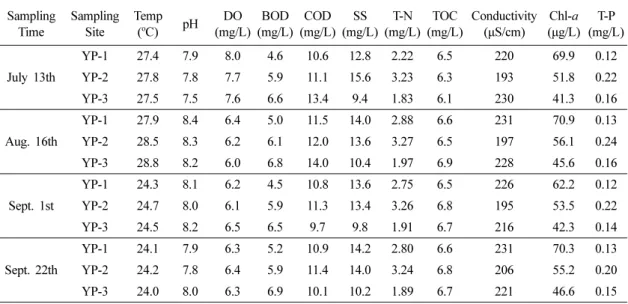
In the Yongpung reservoir, the pH ranged from 7.5-8.4, and the conductivity and TOC were 193- 231 µS/cm and 6.1-6.9 mg/L, respectively (Table 1).

The average values for DO and SS were 6.6 and 12.6 mg/L, respectively. The highest levels (8.0 and

15.6 mg/L, respectively) were found at site YP-1 and YP-2, respectively.

The level of COD ranged from 9.7 to 14 mg/L, and the highest level at all sites was recorded in August. As shown as Fig. 2, which shows the COD levels from 2001 to 2016, COD levels continued to increase after 2011, with the maximum level observed in 2016. The average T-N and T-P levels during the last 16 years have been 2.4 and 0.078 mg/L, respectively. The average mean level of Chl- a was 55.5 μg/L. In 2016, the mean levels of COD, T-P, and T-N were 11.4, 0.17, and 2.6 mg/L, respec- tively. Thus, the water quality was classed as VI (very bad) according to environmental standards for lakes in Korea. This result indicated that the water quality was not suitable for the supply of agricul- tural water to neighboring land and that it could possibly have an adverse effect on the crop and soil environments.

2. Sediments

Three points (YP-1, YP-2, and YP-3) were selected to analyze organic matter and metals in the sediment layer (Table 2). When heavy metals enter sediment layers, they remain there for a long time

Table 1. Analysis of water quality in the Yongpung reservoir Sampling

Time

Sampling Site

Temp

(

o

C) pH DO (mg/L)

BOD (mg/L)

COD (mg/L)

SS (mg/L)

T-N (mg/L)

TOC (mg/L)

Conductivity (µS/cm)

Chl-a (µg/L)

T-P (mg/L)

July 13th

YP-1 27.4 7.9 8.0 4.6 10.6 12.8 2.22 6.5 220 69.9 0.12

YP-2 27.8 7.8 7.7 5.9 11.1 15.6 3.23 6.3 193 51.8 0.22

YP-3 27.5 7.5 7.6 6.6 13.4 9.4 1.83 6.1 230 41.3 0.16

Aug. 16th

YP-1 27.9 8.4 6.4 5.0 11.5 14.0 2.88 6.6 231 70.9 0.13

YP-2 28.5 8.3 6.2 6.1 12.0 13.6 3.27 6.5 197 56.1 0.24

YP-3 28.8 8.2 6.0 6.8 14.0 10.4 1.97 6.9 228 45.6 0.16

Sept. 1st

YP-1 24.3 8.1 6.2 4.5 10.8 13.6 2.75 6.5 226 62.2 0.12

YP-2 24.7 8.0 6.1 5.9 11.3 13.4 3.26 6.8 195 53.5 0.22

YP-3 24.5 8.2 6.5 6.5 9.7 9.8 1.91 6.7 216 42.3 0.14

Sept. 22th

YP-1 24.1 7.9 6.3 5.2 10.9 14.2 2.80 6.6 231 70.3 0.13

YP-2 24.2 7.8 6.4 5.9 11.4 14.0 3.24 6.8 206 55.2 0.20

YP-3 24.0 8.0 6.3 6.9 10.1 10.2 1.89 6.7 221 46.6 0.15

(5)

and may pose a threat to human health following transfer through the food chain. The metals in the sediments were as follows: cadmium (0.34-0.46 mg/

kg), copper (13.13-14.71 mg/kg), arsenic (3.53-4.95 mg/kg), mercury (0.08-0.09 mg/kg), lead (61.68- 76.68 mg/kg), zinc (145.22-159.1 mg/kg), nickel (29.82-31.72 mg/kg), and fluorine (84.0-93.0 mg/kg).

Hexavalent chromium, organic phosphorus com- pounds, polychlorinated biphenyls (PCBs), phenols, benzene, toluene, ethylbenzene, xylene, trichloroeth- ylene, tetrachloroethylene, and benzopyrene were not detected in any of the samples.

However, lead was detected at YP-2 (76.68 mg/

kg) and YP-3 (72.71 mg/kg). Based on these levels, the sediments can be classified as Grade II, accord- ing to pollution assessment standards for sediments in lakes in Korea. The detected levels point to the possibility of their toxicity to benthic organisms.

Jeong and Lee (2006) observed higher heavy metal levels in deeper stream sediments in the Daejeon region.

19)

The sediment layer of the Yongpung reservoir is composed of 4.7% gravel, 58.6% sand, 28.1% slit, and 8.7% clay. The highest organic content was detected at point YP-2 (Table 3). T-N contents ranged from 583.1 to 990.9 mg/kg, and T-P contents ranged from 220.35 to 235.98 mg/kg. The amount of nitrogen released from the sediment under aero- bic and anaerobic conditions was 0.51 and 2.5 mg/

m

3

/day, and the amount of phosphorous released from the sediment was 84.4 and 101.8 mg/m

3

/day.

Sediments may serve as a storage site for pollutants, and such pollutants may have adverse effects on aquatic organisms.

20)

3. Benthic macroinvertebrates

A total of 8 orders, 15 families, and 16 species of benthic macroinvertebrates were found to inhabit the reservoir. Non-insect species and insect species accounted for 18.75 and 81.25%, respectively, of the total order count (Table 4). Insect species belonging Fig. 2. Variations in the water quality from 2001 to 2016

Table 2. Analysis of bed sediments in the Yongpung reservoir

Items YP-1

(mg/kg)

YP-2 (mg/kg)

YP-3 (mg/kg)

T-N 846.9 583.1 990.9

T-P 234.7 220.4 235.9

Cd 0.459 0.380 0.342

Cu 14.71 13.93 13.13

As 4.23 3.53 4.95

Hg 0.089 0.085 0.078

Pb 61.68 76.68 72.71

Zn 145.22 159.10 152.55

Ni 31.72 31.29 29.82

F 84 93 89

*PCBs, phenols, benzene, toluene, ethylbenzene, xylene,

trichloroethylene, tetrachloroethylene, and benzopyrene were

not detected.

(6)

to Odonata, Hemiptera, Diptera, Basommatophora, Archioligochaeta, Decapoda, Ephemeroptera, and

Coleoptera accounted for 25, 25, 18.75, 6.25, 6.25, 6.25, and 6.25%, respectively, of the total order count.

Eleven families and twelve species of benthic macroinvertebrates were observed at St. 1, which was the inlet point of the Bangchu stream. These included Gyraulus chinensis, Limnodrilus gotoi, Asellus hilgendorfii, Palaemon paucidens, Cloeon dipterum, Cercion calamorum, Platycnemis phillop- oda, Anax parthenope julius, Micronecta sedula, Sigara substriata, Chironomidae sp., Stratiomyia KUa, and Anopheles species. In total, 22 specimens (number of an individual) were recorded at St. 2:

Limnodrilus gotoi, Palaemon paucidens, Cloeon dipterum, Cercion calamorum, Anax parthenope julius, Orthetrum albistylum speciosum, Micronecta sedula, Sigara substriata, Muljarus japonicus, Rana- tra unicolor, and Rhantus pulverosus. The reservoir bed consisted of mud and sand at St. 2, with little aquatic plant development. At St. 3, eight specimens were detected, including Palaemon paucidens, Micronecta sedula, Chironomidae sp., Cloeon dip- terum, and Limnodrilus gotoi. At St. 3, the water level was deep, and the bed was mostly composed of sand and cobblestone.

The ESB was 22, 23, and 8 for the benthic mac- roinvertebrate communities at St. 1, St. 2, and St.

3, respectively. These scores indicate that the envi- ronmental conditions were either bad or very bad.

Based on the ESB, St. 3 can be considered a poly- saprobic area.

4. Fish distribution

Four families and seven species of fish were iden- tified in the reservoir. Of these, 94.3% belonged to the Cyprinidae family, with the remainder belonging to Cobitidae, Bagridae, and Siluridae (Table 5 and Fig. 3). Which is different from previous research reported five families and 21 species.

21,22)

Three families and six species were recorded at St. 1. The dominant species were Zacco platypus, Carassius auratus, and Pseudorasbora parva, with Table 3. Physical characteristics of bed sediments in the

Yongpung reservoir

Items YP-1 YP-2 YP-3

Particle Distribution

Gravel (%) 4.9 4.7 4.4

Sand (%) 59.3 58.4 58.2 Silt (%) 29.9 27.5 26.8

Clay (%) 6.0 9.5 10.5

Organics (%) 2.18 2.39 2.17

Ignition loss (%) 5.1 8.9 9.4 Table 4. Benthic macroinvertebrates detected in the

Yongpung reservoir

Scientific Name St.1 St.2 St.3 Family Planorbidae

Gyraulus chinensis 2

Family Tubificidae

Limnodrilus gotoi 2 1 1

Family Palaemonidae

Palaemon paucidens 13 3 1

Family Baetidae

Cloeon dipterum 6 4 1

Family Coenagrionoidae

Cercion calamorum 1 1

Family Platycnemididae

Platycnemis phillopoda 2 Family Aeshnidae

Anax parthenope julius 3 2 Family Libellulidae

Orthetrum albistylum speciosum 1 Family Corixidae

Micronecta sedula 35 4 2

Sigara substriata 7 1

Family Belostomatidae

Muljarus japonicus 1

Family Nepidae

Ranatra unicolor 1

Family Dytiscidae

Rhantus pulverosus 1

Family Chironomidae

Chironomidae sp. 2 1 3

Family Stratiomyiidae

Stratiomyia KUa 1

Family Culicidae

Anopheles sp. 2 1

(7)

14, 7, and 6 specimens recorded, respectively. Spe- cies, such as C. auratus, P. parva, and Z. platypus, belonging to the Cyprinidae family were detected only at St. 2. Two families and three species (C.

auratus, P. parva, and Silurus asotus) were recorded at St 3. Four endemic species were confirmed as inhabitants in 2011: Acheilognathus chankaensis, Squalidus gracilis majimae, Iksookimia koreensis, Odontobutis interrupta, and Carassius cuvieri, which is an exotic species not observed during this investigation.

The lowest numbers of fishes (n=11) were recorded at St. 3. The present study did not observe invasive alien species and legally protected species.

5. Other major ecological groups of animals Ten families and fifteen species of mammals were recorded around the reservoir, including Prionai- lurus bengalensis (the leopard). Footprints of the leopard cat, which has been classed in the list of endangered wild fauna and flora in Korea by the Korean Ministry of Environment, were found around the embankment of the reservoir (Fig. 4).

Twenty-two families and forty-two species of birds were found in the proximity of the study area.

These included endangered species, such as Aix galericulata (Natural Monument No. 327), Accipiter gentilis (a second-grade endangered species), and Falco tinnunculus (Natural Monument No 323-8),

with 878 birds observed in total. The dominant spe- cies of birds in the area were Anas platyrhynchos, Anas poecilorhyncha, Passer montanus, Anas crecca, and Paradoxornis webbiana. Most birds found were residential (73.81%), and the percentages of winter visitor and passage migrants were 23.81% and 2.38%, respectively.

Terrestrial animals inhabit the environment due to the presence of arable land and timberland close to the study area. However, the presence of villages and roads close to the reservoir restricts the move- ment of these animals. Utilization of farm and local roads by vehicles on the northern and southern sides of the reservoir is high.

6. Suggested water quality improvement plan The Yongpung reservoir is a crucial source of agricultural water for its neighboring 2 km

2

area.

However, its water quality is affected by the various conditions there, such as the prospering T. japonica population and the inlet of waste, earth, and sand.

As the lake’s environmental standards have changed from COD to TOC since 2016, the level of TOC is also being monitored. The mean TOC level in 2016 was 7.8 mg/L. This value corresponds to the fifth grade of Korea’s lake environmental standards.

Special plans are required to bring these levels below a TOC level of 6 mg/L and a COD level of 8 mg/L.

A number of pollution sources around the Yong- pung Reservoir were found during this investigation;

water quality had deteriorated as a result of live- stock compost being released in the upstream area, the use of chemical fertilizers, and pollutants from roads that inflow during rainfall events. Untreated wastewater from neighboring villages has also had a negative effect on water quality. Therefore, plans to improve the water quality in the reservoir are required via not only the establishment of a waste- water treatment plant but also a stock waste treat- ment plant and reduction facilities for non-point sources, such as small irrigation ponds. All of these Table 5. Fish fauna in the Yongpung reservoir

Scientific Name St.1 St. 2 St. 3 Family Cyprinidae

Cyprinus carpio 1

Carassius auratus 7 5 8

Pseudorasbora parva 6 3 2

Zacco platypus 14 4

Family Cobitidae

Misgurnus anguillicaudatus 1 Family Bagridae

Pseudobagrus fulvidraco 1 Family Siluridae

Silurus asotus 1

(8)

factors should have a specific plan for improving water quality in the reservoir.

Based on the results of this investigation, the fol- lowing plans are suggested for enhancing the water

quality of the reservoir so that it meets the demands

of fine quality agricultural water. Introducing a

chain of treatment processes for the constructed

wetlands is necessary. This process is expected to

Fig. 3. Photographs of fishes and benthic macroinvertebrates that emerged from the Yongpung Reservoir

(9)

create harmony with the farming villages and make use of natural purification functions.

We suggest a combined type of constructed wet- land, that is, a combination of a surface flow sys-

tem and a subsurface flow system, in this area.

These can be connected with sedimentation pro- cesses to remove dirt and sand during rain events and phosphorus at the inlet points (Fig. 5). Also, a Fig. 4. The status of terrestrial animals in the research

*Detailed lists of birds and mammals were not reported herein.

(10)

drain gate and an induced waterway should be installed in the secondary sedimentation dam, and water intake by the constructed wetlands could be arranged through a water-pumping facility to effi- ciently improve the water quality.

The removal percentages of COD, T-N, and T-P have been projected at 17.9, 32.6, and 31.8%, respectively, using Environmental Fluid Dynamics Code and WASP models in the process rather than a no-treatment approach (figures are not shown).

These expected removal efficiencies satisfy the fourth grade of Korean standards.

Removal processes to control the T. japonica pop- ulation in the upstream area of the reservoir are

required. T. japonica will be aggressively dealt with from July through September, and those will be collected and dried before the treatment of wastes.

The removal area for T. japonica is estimated at a total of 0.1 m

2

and will occur during Year 3 (Fig.

6).

IV. Conclusion

This research was performed to evaluate the eutrophication, fish distribution, pollutants in sedi- ment, and benthic macroinvertebrates in Yongpung reservoir. The analysis of water quality revealed pH of 7.5-8.4, COD of 9.7-14 mg/L, SS of 9.4-15.6 Fig. 6. An image of Trapa japonica growth in the Yongpung reservoir

Fig. 5. Suggested plan for water quality improvement in the Yongpung Reservoir

(11)

mg/L, DO of 6.0-8.0 mg/L, T-P of 0.12-0.24 mg/L, and T-N of 1.83-3.27 mg/L. A significant lead con- tent (61.7-76.7 mg/kg) was detected in the sedi- ments, pointing to a possible toxicity risk to benthic organisms. Based on the mean value of COD and T-P during the last 16 years, the standard of water quality was classed as VI (very bad) according to environmental standards for lakes in Korea. Four families and seven species of fish were recorded in the reservoir, including species tolerant to water pol- lution, such as Cyprinus carpio and C. auratus.

These findings may point to eutrophication and organic pollution of the Yongpung reservoir.

To control water pollution sources, various initia- tives, including the establishment of a community sewage system and livestock effluent treatment facilities should be undertaken in the near future.

The construction of a sedimentation basin and a constructed wetland on waterside land could also be considered. T. japonica growth is rampant in some upstream parts, covering almost 30% of the water area. Given the impact of the decomposition of T.

japonica on water color, a plan to eliminate T.

japonica is required.

Acknowledgments

This study was supported by a grant from the Korea Rural Community Corporation.

References

1. Nam GS, Jang JR, Lee GS., Yoon KS, Lee, SJ.

Characteristics of water environment on Manun res- ervoir, Korean J. Environ. Agric., 2003; 22: 16-25.

2. Jones JR, Knowlton MF, An KG, Developing a par- adigm to study and model the eutrophication pro- cess in Korean reservoirs, Korean J. Limnol. 1997;

82: 1-9.

3. Wetzel RG, Reservoir ecosystems; conclusions and speculation, 227-238, in; Reservoir limnology; eco- logical rerspectives (Thornton, K. W. et al., eds.) John Wiley and Sons, New York, 1990.

4. Ann KK, Shin IC, Influence of the Asian monsoon

on seasonal fluctuations of water quality in a moun- tainous stream, Korean J. Limnol. 2005; 38: 54-62.

5. Kim HS, Hwang SJ, Seasonal variation of water quality in a shallow eutrophic reservoir, Korean J.

Limnol. 2004; 37: 180-192.

6. Reynolds CS, Physical determinants of phytoplank- ton succession. 9-56. in: Plankton ecology: succes- sion in plankton communities (Sommer, U. ed.)., Springer Veri., Berlin, 1989.

7. Edmonson WT, Lehman, JT, The effect of changes in the nutrient income on the condition of Lake Washington, Limnol. Oceanogr. 1981; 26: 1-29.

8. Cooke GD, Welch EG, Peterson, SP, Newroth, PR, Restoration and management of lakes and reser- voirs (2nd ed.), Lewis. Boca Raton, 1993.

9. Jeppesen E, Kristensen P, Jensen JP, Sndergaard M, Mortensen E, Lauridsen, TL, Recovery resilience following a reduction in external phosphorus load- ing of shallow eutrophic Danish lakes: duration, regulating factors and methods for overcoming resilience, Memorie dell’s Istituto Italiano di Idrobi- ologia, 1991; 48: 127-148.

10. Williams WF, Barko, JW, Estimation of phospho- rus exchange between littoral and pelagic zones during nighttime convective circulation. Limnol.

Oceanogr. 1991; 36: 179-187.

11. Kalff J, Limnology, Inland Water Ecosystem. Pren- tice-Hall, 2002.

12. Van der Molen, DT, Boers PM, Influence of inter- nal loading on phosphorus concentration in shallow lakes before and after reduction of the external loading. Hydrobiologia, 1994; 275; 379-389.

13. Faithful JW, Griffiths DJ, Turbid flow through a tropical reservoir (Lake Dalrymple, Queensland, Australia): responses to summer storm event. Lakes

& Reservoir Management, 2000; 5: 231-247.

14. Kwon OD, Kuk YI, Cheon GP, Kor. J. Weed Sci.

2006; 26: 71-79.

15. McCafferty, WP, Aquatic entomology. Jones and Bartlett, Boston, 1981.

16. Kim, IS, An illustrated guide to Korean flora and fauna (freshwater fish), Ministry of Education in Korea, 1997.

17. Kim, IS, Park, YJ, Freshwater Fishes of Korea, Kyohak Press, Seoul, 2002.

18. Nelson, JS, Fishes of the World (4th ed.). John Wiley & Sons, New York, 2006.

19. Jeong, CH, Lee, SG, Physicochemical properties

and distribution of heavy metals in stream sedi-

ments of the Daejeon area, J. Miner. Soc. Korea,

2006; 19: 259-264.

(12)

20. Park YM, Lee, YH, Lee, SJ, An, KK, Trophic state characteristics in Topjeong reservoir and their rela- tions among major quality parameters, Kor. J. Lim- mol., 2009; 42: 382-393.

21. Ministry of Environment in Korea, The third national survey on natural environment: the fresh- water fish in Ganam, 2011a.

22. Ministry of Environment in Korea, The third national survey on natural environment: the fresh- water fish in Saenggeuk, 2011b.

< 저자 정보>

임도훈(이사), 이윤진(교수), 김경(교수)

수치

Fig. 1. Sampling locations throughout the Yongpung Reservoir
Table 1. Analysis of water quality in the Yongpung reservoir Sampling Time SamplingSite Temp(oC) pH DO (mg/L) BOD (mg/L) COD (mg/L) SS (mg/L) T-N (mg/L) TOC (mg/L) Conductivity(µS/cm) Chl-a (µg/L) T-P (mg/L) July 13th YP-1 27.4 7.9 8.0 4.6 10.6 12.8 2.22 6
Table 2. Analysis of bed sediments in the Yongpung reservoir Items YP-1 (mg/kg) YP-2 (mg/kg) YP-3 (mg/kg) T-N 846.9 583.1 990.9 T-P 234.7 220.4 235.9 Cd 0.459 0.380 0.342 Cu 14.71 13.93 13.13 As 4.23 3.53 4.95 Hg 0.089 0.085 0.078 Pb 61.68 76.68 72.71 Zn 1
Fig. 5. Suggested plan for water quality improvement in the Yongpung Reservoir

참조

관련 문서