27(11); 1117~1127; November 2018 https://doi.org/10.5322/JESI.2018.27.11.1117 ORIGINAL ARTICLE
Assessment of Water Pollution and the Ecological Characteristics of the Singu Reservoir
Dohun Lim, Yoonjin Lee1)*
Konkuk University, Department of Civil and Environmental Engineering, Seoul 05029, Korea
1)Konyang University, College of General Education, Daejeon 35365, Korea
Abstract
This study was carried out to gather basic data for the purpose of proposing a plan to improve the water quality and conserve the aquatic ecosystem of the Singu Agricultural Reservoir in Korea. The water quality, sediment composition, benthic macroinvertebrate distribution, and fish distribution in the Singu Reservoir were analyzed; the reservoir is located close to farmlands, forests, villages, and livestock breeding areas. The results of the water quality analysis are as follows: 5.8~7.8 mg/L for dissolved oxygen, 13.1~20.7 mg/L for chemical oxygen demand, 14.4~18.8 mg/L for suspended solid, 0.96~1.70 mg/L for total nitrogen, 0.07~0.11 mg/L for total phosphorous, and 41.9~49.8 μg/L for chlorophyll-a. In total, 75 benthic macroinvertebrate specimens belonging to 4 classes, 7 orders, 14 families, and 17 species were recorded. The ecological scores of the benthic macroinvertebrate communities ranged from 11 to 23.
Fish specimens recorded belonged to two families and four species. The dominant fish species were Carassius auratus and Pseudorasbora parva, both of which are water-pollutant tolerant species.
Key words : Agricultural reservoir, Eutrophication nutrient release, Reservoir management
1)1. Introduction
A reservoir is a natural body of water that is used for the supply of water for specific purposes. The water in a reservoir is managed via a dam and a levee (Steel and Rast, 1996). A reservoir is generally considered a facility for storing and managing water in areas near streams or in coastal areas to supply water to farmlands and fishing villages (KRC, 2010). Reservoirs are currently used for hydroelectric power generation, flood control, recreation, irrigation, and industrial purposes. In terms of water retention times and effects on stream, reservoirs show characteristics in-between
those of streams and natural lakes (Kimmel and Groeger, 1984). In Korea, the shorelines of reservoirs are typically longer and more meandering than those of natural lakes.
The water retention time of a reservoir is generally long and the mean water level is about 3 m (Hwang et al., 2003; Kim et al., 2010). Most small- and medium-sized reservoirs in Korea are characterized by eutrophication and ecosystem disturbance due to increase in phytoplankton productivity.
Organic matter and nutrients accumulate in reservoirs as a result of the inflow of a wide range of nonpoint pollution sources. Point pollution sources,
Received 8 October, 2018; Revised 23 November, 2018;
Accepted 27 November, 2018
*Corresponding author: Yoonjin Lee, Department of General Education, Konyang University, Daejeon 35365, Korea
Phone : +82-42-600-8660 E-mail : [email protected]
ⓒ The Korean Environmental Sciences Society. All rights reserved.
This is an Open-Access article distributed under the terms of the Creative Commons Attribution Non-Commercial License (http://
creativecommons.org/licenses/by-nc/3.0) which permits unrestricted non-commercial use, distribution, and reproduction in any medium, provided the original work is properly cited.
such as wastewater from livestock production facilities, cause algal blooms. A reservoir with a low water depth is vulnerable to pollution, characterized by depletion of oxygen, an unpleasant stench, and eutrophication (Raynolds et al., 1983; Youn et al., 2010). Various factors, including regional climate, inflow water amounts, lake scale, water body flow, and water circulation, affect the environment of reservoirs (Kim and Hwang 2004; Youn et al., 2007).
In a water retention area, such as a reservoir, relatively high levels of pollutants are settled, and nutrients discharged from the sediments affect the water quality (Kim, 2002). Sediments in lakes are formed by sinking during specific periods, and these sediments are then eluted into the water through physical, chemical, and biological processes such as decomposition and diffusion. The discharge of nutrients from sediments is affected by physicochemical and environmental conditions, such as temperature, pH, and DO levels, as well as biological conditions (Kairesalo et al., 1995).
An assessment of the composition of the organic and nutrient structure of a eutrophic reservoir can aid in understanding the organic matter circulation cycle and establishing a management plan. Fish are the highest ranking organisms in the food chain of an aquatic ecosystem (Jones et al., 2005). Fish have a long life cycle compared with that of other aquatic organisms and can serve as a useful indicator due to their resistance to pollution and their response to ecological disturbances.
There has been scant research on variations in water quality in eutrophic reservoirs with low water levels.
The aim of this study was not only to examine the water quality in the Singu Reservoir, but also to evaluate the composition and distribution of fish and benthic macroinvertebrates, and of other aquatic organisms, to supply basic data for environmental-ecological preservation and the establishment of a restoration plan.
2. Materials and Methods
2.1. Research area
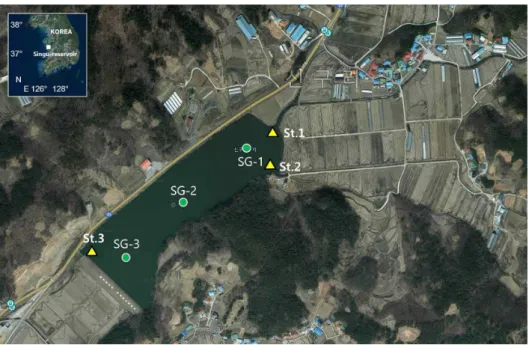
The Singu Reservoir is located in Boryeong City, Chungcheong Province, South Korea. It was constructed for agricultural use. Its watershed area is 2.57 km2 and effective capacity is 4.04 ×10⁵ ton. As part of this study, the investigation of water quality was performed four times from June 13, 2016 to September 22, 2016. Three spots were selected for collecting samples to test the water quality and the sediments (Fig. 1): SG-1, SG-2, SG-3 (inside reservoir; upstream, midstream, and downstream of reservoir).
2.2. Water quality and sediments
Water samples were collected using a van dorn water sampler. Total Nitrogen (T-N) and Total Phosphorus (T-P) were analyzed using a UV-spectrophotometer (Cary 50, Varian). The Suspended Solids (SS) and Chemical Oxygen Demand (COD) concentrations were determined using standard methods for measurement of water pollution in Korea. The pH, turbidity, and water temperature were measured using a professional Plus (YSI-556MPS) at the location. The chlorophyll-a (Chl-a) concentration was determined with a UV spectrophotometer after filtering a sample through GF/F and extracting Chl-a using methanol.
Samples were collected in triplicate from each sampling location. Sediments were analyzed for the Cd, Cu, As, Cr6+, Hg, Pb, Ni, F, Zn, PCBs, CN, BTEX, TPH, TCE, and PCE concentrations using standard methods for measurement of soil pollution in Korea.
2.3. Biological analysis
Benthic macroinvertebrates and fish were sampled and analyzed from the 3 sampling sites indicated in Fig. 1; St. 1, St. 2, St. 3. Samples for benthic macroinvertebrates were collected using a dredge net (30×50 cm) with a 0.2 mm mesh size. The samples were mixed with 10% formalin and
Fig. 1. Map of locations in the inflow stream and reservoirs where samples were collected.
transported to the laboratory. Samples were observed using the Olympus SZ7. The identification of benthic macroinvertebrates was done following the methods proposed by McCaffery(1981), Kwan et al.(1993), Yoon(1995), and Won et al.(2005). The reservoir environmental quality was evaluated using the ecological score for the benthic macroinvertebrate community (ESB), according to methods developed by the Ministry of Environment in Korea in 2006.
Samples for fish were collected using a cast net (mesh size 8×8 mm) and a skimming net (mesh size 6×6 mm), and sampling was repeatedly performed ten times for variations in the environmental condition. These samples were mixed with 10%
formalin transported to the laboratory. The identification of fishes was done using the study by Kim and Park(2002) as reference, and the classification scheme of Nelson(2006) was followed.
The fish community was investigated using dominance indices and richness indices in accordance with the methods developed by Pielou
(1975) and Margalef(1968). The investigation of fishes and benthic macroinvertebrate in the water was performed on November 16, 2016.
Mammal and bird counts were performed to identify their species, including protected species, inhabiting the study area. Mammals were found by searching the ditches, farmlands, and reservoir areas on foot and by driving through the area. In addition, animal footprints and feces were checked with the inquiry investigation from residents. Mammal identification was done with reference to the Ministry of Environment(2005) and Choi et al.(2007).
To investigate the ecological habitats of birds in the area, bird surveys were performed using line and spot censuses. The line census was performed by walking at a velocity of 1 km/h and the birds were observed using binoculars. The spot census was performed by remaining in one spot for 10 min and recording all observed species of birds in a notebook. Bird identification was done in accordance with Lee et al.(2000) and Won(1996).
Sampling Time
Sampling Site
Temp (℃)
pH DO
(㎎/L) BOD (㎎/L)
COD (㎎/L)
SS (㎎/L)
T-N (㎎/L)
TOC (㎎/L)
Conductivity (μS/㎝)
Chl-a (μg/L)
T-P (㎎/L)
July 13th
SSR-1 28.4 7.8 7.6 6.5 20.7 17.2 0.964 5.03 206 41.9 0.093
SSR-2 28.6 8.0 7.8 8.1 15.2 18.8 1.639 5.02 184 45.4 0.112
SSR-3 28.1 8.1 7.8 9.6 13.1 18.0 1.205 5.15 193 45.6 0.056
Aug. 16th
SSR-1 28.9 8.3 6.2 6.3 20.2 15.2 1.074 6.33 202 43.4 0.105
SSR-2 28.8 8.2 6.3 8.6 19.8 18.0 1.690 6.71 190 48.2 0.106
SSR-3 29.2 8.5 6.5 10.1 20.6 17.2 1.112 6.90 197 49.8 0.073
Sept. 1st
SSR-1 25.1 8.0 5.9 5.9 18.8 14.4 1.089 6.44 205 42.4 0.090
SSR-2 25.6 8.1 6.1 8.1 18.0 16.8 1.702 6.70 188 46.2 0.092
SSR-3 25.4 8.0 5.8 9.8 19.4 15.6 1.133 6.58 200 47.7 0.071
Sept. 22th
SSR-1 24.8 8.3 6.1 5.9 19.0 15.0 1.067 6.46 213 44.7 0.082
SSR-2 25.1 8.5 5.8 8.5 18.1 17.2 1.675 6.82 192 47.3 0.090
SSR-3 24.9 8.4 5.9 10.0 19.4 16.2 1.210 6.66 208 48.3 0.075
Table 1. Analysis of the water quality in the Singu Reservoir
Fig. 2. Annual variations in T-N, T-P, and COD from 2001 to 2016.
Fig. 3. An Image of the reservoir on September 22, 2016, showing the green color of the water.
3. Results and Discussion
3.1. Water quality
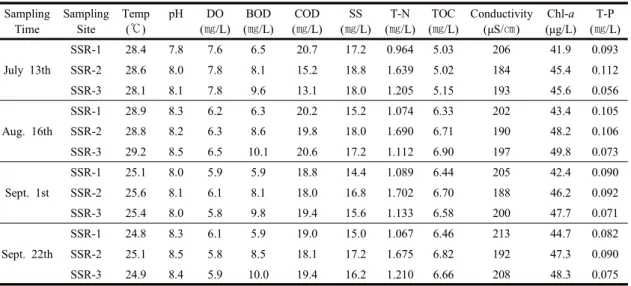
Table 1 provides data on the water quality parameters for the Singu Reservoir. The mean conductivity level was 198 μS/cm, which was relatively low as compared with the level (219.3 μ S/cm) reported by Lee et al.(2008). The Dissolved Oxygen (DO) level ranged from 5.8 to 7.8 mg/L.
DO is affected by water temperature.
The mean COD level was 18.5 mg/L, which
corresponds to grade VI of the environmental water quality standards for lakes in Korea, indicating very poor quality. The lowest COD level was detected at the SG-2 site. The mean SS and TOC levels were 16.6 and 6.23 mg/L, respectively.
The maximum COD level was recorded in 2004.
The mean COD level from 2001 to 2016 was 11.4 mg/L (Fig. 2). For the period of the last 16 years, the mean nitrogen and phosphorus levels are 1.84 and 0.09 mg/L, respectively. These results indicate that a water quality improvement plan is required to
Items SG-1 (mg/kg)
SG-2 (mg/kg)
SG-3 (mg/kg)
T-N 490.6 471.8 721.8
T-P 326.1 300.9 262.4
Cd 0.93 0.97 1.10
Cu 34.64 37.34 39.32
As 4.45 4.77 4.90
Hg 0.098 0.106 0.096
Pb 83.19 62.71 63.17
Zn 239.03 221.58 246.65
Ni 42.78 40.12 42.98
F 91 84 78
*PCBs, phenols, benzene, toluene, ethylbenzene, xylene, trichloroethylene, Tetrachloroethylene and benzopyrene were not detected Table 3. Analysis of the bed sediments in the Singu Reservoir
Items SG-1 SG-2 SG-3
Particle Distribution
Gravel (%) 42.6 33.7 25.7
Sand (%) 52.6 61.5 67.2
Silt (%) 4.2 4.3 3.2
Clay (%) 0.7 0.5 3.9
Organics (%) 2.70 2.78 2.70
Ignition loss (%) 7.3 5.6 8.7
Table 2. Physical characteristics of the bed sediments in the Singu Reservoir
improve the quality of the agricultural water supplied to areas neighboring to the Singu Reservoir.
The mean Chl-a level was 45.9 μg/L from July to September 2016, and the water color in the study area was frequently green during the study period (Fig. 3). The presence of an untreated sewage inlet into the reservoir, as well as direct and indirect routes from cattle sheds, pigsties, and farmlands around the reservoir need to be addressed.
Currently, based on the COD, SS, and T-N concentration values, the water quality in the reservoir may be unsuitable for agricultural use.
3.2. Sediments
The findings of the sediment analysis for the
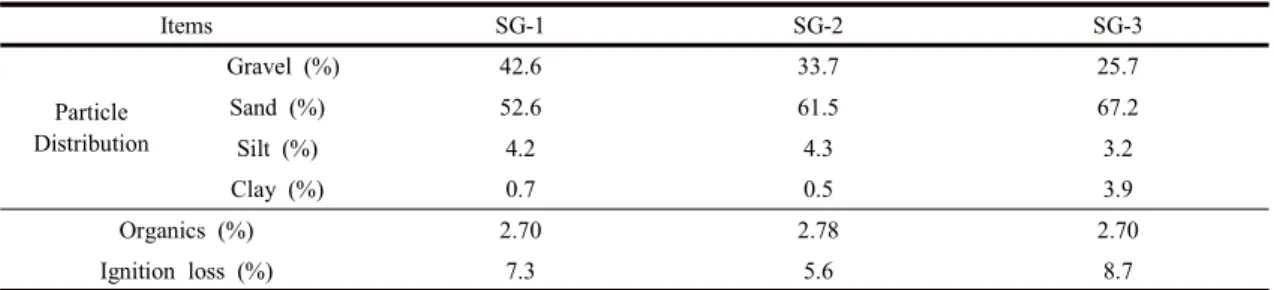
Singu Reservoir are as follows: The proportions of gravel, sand, slit, and clay were 25.7~42.6%, 51.5~67.2%, 3.2~4.3%, and 0.5~3.9%, respectively (Table 2). The contents of the organic compounds varied from 2.70% to 2.78%. The mean T-N and T-P values were 561.41 and 296.46 mg/kg, respectively (Table 3). The maximum T-N value was 721.82 mg/kg, and it was at SG-3; this is lower than the permitted level (3,000 mg/kg) for sediment sludge in this area. The T-P content ranged from 262.4 to 326.1 mg/kg, which is also lower than the permitted level (1,500 mg/kg). The Cd, Cu, As, Pb, Hg, Zn, Ni, and F levels detected in the sediments were 0.93~1.10, 34.64~39.32, 4.45~4.90, 62.71~83.19, 0.10~0.11, 221.58~246.65, 40.12~42.98, and 78.0~91.0 mg/kg, respectively.
Species Name St.1 St.2 St.3 Physidae
Physa acuta 2 1 1
Planorbidae
Gyraulus chinensis 3 1 2
Hippeutis cantori 2
Tubificidae
Limnodrilus gotoi 1 3 2
Palaemonidae
Palaemon paucidens 4 2
Coenagrionoidae
Cercion calamorum 2 1 2
Ischnura asiatica 3 2 1
Libellulidae
Orthetrum albistylum speciosum 2
Corixidae
Micronecta sedula 5
Notonectidae
Notonecta triguttata 1
Nepidae
Ranatra unicolor 1
Dytiscidae
Rhantus pulverosus 5
Hydrophilidae
Enochrus simulans 5 3
Sternolophusrufipes 1
Tipulidae
Tipula latemarginata 1
Chironomidae
Chironomidae sp. 2 5 4
Culicidae
Anopheles sp. 3 2
Table 4. Benthic macroinvertebrates in the Singu Reservoir
Hexavalent chromium, organophosphorus compounds, Total Petroleum Hydrocarbon (TPH), phenols, ethylbenzene, and benzopyrene were not detected.
Kim(2010) reported that the level of pollutants in sediments was higher than that in the surface water, and that this could have long-term effects on the aquatic environment. Baek et al.(2010) stated that sediments could act as a store for pollutants and heavy metals and adversely affect aquatic organisms via bioavailability and bioaccumulation.
Cadmium was detected in sediments at SG-1, SG-2,
and SG-3, indicating possible toxicity for benthic organisms.
3.3. Benthic macroinvertebrates
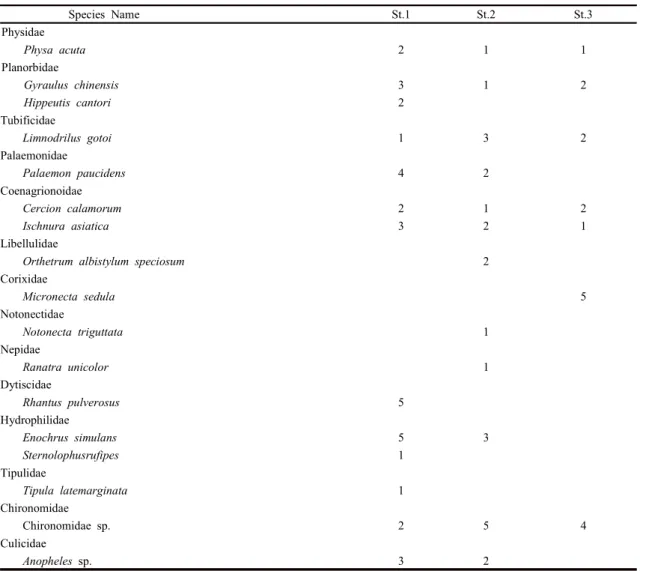
Seven orders, 14 families, and 17 species of benthic macroinvertebrates were found to inhabit the Singu Reservoir. The proportions of non-insect and insect species were 29.4% and 70.6%, respectively. Insect species in the reservoir belonged to the orders Odonata, Hemiptera, Coleoptera, and Diptera (Table 4).
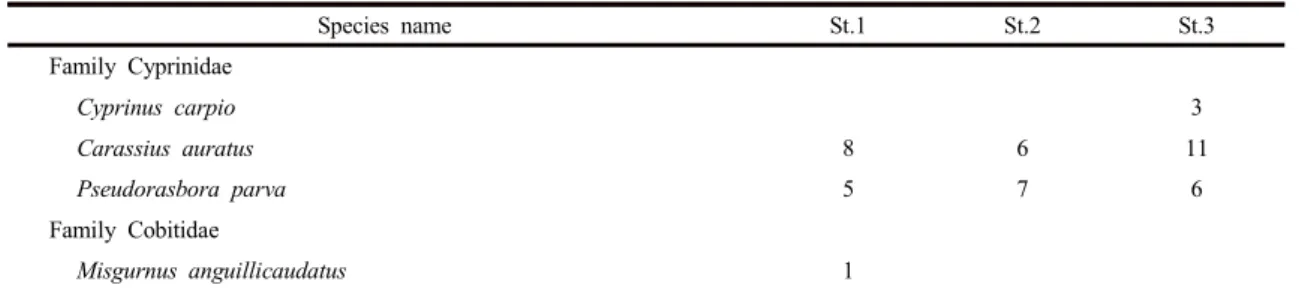
Species name St.1 St.2 St.3 Family Cyprinidae
Cyprinus carpio 3
Carassius auratus 8 6 11
Pseudorasbora parva 5 7 6
Family Cobitidae
Misgurnus anguillicaudatus 1
Table 5. Fish in the Singu Reservoir
At St. 1, 10 families, including Chironomidae, and 13 species were recorded. The species included Physa acuta, Palaemon paucidens, Ischnura asiatica, Rhantus pulverosus, Sternolophus rufipes, Tipula latemarginata, Anopheles sp., Chironomidae sp., Cercion calamorum, Limnodrilus gotoi, Hippeutis cantori, Gyraulus chinensis, and Enochrus simulans.
The water environment at St. 2 was similar to that at St. l. However, R. pulverosus, H. cantori, S.
rufipes, and T. latemarginata were found only at St 1. Orthetrum albistylum speciosum, Notonecta triguttata, and Ranatra unicolor were recorded only at St. 2.
The river bed at St. 3 was found to be composed of mud, sand, and gravel (an outlet section). P.
acuta, G. chinensis, L. gotoi, C. calamorum, I.
asiatica, and Micronecta sedula, as well as members of the Chironomidae sp. were recorded at St. 3. M. sedula was found only at St. 3.
No EPT (Ephemeroptera, Plecoptera, Trichoptera) groups were found in the Singu Reservoir. P. acuta, which is often found in severely polluted waters, was detected at all the sites in the study. Other species, such as L. gotoi and members of the Chironomidae family, known to be tolerant to pollutants, were also found in the reservoir.
The ecological scores of the benthic macroinvertebrate community were 23, 20, and 11 for St. 1, St. 2, and St. 3, respectively. These scores indicated that the environmental conditions were bad or very bad. St. 3 can be considered α
-meso-saprobic, which means that it should be a top priority for environmental improvements in the area.
3.4. Fish distribution
Two families and four species of fish were recorded. This finding differs from that in a previous report by the Ministry of Environment in Korea(2010) where six families and 21 species were said to be inhabiting the Singu Reservoir. The species included Cyprinus carpio, Pseudorasbora parva, and Misgurnus anguillicaudatus, all of which are resistant to pollutants(Table 5 and Fig.
4). The presence of these fish species indicates that the water quality has deteriorated.
Twenty specimens were collected at St. 3, the highest numbers of fish recorded. At St. 1 and St.
2, 14 and 13 specimens (number of an individual) were recorded, respectively. M. anguillicaudatus was found only at St. 1. In this reservoir, 75% of the specimens recorded belonged to the Cyprinidae family, and the diversity index was 0.88, 0.69, and 0.97 for St. 1, St. 2, and St. 3, respectively.
Invasive alien species or endangered fish species were not found.
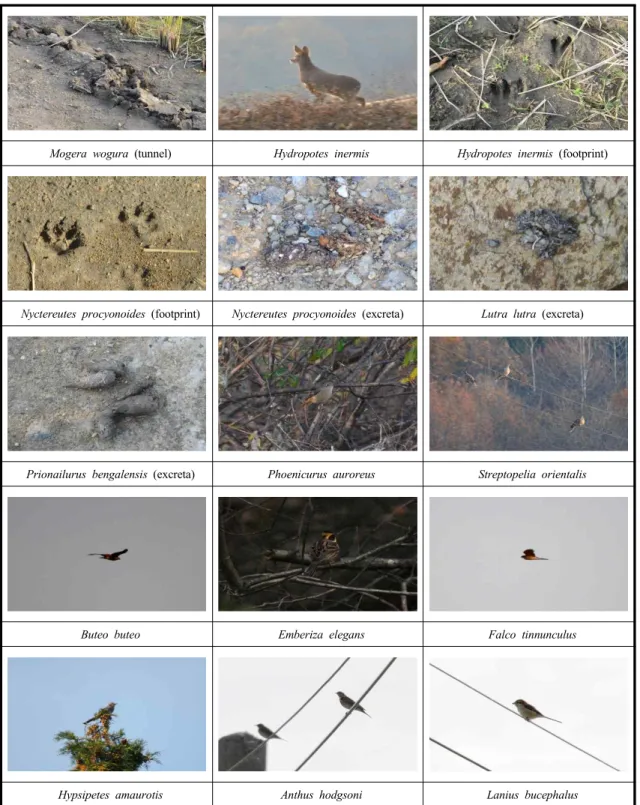
3.5. Other major ecological groups of animals Eight mammal families and 11 species of mammals were recorded around the Singu Reservoir.
In addition, the excrement of Lutra lutra was found. L. lutra is classed as an extremely
Cyprinus carpio Carassius auratus Pseudorasbora parva
Hippeutis cantori Physa acuta Palaemon paucidens
Ischnura asiatica Orthetrum albistylum speciosum Ranatra unicolor
Notonecta triguttata Rhantus pulverosus Enochrus simulans
Sternolophusrufipes Tipula latemarginata Fig. 4. Photographs of fishes and benthic macroinvertebrate in the Singu Reservoir.
Mogera wogura (tunnel) Hydropotes inermis Hydropotes inermis (footprint)
Nyctereutes procyonoides (footprint) Nyctereutes procyonoides (excreta) Lutra lutra (excreta)
Prionailurus bengalensis (excreta) Phoenicurus auroreus Streptopelia orientalis
Buteo buteo Emberiza elegans Falco tinnunculus
Hypsipetes amaurotis Anthus hodgsoni Lanius bucephalus
*A Detailed list of birds and mammals is not reported herein.
Fig. 5. The status of terrestrial animals and birds in research.
endangered species (grade I) in the list of endangered wild fauna and flora consolidated by the Ministry of Environment of Korea, and the Prionailurus bengalensis is classed as an endangered species (grade Ⅱ) (Fig. 5). Habitat traces of other mammals, such as Nyctereutes procyonoides, Hydropotes inermis, and Mogera wogura were found on arable land around the reservoir, most likely due to the presence of forested areas.
Habitats of 19 families and 37 species of birds were found in the study area. The birds detected included Falco tinnunculus, which is designated as a natural monument species in Korea. The dominant bird species in the area were Passer montanus, Paradoxornis webbiana, Emberiza rustica, Parus palustris, and Emberiza elegans. Most of the birds were resident birds(72.97%), and the percentage of winter visitors and passage migrant birds were 18.92% and 8.11%, respectively.
3.6. Water quality improvement plan
Fields and rice paddies were found to be widely distributed in the study area. Wastewater and animal manure were discharged from residential areas and livestock feeding facilities in the upstream of the reservoir. Therefore, an environmental improvement strategy for the area that includes watershed upstream and inside the reservoir should be considered in the plan for water quality preservation and improvement with respect to the reservoir. The untreated sewage inflow from surrounding villages without wastewater treatment plants also needs to be addressed. Further, impermeable surfaces, such as roads, are distributed around the Singu reservoir. The management of the reservoir and the achievement of annual water quality targets are also hampered by the local climate, which is characterized by rainfall concentrated in the summer.
There are no plans in place for the construction of wastewater and night soil treatment plants in this area until 2027. The installment of facilities, such as vegetative swales and small irrigation ponds, for the control of nonpoint pollution sources, together with the construction of rural sewage treatment facilities, with the cooperation of local governments, and consignment processing treatment facilities for livestock manure, are suggested to improve the water quality in the upstream area. Based on the findings of this study, a constructed wetland and sedimentation basin with a water circulation system should be feasible options for the study area.
Acknowledgments
This study was supported by grant from the Korea Rural Community Corporation.
REFERENCES
Baek, Y. W., Lee, Y. H., Kim, H. K., Jung, D. U., An, Y. J., 2010, Assessing the pollution trend in water and sediments of Tancheon down the stream, Korean J.
Limnol., 43, 11-18.
Choi, T. Y., Choi, H. M., 2007, Illustrated guide to Korean wildlife trace, Dolbegae Press Co., Paju.
Hwang, S. J., Yoon, C. G., Kweon, S. K., 2003, Water quality and limnology of Korean reservoirs, Paddy Wat. Environ., 1, 43-52.
Istvanovices, V., 1994, Fractional composition, adsorption and release of sediment phosphorus in the Kis-Balaton Reservoir, Water Res., 28, 717-726.
Jones, J. G., Andriahajaina, F. B., Hockley. N. J., 2005, A Multidisciplinary approach to assessing the sustainability of freshwater crayfish harvesting in Madagascar, Conserv. Biol., 19, 1863-1871.
Kairesalo, T., Tuominen, L., Hartikainen, H., Rankinen, K., 1995, The role of bacteria in the nutrient exchange between sediment and water in a flow-through system, Microb. Ecol., 29, 129-144.
Kim, G. H., 2010, Monitoring of indicator microorganism concentration of river sediment and surface water in
the Geum River basin, J Korean Soc. Wat. Qual., 26,125-132.
Kim, H. S., Hwang. S. J., 2004, Analysis of eutrophication based on chlorophyll-a, depth and limnological characteristics in Korean reservoirs, Korean J.
Limnol., 37, 213-226.
Kim, H. W., La, G. H., Jeong, K. S., Park, J. H., Huh, Y. J., Kim, S. D., Na, J. E., Jung, M. H., Lee, H. Y., 2010, Assessing the plankton dynamics in lakes and reservoirs ecosystem in the southwestern parts of Korea, Korean J. Environ. Biol., 28, 86-94.
Kim, I. S., Park. Y. J., 2002, Freshwater fishes of Korea, Kyohak Press Co., Seoul.
Kimmel, B. L., Groeger, A. W., 1984, Factors controlling primary production in lakes and reservoirs: a perspective, Lake and Reservoir Management,1, 277-281.
KRC, 2010, http://www.ekr.or.kr/. Korea Rural Community Co., Uiwang, Korea.
Lee, J. Y., Lee, S. J., Han, J. H., Lee, Y. H., Choi, J. Y., Hwang, S. J., Ann, G. G., 2008, Water quality Characteristics and Ecosystem Health Assessments using a LEHA Fish Model in Shingu Reservoir, Korean, J. Limnol., 41, 42-49.
Lee, W. S., Gu, T. H., Park, J. Y., 2000, A Field guide to the birds of Korea, LG foundation, Seoul.
Margalef, R., 1968, Perspectives in Ecological Theory, Chicago Press, Chicago.
McCafferty, W. P., 1981. Aquatic Entomology, Jones and Bartlett, Boston.
Ministry of Environment, 2003, A Study for making the restoration standard and soil pollution standard by land use.
Ministry of Environment, 2005, Endemic species of Korea.
Ministry of Environment, 2006, The 3rd Naitonal Ecosystem survey Guide.
Nelson, J. S., 2006, Fishes of the World. John Wiley &
Sons, New York.
Pielou, E. C., 1975, Ecological Diversity, Wiley, New York.
Reynolds, C. S., Wiserman, S. W., Godfrey, B. M., Butterwick, C., 1983, Some effects of artificial mixing on the dynamics of phytoplankton populations in large limnetic enclosures, J. Plankton Res., 5, 203-234.
Steel, J. A., Rast, W., 1996, Reservoirs. Chapter 8. In:
Water quality assessments -A Guide to use of biota, sediments and water in environmental monitoring, UNESCO/WHO/UNEP.
Won, B. H., 2003, The birds of Korea, Kyohak Press Co., Seoul.
Won, D. H., Kwon, S. J., Jun, Y. C., 2005, Aquatic insects of Korea, Korea Ecosystem Service.
Yoon, I. B., 1989, Study on the structures of aquatic insect communities at five wetlands in Gyungsan-namdo, Korea. Kor. J. Environ. Biol., 7, 19-32.
Youn, S. J., Park, H. K., Shin, K. A., 2010, Dynamics of phytoplankton communities of major dam reservoir in Han river system, J. Korean Soc. Water Environ., 26, 317-325.