Print ISSN: 2288-4637 / Online ISSN 2288-4645 doi:10.13106/jafeb.2021.vol8.no11.0087
The Data Sharing Economy and Open Governance of Big Data as Public Good
Jung Wan LEE
1Received: July 15, 2021 Revised: September 28, 2021 Accepted: October 05, 2021
Abstract
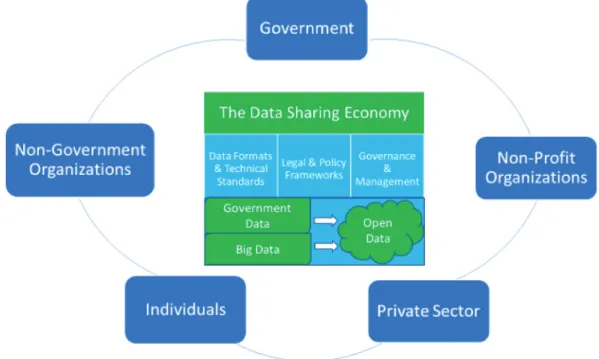
Data-driven markets depend on access to data as a resource for products and services. Since the quality of information that can be drawn from data increases with the available amount and quality of the data, businesses involved in the data economy have a great interest in accessing data from other market players and sharing data with other stakeholders. Despite the growing need for access to data and evidence of the economic and social benefits, data access and sharing remains below its potential. Individuals, businesses, and governments often face barriers to data access, which may be compounded by the reluctance to share, including within and across sectors. To address these challenges, this paper focuses on finding possible solutions for a better data-sharing economy. This paper 1) Discusses opportunities and challenges of open data and the data-sharing economy, limitations of private sector data, and issues with open government data. 2) Introduces open government data initiatives and open governance networks initiatives. 3) Suggests possible solutions, including the governance and management, the legal and policy frameworks, and the technical standards for open data with proposing an open data governance model for the data-sharing economy.
Keywords: Big Data, Open Data, Public Good, Open Government, Open Data Governance, Data Sharing Economy JEL Classification Code: A13, H41, H44, H49
Data-driven markets depend on access to data as a resource for products and services. Since the quality of information that can be drawn from data increases with the available amount and quality of the data, businesses involved in the data economy have a great interest in accessing data from other market players. However, companies still appear to be reluctant to share their data.
The growth of the digital economy means that sharing data between various stakeholders, whether connected or not, has become crucial for driving value in terms of intra- organizational efficiency, inter-organizational standards and practices, and even solving problems and improving living standards for the wider public. But standing in the way of these goals is a number of roadblocks that prevent the free, unencumbered flow of data between parties.
While implementing effective data analytics techniques is frequently discussed as the key challenge when extracting useful information from raw, unstructured data, there now appears a more immediate but arguably less highlighted obstacle in actually attempting to gain access to the data in the first place.
Data-driven innovation forms a key pillar in 21
st-century sources of growth, in particular, during the COVID-19
1
First Author and Corresponding Author. Professor, School of International Economics and Trade, Anhui University of Finance and Economics, China. ORCID ID: 0000-0002-8885-6385. [Postal Address: 962 Caoshan Road, Bengbu City, Anhui Province, 233030, China] Email: [email protected]
© Copyright: The Author(s)
This is an Open Access article distributed under the terms of the Creative Commons Attribution Non-Commercial License (https://creativecommons.org/licenses/by-nc/4.0/) which permits unrestricted non-commercial use, distribution, and reproduction in any medium, provided the original work is properly cited.