Abstract
BACKGROUND: Soil bacteria play important roles in organic matter decomposition and nutrient cycling during the non-growing season. The purpose of this study was to investigate the effects of soil management and chemical properties on the utilization of carbon sources by soil bacteria in paddy fields.
METHODS AND RESULTS: The Biolog EcoPlate was used for analyzing community-level carbon substrate utilization profiles of soil bacteria. Soils were collected from the following three types of areas: plain, interface and mountain areas, which were tested to investigate the topology effect. The results of canonical correspondence analysis and Kendall rank correlation analysis showed that soil C/N ratio and NH4+ influenced utilization of carbon sources by bacteria. The utilization of carbohydrates and complex carbon sources were positively correlated with NH4+ concentration. Cultivated paddy fields were compared
with adjacent abandoned fields to investigate the impact of cultivation cessation. The level of utilization of putrescine was lower in abandoned fields than in cultivated fields.
Monoculture fields were compared with double cropping fields cultivated with barley to investigate the impact of winter crop cultivation. Cropping system altered bacterial use of carbon sources, as reflected by the enhanced utilization of 2-hydroxy benzoic acid under monoculture conditions.
CONCLUSION: These results show that soil use intensity and topological characteristics have a minimal impact on soil bacterial functioning in relation to carbon substrate utilization. Moreover, soil chemical properties were found to be important factors determining the physiological profile of the soil bacterial community in paddy fields.
Key words: Biolog Ecoplate, Cropping System, Carbon Source, Soil Bacteria
서 론
토양생태계의 미생물은 지속적인 작물생산에 필요한 기능 들을 수행한다. 토양세균은 유기물을 분해하여 작물에 양분을 공급하며(Helfrich et al., 2015), 다양한 화합물의 물질순환
*Corresponding author: Jinu Eo
Phone: +82-63-238-2507; Fax: +82-63-238-3823;
E-mail: [email protected]
Korean J Environ Agric. 2019;38(4):219-224. Korean Online ISSN: 2233-4173
Published online 2019 October 17. https://doi.org/10.5338/KJEA.2019.38.4.30 Print ISSN: 1225-3537
논의 휴한기 이용형태와 토양화학성이 토양세균의 탄소원 이용에 미치는 영향
어진우*, 김명현, 송영주
농촌진흥청 국립농업과학원 농업환경부 기후변화생태과
Effect of Agricultural Practice and Soil Chemical Properties on Community-level Physiological Profiles (CLPP) of Soil Bacteria in Rice Fields During the
Non-growing Season
Jinu Eo*, Myung-Hyun Kim and Young Ju Song (Climate Change & Agroecology Division, Department of Agricultural Environment, National Institute of Agricultural Sciences, Rural Development Administration, Wanju 55365, Korea)
Received: 6 September 2019/ Revised: 15 September 2019/ Accepted: 10 October 2019 Copyright ⓒ 2019 The Korean Society of Environmental Agriculture
This is an Open-Access article distributed under the terms of the Creative Commons Attribution Non-Commercial License (http://creativecommons.org/licenses/by-nc/3.0) which permits unrestricted non-commercial use, distribution, and reproduction in any medium, provided the original work is properly cited.
ORCID Jinu Eo
https://orcid.org/0000-0003-3577-9942 Myung-Hyun Kim
https://orcid.org/0000-0002-5590-6622
Young Ju Song
https://orcid.org/0000-0003-5590-6622
219
Research Article-Environmental Microbiology Open Access
에 관여한다. 오염물질의 분해에도 중요한 역할을 하며(Harms and Wick, 2006; Pajares and Bohannan, 2016), 세균의 군 집변화에 의해 식물의 병발생이 달라질 수 있다(Wang et al., 2017). 또한, CO2, N2O, CH4 등 온실가스 생성에 관여하기 때문 에 기후변화의 이해와 조절에 중요하다(Kolb, 2009; Thomson et al., 2012).
농경지토양의 생물적 요소들은 환경이나 영농활동에 의해 영향을 받으며, 토양세균의 군집조성은 경운 등의 환경스트레 스를 나타내는 지표로 활용된다(Figuerola et al., 2012; Gil- Sotres et al., 2005). 토양생태계의 기능적 다양성은 토양미생물 의 생물다양성과 연결되어 있다(Maron et al., 2018; Delgado- Baquerizo et al., 2016). 농경지는 경운이나 시비 등의 영향 으로 자연생태계보다 토양세균의 생물다양성이 낮을 수 있으 며(Ding et al., 2013), 지속적인 생산성 유지를 위해서는 농 경지 이용형태에 따른 토양세균의 다양성 변화에 대한 모니 터링과 이해가 필요하다.
Biolog 시스템은 배양이 가능한 세균의 동정에 이용되며 토 양세균의 기능적 다양성을 연구하는데 사용되고 있다. 그 중 EcoPlate는 31가지의 탄소원을 포함하고 있어 환경변화에 대 한 세균의 군집특성 분석에 이용된다. 세균의 신속한 배양을 통 해 생리적 활성을 군집수준으로 나타내는 CLPP (community- level physiological profile)는 시간과 노력이 소요되는 일반 배양법이나 생화학적방법의 단점을 보완할 수 있으며(Schutter and Dick, 2001), 환경요소가 토양생태계의 생물적 기능에 미치는 영향을 알아보는데 적합하다(Classen et al., 2003).
논에서 벼를 재배하지 않는 휴한기에도 토양세균에 의한 유기물 분해 등의 생물적 작용은 계속되며, 이에 의한 토양양 분 변화는 벼 재배기에도 영향을 미친다. 토양세균의 주요기 능인 탄소화합물 분해는 논의 지형적 특성이나 작물재배 등 의 이용형태에 따라 달라질 수 있다. 휴한기 논의 다양한 이 용형태가 토양세균의 생리적 특성에 미치는 특성을 구명하기 위해 이모작과 휴경에 의한 이용강도 변화 및 논의 공간적 유 형이 토양세균의 CLPP에 미치는 영향을 조사하였다. 또한, 토양화학성도 토양미생물의 군집에 영향을 미치는 중요한 요 소로 알려져 있기 때문에(Wang et al., 2017) 탄소원 이용과 의 상관성을 분석하였다.
재료 및 방법
야외 조사 및 토양채취
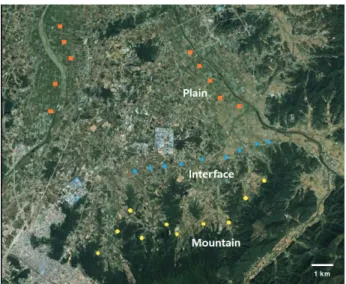
본 연구는 전북 정읍 소재의 논을 대상으로 지형과 이용형태 에 따라 휴한기에 조사하였다. 논이 위치한 지형을 산간지(산림 과의 거리, 30 m 이내), 중간지(산림과의 거리, 50-200 m), 평 야지(산림과의 거리, 500 m 이상)로 나누었으며 조사 위치는 Fig. 1에 나타내었다. 지형적 유형별로 각각 10지점씩 선정하 여 2017년 11월에 0-10 cm의 토양을 채취하였다. 휴경의 효 과를 조사하기 위해 위성사진을 참고하여 4-7년간 경작을 하 지 않은 휴경지와 20 m 이내의 인근 논을 8지점씩 선정하여 2018년 3월에 토양을 채취하였다. 이모작과 일모작 논 토양을
Fig. 1. Map of survey sites under different topological types in Jeongeup city.
비교하기 위해 보리(Hordeum vulgare)를 재배하는 이모작 논 과 인근의 일모작 논을 각각 10지점씩 선정하여 2018년 4월 에 토양을 채취하였다. 채취한 토양시료는 실험실로 운반하여 4℃에 보관하였으며 15일 이내에 실험하였다.
Biolog Ecoplate를 이용한 토양세균의 탄소원 이용 측정 Biolog EcoPlate (Biolog Inc., Hayward, CA)를 이용하 여 토양세균의 생리적 특성을 비교하였다. 토양현탁액(토양:멸 균수, 1:9)을 20℃에서 96시간동안 배양한 후 MicroStation (Biolog Inc., Hayward, CA)을 이용하여 590nm에서 발색을 측정하여 토양세균의 탄소화합물 이용을 조사하였다. 각 탄소원 의 이용량은 발색반응인 OD590으로 표시하였으며, AWCD (average well colour development)는 Garland (1997)의 방법을 따라 계산하였다.
토양화학성 분석
토양의 pH와 EC는 토양과 증류수의 비율을 1:5로 하여 그 현탁액을 pH meter와 EC meter로 각각 측정하였다 (RDA, 1988). 유효인산은 Acetate-lactate buffer로 추출하 였고, NO3-와 NH4+는 2M KCl로 추출하여 SmartChem autoanalyzer (Westco, Italy)를 이용하여 발색법으로 제조 사의 매뉴얼에 따라 측정하였다. 토양의 C와 N 함량은 CN analyzer (Vario Max CN, Elementar, Germany)를 이용 하여 측정하였다.
통계
토양세균의 탄소원이용 결과에 대하여 최소유의차(LSD) 방법을 이용하여 지형 및 이용형태에 따른 차이를 비교하였 다. 탄소원 이용도와 토양화학성과의 상관관계를 알아보기 위 하여 Kendall rank correlation으로 분석하였다. 위의 통계 과정은 SAS9.1 (SAS Institute Inc., Cary, NC, USA)를 이 용하여 수행하였다. 휴경지와 일반논의 비교에서는 31가지의
탄소원을 amino acid (아미노산), amine (아민), carboxylic acid (카르복시산), complex carbon source (복합탄소원), phosphate-carbon (인화합물)로 분류하여 분석하였다. 논의 공간유형별 토양세균 CLPP와 토양화학성의 상관성을 분석하 기 위해 canonical correspondence analysis (CCA)를 실 시하였다. 논의 이용형태별 분석에서는 토양화학성과의 상관 성이 없었기 때문에 principal component analysis (PCA) 로 CLPP를 분석하였다. 또한, CLPP의 두 집단간 통계적 차 이는 MRPP (multi-response permutation procedure)로 분석하였다. 이러한 통계과정은 R studio (version 1.6.)를 이용하여 수행하였다.
결과 및 고찰
논의 공간적 유형별 토양세균 CLPP
토양세균의 CLPP 결과는 MRPP 분석에서 지형적 유형 간 통계적 차이가 있었으나(P = 0.002), CCA 분석에서는 뚜 렷하게 분리되지 않았으며 NH4+와 C/N율에 영향을 받는 것으로 나타났다(Fig. 2). 세균의 탄소원 이용특성과 토양화 학성과 상관관계를 Kendall rank correlation으로 분석한 결과 토양의 C/N율은 N-acetyl-D-glucosamine (tau = -0.28, p = 0.03) 및 phenylethyl-amine (tau = -0.29, p = 0.03)과 상관관계가 있었고, NH4+는 Tween 80 (tau = 0.28, p = 0.03) 및 a-D-lactose (tau = 0.29, p = 0.03)와 상관관
Fig. 2. Canonical correlation analysis (CCA) for community- level physiological profiles of soil bacteria in paddy fields under different topological types.
계가 있었다. 이러한 결과는 토양세균의 CLPP가 논의 공간 적 유형보다는 토양화학성에 영향을 더 받는다는 점을 보여 준다.
토양 C/N율의 증가는 세균의 바이오매스를 감소시키는 효과가 있으며(Eiland et al., 2001; Wan et al., 2015) N-acetyl-D-glucosamine 또는 phenylethyl-amine의 이용 도간의 음의 상관관계를 부분적으로 설명할 수 있다. 토양의 C/N율은 유기물의 분해와 밀접한 관계에 있으며(Zhang et al., 2013), 이 수치의 변화는 세균과 곰팡이의 비율을 변화시 켜 이차적으로 탄소축적에도 영향을 미칠 수 있다(Malik et al., 2016). 분해자인 세균과 곰팡이는 각각의 분해경로를 형 성하고 있어 이들의 작용은 토양생태계의 다양한 먹이망을 통해서 연쇄반응을 일으킨다(Hedlund et al., 2004).
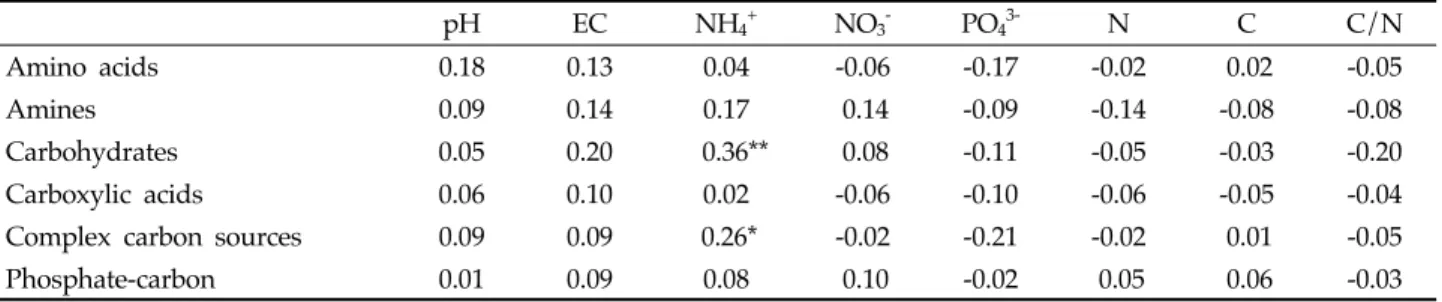
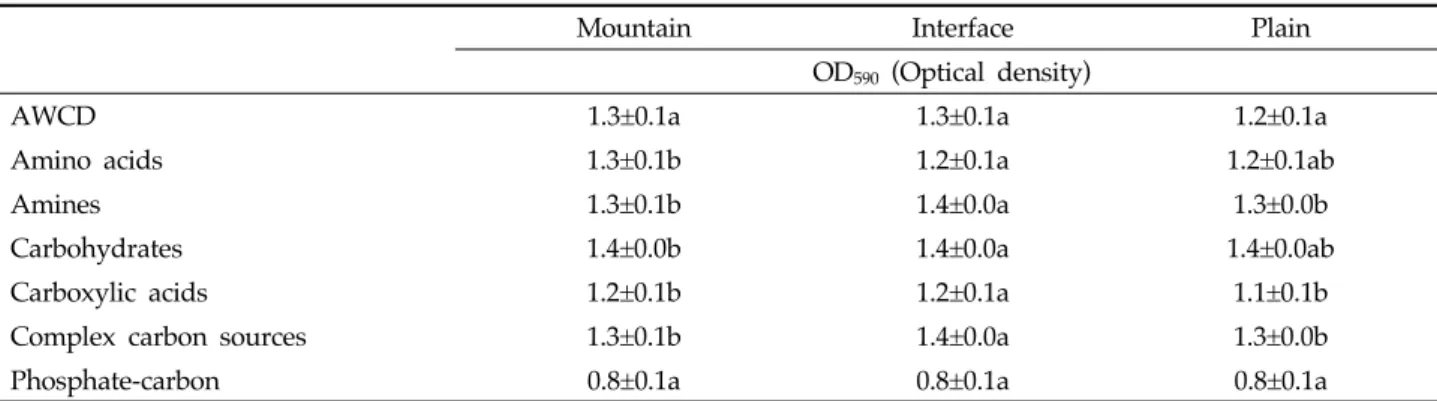
31종류의 탄소원을 그룹별로 나누어 상관계수를 분석한 결 과 NH4+는 carbohydrate 및 complex carbon sources와 유의적 상관관계가 있었다(Table 1). 지형별 비교에서 amino acid, amine, carbohydrate, carboxylic acid, complex carbon source의 이용도가 중간지에서 높은 경향이 있었지 만 유형간 뚜렷한 차이는 없었다(Table 2). Carbohydrate는 불안정한 토양탄소를 구성하는 주요 요소로 토양유기물 변화 를 민감하게 반영한다(Hu et al., 1995). NH4+는 토양 미생 물의 활동을 억제한다고 알려져 있으나(Zhang et al., 2017), carbohydrate 이용도간에 나타난 양의 상관관계는 상반된 결과로 보인다. 한편, 토양 중에는 NH4+를 산화시켜 에너지 를 얻는 세균들이 있으므로(Norman and Barrett, 2014), 이러한 세균에 의해 carbohydrate 이용이 증가했는지 추가 적인 연구가 필요해 보인다.
휴경지과 일반논의 토양세균 CLPP
토양세균 CLPP의 PCA분석 결과에서 휴경지와 논이 구분 되지 않았으며(Fig. 3A), MRPP 분석에 의해서도 집단간 유의 적 차이가 없었다(P = 0.504). PCA 분석 결과에서 양축의 설 명도가 낮은 것은 유형간 탄소이용 특성이 유사했기 때문인 것 으로 추측된다. 대부분의 탄소화합물 이용도가 두 유형간 차이 가 없었으며, putrescine 이용도만 논보다 휴경지에서 낮았다 (Fig. 4A). Putrescine의 분해에는 그램양성균과 그램음성균 이 관여하는 3가지 경로가 알려져 있으며, 토양에서는 Bacillus 속 세균이 분해한다는 보고가 있다(Chang and Chang, 2012;
pH EC NH4+ NO3- PO43- N C C/N
Amino acids 0.18 0.13 0.04 -0.06 -0.17 -0.02 0.02 -0.05
Amines 0.09 0.14 0.17 0.14 -0.09 -0.14 -0.08 -0.08
Carbohydrates 0.05 0.20 0.36** 0.08 -0.11 -0.05 -0.03 -0.20
Carboxylic acids 0.06 0.10 0.02 -0.06 -0.10 -0.06 -0.05 -0.04
Complex carbon sources 0.09 0.09 0.26* -0.02 -0.21 -0.02 0.01 -0.05
Phosphate-carbon 0.01 0.09 0.08 0.10 -0.02 0.05 0.06 -0.03
P values: * < 0.05; ** < 0.01
Table 1. Correlation coefficient between utilization of carbon sources by soil bacteria and soil chemical properties
Mountain Interface Plain OD590 (Optical density)
AWCD 1.3±0.1a 1.3±0.1a 1.2±0.1a
Amino acids 1.3±0.1b 1.2±0.1a 1.2±0.1ab
Amines 1.3±0.1b 1.4±0.0a 1.3±0.0b
Carbohydrates 1.4±0.0b 1.4±0.0a 1.4±0.0ab
Carboxylic acids 1.2±0.1b 1.2±0.1a 1.1±0.1b
Complex carbon sources 1.3±0.1b 1.4±0.0a 1.3±0.0b
Phosphate-carbon 0.8±0.1a 0.8±0.1a 0.8±0.1a
Means followed by different letters are significantly different (P < 0.05) as determined by LSD multiple comparison test.
AWCD, average well colour development.
Table 2. Utilization of carbon sources by soil bacteria in rice field soils under different topological types
PC1 (32.44%)
-2 -1 0 1 2 3
PC2 (13.10%)
-1.0 -0.5 0.0 0.5 1.0 1.5
Abandoned Paddy fields
A
PC 1 (49.07%)
-3 -2 -1 0 1 2 3
PC 2 (11.63%)
-2 -1 0 1
2 Uncultivated
Barley
B
Fig. 3. Principal component analysis for community-level physiological profiles of soil bacteria in abandoned and paddy fields (A) and uncultivated and barley fields (B).
Putrescine (OD590)
0.0 0.5 1.0 1.5 2.0
Abandoned Paddy fields
A *
2-hydroxy benzoic acid (OD590) 0.0 0.5 1.0 1.5 2.0
Uncultivated Barley
*
B
Fig. 4. Comparisons of carbon source utilization by soil bacteria between abandoned and paddy fields (A) and between uncultivated and barley fields (B). Asterisks indicate significant differences (paired t-test, n = 8): *P < 0.05.
Wunderlichova et al., 2014). 또한, putrescine은 토양에 투 입할 경우 가뭄스트레스 상태의 식물 생장을 촉진하는 효과도 있다(Ahmed et al., 2017). 토양세균 종구성과 putrescine 이 용도와의 상관성에 대한 추가적인 연구가 필요한 것으로 사 료된다.
이모작과 일모작 논의 토양세균 CLPP
토양세균의 CLPP의 PCA분석 결과에서 이모작과 일모작이 구분되지 않았으며(Fig. 3B), MRPP 분석에 의해서도 집단간 유의적 차이가 없었다(P = 0.207). 대부분의 탄소화합물 이용도 가 두 유형간에 차이가 없었으며, 2-hydroxybenzoic acid 이
용도만이 보리 이모작에서 낮았다(Fig. 4B). 2-hydroxybenzoic acid은 salicylic acid으로도 알려져 있으며, 살충제를 포함한 많은 방향성 화합물의 분해과정 중간대사물로 토양에서 mg/kg 수준까지도 검출된다(Meyer et al., 1999). 또한, salicylic acid 는 다양한 식물 페놀성화합물에 속하며, 식물의 생장이나 발달 에 영향을 미친다(Dong et al., 2015; Popova et al., 1997).
또한 이 물질의 처리에 의해 식물의 근권은 특정 종류의 세균 으로 군집을 형성한다(Lebeis et al., 2015). Salicylic acid는 근권에서 Azospirillum, Pseudomonas, Mycobacterium, Yersinia 속에 속하는 세균에 의해 생성되며(Mauch et al., 2001), 토양 병원균에 대한 저항성을 높일 수 있다(Anand et al., 2008). 따라서 두 유형의 토양에서 salicylic acid의 이용 도가 다르다는 것은 이 물질의 토양내 분해 차이에 따라 이차 적으로 식물의 생장에도 간접적으로 영향을 줄 수 있다는 것 을 시사한다.
결 론
토양의 NH4+ 농도와 C/N율은 토양세균의 탄소원 이용과 밀접한 상관관계가 있었다. 반면에 휴경이나 이모작 등의 농지 이용 형태에 따른 토양세균의 생리적 특성 차이가 적었다는 것은 관리방법에 따른 토양환경 변화의 영향이 크지 않다는 것을 시사한다. 이는 토양세균의 군집이 토지이용보다는 토양 화학성에 더 영향을 받는다는 기존의 연구와 같다(Kaiser et al., 2016). 다만 토양시료를 채취한 시기에 따라 세균 활성에 차이가 나타날 수 있기 때문에 이에 대한 고려가 필요하다.
농경지토양은 세균을 중심으로 하는 먹이망이 형성되어 이를 통한 물질순환이 이루어지기 때문에 토양세균의 탄소원 이용 변화에 따른 토양생태계의 농업적 기능 변화에 대한 추가적 인 연구가 필요할 것으로 사료된다.
Note
The authors declare no conflict of interest.
Acknowledgement
This study was carried out with the support of
“Research Program for Agricultural Science &
Technology Development (Project No. PJ01353301)”, National Institute of Agricultural Sciences, Rural Development Administration, Republic of Korea.
References
Ahmed, A. H. H., Darwish, E., & Alobaidy, M. G. (2017).
Impact of putrescine and 24-epibrassinolide on growth, yield and chemical constituents of cotton (Gossypium barbadense L.) plant growth under drought stress
conditions. Asian Journal of Plant Sciences, 16, 9-23.
Anand, A., Uppalapati, S. R., Ryu, C. M., Allen, S. N., Kang, L., Tang, Y., & Mysore, K. S. (2008). Salicylic acid and systemic acquired resistance play a role in attenuating crown gall disease caused by Agrobacterium tumefaciens. Plant Physiology, 146(2), 703-715.
Chang, M., & Chang, H. C. (2012). Development of a screening method for biogenic amine producing Bacillus spp. International Journal of Food Microbiology, 153(3), 269-274.
Classen, A. T., Boyle, S. I., Haskins, K. E., Overby, S. T.,
& Hart, S. C. (2003). Community-level physiological profiles of bacteria and fungi: plate type and incubation temperature influences on contrasting soils.
FEMS Microbiology Ecology, 44(3), 319-328.
Delgado-Baquerizo, M., Maestre, F. T., Reich, P. B., Jeffries, T. C., Gaitan, J. J., Encinar, D., Berdugo, M., Campbell, C. D., & Singh, B. K. (2016). Microbial diversity drives multifunctionality in terrestrial ecoysstems. Nature Communications, 7, 10541.
Ding, G. C., Piceno, Y. M., Heuer, H., Weinert, N., Dohrmann, A. B., Carrillo, A., Carrillo, A., Andersen, G. L., Castellanos, T., Tebbe, C. C., & Smalla, K. (2013).
Changes of soil bacterial diversity as a consequence of agricultural land use in a semi-arid ecosystem. PLoS One, 8(3), e59497.
Dong, Y. J., Wang, Z. L., Zhang, J. W., Liu, S., He, Z. L.,
& He, M. R. (2015). Interaction effects of nitric oxide and salicylic acid in alleviating salt stress of Gossypium hirsutum L. Journal of Soil Science and Plant Nutrition, 15(3), 561-573.
Eiland, F., Klamer, M., Lind, A. M., Leth, M., & Bﻪﻫth, E.
(2001). Influence of initial C/N ratio on chemical and microbial composition during long term composting of straw. Microbial Ecology, 41(3), 272-280.
Figuerola, E. L. M., Guerrero, L. D., Rosa, S. M., Simonetti, L., Duval, M. E., Galantini, J. A., Bedano, J.
C., Wall, L. G., & Erijman, L. (2012). Bacterial indicator of agricultural management for soil under no-till crop production. PLoS One, 7(11), e51075.
Garland, J. L. (1997). Analysis and interpretation of community-level physiological profiles in microbial ecology. FEMS Microbiology and Ecology, 24(4), 289-300.
Gil-Sotres, F., Trasar-Cepeda, C., Leiros, M. C., & Seoane, S. (2005). Different approaches to evaluating soil quality using biochemical properties. Soil Biology and Biochemicstry, 37(5), 877-887.
Harms, H., & Wick, L. Y. (2006). Dispersing pollutant- degrading bacteria in contaminated soil without touching
it. Engineering in Life Science, 6(3), 252-260.
Hedlund, K., Griffiths, B., Christensen, S., Scheu, S., Setala, H., Tscharntke, T., & Verhoef, H. (2004). Trophic interactions in changing landscapes: responses of soil food webs. Basic and Applied Ecology, 5(6), 495-503.
Helfrich, M., Ludwig, B., Thoms, C., Gleixner, G., &
Flessa, H. (2015). The role of soil fungi and bacteria in plant litter decomposition and macroaggregate formation determined using phospholipid fatty acids. Applied Soil Ecology, 96, 261-264.
Hu, S., Coleman, D. C., Hendrix, P. F., & Beare, M. H.
(1995). Biotic manipulation effects on soil carbohydrates and microbial biomass in a cultivated soil. Soil Biology and Biochemistry, 27(9), 1127-1135.
Kaiser, K., Wemheuer, B., Korolkow, V., Wemheuer, F., Nacke, H., Schoning, I., Schrumpf, M., & Daniel, R.
(2016). Driving forces of soil bacterial community structure, diversity, and function in temperate grasslands and forest. Scientific Reports, 6, 33696.
Kolb, S. (2009). The quest for atmospheric methane oxidizers in forest soils. Environmental Microbiology Reports, 1(5), 336-346.
Lebeis, S. L., Paredes, S. H., Lundberg, D. S., Breakfield, N., Gehring, J,. McDonald M, Malfatti, S., Rio, T. G., Jones, C. D., Tringe, S. G., & Dang, J. L. (2015). Salicylic acid modulates colonization of the root microbiome by specific bacterial taxa. Science, 349(6250), 860-864.
Malik, A. A., Chowdhury, S., Schlager, V., Oliver, A., Puissant, J., Vazquez, P. G. M., Jehmlich, N., von Bergen, M., Griffiths, R., & Gleixner, G. (2016). Soil fungal:bacterial ratios are linked to altered carbon cycling. Frontiers in Microbiology, 7, 1247.
Maron, P. A., Sarr, A., Kaisermann, A., Lévêque, J., Mathieu, O., Guigue, J., Karimi, B., Bernard, L., Dequiedt, S., Terrat, S., Chabbi, A., & Ranjard, L. (2018).
High microbial diversity promotes soil ecosystem functioning. Applied and Environmental Microbiology, 84(9), e02738-17.
Mauch, F., Mauch‐Mani, B., Gaille, C., Kull, B., Haas, D.,
& Reimmann, C. (2001). Manipulation of salicylate content in Arabidopsis thaliana by the expression of an engineered bacterial salicylate synthase. The Plant Journal, 25(1), 67-77.
Meyer, S., Cartellieri, S., & Steinhart, H. (1999). Simultaneous determination of PAHs, hetero-PAHs (N, S, O) and their degradation products in creosote-contaminate
soils. Method development, validation, and application to hazardous wasted sites. Analytical Chemistry, 71(18), 4023-4029.
Norman, J. S., & Barrett, J. E. (2014). Substrate and nutrient limitation of ammonia-oxidizing bacteria and archaea in temperate forest soil. Soil Biology and Biochemistry, 69, 141-146.
Pajares, S., & Bohannan, B. J. M. (2016). Ecology of nitrogen fixing, nitrifying, and denitrifying microorganisms in tropical forest soils. Frontiers in Microbiology, 7, 1045.
Popova, L., Pancheva, T., & Uzunova, A. (1997). Salicylic acid: Properties, biosynthesis and physiological role.
Bulgarian Journal of Plant Physiology, 23(1-2), 85-93.
Schutter, M., & Dick, R. (2001). Shifts in substrate- utilization potential and structure of soil microbial communities in response to carbon substrates. Soil Biology and Biochemistry, 33(11), 1481-1491.
Thomson, A. J., Giannopoulous, G., Pretty, J., Baggs, E.
M., & Richardson, D. J. (2012). Biological sources and sinks of nitrous oxide and strategies to mitigate emissions. Philosophical Transactions of The Royal Society of London Series B-Biological Sciences, 367(1593), 1157-1168.
Wan, X., Huang, Z., He, Z., Yu, Z., Wang, M., Davis, M.
R., & Yang, Y. (2015). Soil C: N ratio is the major determinant of soil microbial community structure in subtropical coniferous and broadleaf forest plantations.
Plant and soil, 387(1-2), 103-116.
Wang, R., Zhang, H., Sun, L., Qi, G., Chen, S., & Zhao, X. (2017). Microbial community composition is related to soil biological and chemical properties and bacterial wilt outbreak. Scientific Reports, 7(1), 343.
Wunderlichová, L., Buňková, L., Koutný, M., Jančová, P.,
& Buňka, F. (2014). Formation, degradation, and detoxification of putrescine by foodborne bacteria: a review. Comprehensive Reviews in Food Science and Food Safety, 13(5), 1012-1030.
Zhang, C., Zhang, X., Zou, H., Kou, L., Yang, Y., Wen, X., Li, S., Wang, H., & Sun, X. (2017). Contrasting effects of ammonium and nitrate additions on the biomass of soil microbial communities and enzyme activities in subtropical China. Biogeosciences, 14(20), 4815-4827.
Zhang, W., Wang, X., & Wang, S. (2013). Addition of external organic carbon and native soil organic carbon decomposition: a meta-analysis. PLoS One, 8(2), e54779.